CBSE Class 12 Question Paper 2025 Solution Medical Diagnostics
Finished viewing? Save it for later —
Download CBSE Class 12 Question Paper 2025 Solution Medical Diagnostics (PDF · 11 pages)About CBSE Class 12 Question Paper 2025 Solution Medical Diagnostics
CBSE Class 12 Question Paper 2025 Solution Medical Diagnostics is available here for free download. Published by CBSE for Class 12, this solution can be viewed online or downloaded as a PDF (11 pages). Candidates preparing for Class 12 can use CBSE Class 12 Question Paper 2025 Solution Medical Diagnostics to understand the exam pattern, the type of questions asked, and the overall difficulty level.
Frequently Asked Questions
How can I download CBSE Class 12 Question Paper 2025 Solution Medical Diagnostics?
Open this page and click the Download button to save CBSE Class 12 Question Paper 2025 Solution Medical Diagnostics as a PDF. It is completely free on AglaSem Docs.
Is CBSE Class 12 Question Paper 2025 Solution Medical Diagnostics free to download?
Yes. CBSE Class 12 Question Paper 2025 Solution Medical Diagnostics can be viewed online and downloaded as a PDF free of cost on AglaSem Docs.
How many pages does CBSE Class 12 Question Paper 2025 Solution Medical Diagnostics have?
CBSE Class 12 Question Paper 2025 Solution Medical Diagnostics contains 11 pages, which you can read online or download together as a single PDF.
Where can I find more Class 12 study material?
You can find more Class 12 question papers, sample papers, syllabus, and answer keys on AglaSem Docs.
CBSE Class 12 Question Paper 2025 Solution Medical Diagnostics – Text
Read the full text of this solution below — useful to quickly search, copy and reference the content online without downloading the PDF.
📄 View text version (11 pages)
Page 1
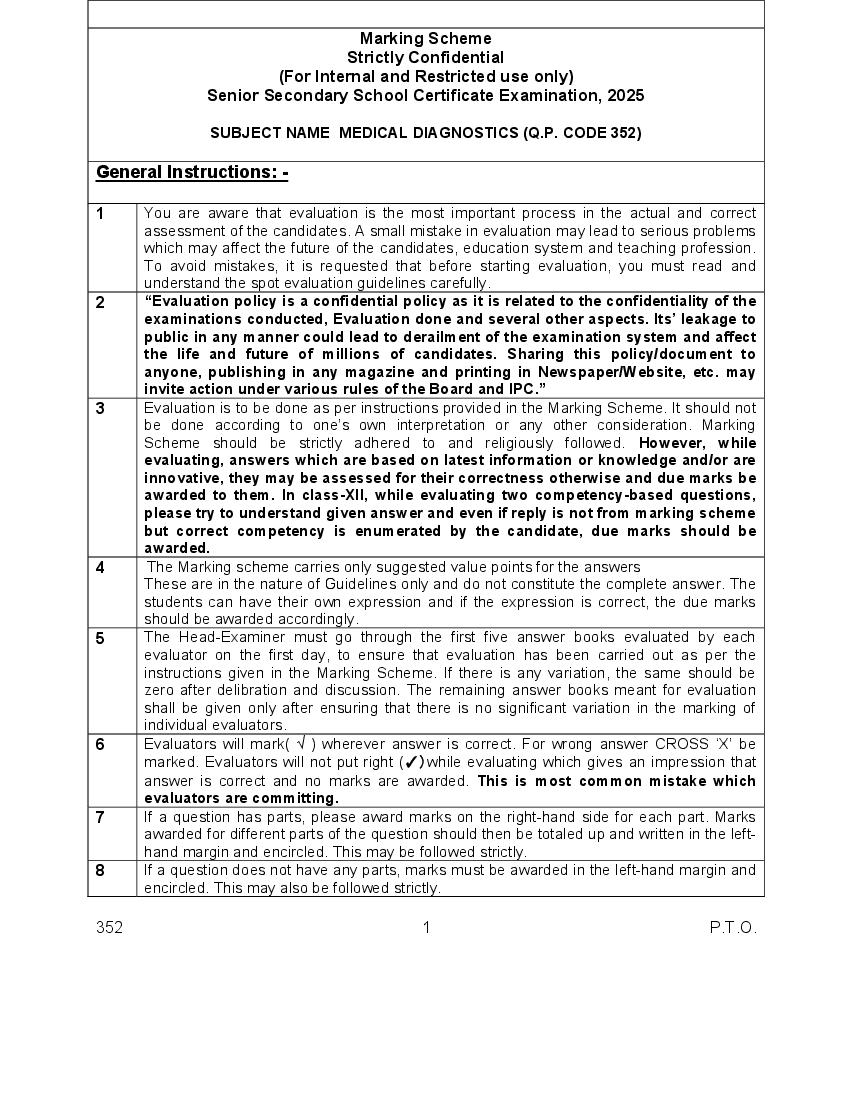
Strictly Confidential
(For Internal and Restricted use only)
Senior Secondary School Certificate Examination, 2025
SUBJECT NAME MEDICAL DIAGNOSTICS (Q.P. CODE 352)
General Instructions: -
1 You are aware that evaluation is the most important process in the actual and correct
assessment of the candidates. A small mistake in evaluation may lead to serious problems
which may affect the future of the candidates, education system and teaching profession.
To avoid mistakes, it is requested that before starting evaluation, you must read and
understand the spot evaluation guidelines carefully.
2 “Evaluation policy is a confidential policy as it is related to the confidentiality of the
examinations conducted, Evaluation done and several other aspects. Its’ leakage to
public in any manner could lead to derailment of the examination system and affect
the life and future of millions of candidates. Sharing this policy/document to
anyone, publishing in any magazine and printing in Newspaper/Website, etc. may
invite action under various rules of the Board and IPC.”
3 Evaluation is to be done as per instructions provided in the Marking Scheme. It should not
be done according to one’s own interpretation or any other consideration. Marking
Scheme should be strictly adhered to and religiously followed. However, while
evaluating, answers which are based on latest information or knowledge and/or are
innovative, they may be assessed for their correctness otherwise and due marks be
awarded to them. In class-XII, while evaluating two competency-based questions,
please try to understand given answer and even if reply is not from marking scheme
but correct competency is enumerated by the candidate, due marks should be
awarded.
4 The Marking scheme carries only suggested value points for the answers
These are in the nature of Guidelines only and do not constitute the complete answer. The
students can have their own expression and if the expression is correct, the due marks
should be awarded accordingly.
5 The Head-Examiner must go through the first five answer books evaluated by each
evaluator on the first day, to ensure that evaluation has been carried out as per the
instructions given in the Marking Scheme. If there is any variation, the same should be
zero after delibration and discussion. The remaining answer books meant for evaluation
shall be given only after ensuring that there is no significant variation in the marking of
individual evaluators.
6 Evaluators will mark( √ ) wherever answer is correct. For wrong answer CROSS ‘X’ be
marked. Evaluators will not put right (✓)while evaluating which gives an impression that
answer is correct and no marks are awarded. This is most common mistake which
evaluators are committing.
7 If a question has parts, please award marks on the right-hand side for each part. Marks
awarded for different parts of the question should then be totaled up and written in the left-
hand margin and encircled. This may be followed strictly.
8 If a question does not have any parts, marks must be awarded in the left-hand margin and
encircled. This may also be followed strictly.
352 1 P.T.O.
Page 2
marks should be retained and the other answer scored out with a note “Extra Question”.
10 No marks to be deducted for the cumulative effect of an error. It should be penalized only
once.
11 A full scale of marks __________(example 0 to 80/70/60/50/40/30 marks as given in
Question Paper) has to be used. Please do not hesitate to award full marks if the answer
deserves it.
12 Every examiner has to necessarily do evaluation work for full working hours i.e., 8 hours
every day and evaluate 20 answer books per day in main subjects and 25 answer books
per day in other subjects (Details are given in Spot Guidelines).This is in view of the
reduced syllabus and number of questions in question paper.
13 Ensure that you do not make the following common types of errors committed by the
Examiner in the past:-
● Leaving answer or part thereof unassessed in an answer book.
● Giving more marks for an answer than assigned to it.
● Wrong totaling of marks awarded on an answer.
● Wrong transfer of marks from the inside pages of the answer book to the title page.
● Wrong question wise totaling on the title page.
● Wrong totaling of marks of the two columns on the title page.
● Wrong grand total.
● Marks in words and figures not tallying/not same.
● Wrong transfer of marks from the answer book to online award list.
● Answers marked as correct, but marks not awarded. (Ensure that the right tick mark
is correctly and clearly indicated. It should merely be a line. Same is with the X for
incorrect answer.)
● Half or a part of answer marked correct and the rest as wrong, but no marks awarded.
14 While evaluating the answer books if the answer is found to be totally incorrect, it should
be marked as cross (X) and awarded zero (0)Marks.
15 Any unassessed portion, non-carrying over of marks to the title page, or totaling error
detected by the candidate shall damage the prestige of all the personnel engaged in the
evaluation work as also of the Board. Hence, in order to uphold the prestige of all
concerned, it is again reiterated that the instructions be followed meticulously and
judiciously.
16 The Examiners should acquaint themselves with the guidelines given in the “ Guidelines
for Spot Evaluation” before starting the actual evaluation.
17 Every Examiner shall also ensure that all the answers are evaluated, marks carried over to
the title page, correctly totaled and written in figures and words.
18 The candidates are entitled to obtain photocopy of the Answer Book on request on
payment of the prescribed processing fee. All Examiners/Additional Head Examiners/Head
Examiners are once again reminded that they must ensure that evaluation is carried out
strictly as per value points for each answer as given in the Marking Scheme.
352 2
Page 3
$
MARKING SCHEME
MEDICAL DIAGNOSTICS
SECTION A
(Objective Type Questions)
1. Answer any 4 out of the given 6 questions on Employability Skills. 41=4
(i) (B) Listening
Page : 3 ; Communication Skill, CBSE NCERT book
(ii) (A) Paranoid
Page : 27 ; Self-management Skill, CBSE NCERT book
(iii) (A) Positive attitude
Page : 24 ; Self-management Skill, CBSE NCERT book
(iv) (A) Spreadsheet
Page : 39 ; ICT Skill, CBSE NCERT book
(v) (C) It avoids any kind of risk in business
Page : 80 ; Entrepreneurial Skill, CBSE NCERT book
(vi) (C) Financial management
Page : 112 ; Green Skill, CBSE NCERT book
2. Answer any 5 out of the given 7 questions. 51=5
(i) (B) Tube sealer
(2.1 Material and Equipment, Unit-2 Blood Bank and Transfusion)
(ii) (A) 10 – 12 seconds
(1.9 Haemostasis, Unit : 1- hematology Laboratory)
(iii) (A) Light microscope
352 3 P.T.O.
Page 4
(iv) (C) Kidd blood group system
(2.4 Practical importance of other blood groups, Unit-2 Blood bank and
Transfusion)
(v) (D) 95% Ethyl Alcohol (Ethanol)
(3.4 Cytological Fixatives, Unit – 3 Cytopathology)
(vi) (A) FNAC
(3.3 FNAC, Unit – 3 Cytopathology)
(vii) (B) AB–
(2.3 ABO blood group system, Unit 2-Blood bank and transfusion)
3. Answer any 6 out of the given 7 questions. 61=6
(i) (C) AAF Fixative
(3.4 Cytological Fixatives, Unit - 3 Cytopathology)
(ii) (A) Oral
(3.2 Exfoliated cytology, Unit - 3 Cytopathology)
(iii) (A) Heart
(3.2 Exfoliated cytology, Unit – 3 Cytopathology)
(iv) (A) acetone free methyl alcohol
(1.5 Reagents – preparation and their uses, Unit-1 Hematology Lab)
(v) (A) Red blood
(2.4 Practical importance of other blood groups, Unit-2 Blood bank and
Transfusion)
(vi) (A) Nucleoside
(2.2 Records in blood bank-Ag-Ab reaction, Unit-2 Blood bank and
Transfusion)
(vii) (C) Precipitation
(2.2 Records in blood bank-Ag-Ab reaction, Unit-2 Blood bank and
Transfusion)
4. Answer any 5 out of the given 6 questions. 51=5
352 4
Page 5
(2.4 Practical importance of other blood groups, Unit-2 Blood bank and
Transfusion)
(ii) (C) Ether alcohol mixture
(3.4 Cytological Fixatives, Unit - 3 Cytopathology)
(iii) (B) 10 40 = 400x
(2.1 Material and Equipment, Unit-2 Blood Bank and Transfusion)
(iv) (D) Antibodies
(2.2 Records in blood bank-Ag-Ab reaction, Unit-2 Blood bank and
Transfusion)
(v) (D) Bone joints
(3.2 Exfoliated cytology, Unit - 3 Cytopathology)
(vi) (D) O+
(2.3 ABO blood group system, Unit 2-Blood bank and transfusion)
5. Answer any 5 out of the given 6 questions. 51=5
(i) (A) Flammable materials
(3.9 Safety in laboratory, Unit – 3 Cytopathology)
(ii) (B) EDTA
(1.7 Measurements and Quantitative analysis- Differential Count,
Unit-1 Hematology Lab)
(iii) (B) 63 ml
(2.1 Material and Equipment, Unit-2 Blood Bank and Transfusion)
(iv) (B) Cytolyt solution
(3.4 Cytological Fixatives, Unit – 3 Cytopathology)
(v) (C) Activated Partial Thromboplastin time
(1.9 Haemostasis, Unit 1- hematology Laboratory)
(vi) (A) Five years
(3.8 Storage and archiving of specimens, Unit – 3 Cytopathology)
6. Answer any 5 out of the given 6 questions. 51=5
(i) (B) Reticulocyte
352 5 P.T.O.
Page 6
Unit-1 Hematology Lab)
(ii) (A) FNAC
(3.3 FNAC, Unit – 3 Cytopathology)
(iii) (C) Flammable materials
(3.9 Safety in laboratory, Unit – 3 Cytopathology)
(iv) (D) Neutrophil
(1.7 Measurements and Quantitative analysis- Identification of
different blood cells under microscope, Unit-1 Hematology Lab)
(v) (C) Normocytic
(1.8 Anemia, Unit 1-hematology Laboratory)
(vi) (B) Lungs
(3.2 Exfoliated cytology, Unit – 3 Cytopathology)
SECTION B
(Subjective Type Questions)
Answer any 3 out of the given 5 questions on Employability Skills in 20 – 30
words each. 32=6
7. i. verbal form ii. non-verbal form iii. written form iv. visual form
Page : 24 ; Communication Skill, CBSE NCERT book
8. Self-motivation is important because • It increases individual’s energy
and activity • It directs an individual towards specific goals. • It
results in initiation and persistence of specific activities • it affects
cognitive processes and learning strategies used for completing similar
tasks
Page : 32 ; Self-management Skill, CBSE NCERT book
9. A cell reference identifies a cell or a range of cells. Each cell in the
worksheet has a unique address formed by the combination of its
intersecting row and column. When a cell address is referred to in a
formula, it is called cell referencing.
Page : 44 ; ICT Skill, CBSE NCERT book
10. Yes, Decision making is one of the important entrepreneurial
competency, entrepreneurs often have to take that one decision at the
352 6
Page 7
also have to quickly act upon their decisions.
Page : 79 ; Entrepreneurial Skill, CBSE NCERT book
11. Water Pollution is in its alarming state. This has given rise to the need
of Water Quality Technicians to help monitor the water quality and
treat it.
Page : 112 ; Green Skill, CBSE NCERT book
Answer any 3 out of the given 5 questions in 20 – 30 words each. 32=6
12. 1. Washing improves reactivity and removes plasma that contains
fibrinogen and forms clot when mixed with serum giving false
positive.
2. Plasma can cause rouleaux’s formation.
3. Anticoagulant present in plasma is anticomplementary and
inhibits complement binding reactions.
4. Plasma contains blood group substances that can neutralize that
reaction.
(2.2 Records in blood bank-Ag-Ab reaction, Unit -2 Blood bank and
Transfusion)
13. EDTA in excess of 2 mg/ml may produce changes in RBCs irrespective
of the salt used. An increased MCHC and a decreased PCV (by manual
method) may be seen.
Excessive EDTA may also lead to a spuriously high platelet count
(platelets may swell and then disintegrate into fragments which are
counted as platelets)
(1.3 Collection of Blood samples, Unit-1 Hematology Lab)
14. Properties of a good cytological fixative :
• It should not excessively shrink or swell cells.
• It should not distort or dissolve cellular components.
• It should help preserve nuclear details.
• It should improve optical differentiation and enhance staining
properties of the tissues and cell components.
(3.4 Cytological Fixatives, Unit – 3 Cytopathology)
15. The two methods of Venipuncture are
Syringe method.
352 7 P.T.O.
Page 8
(1.3 Collection of Blood samples, Unit-1 Hematology Lab)
16. Immune antibodies are IgG. They develop due to immunization
following pregnancy, previous transfusion or deliberate injection of
immunogenic material. In some instances, immunogenic event is
unknown .
(2.2 Records in blood bank, Unit -2 Blood bank and Transfusion)
Answer any 2 out of the given 3 questions in 30 – 50 words each. 23=6
17. Bone Merrow Aspirate
Smear Preparation Anti-coagulated sample Clot preparation
Morphology Flow Cytometry (EDTA) Processed as biopsy
Cytochemistry Cytogenetic studies (Heparin)
FISH (If required) Molecular studies (EDTA)
(1.10 Bone marrow Aspiration/biopsy Unit-1 Hematology Lab)
18. (a) 50% Alcohol: This is a clear fixative for the collection of fluid
specimens. A 50:50 ratio of specimen to fixative is considered
appropriate.
(b) Carnoy’s fixative: This is a special purpose fixative for
haemorrhagic samples. The acetic acid in the fixative haemolyses
the red blood cells. It is an excellent nuclear fixative as well as
preservative for glycogen but results in considerable shrinkage of
cells. Carnoy’s fixative must be prepared fresh when needed and
discarded after each use. It loses its effectiveness on long standing,
and chloroform can react with acetic acid to form hydrochloric acid.
(3.4 Cytological Fixatives, Unit – 3 Cytopathology)
19. Duffy system
352 8
Page 9
Plasmodium vivax infection does not affect red cells lacking Fya and
Fyb
Anti Fya and Fyb antibodies are IgG and react at 37 deg c and cause
hemolytic reaction and hemolytic disease of the newborn (HTR and
HDN)
Duffy antigens are classified as Fy (a+b-), Fy (a+b+), Fy (a-b+),
Fy (a-b-)
Kidd blood group system
Two antigens Jka and Jkb
The antibodies may be either IgG or IgM and may cause HTR or HDN
(2.4 Practical importance of other blood groups, Unit-2 Blood bank and
Transfusion)
Answer any 3 out of the given 5 questions in 50 – 80 words each. 34=12
20. This instrument helps us to examine tiny objects which cannot be
visualized with the naked eye. It is a delicate instrument and needs
utmost care.
(a) Cleaning of objective and eyepiece should be done regularly and
they should be kept free from dust. The optical part is cleaned to
remove grease using soft cloth or lens paper.
(b) Hold the microscope firmly while moving it to prevent the lenses
from dropping down.
(c) Exposure to sunlight should be avoided and it should be kept at
room temperature.
(d) After one can use oil immersion, one must always clean the oil from
the objective.
(1.2 Hematology Lab Instruments, Unit – 1 Hematology Laboratory)
21. (a) electronic weighing machine : for weighing the bags accurately.
(b) refrigerated centrifuge : bucket handle typed of centrifuge to hold
the collected bags with a provision for a wide range of temperature
is preferred. The main unit is built on a sturdy metal frame resting
on castors and enclosed by sheet metal, which has an electrical
interlock. Rotor consists of 4 to 6 buckets.
(c) plasma expressor : to manually express the plasma
352 9 P.T.O.
Page 10
whatever components required for the patients.
(2.1 Material and Equipment, Unit-2 Blood Bank and Transfusion)
22. Procedure for hemorrhagic fluids
– Frankly hemorrhagie fluids are centrifuged like all fluids and fish
tailed smears made from the sediment of the centrifuged deposit.
– Alternatively, if very hemorrhagic, smears can be air dried and then
flooded with normal saline for 30 seconds. This causes layers of red
cells; smears are than air dried or wet fixed and stained by pap and
Giemsa stains respectively.
(3.2 Exfoliated cytology, Unit - 3 Cytopathology)
23. The efficiency of all stages of intrinsic pathway of coagulation can be
screened by clotting time test by Lee White method.
SAMPLE: Fresh whole blood 4 ml.
PROCEDURE:
About 2 ml of blood is collected and dispensed in two test tubes
(1 ml each). The stopwatch is started immediately.
The test tubes are kept at 3700C after putting cotton plugs.
After about 3 minutes, take out one tube, tilt it gently by 4500C and
observe whether blood has clotted (the test tube can be inverted
without the blood spilling). Repeat the procedure every 30 sec till the
blood clots and record the time.
Confirm the observation by checking the second tube. (one can further
observe the clotted blood for clot retraction and clot lysis time)
INTERPRETATION: Prolonged Clotting time observed: 1. Patient on
heparin 2. DIC 3. Severe Hemophiliacs
(1.9 Clotting Time by Lee White Method, Unit-1 Hematology Lab)
352 10
Page 11
cytology or by bronchoscopy material. Sputum Cytology: Sputum
specimen can be obtained from the patient either spontaneously or by
aerosol – induced method. Morning specimen resulting from overnight
accumulation of secretion yields best results. Three to five consecutive
days’ sputum samples should be examined to ensure maximum
diagnostic accuracy. Fresh unfixed specimens are better than prefixed
specimens in 70% ethyl alcohol or coating fixative such as carbowax or
saccomano fixative. (Fixation of slides is discussed in a separate
chapter). The sputum must be carefully inspected by pouring the
specimen into a petri dish and examining on a dark background. Select
any bloody, discolored or solid particles, if present, place a small
portion of each particle on a micro slide, spread evenly and fix it
immediately. Prefixed specimens should be smeared on albumen or
polylysine coated slides.
Bronchoscopy Specimens: Specimens that are obtained by
bronchoscopy are secretions (branchioalveolar lavage), direct needle
aspirate from suspicious area and bronchial brushing and washings.
Post bronchoscopy sputum is one of the most valuable specimens for
the detection of pulmonary lesions.
(3.2 Exfoliated cytology, Unit - 3 Cytopathology)
352 11 P.T.O.
Document Details
| Board / Org | CBSE |
| Exam | Class 12 |
| Type | Solution |
| Pages | 11 |
| Updated | 24 Sep 2026 |