Finished viewing? Save it for later —
Download CBSE Class 12 Question Paper 2025 Solution Mizo (PDF · 5 pages)About CBSE Class 12 Question Paper 2025 Solution Mizo
CBSE Class 12 Question Paper 2025 Solution Mizo is available here for free download. Published by CBSE for Class 12, this solution can be viewed online or downloaded as a PDF (5 pages). Candidates preparing for Class 12 can use CBSE Class 12 Question Paper 2025 Solution Mizo to understand the exam pattern, the type of questions asked, and the overall difficulty level.
Frequently Asked Questions
How can I download CBSE Class 12 Question Paper 2025 Solution Mizo?
Open this page and click the Download button to save CBSE Class 12 Question Paper 2025 Solution Mizo as a PDF. It is completely free on AglaSem Docs.
Is CBSE Class 12 Question Paper 2025 Solution Mizo free to download?
Yes. CBSE Class 12 Question Paper 2025 Solution Mizo can be viewed online and downloaded as a PDF free of cost on AglaSem Docs.
How many pages does CBSE Class 12 Question Paper 2025 Solution Mizo have?
CBSE Class 12 Question Paper 2025 Solution Mizo contains 5 pages, which you can read online or download together as a single PDF.
Where can I find more Class 12 study material?
You can find more Class 12 question papers, sample papers, syllabus, and answer keys on AglaSem Docs.
CBSE Class 12 Question Paper 2025 Solution Mizo – Text
Read the full text of this solution below — useful to quickly search, copy and reference the content online without downloading the PDF.
📄 View text version (5 pages)
Page 1
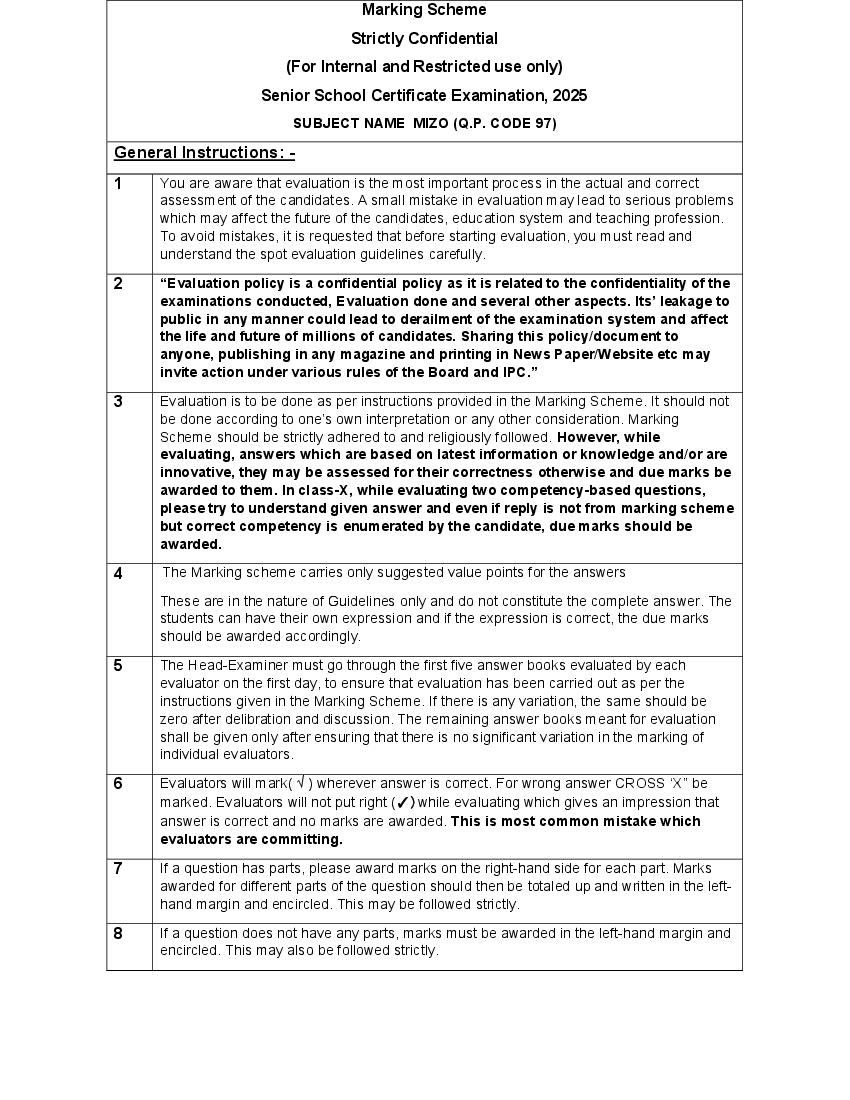
Strictly Confidential
(For Internal and Restricted use only)
Senior School Certificate Examination, 2025
SUBJECT NAME MIZO (Q.P. CODE 97)
General Instructions: -
1 You are aware that evaluation is the most important process in the actual and correct
assessment of the candidates. A small mistake in evaluation may lead to serious problems
which may affect the future of the candidates, education system and teaching profession.
To avoid mistakes, it is requested that before starting evaluation, you must read and
understand the spot evaluation guidelines carefully.
2 “Evaluation policy is a confidential policy as it is related to the confidentiality of the
examinations conducted, Evaluation done and several other aspects. Its’ leakage to
public in any manner could lead to derailment of the examination system and affect
the life and future of millions of candidates. Sharing this policy/document to
anyone, publishing in any magazine and printing in News Paper/Website etc may
invite action under various rules of the Board and IPC.”
3 Evaluation is to be done as per instructions provided in the Marking Scheme. It should not
be done according to one’s own interpretation or any other consideration. Marking
Scheme should be strictly adhered to and religiously followed. However, while
evaluating, answers which are based on latest information or knowledge and/or are
innovative, they may be assessed for their correctness otherwise and due marks be
awarded to them. In class-X, while evaluating two competency-based questions,
please try to understand given answer and even if reply is not from marking scheme
but correct competency is enumerated by the candidate, due marks should be
awarded.
4 The Marking scheme carries only suggested value points for the answers
These are in the nature of Guidelines only and do not constitute the complete answer. The
students can have their own expression and if the expression is correct, the due marks
should be awarded accordingly.
5 The Head-Examiner must go through the first five answer books evaluated by each
evaluator on the first day, to ensure that evaluation has been carried out as per the
instructions given in the Marking Scheme. If there is any variation, the same should be
zero after delibration and discussion. The remaining answer books meant for evaluation
shall be given only after ensuring that there is no significant variation in the marking of
individual evaluators.
6 Evaluators will mark( √ ) wherever answer is correct. For wrong answer CROSS ‘X” be
marked. Evaluators will not put right (✓)while evaluating which gives an impression that
answer is correct and no marks are awarded. This is most common mistake which
evaluators are committing.
7 If a question has parts, please award marks on the right-hand side for each part. Marks
awarded for different parts of the question should then be totaled up and written in the left-
hand margin and encircled. This may be followed strictly.
8 If a question does not have any parts, marks must be awarded in the left-hand margin and
encircled. This may also be followed strictly.
Page 2
marks should be retained and the other answer scored out with a note “Extra Question”.
10 No marks to be deducted for the cumulative effect of an error. It should be penalized only
once.
11 A full scale of marks __________(example 0 to 80/70/60/50/40/30 marks as given in
Question Paper) has to be used. Please do not hesitate to award full marks if the answer
deserves it.
12 Every examiner has to necessarily do evaluation work for full working hours i.e., 8 hours
every day and evaluate 20 answer books per day in main subjects and 25 answer books
per day in other subjects (Details are given in Spot Guidelines).This is in view of the
reduced syllabus and number of questions in question paper.
13 Ensure that you do not make the following common types of errors committed by the
Examiner in the past:-
● Leaving answer or part thereof unassessed in an answer book.
● Giving more marks for an answer than assigned to it.
● Wrong totaling of marks awarded on an answer.
● Wrong transfer of marks from the inside pages of the answer book to the title page.
● Wrong question wise totaling on the title page.
● Wrong totaling of marks of the two columns on the title page.
● Wrong grand total.
● Marks in words and figures not tallying/not same.
● Wrong transfer of marks from the answer book to online award list.
● Answers marked as correct, but marks not awarded. (Ensure that the right tick mark is
correctly and clearly indicated. It should merely be a line. Same is with the X for
incorrect answer.)
● Half or a part of answer marked correct and the rest as wrong, but no marks awarded.
14 While evaluating the answer books if the answer is found to be totally incorrect, it should
be marked as cross (X) and awarded zero (0)Marks.
15 Any unassessed portion, non-carrying over of marks to the title page, or totaling error
detected by the candidate shall damage the prestige of all the personnel engaged in the
evaluation work as also of the Board. Hence, in order to uphold the prestige of all
concerned, it is again reiterated that the instructions be followed meticulously and
judiciously.
16 The Examiners should acquaint themselves with the guidelines given in the “Guidelines
for Spot Evaluation” before starting the actual evaluation.
17 Every Examiner shall also ensure that all the answers are evaluated, marks carried over to
the title page, correctly totaled and written in figures and words.
18 The candidates are entitled to obtain photocopy of the Answer Book on request on
payment of the prescribed processing fee. All Examiners/Additional Head Examiners/Head
Examiners are once again reminded that they must ensure that evaluation is carried out
strictly as per value points for each answer as given in the Marking Scheme.
SECTION-A
1. 5x1=5
(i)
(C) Tawngkaa inhlanchhawn thu leh hla.
Page 3
(A) Tlar hnih hla (couplet) a no.
(iii)
(A) Thingpui tam a ni.
(iv)
(C) Lalvunga
(v)
(D) An rethei em em.
2. 5x1=5
(i)
(A) Hlado
(ii)
(B) Pi Hmuaki
(iii)
(D) A
(iv)
(C) ln
(v)
(A) 1870-1920 a ni.
3. 5x1=5
(i)
(A) Lunghnur tina a ni.
(ii)
(D) Sum lakluhna tawp
(iii)
(C) Mi tha, Vantlang chung a mi
(iv)
(D) Hmu chiang lova rink al
(v)
(A) Sava hming a ni
4. 5x1=5
(i)
(D) Thenrual thate
(ii)
(A) Sava hming a ni.
(iii)
(B) Ram hmangaiha hla a ni.
(iv)
(C) mitdel a ni.
(v)
(A) chi 6
SECTION – B
5. 3
Fa enkawl hi inzir thinam theih tak a ni a, a zirna hmun
Erawh chu a awm lo. An taksa hriselna ngaih Pawimawh
leh an hma lam hunk al zel tur atana ruahmanna kan neih
Page 4
fate enkawl dan hi kan hmazawn theuhah kan zir thei a ni.
6. 1x2=2
Thlarau thianghlim hnathawh avanga inhmangaihna leh
induhsak tawnna.
7. 1x5=5
Zirlaite hi hmalam huu eng tak nei, thahrui pawh ngah
zawk leh thluok pawh la fim tak an ni a, an hawilam leh
an tuizawng pawh mai thin an ni.Thalai zawk annih
avangin an rilru
Puthmang chu mi nawlpuiten an ngaihvana, chumi lam
chu an hawi ve mai thin. Ram an vei a, atha zawnga hma
an lak chuan ramin a , hnam veina rilru an Put Pawhin
hnamin hma a sawn chenna leh nun Pawnlang leh nuam
ringawt an um erawh chuan ram leh hnamin a tuar nasa
thei em em a, chhiatua a thleng maithin
Chuvangin zirlaite hi ram leh hnam hmasawana leh
tlukchhiatna ah mawhphurtu ber an ni.
SECTION – C
8. 4x1=4
(i) na
(ii) a
(iii) zia
(iv) zia
9. 4x1=4
(i) ngul
(ii) hlur
(iii) hler
(iv) kerh
10. 1x2=2
Adverb thumal lan nawn hi mizo tawngah a awn nual
mai a. Hengte hi biuble adverb tiin kan sawi thin lam
nawn anih lih erawh chuan mizo tawngah hian awmzia
a nei vak lo a ni.
(i) Ramngaw hi a hlu em em a ni.
(ii) Leg kual mai mai suh ang che.
11. 5
He hla hi phungrwar an tin ang a, Vanduai han run tah
na ah hian tih atang a lak a ni a tih atanga lak chhuah a
ni a. A phuah tu pa hina a har em em he hla lungrun tak
hi a phuah to a ni.
12. 5
Thurep ni ber induh tamn na awnzia chu, Khanvel mehring
te hi awm ho leh hung owal taka awn tur kan nia Mahse
hungrual in ran awm ngai lo a ni. Chunrang in chuting
kara induh tanra hi a repin em em a ni
Page 5
(i) zokhia
(ii) zaithiam
(iii) Mirethei
(iv) chhuncha
(v) zan
14. 3x1=3
(i) Mizo chu zpfate Rhami hmn a ni pawh lung rual lak
a ran awm thawn na ho ani
15. 2
Valupa chu thuhnuai rauth Mitaima Mi khawng thei tak
an ni thin
16. 5
K.L. saingaln Mizo te chanchin a sami dan chu Mizo te chu
mi taina tlawngai thei chu an ni a, thian chhan thih anam
in an tlawm ngai thei chang ah pawh isna kha an ngaihsan
zawng tak ania. Kan sual phur a kalvari thang a min
chhandam Vang in
17. 5
Rehkha ka zir chhan chu thinem na hi a hlu ka ha hna eng
pawh thawk ila lakha thinan chuam chuan a nginhana an
hre nge nge thin a ni.
18. 3x1=3
(i) sulai an hmehpuah
(ii) Pasal tha ten sa an kah a khua an thlen dwn in hlada
an sa thin.
(iii) Khan luhna tur tak hi.
19. 2
Kaptluanga chuan ngawr hri a vei a, a thih phah ta ani.
20. 5
Tunhma pipu te hun ah khan, Mizo hmeichhia te hi an dah
hniam hle mai a, tauengka lamah hian hmeichhia teh
palchhia chu thlak a hawl te hian an laumpa te thaumhnam
zawng zawng te an suk sak vek thin. Zam ah lah tlangval in
an rim a chauh pawh an sawn ther lo a ni.
Document Details
| Board / Org | CBSE |
| Exam | Class 12 |
| Type | Solution |
| Pages | 5 |
| Updated | 24 Sep 2026 |