CBSE Class 12 Question Paper 2025 Solution National Cadet Corps
Finished viewing? Save it for later —
Download CBSE Class 12 Question Paper 2025 Solution National Cadet Corps (PDF · 14 pages)About CBSE Class 12 Question Paper 2025 Solution National Cadet Corps
CBSE Class 12 Question Paper 2025 Solution National Cadet Corps is available here for free download. Published by CBSE for Class 12, this solution can be viewed online or downloaded as a PDF (14 pages). Candidates preparing for Class 12 can use CBSE Class 12 Question Paper 2025 Solution National Cadet Corps to understand the exam pattern, the type of questions asked, and the overall difficulty level.
Frequently Asked Questions
How can I download CBSE Class 12 Question Paper 2025 Solution National Cadet Corps?
Open this page and click the Download button to save CBSE Class 12 Question Paper 2025 Solution National Cadet Corps as a PDF. It is completely free on AglaSem Docs.
Is CBSE Class 12 Question Paper 2025 Solution National Cadet Corps free to download?
Yes. CBSE Class 12 Question Paper 2025 Solution National Cadet Corps can be viewed online and downloaded as a PDF free of cost on AglaSem Docs.
How many pages does CBSE Class 12 Question Paper 2025 Solution National Cadet Corps have?
CBSE Class 12 Question Paper 2025 Solution National Cadet Corps contains 14 pages, which you can read online or download together as a single PDF.
Where can I find more Class 12 study material?
You can find more Class 12 question papers, sample papers, syllabus, and answer keys on AglaSem Docs.
CBSE Class 12 Question Paper 2025 Solution National Cadet Corps – Text
Read the full text of this solution below — useful to quickly search, copy and reference the content online without downloading the PDF.
📄 View text version (14 pages)
Page 1
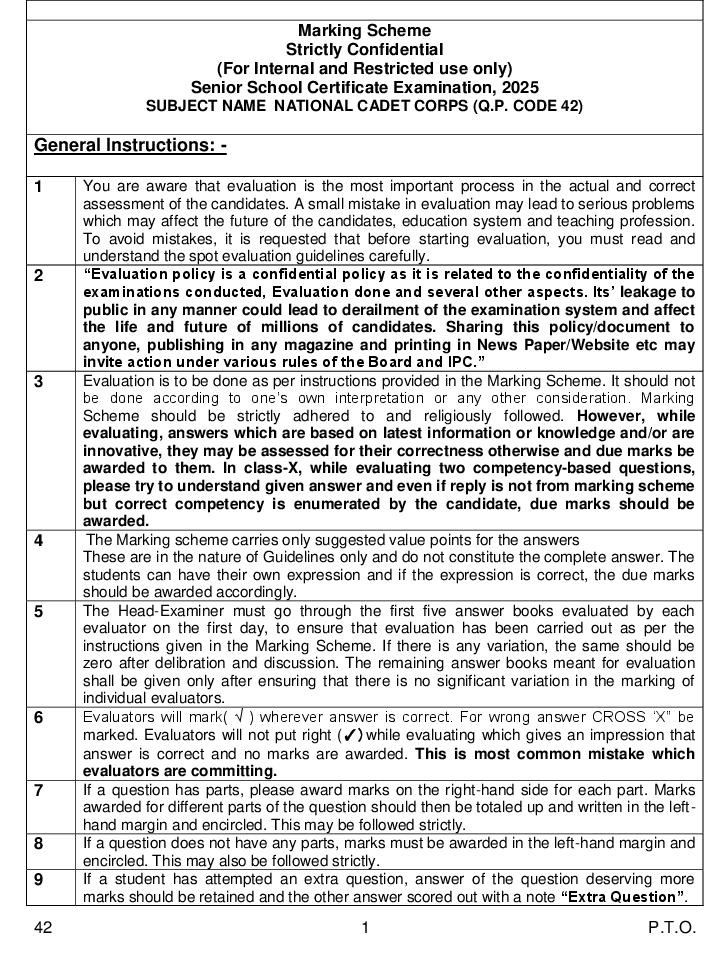
Strictly Confidential
(For Internal and Restricted use only)
Senior School Certificate Examination, 2025
SUBJECT NAME NATIONAL CADET CORPS (Q.P. CODE 42)
General Instructions: -
1 You are aware that evaluation is the most important process in the actual and correct
assessment of the candidates. A small mistake in evaluation may lead to serious problems
which may affect the future of the candidates, education system and teaching profession.
To avoid mistakes, it is requested that before starting evaluation, you must read and
understand the spot evaluation guidelines carefully.
2 “Evaluation policy is a confidential policy as it is related to the confidentiality of the
examinations conducted, Evaluation done and several other aspects. Its’ leakage to
public in any manner could lead to derailment of the examination system and affect
the life and future of millions of candidates. Sharing this policy/document to
anyone, publishing in any magazine and printing in News Paper/Website etc may
invite action under various rules of the Board and IPC.”
3 Evaluation is to be done as per instructions provided in the Marking Scheme. It should not
be done according to one’s own interpretation or any other consideration. Marking
Scheme should be strictly adhered to and religiously followed. However, while
evaluating, answers which are based on latest information or knowledge and/or are
innovative, they may be assessed for their correctness otherwise and due marks be
awarded to them. In class-X, while evaluating two competency-based questions,
please try to understand given answer and even if reply is not from marking scheme
but correct competency is enumerated by the candidate, due marks should be
awarded.
4 The Marking scheme carries only suggested value points for the answers
These are in the nature of Guidelines only and do not constitute the complete answer. The
students can have their own expression and if the expression is correct, the due marks
should be awarded accordingly.
5 The Head-Examiner must go through the first five answer books evaluated by each
evaluator on the first day, to ensure that evaluation has been carried out as per the
instructions given in the Marking Scheme. If there is any variation, the same should be
zero after delibration and discussion. The remaining answer books meant for evaluation
shall be given only after ensuring that there is no significant variation in the marking of
individual evaluators.
6 Evaluators will mark( √ ) wherever answer is correct. For wrong answer CROSS ‘X” be
marked. Evaluators will not put right (✓)while evaluating which gives an impression that
answer is correct and no marks are awarded. This is most common mistake which
evaluators are committing.
7 If a question has parts, please award marks on the right-hand side for each part. Marks
awarded for different parts of the question should then be totaled up and written in the left-
hand margin and encircled. This may be followed strictly.
8 If a question does not have any parts, marks must be awarded in the left-hand margin and
encircled. This may also be followed strictly.
9 If a student has attempted an extra question, answer of the question deserving more
marks should be retained and the other answer scored out with a note “Extra Question”.
42 1 P.T.O.
Page 2
once.
11 A full scale of marks __________(example 0 to 80/70/60/50/40/30 marks as given in
Question Paper) has to be used. Please do not hesitate to award full marks if the answer
deserves it.
12 Every examiner has to necessarily do evaluation work for full working hours i.e., 8 hours
every day and evaluate 20 answer books per day in main subjects and 25 answer books
per day in other subjects (Details are given in Spot Guidelines).This is in view of the
reduced syllabus and number of questions in question paper.
13 Ensure that you do not make the following common types of errors committed by the
Examiner in the past:-
● Leaving answer or part thereof unassessed in an answer book.
● Giving more marks for an answer than assigned to it.
● Wrong totaling of marks awarded on an answer.
● Wrong transfer of marks from the inside pages of the answer book to the title page.
● Wrong question wise totaling on the title page.
● Wrong totaling of marks of the two columns on the title page.
● Wrong grand total.
● Marks in words and figures not tallying/not same.
● Wrong transfer of marks from the answer book to online award list.
● Answers marked as correct, but marks not awarded. (Ensure that the right tick mark
is correctly and clearly indicated. It should merely be a line. Same is with the X for
incorrect answer.)
● Half or a part of answer marked correct and the rest as wrong, but no marks awarded.
14 While evaluating the answer books if the answer is found to be totally incorrect, it should
be marked as cross (X) and awarded zero (0)Marks.
15 Any unassessed portion, non-carrying over of marks to the title page, or totaling error
detected by the candidate shall damage the prestige of all the personnel engaged in the
evaluation work as also of the Board. Hence, in order to uphold the prestige of all
concerned, it is again reiterated that the instructions be followed meticulously and
judiciously.
16 The Examiners should acquaint themselves with the guidelines given in the “Guidelines
for Spot Evaluation” before starting the actual evaluation.
17 Every Examiner shall also ensure that all the answers are evaluated, marks carried over to
the title page, correctly totaled and written in figures and words.
18 The candidates are entitled to obtain photocopy of the Answer Book on request on
payment of the prescribed processing fee. All Examiners/Additional Head Examiners/Head
Examiners are once again reminded that they must ensure that evaluation is carried out
strictly as per value points for each answer as given in the Marking Scheme.
42 2
Page 3
MARKING SCHEME
NATIONAL CADET CORPS
PART – I
(Common Subjects) (49 marks)
SECTION – A
1. Choose the correct option : 111=11
(i) (A) 16 1
(ii) (B) Six steps on the left flank, and centered on the platoon. 1
(iii) (C) 150 1
(iv) (A) U 1
(v) (A) 05 rounds per minute 1
(vi) (A) Both Assertion (A) and Reason (R) are true and Reason (R)
is the correct explanation of Assertion (A). 1
(vii) (B) Starvation 1
(viii) (C) Mahatma Gandhi 1
(ix) (A) 3 1
(x) (D) Variometer 1
(xi) (A) 16 years 1
SECTION – B
42 3 P.T.O.
Page 4
individuals sharing common interests and goals. This kind of
relationship exists between man and woman, friends, coworkers,
siblings, child and parents and other people whom we meet. 2
OR
(b) While speaking we should be careful with our words. One wrong
word can change the meaning of entire communication. You could
be misinterpreted by others or media. Hence, select your words
carefully and if possible write down brief points about what you
are going to speak.
3. A fire can spread by the following modes : 1
4=2
2
(a) Conduction
(b) Radiation
(c) Convection
(d) Direct burning
4. (a) INGO – International Non-Governmental Organisation 1
4=2
2
(b) BINGO – Business-oriented International Non-Governmental
Organisation
(c) RINGO –Religious International Non-Governmental Organisation
(d) ENGO – Environmental Non-Governmental Organisation
5. The National Cadet Corps teaches discipline and patriotism to its cadets.
It also grooms them to imbibe moral ethics and social values. Cadets are
taught to respect the religious and cultural diversity of India. Therefore,
an NCC cadet is an ideal citizen of India. 2
6. (a) In air conditioners Chloroflurocarbons (CFC) gas is used. The CFC
is responsible for the depletion of the Ozone layer around the
earth's atmosphere. 2
OR
(b) E-waste : The e-waste comprise of old and discarded computers,
telephones, electronic gadgets, television sets, printed circuit
boards, refrigerators, etc.
42 4
Page 5
country: 1
4=2
2
(a) Sovereignty
(b) Integrity
(c) Security
(d) Unity
8. (a) Wheeling : Wheeling is a drill movement which is performed while
marching in single file or threes. The inner man wheels on the
circumference of a circle in order to turn a marching file or squad. 2
OR
(b) Drill : Drill is defined as being instructed in military exercises
which involves marching, saluting and turning. Drill is performed
as an individual, by a squad and with or without arms.
9. (a) For the Vice President and Prime Minister a Guard of Honour of
the strength of 100 rank and file formed up in two equal divisions
is given. 2+1+1=4
(b) Rashtriya Salute is given to the President and Governors (in their
own state).
(c) National Salute is given to other dignitaries of the rank of Major
General and above.
10. (a) Laws of Aiming : 1+1+1+1=4
(i) Focus on the target so that a clear picture of the target is
formed on the retina of the eye and the firer gets the centre
of the target.
(ii) Hold the rifle properly, keeping it upright.
(iii) Focus on the foresight of the rifle and close the left eye and
focus on the foresight.
(iv) See the foresight through the backsight ‘‘U’’. The foresight is
seen right in the centre of the ‘‘U’’. Align the tip of the
foresight in the centre and with the shoulder of the U.
OR
42 5 P.T.O.
Page 6
programme. Training of shooting with rifles is an integral part of
this programme. The fine art of shooting teaches a person
precision, accuracy, coordination of body movements, patience and
confidence, which all help him or her to make better person in
public life. The shooting at the ranges helps and individual to
master this art as a sport and learn to handle weapon for
self-protection.
11. Precautions to be taken during parasailing are: 1+1+1+1=4
(i) High winds: Avoid parasailing in high wind conditions i.e. over
15 knots at sea level.
(ii) Altitude: Do not do parasailing at an altitude of more than
600 feet.
(iii) Visibility: Do not do parasailing in mist, fog or approaching storm.
(iv) Weight restriction: Persons weighing more than 300 pounds should
not do parasailing.
12. (a) Checklist for Food Handlers: 1+1+1+1=4
(i) Regular medical examination of food Handlers.
(ii) Educate food handlers on health and hygiene aspects.
(iii) Personal hygiene of the food handlers including nails, hairs,
skin infection, and communicable disease.
(iv) Use of head cover, glove, aprons and coughing and sneezing
manners.
OR
(b) First aid for dog bite:
(i) Wash the wound and bite area with water and soap.
(ii) Clean the wound and bite area with available antiseptic
lotion.
(iii) Send the friend to the hospital for further treatment.
(iv) If possible, catch the dog and keep it under observation for
at least 10 days.
42 6
Page 7
13. (a) The guard commander is on the right side of the front rank 1+1=2
(b) Two ranks
14. (a) The prisoners arrived at the command post almost at
midnight. 1+1+1+1+1+1=6
(b) Badly
(c) Because their commander took shelter behind the trunk of a huge
pine tree.
(d) Commander was unable to set the right example. Good or bad
personal example by a leader is most infectious.
(e) The brigadier
(f) Indian troops
PART – II
(Specialized Subject) – (Army Wing) (21 marks)
SECTION – D
15. Choose the correct answer: 51=5
(i) (C) 19 to 24 years 1
(ii) (A) True North 1
(iii) (C) Section 1
(iv) (B) 20, 42, 794 1
(v) (A) Both Assertion (A) and Reason (R) are true and Reason (R)
is the correct explanation of Assertion (A). 1
SECTION – E
16. (a) PVC, MVC, VrC, SM, NM, VM, Mentioned in Dispatches,
COAS CC, CNS CC, CAS CC (Any two) 2
OR
(b) AC, KC, SC (All two)
42 7 P.T.O.
Page 8
15 km height is called troposphere, Communication carried out in
this layer is called troposcatter communication. Microwaves
transmitted in ultra high frequency and super high frequency
band achieve radio communication over the horizon from 70 km to
1000 km. 2
OR
(b) (i) Very High Frequency – 136 MHz to 176 MHz
(ii) Ultra High frequency – 403 MHz to 470 MHz 1+1=2
18. There are three types of North – True North, Magnetic North, and Grid
North 2
19. (a) Bearing are of three types as under : 2
(i) Grid bearing
(ii) Magnetic bearing
(iii) True bearing
OR
(b) Magnetic variation is the difference between True North and
Magnetic North. It varies with the time and place.
20. (a) (i) Methods of Judging Distance : 1
+ 1 + 1 + 1 =2
2 2 2 2
(I) Unit of measure
(II) Appearance method
(III) Section average
(IV) Key range
(V) Halving
(VI) Bracketing
(ii) Cover from View : It means a person is only concealed from
view not from fire.
Cover from Fire : It means a person is concealed from view
as well as protected from fire. 1+1=2
OR
42 8
Page 9
over section may not be possible:
(i) Battle noises
(ii) Need for silence
(iii) Intervening distances between troops is too large
To overcome this difficulty as a section commander, I will use field
signals to pass orders/instructions to my section.
SECTION – F
21. (a) President Yahya Khan 1+1+1+1=4
(b) 15 Dec 1971
(c) 16 Dec 1971
(d) General Sam Manekshaw
PART – 2
(Specialized Subject) – (Navy Wing) (21 marks)
SECTION – D
15. Choose the correct answer : 51=5
(i) (C) Port Blair 1
(ii) (A) Depth charge 1
(iii) (B) Deviation 1
(iv) (C) Bend 1
(v) (A) Both Assertion (A) and Reason (R) are true and Reason (R)
is the correct explanation of Assertion (A). 1
SECTION – E
16. Magnetic Anomaly Detection : It is a technique used to detect minute
changes in the earth's magnetic field caused by the presence of a
submarine under the water. The range of this method is limited and
depends on the aircraft's flying height. It is used mainly to conform the
presence of a submarine (contact). 2
42 9 P.T.O.
Page 10
immediately but slow and progressive flooding is probable cause of
damage to the hull and bulkheads/ decks surrounding the primary
zone. 2
OR
(b) Damage and flooding in a ship can occur due to the following
situations :
(i) Collision
(ii) Grounding
(iii) Weapon explosion
(iv) Enemy attack
18. Gyro Compass : This instrument is a rapidly spinning wheel or
gyroscope, the axis of which is made to point along the meridian towards
True North. It is measured clockwise from 000 degree to 360 degrees. 2
19. (a) Suitable Wood : Wood varieties like Douglas fir, silver spruce,
yellow pine, red cedar, hickory, maple, African white wood,
mahogany, teak and balsa are used for ship and boat modeling.
Balsa is the most suited wood for this purpose. 2
OR
(b) Straight Run : The ship/ boat model is made to run to centre mark
at the middle of the tank from the opposite side. Graduation of 6
inches are made on the either side of the centre mark representing
loss of one mark each on deviation from the centre mark.
20. (a) (i) Vice Chief of Naval Staff (VCNS) : The VCNS is the head of
the Headquarter Staff Branch – 1. He is responsible for
planning, programming and all administrative services.
He coordinates with the Integrated Headquarters (IHQ)
and officiates in the absence of Chief of Naval Staff
(CNS). 2+2=4
42 10
Page 11
providing maintenance and assistance to ships of the Indian
Navy. He is also responsible for design, construction and
maintenance of ships and crafts including engineering,
electrical and weaponry aspects.
OR
(b) Piping the Side Ceremony : This honour is given to the following
persons: 1+1+1+1=4
(i) The President and the Head of States
(ii) All flag officers in uniform
(iii) All commanding officers of ships and establishments
(iv) President or a member of a court martial
(v) Officer of the guard when flying a pennant
(vi) A dead body when being brought on board or sent out of a
ship
SECTION – F
21. (a) (B) 14 years 1
(b) (B) 2 1
(c) (A) Yes 1
(d) (C) Union Public Service Commission 1
PART – 2
(Specialized Subject) – (Air Wing) (21 marks)
SECTION – D
15. Choose the correct answer : 51=5
(i) (D) Echo 1
(ii) (D) All of the above 1
42 11 P.T.O.
Page 12
(iv) (D) 1999 1
(v) (A) Both Assertion (A) and Reason (R) are true and Reason (R)
is the correct explanation of Assertion (A). 1
SECTION – E
16. RADAR Radio Detection And Ranging 1
+ 1 + 1 + 1 =2
2 2 2 2
Types of RADAR
(a) Primary RADAR
(b) Secondary RADAR
(c) Continuous Wave RADAR
17. (a) The Air Traffic Service Units are as under : 1
4=2
2
(i) Area control centre
(ii) Approach control office
(iii) Aerodrome control tower
(iv) Flight information centre
OR
(b) The objectives of Air Traffic Services are :
(i) To prevent collision between aircrafts
(ii) To prevent collision between aircrafts on the maneuvering
area and obstruction on that area
(iii) To expedite and maintain an orderly flow of traffic
(iv) To provide advice and information useful for the safe and
efficient conduct of flight
(v) To notify appropriate organization regarding aircraft in
need of search and rescue and assist such organization
42 12
Page 13
following armaments : 2
(i) Missiles :
(I) Anti-tank guided missile
(II) Air to air missile
(III) Anti-ship missile
(ii) Rockets
(iii) Torpedoes and depth charge
OR
(b) Chetak is a single engine, turboshaft, light utility helicopter of
French origin with a capacity of carrying 6 persons or 500 kgs of
load. It has a maximum speed of 220 km per hour.
19. The following are the different branches in the Indian Air Force (IAF) : 2
(a) Flying branch
(b) Navigation Branch
(c) Education Branch
(d) Medical Branch
(e) Administrative Branch
(f) Logistics Branch
(g) Meteorology Branch
(h) Engineering Branch
20. (a) Four forces act on an aeroplane during the flight are: 4
42 13 P.T.O.
Page 14
(ii) Lift
(iii) Drag
(iv) Weight (Gravity)
OR
(b) Bernoulli's Principle : Bernoulli's principle describes relationship
between the velocity and pressure exerted by a moving liquid. It
states that for an increased flow, an increase in the speed of the
fluid occurs simultaneously with a decrease in pressure or a
decrease in the fluid's potential energy.
SECTION – F
21. (i) (D) Drawing 1
(ii) (C) Sandpaper and sand blocks 1
(iii) (D) 2 – 3 times 1
(iv) (B) Construction plan 1
42 14
Document Details
| Board / Org | CBSE |
| Exam | Class 12 |
| Type | Solution |
| Pages | 14 |
| Updated | 24 Sep 2026 |