CG Board 12th Sample Paper Chemistry
Finished viewing? Save it for later —
Download CG Board 12th Sample Paper Chemistry (PDF · 20 pages)About CG Board 12th Sample Paper Chemistry
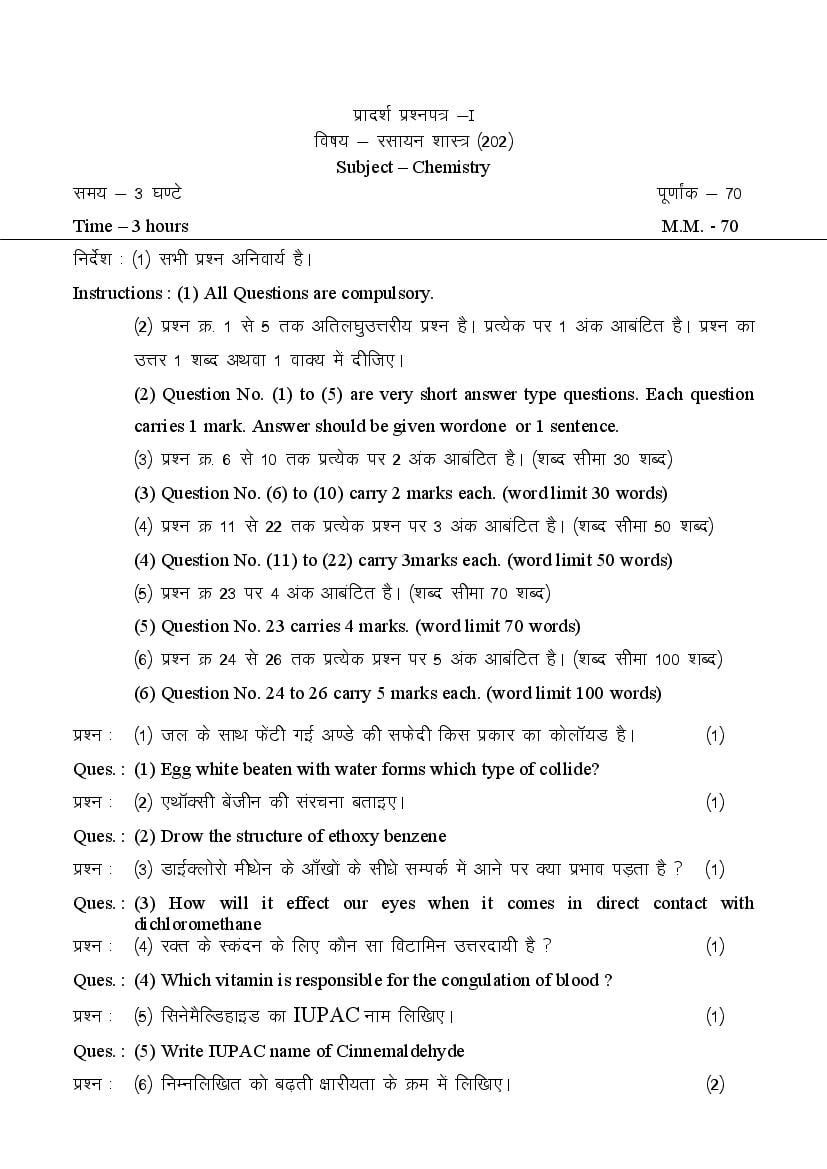
CG Board 12th Sample Paper Chemistry is available here for free download. Published by Chhattisgarh Board for Class 12, this sample paper can be viewed online or downloaded as a PDF (20 pages). Candidates preparing for Class 12 can use CG Board 12th Sample Paper Chemistry to understand the exam pattern, the type of questions asked, and the overall difficulty level.
Frequently Asked Questions
How can I download CG Board 12th Sample Paper Chemistry?
Open this page and click the Download button to save CG Board 12th Sample Paper Chemistry as a PDF. It is completely free on AglaSem Docs.
Is CG Board 12th Sample Paper Chemistry free to download?
Yes. CG Board 12th Sample Paper Chemistry can be viewed online and downloaded as a PDF free of cost on AglaSem Docs.
How many pages does CG Board 12th Sample Paper Chemistry have?
CG Board 12th Sample Paper Chemistry contains 20 pages, which you can read online or download together as a single PDF.
Where can I find more Class 12 study material?
You can find more Class 12 question papers, sample papers, syllabus, and answer keys on AglaSem Docs.
CG Board 12th Sample Paper Chemistry – Text
Read the full text of this sample paper below — useful to quickly search, copy and reference the content online without downloading the PDF.
📄 View text version (10 pages)
Page 1
शिक्षा मण्डल
Model Paper
CGBSE Sample Paper
(Practice Paper)
Page 2
-- AGLASEM --
Subject –Chemistry (202)
d{kk & 12oha
Class-12th
le; % 03 ?k.Vs iw.kkZad % 70
Time: 3 hours Total :70
lkekU; funsZ”k % iz”u Øekad 01 oLrqfu’B iz”u gS] nks [k.M gS &
General instructions: - Question number 1 is an objective question which has two parts-
(i) [k.M *v* esa dqy 10 cgqfodYih; iz”u gSA izR;sd esa 01 vad gSA
(i) Parts ‘A’ has 10 multiple choice questions each carries 1 mark
(ii) [k.M *c* es dqy 05 vfry?kqmRrjh; (VSA) iz”u gSA izR;sd esa 01 vad gSA
(ii) Part ‘B’ has 5 very short answer (VSA) questions each carries 1 mark
iz”u Øekad 02 ls iz”u Øekad 08 rd y?kqmRrjh; (SA-I) iz”u gSA izR;sd esa 02 vad gSA
¼”kCn lhek 20&30 “kCn½
Question numbers 2 to 8 are short answer-I (SA-I) questions. Each carries 2 marks
(word limit 20-30 words)
iz”u Øekad 09 ls iz”u Øekad 14 rd y?kqmRrjh; (SA-II) iz”u gSA izR;sd esa 03 vad gSA
¼”kCn lhek 40&50 “kCn½
Questions numbers 9 to 14 are short answer –II (SA-II) questions. Each carries 3 marks.
(word limit 40-50 words)
iz”u Øekad 15 ls iz”u Øekad 16 rd nh?kZmRrjh; (LA-I) iz”u gSA izR;sd esa 04 vad gSA
¼”kCn lhek 70&80 “kCn½
Question numbers 15 to 16 are long answer-I (LA-I) questions. each carries 4 marks
iz”u Øekad 17 ls iz”u Øekad 19 rd nh?kZmRrjh; (LA-II) iz”u gSA izR;sd esa 05 vad gSA
¼”kCn lhek 80&100 “kCn½
Question numbers 17 to 19 are long answer-I (LA-II) questions. each carries 5 marks.
iz”u Øekad 01 oLrqfu’B iz”u ¼vad 15½
¼v½ cgqfodYih; iz”u
Question numbers 1 (objective questions) 15 marks
lgh fodYi pqfu, &
Part A [Multiple choice Questions ] (1x10=10 marks)
1- lokZf/kd DoFkukad okyk nzo gS & (1)
¼v½ 1& C;qVsukWy ¼c½ 2&C;qVsukWy
¼l½ Mkb ,Fkkby bZFkj ¼n½ C;wVsu
1- The compound with the highest boiling point is –
(a) 1-Butanol (b) 2-butanol
(c) Diethyl ether (d) Butane
Page 3
¼v½ 0.5m ¼c½ 0.8m ¼l½ 0.9m ¼n½ 1.0
2. The molality of a solution obtained by dissolving 36 grams of glucose in 250 grams
of water will be-
(a) 0.5 m (b) 0.8 m (c) 0.9 m (d) 1.0m
3- CuSO4 foy;u ds Cu bysDVªksM ds lkFk fo|qr vi?kVu izfØ;k esa & (1)
¼v½ ,uksM ij rkack ?kqyrk gS rFkk dSFkkSM ij terk gS ¼c½ dSFkksM ij rkack ?kqyrk gSA
¼l½ ,uksM ij vkDlhtu fudyrh gSA ¼n½ dSFkksM ij gkbMªkts u fudyrk gSA
3- In the electrolysis of CuSO4 solution using a Cu electrode-
(a) Copper is deposited at the cathode and gets dissolved at the Anode.
(b) Copper is deposited at the cathode
(c) Oxygen is released at the anode.
(d) Hydrogen is released at the cathode.
4- fof”k’V pkydrk dh bdkbZ gS & (1)
¼v½ vkse&1 ¼c½ vkse&1 lseh&1
¼l½ vkse lseh ¼n½ vkse lseh&1
4. The unit of specific conductivity is -
(a) ohm-1 (b) ohm-1 cm-1
(c) ohm cm (d) ohm cm-1
5- ,fFky ,lhVsV dk vEy }kjk mRizfs jr ty vi?kVu vfHkfØ;k dh dksfV gksrh gS & (1)
¼v½ “kwU; ¼c½ ,d
¼l½ nks ¼n½ rhu
5- The order of reaction of the hydrolysis reaction of ethyl acetate catalyzed by acid is
(a) zero (b) one (c) Two (d) Three
6- tc ,fYdy gSykbM ij ,YdksgkWyh (alcoholic) KOH dh vfHkfØ;k dh tkrh gS ml
vfHkfØ;k dk uke & (1)
¼v½ cgqyhdj.k ¼c½ ;ksx”khy ¼l½ foLFkkiu ¼n½ foyksiu
6- The name of the reaction that occurs when an alkyl halide is reacted with alcoholic
KOH is-
(a) Polymerization. (b) Addition (c) Substitution. (d) Elimination.
7- vk;ju (Fe ) vkDlhdj.k voLFkk esa v;qfXer bysDVªkWuks dh la[;k gS &
2+
(1)
¼v½ 2 ¼c½ 3 ¼l½ 4 ¼n½ 5
2+
7- The number of unpaired electrons in the Iron (Fe ). Oxidation state is-
(a) 2 (b) 3 (c) 4 (d) 5
8- [Co(NH3)6]Cl3 esa Co dk leUo; la[;k gS & (1)
¼v½ 3 ¼c½ 4 ¼l½ 5 ¼n½ 6
8- The Coordination number of Co in [Co(NH3)6] Cl3 is -
(a) 3 (b) 4 (c) 5 (d) 6
Page 4
gksrs gS & (1)
¼v½ csathu ¼c½ MkbQsfuy ¼l½ ,sFksu ¼n½ fQukWy
9- When Chloro benzene reacts with sodium in dry ether, the main product obtained is -
(a) Benzene (b) Diphenyl (c) Ethane (d) Phenol
10- ÝsvkWu & 12 dk lw= gS & (1)
¼v½ CCl2F2 ¼c½ CH2Cl2 ¼l½ CH2F2 ¼n½ CCl2F3
10- The formula of Freon -12 is -
(a) CCl2F2 (b) CH2Cl2 (c) CH2f2 (d) CCl2F3
[k.M ¼c½ vfry?kqmRrjh; iz”u ¼5X1=05 vad ½
Section B :- Very short Answer Question (each 1 mark )
1- 2&Dyksjks &3 esfFky isUVsu dh lajpuk fyf[k, A (1)
1- Write the structure of 2- Chloro-3 methyl pentane.
2- izksius kWy dk DoFkukad C;wVus ls vf/kd D;ksa gksrk gS\ (1)
2. Why is the boiling point of propanol higher than that of butane ?
3- fuEufyf[kr ;kSfxdh dks ukfHkdLusgh ;ksxkRed vfHkfØ;kvksa ds izfr c<+rh gqbZ fØ;k”khyrk
ds Øe esa fyf[k, & QkesZfYMgkbM] ,flVsYMhgkbM vkSj ,lhVksu (1)
3. Arrange the following compounds in increasing order of their reactivity in
nucleophile addition reactions formaldehyde, Acetaldehyde and Acetone
4- ,fFky ,ehu ty esa foys; gksrs gSA tcfd ,uhyhu ugha ?kqyrk gS D;ksa\ (1)
4. Ethylamine is soluble in water whereas aniline is not, why?
5- vipk;h “kdZjk fdls dgrs gS\ (1)
5. What are reducing sugar called?
y?kqmRrjh; (SA-I) iz”u gSA izR;sd esa 02 vad gSA
Short Answer Question (2 marks)
iz”u 2% D;k vki ,d ftad ds ik= esa dkWij lYQsV dk foy;u j[k ldrs gSa \ dkj.k nhft,A (2)
Que 2: Can you keep a solution of copper sulphate in a zinc Pot? Give reasons
iz”u 3% vfHkfØ;k dh dksfV vkSj vk.kfodrk dks ifjHkkf’kr dhft,A (2)
Que 3: Define order of reaction and molecularity .
iz”u 4% fuEu milgla;ksth ;kSfxdksa esa fdl izdkj dh leko;ork ikbZ tkrh gS] dSls
igpkusx
a s& (2)
[Co (NH3)5Cl]SO4
[Co (NH3)5 SO4]Cl
Que 4: What kind of isomerism is shown by the following coordination compound
and how would you identify them?
[Co (NH3)5Cl]SO4
[Co (NH3)5 SO4]Cl
Page 5
Que 5: Which is more acidic among alcohol and phenol? and why?
iz”u 6% Qsgfyax foay;u A vkSj Qsgfyax foy;u B ls D;k le>rs gS\ (2)
Que 6: What do you understand by fehling’s solution ‘A’ and fehling’s solution ‘B’?
iz”u 7% veksfu;k] esfFky ,ehu] ,fFky ,ehu vkSj ,fuyhu dks c<+rs gq, {kkjh;rk ds Øe esa
fyf[k,A (2)
Que 7: Arrange ammonia, methyl amine, ethyl amine and aniline in increasing order
of their basicity?
iz”u 8% gekjs “kjhj esa foVkfeu C lafpr D;ksa ugha gksrh\ (2)
Que 8: Why is Vitamin C not stored in our body ?
y?kqmRrjh; (SA-II) iz”u gSA izR;sd esa 03 vad gSA
Long Answer Questions (SA-II) 3 Marks.
iz”u 9% vkn”kZ ,oa vukn”kZ foy;u esa mnkgj.k lfgr rhu varj fyf[k, A (3)
Que 9: Write any three differences between ideal and non-ideal solution with
example
iz”u10% jklk;fud vfHkfØ;k dh osx dks izHkkfor djus okys rhu dkjdksa dks le>kb;sA (3)
Que10: Explain three factors that affect the rate of a chemical reactions.
iz”u11% gSyks,jhu ds bysDVªkWu Lusgh izfrLFkkiu O-P funsZ”kd D;ksa gksrh gS\ (3)
Que11: Why are electrophilic substitutions of haloarenes o-p directing?
iz”u12% izkFkfed] f}rh;d ,oa r`rh;d ,YdksgkWy esa foHksn ds fy, Y;wdkl ijh{k.k fyf[k,A (3)
Que 12: Write the Lucas test for distinguishing between primary, secondary and
tertiary alcohols.
iz”u13% fuEufyf[kr vfHkfØ;k dks iw.kZ dhft, & (3)
alc
(i) C6H5NH2 + CHCl3 + KOH
(ii) C6H5NH2 + Br2
(iii) C6H5N2 Cl
/
Que 13:- Complete the following reaction –
(i) C6H5NH2 + CHCl3 + alc KOH
(ii) C6H5NH2 + Br2
(iv) C6H5N2 Cl
/
iz”u14% izksVhu ds lanHkZ esa fuEu dks Li’V dhft, & (3)
(i) isIVkbM ca/k (ii) izkFkfed lajpuk
Que 14:- Explain the following term with reference to proteins.
(i) Peptide bond (ii) Primary Structure
nh?kZmRrjh; (LA-I) iz”u gSA izR;sd esa 04 vad gSA
Long Answer Type LA-I (4 Marks)
iz”u15% (i) fl) dhft, dh fdlh vok’i”khy foys; ;qDr foy;u dk vkisf{kd ok’inkc
esa voueu foy;u esa mifLFkr foys; ds eksy izHkkt ds cjkcj gksrk gS\ (2+2)
Page 6
foy;u ds fgekad esa voueu dh x.kuk dhft, \
Que 15: (i) Prove that the relative lowering of vapor pressure of a solution
containing a non-volatile solute is equal to the Mole fraction of the
solute.
(ii) Calculate the depression in freezing point of a solution prepared by
dissolving 45 grams of ethylene glycol (C2H6O2) in 600 grams of
water
vFkok (or)
(i) leijklkjh foy;u fdls dgrs gS \ fl) dhft, fd leijklkjh foy;u
dk vk.kfod lkanz.k leku gksrs gSA
(ii) 2-82 xzke Xywdkst (MB=180) 30 xzke ty esa ?kqyk gqvk gS A Xywdkst dk
eksy izHkkt Kkr dhft,A
(i) What is an isotonic solution ? Prove that isotonic solutions have the
same molecular concentration.
(ii) 2.82 gm of glucose (MB=180) is dissolved in 30 gm of water. Find
the mole fraction of glucose.
iz”u16% (A) [Ni (H2O)6]2+ dk foy;u gjk gS] fdUrq [Ni (CN)4]2- foy;u jaxghu gSA
le>kb;sA (2+2)
(B) fuEufyf[kr milgla;ksth ;kSfxd ds uke fyf[k, &
(i) [Pt (NH3)3 Cl3] (ii) [Cr (H2O)5 SCN]2+
Que 16: [A] [Ni(H2O)6]2+ is green, but [Ni(CN)4]2- is colorless. Explain.
[B] Write the IUPAC names of the following coordination compounds-
(i) [Pt(NH3)3Cl3] (ii) [Cr (H2O)5 SCN]2+
vFkok (Or)
(A) [Cr (NH3)6]3+ vuqpEq cdh; gSA tcfd [Ni (CN)4]2- izfrpqEcdh; gSA le>kb;s D;ksa \
(B) fuEufyf[kr ;kSfxdksa ds dsUnzh; ijek.kq ds vkDlhdj.k la[;k ,oa leUo;
la[;k fyf[k, &
(i) K3[Fe (CN)6 ] (ii) [Zn (H2O)3 OH]+
[A] The complex ion [Cr (NH3)6 ]3+ is paramagnetic whereas the
complexion [Ni (CN)4 ]2- is diamagnetic. Explain why?
[B] Write the oxidation number and coordination number of the central
atom for the following compounds –
(i) K3[Fe (CN)6 ] (ii) [Zn (H2O)3 OH]+
Page 7
Long Answer Type LA-II (5 Marks)
iz”u 17%¼1½ ,d eksyj dkWij lYQsV ;qDr dkWij bysDVªksM ,oa izekf.kd gkbMªkstu
bysDVªksM ls fo|qr jklk;fud lsy cukb;s ,oa mudk lsy lw= Hkh Li’V
dhft,A [1+2+2=5]
(i) Construct the electro chemical cell using one molar copper sulphate containing
copper electrode and standard hydrogen electrode and also explain its cell formula.
¼2½ bl lsy dh lsy vfHkfØ;k fyf[k, rFkk fo|qr okgd cy dh x.kuk dhft, ;fn dkWij
bysDVªksM ds fy, fo|qr okgd cy dk eku +0.34V gSA
(ii) Write the cell reaction of this cell and calculate the emf if the emf for the copper
electrode is +0.34V
vFkok (or)
¼1½ ml xSYofud lsy dks n”kkZb;s ftlesa fuEu vfHkfØ;k gksrh gS &
Zn(s) + 2Ag+(aq) 𝑍𝑛 2+ (aq) + 2Ag (s)
(i) Show the galvanic cell in which the following reaction takes place-
Zn(s) + 2Ag+(aq) 𝑍𝑛 2+ (aq) + 2Ag (s)
¼2½ jsMkDl vfHkfØ;k
Fe + 𝑍𝑛 2+ Fe2+ + 𝑍𝑛
mDr jsMkDl vfHkfØ;k laHko gksxh ;k ughaA le>kb;sA
(i) Redox reaction-
Fe + 𝑍𝑛 2+ Fe2+ + 𝑍𝑛
Explain that above reaction is possible or not-
iz”u18% le>kb;sA
Que 18: Explain – [1+2+2=5]
(i) laØe.k /kkrqvksa dk bysDVªkWfud foU;kl fyf[k, A
(ii) laØe.k /kkrq ds d.ku ,UFkSYih dk eku mPp gksrk gSA D;ksa \
(iii) laØe.k /kkrq,¡ ,oa muds ;kSfxd mRre mRizsjd dk dk;Z djrs gS A D;ksa \
Que 18:- (i) write the electronic configuration of transition metals.
(ii)Transition metals have high enthalpy of atomization why?
(iii)Transition metals and their compounds act as good catalyst why ?
vFkok (or)
(i) ySaFksukWbM ladp
q u D;k gS \
(ii) buds ladqpu ds D;k dkj.k gksrs gSa \
(iii) buds ladqpu ls gksus okys nks ifj.kkeksa dks Li’V djsaA
(i) What is lanthanoid contraction?
(ii) What causes their contraction?
(iii) Explain two consequences of their contraction.
Page 8
Que 19: Explain –
01- dhVksu] ,fYMgkbM ls de fØ;k”khy gksrs gSaA D;ksa \
01- Why are ketones less reactive than aldehyde
02- fuEu vfHkfØ;kvksa ds lehdj.k fyf[k, &
(a) Økl ,YMkWy la?kuu
(b) dSfutkjksa vfHkfØ;k
(c) fodkcksZDlhyu
02. Write the equation for following reaction
(a) Cross aldol condensation
(b) Cannizaro reaction
(c) Decarboxylation
vFkok (Or)
01- ,lhfVd vEy dk ,fFky ,lhVsV esa ifjorZu dk lehdj.k ,oa bl vfHkfØ;k dk uke
fy[ksAa
1- Write the equation for the conversion of acetic acid into ethyl acetate and give
name of the reaction.
02- D;k gksrk gS tc &
(a) fxzxukWMZ vfHkdeZd dkcZu MªkbZvkDlkWbM ds lkFk “kq’d bZFkj dh mifLFkfr esa vEyh; ek/;e
esa fØ;k djrk gSA
(b) ,lhfVd vEy dh vfHkfØ;k PCl5 ls djkbZ tkrh gSA
(c) dkcksZDlfyd vEy veksfu;k ds lkFk mPp rki ij fØ;k djrk gSA
2- What happens when-
(a) Grignard reagent reacts with carbon dioxide in presence of ether in acidic
medium.
(b) Acetic acid reacts with PCl5
(c) Carboxylic acid reacts with ammonia at high temperature.
&&&00&&
Page 9
Share your recent question papers with us and get paid!
अपने हाल के न प हम भेज और कमाएँ!
To participate, email us with the following details:
भाग लेने के लए हम न न ववरण के साथ ईमेल कर:
- Your Name
- Your Class
- Your Board
- Details of the Question Papers you have
आपके पास उपल ध न प का ववरण
Our team will reach out to you with the next steps.
हमार ट म आगे क या के लए आपसे संपक करे गी।
Email: support@
Page 10
Notes
Model Papers Class 6 Notes
Sample Papers Class 7 Notes
Half Yearly Sample Papers Class 8 Notes
Class 9 Notes
Important Resources
Class 10 Notes
Periodic Table
Class 11 Notes
Writing Skills / Formats
Maps of India / World Class 12 Notes
Books and Solutions
NCERT Books
NCERT Book Solutions
HC Verma Chapter Wise Solutions
RD Sharma Solutions
CGBSE Solutions
Document Details
| Board / Org | Chhattisgarh Board |
| Exam | Class 12 |
| Type | Sample Paper |
| Pages | 20 |
| Updated | 29 Aug 2026 |