MAHA SET 2015 Question Paper 2 Psychology
Finished viewing? Save it for later —
Download MAHA SET 2015 Question Paper 2 Psychology (PDF · 28 pages)About MAHA SET 2015 Question Paper 2 Psychology
MAHA SET 2015 Question Paper 2 Psychology is available here for free download. Published by Maharashtra Exams for Maharashtra State Eligibility Test, this question paper can be viewed online or downloaded as a PDF (28 pages). Candidates preparing for Maharashtra State Eligibility Test can use MAHA SET 2015 Question Paper 2 Psychology to understand the exam pattern, the type of questions asked, and the overall difficulty level.
Frequently Asked Questions
How can I download MAHA SET 2015 Question Paper 2 Psychology?
Open this page and click the Download button to save MAHA SET 2015 Question Paper 2 Psychology as a PDF. It is completely free on AglaSem Docs.
Is MAHA SET 2015 Question Paper 2 Psychology free to download?
Yes. MAHA SET 2015 Question Paper 2 Psychology can be viewed online and downloaded as a PDF free of cost on AglaSem Docs.
How many pages does MAHA SET 2015 Question Paper 2 Psychology have?
MAHA SET 2015 Question Paper 2 Psychology contains 28 pages, which you can read online or download together as a single PDF.
Where can I find more Maharashtra State Eligibility Test study material?
You can find more Maharashtra State Eligibility Test question papers, sample papers, syllabus, and answer keys on AglaSem Docs.
MAHA SET 2015 Question Paper 2 Psychology – Text
Read the full text of this question paper below — useful to quickly search, copy and reference the content online without downloading the PDF.
📄 View text version (28 pages)
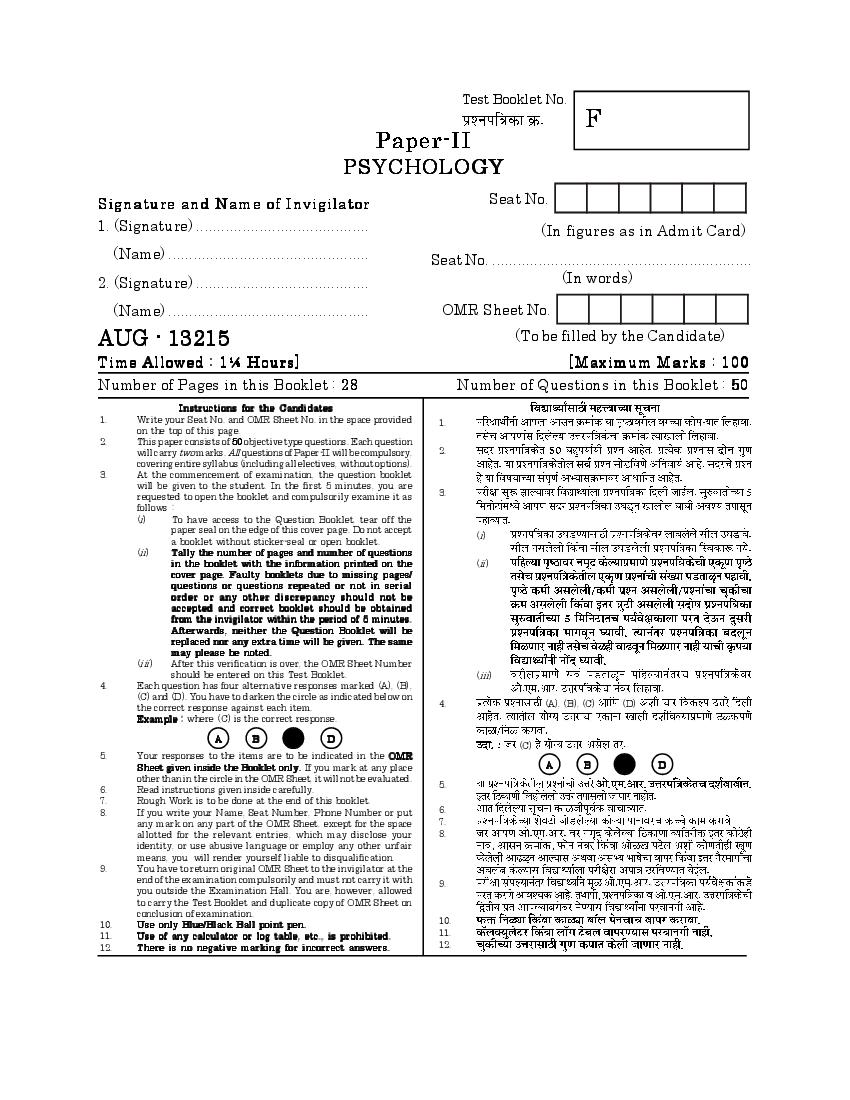
Page 1
F
PSYCHOLOGY
Signature and Name of Invigilator Seat No.
1. (Signature) ......................................... (In figures as in Admit Card)
(Name) ................................................ Seat No. ..............................................................
2. (Signature) ......................................... (In words)
(Name) ................................................ OMR Sheet No.
AUG - 13215 (To be filled by the Candidate)
Time Allowed : 1¼ Hours] [Maximum Marks : 100
Number of Pages in this Booklet : 28 Number of Questions in this Booklet : 50
Instructions for the Candidates
1. Write your Seat No. and OMR Sheet No. in the space provided 1.
on the top of this page.
2. This paper consists of 50 objective type questions. Each question
will carry two marks. All questions of Paper-II will be compulsory, 2.
covering entire syllabus (including all electives, without options).
3. At the commencement of examination, the question booklet
will be given to the student. In the first 5 minutes, you are
requested to open the booklet and compulsorily examine it as 3.
follows :
(i) To have access to the Question Booklet, tear off the
paper seal on the edge of this cover page. Do not accept
(i)
a booklet without sticker-seal or open booklet.
(ii) Tally the number of pages and number of questions
in the booklet with the information printed on the (ii)
cover page. Faulty booklets due to missing pages/
questions or questions repeated or not in serial
o rder or any other discre pancy should not be
accepted and correct booklet should be obtained
from the invigilator within the period of 5 minutes.
Afterwards, neither the Question Booklet will be
replaced nor any extra time will be given. The same
may please be noted.
(iii) After this verification is over, the OMR Sheet Number
should be entered on this Test Booklet. (iii)
4. Each question has four alternative responses marked (A), (B),
(C) and (D). You have to darken the circle as indicated below on
the correct response against each item. 4. (A), (B), (C) (D)
Example : where (C) is the correct response.
A B D
(C)
5. Your responses to the items are to be indicated in the OMR
Sheet given inside the Booklet only. If you mark at any place A B D
other than in the circle in the OMR Sheet, it will not be evaluated.
5.
6. Read instructions given inside carefully.
7. Rough Work is to be done at the end of this booklet.
8. If you write your Name, Seat Number, Phone Number or put 6.
any mark on any part of the OMR Sheet, except for the space 7.
allotted for the relevant entries, which may disclose your 8.
identity, or use abusive language or employ any other unfair
means, you will render yourself liable to disqualification.
9. You have to return original OMR Sheet to the invigilator at the
end of the examination compulsorily and must not carry it with 9.
you outside the Examination Hall. You are, however, allowed
to carry the Test Booklet and duplicate copy of OMR Sheet on
conclusion of examination.
10. Use only Blue/Black Ball point pen. 10.
11. Use of any calculator or log table, etc., is prohibited. 11.
12. There is no negative marking for incorrect answers. 12.
Page 2
Page 3
Paper II
II
Time Allowed : 75 Minutes] [Maximum Marks : 100
Note : This Paper contains Fifty (50) multiple choice questions, each question
carrying Two (2) marks. Attempt All questions.
(50) (2)
1. Adler’s theory is labelled as : 1.
(A) Analytical psychology
(B) Interpersonal psychoanalytic (A)
theory (B)
(C) Individual psychology (C)
(D) Psychoanalysis (D)
2. Prosopagnosia is the loss of : 2.
(A) Depth perception
(B) Colour perception (A)
(C) Face recognition (B)
(D) Size judgement (C)
3. The conditioned stimulus gets its (D)
reinforcing power from association 3.
with the :
(A) Unconditioned response (A)
(B) Unconditioned stimulus (B)
(C) Discriminative stimulus (C)
(D) Generalised stimulus (D)
3 [P.T.O.
Page 4
between the ....................... memory.
(A) episodic and semantic (A)
(B) deep and shallow (B)
(C) event related and generalized (C)
(D) short-term and long-term (D)
5. A concept that is made of several 5.
characteristics is known as :
(A) Disjunctive concept (A)
(B) Conjunctive concept (B)
(C) Natural concept (C)
(D) Relational concept (D)
6. A person wants to buy an expensive 6.
sports car but he is apprehensive
that his financial budget may be
collapsed.
The conflict faced is :
(A) Approach-approach (A)
(B) Approach-avoidance (B)
(C) Avoidance-avoidance (C)
(D) Double approach-avoidance (D)
4
Page 5
by traditional IQ tests ?
(A) Divergent thinking (A)
(B) Convergent thinking (B)
(C) Creative thinking (C)
(D) Autistic thinking
(D)
8. While computing the split-half
8.
reliability, the correlation between
the odd and even parts was 0.50.
What would be the reliability
coefficient of the test after Spearman-
Brown correction ?
(A) 0.50
(A) 0.50
(B) 0.62
(B) 0.62
(C) 0.67
(C) 0.67
(D) 0.76 (D) 0.76
9. Sagittal plane of the brain allows us 9.
to see the brain :
(A) as bisected into R and L halves (A)
(B) as viewed from behind (B)
(C) as seen from the front (C)
(D) as seen from above (D)
5 [P.T.O.
Page 6
in a completely dark room, the light
will appear to move about in an
erratic manner after a few seconds.
This is due to :
(A) Stroboscopic motion (A)
(B) Phi-phenomenon
(B)
(C) Autokinetic effect
(C)
(D) Defective visual perception
(D)
11. The plateau point in a learning
11.
curve is the point at which :
(A) physiological limit of capability
(A)
has been reached
(B) incubation is occurring and
(B)
performance will increase later
(C) response has been extinguished
(C)
(D) spontaneous recovery occurs
(D)
12. The phenomenon of TOT is
connected with that theory of 12. TOT
forgetting in which ......................... is
the basis.
(A) Retroactive inhibition (A)
(B) Proactive inhibition (B)
(C) Trace change (C)
(D) Retrieval failure (D)
6
Page 7
help in problem solving is :
(A) hypothesis formulation (A)
(B) means end analysis (B)
(C) insight (C)
(D) functional fixedness
(D)
14. The brain structure capable of
14.
responding to an alarming situation
before the cortex does is :
(A) Hypothalamus
(A)
(B) Amygdala
(B)
(C) Insula
(C)
(D) Hippocampus
(D)
15. The following is not a scoreable
15.
subarea of the vineland social
maturity scale :
(A) Self-direction (A)
(B) Occupation (B)
(C) Communication (C)
(D) Adaptation (D)
7 [P.T.O.
Page 8
aggressive, hostile, impatient
......................... . He finds waiting in
lines quite annoying.
The person would be considered as (A) ‘B’
having :
(B)
(A) Type B personality
(C)
(B) Cyclothymic personality
(C) State-anxiety (D) ‘A’
(D) Type A personality 17.
17. Twelve attitude statements are to be
scaled by the method of paired
comparison. What would be the
possible number of pairs of
statements ? (A) 144
(A) 144
(B) 132
(B) 132
(C) 72
(C) 72
(D) 66
(D) 66
18. During depolarisation the 18.
membrane opens :
(A)
(A) Sodium gates
(B)
(B) Potassium gates
(C)
(C) Chlorine gates
(D) Calcium gates (D)
8
Page 9
the correct answer using codes given
below :
I
List I
(Organizational Law)
(P)
(P) Closure
(Q)
(Q) Proximity
(R)
(R) Similarity
(S)
(S) Simplicity
List II II
(Meaning)
(1) Elements close together are (1)
grouped together
(2) Patterns are perceived in the (2)
most basic direct manner
possible
(3)
(3) Groupings are made in terms of
complete figure
(4)
(4) Elements similar in appearance
are grouped together
Codes :
(P) (Q) (R) (S)
(P) (Q) (R) (S)
(A) (3) (1) (4) (2) (A) (3) (1) (4) (2)
(B) (2) (3) (1) (4) (B) (2) (3) (1) (4)
(C) (1) (2) (3) (4) (C) (1) (2) (3) (4)
(D) (4) (1) (2) (3) (D) (4) (1) (2) (3)
9 [P.T.O.
Page 10
result of :
(A)
(A) Variable ratio schedules
(B)
(B) Variable interval schedules
(C)
(C) Fixed ratio schedules
(D) Fixed interval schedules (D)
21. According to the levels of processing 21.
model a memory will last longer :
(A) if maintenance rehersal occurs (A)
(B) it is processed at acoustic level (B)
(C) it is processed semantically
(C)
(D) it is processed according to
sensory qualities (D)
22. Which of the following statements 22.
are correct of Inductive reasoning ?
(1) Processes by which one comes (1)
to conclusion that are probable
(2) Reasoning involves generating
(2)
hypotheses and then rejecting
or accepting them
(3) Reasoning can be expressed by (3)
syllogisms
(4) Reasoning involves reasoning (4)
from a general level to specific
conclusion
Codes :
(A) (1) (3)
(A) (1) and (3) only
(B) (2) and (4) only (B) (2) (4)
(C) (3) and (4) only (C) (3) (4)
(D) (1) and (2) only (D) (1) (2)
10
Page 11
theory, Mohan’s heart is racing,
since he just ran 5 kms, and does
not experience any emotion because :
(A)
(A) he knows that arousal stems
from the exercise
(B)
(B) his heart rapidly returns to its
normal state as soon as he stops
running (C)
(C) he does not have satisfactory
explanation for why his heart
is racing (D)
(D) he is too tired to think about
anything
24. Match the information from List I 24. I II
and List II and choose the correct
answer by using the codes given
below :
I
List I
(Psychologists)
(P)
(P) Guilford
(Q)
(Q) Thurstone
(R)
(R) Spearman
(S)
(S) Stern
II
List II
(Concepts)
(1) Primary mental abilities (1)
(2) ‘S’ and ‘G’ factors of intelligence (2) ‘S’ ‘G’
(3) Content, process and product (3)
dimensions of intelligence
(4) Ratio I.Q. (4)
Codes :
(P) (Q) (R) (S) (P) (Q) (R) (S)
(A) (2) (3) (1) (4) (A) (2) (3) (1) (4)
(B) (3) (1) (2) (4) (B) (3) (1) (2) (4)
(C) (1) (2) (4) (3) (C) (1) (2) (4) (3)
(D) (4) (2) (3) (1) (D) (4) (2) (3) (1)
11 [P.T.O.
Page 12
represented by the following
alphabets : (A)
(A) T, F, C
(B)
(B) L, F, K
(C)
(C) M, P, R
(D)
(D) Y, N, C
26. Match List I with List II and 26. I II
indicate your answer using the codes
given below : I
List I
(Scaling method) (P)
(P) Paired comparison (Q)
(Q) Equal appearing intervals (R)
(R) Summated ratings
(S)
(S) Scalogram
II
List II
(Features)
(1) Assesses unidimensionality of (1)
the scale
(2) Suitable for assessing (2)
multidimensional attitudes
(3) Uses Thurstone’s law of (3)
comparative judgment for
computing scale values
(4)
(4) Suitable for scaling large
number of attitude statements
Codes :
(P) (Q) (R) (S) (P) (Q) (R) (S)
(A) (3) (2) (4) (1) (A) (3) (2) (4) (1)
(B) (3) (4) (2) (1) (B) (3) (4) (2) (1)
(C) (4) (3) (2) (1) (C) (4) (3) (2) (1)
(D) (3) (4) (1) (2) (D) (3) (4) (1) (2)
12
Page 13
statements are usually true for
punishment ?
(1)
(1) Punishment decreases the
likelihood of a particular
behaviour
(2)
(2) Punishment increases the
likelihood of a particular
behaviour (3)
(3) Punishment leads to
(4)
undesirable consequences
(4) Punishment is used to promote
adaptive behaviour
Codes :
(A) (1) (2)
(A) (1) and (2) only
(B) (2) (3)
(B) (2) and (3) only
(C) (1) (3)
(C) (1) and (3) only
(D) (2) and (4) only (D) (2) (4)
13 [P.T.O.
Page 14
models and choose the correct
answer by using the following code :
List I I
(Models)
(P) Attribute model
(P)
(Q) Prototype model
(Q)
(R) Exempler model
(R)
(S) Associative network model
(S)
List II
II
(Statements)
(1) Concepts are represented by
nodes (1)
(2) Concepts are represented by list (2)
of attributes
(3) Concepts are represented as an (3)
abstraction of characteristic
features
(4)
(4) Concepts are represented as
specific instances
Codes :
(P) (Q) (R) (S) (P) (Q) (R) (S)
(A) (1) (3) (4) (2) (A) (1) (3) (4) (2)
(B) (2) (4) (3) (1) (B) (2) (4) (3) (1)
(C) (4) (1) (2) (3) (C) (4) (1) (2) (3)
(D) (3) (2) (1) (4) (D) (3) (2) (1) (4)
14
Page 15
are characteristics of :
(A) Convergent thinking
(A)
(B) Divergent thinking
(B)
(C) Symbolic thinking
(C)
(D) Critical thinking
(D)
30. Read the following statements
regarding heredity and environment 30.
controversy and select the correct
statements :
(1) Genetic differences could
(1)
account for many of the
observed differences between
individuals
(2) Environment effects could (2)
account for observed differences
between groups
(3) Genetic differences could not (3)
account for differences in IQ
among individuals to an
appreciable extent
(4) Environmental factors play (4)
significant role in IQ
Codes :
(A) (3) and (4) only (A) (3) (4)
(B) (1), (2) and (4) only (B) (1), (2) (4)
(C) (2), (3) and (4) only
(C) (2), (3) (4)
(D) (1), (3) and (4) only
(D) (1), (3) (4)
15 [P.T.O.
Page 16
your answer by using the codes
given below :
I
List I
(Nature of Intelligence Measure)
(P) Measure of intelligence that (P)
takes into account both the
person’s chronological and
mental ages (Q)
(Q) Tests predict a person’s ability
in a specific area (R)
(R) Intelligence which reflects
reasoning, memory and
(S)
information processing
capabilities
(S) Model of intelligence presented II
by J.P. Das
List II
(1)
(Measured aspect)
(1) Information processing (2)
(2) Fluid intelligence (3)
(3) Aptitude (4)
(4) I.Q.
Codes :
(P) (Q) (R) (S)
(P) (Q) (R) (S)
(A) (4) (3) (2) (1)
(A) (4) (3) (2) (1)
(B) (3) (4) (1) (2)
(B) (3) (4) (1) (2)
(C) (1) (2) (4) (3) (C) (1) (2) (4) (3)
(D) (2) (1) (3) (4) (D) (2) (1) (3) (4)
16
Page 17
test, item remainder correlation is
employed. Which one of the
following correlations should be
used for this purpose ?
(A)
(A) Tetrachoric correlation
(B) Phi-coefficient (B)
(C) Point biserial correlation (C)
(D) Contingency coefficient (D)
33. Which of the following is released
33.
maximally during the first few hours
of sleep ?
(A)
(A) Cortisol
(B)
(B) Testosterone
(C) Growth hormone (C)
(D) Melatonin (D)
17 [P.T.O.
Page 18
In the following questions, each
question has two statements —
Assertion (A) and Reason (R). Read (Assertion or A)
(Reason or R).
each question carefully and decide
whether Assertion and Reason are
individually correct or not, and if
they are correct, whether the Reason
is a valid explanation of the
Assertion. For each question, before
the corresponding question number,
(A) (A) (R)
indicate your answer using the
(R)
following codes :
(A) Both (A) and (R) are true and
(B) (A) (R)
(R) is the correct explanation
(R)
of (A)
(B) Both (A) and (R) are true but
(C) (A) (R)
(R) is not the correct explanation
(C) (A) is true but (R) is false (D) (A) (R)
(D) (A) is false but (R) is true
18
Page 19
Eysenck’s theory would predict that
a person high on Neuroticism may
be highly extrovert moderately
extravert or introvert.
Reason (R) :
According to Eysenck Extraversion (R) :
and Neuroticism are orthogonal
factors.
35. Assertion (A) :
Illusions are instances in which 35. (A) :
perception yields false interpretation
of physical reality.
Reason (R) :
(R) :
Illusions are influenced by cultural
experiences.
36. Assertion (A) : 36. (A) :
A strong visual illusion is created
by the Ames room, wherein an
individual walking backwards and
forwards appears to grow and shrink
as he moves.
(R) :
Reason (R) :
The Ames room has a sloping floor,
and a rear wall which is not at right
angles to the adjoining walls.
19 [P.T.O.
Page 20
Neurons cannot fire during the
absolute refractory period.
Reason (R) :
Dale’s principle states that a neuron (R) :
can release only one neuro-
transmitter.
38. Assertion (A) :
In the classical test theory, 38. (A) :
according to true score model, the
observed variance of test scores is
the sum of true variance and error
variance.
Reason (R) :
(R) :
The random errors of measurement
are assumed to be uncorrelated with
the true scores.
Instructions for questions 39 to 43 :
Read the following paragraph and
answer the five questions following
it :
Paragraph : A researcher wanted
to study the effectiveness of a new
antidepressant drug, developed by a
pharmaceutical company, for the
20
Page 21
researcher hypothesized that the
new drug would be useful in the
treatment of depression. Thirty-five
depression patients were randomly
selected from a pool of newly
admitted depression patients in a
state hospital for psychiatric
disorders. The severity of depression
was assessed for each patient by a
suitable depression symptom check-
list, the higher score being
associated with depression.
Afterwards, for a period of two
weeks, each patient received a daily
specific dose of the new drug. At the
end of the two weeks, again each
patient was assessed by the same
depression symptom check-list. The (means)
mean depression symptoms were 16
and 22 for the first and second
assessment respectively. The
corresponding standard deviations
were also obtained. The mean
difference was evaluated by the
appropriate statistical test and the
difference was statistically
significant at 0.1 level.
21 [P.T.O.
Page 22
can be drawn on the basis of the
present study ?
(1)
(1) The new drug has adverse effect
in the treatment of depression.
(2) The null hypothesis has been (2)
rejected (3)
(3) The researcher’s hypothesis has
(4)
been accepted
(4) From the given data, none of the
above inferences can be drawn
Choose the correct option : (A) (4)
(A) (4) only (B) (1) (2)
(B) (1) and (2) only (C) (1) (3)
(C) (1) and (3) only
(D) (2) (3)
(D) (2) and (3) only
40.
40. Which of the following statistical
tests can be applied in the above
study for evaluating the mean
difference ? (1)
(1) Independent samples t-test (2)
(2) Repeated measures ANOVA
(3)
(3) Paired samples t-test
(4)
(4) Kruskal-Wallis H-test
Choose the correct option :
(A) (3)
(A) (3) only
(B) (1) and (2) only (B) (1) (2)
(C) (2) and (3) only (C) (2) (3)
(D) (3) and (4) only (D) (3) (4)
22
Page 23
be labelled as :
(1) Continuous variable (1)
(2) Dependent variable (2)
(3) Stimulus variable (3)
(4) Organismic variable (4)
Choose the correct option :
(A) (2) only
(A) (2)
(B) (1) and (2) only
(B) (1) (2)
(C) (1), (2) and (4) only
(C) (1), (2) (4)
(D) (2), (3) and (4) only
(D) (2), (3) (4)
42. Which name/s can be employed for
42.
the design used in the present
study ?
(1)
(1) Matched groups design
(2)
(2) Randomized groups design with
pretest and posttest
(3) Repeated measures design (3)
(4) Pretest-posttest design (4)
Choose the correct option :
(A) (4) only (A) (4)
(B) (2) and (4) only (B) (2) (4)
(C) (1) and (3) only (C) (1) (3)
(D) (3) and (4) only (D) (3) (4)
23 [P.T.O.
Page 24
regarded as an example of a :
(A) Quasi-experiment (A)
(B) Multivariate experiment (B)
(C) Controlled experiment (C)
(D)
(D) Multivariate field experiment
44.
44. Which of the following equations is
correct according to Emmart’s law ?
(A) =
(A) Retinal image size = Perceived
×
distance × perceived size
(B) =
(B) Perceived size = Retinal image
×
size × Perceived distance
(C) = ×
(C) Real size = Perceived size ×
Real distance
(D) = ×
(D) Perceived distance = Real size
× Retinal image size
45.
45. ‘Token economy’ is based on :
(A) Classical conditioning (A)
(B) Operant conditioning (B)
(C) Purposive behaviourism (C)
(D) Observational learning (D)
24
Page 25
responsible for consolidation of
memories ?
(A)
(A) Hypothalamus
(B)
(B) Hippocampus
(C)
(C) Thalamus
(D)
(D) Cingulate cortex
47.
47. You see a dog on the street and you
do not know if it is friendly. You
have a dog at home. It is friendly,
you have a dog at your next door
and that is friendly too. You decide
that this dog on the street must be
friendly too. This is an example of :
(A)
(A) Means-end thinking
(B) Functional fixedness (B)
(C) Inductive reasoning (C)
(D) Deductive reasoning (D)
25 [P.T.O.
Page 26
your answer from the codes given
below :
I
List I
(Approaches to Motivation)
(P)
(P) Cognitive approach
(Q)
(Q) Instinct approach
(R)
(R) Arousal approach
(S)
(S) Humanistic
List II II
(Characteristics)
(1) We try to increase the level of (1)
stimulation if it is low
(2) Expectancy of value motivates (2)
individuals
(3)
(3) People need a safe, secure
environment to function
effectively
(4)
(4) Motivation is the result of an
inborn pattern of behaviour
Codes :
(P) (Q) (R) (S)
(P) (Q) (R) (S)
(A) (1) (2) (3) (4) (A) (1) (2) (3) (4)
(B) (2) (4) (1) (3) (B) (2) (4) (1) (3)
(C) (4) (3) (2) (1) (C) (4) (3) (2) (1)
(D) (3) (1) (4) (2) (D) (3) (1) (4) (2)
26
Page 27
normalized standard score was first
used in :
(A) Stanford Binet Scale (A)
(B) Wechsler Intelligence Scale (B)
(C) Jenkin’s Intelligence Scale (C)
(D) Sternberg’s Intelligence Scale (D)
50. Form level rating is used in : 50.
(A) Thematic apperception test
(A)
(B) House tree person test
(B)
(C) Rosenzweig Picture frustration
test (C)
(D) Rorschach Inkblot method (D)
27 [P.T.O.
Page 28
28
Document Details
| Board / Org | Maharashtra Exams |
| Exam | Maharashtra State Eligibility Test |
| Type | Question Paper |
| Pages | 28 |
| Updated | 30 Apr 2026 |