CBSE Class 12 Sample Paper 2027 Solution (Marking Scheme) for Manipuri Dance
Finished viewing? Save it for later —
Download CBSE Class 12 Sample Paper 2027 Solution (Marking Scheme) for Manipuri Dance (PDF · 5 pages)About CBSE Class 12 Sample Paper 2027 Solution (Marking Scheme) for Manipuri Dance
CBSE Class 12 Sample Paper 2027 Solution (Marking Scheme) for Manipuri Dance is available here for free download. Published by CBSE for Class 12, this solution can be viewed online or downloaded as a PDF (5 pages). Candidates preparing for Class 12 can use CBSE Class 12 Sample Paper 2027 Solution (Marking Scheme) for Manipuri Dance to understand the exam pattern, the type of questions asked, and the overall difficulty level.
Frequently Asked Questions
How can I download CBSE Class 12 Sample Paper 2027 Solution (Marking Scheme) for Manipuri Dance?
Open this page and click the Download button to save CBSE Class 12 Sample Paper 2027 Solution (Marking Scheme) for Manipuri Dance as a PDF. It is completely free on AglaSem Docs.
Is CBSE Class 12 Sample Paper 2027 Solution (Marking Scheme) for Manipuri Dance free to download?
Yes. CBSE Class 12 Sample Paper 2027 Solution (Marking Scheme) for Manipuri Dance can be viewed online and downloaded as a PDF free of cost on AglaSem Docs.
How many pages does CBSE Class 12 Sample Paper 2027 Solution (Marking Scheme) for Manipuri Dance have?
CBSE Class 12 Sample Paper 2027 Solution (Marking Scheme) for Manipuri Dance contains 5 pages, which you can read online or download together as a single PDF.
Where can I find more Class 12 study material?
You can find more Class 12 question papers, sample papers, syllabus, and answer keys on AglaSem Docs.
CBSE Class 12 Sample Paper 2027 Solution (Marking Scheme) for Manipuri Dance – Text
Read the full text of this solution below — useful to quickly search, copy and reference the content online without downloading the PDF.
📄 View text version (6 pages)
Page 1
CBSE Class 12 Sample
Paper 2027 Solution
(Marking Scheme) for
Manipuri Dance
EXAM YEAR TYPE SUBJECT
CBSE Class 12 2027 Solutions Dance
Notes · Sample Papers · Previous Year Papers · Mock Tests
Page 2
m
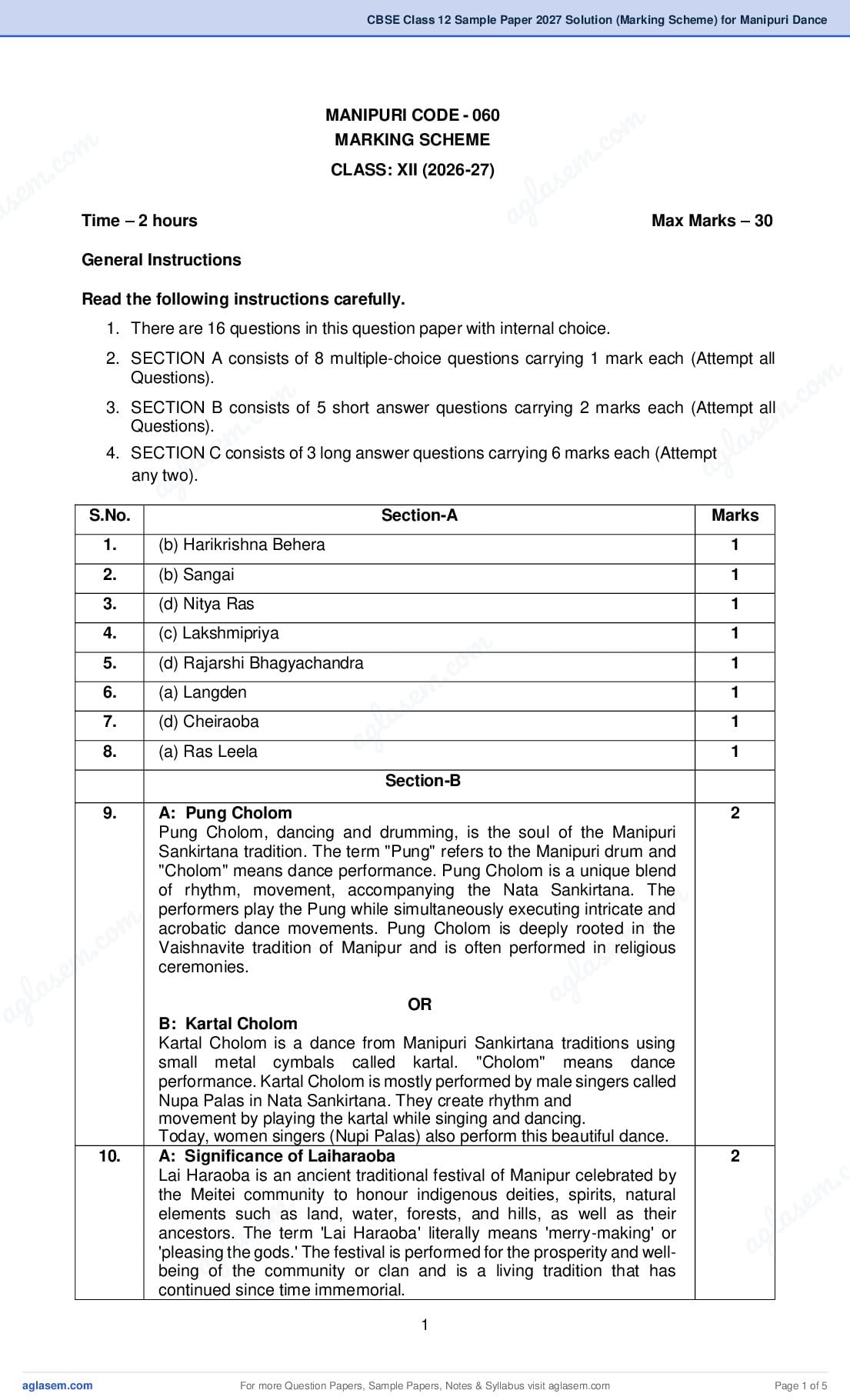
m MARKING SCHEME
.co
m .co CLASS: XII (2026-27)
s e m
as e g la
Time – 2 hours a Max Marks – 30
General Instructions
Read the following instructions carefully.
1. There are 16 questions in this question paper with internal choice.
2. SECTION A consists of 8 multiple-choice questions carrying 1 mark each (Attempt all
Questions).
o m
m . c
3. SECTION B consists
. co of 5 short answer questions carrying 2 marks each (Attempt
s
all
e m
Questions).
4. SECTION s
m
Ceconsists of 3 long answer questions carrying 6 marks each (Attempt la
l a a g
ag
any two).
S.No. Section-A Marks
1. (b) Harikrishna Behera 1
2. (b) Sangai 1
3. (d) Nitya Ras 1
4. (c) Lakshmipriya 1
m
5. (d) Rajarshi Bhagyachandra
m .co 1
6. (a) Langden
s e 1
l a
ag
7. (d) Cheiraoba 1
8. (a) Ras Leela 1
Section-B
9. A: Pung Cholom 2
Pung Cholom, dancing and drumming, is the soul of the Manipuri
Sankirtana tradition. The term "Pung" refers to the Manipuri drum and
"Cholom" means dance performance. Pung Cholom is a unique blend
of rhythm, movement, accompanying the Nata Sankirtana. The
m
.co
performers play the Pung while simultaneously executing intricate and
m
.co m
acrobatic dance movements. Pung Cholom is deeply rooted in the
m
Vaishnavite tradition of Manipur and is often performed in religious
s e
s e ceremonies.
g la
g la a
a B: Kartal Cholom
OR
Kartal Cholom is a dance from Manipuri Sankirtana traditions using
small metal cymbals called kartal. "Cholom" means dance
performance. Kartal Cholom is mostly performed by male singers called
Nupa Palas in Nata Sankirtana. They create rhythm and
movement by playing the kartal while singing and dancing.
Today, women singers (Nupi Palas) also perform this beautiful dance.
10. A: Significance of Laiharaoba 2
m . c
c. o
Lai Haraoba is an ancient traditional festival of Manipur celebrated by
the Meitei community to honour indigenous deities, spirits, natural
e m
em
elements such as land, water, forests, and hills, as well as their
l as
as
ancestors. The term 'Lai Haraoba' literally means 'merry-making' or
l ag
ag
'pleasing the gods.' The festival is performed for the prosperity and well-
being of the community or clan and is a living tradition that has
continued since time immemorial.
1
For more Question Papers, Sample Papers, Notes & Syllabus visit Page 1 of 5
Page 3
B: Types of Abhinaya
Although Abhinaya is not as formally defined and systematically taught
in Manipuri dance as in other Indian classical dance forms
- such as in the Abhinaya Darpana, where it is classified into four types
(Angika, Vachika, Aharya, and Sattvika) - all four aspects of Abhinaya
are nevertheless inherently present in Manipuri dance. Sattvika
Abhinaya is one of the Abhinayas in which internal emotions are
expressed by the performer through bodily reactions of foot
movements, change in eye movement, and hand gestures of joy, anger,
and fear etc.
11. A: Thougal Jagoi 2
Thougal Jagoi is a traditional folk dance of Manipur. 'Thougal' in
Manipuri language means "to serve" and "Jagoi" means "Dance". It
means "dance of dedication". It is performed during the Laiharaoba
festival to seek blessings for peace and prosperity before the ancestral
deities. This dance form is performed by males and females
irrespective of their age group. It is not essentially part of the ritual
however, perform during the festivals prior to the Lai Haraoba rituals.
OR
B: Amaibi Jagoi
Amaibi Jagoi is a ritual dance performed by Amaibis (priestesses) during
the Lai Haraoba festival in Manipur. As a deeply devotional and
spiritual practice, it is performed exclusively by the Amaibis and not
by other performers. Through this dance, they enact various
ritualistic sequences, including aspects of Meitei cosmogony as
well as activities such as cultivation, weaving, boat-making, and
house-building. Amaibi Jagoi holds a central and significant place
in the Lai Haraoba festival.
12. A: Brief History of Nitya Ras 2
Nitya Ras is a form of Jagoi Ras Leela of Manipur that is not performed
at the Shri Shri Govindaji Temple and has no fixed day of performance.
The first Nitya Ras was dedicated in the late 19th century during the reign
of Maharaj Chandrakirti in connection
with Nata Sankirtana music. Its actual performance was later organised
and developed during the reign of Maharaj Churachand through the
efforts of various artists.
OR
B: Brief History of Maha Ras
Maha Ras was the first Ras Leela introduced in Manipur by King
Rajarshi Bhagyachandra in 1779 CE. It is performed on the full-moon
night of Kartik (October - November). The narrative of Maha Ras is
based on the Rasapanchadhyaya of the Shreemad Bhagavata Purana.
According to the legend, on this auspicious night, Lord Krishna fulfills
his promise to the Gopis by appearing at the appointed place and
dancing simultaneously with each of them. The performance is guided
by the Sutradhari, who narrates the story through slokas and songs
such as Krishna Abhisar, followed by Radha Abhisar and Bhangi
Pareng, and concludes
with the return home (Griha Gaman).
13. A: Kabui Naga Dance 2
Kabui Naga dance is a traditional dance form performed by the Kabui
tribe of Manipur. It is closely associated with various festivals related to
cultivation, harvest, and cultural traditions. One of the most important
festivals of the Kabuis is Gaan Ngai, celebrated in January by the valley
Kabuis and usually in December by the hill Kabuis. The dances are
performed in different forms - some exclusively by unmarried women,
some by married women, while many are performed jointly by both boys
2
For more Question Papers, Sample Papers, Notes & Syllabus visit Page 2 of 5
Page 4
m
m .co
.co
OR
e m
s
B: Mao Naga Dance
em The Mao Naga Dance is a popular dance form of the Mao Naga
la
as community of Manipur, who reside in the northern hill regions of the
ag
state. It is performed by young boys and girls during annual harvesting
and seed-sowing festivals such as Chikhuni. The dance is characterised
by intricate footwork and graceful body movements. One of the well-
known dances of this community is the Mao Maram Dance (Asharali
Odo), noted for its vocal rhythms and melodious movements. The
performances often incorporate
rhythmic beats, circular formations, and coordinated singing.
Section-C
m
co
Attempt any two questions from the given options
om .
14. Ras Leela is a Vaishnavite dance-theatre tradition of Manipur based on 6
. c
the divine love of Radha and Krishna, emphasising prem bhakti
e m
e m
(devotion through love). According to Manipuri tradition, it is classified
l as
as
into five main types: Maha Ras, Kunja Ras, Vasanta Ras, Nitya Ras, and
l ag
g
Diba Ras.
a Ras, introduced by King Rajarshi Bhagyachandra in 1779 CE, is
Maha
performed on the full-moon night of Kartik (October - November). Based
on the Rasapanchadhyaya of the Bhagavata Purana, it depicts Krishna
fulfilling his promise to the Gopis by
dancing with each of them simultaneously. The performance is narrated
by the Sutradhari through slokas and songs such as Krishna Abhisar,
Radha Abhisar, and Bhangi Pareng, concluding with Griha Gaman.
m
Kunja Ras, also established by Bhagyachandra, focuses on Krishna's
.co
meeting with Radha and the Gopis in a sacred grove (Kunja). Performed
m
on the full moon of Mera (October - November), it symbolises the union
e
l as
of the individual soul with the Supreme Being. Traditionally staged in
ag
temple mandaps, it is considered an act of worship rather than
entertainment.
Vasanta Ras is celebrated on Chaitra Purnima (April - May) and
portrays the eternal love of Radha and Krishna. Inspired by texts such
as the Brahmavaivarta Purana and Gita Govinda, it is known for its rich
costumes and concludes with Aarti and the ritual of Aabir Khel (playing
with colours).
Nitya Ras has no fixed day of performance and is not performed at the
Shri Shri Govindaji Temple. It originated in the late 19th century during
m
.co
Maharaj Chandrakirti's reign and was later developed under Maharaj
m
.co
Churachand with contributions from several artists.
e m
e m
Diba Ras, developed in the 1940s during Maharaj Churachand's reign,
las
las is a daytime performance. First staged at the Hidangmayum temple in
Sagolband, it incorporates narrative sequences and devotional themes,
ag
ag including the figure of Anangamanjuri, regarded as Radha's spiritual
counterpart.
Together, these forms of Ras Leela represent the rich devotional,
aesthetic, and spiritual heritage of Manipuri dance.
15. Manipuri Ras Leela is distinguished by a highly codified and visually 6
striking system of costume that embodies both aesthetic refinement and
Vaishnav devotional symbolism. Female characters are adorned in the
iconic Potloi or Kumin costume, traditionally believed to have been
conceived in a dream by King Rajarshi Bhagyachandra. The Kumin is a
m . c
c. o m
rigid, barrel-shaped skirt, richly embellished with intricate gold and silver
embroidery, appliqué work, and small mirrors that lend it a luminous,
s e
s em
jewel-like quality.
g l a
l a a
ag
Unlike many other classical dance forms, Manipuri dancers do not wear
ankle bells; instead, they use delicate anklets and foot ornaments,
reinforcing the tradition's emphasis on subtlety and inward grace rather
3
For more Question Papers, Sample Papers, Notes & Syllabus visit Page 3 of 5
Page 5
are adorned with circular ornaments across the face, back, waist, hands,
and legs, often complemented by fresh flower garlands. Marei
necklaces, pambomphabi armlets, khuji bangles, sana earrings, and
hair ornaments draw from traditional Manipuri forms yet are carefully
codified: layered necklaces frame the face and chest, bangles and
armlets accentuate soft hand gestures, and floral hairpieces evoke the
eternal springtime of Vrindavan.
The head is covered with the Koktombi (a decorative cap) and
Meikhumbi (a fine, transparent veil), which together symbolise the
spiritual modesty and devotional ethos of Vaishnavism, especially in
Maha Ras, Vasant Ras, and Kunja Ras. In Nitya Ras and Diba Ras,
alternative head ornaments such as Jhapa, Koknam, and Samjithet are
worn. Costume colours are also symbolic: Radha is dressed in red, while
the gopis wear green velvet blouses. The face is marked with the sacred
Gaudiya Vaishnava chandan (tilak), reinforcing the theological
grounding of the performance.
Male performers portraying Krishna wear the Kajenglei (a golden
headdress encircling the head), along with the Mukut, Chura (a
peacock-feather crest wired atop the head), and Cherei. Like their
female counterparts, they wear kolu necklaces and are adorned with
ornaments and garlands. The lower garment, the Sana Phige dhoti in
bright yellow-orange, is wrapped at the waist in a manner that allows
complete freedom of movement. The face is similarly marked with
Vaishnava tilak, completing a costume system that seamlessly
integrates devotion, symbolism, and performance
aesthetics.
16. Abhinaya, a foundational principle of Indian aesthetics, refers to the art 6
of expressive communication that guides the audience toward the
experience of rasa, or aesthetic emotion. While Manipuri dance does
not codify Abhinaya as systematically as classical texts such as the
Abhinaya Darpanam - which classifies it into four types: Angika,
Vachika, Aharya, and Sattvika - all four dimensions are nevertheless
deeply integrated into the practice of Manipuri Ras Leela.
Angika Abhinaya involves expression through the body. In Manipuri
dance, it is characterised by soft, controlled, and fluid movements of the
head, hands, torso, and face. The style avoids exaggeration, instead
emphasising grace, subtlety, and devotional inwardness. Hand
gestures, though restrained compared to other classical forms, remain
essential in conveying narrative meaning and emotional nuance within
Ras Leela.
Vachika Abhinaya pertains to expression through speech, music, and
sound. In Manipuri dance-drama traditions such as Ras Leela and other
Krishna Leelas, this is realised through devotional songs, recitation, and
occasional dialogue. These vocal elements help articulate the storyline
and enhance the emotional depth of the performance, creating a closer
connection between the performers and the audience.
Aharya Abhinaya encompasses costume, makeup, and all external
visual elements that support characterisation. In Manipuri Ras Leela,
elaborate costumes, distinctive adornments, and carefully curated stage
settings - including lighting and props - play a crucial role in shaping the
visual and emotional atmosphere. These elements not only heighten
aesthetic appeal but also clearly distinguish characters and reinforce
the spiritual and narrative context.
Sattvika Abhinaya represents the expression of inner emotional states
through subtle physical responses. In Manipuri dance, it is conveyed
through delicate eye movements, gentle gestures, and nuanced bodily
reactions that reflect emotions such as devotion, longing, joy, or sorrow.
The emphasis lies on internalisation rather than overt dramatization,
allowing the performer's inner experience to resonate authentically with
4
For more Question Papers, Sample Papers, Notes & Syllabus visit Page 4 of 5
Page 6
m
m .co
Together, these four modes of Abhinaya function in harmony within
.co m
Manipuri Ras Leela, creating a refined, immersive, and spiritually
m
resonant aesthetic experience.
s e
as e g la
a
m
om . co
. c em
em l as
l as ag
ag
m
m .co
s e
l a
ag
m
m .co
m .co s e m
s e g la
g la a
a
m . c
c. o s e m
s em g l a
l a a
ag
5
For more Question Papers, Sample Papers, Notes & Syllabus visit Page 5 of 5
Document Details
| Board / Org | CBSE |
| Exam | Class 12 |
| Type | Solution |
| Pages | 5 |
| Updated | 29 Oct 2026 |