CBSE Class 12 Sample Paper 2027 Solution (Marking Scheme) for Maths
Finished viewing? Save it for later —
Download CBSE Class 12 Sample Paper 2027 Solution (Marking Scheme) for Maths (PDF · 13 pages)About CBSE Class 12 Sample Paper 2027 Solution (Marking Scheme) for Maths
CBSE Class 12 Sample Paper 2027 Solution (Marking Scheme) for Maths is available here for free download. Published by CBSE for Class 12, this solution can be viewed online or downloaded as a PDF (13 pages). Candidates preparing for Class 12 can use CBSE Class 12 Sample Paper 2027 Solution (Marking Scheme) for Maths to understand the exam pattern, the type of questions asked, and the overall difficulty level.
Frequently Asked Questions
How can I download CBSE Class 12 Sample Paper 2027 Solution (Marking Scheme) for Maths?
Open this page and click the Download button to save CBSE Class 12 Sample Paper 2027 Solution (Marking Scheme) for Maths as a PDF. It is completely free on AglaSem Docs.
Is CBSE Class 12 Sample Paper 2027 Solution (Marking Scheme) for Maths free to download?
Yes. CBSE Class 12 Sample Paper 2027 Solution (Marking Scheme) for Maths can be viewed online and downloaded as a PDF free of cost on AglaSem Docs.
How many pages does CBSE Class 12 Sample Paper 2027 Solution (Marking Scheme) for Maths have?
CBSE Class 12 Sample Paper 2027 Solution (Marking Scheme) for Maths contains 13 pages, which you can read online or download together as a single PDF.
Where can I find more Class 12 study material?
You can find more Class 12 question papers, sample papers, syllabus, and answer keys on AglaSem Docs.
CBSE Class 12 Sample Paper 2027 Solution (Marking Scheme) for Maths – Text
Read the full text of this solution below — useful to quickly search, copy and reference the content online without downloading the PDF.
📄 View text version (14 pages)
Page 1
CBSE Class 12 Sample
Paper 2027 Solution
(Marking Scheme) for
Maths
EXAM YEAR TYPE SUBJECT
CBSE Class 12 2027 Solutions Maths
Notes · Sample Papers · Previous Year Papers · Mock Tests
Page 2
m .co
m .co MATHEMATICS (041)
s e m
se MARKING SCHEME
g l a
CLASS XII (2026-27) a
SECTION: A (Solution of MCQs of 1 Mark each, no part marks)
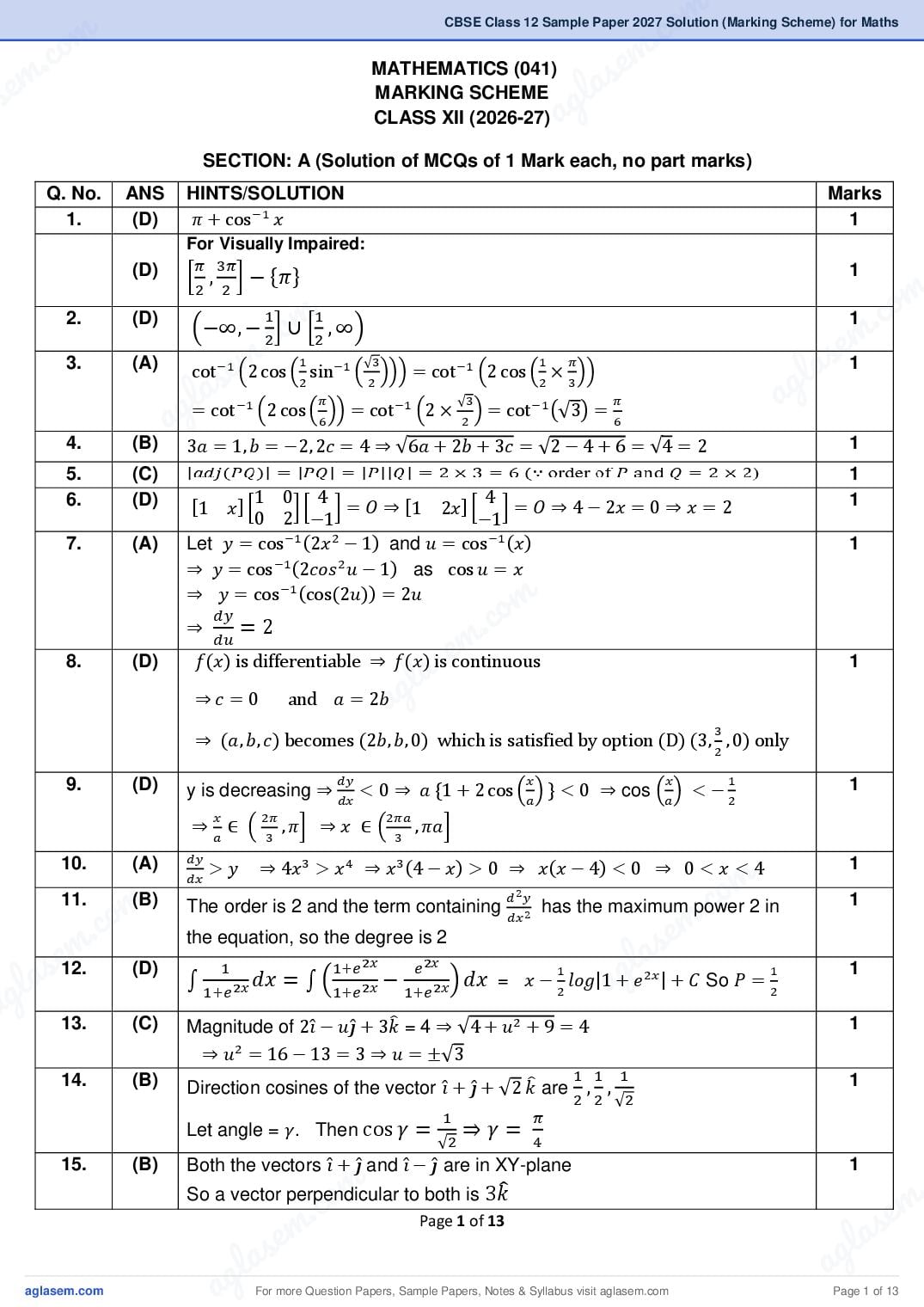
Q. No. ANS HINTS/SOLUTION Marks
1. (D) 𝜋 + cos −1 𝑥 1
For Visually Impaired:
(D) 𝜋 3𝜋
[ , ] − {𝜋} 1
2 2
m
m .co
.co
2. (D) 1 1 1
(−∞, − 2] ∪ [2 , ∞)
e m
3. (A)
em 1 √3 1 𝜋
l as1
s
cot −1 (2 cos ( sin−1 ( ))) = cot −1 (2 cos ( × ))
lacot (2 cos ( )) = cot (2 × ) = cot (√3) =
2 2 2 3
ag
ag= −1 𝜋
6
−1 √3
2
−1 𝜋
6
4. (B) 3𝑎 = 1, 𝑏 = −2, 2𝑐 = 4 ⇒ √6𝑎 + 2𝑏 + 3𝑐 = √2 − 4 + 6 = √4 = 2 1
5. (C) |𝑎𝑑𝑗(𝑃𝑄)| = |𝑎𝑑𝑗𝑄. 𝑎𝑑𝑗𝑃| = |𝑎𝑑𝑗𝑄||𝑎𝑑𝑗𝑃| = |𝑄||𝑃| = 3 × 2 = 6 1
6. (D) 1 0 4 4 1
[1 𝑥] [ ] [ ] = 𝑂 ⇒ [1 2𝑥] [ ] = 𝑂 ⇒ 4 − 2𝑥 = 0 ⇒ 𝑥 = 2
0 2 −1 −1
7. (A) Let 𝑦 = cos −1(2𝑥 2 − 1) and 𝑢 = cos −1 (𝑥) 1
⇒ 𝑦 = cos −1(2𝑐𝑜𝑠 2 𝑢 − 1) as cos 𝑢 = 𝑥
⇒ 𝑦 = cos −1 (cos(2𝑢)) = 2𝑢
m
⇒
𝑑𝑦
=2
m .co
𝑑𝑢
s e
la
8. (D) 𝑓(𝑥) is differentiable ⇒ 𝑓(𝑥) is continuous 1
⇒𝑐 =0 and 𝑎 = 2𝑏ag
3
⇒ (𝑎, 𝑏, 𝑐) becomes (2𝑏, 𝑏, 0) which is satisfied by option (D) (3, , 0) only
2
9. (D) 𝑑𝑦 𝑥 𝑥 1 1
y is decreasing ⇒ < 0 ⇒ 𝑎 {1 + 2 cos ( ) } < 0 ⇒ cos ( ) < −
𝑑𝑥 𝑎 𝑎 2
𝑥 2𝜋 2𝜋𝑎
⇒ ∈ ( , 𝜋] ⇒ 𝑥 ∈ ( , 𝜋𝑎]
𝑎 3 3
𝑑𝑦
10. (A) >𝑦 ⇒ 4𝑥 3 > 𝑥 4 ⇒ 𝑥 3 (4 − 𝑥) > 0 ⇒ 𝑥(𝑥 − 4) < 0 ⇒ 0 < 𝑥 < 4 1
m
.co
𝑑𝑥
om
11. (B) 𝑑2 𝑦 1
The order is 2 and the term containing 2 has the maximum power 2 in
. c em
𝑑𝑥
e12.m the equation, so the degree is 2
l as
las (D) 1
∫ 1+𝑒 𝑑𝑥 = (
1+𝑒
∫ 1+𝑒 −
𝑒
) 𝑑𝑥 𝑥 − 𝑙𝑜𝑔|1 g
2𝑥
a | + 𝐶 So 𝑃 =
+ 𝑒
2𝑥
1 2𝑥 1 1
g 2𝑥
= 2𝑥 2𝑥
1+𝑒 2 2
a 13. (C) Magnitude of 2𝑖̂ − 𝑢𝑗̂ + 3𝑘̂ = 4 ⇒ √4 + 𝑢2 + 9 = 4 1
⇒ 𝑢2 = 16 − 13 = 3 ⇒ 𝑢 = ±√3
14. (B) 1 1 1 1
Direction cosines of the vector 𝑖̂ + 𝑗̂ + √2 𝑘̂ are , ,
2 2 √2
1 𝜋
Let angle = 𝛾. Then cos 𝛾 = ⇒𝛾=
√2 4
15. (B) Both the vectors 𝑖̂ + 𝑗̂ and 𝑖̂ − 𝑗̂ are in XY-plane 1
m .
.co
̂
So a vector perpendicular to both is 3𝑘
e m
em
Page 1 of 13
l as
l as ag
ag For more Question Papers, Sample Papers, Notes & Syllabus visit Page 1 of 13
Page 3
The probability that it rains on a particular day is .
5
1 1 1 1
Probability that it rains on three consecutive days = × × =
5 5 5 125
17. (D) Let the events be 1
𝐴: sum of the numbers appeared is a multiple of 5
𝐵: at least one number is 4
𝐴 = {(1,4), (2,3), (3,2), (4,1), (4,6), (5,5), (6,4)}
𝐴 ∩ 𝐵 = {(1,4), (4,1), (4,6), (6,4)}
4
So required probability = 𝑃(𝐵|𝐴) =
7
18. (A) 1 1
Probability of occurrence of any one of them is
3
1 1
⇒ 𝑃(𝐴′ ∩ 𝐵) + 𝑃(𝐴 ∩ 𝐵 ′ ) = ⇒ 𝑃(𝐴′ )𝑃(𝐵) + 𝑃(𝐴)𝑃(𝐵 ′ ) =
3 3
1 1 1 5 1 1 1 1 6 1
⇒ (1 − ) 𝑘 + 6 (1 − 𝑘) = 3 ⇒ 𝑘 (6 − 6) = 3 − 6 ⇒ 𝑘 = 6 × 4 = 4
6
19. (B) Both assertion and reason are true, but reason is not the correct 1
explanation of the assertion
1 1
∫−1|𝑥 − 2| 𝑑𝑥 = ∫−1(−𝑥 + 2) 𝑑𝑥 = 4
20. (A) Both assertion and reason are true, and reason is the correct explanation 1
of the assertion.
Section –B
[This section comprises of solution of very short answer type questions (VSA) of 2 marks
each]
21(A). 1 1 6𝑥 5
𝐼=∫ 𝑑𝑥 = ∫ 6 √𝑥 6 𝑑𝑥
𝑥 √𝑥 6 −1 6 𝑥 −1
Let 𝑥 6 − 1 = 𝑡 2 ⇒ 6𝑥 5 𝑑𝑥 = 2𝑡𝑑𝑡
1 1 1
½
𝐼 = ∫ 2 𝑑𝑡 = tan−1 (√𝑥 6 − 1) + 𝐶 1+½
3 (𝑡 +1) 3
OR
21(B). 𝑐𝑜𝑠 𝑥−sin 𝑥 𝑐𝑜𝑠 𝑥−sin 𝑥 𝑐𝑜𝑠 𝑥−sin 𝑥
Let 𝐼 = ∫ 𝑑𝑥 = ∫ 𝑑𝑥 = ∫ 𝑑𝑥
√sin(2𝑥) √1+sin(2𝑥)−1 √(𝑠𝑖𝑛𝑥+𝑐𝑜𝑠𝑥)2 −1
½
Let 𝑠𝑖𝑛𝑥 + 𝑐𝑜𝑠𝑥 = 𝑡 ⇒ ( 𝑐𝑜𝑠 𝑥 − sin 𝑥)𝑑𝑥 = 𝑑𝑡
½
1
𝐼=∫ 𝑑𝑡 = 𝑙𝑜𝑔|𝑡 + √𝑡 2 − 1| + 𝐶 ½
√𝑡 2 −1
= 𝑙𝑜𝑔|𝑠𝑖𝑛𝑥 + 𝑐𝑜𝑠𝑥 + √(𝑠𝑖𝑛𝑥 + 𝑐𝑜𝑠𝑥)2 − 1| + 𝐶
½
= 𝑙𝑜𝑔|𝑠𝑖𝑛𝑥 + 𝑐𝑜𝑠𝑥 + √sin(2𝑥)| + 𝐶
22. 𝑦 = sin(𝑥 + 𝑦) ⇒ sin−1 𝑦 = 𝑥 + 𝑦
1 𝑑𝑥 𝑑𝑥 1−√1−𝑦 2 1
⇒ 2
= +1 ⇒ =
√1−𝑦 𝑑𝑦 𝑑𝑦 √1−𝑦 2
𝑑𝑦 √1−𝑦 2
⇒ =
𝑑𝑥 1−√1−𝑦 2
1
𝑑𝑦
So, = 0 ⇒ 𝑦 = ±1
𝑑𝑥
Page 2 of 13
For more Question Papers, Sample Papers, Notes & Syllabus visit Page 2 of 13
Page 4
m .co
m .co s em
a
Alternative way:
se 𝑦 = sin(𝑥 + 𝑦) ⇒
𝑑𝑦
𝑑𝑥
= cos(𝑥 + 𝑦) (1 +
𝑑𝑦
𝑑𝑥
)
ag l
𝑑𝑦 1
⇒ (1 − cos(𝑥 + 𝑦)) = cos(𝑥 + 𝑦)
𝑑𝑥
𝑑𝑦
⇒ cos(𝑥 + 𝑦) = 0 as =0 1
𝑑𝑥
⇒ sin(𝑥 + 𝑦) = ±1 ⇒ y = ±1
23(A). Given points are 𝐴(2,6,5), 𝐵(3, 𝑝, 7), 𝐶(−4, 3,4) and 𝐷(−1,0, 𝑞)
Direction ratios of the line ⃡𝐴𝐵 are 〈1, 𝑝 − 6, 2〉 and
m
m
⃡ are 〈3, −3, 𝑞 − 4〉
.co
.co
Direction ratios of the line 𝐶𝐷
e m
As the lines are parallel, so we have
1
e=m𝑝−6 2
l as
s
=
ag 1
⇒ −1 =la
3 −3 𝑞−4
ag 𝑝 − 6 𝑎𝑛𝑑 𝑞 − 4 = 3 × 2
⇒ 𝑝 = −1 + 6 = 5, 𝑞 = 6 + 4 = 10 ½
𝑞 10
Thus, = =2 ½
𝑝 5
OR
23 (B).
m
.co
s em
g la
a sides of the rectangle are as follows
Let vectors representing the four
𝐴𝐵 = 𝑎, 𝐵𝐶 = 𝑏, 𝐶𝐷 = 𝑐 , 𝑎𝑛𝑑 𝐷𝐴 = 𝑑
Then 𝐴𝐶 = 𝑢 = 𝑎 + 𝑏 …(i)and 𝐵𝐷 = 𝑣 = 𝑏 + 𝑐 = 𝑏 − 𝑎 …(ii) ½
Solving (i) and (ii),
1 1
𝑎 = (𝑢 − 𝑣) 𝑎𝑛𝑑 𝑏 = (𝑢 + 𝑣) 1
2 2
1 1
Also, 𝑐 = −𝑎 = (𝑣 − 𝑢) and 𝑑 = −𝑏 = − 2 (𝑢 + 𝑣)
2 ½
m
.co
24. Given |𝑎| = √6 , 𝑎 ∙ 𝑏 = 1 and 𝑏 × 𝑎 = 3𝑖̂ + 4𝑗̂ − 2𝑘̂
m
c. o So |𝑎 × 𝑏| = |𝑏 × 𝑎| = √29 s e m
em a
½
as 2 2
g l
a
2
l We know, |𝑎 × 𝑏 | + |𝑎 ∙ 𝑏| = |𝑎|2 |𝑏|
ag
½
2 2 30
⇒ 29 + 1 = 6|𝑏| ⇒ |𝑏| = = 5 ⇒ |𝑏| = √5
6 1
25. Constraints are
3𝑥 + 2𝑦 ≥ 10, 𝑥 + 2𝑦 ≤ 6, 𝟏½
𝑦≥0 ½
m .
.co s e m
em a
Page 3 of 13
s l
l a ag
ag For more Question Papers, Sample Papers, Notes & Syllabus visit Page 3 of 13
Page 5
𝑞
As maximum value exists at (𝑝, 𝑞) and (2𝑝, )
2
𝑞
So 𝑍 𝑎𝑡 (𝑝, 𝑞) = 𝑍 𝑎𝑡 (2𝑝, ) 1
2
𝑞
⇒ 3𝑝 + 4𝑞 = 3 × 2𝑝 + 4 ×
2
⇒ 3𝑝 + 4𝑞 = 6𝑝 + 2𝑞
⇒ 6𝑝 − 3𝑝 = 4𝑞 − 2𝑞
⇒ 3𝑝 = 2𝑞 1
Section –C
[This section comprises of solution of short answer type questions (SA) of 3 marks each]
26(A) Let 𝐴 = 𝑃𝑄 and 𝐵 = 𝑄𝑃. Then
1 0
2 0 0 2 0
𝐴 = 𝑃𝑄 = [ ] [0 2 ] = [ ] 1
0 1 2 2 2
1 0
1 0 2 0 0
2 0 0 1
𝐵 = 𝑄𝑃 = [0 2] [ ] = [0 2 4]
0 1 2
1 0 2 0 0
Here |𝐴| = 4 ≠ 0
So, 𝐴 is a non-singular matrix, hence its inverse exists.
1
1 1 2 0 0
Now 𝐴 −1
= |𝐴| 𝑎𝑑𝑗 𝐴 = 4 [ ] = [ 21 1]
½
−2 2 −
2 2
Here |𝐵| = 0 ½
So, 𝐵 is a singular matrix, hence its inverse does not exist.
27. Let 𝐴 be the area of the circular region covered by the drone and let 𝑟 be its
radius. Let ℎ be the height of the drone at any time 𝑡.
𝑑𝐴 𝑑𝑟 𝑑ℎ
Given
𝑑ℎ
= 44 𝑚2 𝑝𝑒𝑟 𝑚𝑒𝑡𝑟𝑒 and = 6 𝑚/𝑠 To find when 𝑟 = 14 m. ½
𝑑𝑡 𝑑𝑡
𝑑𝐴 𝑑𝑟 𝑑𝐴 𝑑ℎ 𝑑𝑟
𝐴 = 𝜋𝑟 2 ⇒ = 2𝜋𝑟 ⇒ . = 2𝜋𝑟 1½
𝑑𝑡 𝑑𝑡 𝑑ℎ 𝑑𝑡 𝑑𝑡
𝑑ℎ 22 𝑑ℎ
44 = 2( )6𝑟 ⇒ ] = 12 m/s 1
𝑑𝑡 7 𝑑𝑡 𝑟=14𝑚
The height of the drone increases at the rate of 12 m/s at that moment.
𝑑𝑥 𝑑𝑦
28(A). = 3𝑠𝑖𝑛2 𝑡 𝑐𝑜𝑠 𝑡 and = −3 𝑐𝑜𝑠 2 𝑡 𝑠𝑖𝑛 𝑡
𝑑𝑡 𝑑𝑡
𝑑𝑦
𝑑𝑦 𝑑𝑡⁄
= 𝑑𝑥 = −𝑐𝑜𝑡 𝑡 1
𝑑𝑥
𝑑𝑡
𝑑2 𝑦 𝑑 𝑑𝑦 𝑑𝑡 1 1
𝑑𝑥 2
= ( ). = 𝑐𝑜𝑠𝑒𝑐 2 𝑡 ( ) = (𝑠𝑒𝑐 𝑡. 𝑐𝑜𝑠𝑒𝑐 4 𝑡)
𝑑𝑡 𝑑𝑥 𝑑𝑥 3𝑠𝑖𝑛2 𝑡 cos t 3 1
1 1 1 𝜋
At the point ( ,
2√2 2√2
) , 𝑠𝑖𝑛3 𝑡 = ⇒𝑡=
2√2 4
𝑑2𝑦 4√2 1
2
] 𝜋 =
𝑑𝑥 𝑡= 3
4
Page 4 of 13
For more Question Papers, Sample Papers, Notes & Syllabus visit Page 4 of 13
Page 6
m .co
m .co s em
se
OR
g la 𝑣 = (𝑙𝑜𝑔𝑥)
a
𝑙𝑜𝑔𝑥 𝑥
28(B). Let 𝑦 = 𝑥 + (𝑙𝑜𝑔𝑥) = 𝑢 + 𝑣 where 𝑢 = 𝑥 𝑙𝑜𝑔𝑥 and 𝑥
𝑙𝑜𝑔 𝑢 = (𝑙𝑜𝑔 𝑥)2 and 𝑙𝑜𝑔 𝑣 = 𝑥. 𝑙𝑜𝑔(𝑙𝑜𝑔 𝑥)
1 𝑑𝑢 1 1 𝑑𝑣 1 1
= 2( 𝑙𝑜𝑔 𝑥). and = 𝑙𝑜𝑔(𝑙𝑜𝑔 𝑥) +
𝑢 𝑑𝑥 𝑥 𝑣 𝑑𝑥 𝑙𝑜𝑔 𝑥
𝑑𝑢 1 𝑑𝑣 1
𝑑𝑥
= 𝑥 𝑙𝑜𝑔𝑥 (2( 𝑙𝑜𝑔 𝑥). ) and = (𝑙𝑜𝑔𝑥)𝑥 (𝑙𝑜𝑔(𝑙𝑜𝑔 𝑥) + )
𝑥 𝑑𝑥 𝑙𝑜𝑔 𝑥
1
𝑑𝑦 𝑑𝑢 𝑑𝑣
= +
m
.co
𝑑𝑥 𝑑𝑥 𝑑𝑥
m
.co m
𝑑𝑦 2 1
⇒ = 𝑥 𝑙𝑜𝑔𝑥 𝑙𝑜𝑔 𝑥 + (𝑙𝑜𝑔𝑥)𝑥 (𝑙𝑜𝑔(𝑙𝑜𝑔 𝑥) + )
s e
em
𝑑𝑥 𝑥 𝑙𝑜𝑔 𝑥
s l a 1
ag
Alternative Solution:
la
Since 𝑥 = 𝑒 𝑙𝑜𝑔𝑥
g
a + (𝑙𝑜𝑔𝑥) = 𝑒
𝑦=𝑥 𝑙𝑜𝑔𝑥 𝑥 log(𝑥 𝑙𝑜𝑔𝑥 ) 𝑥
+ 𝑒 log((𝑙𝑜𝑔𝑥) ) 1
(log 𝑥)2 𝑥 log(log 𝑥)
=𝑒 +𝑒
𝑑𝑦 (log 𝑥)2 2 log 𝑥 1 1 1+1
=𝑒 [ ] + 𝑒 𝑥 log(log 𝑥) [log(log 𝑥) + 𝑥 ( ) ( )]
𝑑𝑥 𝑥 log 𝑥 𝑥
2 log 𝑥 1
𝑂𝑅 𝑥 𝑙𝑜𝑔𝑥 [ ] + (𝑙𝑜𝑔𝑥)𝑥 [log(log 𝑥) + ( )]
𝑥 log 𝑥
29(A). 𝑥𝑑𝑦 + (𝑦 − 𝑥 2 𝑒 𝑥 )𝑑𝑥 = 0 is a linear differential equation given by
m
c. o
𝑑𝑦 1
½
+ 𝑦 = 𝑥𝑒 𝑥
m
𝑑𝑥 𝑥
1
s e
I.F = 𝑒 ∫𝑥𝑑𝑥 = 𝑒 𝑙𝑜𝑔 𝑥 = 𝑥
g la ½
Solution is 𝑦. 𝑥 = ∫ 𝑥 2 𝑒 𝑥 𝑑𝑥 a
using by parts
½
𝑦𝑥 = 𝑥 2 𝑒 𝑥 − ∫ 2𝑥𝑒 𝑥 𝑑𝑥
using by parts again
½
𝑦𝑥 = 𝑥 2 𝑒 𝑥 − 2{𝑥𝑒 𝑥 − 𝑒 𝑥 } + 𝐶
m
m y (1) = 0
c. o Particular solution is
⇒ 𝐶 = −𝑒
.co
m s em ½
s e 𝑦𝑥 = 𝑥 2 𝑒 𝑥 − 2{𝑥𝑒 𝑥 − 𝑒 𝑥 } − 𝑒 = 𝑒 𝑥 {𝑥 2 − 2𝑥 + 2} − 𝑒
g la
la a ½
ag OR
29(B). 𝑑𝑦 𝑥𝑦
= is a homogeneous differential equation.
𝑑𝑥 𝑥 2 +𝑦 2
𝑑𝑦 𝑑𝑣
Let 𝑦 = 𝑣 𝑥 ⇒ =𝑣+𝑥
𝑑𝑥 𝑑𝑥
So, equation reduces to
m .
.co s e m
em a
Page 5 of 13
s l
l a ag
ag For more Question Papers, Sample Papers, Notes & Syllabus visit Page 5 of 13
Page 7
𝑣+𝑥 = ⇒𝑥 =
𝑑𝑥 1+𝑣 2 𝑑𝑥 1+𝑣 2 1
1+𝑣 2 𝑑𝑥
∫ 𝑣 3 𝑑𝑣 = − ∫ 𝑥
1 1 −1
∫(𝑣3 + 𝑣) 𝑑𝑣 = −𝑙𝑜𝑔 |𝑥| + log 𝐶 ⇒ 2𝑣2 + log|𝑣| = − log|𝑥| + log 𝐶
𝑥2
𝑦 𝑥2 2𝑦2 1
log | | =
𝐶 2𝑦 2
or 𝑦=𝐶𝑒
𝐶 = 1 when 𝑥 = 0 and 𝑦 = 1.
𝑥2
2𝑦2
1
The particular solution is 𝑦=𝑒
30(A). 2𝑦+3 4𝑘−3 ½
A point on the line 𝑥 − 2 = = 2 − 𝑧 = 𝑘 𝑖𝑠 𝑃 (𝑘 + 2, , 2 − 𝑘)
4 2
And direction ratios of the given line are 〈1, 2, −1〉.
Direction Ratios of the line joining the points 𝐴(2,1,4) and this point P are
4𝑘−3 4𝑘−5
〈𝑘 + 2 − 2, − 1, 2 − 𝑘 − 4〉 = 〈𝑘, , −𝑘 − 2〉 ½
2 2
As 𝐴𝑃 is perpendicular to the given line, So
4𝑘−5
1×𝑘+2× + (−1) × (−𝑘 − 2) = 0
2
1
⇒ 𝑘 + 4𝑘 − 5 + 𝑘 + 2 = 0 ⇒ 6𝑘 − 3 = 0 ⇒ 𝑘 = ½
2
So, foot of the perpendicular is
4𝑘−3 1 2−3 1 5 −1 3 ½
𝑃 (𝑘 + 2, , 2 − 𝑘) = ( + 2, ,2 − ) = ( , , )
2 2 2 2 2 2 2
4𝑘−5 1 3 5
Direction ratios of the line ⃡𝐴𝑃 are 〈𝑘, , −𝑘 − 2〉 = 〈 , − , − 〉 or
2 2 2 2
〈1, −3, −5〉
⃡ is ½
And equation of 𝐴𝑃
𝑥−2 𝑦−1 𝑧−4 1−𝑦 4−𝑧
= = OR 𝑥 − 2 = = ½
1 −3 −5 3 5
OR
30(B). 𝑥−1 𝑦−1 𝑧−2
Given lines are = = and
2 2 1
1
𝑥−5 1 3−𝑧 𝑥−5 𝑦− 𝑧−3 ½
=𝑦− = ⇒ = 2
=
2 2 2 2 1 −2
Let the angle between the lines be 𝜃, then
2×2+2×1+1×(−2) 4 4
cos 𝜃 = = ⇒ 𝜃 = cos −1 ( ) 1
√9×√9 9 9
Now required line will be in the direction of the vector
𝑖̂ 𝑗̂ 𝑘̂
|2 2 1 | = −5𝑖̂ + 6𝑗̂ − 2𝑘̂ 1
2 1 −2
𝑥−1 𝑦−1 𝑧−1 𝑥−1 y−1 𝑧−1 ½
So required line is = = OR = −6 =
−5 6 −2 5 2
Page 6 of 13
For more Question Papers, Sample Papers, Notes & Syllabus visit Page 6 of 13
Page 8
m .co
c. o31. s e m
m a
se ag l
1½
m
m .co
m .co s e m
s e l a
ag ½
Feasible region is bounded with three vertices 𝐴(1,2), 𝐵(4,2), 𝐶(2,4)
g l a
Now 𝑍𝐴 = 100, 𝑍𝐵 = 220, 𝑍𝐶 = 200
1
a
So, Maximum Value of Z is 220 at the point 𝐵(4,2).
For Visually Impaired:
The vertices of the feasible region are 𝐴(20,0), 𝐵(40,0), 𝐶(30,10), 𝐷(0,20) and
𝐸(0,10).
Now 𝑍𝐴 = 50 × 20 − 20 × 0 = 1000
𝑍𝐵 = 50 × 40 − 20 × 0 = 2000
𝑍𝐶 = 50 × 30 − 20 × 10 = 1300
m
𝑍𝐷 = 50 × 0 − 20 × 20 = −400
.co
em
2
𝑍𝐸 = 50 × 0 − 20 × 10 = −200
Minimum value of 𝑍 is −400 at 𝐷(0,20)
l as
ag
1
Maximum Value of 𝑍 is 2000 at 𝐵(40,0)
Section –D
[This section comprises of solution of long answer type questions (LA) of 5 marks each]
32(A). Given relation 𝑅 is defined on 𝐴 = 𝑁 × 𝑁 such that
(𝑎, 𝑏)𝑅(𝑐, 𝑑) 𝑖𝑓 𝑎𝑛𝑑 𝑜𝑛𝑙𝑦 𝑖𝑓 𝑎2 + 𝑑 2 = 𝑏 2 + 𝑐 2
m
.co
Reflexive:
mLet (𝑝, 𝑞) ∈ 𝐴 = 𝑁 × 𝑁
m .co Then as 𝑝, 𝑞 ∈ 𝑁, so 𝑝2 + 𝑞 2 = 𝑞 2 + 𝑝2
s e m
s e ⇒(𝑝, 𝑞)𝑅(𝑝, 𝑞) ∀(𝑝, 𝑞) ∈ 𝑁 × 𝑁
g l a
g la ⇒ 𝑅 is a reflexive relation. a 1½
a Symmetric:
Let (𝑝, 𝑞) 𝑎𝑛𝑑 (𝑟, 𝑠) ∈ 𝐴 = 𝑁 × 𝑁 such that (𝑝, 𝑞) 𝑅 (𝑟, 𝑠)
⇒ 𝑝2 + 𝑠 2 = 𝑞 2 + 𝑟 2
⇒ 𝑞 2 + 𝑟 2 = 𝑝2 + 𝑠 2
⇒ 𝑟 2 + 𝑞 2 = 𝑠 2 + 𝑝2
⇒ (𝑟, 𝑠) 𝑅 (𝑝, 𝑞)
Thus, 𝑅 is a symmetric relation. 1½
Transitive:
m .
.co s e m
em a
Page 7 of 13
s l
l a ag
ag For more Question Papers, Sample Papers, Notes & Syllabus visit Page 7 of 13
Page 9
⇒ 𝑝2 + 𝑠 2 = 𝑞 2 + 𝑟 2 … (𝑖) and 𝑟 2 + 𝑣 2 = 𝑠 2 + 𝑢2 … (𝑖𝑖)
Adding (i) and (ii), 𝑝2 + 𝑠 2 + 𝑟 2 + 𝑣 2 = 𝑞 2 + 𝑟 2 + 𝑠 2 + 𝑢2
⇒ 𝑝2 + 𝑣 2 = 𝑞 2 + 𝑢2
⇒ (𝑝, 𝑞) 𝑅 (𝑢, 𝑣)
Thus, 𝑅 is a transitive relation 1½
So, 𝑅 is a reflexive, symmetric and transitive relation.
Hence 𝑅 is an equivalence relation ½
OR
32(B).
1 for
correc
t
graph
Yes, 𝑅 is a function as the graph shows every element of the set (−∞, ∞) has a
unique image in the set [0, ∞). 1
Now, let us denote this function by 𝑓: (−∞, ∞) → [0, ∞) as 𝑓(𝑥) = 𝑥 2 + 5
Injective Function:
Here 𝑓(−1) = (−1)2 + 5 = 6 and 𝑓(1) = 12 + 5 = 6
So 𝑓(−1) = 𝑓(1) = 6
Thus 𝑓 is a many-one function, so not an injective function. 1½
Surjective Function:
Range of 𝑓(𝑥) = [5, ∞) ≠ co-domain= [0, ∞)
So, it is not surjective. 1½
Alternate Method:
Correct graph as above
Yes, 𝑅 is a function as the graph shows every element of the set (−∞, ∞) has a
unique image in the set [0, ∞).
Now, let us denote this function by 𝑓: (−∞, ∞) → [0, ∞) as 𝑓(𝑥) = 𝑥 2 + 5 1
Injective Function:
Let 𝑎, 𝑏 ∈ (−∞, ∞), such that 𝑓(𝑎) = 𝑓(𝑏)
⇒ 𝑎2 + 5 = 𝑏 2 + 5 ⇒ 𝑎2 = 𝑏 2 ⇒ 𝑎 = ±𝑏
So 𝑓 is not injective.
Surjective Function: 1½
For 𝑦 = 1 there is no pre-image as if 1 = 𝑥 2 + 5 ⇒ 𝑥 2 = −4 not possible.
So, it is not surjective. 1½
For Visually Impaired:
For every element a of the set (−∞, ∞), 𝑎2 ∈ [0, ∞) and therefore 𝑎2 + 7 ∈ [7, ∞)
Hence every element of the set (−∞, ∞) has a unique image in the set [0, ∞).
Page 8 of 13
For more Question Papers, Sample Papers, Notes & Syllabus visit Page 8 of 13
Page 10
m .co
.co s e m
em
So, 𝑓 : (−∞, ∞) → [0, ∞), 𝑓(𝑥) = 𝑥 2 + 7 is a function.
a
1
s Now, let us denote this function by 𝑓: (−∞, ∞) → [0, ∞) as 𝑓(𝑥) = 𝑥 2 + 7
g l
Injective Function: a
Here 𝑓(−1) = (−1)2 + 7 = 8 and 𝑓(1) = 12 + 7 = 8
So 𝑓(−1) = 𝑓(1) = 8
Thus 𝑓 is a many-one function, so not an injective function. 1½
Surjective Function:
Range of 𝑓(𝑥) = [7, ∞) ≠ co-domain= [0, ∞)
So, it is not surjective. 1½
m
.co
Thus 𝑓(𝑥) is neither injective nor surjective and hence not bijective 1
m
c. 𝑑𝑥o m
33. 𝑎 𝑎−𝑥
Let 𝐼 = ∫−𝑎 √
e
s½
e×m 𝑑𝑥
𝑎+𝑥
s l a
ag
𝑎 𝑎−𝑥 𝑎−𝑥
la
𝐼 = ∫−𝑎 √
g
𝑎+𝑥 𝑎−𝑥
= ∫a
𝑎 𝑎−𝑥 𝑎 𝑎 𝑎 𝑥
𝑑𝑥 = ∫
−𝑎 √𝑎2 −𝑥2 −𝑎 √𝑎2 −𝑥 2
𝑑𝑥 − ∫−𝑎 √𝑎2 2 𝑑𝑥 = 𝐼1 − 𝐼2
−𝑥
1
𝑎 1
𝐼1 = 𝑎 ∫−𝑎 √𝑎2 𝑑𝑥
−𝑥 2
𝑎 1 𝑎 𝑎
= 2𝑎 ∫0 √𝑎2 𝑑𝑥 using ∫−𝑎 𝑓(𝑥) 𝑑𝑥 = 2 ∫0 𝑓(𝑥) 𝑑𝑥 if 𝑓(−𝑥) = 𝑓(𝑥) 1
−𝑥2
om
𝑥 𝑎 𝜋 1
𝐼1 = 2𝑎 [sin−1 ( )] = 2𝑎 ( 2 ) = 𝜋𝑎
𝑎 0
. c
and
e m
𝑎 𝑥
𝐼2 = ∫−𝑎 √𝑎2 𝑑𝑥 = 0
la
𝑎
s
using ∫−𝑎 𝑓(𝑥) 𝑑𝑥 = 0 if 𝑓(−𝑥) = −𝑓(𝑥) 1
−𝑥2
ag
𝐼 = 𝐼1 + 𝐼2 = 𝜋𝑎 ½
Alternate Method:
Let 𝑥 = 𝑎 𝑐𝑜𝑠 2𝜃 ⇒ 𝑑𝑥 = −2 𝑎 sin(2 𝜃) 𝑑𝜃 ½
𝜋
When 𝑥 = −𝑎, 𝜃 = and 𝑥 = 𝑎, 𝜃 = 0
2 ½
𝑎
𝐼 = ∫−𝑎 √
𝑎−𝑥
𝑑𝑥
0
= −2 𝑎 ∫𝜋 tan 𝜃 sin(2𝜃) 𝑑𝜃
com
om .
𝑎+𝑥
c 𝐼 = 2 𝑎 ∫ tan 𝜃 sin(2𝜃) 𝑑𝜃 m
2
m . 𝜋
………(i)
𝑏
s e
using ∫𝑎 𝑓(𝑥)𝑑𝑥 = − ∫𝑏 𝑓(𝑥)𝑑𝑥
𝑎
a
2 1
s e 0
𝜋
g l= ∫ 𝑓(𝑎 − 𝑥)𝑑𝑥
la a
𝜋 𝑎 𝑎
𝐼 = 2𝑎 ∫0 tan ( − 𝜃) sin(𝜋 − 2 𝜃)𝑑𝜃
2 using ∫ 𝑓(𝑥)𝑑𝑥
ag 𝜋
𝐼 = 2𝑎 ∫0 cot( 𝜃) sin(2𝜃) 𝑑𝜃
2
2
………(ii)
0 0 1
Adding equations (i) and (ii)
𝜋
2𝐼 = 2𝑎 ∫02 ( tan𝜃 + cot 𝜃) sin(2𝜃) 𝑑𝜃 1
𝜋
⇒ 𝐼 = 2𝑎 ∫0 (𝑠𝑖𝑛2 𝜃 + 𝑐𝑜𝑠 2 𝜃) 𝑑𝜃
2
𝜋 1
𝜋
⇒ 𝐼 = 2𝑎 ∫0 1 𝑑𝜃 = 2𝑎 ( ) = 𝜋𝑎
2
2
m .
.co s e m
em a
Page 9 of 13
s l
l a ag
ag For more Question Papers, Sample Papers, Notes & Syllabus visit Page 9 of 13
Page 11
1 mark for correct figure
1
𝑦 = √4 − 𝑥 2 is a semi-circle with radius 2 units and centre (0,0)
𝑥 = 2 − 𝑦 which is x + y = 2 is a line with intercepts 2 on each axis.
Curves meet at (0,2) and (2,0)
2
1
Area = ∫0 (√4 − 𝑥 2 − (2 − 𝑥)) 𝑑𝑥 1
2
𝑥 𝑥 𝑥2
= [ √4 − 𝑥 2 + 2 sin−1 (2) − 2𝑥 + 2 ]
2 0 1
= 𝜋 − 4 + 2 = ( 𝜋 − 2) sq. units 1
OR
34(B).
1 mark for correct figure. 1
𝑦 2 = 2𝑥 represents a parabola, whose points of intersection with the given line
𝑥 = 2𝑦 are (0, 0 ) , (8, 4) 1
8 𝑥
Area = ∫0 (√2𝑥 − 2) 𝑑𝑥 1
2 3
𝑥 2 8
= [√2 3 𝑥 2 − 4 ] 1
0
64 16
= − 16 = sq. units 1
3 3
34(A). For Visually Impaired:
𝑥2 𝑦2 ½
25𝑥 2 + 16𝑦 2 = 400 is an Ellipse with the standard equation as + 25 = 1
16
5
⇒ 𝑦 = √42 − 𝑥 2
4 1
4 5
Area = 4 ∫0 ( √42 − 𝑥2 ) 𝑑𝑥
4
4 1
= 5 ∫0 (√42 − 𝑥 2 ) 𝑑𝑥
𝑥 𝑥 4
= 5[ √16 − 𝑥 2 + 8 sin−1 ( )] 1½
2 4 0
1
= 5[4(𝜋)] = 20𝜋 sq. units
OR
Page 10 of 13
For more Question Papers, Sample Papers, Notes & Syllabus visit Page 10 of 13
Page 12
om .co
c. 34(B). e m
em
𝑦 2 = 8𝑥 represents a parabola, and the area of the region above the x-axis, below
l as ½
s the parabola, between the lines 𝑥 = 2 and 𝑥 = 5 is given by
5 ag 2
Area = ∫2 (√8𝑥 ) 𝑑𝑥
3 5
2
= [2√2 3 𝑥 2 ] 1½
2
4 4
= √2 3 [5√5 − 2√2] = 3 [5√10 − 4] sq. units 1
35. Let the events be
𝐸1 ∶ User uses Alpha smartwatch
m
.co
𝐸2 ∶ User uses Beta smartwatch
m
.co
𝐸3 ∶ User uses Gamma smartwatch
e m
𝐸4 ∶ User uses Delta smartwatch
e m l as
l as
𝐴 ∶ User gets a false heart-rate alert
Clearly {𝐸1 , 𝐸2 , 𝐸3 , 𝐸4 } is a partition of the sample space. ag 1
ag
Then 𝑃(𝐸1 )=0.45, 𝑃(𝐸2 ) = 0.3, 𝑃(𝐸3 ) = 0.15, 𝑃(𝐸4 ) = 0.1
Now 𝑃(𝐴|𝐸1 ) = 0.01, 𝑃(𝐴|𝐸2 ) = 0.02, 𝑃(𝐴|𝐸3 ) = 0.05, 𝑃(𝐴|𝐸4 ) = 0.01 1
(i) By Theorem of Total Probability,
The total probability that a randomly selected user gets a false alert
= 𝑃(𝐴)
= 𝑃(𝐸1 )𝑃(𝐴|𝐸1 ) + 𝑃(𝐸2 )𝑃(𝐴|𝐸2 ) + 𝑃(𝐸3 )𝑃(𝐴|𝐸3 ) + 𝑃(𝐸4 )𝑃(𝐴|𝐸4 )
= 0.45 × 0.01 + 0.3 × 0.02 + 0.15 × 0.05 + 0.1 × 0.01
om
= 0.0045 + 0.006 + 0.0075 + 0.001 = 0.019 1½
(ii) By Bayes Theorem, . c
e m
s
The probability that false alert came from a Beta smartwatch
= 𝑃(𝐸2 |𝐴)
g la
= a
𝑃(𝐸2 )𝑃(𝐴|𝐸2 )
𝑃(𝐸1 )𝑃(𝐴|𝐸1 )+𝑃(𝐸2 )𝑃(𝐴|𝐸2 )+𝑃(𝐸3 )𝑃(𝐴|𝐸3 )+𝑃(𝐸4 )𝑃(𝐴|𝐸4 )
0.3×0.02 0.006 6
= = = 1½
0.019 0.019 19
Section –E
[ This section comprises solution of 3 case- study/passage-based questions of 4 marks]
36. (i) Given lines are
m
m 𝑙1 : 𝑟 = 𝑖̂ + 2𝑗̂ + 3𝑘̂ + 𝜆(𝑖̂ + 3𝑗̂ − 𝑘̂) ) ≡ 𝑎 + 𝜆 𝑏 .co
m .co and
s em
s e 𝑙2 : 𝑟 = 2𝑖̂ − 𝑗̂ + 𝑘̂ + 𝜇(2𝑖̂ + 3𝑗̂ + 𝑘̂) ≡ 𝑐 + 𝜇 𝑑
g l a
la Here 𝑎 = 𝑖̂ + 2𝑗̂ + 3𝑘̂, 𝑏 = 𝑖̂ + 3𝑗̂ − 𝑘̂, 𝑐 = 2𝑖̂ − 𝑗̂ + 𝑘̂, 𝑑 = 2𝑖̂a+ 3𝑗̂ + 𝑘̂
1
ag For direction vectors 𝑏 and 𝑑 , 𝑏 ≠ 𝜆 𝑑 , for any 𝜆 ∈ 𝑅
⇒ 𝑏 is not parallel to 𝑑
So, lines are not parallel.
(ii) Given lines are
𝑙1 : 𝑟 = 𝑖̂ + 2𝑗̂ + 3𝑘̂ + 𝜆(𝑖̂ + 3𝑗̂ − 𝑘̂) ) ≡ 𝑎 + 𝜆 𝑏 1
and
m
𝑙3 : 𝑟 = 3𝑖̂ − 𝑗̂ + 𝑘̂ + 𝛾(𝑖̂ + 3𝑗̂ − 𝑘̂ ) ≡ 𝑒 + 𝛾 𝑓
.
.co s e m
em a
Page 11 of 13
s l
l a ag
ag For more Question Papers, Sample Papers, Notes & Syllabus visit Page 11 of 13
Page 13
(iii) (a) 𝑐 − 𝑎 = 2𝑖̂ − 𝑗̂ + 𝑘̂ − (𝑖̂ + 2𝑗̂ + 3𝑘̂) = 𝑖̂ − 3𝑗̂ − 2𝑘̂
𝑖̂ 𝑗̂ 𝑘̂ 1
𝑏 × 𝑑 = |1 3 −1| = 6𝑖̂ − 3𝑗̂ − 3𝑘̂ = 3(2𝑖̂ − 𝑗̂ − 𝑘̂)
2 3 1
( 𝑐 − 𝑎). (𝑏 × 𝑑 ) = (𝑖̂ − 3𝑗̂ − 2𝑘̂). 3(2𝑖̂ − 𝑗̂ − 𝑘̂) = 3(2 + 3 + 2) = 21 ≠ 0
So, the lines are skew lines. 1
|𝑏 × 𝑑| = 3√22 + (−1)2 + (−1)2 = 3√6
Thus, the shortest distance between the given lines is
( 𝑐 −𝑎).(𝑏×𝑑) 21 7 7√6
𝐷=| |𝑏 ×𝑑|
|=| |= = 𝑢𝑛𝑖𝑡𝑠
3√6 √6 6
OR
(b) 𝑙1 : 𝑟 = 𝑖̂ + 2𝑗̂ + 3𝑘̂ + 𝜆(𝑖̂ + 3𝑗̂ − 𝑘̂) ≡ 𝑎 + 𝜆 𝑏
and 1
̂ + 𝛾(𝑖̂ + 3𝑗̂ − 𝑘
𝑙3 : 𝑟 = 3𝑖̂ − 𝑗̂ + 𝑘 ̂) ≡ 𝑒 + 𝛾 𝑏
|𝑏 ×( 𝑒 −𝑎)| 1
Since the lines are parallel, the shortest distance = |𝑏 |
1
𝑖̂ 𝑗̂ 𝑘̂ ̂|
|−9𝑖̂−9𝑘 9√22
= ||1 3 −1|| = = 𝑢𝑛𝑖𝑡𝑠
√11 √11 11
2 −3 −2
37. (i) 𝑊(𝑥) = 35 + 1.6𝑥 − 0.02𝑥 2
𝑊 ′ (𝑥) = 1.6 − 0.04𝑥 = 0 ⇒ 𝑥 = 40
Therefore, the value of 𝑥 is 40 crores at the stationary point of 𝑊(𝑥). 1
(ii) 𝑊 ′′ (𝑥) = −0.04 < 0 ⇒ 𝑊(𝑥) is maximum at 𝑥 = 40 by the second ½
derivative test.
Thus, the WQI is maximum when ₹ 40 crores are spent on the revival.
Max. WQI = 𝑊(40) = 35 + 64 − 32 = 67 ½
(iii) (a) If the investment is ₹35 crores, then the WQI = 𝑊(35)
𝑊(35) = 35 + (1.6)(35) − (0.02)(35)2
= (2.6)(35) − (0.02)(1225) 1
= 91 − 24.5 = 66.5
Also, 67-66.5 = 0.5 1
So, the WQI is short by 0.5 units of its maximum level.
OR
(b) 𝑊(60) = 35 + 96 − 72 = 59 1
59 is less than the maximum value 67 of WQI, even when the
investment has been increased from 40 crores to 60 crores. This shows 1
that the returns are diminishing.
Page 12 of 13
For more Question Papers, Sample Papers, Notes & Syllabus visit Page 12 of 13
Page 14
m .co
. co s e m
em
(i) Taking price of each kg of apples, oranges and pomegranate as
a
38.
s ₹𝑥, ₹𝑦, ₹𝑧 respectively.
g l
Matrix form is 𝐴𝑋 = 𝐵, a
5 10 5 𝑥 2750
where 𝐴 = (10 10 5) , 𝑋 = (𝑦) , 𝐵 = (3500) 1
8 15 7 𝑧 4100
Here |𝐴| = 25 ≠ 0
So, the system is consistent and has unique solution
−5 5 0
Adjoint of the matrix A = adjA = (−30 −5 25 )
m
.co
70 5 −50 1
m
.co
(ii) Unique solution of the system is given by
−5 5 0 2750 e m
em 1
𝑋 = 𝐴−1 𝐵 = (−30 −5 25 ) (3500)
l as
l as 25
70 5 −50 4100
ag 1
ag 𝑥 150
⇒ (𝑦) = (100) ⇒ 𝑥 = 150, 𝑦 = 100, 𝑧 = 200
𝑧 200
So the price of Apples, Oranges and Pomegranate are respectively 1
₹150 per kg, ₹100 per kg, ₹200 per kg.
m
m .co
s e
g la
a
m
m .co
m .co s e m
s e g l a
g la a
a
m .
.co s e m
em a
Page 13 of 13
s l
l a ag
ag For more Question Papers, Sample Papers, Notes & Syllabus visit Page 13 of 13
Document Details
| Board / Org | CBSE |
| Exam | Class 12 |
| Type | Solution |
| Pages | 13 |
| Updated | 29 Oct 2026 |