Kerala PG Nursing 2022 Question Paper with Answer Key
Finished viewing? Save it for later —
Download Kerala PG Nursing 2022 Question Paper with Answer Key (PDF · 14 pages)About Kerala PG Nursing 2022 Question Paper with Answer Key
Kerala PG Nursing 2022 Question Paper with Answer Key is available here for free download. Published by CEE Kerela for Kerala PG Nursing, this question paper can be viewed online or downloaded as a PDF (14 pages). Candidates preparing for Kerala PG Nursing can use Kerala PG Nursing 2022 Question Paper with Answer Key to understand the exam pattern, the type of questions asked, and the overall difficulty level.
Frequently Asked Questions
How can I download Kerala PG Nursing 2022 Question Paper with Answer Key?
Open this page and click the Download button to save Kerala PG Nursing 2022 Question Paper with Answer Key as a PDF. It is completely free on AglaSem Docs.
Is Kerala PG Nursing 2022 Question Paper with Answer Key free to download?
Yes. Kerala PG Nursing 2022 Question Paper with Answer Key can be viewed online and downloaded as a PDF free of cost on AglaSem Docs.
How many pages does Kerala PG Nursing 2022 Question Paper with Answer Key have?
Kerala PG Nursing 2022 Question Paper with Answer Key contains 14 pages, which you can read online or download together as a single PDF.
Where can I find more Kerala PG Nursing study material?
You can find more Kerala PG Nursing question papers, sample papers, syllabus, and answer keys on AglaSem Docs.
Kerala PG Nursing 2022 Question Paper with Answer Key – Text
Read the full text of this question paper below — useful to quickly search, copy and reference the content online without downloading the PDF.
📄 View text version (14 pages)
Page 1
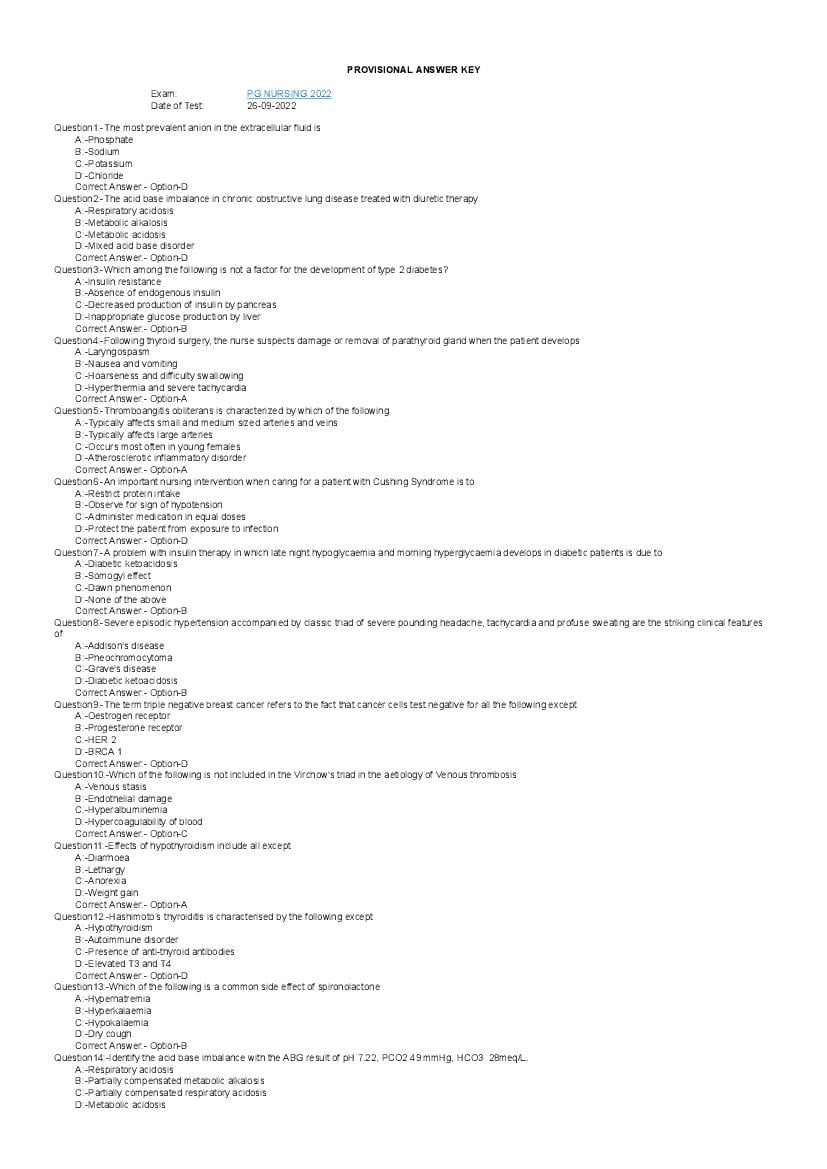
Exam: PG NURSING 2022
Date of Test: 26-09-2022
Question1:-The most prevalent anion in the extracellular fluid is
A:-Phosphate
B:-Sodium
C:-Potassium
D:-Chloride
Question2:-The acid base imbalance in chronic obstructive lung disease treated with diuretic therapy
A:-Respiratory acidosis
B:-Metabolic alkalosis
C:-Metabolic acidosis
D:-Mixed acid base disorder
Question3:-Which among the following is not a factor for the development of type 2 diabetes?
A:-Insulin resistance
B:-Absence of endogenous insulin
C:-Decreased production of insulin by pancreas
D:-Inappropriate glucose production by liver
Question4:-Following thyroid surgery, the nurse suspects damage or removal of parathyroid gland when the patient develops
A:-Laryngospasm
B:-Nausea and vomiting
C:-Hoarseness and difficulty swallowing
D:-Hyperthermia and severe tachycardia
Question5:-Thromboangitis obliterans is characterized by which of the following
A:-Typically affects small and medium sized arteries and veins
B:-Typically affects large arteries
C:-Occurs most often in young females
D:-Atherosclerotic inflammatory disorder
Question6:-An important nursing intervention when caring for a patient with Cushing Syndrome is to
A:-Restrict protein intake
B:-Observe for sign of hypotension
C:-Administer medication in equal doses
D:-Protect the patient from exposure to infection
Question7:-A problem with insulin therapy in which late night hypoglycaemia and morning hyperglycaemia develops in diabetic patients is due to
A:-Diabetic ketoacidosis
B:-Somogyi effect
C:-Dawn phenomenon
D:-None of the above
Question8:-Severe episodic hypertension accompanied by classic triad of severe pounding headache, tachycardia and profuse sweating are the striking clinical features
of
A:-Addison's disease
B:-Pheochromocytoma
C:-Grave's disease
D:-Diabetic ketoacidosis
Question9:-The term triple negative breast cancer refers to the fact that cancer cells test negative for all the following except
A:-Oestrogen receptor
B:-Progesterone receptor
C:-HER 2
D:-BRCA 1
Question10:-Which of the following is not included in the Virchow's triad in the aetiology of Venous thrombosis
A:-Venous stasis
B:-Endothelial damage
C:-Hyperalbuminemia
D:-Hypercoagulability of blood
Question11:-Effects of hypothyroidism include all except
A:-Diarrhoea
B:-Lethargy
C:-Anorexia
D:-Weight gain
Question12:-Hashimoto’s thyroiditis is characterised by the following except
A:-Hypothyroidism
B:-Autoimmune disorder
C:-Presence of anti-thyroid antibodies
D:-Elevated T3 and T4
Question13:-Which of the following is a common side effect of spironolactone
A:-Hypernatremia
B:-Hyperkalaemia
C:-Hypokalaemia
D:-Dry cough
Question14:-Identify the acid base imbalance with the ABG result of pH 7.22, PCO2 49 mmHg, HCO3 28meq/L.
A:-Respiratory acidosis
B:-Partially compensated metabolic alkalosis
C:-Partially compensated respiratory acidosis
D:-Metabolic acidosis
Page 2
A:-Pulmonary edema
B:-Hepatomegaly
C:-Ankle edema
D:-Jugular venous distention
Question16:-The most common clinical manifestation of GERD is
A:-Dysphagia
B:-Hoarseness of voice
C:-Cough
D:-Pyrosis
Question17:-Ventricular remodelling refers to
A:-Hypertrophy of infarcted myocardium
B:-Hypertrophy of normal myocardium
C:-Formation of necrotic tissue in myocardium
D:-Development of collateral circulation
Question18:-The health education for a patient to reduce dumping syndrome after partial gastrectomy include all the following except
A:-Wait 30 minutes after meals to consume liquids
B:-Sit up for 30 minutes after eating
C:-Eat 5 to 6 small meals a day rather than three large meals.
D:-Diet containing low carbohydrate and moderate protein.
Question19:-Normal PR interval in ECG is
A:-0.06 to 0.12 sec
B:-0.04 to 0.12 sec
C:-0.12 to 0.2 sec
D:-0.02 to 0.08 sec
Question20:-Appearance of spider angiomas in chronic liver disease is due to
A:-Increase in circulatory oestrogen
B:-Portal hypertension
C:-Decreased serum albumin
D:-Decreased platelet count
Question21:-Characteristics of ventricular tachycardia include all the following except
A:-P wave is followed by QRS complex
B:-Ventricular rate is 100 to 250 beats per minute
C:-Wide and distorted QRS complex
D:-Rhythm may be regular or irregular.
Question22:-Most common cause of death in early acute pancreatitis is
A:-Renal failure
B:-Cardiac failure
C:-Respiratory failure
D:-Uncontrolled coagulopathy
Question23:-Normal changes in urinary system associated with aging include
A:-Decreased BUN level
B:-Post voiding residual urine
C:-Increased bladder capacity
D:-Easily palpable kidneys
Question24:-Which of the following is a slowly progressive non inflammatory disorder of synovial joint.
A:-Osteoarthritis
B:-Rheumatoid arthritis
C:-Systemic lupus erythematosus
D:-Osteomyelitis
Question25:-In adults, the GFR in end stage renal disease is
A:-60-89ml/mt
B:-30-59ml/mt
C:-15-29ml/mt
D:-Less than 15 ml/mt
Question26:-The mode of mechanical ventilator in which breaths are delivered at a pre-set rate and tidal volume independent of patient’s ventilatory efforts.
A:-Assist control mode
B:-CMV
C:-SIMV
D:-Pressure support
Question27:-The most serious electrolyte disorder associated with kidney disease
A:-Sodium
B:-Calcium
C:-Potassium
D:-Phosphate
Question28:-Biotherapeutic agents affect the host tumour response by the following ways except
A:-Direct antitumour effect
B:-Promote DNA and protein synthesis in tumour cells
C:-Modulation of host immune system
D:-Interfere with cancer cell's ability to metastasis.
Question29:-A patient having 60 kg body weight with 50 percentage total body surface area burns is brought in the emergency department. The nurse should anticipate
how much amount of fluid replacement during the first 8 hours according to Parkland formula.
A:-3000 ml
B:-6000 ml
C:-4000 ml
Page 3
Question30:-Chronic bilateral inflammation of the eyelid margins is known as
A:-Blepharitis
B:-Hordeolum
C:-Chalazion
D:-Sty
Question31:-A patient with the diagnosis of which of the following disorder is most at risk for spreading the disease
A:-Pemphigus vulgaris
B:-Impetigo on face
C:-Candidiasis on nails
D:-Psoriasis on palms and sole.
Question32:-Otosclerosis is associated with all except
A:-Autosomal dominant disease
B:-Conductive hearing loss
C:-Mostly affects stapes
D:-Common in males
Question33:-During acute episode of cholecystitis, the major form of treatment is
A:-control of pain
B:-control of infection
C:-maintenance of fluid and electrolytes
D:-All the above
Question34:-Which among the following is not included in Cushing triad?
A:-narrow pulse pressure
B:-bradycardia
C:-irregular respiratory pattern
D:-widened pulse pressure
Question35:-During the admission of patient with severe head injury to the emergency department, the nurse places highest priority on the assessment for
A:-Presence of neck injury
B:-Patency of airway
C:-Neurologic status with Glasgow coma scale
D:-CSF leakage from ears or nose
Question36:-Which of the following is a highly malignant and invasive primary brain tumor?
A:-Meningioma
B:-Pituitary adenoma
C:-Glioblastoma multiforme
D:-Hemangioblastoma
Question37:-When should the tracheostomy tube be suctioned?
A:-As clinically indicated
B:-Every 1-2 hrs.
C:-Only when secretions are visible
D:-Every shift
Question38:-An autoimmune disease of neuromuscular junction characterized by the fluctuating weakness of certain skeletal muscle groups
A:-Parkinson’s disease
B:-Myasthenia gravis
C:-Epilepsy
D:-Multiple sclerosis
Question39:-A 30 years old man had road traffic accident and sustained fracture of femur. Two days later he developed sudden breathlessness. The most probable
cause can be
A:-Pneumonia
B:-Congestive heart failure
C:-Fat embolism
D:-Bronchial asthma
Question40:-The triad of symptoms the nurse would expect to find during the assessment of patient with Parkinson’s disease
A:-Tremor, rigidity, bradykinesia
B:-Spasticity, diplopia, tremor
C:-Ataxia, drowsiness, dysarthria
D:-Diplopia, tremor bradykinesia
Question41:-Which of the following is a common complication of pneumonia
A:-Lung abscess
B:-Pleurisy
C:-Empyema
D:-None of the above
Question42:-Latent tuberculosis infection refers to all the following except
A:-Patient is acutely ill
B:-Patient is infected with M. tuberculosis
C:-Patient is not acutely ill
D:-Tuberculin test is positive
Question43:-The nurse should understand that portal hypertension usually does not cause
A:-Oesophageal varices
B:-Pulmonary edema
C:-Ascites
D:-Haemorrhoids
Question44:-Prerenal cause of acute renal failure include
A:-Hypovolemia and myocardial infarction
B:-Prostate cancer and calculi formation
Page 4
D:-Nephrotic injury from drugs
Question45:-"Spiritual world is real whereas the material world is transitory and mortal “. This fundamental principle is propagated by
A:-Realism
B:-Idealism
C:-Naturalism
D:-Pragmatism
Question46:-In which year the Union cabinet has approved the current National Education Policy in India
A:-2021
B:-2022
C:-2002
D:-2020
Question47:-A nurse in a post operative Care unit independently implements coughing and deep breathing exercise for a patient who underwent surgery. Which
characteristic of nursing profession is demonstrated here?
A:-Advocacy
B:-Autonomy
C:-Competency
D:-Commitment
Question48:-At the end of the session the leaner would be able to prepare and individualised plan for a patient with anaemia. This type of objective reflects which of the
following domains of educational objective.
A:-Cognitive domain
B:-Affective domain
C:-Psycho motor domain
D:-Conative domain.
Question49:-Which of the following is not included in Roach's human mode of being?
A:-Competence
B:-Confidence
C:-Commitment
D:-Comprehensiveness
Question50:-Which of the following provides a definitive objective for each day's work for a teacher?
A:-Lesson plan
B:-Unit plan
C:-Course plan
D:-None of the above
Question51:-Inductive approach refers to
A:-Concrete instance to abstract rules
B:-General rules to particular cases
C:-Abstract rules to concrete instance
D:-Complex to simple
Question52:-Which method of teaching is the outcome of philosophy of pragmatism
A:-Project method
B:-Seminar
C:-Symposium
D:-Panel discussion
Question53:-Which ethical principle describes the agreement of “do no harm”
A:-Beneficence
B:-Justice
C:-Non maleficence
D:-Autonomy
Question54:-Which method of teaching is most suitable for presentation of a new and sensitive issue?
A:-Seminar
B:-Lecture
C:-Symposium
D:-Panel discussion
Question55:-Micro teaching aims at
A:-Developing teaching skills in teachers
B:- Developing student’s learning ability
C:-Achieving mastery of a topic
D:-Developing feedback skills of students
Question56:-Characteristics of problem-based learning include all except
A:-Learning is driven by challenging open ended ill-defined problem
B:-Students generally work in collaborative groups
C:-The teacher is the authority of learning process
D:-Teacher takes the role as a facilitator of learning
Question57:-Which of the following is a Socratic method of teaching
A:-Lecture
B:-Film
C:-Exhibition
D:-Panel discussion
Question58:-Which of the following is a legal document that designate a person to take health care decision when the patient is no longer able to make decisions on his
or her own behalf.
A:-Healthcare proxy
B:-Living will
C:-Durable power of attorney
D:-Both a and c
Page 5
benefits.
A:-Nurse
B:-Surgeon
C:-Nurse manager
D:-Public relations officer
Question60:-The primary source of data for evaluation is the
A:-Physician
B:-Client
C:-Family
D:-Nurse
Question61:-The nursing diagnosis: "readiness for enhanced family coping" is an example of
A:-Actual nursing diagnosis
B:-Wellness nursing diagnosis
C:-Risk nursing diagnosis
D:-Diagnostic nursing diagnosis
Question62:-While administering medication the nurse realises that she has given the wrong dose of medication to the client. The nurse immediately documented it and
notified the physician. The nurse is exercising
A:-Authority
B:-Responsibility
C:-Accountability
D:-Decision making
Question63:-The quality of a nurse to understand and accept the feelings of another person is known as
A:-Sympathy
B:-Empathy
C:-Judgement
D:-Affection
Question64:-The nurse asks the client "how do you feel about yourself". The nurse is assessing the client's
A:-Body image
B:-Identity
C:-Self esteem
D:-Role performance
Question65:-Fever which spikes and falls without a return to normal temperature is known as
A:-Remittent fever
B:-Intermittent fever
C:-Sustained fever
D:-Relapsing fever
Question66:-The temperature in Fahrenheit scale corresponding to 36 0 Celsius is
A:-52 0 Fahrenheit
B:-96.80 Fahrenheit
C:-98.8 0 Fahrenheit
D:-32.8 0 Fahrenheit
Question67:-The pulse located at the inner side of the angle below medial malleolus is
A:-Popliteal
B:-Dorsalis pedis
C:-Posterior tibial
D:-Anterior tibial
Question68:-Abnormal deep, regular and increased rate of respiration is known as
A:-Kussmaul's respiration
B:-Biot's respiration
C:-Cheynestoke's respiration
D:-Tachypnoea
Question69:-If the blood pressure cuff is too narrow or wrapped to loosely, the BP reading will be
A:-Falsely low
B:-Difficult to hear because sound will be muffled
C:-Falsely high
D:-BP will not be affected by cuff size or looseness
Question70:-Exaggeration of posterior curvature of thoracic spine is known as
A:-Kyphosis
B:-Lordosis
C:-Scoliosis
D:-Sway back
Question71:-A technique of physical examination which involves the detection of difference in density of tissues by listening to sounds produced while striking the body
surface.
A:-Inspection
B:-Palpation
C:-Percussion
D:-Auscultation
Question72:-The interval when a client manifests signs and symptoms specific to type of infection is the
A:-Incubation period
B:-Convalescent period
C:-Prodromal stage
D:-Illness stage
Question73:-An effect of medication in which a client over reacts or under reacts to a medication or has a reaction different from normal is
A:-Toxic reaction
B:-Adverse reaction
C:-Idiosyncratic reaction
Page 6
Question74:-Three pints of normal saline is ordered for a client over 24 hours. What is the rate of flow of fluid?
A:-0.03 drops/mt
B:-60 drops/mt
C:-62.5 drops/mt
D:-16 drops/mt
Question75:-A nurse has to give 16 units of human regular insulin (40 units/ml) for a client. How much units of insulin have to be taken in a 100 units/ ml insulin syringe.
A:-40 U
B:-6.4 U
C:-16 U
D:-20 U
Question76:-The physician ordered the client to receive Inj. Ondansetron 4mg IV. The medication is available in an ampoule of 4ml with a dose of 2mg/ml. How much ml
of Ondansetron has to be administered to the client?
A:-2ml
B:-4ml
C:-1ml
D:-8ml
Question77:-A patient who is terminally ill asked the nurse “why did this happen to me". The nurse understands that the stage of dying experienced by the patient is
A:-Denial
B:-Anger
C:-Bargaining
D:-Depression
Question78:-The technique effleurage means
A:-Beating and chopping strokes
B:-Tapping the back with both hands
C:-Muscles are grabbed and lifted
D:-Applying long, slow and gliding strokes
Question79:-Test used to find out the presence of acetone in urine is
A:-Smith’s test
B:-Benedict's test
C:-Hey's test
D:-Rothera's test
Question80:-The correct sequence of donning personal protective equipment is
A:-Mask, gown, gloves, goggles
B:-Gown, mask, gloves, goggles
C:-Gown, mask, goggles, gloves
D:-Gloves, gown, mask, goggles
Question81:-Collapsing pulse is also known as
A:-Bigeminal pulse
B:-Pulses alternans
C:-Water hammer pulse
D:-Bounding pulse
Question82:-Which of the following is the meaning of prn?
A:-When necessary
B:-Immediately
C:-At noon
D:-At night
Question83:-A pre-printed document directing the conduct of client care in certain settings is known as
A:-Advanced directive
B:-Standing order
C:-Living will
D:-Doctors medical order
Question84:-Physical therapy intervention to prevent musculoskeletal changes from immobility comes under:
A:-Collaborative intervention
B:-Physician initiated intervention
C:-Nurse initiated intervention
D:-None of the above
Question85:-A nurse is transferred from Intensive Care Unit to OPD as a punishment for committing negligence. The manager has executed a
A:-Remedial transfer
B:-Replacement transfer
C:-Panel transfer
D:-Shift transfer
Question86:-While resolving a conflict between two nurses, the nurse manager observes that one nurse imposes her own will without listening to opposing nurse’s
viewpoint. This is an example of
A:-Competing
B:-Collaborating
C:-Compromising
D:-Accommodating
Question87:-An unintentional, unlawful act of threatening and creating a reasonable fear of eminent danger is termed as
A:-Assault
B:-Battery
C:-Libel
D:-Slander
Question88:-The current Secretary of Indian Nursing Council is
A:-Lt Col (Dr) Sarvjeet Kaur
Page 7
C:-Ms K S Bharati
D:- Dr.Jogendra Sharma
Question89:-In an organisation, all employees should have one goal and motive which will make the work easier and achieve the set goal easily. This is the Henry
Fayol’s principle of
A:-Unity of command
B:-Unity of direction
C:-Esprit de corps
D:-Subordination of Individual Interest
Question90:-The inventory control technique based on the value of items stored is
A:-ABC analysis
B:-VED analysis
C:-HML analysis
D:-XYZ analysis
Question91:-A nurse leader gives rewards to her staff nurses for performance of a task and threatens by offering punishment for non-performance. He adopts
A:-Transformational leadership
B:-Transactional leadership
C:-Instrumental leadership
D:-Passive avoidance leadership
Question92:-The father of Total Quality Management is
A:-Edwards Deming
B:-Peter Drucker
C:-Mary Parker
D:-Elton Mayo
Question93:-Which one of the following steps is not included in the conceptual phase of quantitative study?
A:-Reviewing the related literature
B:-Undertaking clinical fieldwork
C:-Developing intervention protocol
D:-Formulating hypothesis
Question94:-The procedures used to avoid bias stemming from participants or researcher’s awareness of group status or study hypothesis is
A:-Control
B:-Randomization
C:-Blinding
D:-Rigor
Question95:-A true experimental design in which two or more independent variables are manipulated simultaneously which allows the researcher to test main effects and
interaction effects is
A:-Solomon for group design
B:-Cross over design
C:-Factorial design
D:-Randomized block design
Question96:-The interpretative translations produced from the integration or comparison of findings from qualitative studies on a specific topic is called
A:-Meta synthesis
B:-Meta-analysis
C:-Meta inference
D:-Method triangulation
Question97:-Accepting the null hypothesis when it is false result in
A:-Type I error
B:-Type II error
C:-Sampling error
D:-Standard Error
Question98:-The test of significance used to compare two independent groups of categorical variables is
A:-Chi square test
B:-Paired t test
C:-ANOVA
D:-Friedman’s test
Question99:-Appropriate restraint applied to a 10-month-old baby after cleft palate surgery in the first post-operative week is
A:-Logan’s bow
B:-Elbow restraint
C:-Jacket restraint
D:-Mummy restraint
Question100:-While instilling ear drop for a 2-year-old infant, the Nurse must pull the auricle
A:-Downwards and backwards
B:-Upwards and downwards
C:-Downwards and towards front
D:-Upwards and towards front
Question101:-The expected response while eliciting Babinski’s reflex in a neonate is
A:-Flexion of toes
B:-Symmetric abduction of arms
C:-Fanning of toes
D:-Lateral flexion of spine
Question102:-Waiter’s tip hand is a classic sign of
A:-Erb’s palsy
B:-Cerebral palsy
C:-Bell’s palsy
D:-Klumpke palsy
Page 8
A:-Club foot
B:-Congenital hip dislocation
C:-Scoliosis
D:-Kyphosis
Question104:-In children with thalassemia, there is excessive storage of iron in the tissues without tissue damage. This is called
A:-Hemosiderosis
B:-Hemochromatosis
C:-Chelation
D:-Crisis
Question105:-A 6-year-old child presents with crazy pavement dermatosis, flaky paint dermatosis and poor appetite. These are features of
A:-Marasmus
B:-Kwashiorkor
C:-Scarlet fever
D:-Kawasaki disease
Question106:-A newborn present with abdominal distension and on rectal examination, there was explosive leakage of accumulated feces. The findings are suggestive of
A:-Anorectal malformation
B:-Intussusception
C:-Hirschsprung disease
D:-Exstrophy
Question107:-According to Plan C for management of severe dehydration, the amount of Ringer lactate to be administered for a 6-month-old baby weighing 5 kg is
A:-350 ml in first one hour and 150 ml in next 5 hours
B:-150 ml in first one hour and 350 ml in next 5 hours
C:-150 ml in first 30 minutes and 350 ml in next 2½ hours
D:-350 ml in first 30 minutes and 150 ml in next 2½ hours
Question108:-Which type of cerebral palsy exhibit clinical signs of scissoring of legs?
A:-Ataxic cerebral palsy
B:-Choreo athetotic cerebral palsy
C:-Dystonic cerebral palsy
D:-Spastic cerebral palsy
Question109:-A baby with congenital heart disease has a classic “egg on a string” appearance in the chest x ray. This is hallmark feature of
A:-Tetralogy of Fallot
B:-Transposition of great vessels
C:-Total Anomalous Pulmonary Venous Connection
D:-Tricuspid atresia
Question110:-A Nurse observes the doctor prescribing Inj. Magnesium Sulphate for a child with acute exacerbation of asthma who is not responding to theophylline. The
therapeutic action of Magnesium sulphate is
A:-Correction of electrolyte imbalance
B:-Broncho dilation
C:-Immune modulatory effect
D:-Altering inflammatory effects
Question111:-Usually what happens to the blood level of lipoproteins and cholesterol in a child with nephrotic syndrome?
A:-Both lipoproteins and cholesterol decreases
B:-Both lipoproteins and cholesterol increases
C:-Lipoproteins decreases and cholesterol increases
D:-Lipoproteins increases and cholesterol decreases
Question112:-The most common defects associated with Congenital Rubella Syndrome is
A:-Cataract, Patent Ductus Arteriosus, Sensorineural hearing loss
B:-Cataract, Patent Ductus Arteriosus, conductive hearing loss
C:-Cataract, cleft palate, Sensory neural hearing loss
D:-Cleft palate, Sensory neural hearing loss, dental dysplasia
Question113:-According to Jean Piaget’s theory of intellectual development, a 5-year-old child is in
A:-Pre conceptual stage
B:-Concrete operational stage
C:-Intuitive stage
D:-Sensorimotor stage
Question114:-The paly in toddlers is
A:-Solitary play
B:-Associate play
C:-Parallel play
D:-Cooperative play
Question115:-Client, who is a known alcoholic presents with ataxia, nystagmus and confusion. This triad of symptoms is associated with
A:-Wernicke encephalopathy
B:-Korsakoff’s psychosis
C:-Alcoholic seizures
D:-Alcoholic hallucinosis
Question116:-Which among the following is an inappropriate nursing intervention for a client with suicidal ideations
A:-Maintain 1:1 nurse patient ratio
B:-Provide him a private single room
C:-Supervise the client during medicine administration
D:-Maintain an environment with a low stimulus
Question117:-The schizophrenia with periods of extreme restlessness and excessive purposeless motor activity which increases the risk for dehydration and renal failure
A:-Paranoid schizophrenia
B:-Disorganized schizophrenia
C:-Nuclear schizophrenia
D:-Catatonic schizophrenia
Page 9
A:-Narcolepsy
B:-Ekbom syndrome
C:-Nightmares
D:-Familial sleep paralysis
Question119:-The type of specific developmental disorder in which child presents with serious delay in reading and problems like omissions, distortions or substitution of
words
A:-Dyslalia
B:-Dyslexia
C:-Dyscalculia
D:-Dyspraxia
Question120:-The dose and frequency of depot preparation, Fluphenazine decanoate is
A:-25-50mg IM every 2-4 weeks
B:-25-75 mg IM every 2-4 weeks
C:-250-500mg IM every 2-4 weeks
D:-25-250mg IM every 2-4 weeks
Question121:-In India, Mental Health Care Act was passed in the year
A:-1987
B:-2017
C:-2007
D:-1982
Question122:-Which among the following is not a professional performance standards of Psychiatric Nursing
A:-Peer review
B:-Continuing education
C:-Health teaching
D:-Research
Question123:-The type of behavior therapy in which the client is directly exposed to the fearful stimuli, from which the escape is not possible is
A:-Modeling
B:-Implosion therapy
C:-Systematic desensitization
D:-Aversion therapy
Question124:-A dissociative disorder commonly found in prison inmates in which they give approximate answers to questions is referred to as
A:-Trance
B:-Neurasthenia
C:-Gansers syndrome
D:-Amok
Question125:-A form of severe depression occurring at 45 -60 years of age characterized by marked agitation, delusion of persecution, auditory and tactile hallucination
is referred to as
A:-Double depression
B:-Masked depression
C:-Atypical depression
D:-Involutional melancholia
Question126:-Inability to express or describe one’s own emotion is referred as
A:-Alexithymia
B:-Asthenia
C:-Abreaction
D:-Anosognosia
Question127:-Nurses respond to crisis situations. Which among the following is not a technique of crisis intervention
A:-Clarification
B:-Manipulation
C:-Support of defenses
D:-Facilitating dependence
Question128:-Lithium is contraindicated during pregnancy due to its teratogenic effect. The malformation associated with Lithium is
A:-Craniofacial defects
B:-Neural tube defects
C:-Ebstein anomaly
D:-Cardiac arrhythmia
Question129:-A nursing student watches demonstration of a nursing procedure and she then performs the same procedure. Here the appropriate learning theory applied
is
A:-Trial and Error theory
B:-Theory of classical conditioning
C:-Theory of operant conditioning
D:-Observational learning
Question130:-A memorizing method in which a sentence will be invented, where the first letter of each word is a clue to an idea to remember is
A:-Mnemonics
B:-Memory peg system
C:-Acrostic
D:-Whole and part method
Question131:-A person does not show any emotional response after death of his child. The ego defense mechanism used is
A:-Projection
B:-Displacement
C:-Sublimation
D:-Intellectualization
Question132:-According to Eric Erikson, the psychosocial developmental task after 45 years of age is
Page 10
B:-Ego Integrity vs Despair
C:-Intimacy vs Isolation
D:-Generativity vs Stagnation
Question133:-When faced with a stressor, persons use different coping strategies. Which among the following is an emotion focused strategy that he could adopt
A:-Engage in problem solving
B:-Prayer
C:-Time management
D:-Create a do list
Question134:-Which among the following is a secondary motive
A:-Affiliation motive
B:-Respiratory motive
C:-Hunger motive
D:-Thirst motive
Question135:-The largest endocrine gland in the human body is
A:-Pituitary gland
B:-Adrenal glands
C:-Thyroid gland
D:-Pancreas
Question136:-The cerebellar hemispheres are joined together by
A:-Corpus callosum
B:-Vermis
C:-Cerebellar peduncles
D:-Cerebro cerebellum
Question137:-The epidermis of the skin is formed by
A:-Columnar epithelium
B:-Pseudostratified epithelium
C:-Nonkeratinized stratified squamous epithelium
D:-Keratinized stratified squamous epithelium
Question138:-The smallest airway in the conducting zone of tracheobronchial tree is
A:-Lobular bronchiole
B:-Terminal bronchiole
C:-Respiratory bronchiole
D:-Alveolar duct
Question139:- Which of the following is NOT a muscle of mastication
A:-Masseter
B:-Temporalis
C:-Occipitofrontalis
D:-Pterygoid
Question140:-Glisson’s capsule is seen in
A:-Testes
B:-Ovary
C:-Liver
D:-Pancreas
Question141:- HCl production in the stomach is decreased by
A:-Presence of food in the stomach
B:-Gastrin
C:-Vagal stimulation
D:-Prostaglandin E
Question142:-The substance used to measure glomerular filtration rate is
A:-Urinary protein
B:-Inulin
C:-Urinary electrolytes
D:-Organic acids
Question143:- The major hormone produced by the cells of corpus luteum is
A:-Oestrogen
B:-Progesterone
C:-Luteinising hormone
D:-Follicle stimulating hormone
Question144:- The globin part of haemoglobin is synthesized in the
A:-Mitochondria
B:-Ribosome
C:-Golgi complex
D:-Smooth endoplasmic reticulum
Question145:-Which of the following indices classify the red blood cells into normocytes, macrocytes or microcytes
A:-Packed cell volume
B:-Mean corpuscular volume
C:-Mean corpuscular haemoglobin
D:-Mean corpuscular haemoglobin concentration
Question146:-The metabolic function of insulin includes all the following EXCEPT
A:-Stimulate glycogenesis
B:-Stimulate gluconeogenesis
C:-Inhibit lipolysis
D:-Inhibit protein catabolism
Question147:-The functions of thalamus include the following except
Page 11
B:-Centre for reflex activity
C:-Integrating centre for sensory and motor activity
D:-Centre for perception of sexual sensation
Question148:- Enzymes are
A:-Proteins
B:-Lipids
C:-Phospholipids
D:-Polysaccharides
Question149:-Which among the following is a non-reducing sugar
A:-Glucose
B:-Sucrose
C:-Fructose
D:-Galactose
Question150:-Example of an amino acid that is both glycogenic and ketogenic
A:-Leucine
B:-Alanine
C:-Phenylalanine
D:-Valine
Question151:-Which of the following is a micronutrient
A:-Water
B:-Carbohydrate
C:-Proteins
D:-Minerals
Question152:-Angular stomatitis and cheilosis is due to the deficiency of
A:-Thiamine
B:-Riboflavin
C:-Niacin
D:-Folic acid
Question153:-Negative nitrogen balance result in
A:-Proteinuria
B:-Loss of muscle mass
C:-Obesity
D:-Liver disorders
Question154:-The mineral supplement used in the management of acute watery diarrhoea
A:-Iron
B:-Copper
C:-Calcium
D:-Zinc
Question155:- Which of the following bacterium is cell wall deficient
A:-Streptococcus pyogens
B:-Streptococcus pneumonia
C:-Neisseria meningitides
D:-Mycoplasma
Question156:- Administration of hepatitis B immunoglobulin at birth for a baby borne to a hepatitis B positive mother will provide
A:-Active artificial immunity
B:-Active natural immunity
C:-Passive artificial immunity
D:-Passive natural immunity
Question157:- Most common mode of transmission of rotavirus
A:-Respiratory tract
B:-Feco-oral route
C:-Vertical transmission
D:-Genito urinary tract
Question158:- Ziehl – Neelsen staining is useful in studying the morphology of
A:-Mycobacterium tuberculosis
B:-Staphylococcus aureus
C:-Coryne bacterium diphtheria
D:-Meningococci
Question159:-Which of the following specimen is most appropriate for the diagnosis of carrier state in enteric fever
A:-Blood
B:-Faeces
C:-Urine
D:-Sputum
Question160:- Human immuno deficiency virus is a
A:-Adeno virus
B:-Parvo virus
C:-Reo virus
D:-Retro virus
Question161:-Norm is a
A:-Specific guide to action
B:-Culture of society
C:-Guideline for socialization
D:-Guideline for social interaction
Question162:-Social mobility where people move from one position to another without any change in status
Page 12
B:-Horizontal mobility
C:-Intergenerational mobility
D:-Intragenerational mobility
Question163:- The major form of socialization that takes place at school is
A:-Education
B:-Personality development
C:-Primary socialization
D:-Secondary socialization
Question164:-Alterations in structure and function of society over a period of time
A:-Social disorganization
B:-Social control
C:-Social change
D:-Socialization
Question165:- Criticizing or shaming a child is
A:-Neglect
B:-Physical abuse
C:-Emotional abuse
D:-Not an abuse
Question166:- C.H. Cooley classified social group into
A:-Vertical groups & horizontal groups
B:-In- groups & out groups
C:-Primary groups & secondary groups
D:-Open groups & closed groups
Question167:-Type of abortion in which process of abortion has started, but not progressed to a state from which recovery is impossible
A:-Inevitable abortion
B:-Threatened abortion
C:-Missed abortion
D:-Septic abortion
Question168:-Expulsion of grape like vesicles per vaginum is a characteristic of....
A:-Ectopic pregnancy
B:-Hydatidiform mole
C:-Multiple pregnancy
D:-Hyper emesis gravidarum
Question169:-Fertilization of two different ova released in the same cycle, by separate acts of coitus within a short period of time is called.........
A:-Superfetation
B:-Superfecundation
C:-Both A and B
D:-None of the above
Question170:-When placenta is implanted partially or completely over lower uterine segment is called....
A:-Hydatidiform mole
B:-PPH
C:-Abruption placenta
D:-Placenta previa
Question171:-Antidote of magnesium sulphate is
A:-10% calcium gluconate
B:-Naloxone
C:-Vitamin K
D:-Protamine sulphate
Question172:-Cephalo pelvic disproportion can be detected by
A:-Imaging Pelvimetry
B:-Abdominal method
C:-Muller-Munro Kerr method
D:-All of the above
Question173:-Which is the tocolytic agent
A:-Isoxsuprine hydrocholoride
B:-Magnesium sulphate
C:-Nifedipine
D:-All of the above
Question174:-Drug which is used for foetal lung maturation is
A:-Isoxsuprine hydrochloride
B:-Betamethasone
C:-Magnesium sulphate
D:-Oxytocin
Question175:-Appearance of gas shadow in the chamber of the heart and great vessels of dead foetus is called....
A:-Spalding sign
B:-Robert’s sign
C:-Lamda sign
D:-Cullen’s sign
Question176:- Inj. Anti –D should be given to the mother within ------hours after delivery
A:-24 hours
B:-48 hours
C:-58 hours
D:-72 hours
Question177:-Burns- Marshall method is associated with
Page 13
B:-Brow presentation
C:-Breech presentation
D:-Shoulder presentation
Question178:-The cord is placed by the side of the presenting part and is not felt by the fingers on internal examination is....
A:-Cord presentation
B:-Cord prolapse
C:-Occult prolapse
D:-All of the above
Question179:-Methergine is contra-indicated in
A:-Pregnancy Induced Hypertension
B:-Post-partum Haemorrhage
C:-Abortion
D:-Hydatidiform mole
Question180:-Drug which is used to supress milk production is
A:-Bromocriptine
B:-Miconazole
C:-Chlorpromazine
D:-Oestradiol
Question181:-Number of exposed persons developing the disease within the range of incubation period following the exposure to primary case
A:-Incidence rate
B:-Attack rate
C:-Secondary attack rate
D:-Prevalence rate
Question182:-The vaccine which is not under open vial policy
A:-OPV
B:-IPV
C:-Measles
D:-DPT
Question183:-Reverse cold chain refers
A:-Transportation of vaccines from the centre to immunization site
B:-Restoring vaccines to ILR after vaccination
C:-Process of defreezing vaccines
D:-Transportation of stool specimen for detecting polio virus
Question184:- Encircling the infected persons with a barrier of immune persons through whom the infection is unable to spread
A:-Herd immunity
B:-Reverse quarantine
C:-Ring isolation
D:-Standard isolation
Question185:-Subclinical cases denote …………... of a disease
A:-Epidemicity
B:-Endemicity
C:-Latency
D:-Communicability
Question186:-Contraceptive efficacy is measured by
A:-Pearl index
B:-Brocca index
C:-Ponderal index
D:-Golden index
Question187:-Any restriction or lack of ability to perform an activity which is considered normal for a human being is
A:-Disease
B:-Disability
C:-Impairment
D:-Handicap
Question188:- Child health screening and early intervention services are included in
A:-Rashtriya Bal Swasthya Karyakram (RBSK)
B:-Navajat Shishu Suraksha Karyakram (NSSK)
C:-Jnanni Suraksha Yojana (JSY)
D:-Integrated Management of Neonatal and Childhood Illness (IMNCI)
Question189:-The percentage of available chlorine in freshly prepared bleaching powder
A:-33%
B:-44%
C:-55 %
D:-66%
Question190:-The larva which floats horizontally in the water
A:-Culex
B:-Anopheles
C:-Aedes
D:-Mansonia
Question191:-To operate herd immunity for measles what percentage of population must be immune
A:-84 %
B:-90 %
C:-94 %
D:-91 %
Question192:-Sustainable developmental goals officially came into force on
Page 14
B:-2016
C:-2017
D:-2018
Question193:-The carriers which can reintroduce disease into areas which are otherwise free of infection
A:-Temporary Carriers
B:-Chronic Carriers
C:-Convalescent Carriers
D:-Incubatory Carriers
Question194:-Anti-Retroviral Therapy centres are called
A:-Jyothis
B:-Pulari
C:-Ushas
D:-Sneha
Question195:-The surveillance under Integrated Disease Surveillance Project (IDSP) include all except
A:-Syndromic diagnosis
B:-Presumptive diagnosis
C:-Confirmed diagnosis
D:-Probable diagnosis
Question196:-Number of years of life added by intervention
A:-QALY
B:-DALY
C:-HALE
D:-Sullivan’s index
Question197:-Permanent hardness of water is due to the presence of all except
A:-Calcium and magnesium sulphate
B:-Calcium and magnesium chloride
C:-Calcium and magnesium bicarbonate
D:-Calcium and magnesium nitrate
Question198:-The heart of the activated sludge process is
A:-Grit chamber
B:-Aeration tank
C:-Trickling filter
D:-Sludge digester tank
Question199:-Which one of the following is not a test to ensure adequate pasteurization of milk
A:-Standard plate count
B:-Cauliform count
C:-Phosphatase test
D:-Shake test
Question200:-Group on medical education and support manpower is popularly known as
A:-Shrivastava Committee
B:-Chanda Committee
C:-Kartar Singh Committee
D:-Jangalwalla Committee
Document Details
| Board / Org | Kerala CEE |
| Exam | Kerala PG Nursing |
| Type | Question Paper |
| Pages | 14 |
| Updated | 22 Jul 2026 |