PSEB 12th Class Syllabus 2023 Music
Finished viewing? Save it for later —
Download PSEB 12th Class Syllabus 2023 Music (PDF · 11 pages)About PSEB 12th Class Syllabus 2023 Music
PSEB 12th Class Syllabus 2023 Music is available here for free download. Published by Punjab Board for Class 12, this syllabus can be viewed online or downloaded as a PDF (11 pages). Candidates preparing for Class 12 can use PSEB 12th Class Syllabus 2023 Music to understand the exam pattern, the type of questions asked, and the overall difficulty level.
Frequently Asked Questions
How can I download PSEB 12th Class Syllabus 2023 Music?
Open this page and click the Download button to save PSEB 12th Class Syllabus 2023 Music as a PDF. It is completely free on AglaSem Docs.
Is PSEB 12th Class Syllabus 2023 Music free to download?
Yes. PSEB 12th Class Syllabus 2023 Music can be viewed online and downloaded as a PDF free of cost on AglaSem Docs.
How many pages does PSEB 12th Class Syllabus 2023 Music have?
PSEB 12th Class Syllabus 2023 Music contains 11 pages, which you can read online or download together as a single PDF.
Where can I find more Class 12 study material?
You can find more Class 12 question papers, sample papers, syllabus, and answer keys on AglaSem Docs.
PSEB 12th Class Syllabus 2023 Music – Text
Read the full text of this syllabus below — useful to quickly search, copy and reference the content online without downloading the PDF.
📄 View text version (11 pages)
Page 1
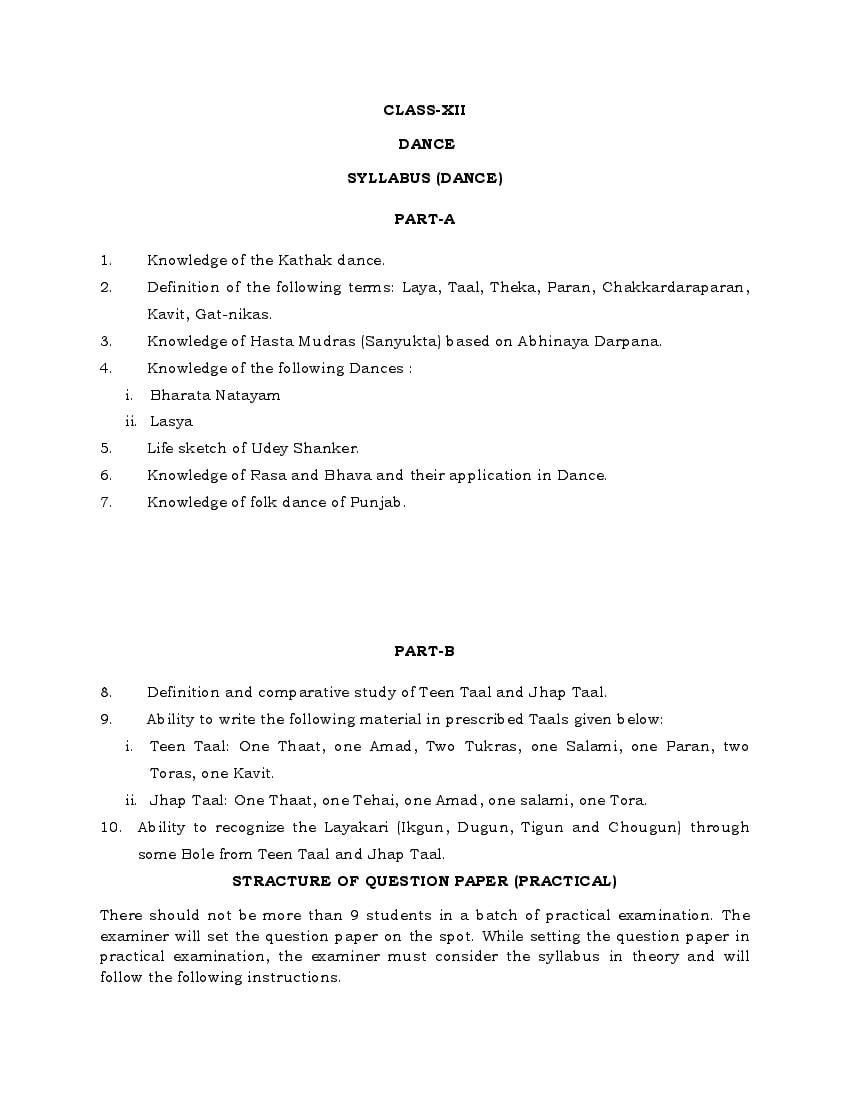
DANCE
SYLLABUS (DANCE)
PART-A
1. Knowledge of the Kathak dance.
2. Definition of the following terms: Laya, Taal, Theka, Paran, Chakkardaraparan,
Kavit, Gat-nikas.
3. Knowledge of Hasta Mudras (Sanyukta) based on Abhinaya Darpana.
4. Knowledge of the following Dances :
i. Bharata Natayam
ii. Lasya
5. Life sketch of Udey Shanker.
6. Knowledge of Rasa and Bhava and their application in Dance.
7. Knowledge of folk dance of Punjab.
PART-B
8. Definition and comparative study of Teen Taal and Jhap Taal.
9. Ability to write the following material in prescribed Taals given below:
i. Teen Taal: One Thaat, one Amad, Two Tukras, one Salami, one Paran, two
Toras, one Kavit.
ii. Jhap Taal: One Thaat, one Tehai, one Amad, one salami, one Tora.
10. Ability to recognize the Layakari (Ikgun, Dugun, Tigun and Chougun) through
some Bole from Teen Taal and Jhap Taal.
STRACTURE OF QUESTION PAPER (PRACTICAL)
There should not be more than 9 students in a batch of practical examination. The
examiner will set the question paper on the spot. While setting the question paper in
practical examination, the examiner must consider the syllabus in theory and will
follow the following instructions.
Page 2
per the choice of student. It will be for 6 minutes .
2. A systematic dance performance in any Taal out of the prescribed syllabusas
per the choice of the examiner. It will be for 4 minutes .
3. Demonstration/performance of any Taal in Ikgun, Dugun layakaries. It will be
for 4 minutes .
4. Student will be given some Bols out of the prescribed Taals.m He/She will have
to recognize two out of these. It will be for 2 minutes .
5. Padhant of prescribed Taal and layarkries on hand. It will be for 4 minutes .
SYLLABUS (PRACTICAL)
Systematic performance of the following Taals:
I. (a).Teen Taal:
(i) Four varaties of advance Tatkar, in Ikgun and Dugun layakaries.
(ii) One Thaat
(iii) One Amad
(iv) two simple Tukras
(v) One Salami
(vi) One Paran
(vii) One Kavit.
(b) Jhap Taal:-
(i) One Thaat
(ii) one Tehai
(iii) one Amad
(iv) one Salami
(v) one Tora.
II. Padhant of Thekas of Teen Taal and Jhap Taal in Ikgun, Dugun and
Chougun layakaries by hand.
III. Padhant of all material in Teen Taal by hand.
Page 3
MUSIC (INSTRUMENTAL)
SYLLABUS (THEORY)
PART-A
1. History of Modren Period of Hindustani Music.
2. Detailed knowledge of the following instruments:-Sitar,Tabla.
3. Time Theory of Ragas.
4. Definition of the following music terms:-
Varna, kan, meend, mizrab, jhalla, chikari, gamak, soot, krintan, zamjama, Shudh,
chyalag, sankeeran raags.
5. Vadak ke Gun our Dosh.
6. Definition and Principles of Thaats. Ten Thaats of Pandit Bhatkhande.
Comparision between raags and thats rules.
7. (a) Importance of taal in music
(b) Music and other Fine-Arts
8. Contribution towards music by the following schotars:-
(a) Ustad Allaudin Khan
(b) Sh. Nikhil Banerjee
(c) Pandit Harwinder Kumar Sharma
(d) Ustad Vilayat Khan
9. Development of vadan styles in Indian Music.
10. Instruments used in solo performance in Indian Music.
Sitar, Sarood, Sarangi, Dilruba, Shanai, Flute, Jattarang, Harmonimum,Tabla,
Dhol
PART-B
1. 10 Alankaars.
2. To write the notation of Razakhani Gats in Bhairav, Malkauns, Bhimplasi
and Khamaj Raags.
3. One slow Gat in prescribed Raags.
4. One composition in Ek Taal or Jhap Taal in prescribed Raags.
5. One Dhun in any Raag.
Page 4
Taal with Ekgun and Dugan layakaries.
7. Knowledge of the structure of your Instrument.
STRUCTURE OF QUESTION PAPER (PRACTICAL)
There should not be more than 9 students in a batch of practical examination.
Harmonium is allowed as accompaniment in music (Vocal). The examiner will set the
question paper on the spot. While setting the question paper in practical, the examiner
must consider the syllabus in theory and will follow the following instructions.
1. Demonstration/performance of any one Raag out of the prescribed syllabus. The
students can exercise the choice of Raags. It will be for 4 minutes .
2. Demonstration/performance of one Raag from prescribed syllabus. The choice will
be of examiner. It will be for 4 minutes .
3. Demonstration/performance of prescribed Taals in Ikgun and Dugun Layakaries
by hand. It will be for 4 minutes .
4. Recognition of one Taal and one Raag out of the prescribed syllabus. It will be for 4
minutes.
5. Demonstration/performance regarding Tarana/Tappa/ Lok geet/Patriotic song. It
will also be for 4 minutes .
Page 5
1. One Drut Gat with short Alaap, Toras and Jhalla in each of the following
Raags.
i. Bhairav
ii. Malkauns
iii. Bhimplasi
iv. khamaaj
2. One slow Gat with short Alaap and Toras in any of the prescribed Raags in
the syllabus.
3. Ability to demonstrate Ek taal, Tilwara Taal, Dhamaar taal, Sultal and jhap
taal by hand with reciting bols in Ikgun and Dugun layakari.
4. Ability to play one gat in Ek Taal or Jhap Taal.
5. Ten Alankars.
6. One Dhun in any Raag.
Note:- The book Published and Prescribed by the Punjab School Education
Board:-
Sangeet Vadan-12 (Instrumental)
Page 6
MUSIC (TABLA)
SYLLABUS (THEORY)
PART-A
1. Defination of the following :- Uthan, Peshkar, Paran, Tehai, Duppali, Tippali, Rela,
Nagma.
2. Principles of formation of Taal.
3. Essay on importance of Laya and Taal in music and importance of Tabla in music. .
4. Comparative study of Tabla and Pakhawaj Vadan.
5. Taal and its ten Parans.
6. Brief introduction of Gharanas of Tabla.
7. Priciples of Tabla solo Vadan.
8. Biographical sketches of the following Tabla maestro :
a. Pt. Kanthe Maharaz
b. Pt. Shamta Prasad
c. Ustad Zakir Hussian
d. Ustad Laxaman Singh Seen.
PART-B
1. Introduction and notation of the following Taals with Ikgun, Dugun, Tigun and
Chougun Layakaries :(i) Rupak Taal (ii) Jhap Taal (iii) Ek Taal (iv) Deepchandi (v)
Teen Taal (vi) Punjabi Theka ( Chhota Teen Taal)
2. Description and comparison of the following Taals :
a. Teen Taal- Punjabi Theka
b. Deepchandi- Dhamar Taal
Page 7
3. Notation of the following material in Teen Taal, Jhap Taal, Rupak Taal: Peskhar,
Kayada, Tehai, Paran, Rela and Tukra.
4. Recognition of Teen Taal, Deepchandi, Punjabi Theka, Dhamar, Rupak, Tivra Taals
through some Bols.
5. Notation of Nagama in prescribed Taals.
STRUCTURE OF QUESTION PAPER (PRACTICAL)
There should not be more than 9 students in a batch of practical examination. Harmonium
is allowed as accompaniment in music (Vocal). The examiner will set the question paper on the
spot. While setting the question paper in practical, the examiner must consider the syllabus in
theory and will follow the following instructions.
1. Demonstration/performance of any one Raag out of the prescribed syllabus. The students can
exercise the choice of Raags. It will be for 4 minutes .
2. Demonstration/performance of one Raag from prescribed syllabus. The choice will be of
examiner. It will be for 4 minutes .
3. Demonstration/performance of prescribed Taals in Ikgun and Dugun Layakaries by hand. It
will be for 4 minutes .
4. Recognition of one Taal and one Raag out of the prescribed syllabus. It will be for 4 minutes .
5. Demonstration/performance Play Nagma on Harmonium in any taal in precibed syllabus. It
will be 4 minutes .
SYLLABUS (PRACTICAL)
1. System solo performance of the following Taals: Ek Taal and Teen Taal, Teewra Taal,
Rupak Taal.
Page 8
3. To play Thekas in Ikgun and Dugun Layakaries in Deepchandi, Teen Taal and Chhota
Teen Taal, Rupak, Jhap Taal and Ek Taal.
4. Recognition of Taals.
5. Tuning of Tabla.
6. Ability to play Nagama on Harmonium in any Taal of your syllabus.
7. Ability to Padhant showing Tali and Khali of Taals in Ikgun and Dugun Layakaries.
Page 9
MUSIC (VOCAL)
SECTION-A
1. Brief history of modern period of Hindustani music.
2. Detailed knowledge of Tabla and Harmonium.
3. Time theory of Ragas.
4. Define and explain the, following terms:
Varna, Kan, Khatka, Murki,Gamak, Gayak, Gayaki, shudh Rag, Chhayalg Rag,
Sankiran Rag, Lakshan geet.
5. Gayak ke gun aur dosh.
6. Definition of that. Its Characterstics, Ten that of Bhat Khande. Comparision
between Raag and Thal Rules.
7. Essay:-(1) Importance of Tal in Music
(2) Place of Fine Arts in Music.
1. Cantribution towards music by the following scholars:-
(1) Bade Gulam Ali Khan.
(2) Bhim Sain Joshi.
(3) Prof: Baldev sharan Narang
(4) Faiyaz Khan
2. Shastri gayan shailies:-
Dharupad, Dhamar, Tarana, Dhumri, Khayal, Tappa.
3. Cantribultion of famous folk singers of Punjab in Folks music.
i. Assa Singh Mastana
ii. Surinder Kaur
iii. Narinder Biba
iv. Kuldeep Manak
v. Lal Chand Yamala Jat
vi. Didar Sandhu
vii. Parkash Kaur
Page 10
1. 10 Alankaras
2. To write the notations of Drut Khyals in prescribed.
Raags: Bhairav Bhimplasi, Malkauns, Khamaj.
3. Notation of Rupak tal, EK taal, jhaptal, Sul Taal, Tilwara tal, Dhamar tal.
4. Recognition of Raags from given Swar Sangaties.
5. Description of prescribed Raags.
STRUCTURE OF QUESTION PAPER (PRACTICAL)
There should not be more than 9 students in a batch of practical examination.
Harmonium is allowed as accompaniment in music (Vocal). The examiner will set the
question paper on the spot. While setting the question paper in practical, the examiner
must consider the syllabus in theory and will follow the following instructions.
1. Demonstration/performance of any one Raag out of the prescribed syllabus. The
students can exercise the choice of Raags. It will be for 4 minutes
Demonstration/performance of one Raag from prescribed syllabus. The choice will
be of examiner. It will be for 4 minutes .
2. Demonstration/performance of prescribed Taals in Ikgun and Dugun Layakaries
by hand. It will be for 4 minutes .
3. Recognition of one Taal and one Raag out of the prescribed syllabus. It will be for 4
minutes .
4. Demonstration/performance regarding Tarana/Tappa/ Lok geet/Patriotic song. It
will also be for 4 minutes .
SYLLABUS (PRACTICAL)
1. One Drut Khayal with Alaap- Taan the following Raags:
Bhairav, Bhimplasi, Malkauns, Khamaj.
2. One slow Khyal with short Alaaps and Taans in any of the prescribed Raags.
3. One Tarana only Sathai and Antra in any of the prescribed Raags.
4. Ability to demonstrate Rupak tal, jhaptal, Sul tal, Tilwara tal, dhamar tal with
reciting bols by hands in Ikgun and Dugun layakari.
Page 11
6. Ability to recognise the prescribed Raag from the passages of swaras.
7. Knowledge of the structure of Harmonum and Tabla.
8. 10 Alankaras.
Note:- The book Published and Prescribed by the Punjab School Education
Board:-
Sangeet Gayan-12
Document Details
| Board / Org | Punjab Board |
| Exam | Class 12 |
| Type | Syllabus |
| Pages | 11 |
| Updated | 09 Jun 2026 |