PSEB 12th Class Syllabus 2023 NCC
Finished viewing? Save it for later —
Download PSEB 12th Class Syllabus 2023 NCC (PDF · 4 pages)About PSEB 12th Class Syllabus 2023 NCC
PSEB 12th Class Syllabus 2023 NCC is available here for free download. Published by Punjab Board for Class 12, this syllabus can be viewed online or downloaded as a PDF (4 pages). Candidates preparing for Class 12 can use PSEB 12th Class Syllabus 2023 NCC to understand the exam pattern, the type of questions asked, and the overall difficulty level.
Frequently Asked Questions
How can I download PSEB 12th Class Syllabus 2023 NCC?
Open this page and click the Download button to save PSEB 12th Class Syllabus 2023 NCC as a PDF. It is completely free on AglaSem Docs.
Is PSEB 12th Class Syllabus 2023 NCC free to download?
Yes. PSEB 12th Class Syllabus 2023 NCC can be viewed online and downloaded as a PDF free of cost on AglaSem Docs.
How many pages does PSEB 12th Class Syllabus 2023 NCC have?
PSEB 12th Class Syllabus 2023 NCC contains 4 pages, which you can read online or download together as a single PDF.
Where can I find more Class 12 study material?
You can find more Class 12 question papers, sample papers, syllabus, and answer keys on AglaSem Docs.
PSEB 12th Class Syllabus 2023 NCC – Text
Read the full text of this syllabus below — useful to quickly search, copy and reference the content online without downloading the PDF.
📄 View text version (4 pages)
Page 1
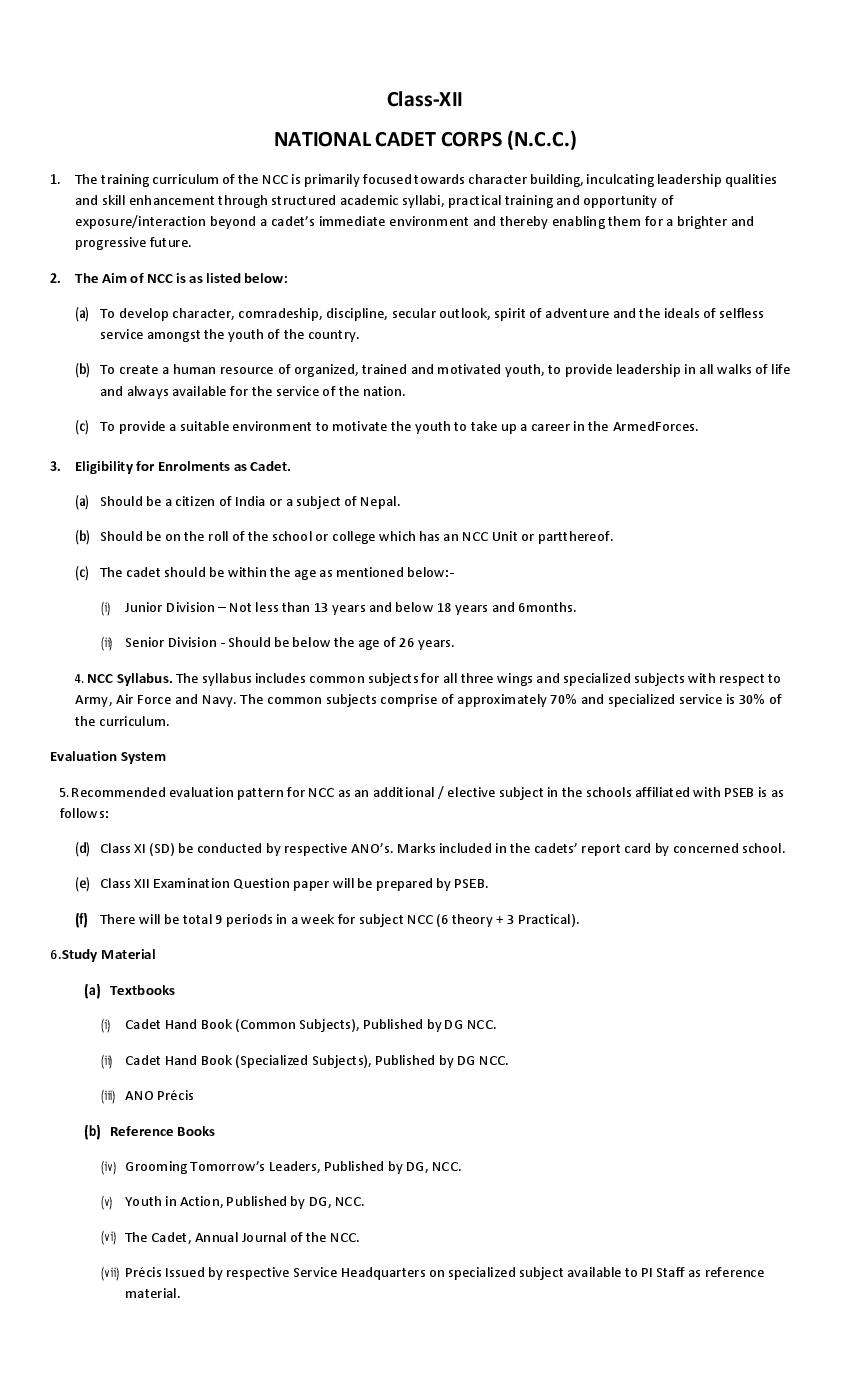
NATIONAL CADET CORPS (N.C.C.)
1. The training curriculum of the NCC is primarily focused towards character building, inculcating leadership qualities
and skill enhancement through structured academic syllabi, practical training and opportunity of
exposure/interaction beyond a cadet’s immediate environment and thereby enabling them for a brighter and
progressive future.
2. The Aim of NCC is as listed below:
(a) To develop character, comradeship, discipline, secular outlook, spirit of adventure and the ideals of selfless
service amongst the youth of the country.
(b) To create a human resource of organized, trained and motivated youth, to provide leadership in all walks of life
and always available for the service of the nation.
(c) To provide a suitable environment to motivate the youth to take up a career in the ArmedForces.
3. Eligibility for Enrolments as Cadet.
(a) Should be a citizen of India or a subject of Nepal.
(b) Should be on the roll of the school or college which has an NCC Unit or partthereof.
(c) The cadet should be within the age as mentioned below:-
(i) Junior Division – Not less than 13 years and below 18 years and 6months.
(ii) Senior Division - Should be below the age of 26 years.
4. NCC Syllabus. The syllabus includes common subjects for all three wings and specialized subjects with respect to
Army, Air Force and Navy. The common subjects comprise of approximately 70% and specialized service is 30% of
the curriculum.
Evaluation System
5. Recommended evaluation pattern for NCC as an additional / elective subject in the schools affiliated with PSEB is as
follows:
(d) Class XI (SD) be conducted by respective ANO’s. Marks included in the cadets’ report card by concerned school.
(e) Class XII Examination Question paper will be prepared by PSEB.
(f) There will be total 9 periods in a week for subject NCC (6 theory + 3 Practical).
6.Study Material
(a) Textbooks
(i) Cadet Hand Book (Common Subjects), Published by DG NCC.
(ii) Cadet Hand Book (Specialized Subjects), Published by DG NCC.
(iii) ANO Précis
(b) Reference Books
(iv) Grooming Tomorrow’s Leaders, Published by DG, NCC.
(v) Youth in Action, Published by DG, NCC.
(vi) The Cadet, Annual Journal of the NCC.
(vii) Précis Issued by respective Service Headquarters on specialized subject available to PI Staff as reference
material.
Page 2
S.No. Unit Contents
1 Duties of NCC cadets, NCC Song
The NCC
2 NCC camps- types and Conduct
3 National Integration and Unity in Diversity and role of NCC in nation building
4 Awareness Threats to national security, Freedom struggle and nationalist movement in India
5 Rifle ke saath savdhan,vishram aur araam se
6 Rifle ke saath parade par aur saj
7 Rifle ke saath visarjan, line tod
8 Bhoomi shastra aur uthayo shastra
9 Drill Bagal shastra aur baaju shastra
10 Salaami shastra
11 Squad drill
12 Guard mounting
13 Guard of honour
14 Range procedure and theory of group
Weapon Training Short range firing (7.62 SLR)- Loading, cocking and unloading, Positions of holding
15
and aiming, Group and snap shooting
Group Discussion - Stress and emotions, change your mind set, interpersonal
16
relations and team work, Time management , civic sense
17 Carrier counseling, SSB procedure and interview skills
Personality Development
18 Public speaking
and Leadership
Case Studies - Mahatma Gandhi, Shivaji, APJ Abdul Kalaam, Deepa Malik, Maharana
19 Pratap, Ratan Tata, Jhansi ki Rani, Narayan Murti, Prakash Padukone, Tipu Sultan,
Rabindra Nath Tagore
20 Fire Service and fire fighting, Civil defence and NDMA
Disaster Management and
Initiative training, organising skills, do's and don'ts, natural disasters, man made
21 Civil Affairs
disasters
22 Road/Rail travel safety
23 Social Awareness and Cyber and mobile safety awareness
24 Community Development Civic responsibilities
25 Causes and preventions of HIV/AIDS
First aid in common medical emergencies , treatment and care of wounds,
26 Infectious and contagious diseases and its prevention
Health and Hygiene
27 Introduction to yoga and excercises
Adventure and Obstacle Obstacle training
28
Training
Environment Awareness Water conservation and rain water harvesting
29
and Conservation
Page 3
Sr. Unit Content
No.
1. Armed Forces Armed Forces, Army, CAPF, Police
*Basic organization of Armed Forces
2. Map Reading (MR) Conduct to MR
3. *Google & Tourist Maps and Apps
* Prismatic compass and its use and GPS
4. Field Craft and Introduction to Field Craft
5. Battle Craft (FC &BC) Indication of Landmark
6. Observation, camouflage &
Concealment
7. Introduction to Organisatyion of Infantry Battalion & its Weapons
Infantry Weapons& * Characteristics of 7.62mm SLR Rifle, ammunition, fire power, Stripping ,assembling
Equipments and cleaning.
(INF)
8. Military History Biographies of Renowned Generals
9. (MH) Study of Battles - Indo Pak war 1965, 1971, & Kargil
10. Communication (C) Basic Communication Procedure
*Types of Communication
* Characteristics of Wireless technology (mobile, Wi-Fi etc.)
Specialized Subject:Air Force
S. Unit Contents
No.
1 Aircraft recognition
General Service
2 Latest trends and acquisitions
Knowledge
3 1971 War, operation safed sagar, operation meghdoot
4 Principles of Flight Forces acting on aircraft
5 Airmanship Aviation medicine
6 Aircraft control
Aero Engines
7 Parts of aircraft
8 Air frames Landing gear
9 Instruments Introduction to RADARs
10 Aircraft Particulars Aircraft particular type specific
11 Aero Modeling Building and flying of aero models
12 Effects of flight control
Flying
13 Effects of weather
Specialized Subject:Navy
S. Unit Contents
No.
1 Naval Orientation and Naval expeditions and campaigns
2 Service Subjects Rank profiles of officers and sailors and their equivalents in other services
3 Semaphore
Naval Communication
4 Wearing of flags
5 Seamanship Navigation tactics and methods
6 Bends and hitches
Rigging
7 Introduction to shackles
8 Instructions on boat pulling
Page 4
10 Whaler sailing instructions
Ship and Boat
11 Maintenance and care of tools
Modeling
12 Search and Rescue SAR organization in the Indian Ocean
13 Swimming Floating and free style swimming
Document Details
| Board / Org | Punjab Board |
| Exam | Class 12 |
| Type | Syllabus |
| Pages | 4 |
| Updated | 09 Jun 2026 |