GTET 2025 Syllabus
Finished viewing? Save it for later —
Download GTET 2025 Syllabus (PDF · 9 pages)About GTET 2025 Syllabus
GTET 2025 Syllabus is available here for free download. Published by Goa Board for Goa Teacher Eligibility Test, this syllabus can be viewed online or downloaded as a PDF (9 pages). Candidates preparing for Goa Teacher Eligibility Test can use GTET 2025 Syllabus to understand the exam pattern, the type of questions asked, and the overall difficulty level.
Frequently Asked Questions
How can I download GTET 2025 Syllabus?
Open this page and click the Download button to save GTET 2025 Syllabus as a PDF. It is completely free on AglaSem Docs.
Is GTET 2025 Syllabus free to download?
Yes. GTET 2025 Syllabus can be viewed online and downloaded as a PDF free of cost on AglaSem Docs.
How many pages does GTET 2025 Syllabus have?
GTET 2025 Syllabus contains 9 pages, which you can read online or download together as a single PDF.
Where can I find more Goa Teacher Eligibility Test study material?
You can find more Goa Teacher Eligibility Test question papers, sample papers, syllabus, and answer keys on AglaSem Docs.
GTET 2025 Syllabus – Text
Read the full text of this syllabus below — useful to quickly search, copy and reference the content online without downloading the PDF.
📄 View text version (9 pages)
Page 1
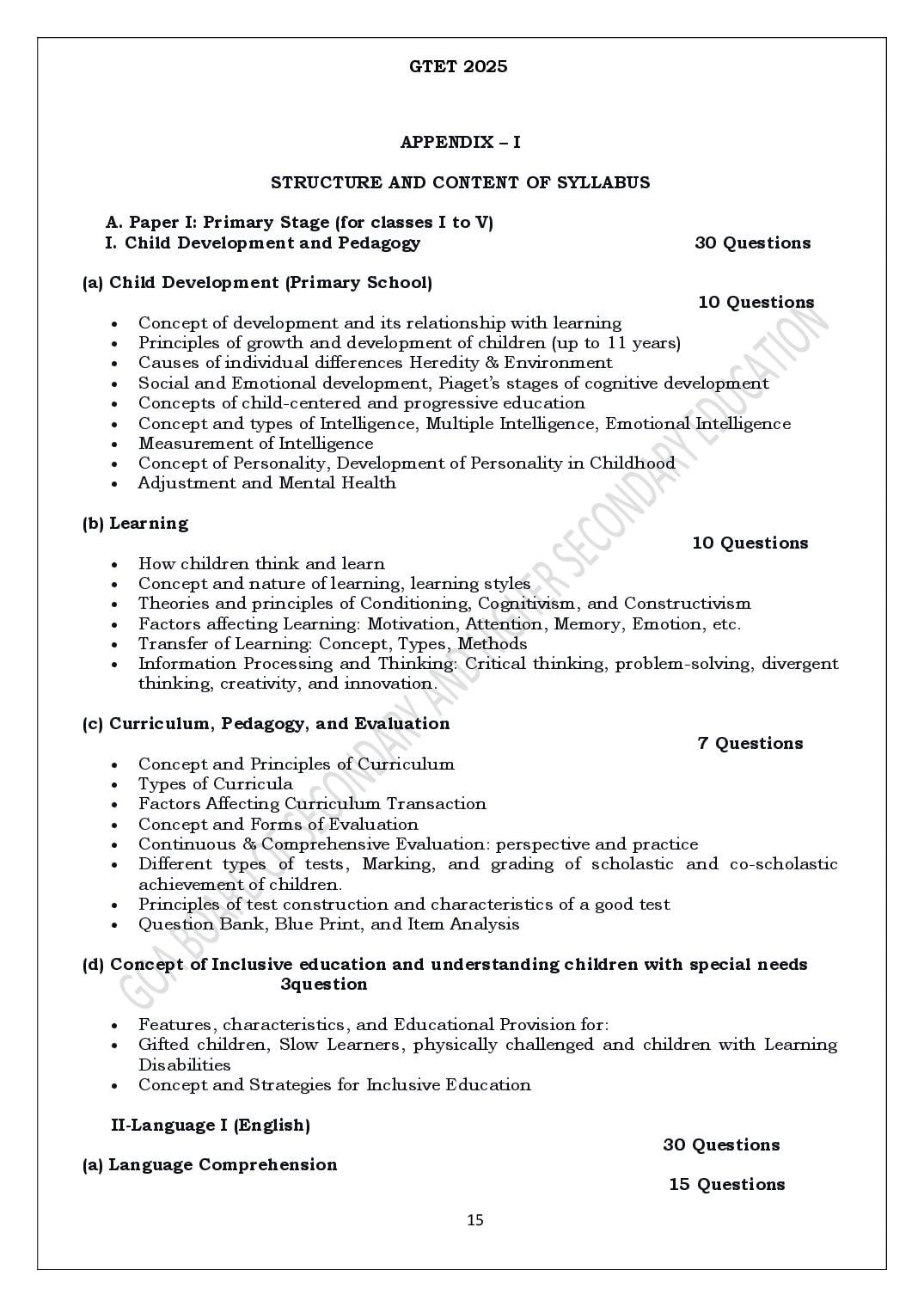
STRUCTURE AND CONTENT OF SYLLABUS
A. Paper I: Primary Stage (for classes I to V)
I. Child Development and Pedagogy 30 Questions
(a) Child Development (Primary School)
10 Questions
• Concept of development and its relationship with learning
• Principles of growth and development of children (up to 11 years)
• Causes of individual differences Heredity & Environment
• Social and Emotional development, Piaget’s stages of cognitive development
• Concepts of child-centered and progressive education
• Concept and types of Intelligence, Multiple Intelligence, Emotional Intelligence
• Measurement of Intelligence
• Concept of Personality, Development of Personality in Childhood
• Adjustment and Mental Health
(b) Learning
10 Questions
• How children think and learn
• Concept and nature of learning, learning styles
• Theories and principles of Conditioning, Cognitivism, and Constructivism
• Factors affecting Learning: Motivation, Attention, Memory, Emotion, etc.
• Transfer of Learning: Concept, Types, Methods
• Information Processing and Thinking: Critical thinking, problem-solving, divergent
thinking, creativity, and innovation.
(c) Curriculum, Pedagogy, and Evaluation
7 Questions
• Concept and Principles of Curriculum
• Types of Curricula
• Factors Affecting Curriculum Transaction
• Concept and Forms of Evaluation
• Continuous & Comprehensive Evaluation: perspective and practice
• Different types of tests, Marking, and grading of scholastic and co-scholastic
achievement of children.
• Principles of test construction and characteristics of a good test
• Question Bank, Blue Print, and Item Analysis
(d) Concept of Inclusive education and understanding children with special needs
3question
• Features, characteristics, and Educational Provision for:
• Gifted children, Slow Learners, physically challenged and children with Learning
Disabilities
• Concept and Strategies for Inclusive Education
II-Language I (English)
30 Questions
(a) Language Comprehension
15
Page 2
questions on comprehension, inference, grammar, and verbal ability (Prose
passage may be literary, scientific, narrative, or discursive)
(b) Pedagogy of Language Development
• Principles aims, and objectives of English language teaching
• Approaches, Methods, and techniques of teaching English
• Learning and acquisition of English language skills: Pronunciations, Stress, and
Modulation
• Role of listening and speaking: function of language and how children use it as
a tool
• Communicative and writing skills in English
• Role of grammar in learning the English language for communicating ideas
verbally and in written form
• Challenges of teaching the English language: Prose, Poetry, Composition, Letter
Writing, creative writing, etc.
• Evaluating English language comprehension and proficiency: speaking,
listening, reading, and writing
• Teaching–learning materials: Textbook, multi-media materials, multilingual
resources of the classroom
• Diagnostics Test and Remedial Teaching
III. Language – II Marathi/Konkani 30 Questions
(a) Comprehension
• Reading unseen passages – two passages, a prose/ drama and a poem with
questions on comprehension, inference, grammar, and ve4rbal ability (Prose
passage may be literary, scientific, narrative, or discursive
(b) Pedagogy of Language Development
• Principles, aims, and objectives of language teaching
• Approaches, Methods, and Techniques of Teaching Language
• Learning and acquisition of language skills: Pronunciations, Stress, and
Modulation
• Role of listening and speaking: function of language and how children use it as
a tool
• Communicative and the Writing skills
• Role of grammar in learning a language for communicating ideas verbally and
in written form
• Challenges of teaching language: Prose, Poetry, Composition, letter writing,
creative writing, etc.
• Evaluating language comprehension and proficiency: speaking, listening,
reading, and writing
• Teaching–learning materials: Textbook, multi-media materials, multilingual
resources of the classroom
• Diagnostic Test and Remedial Teaching
IV. Mathematics
30 Questions
16
Page 3
• Geometry
• Shapes & Spatial Understanding
• Solids around Us
• Numbers
• Addition and Subtraction
• Multiplication
• Division
• Measurement
• Weight
• Time
• Volume
• Data Handling
• Patterns
• Money
(b) Pedagogical issues
• Aims and objectives of teaching Mathematics
• Place of Mathematics in School Curriculum
• Methods of teaching Mathematics: inductive, deductive, analytic, synthetic, heuristic
• Approaches and techniques involved in the teaching of Mathematics
• Competency-based mode of instruction in Mathematics (class-I-IV)
• Concept Attainment Model of instructions in Mathematics
• Challenges of Teaching Mathematics
• Teaching–learning materials: Textbook, Mathematical Kit, Models, other aids
• Evaluation through formal and informal methods
• Error analysis and related aspects of learning and teaching
• Diagnostic Test and Remedial Teaching
V. Environmental Studies
30 Questions
(a) Content
• Family and Friends:
• Relationships
• Work and Play
17
Page 4
• Plants
• Food Shelter
• Water
• Travel
• Things We Make and Do
(b) Pedagogical Issues
• Meaning, scope, and purpose of EVS
• Significance of EVS as an integrated area of study at the primary level
• Environmental Studies concerning Science & Social Studies
• Methods of teaching EVS: Observation Method, Project Method, Role Play,
• Storytelling, Environmental Games, Exhibition, etc.
• Approaches to teaching EVS: Activity-based, Exploration, Discovery,
• Experimentation/ Practical Work, Reporting
• Teaching–learning materials: Textbook, computer-aided Learning, Models, other
locally relevant resources, etc.
• Evaluation of learning objectives of EVS: Achievement test, Environmental
• Awareness test, assessment of attitude towards Environment, Interest, etc.
• Diagnostic Test and Remedial Teaching in EVS
18
Page 5
1. Child Development and Pedagogy 30 Questions
(a) Child Development (Elementary School) 10 Questions
• Meaning and Nature and Scope of Educational Psychology
• Concept and Principles of Growth and Development and its relationship with
learning
• Characteristics of growth and development of children (Physical, Emotional,
Social)
• Causes of Individual differences: Heredity & Environment,
• Social and Emotional Development, Paget’s stages of cognitive development
• Concepts of child-centered and progressive education
• Concept and types of Intelligence, Multiple Intelligence, Emotional Intelligence
• Measurement of Intelligence
• Concept of Personality, Development of Personality in Childhood
• Adjustment and Mental Health at home and school
• Self-concept, attitude, interest, values
•
(b) Learning 10 Questions
• How children think and learn
• Concept and nature of Learning, Learning styles
• Laws of Learning
• Theories and principles of Conditioning, Cognitivism, and Constructivism
• Factors Affecting Learning: Concept, Types, Methods
•
(c) Curriculum, Pedagogy, and Evaluation 7 Questions
• Concept and Principles of Curriculum
• Bases of Curriculum Development: Models of Curriculum Development
• Types of Curriculum Development
• Factors Affecting Curriculum Transaction
• Concept and Forms of Evaluation
• Continuous & Comprehensive Evaluation: perspective and practice
• Different types of tests: Marking, grading of scholastic and co-scholastic
• Achievement of children.
• Principles of test construction and characteristics of a good test
• Question Bank, Blue Print, and Item Analysis
(d) Concept of Inclusive education and understanding children's special
needs 3 Questions
• Features, Characteristics, and Educational Provision for:
• Gifted children, Slow Learners, physically challenged and children with Learning
Disabilities
• Concept and Strategies for Inclusive Education
19
Page 6
(a) Language Comprehension 15 Questions
• Reading unseen passage – two passages, one prose/drama and a poem with
questions on comprehension, inference, grammar, and verbal ability (Prose
passage may be literary, scientific, narrative, or discursive)
(b) Pedagogy of Language Development
• Principles aims, and objectives of English language teaching
• Approaches, Methods, and techniques of teaching English
• Learning and acquisition of English language skills: Pronunciations, Stress, and
Modulation
• Role of listening and speaking: function language and how children use it as a
tool
• Communicative and writing skills in English
• Role of grammar in learning the English language for communicating ideas
verbally and in written form
• Challenges of teaching the English language; Prose, Poetry, composition, letter
writing, creative writing, etc.
• Evaluating English language comprehension and proficiency: speaking,
listening, reading, and writing
• Teaching–learning materials: Textbook, multi-media materials, multilingual
resources of the classroom
• Diagnostic Test and Remedial Teaching
III. Language – II: Marathi/Konkani 30Questions
a) Comprehension 15 Questions
• Reading unseen passage – two passages of prose or drama and a poem with
questions on comprehension, inference, grammar, and verbal ability (Prose
passage may be literary, scientific, narrative, or discursive)
b) Pedagogy of Language Development 15 Questions
• Principles, aims, and objectives of language teaching
• Approaches, Methods, and techniques of teaching language
• Learning and acquisition of language skills: Pronunciations, Stress, and
Modulation
• Role of listening and speaking: function of language and how children use it as
a tool
• Communicative and writing skills
• Role of grammar in learning a language: Prose, Poetry, composition, letter
writing, creative writing, etc.
• Evaluating language comprehension and proficiency: speaking, listening,
reading, and writing
• Teaching–learning materials: Textbook, multi-media materials, multilingual
resources of the classroom
• Diagnostic Test and Remedial Teaching
20
Page 7
I Mathematics
30 Questions
(a) Content
20 Questions
Number System
• Knowing our Numbers
• Playing with Numbers
• Whole Numbers
• Negative Numbers and Integers
• Fractions
Algebra
• Introduction to Algebra
• Ratio and Proportion
Geometry
• Basic geometrical ideas (2-D)
• Understanding Elementary Shapes (2-D and 3-D)
• Symmetry: (reflection)
• Construction (Using Straight edge Scale, protractor, compasses)
Menstruation
Data handling
(b) Pedagogical issues 10 Questions
• Aims and objectives of teaching Mathematics
• Place of Mathematics in School Curriculum
• Methods of teaching Mathematics: inductive, deductive, analytic,
synthetic, heuristic
• Approaches and techniques involved in the teaching of Mathematics
• Competency-based teaching in Mathematics (class-I-IV)
• Concept Attainment Model of Teaching in Mathematics
• Challenges of Teaching Mathematics
• Teaching–learning materials: Textbook, Mathematical Kit, models, other aids
• Evaluation through formal and informal methods
• Error analysis and related aspects of learning and teaching
• Diagnostic Test and Remedial Teaching
II Science
30 Questions
(a) Content
20 Questions
Food
• Sources of food
• Components of food
21
Page 8
Material
Materials of daily use
The World of the Living
Moving Things People and Ideas
How things work
• Electric Current and Circuits
• Magnets
Natural Phenomena
Natural Resources
(b) Pedagogical issues
10 Questions
• Nature aims, and objectives of teaching Sciences
• Correlation of Science with other subjects in the curriculum
• Methods and Teaching Strategies of Science: Lecture, Demonstration.
• Heuristic, Inductive-deductive, Project, etc.
• Observation/Experiment/Discovery (Methods of Science)
• Teaching Resources: Textbooks, charts, models, specimens, use of mass
media, use of ICT
• Science Laboratory, Science Club, Science Exhibition
• Scientific Attitude
• Diagnostic Test and Remedial Teaching
V. Social Studies/ Social Science 60 Questions
(a) Content 40 Questions
History
20 Questions
• When, Where, and How
• The Earliest Societies
• The First Cities
• Early States
• New Ideas
• The First Empire
• Contacts with Distant lands
• Political Developments
• Culture and Science
• New Kings and Kingdom
• Sultans of Delhi
• Architecture
• Creation of an Empire Social Change
• Regional Cultures
• The Establishment of Company Power
• Rural Life and Society
• Colonialism and Tribal Societies
• The Revolt of 1857-58
• Women and reform
• Challenging the Caste System
• The Nationalist Movement
• India After Independence
22
Page 9
10 Questions
• Geography as a social study and as a science
• Planet: Earth in the Solar system
• Globe
• Environment in its totality: natural and human environment Air Water
• Human Environment: Settlement, Transport, and Communication
• Resources: Types- Natural and Human
• Agriculture
Social and Political Life
10 Questions
• Diversity
• Government
• Local Government
• Making a Living Democracy
• State Government
• Understanding media
• Unpacking Gender
• The Constitution
• Parliamentary Government
• The Judiciary
• Social Justice and the Marginalized
Pedagogical issues
20 Questions
• Nature, aims, and objectives of teaching Social Studies (History, Geography,
Social and Political Life)
• Correlation of Social Studies with other subjects in the curriculum
• Methods and Teaching Strategies of Social Studies: Lecture, Story Telling,
Dramatization, Discussion, Brain Storming, Field trips, project, methods, etc.
• Observation/Excursion/Regional (Method of social studies)
• Teaching Resources: Textbooks, charts, models, News Paper, Historical Lab,
Geography room, Museum, Exhibition
• Practical Geography
• Infusion of Local History
• Diagnostic Test and Remedial Teaching
23