CBSE Class 12 Political Science Question Paper 2020 Set 59-4-2 Solutions
Finished viewing? Save it for later —
Download CBSE Class 12 Political Science Question Paper 2020 Set 59-4-2 Solutions (PDF · 14 pages)About CBSE Class 12 Political Science Question Paper 2020 Set 59-4-2 Solutions
CBSE Class 12 Political Science Question Paper 2020 Set 59-4-2 Solutions is available here for free download. Published by CBSE for Class 12, this solution can be viewed online or downloaded as a PDF (14 pages). Candidates preparing for Class 12 can use CBSE Class 12 Political Science Question Paper 2020 Set 59-4-2 Solutions to understand the exam pattern, the type of questions asked, and the overall difficulty level.
Frequently Asked Questions
How can I download CBSE Class 12 Political Science Question Paper 2020 Set 59-4-2 Solutions?
Open this page and click the Download button to save CBSE Class 12 Political Science Question Paper 2020 Set 59-4-2 Solutions as a PDF. It is completely free on AglaSem Docs.
Is CBSE Class 12 Political Science Question Paper 2020 Set 59-4-2 Solutions free to download?
Yes. CBSE Class 12 Political Science Question Paper 2020 Set 59-4-2 Solutions can be viewed online and downloaded as a PDF free of cost on AglaSem Docs.
How many pages does CBSE Class 12 Political Science Question Paper 2020 Set 59-4-2 Solutions have?
CBSE Class 12 Political Science Question Paper 2020 Set 59-4-2 Solutions contains 14 pages, which you can read online or download together as a single PDF.
Where can I find more Class 12 study material?
You can find more Class 12 question papers, sample papers, syllabus, and answer keys on AglaSem Docs.
CBSE Class 12 Political Science Question Paper 2020 Set 59-4-2 Solutions – Text
Read the full text of this solution below — useful to quickly search, copy and reference the content online without downloading the PDF.
📄 View text version (14 pages)
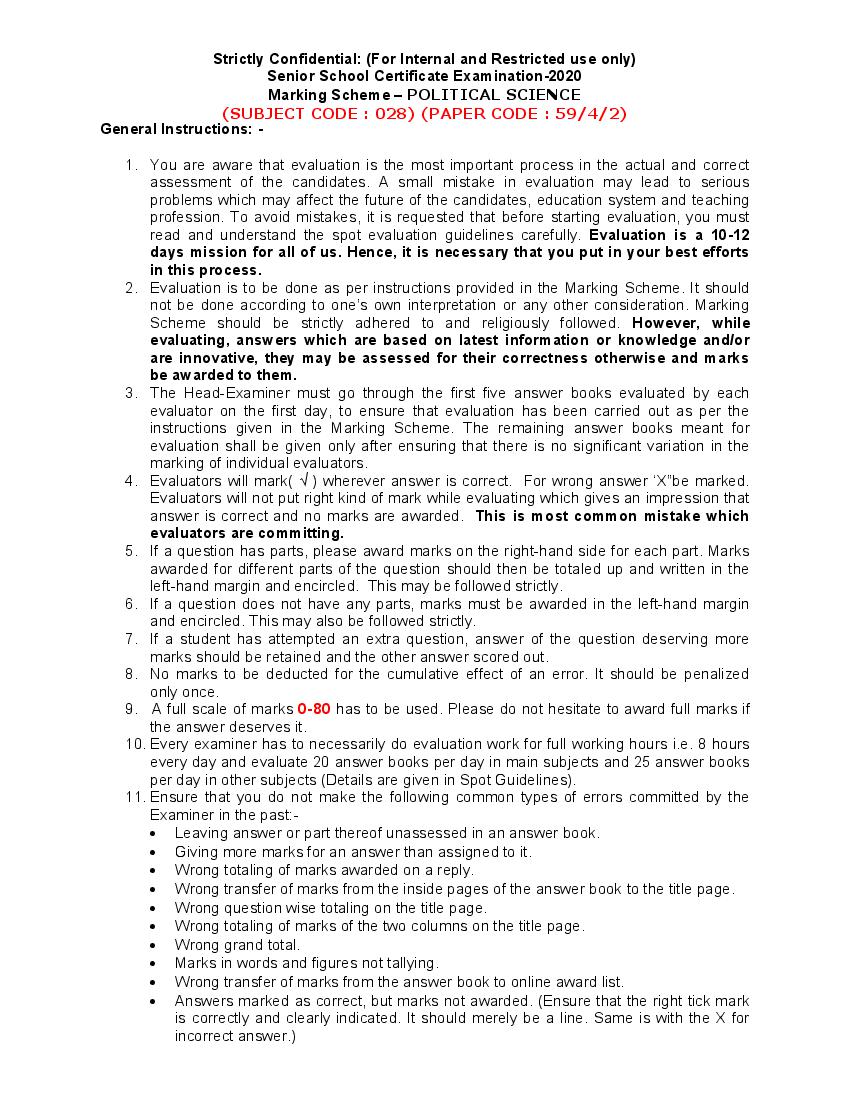
Page 1
Senior School Certificate Examination-2020
Marking Scheme – POLITICAL SCIENCE
(SUBJECT CODE : 028) (PAPER CODE : 59/4/2)
General Instructions: -
1. You are aware that evaluation is the most important process in the actual and correct
assessment of the candidates. A small mistake in evaluation may lead to serious
problems which may affect the future of the candidates, education system and teaching
profession. To avoid mistakes, it is requested that before starting evaluation, you must
read and understand the spot evaluation guidelines carefully. Evaluation is a 10-12
days mission for all of us. Hence, it is necessary that you put in your best efforts
in this process.
2. Evaluation is to be done as per instructions provided in the Marking Scheme. It should
not be done according to one’s own interpretation or any other consideration. Marking
Scheme should be strictly adhered to and religiously followed. However, while
evaluating, answers which are based on latest information or knowledge and/or
are innovative, they may be assessed for their correctness otherwise and marks
be awarded to them.
3. The Head-Examiner must go through the first five answer books evaluated by each
evaluator on the first day, to ensure that evaluation has been carried out as per the
instructions given in the Marking Scheme. The remaining answer books meant for
evaluation shall be given only after ensuring that there is no significant variation in the
marking of individual evaluators.
4. Evaluators will mark( √ ) wherever answer is correct. For wrong answer ‘X”be marked.
Evaluators will not put right kind of mark while evaluating which gives an impression that
answer is correct and no marks are awarded. This is most common mistake which
evaluators are committing.
5. If a question has parts, please award marks on the right-hand side for each part. Marks
awarded for different parts of the question should then be totaled up and written in the
left-hand margin and encircled. This may be followed strictly.
6. If a question does not have any parts, marks must be awarded in the left-hand margin
and encircled. This may also be followed strictly.
7. If a student has attempted an extra question, answer of the question deserving more
marks should be retained and the other answer scored out.
8. No marks to be deducted for the cumulative effect of an error. It should be penalized
only once.
9. A full scale of marks 0-80 has to be used. Please do not hesitate to award full marks if
the answer deserves it.
10. Every examiner has to necessarily do evaluation work for full working hours i.e. 8 hours
every day and evaluate 20 answer books per day in main subjects and 25 answer books
per day in other subjects (Details are given in Spot Guidelines).
11. Ensure that you do not make the following common types of errors committed by the
Examiner in the past:-
Leaving answer or part thereof unassessed in an answer book.
Giving more marks for an answer than assigned to it.
Wrong totaling of marks awarded on a reply.
Wrong transfer of marks from the inside pages of the answer book to the title page.
Wrong question wise totaling on the title page.
Wrong totaling of marks of the two columns on the title page.
Wrong grand total.
Marks in words and figures not tallying.
Wrong transfer of marks from the answer book to online award list.
Answers marked as correct, but marks not awarded. (Ensure that the right tick mark
is correctly and clearly indicated. It should merely be a line. Same is with the X for
incorrect answer.)
Page 2
awarded.
12. While evaluating the answer books if the answer is found to be totally incorrect, it should
be marked as cross (X) and awarded zero (0)Marks.
13. Any unassessed portion, non-carrying over of marks to the title page, or totaling error
detected by the candidate shall damage the prestige of all the personnel engaged in the
evaluation work as also of the Board. Hence, in order to uphold the prestige of all
concerned, it is again reiterated that the instructions be followed meticulously and
judiciously.
14. The Examiners should acquaint themselves with the guidelines given in the Guidelines
for spot Evaluation before starting the actual evaluation.
15. Every Examiner shall also ensure that all the answers are evaluated, marks carried over
to the title page, correctly totaled and written in figures and words.
16. The Board permits candidates to obtain photocopy of the Answer Book on request in an
RTI application and also separately as a part of the re-evaluation process on payment of
the processing charges.
Page 3
Q1. Explain the meaning of garage sale in the context of 'Shock
Therapy'.
OR
How did the disintegration of collective farm system affect
Russia ?
Ans Due to shock therapy industries were put up for sale to private 1 Pg
individuals and companies. It led to virtual disappearance of entire 25
industries. Industries were sold at throw away prices. It was called
“Garage Sale”.
OR
Disintegration of collective farm system.
(i) It left the people of Russia without food security.
Pg
(ii) Russia started to import food. 78
(Any one)
Q2 Complete the sentence to make it meaningful. Even after the
U.N. refused to give its mandate to the invasion, President
Clinton ordered “Operation ________ __________.”
Ans Operation Infinite Reach 1 Pg 24
Q3. The U.N. was founded as a successor to which international
organization?
Ans The UN was founded as a successor to League of Nations. 1 Pg 84
Q4. Which one of the following was NOT an outcome of Shock
Therapy?
(a) The old system of social welfare got destroyed.
(b) Industries were put up for sale to the private sector.
(c) The value of the Russian currency, the 'Ruble rose
dramatically.
(d) Russia started to import food grains.
Ans. (c)The value of the Russian currency, the ‘Ruble’ rose dramatically 1 Pg 25
Q5. What was the core idea behind Non-alignment?
Ans. Core Idea behind NAM- 1
i. To democratise international system by thinking about an Pg 13
alternative world order to redress existing inequalities.
ii. Idea based on recognition that decolonized States share
historical affiliation and can become a powerful force if they
come together.
Any other relevant point (Any one)
Q6. Fill in the blank with a suitable word to make the sentence
meaningful. "Soviet Union represented the ideology
of______during the Cold War.
Page 1
Page 4
during the Cold War. 3
(Anyone)
Q7. Write the full form of SAARC.
Ans. South Asian Association for Regional Cooperation 1 Pg
78
Q8. Which one of the following was not a part of the early
development policy?
(a) Planning
(b) Self sufficiency
(c) Privatisation
(d) Social and economic justice
Ans. (c) Privatisation
1 Pg
49
Q9. What was the Two Nation Theory as advanced by the Muslim
League ?
Ans. The two Nation Theory stated that India consisted of not one but two 1 Pg 8
peopleHindus and Muslims.Hence,a separate country for Muslims is
required and was demanded.
Q10. Why was the United Front government of 1996 similar to the
National Front Goverenment of 1989?
Ans • United front government of 1996 national front government of 1 Pg
1989 were similar as both were coalition governments’ i.e. 177
governments were formed with the support of regional parties.
• They were supported by the left front.
(Any one)
Q11. Correct and rewrite the following sentence in your answer
book.
Global commons are those resources which are owned by big
countries only.
Ans. Global Commons are those resources which are not owned by 1 Pg
anyone country but are common to all. 20
Q12. Which one of the following is a right cause of globalisation ?
(a) The U.S. people initiated globalisation.
(b) Technology led to globalisation.
(c) The Cold War led to globalisation.
(d) The policy of Non-alignment led to globalisation.
Ans. b)Technology led to globalisation 1 Pg
138
Q13. As permanent members of the U.N. Security Council, which
special power do Britain and France enjoy?
Ans Britain and France enjoy VETO POWER 1 Pg
54
Page 2
Page 5
major split?
Ans. The communist Party of India abandoned the path of violence and 1 Pg-
decided to participate in the elections because the party failed to 37
generate popular support for their position.
Q15 Give any one suitable argument to justify the Chipko
Movement.
Ans.. (i) The villagers were refused the permission to fell ash trees for 1 Pg
making agricultural tools but the same patch was allotted to 129
the commercial sports manufacturers.
(ii) This involved the larger issues of ecological and economic
exploitation of the region.
(iii) The locals demanded an effective control over natural
resources like land,water and forests.
Or any other relevant argument (Any one)
Q16. Identify the Prime Minister of India from amongst the following
whoheaded the first Coalition Government in India.
(a) AtalBihari Vajpayee
(b) V.P. Singh
(c) Morarji Desai
(d) H.D. DeveGowda
Ans V.P.Singh (Morarji Desai can also be considered) 1 Pg
119
Analyse the reason for preponing the fifth General Elections in
Q17. India from1972 to 1971.
Reason for preponing of 5th General Election in India- 1
Ans (i) The split in Congress led to Congress government in minority Pg
(ii) To end Indira Gandhi’s dependence on other political parties 96
(iii) To strengthen her party position in Parliament
Or any other relevant reason (Anyone)
Q18. Explain the meaning of 'Congress Syndicate' as a part of the
Congress Party.
Ans Syndicate was the name given to a group of powerful influential 1 Pg
leaders from within the Congress. 92
Q19. Show with the help of any one example when India refrained to
condemn the U.S.S.R. during the Cold War period.
Ans When USSR invaded Hungary in 1956, India did not join its public 1 Pg
condemnation. 67
(Any four points)
Q20. Is there any mention of‘ International Peace and Security’ in the
Constitution of India ? If yes, then where and under which
Article of the Constitution has it been mentioned ?
Page 3
Page 6
Ans 1 Pg
of India under Article 51 of Indian Constitution.
66
SECTION B
Q21. Highlight the needs of the smaller states to have alliance with
super powers.
Ans. Need of the smaller States to have alliance with superpowers- 2 Pg 5
(i) To get security about being defended in case of war by any neighbouring
country.
(ii) Got promise of protection , weapons and economic aid against local
rivals.
(any other relevant point)
Q22. Name any four permanent members of the UN Security Council.
Ans. Four permanent members of security council- 4x Pg
• US ½ =2 86
• Russia
• United Kingdom
• France
• China
(Any four)
Q23. Show with the help of two examples that Indira Gandhi did not
bow down to the power of the Syndicate and took bold steps
to sideline the Syndicate
Ans. Two examples - 2x1= Pg
(i) Indira Gandhi did not abide by the whip and oppose the official candidate 2 93-
for the presidential election nominated by the syndicate. 94
(ii) She converted a simple power into an ideological struggle.
(iii) She launched a series of initiatives to win the popular support.
(Any Two)
SECTION C
Q24. Explain the strength of the European Union as a regional
organisation
Ans. Strength of European Union as a regional organisation - 4 Pg
(i) European Union is the world's biggest economy. 53
(ii) Its share of World Trade is 3 times larger than that of United States.
(iii) Two of its members are the permanent members of the UN security
council.
(iv) Its currency Euro can pose a threat to the dominance of the US dollar. it
shows that EU is the strong Regional organisation.
or Any other relevant point.
(Any four)
Q25. State any four policies and programmes of Bharatiya Jana
Sangh.
Ans.. Policies and programmes of Bhartiya JanaSangha- 4x1= Pg
i. The idea of one country ,one culture and one nation. 4 39
ii. Called for reunion of India and Pakistan
iii. Was in forefront for replacement of English with Hindi as the
Page 4
Page 7
iv. Was against the concessions being offered to religious and
cultural minorities.
v. Was in favour of the abolition of Art370 .
or any other relevant point ( Any four)
Q26. Evaluate any four salient features of India’s Foreign Policy
after Independence
OR
Assess the steps taken by the Indian Government due to
volatile situation in the North East region caused by the Indo
China war.
Ans. Four features of India's foreign policy 4x1= Pg
(i) The policy of Non - Alignment. 4 66
(ii) To promote international peace and security.
(iii) To respect the sovereignty of all other nations.
(iv) To maintain friendly relations with neighbouring countries.
(v) To encourage settlement of international disputes.
Any other relevant point (Any four)
OR
Steps taken by Indian Govt. -
(i) The process of reorganization began soon after the China war.
(ii) Nagaland was granted statehood. Pg
(iii) Manipur and Tripura though UTs were given the right to elect their own 4 73
legislative assemblies.
(iv) Indian leadership got allotted to the volatile situation in N.E region.
or Any other relevant point. (Any four)
Q27. Analyse any two reasons for the movement against outsiders
in Assam
Ans. Two reasons for the movement against outsiders in Assam- 2x2= Pg
(i) Outsiders were seen as encroachers on scare resources like land and to 4 165
the employment opportunities.
(ii) Fear of the natives of being reduced into a minority in their own state.
(iii) It was felt that the natural resources were being drained out of the state
without any benefit to the local people.
or Any other relevant reason.
(Any two)
SECTION D
Q28. Read the passage given below carefully and answer the
following questions :
During the Cold War years. India found itself on the opposite
side on the divide from the U.S. India's closest friendship during
those years with the Soviet Union. After the collapse of the
Soviet Union, suddenly found itself friendless in an increasingly
hostile internationa environment. However, these were also the
years when India decideliberalise its economy and integrate it
with the global economy. This policy and India's impressive
economic growth rates in recent years ha made the country an
Page 5
Page 8
the U.S.
(i) Which were the years of the Cold War period ?
(ii) (ii) Explain any two factors responsible for the close
relationship between India and the Soviet Union.
(iii) Give any two examples of economic liberalization that have
benefitted India.
Ans.. (i) Cold War period - 1945 to 1991 1+2 Pg
( 1961 to 1991 can also be considered) +2= 45
(ii) 5
• Soviet Union had supported India on the issue of Kashmir in
Security Council.
• India had accepted the planned development and socialist
ideology followed by the USSR
• India has signed a 20 year Treaty of friendship with the Soviet
Union
(Any two)
(iii) Two examples of Economic liberalization that have benefited
India-
• Growth in exports.
• More foreign investments.
• Liberal rules
Any other relevant point
Q29. Read the passage given below carefully and answer the
questions that follows:
The defeat of the official Congress candidate formalized the split
in the party. The Congress President expelled the Prime Minister
from the party; she claimed that her group was the real
congress. By November 1969, the Congress group led by the
'syndicate' came to be referred to as the Congress
(Organization) and the group led by Indira Gandhi came to be
called the Congress (Requisitionists). These twoparties were
also described as Old Congress and New Congress. Indira
Gandhi projected the split as an ideological divide.
(i) The passage is related to which election in India ?
(ii) Who was the official Congress candidate in that
election ?
(iii) Why did then Congress President expelled the Prime
Minister from
the party ?
(iv) According to Indira Gandhi, how was the split in the
Congress an ideological divide ?
Page 6
Page 9
(ii) The official Congress candidate was Mr.NeelamSanjeeva Reddy +1 94
in that election. +2 =
(iii)The Congress President expelled the PM from the party because 5
of the non compliance of the whip issued by Party President.
(iv)
• The split in the Congress was an ideological divide between
socialists and conservatives, between the pro poor and pro-
rich.
• The ideological difference between old Congress and new
Congress.
(Any one)
Q30. Study the cartoon given below carefully and answer the
questions that follow :
(i)How do the big powers react when new countries claim
nuclear status?
(ii) On what basis can we say that some countries can be trusted
withnuclear weapons while others can't be?
(iii) Besides the big powers, N. Korea and Iran, name any other
two countries which possess nuclear weapons ?
Ans.. 2+2+ Pg
(i)All the big powers start opposing the new/ coming up nuclear 1 102
countries =5
• They discouraged them .
• They advised them not to spend money on nuclear
ventures.Instead they should spend it for development
or any other relevant reaction (Any two)
(ii) There can be various basis like
• Only terrorism free countries can be relied upon.
• Or Those who are using nuclear power for peace and
development -can be trusted
Page 7
Page 10
trusted.
Or any other relevant Basis ( any two )
(iii) (i)India
(ii) Pakistan
Q30 Note: The following questions are for the visually impaired
only in lieu of Q. No.30.
(30.1) Explain alliance building as a component of traditional sec
(30.2) Mention any two right reasons to justify war.
(30.3) Write the full form of NPT.
Ans. Note- Visually impaired candidates only 2+2
30.1 An alliance is a coalition of states that co-ordinate their actions +1=
to deter or defend against military attack . 5
• countries form alliances to increase their effective power
relative to another country .
30.2 Reasons to justify war-
(i) Self defence
(ii) To protect other people from genocide.
30.3 NPT –Non Proliferation Treaty
Q31. In the given political outline map of India (on page 17), five
States have been marked as (A), (B), (C), (D) and (E). Identify
these States on the basis of the information given below and
write their correct names in your
answer-book along with the respective serial number of the
information used and the concerned alphabet given in the map
as per the following format:
Page 8
Page 11
information used alphabet State
in the map
(i)
(ii)
(iii)
(iv)
(v)
DO
(i)The Princely State which resisted its merger with Union of
India
(ii)The state which was carved out of Punjab in 1966.
(iii) The state which was created in December 1952.
(iv) The 22nd State of the Indian Union.
(v) The state that was created in 1960.
Ans.. (i) Manipur C 1+1
(ii) Haryana D +1 +
(iii) Andhra Pradesh E 1+1
(iv) Sikkim A =5
(v) Gujarat B
Q31. Note : The following questions are for the Visually Impaired
Candidates only in lieu of Q. No. 31: . Answer the following
questions :
(31.1) Mention any two Princely States that resisted their merger
with the Indian Union just after independence.
(31.2) What did the signing of the 'Instrument of Accession by
the rulersof the Princely States mean?
(31.3) Why did the people of Hyderabad rise against the Nizam?
(31.4) Who was PottiSriramulu and what was his contribution for
the formation of Andhra state?
Ans. Visually impaired candidates 1+1+
1+2=
31.1 Hyderabad and Jammu Kashmir 5
or any other
31.2 Instrument of Accession means the signing of an agreement for
merging the province in India .
31.3 The people of Hyderabad rose against the Nizam because of his
atrocities and communal nature.
Page 9
Page 12
leader.He contributed in the formation of a separate state of Andhra
Pradesh.He went on an indefinite fast demanding for a separate state
that led to his death after 56 days.This resulted in the violent outburst
in Andhra region and finally the PM announced the formation of a
separate Andhra state in December 1952.
SECTION E
Q32. Explain the meaning of 'Common but differentiated
responsibilities' in thelight of the Earth Summit' and the United
Nations framework Convention on Climate Change-1992.
OR
Explain any six effects of globalisation on the people all over
the world.
Ans (i)The Earth Summit produced conventions dealing with climatic
change, bio-diversity ,forestry and recommended developmental
practices called Agenda 21.
(ii)There was a consensus on combining economic growth with
ecological responsibility
Pg
(iii)A difference in the approach to environment between the countries 6 122-
of the North and South. 123
(iv) Rio declaration in 1992 called the principle of common but
differentiated responsibilities.
(v) Rio declaration says, states shall corporate in the spirit of global
partnership to conserve ,protect and restore the health and integrity
of Earth’s ecosystem.
(vi)It was expected that the largest share of historical and current
Global emissions of greenhouse gases has originated in developed
countries.So they are more responsible and must contribute more.
Or any other explanation(Evaluate as a whole )
OR
Effects of Globalization
(i) Globalisation has eroded the state capacity .
(ii) It has also limited the sovereignity of the state.
(iii) The old welfare state is giving way to a more minimalist
state.
(iv) Greater economic flow among the different countries of
world. Pg
6x1=
(v) Evolved greater trade across the globe. 140
6
(vi) Restrictions imposed on the international trade have been
reduced .
(vii) Choice of the consumers has increased.
(viii) Cultural homogenisation is taking place.
(ix) Eating, dress, music etc habits are changing.
(Any six)
Page
10
Page 13
Support the statement with any three suitable arguments.
OR
"In the present unipolar world inspite of strong friendly bonds
with Russia, India should change its foreign policy and improve
its relations with the U.S.A.” Support the statement with any
three suitable arguments.
Ans.. (i)Cold war promoted an arms race between the superpowers US and 3 x 2 Pg 4
USSR.Both had acquired nuclear weapons ,strong armies, missiles, =6
worships and other related strength.
(ii)But the fear of vast destruction and the fear of self harm and
destruction prove to be a detterant.
(iii)Both were rational and responsible and were aware that use of
atomic bombs and nuclear weapons will lead to the danger of human
survival .
or any other relevant argument (Any three)
OR
Although India is having good relations with Russia,yet in the present
context for economic development and to face the challenge posed
by Pakistan and China- India must have good relations with us also-
To be explained under the following heads-
(i) for economic development
Pg
(ii) for balance of power . 29
(iii) for oil ,space research and against terrorism spread by 3x2
Pakistan. =6
or any other relevant argument
Q34. Inspite of the fact that Indian Constitution abolished the practice
of untouchability, why did the Dalit Panthers resort to mass
action ? Describe any three activities undertaken by them to
achieve their goals.
OR
Describe any three elements that appeared to have emerged
among most political parties in the midest of severe competition
and many conflicts after 2004.
Ans. Reasons for mass action- (i) Even after constitutional remedies, 3+3= Pg
discrimination against intouchable groups continued. 6 133
(ii) Dalit settlements were set apart from the main village.
(iii) Dalit women were dishonored and abused.
(iv) Dalits faced collective atrocities.
(v) Legal mechanism approved inadequate. (Any three)
Activities undertaken
(i) The agenda of the Panthers was to destroy the caste system and to build
an organisation of all oppressed sections like landless poor peasants and
urban workers.
Page
11
Page 14
a protest activity.
(iii) Writers protested against the brutalities of the caste system in their
literary work.
(iv) Post emergency - Dalit Panthers got involved in electoral compromises.
(Any three)
OR
Elements of growing consensus
(i) Agreement on new economic policies. 3x2=
(ii) Acceptance of the political and social claims of the backward castes. 6 Pg
(iii) Acceptance of the role of the state level parties in governance of the 190
country.
(iv) Emphasis on pragmatic considerations rather than ideological positions
and political alliances.
(Any three to be described)
Page
12
Document Details
| Board / Org | CBSE |
| Exam | Class 12 |
| Type | Solution |
| Pages | 14 |
| Updated | 22 Jul 2026 |