CBSE Class 12 Sample Paper 2027 Solution (Marking Scheme) for Odissi
Finished viewing? Save it for later —
Download CBSE Class 12 Sample Paper 2027 Solution (Marking Scheme) for Odissi (PDF · 4 pages)About CBSE Class 12 Sample Paper 2027 Solution (Marking Scheme) for Odissi
CBSE Class 12 Sample Paper 2027 Solution (Marking Scheme) for Odissi is available here for free download. Published by CBSE for Class 12, this solution can be viewed online or downloaded as a PDF (4 pages). Candidates preparing for Class 12 can use CBSE Class 12 Sample Paper 2027 Solution (Marking Scheme) for Odissi to understand the exam pattern, the type of questions asked, and the overall difficulty level.
Frequently Asked Questions
How can I download CBSE Class 12 Sample Paper 2027 Solution (Marking Scheme) for Odissi?
Open this page and click the Download button to save CBSE Class 12 Sample Paper 2027 Solution (Marking Scheme) for Odissi as a PDF. It is completely free on AglaSem Docs.
Is CBSE Class 12 Sample Paper 2027 Solution (Marking Scheme) for Odissi free to download?
Yes. CBSE Class 12 Sample Paper 2027 Solution (Marking Scheme) for Odissi can be viewed online and downloaded as a PDF free of cost on AglaSem Docs.
How many pages does CBSE Class 12 Sample Paper 2027 Solution (Marking Scheme) for Odissi have?
CBSE Class 12 Sample Paper 2027 Solution (Marking Scheme) for Odissi contains 4 pages, which you can read online or download together as a single PDF.
Where can I find more Class 12 study material?
You can find more Class 12 question papers, sample papers, syllabus, and answer keys on AglaSem Docs.
CBSE Class 12 Sample Paper 2027 Solution (Marking Scheme) for Odissi – Text
Read the full text of this solution below — useful to quickly search, copy and reference the content online without downloading the PDF.
📄 View text version (5 pages)
Page 1
CBSE Class 12 Sample
Paper 2027 Solution
(Marking Scheme) for
Odissi
EXAM YEAR TYPE SUBJECT
CBSE Class 12 2027 Solutions Dance
Notes · Sample Papers · Previous Year Papers · Mock Tests
Page 2
.co s e m
s em l a
a ag
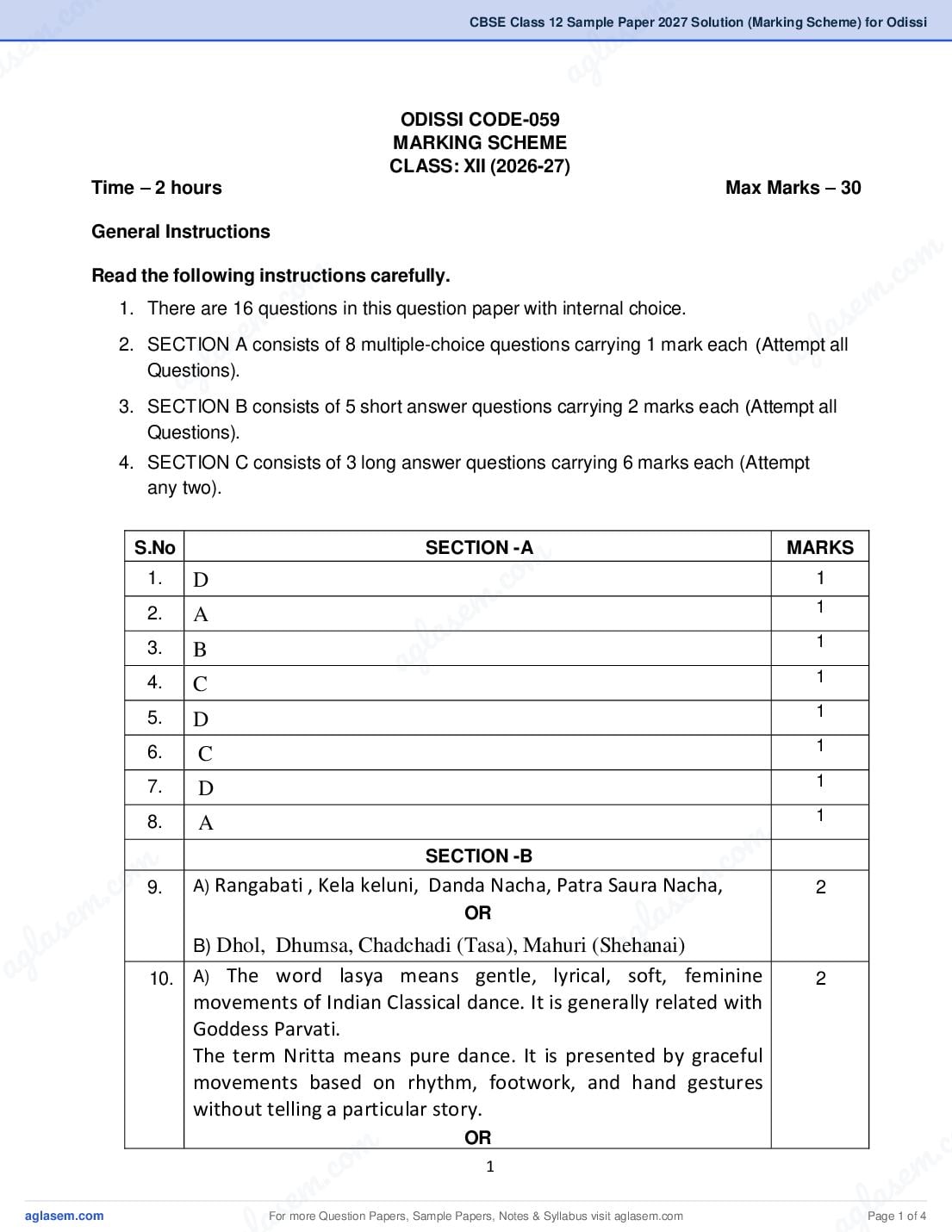
ODISSI CODE-059
MARKING SCHEME
CLASS: XII (2026-27)
Time – 2 hours Max Marks – 30
General Instructions
m
om
Read the following instructions carefully.
. co
. c e m
m
1. There are 16 questions in this question paper with internal choice.
a s
2. SECTION sAeconsists of 8 multiple-choice questions carrying 1 mark each (Attempt
g lall
g l a a
a
Questions).
3. SECTION B consists of 5 short answer questions carrying 2 marks each (Attempt all
Questions).
4. SECTION C consists of 3 long answer questions carrying 6 marks each (Attempt
any two).
m
S.No SECTION -A MARKS
1. D
m .co 1
2. A
s e 1
l a
ag
3. 1
B
4. 1
C
5. 1
D
6. 1
C
7. 1
D
8. 1
A
o m
m SECTION -B
. c
c. o 9. A) Rangabati , Kela keluni, Danda Nacha, Patra Saura Nacha,
s e m 2
e m OR
l a
las a g
ag B) Dhol, Dhumsa, Chadchadi (Tasa), Mahuri (Shehanai)
10. A) The word lasya means gentle, lyrical, soft, feminine 2
movements of Indian Classical dance. It is generally related with
Goddess Parvati.
The term Nritta means pure dance. It is presented by graceful
movements based on rhythm, footwork, and hand gestures
without telling a particular story.
om
OR
. c
. c 1
e m
m as
se
For more Question Papers, Sample Papers, Notes & Syllabus visit
glPage 1 of 4
Page 3
stylized gestures, techniques and symbolism. It is stylized way of
presentation, mainly presented in Indian classical dances and
drama.
11. A) . Ektaali- 4 Matra, Vibhag-1, Chhanda 1 2
1 2 3 4
Tai ithi naterekete Takthini l
OR
B) Tripatta Taal- 7 Matra, Vibhag- 3, Chhand -3+ 2+2
1 2 3
Dhei Tathun Daka l
4 5
Tathun Daka l
6 7
Tathun Daka l
12. A) Taal is a combination of specific beats which measures the 2
musical time of a composition by clapping or playing the
musical instruments.
Matra is a beat of a Taal. It is the smallest rhythmic sub -unit of
a Taal.
OR
B) The medieval boy dancers of Odisha were known as Gotipua.
The word Goti means one and pua means a boy. The Gotipua boy
dancers wear women attire to present dance in front of the
audience. The dance they perform are mostly based on acrobatic
movements based on Raag and Taal.
13. A) The peculiar mental, emotional, and physical condition of 2
enjoyment is known as Rasa. The enjoyment of mind by five
senses of human body either by watching, hearing, smelling,
touching and speaking. Sentiment and mood give rise to
aesthetic feeling. Four Rasa are Shringar, Veer, Shant, Adbhuta.
OR
B) The Dance performed by lord Shiva is known as Tandav, which
depicts his violent nature as the destruction of the Universe.
2
For more Question Papers, Sample Papers, Notes & Syllabus visit Page 2 of 4
Page 4
.co s e m
s em l a
a ag
Tandav type of dance depicts aggressive, sharp, forceful and fast
movements based on Taal. It is also performed with joy.
SECTION-C
Attempt any two questions from the given options
m
co
14. Abhinaya Chandrika is an ancient Text written in 17th Century by 6
m
Maheshwar oMahapatra.
m .
. c It is one of the earliest text which
s e
e
describesm treatise of Odissi Dance. The manuscript originally
l a
s
la detail descriptions on many Odisha temple sculptures, a
written in Sanskrit language (in shloka) on palm leaves. The text g
ag
gives
Bandh Nritya (acrobatic or yoga poses), Sapta Tandav of lord
Shiva, Bhumis, Chaaris, Karakshetra (Positioning of hands on
different parts of the body), Mudras, Taal, Aharya and folk dances
of Odisha etc. It is an important text which describes the peculiar
characteristic of Odra Nrutya or Odissi Dance which have helped
m
immensely to revive and reestablish the dance during the sixties
of this century.
m .co
e
th
15. Guru Kelucharan Mahaptra was born on 8 Jan, 1926 in
s
6
l a
Raghurajpurvillage in Puri district of Odisha. He belongs to the
ag
family of painters. As a young boy he was fascinated by many folk
dance performances of his region such as Raslila, Gotipua , Pala
etc. He was also skilled with the art of Pattachitra painting on
clothes or on palm leaves. He also knew the art of playing Tabla
and Mardal musical instrument, which contributed to his
understanding of musical compositions in Odissi Dance. His early
performance life began with performing as a Gotipua dancer,
m
.co
later he used his knowledge to reconstruct Odissi dance in
m
.co m
Gotipua style. He was one the founding member of Jayantika.
m Some of his popular compositions are of Pallavis and s e
s e g la
la
Ashtapadis. He has received many prestigious awards for his
g contribution to Odissi Dance such as Padma Shri, Padma a
a Bhushan, Sangeet Natak Academy etc.
16. There are four type of Abhinaya which are used in Indian
classical dance and drama to express different type of emotions.
Angika- Angika Abhinaya denotes the movements of Angas or
body. It has three devisions such as Shariraj, Mukhaj and
Chestakrut. The Angika abhinay are shown with the movements
of limbs.
m . c
c. o 3
s e m
s em
For more Question Papers, Sample Papers, Notes & Syllabus visit
gl a
Page 3 of 4
Page 5
and dialogue is known as Vacchika Abhinaya. It deals with poetry,
songs, ukuta, bol or music to express different types of emotions
in dance and drama.
Aharaya- Aharya Abhinaya is related with costumes, makeup,
and ornaments. It is the decoration of body or stage to express
the emotion of particular dance or drama.
Sattvika- Sattvik Abhinaya is the inner emotion. It is the highest
most subtle form of emotion or expression in Indian classical
dance and drama. It focuses on inner mental state (sattva) to
express the emotion.
4
For more Question Papers, Sample Papers, Notes & Syllabus visit Page 4 of 4
Document Details
| Board / Org | CBSE |
| Exam | Class 12 |
| Type | Solution |
| Pages | 4 |
| Updated | 29 Oct 2026 |