CBSE Class 12 Question Paper 2025 Solution Office Procedures and Practices
Finished viewing? Save it for later —
Download CBSE Class 12 Question Paper 2025 Solution Office Procedures and Practices (PDF · 26 pages)About CBSE Class 12 Question Paper 2025 Solution Office Procedures and Practices
CBSE Class 12 Question Paper 2025 Solution Office Procedures and Practices is available here for free download. Published by CBSE for Class 12, this solution can be viewed online or downloaded as a PDF (26 pages). Candidates preparing for Class 12 can use CBSE Class 12 Question Paper 2025 Solution Office Procedures and Practices to understand the exam pattern, the type of questions asked, and the overall difficulty level.
Frequently Asked Questions
How can I download CBSE Class 12 Question Paper 2025 Solution Office Procedures and Practices?
Open this page and click the Download button to save CBSE Class 12 Question Paper 2025 Solution Office Procedures and Practices as a PDF. It is completely free on AglaSem Docs.
Is CBSE Class 12 Question Paper 2025 Solution Office Procedures and Practices free to download?
Yes. CBSE Class 12 Question Paper 2025 Solution Office Procedures and Practices can be viewed online and downloaded as a PDF free of cost on AglaSem Docs.
How many pages does CBSE Class 12 Question Paper 2025 Solution Office Procedures and Practices have?
CBSE Class 12 Question Paper 2025 Solution Office Procedures and Practices contains 26 pages, which you can read online or download together as a single PDF.
Where can I find more Class 12 study material?
You can find more Class 12 question papers, sample papers, syllabus, and answer keys on AglaSem Docs.
CBSE Class 12 Question Paper 2025 Solution Office Procedures and Practices – Text
Read the full text of this solution below — useful to quickly search, copy and reference the content online without downloading the PDF.
📄 View text version (26 pages)
Page 1
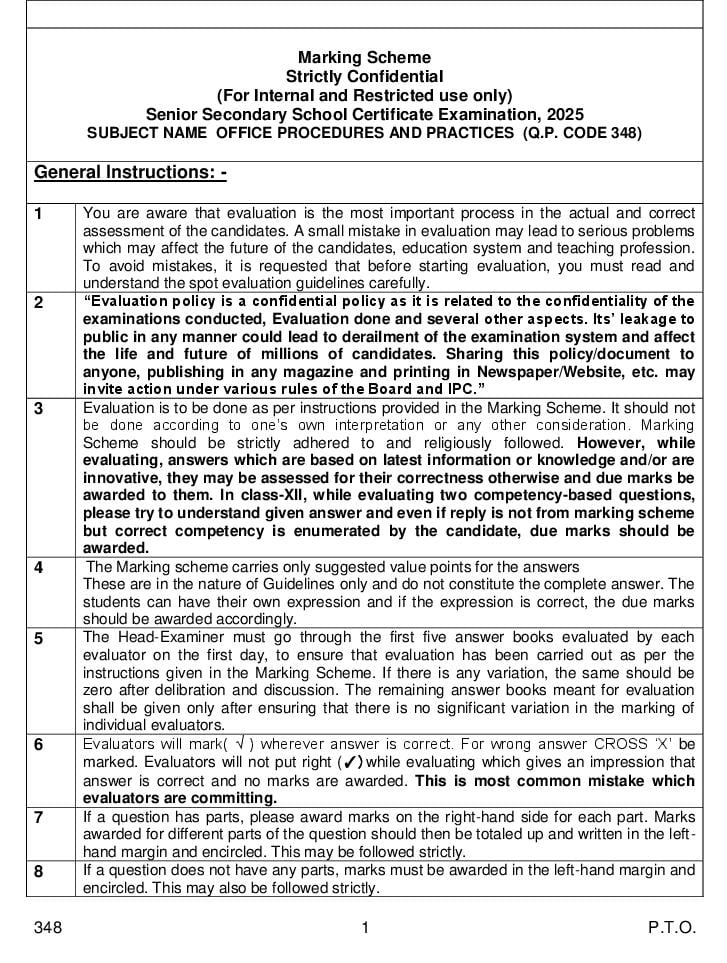
Strictly Confidential
(For Internal and Restricted use only)
Senior Secondary School Certificate Examination, 2025
SUBJECT NAME OFFICE PROCEDURES AND PRACTICES (Q.P. CODE 348)
General Instructions: -
1 You are aware that evaluation is the most important process in the actual and correct
assessment of the candidates. A small mistake in evaluation may lead to serious problems
which may affect the future of the candidates, education system and teaching profession.
To avoid mistakes, it is requested that before starting evaluation, you must read and
understand the spot evaluation guidelines carefully.
2 “Evaluation policy is a confidential policy as it is related to the confidentiality of the
examinations conducted, Evaluation done and several other aspects. Its’ leakage to
public in any manner could lead to derailment of the examination system and affect
the life and future of millions of candidates. Sharing this policy/document to
anyone, publishing in any magazine and printing in Newspaper/Website, etc. may
invite action under various rules of the Board and IPC.”
3 Evaluation is to be done as per instructions provided in the Marking Scheme. It should not
be done according to one’s own interpretation or any other consideration. Marking
Scheme should be strictly adhered to and religiously followed. However, while
evaluating, answers which are based on latest information or knowledge and/or are
innovative, they may be assessed for their correctness otherwise and due marks be
awarded to them. In class-XII, while evaluating two competency-based questions,
please try to understand given answer and even if reply is not from marking scheme
but correct competency is enumerated by the candidate, due marks should be
awarded.
4 The Marking scheme carries only suggested value points for the answers
These are in the nature of Guidelines only and do not constitute the complete answer. The
students can have their own expression and if the expression is correct, the due marks
should be awarded accordingly.
5 The Head-Examiner must go through the first five answer books evaluated by each
evaluator on the first day, to ensure that evaluation has been carried out as per the
instructions given in the Marking Scheme. If there is any variation, the same should be
zero after delibration and discussion. The remaining answer books meant for evaluation
shall be given only after ensuring that there is no significant variation in the marking of
individual evaluators.
6 Evaluators will mark( √ ) wherever answer is correct. For wrong answer CROSS ‘X’ be
marked. Evaluators will not put right (✓)while evaluating which gives an impression that
answer is correct and no marks are awarded. This is most common mistake which
evaluators are committing.
7 If a question has parts, please award marks on the right-hand side for each part. Marks
awarded for different parts of the question should then be totaled up and written in the left-
hand margin and encircled. This may be followed strictly.
8 If a question does not have any parts, marks must be awarded in the left-hand margin and
encircled. This may also be followed strictly.
348 1 P.T.O.
Page 2
marks should be retained and the other answer scored out with a note “Extra Question”.
10 No marks to be deducted for the cumulative effect of an error. It should be penalized only
once.
11 A full scale of marks __________(example 0 to 80/70/60/50/40/30 marks as given in
Question Paper) has to be used. Please do not hesitate to award full marks if the answer
deserves it.
12 Every examiner has to necessarily do evaluation work for full working hours i.e., 8 hours
every day and evaluate 20 answer books per day in main subjects and 25 answer books
per day in other subjects (Details are given in Spot Guidelines).This is in view of the
reduced syllabus and number of questions in question paper.
13 Ensure that you do not make the following common types of errors committed by the
Examiner in the past:-
● Leaving answer or part thereof unassessed in an answer book.
● Giving more marks for an answer than assigned to it.
● Wrong totaling of marks awarded on an answer.
● Wrong transfer of marks from the inside pages of the answer book to the title page.
● Wrong question wise totaling on the title page.
● Wrong totaling of marks of the two columns on the title page.
● Wrong grand total.
● Marks in words and figures not tallying/not same.
● Wrong transfer of marks from the answer book to online award list.
● Answers marked as correct, but marks not awarded. (Ensure that the right tick mark
is correctly and clearly indicated. It should merely be a line. Same is with the X for
incorrect answer.)
● Half or a part of answer marked correct and the rest as wrong, but no marks awarded.
14 While evaluating the answer books if the answer is found to be totally incorrect, it should
be marked as cross (X) and awarded zero (0)Marks.
15 Any unassessed portion, non-carrying over of marks to the title page, or totaling error
detected by the candidate shall damage the prestige of all the personnel engaged in the
evaluation work as also of the Board. Hence, in order to uphold the prestige of all
concerned, it is again reiterated that the instructions be followed meticulously and
judiciously.
16 The Examiners should acquaint themselves with the guidelines given in the “Guidelines
for Spot Evaluation” before starting the actual evaluation.
17 Every Examiner shall also ensure that all the answers are evaluated, marks carried over to
the title page, correctly totaled and written in figures and words.
18 The candidates are entitled to obtain photocopy of the Answer Book on request on
payment of the prescribed processing fee. All Examiners/Additional Head Examiners/Head
Examiners are once again reminded that they must ensure that evaluation is carried out
strictly as per value points for each answer as given in the Marking Scheme.
348 2
Page 3
$
MARKING SCHEME
OFFICE PROCEDURES AND PRACTICES
SECTION A
OBJECTIVE TYPE QUESTIONS
1. Answer any 4 out of the given 6 questions on Employability Skills. 41=4
Answer Book Unit Pg Marks
(i) (C) We listen toincrease Textbook on Unit 1 3-4 1
conflicts. Employability Communication
Skills Skills
(ii) (D) Look after your physical Unit 2 Self 28-29 1
health. Management
Skills
(iii) (C) Apply filter Unit 3 59 1
ICT Skills
(iv) (A) Content is rearranged in Unit 4 76 1
an organised way. ICT Skills
(v) Taking risks Unit 5 87 1
Entrepreneurial
Skills
(vi) (D) Send it back to production Unit 6 119- 1
line. Green Skills 120
2. Answer any 5 out of the given 7 questions. 51=5
Answer Book Unit Pg Marks
(i) (A) Positive Textbook on Unit 1 14 1
Office Introduction to
Procedures & Secretarial
Practices by Practice
CBSE
(ii) (A) Authorized person Unit 2 28 1
348 3 P.T.O.
Page 4
The Mail
(iii) Minority Unit 4 75 1
Arranging
Meetings
(iv) (D) Personal shopping bills Unit 5 Travel 83 1
Information
(v) True Unit 6 Banking 105 1
Services
(vi) Motion Unit 4 76 1
Arranging
Meetings
(vii) Secretaries Unit 1 5
Introduction to
Secretarial
Practice
3. Answer any 6 out of the given 7 questions. 61=6
Answer Book Unit Pg Marks
(i) (A) Note priority items and Textbook on Unit 1 18 1
attend to them first. Office Introduction to
Procedures & Secretarial
Practices by Practice
(ii) (C) Inland Letter CBSE Unit 2 30 1
Handling
The Mail
(iii) (C) Subjectwise Unit 3 52 1
Filing &
Indexing
(iv) Web Conferencing Unit 4 82 1
Arranging
Meetings
(v) One Time Password Unit 6 Banking 109 1
Services
(vi) (C) Foreign Currency Non- Unit 6 Banking 110 1
Resident Account – FCNR Services
(vii) False Unit 5 Travel 97 1
Information
348 4
Page 5
Answer Book Unit Pg Marks
(i) (C) Company Secretary Textbook on Unit 1 8 1
Office Introduction to
Procedures & Secretarial
Practices by Practice
(ii) Mail CBSE Unit 2 24 1
Handling
The Mail
(iii) (C) Record Management Unit 3 44 1
Filing &
Indexing
(iv) Poll Unit 4 81 1
Arranging
Meetings
(v) (B) Religion of Passengers Unit 5 Travel 86 1
Information
(vi) True Unit 6 Banking 106 1
Services
5. Answer any 5 out of the given 6 questions. 51=5
Answer Book Unit Pg Marks
(i) True Textbook on Unit 1 4 1
Office Introduction to
Procedures & Secretarial
Practices by Practice
(ii) (D) Prescribed CBSE Unit 2 30 1
Handling
The Mail
(iii) (B) Long Drive Unit 3 57 1
Filing &
Indexing
(iv) (B) Chairperson is not present. Unit 4 81 1
Arranging
Meetings
(v) (C) One to five stars Unit 5 Travel 93 1
Information
(vi) OTP – One Time Password Unit 6 Banking 109 1
Services
348 5 P.T.O.
Page 6
Answer Book Unit Pg Marks
(i) False Textbook on Unit 1 12 1
Office Introduction to
Procedures & Secretarial
Practices by Practice
(ii) True CBSE Unit 2 40 1
Handling
The Mail
(iii) (D) Rigidity Unit 3 47 1
Filing &
Indexing
(iv) Accurate Unit 4 71 1
Arranging
Meetings
(v) (D) List of grocery items Unit 5 Travel 98 1
Information
(vi) (D) Mortgage Unit 6 Banking 109 1
Services
SECTION B
SUBJECTIVE TYPE QUESTIONS
Answer any 3 questions out of the given 5 questions on Employability Skills.
Answer each question in 20 – 30 words. 32=6
Answer Book Unit Pg Marks
7. A sentence is a group of words, Textbook on Unit 1 9, 16 2
which together expresses a Employability Communication
complete idea that has meaning. Skills Skills
A sentence is formed by putting
together a group of words in
sequence. A sentence, typically,
contains a subject and an object,
conveying a statement, question,
exclamation, or command.
348 6
Page 7
putting sentences in sequence so
that they are understandable. A
group of sentences conveying
one idea form a paragraph.
While writing a paragraph, one
has to make Neuroticism :
Neuroticism is a trait, wherein,
individuals show tendency
towards anxiety, self-doubt,
depression, shyness and other
similar negative feelings.
Any 2
8. Personality is a cluster of Self 33 2
thoughts, feelings and Management
behaviours that make a person Skills
unique and different from
others.
Two big factors of individual’s
personality
1. Openness : Individuals with
openness to experience are,
generally, creative, curious,
active, flexible and
adventurous.
2. Consciousness : Individuals,
who listen to their
conscience, are self
disciplined, do their work on
time, take care of other
before themselves and care
about others’ feelings.
9. Presentation software is being Unit 3 63, 2
widely used to make digital ICT Skills 68
presentations due to the
following reasons :
1. They are interesting as they
have features like images,
videos, animation and
music.
2. Making changes in digital
presentations is easy.
348 7 P.T.O.
Page 8
shown to a much, larger
audience by projecting on a
screen.
4. The presentation can be
printed and distributed to
the audience.
Before you try to print a file,
please make sure that a printer
is connected to the computer.
The steps to print a presentation
are as follows.
1. Click on File
2. Select Print from the drop-
down or you can press
Ctrl+p on the keyboard.
3. A print dialog box is
displayed.
4. A printer attached to the
computer is displayed in the
dialog box.
5. Select the number of copies
you want to print.
6. Select All, if you want to
print all slides.
7. Select Slides, if you want to
print few of them and
provide the slide numbers.
8. Click on OK.
10. Start up is a company that is in Unit 5 88-89 2
the first stage of its operations. Entrepreneurial
A startup is often financed by Skills
the founders until the business
gets off the ground, and it gets
outside finance or investments.
Startups can be started with
minimum investment. Most
startups thrive on an idea that
involve technology or offer
technology-driven solutions.
348 8
Page 9
investment differently than
most small businesses. Startups
come up with an innovative
idea. At the same time, they like
to get guidance and mentoring
from an expert. Most people,
who create startups, join various
groups at local and global level
for continued support by expert
mentors and investors. ‘Startup
India’, a flagship initiative of the
Government of India, is
intended to build an ecosystem
for the growth of startup
business.
11. Instead of only thinking about Unit 6 Green 119- 2
how to recycle or reuse waste, it Skills 120
is important to work towards
finding solutions on how to
reduce the amount of waste
produced. This will help in
waste management. In
manufacturing plants and
factories, managers try to find
various ways to reduce the
amount of waste produced at
every step of the process. Waste
exchange is the process where
the waste product of one process
becomes the raw material for
another. It represents the way of
reducing waste disposal through
re-use.
Answer any 3 out of the given 5 questions in 20 – 30 words. 32=6
348 9 P.T.O.
Page 10
12. Time Management means ‘to Textbook on Unit 1 17-19 2
control how time is to be spent’. Office Introduction to
Management of time is Procedures Secretarial
systematic planning of available and Practices Practice
time and setting right priorities. by CBSE
Usually, a PS has to do more
work than he/she can
accomplish in any given time.
Time is a very essential
component of life and the
management of time is essential
both at work and outside.
Better Management of Time
• Setting targets and
deadlines
• Planning your work
• Noting the priority items
and attending to them first
• Keeping frequently used
information or details ready
• Developing proper routine
• Being systematic and tidy
• Improving reading speed
and accuracy
• Avoiding mood swings
• Avoiding personal and
unnecessary telephone calls
Any 2
13. Franking Machine Unit 2 36-37 2
A Postal Franking Machine is a Handling
stamping machine intended to The Mail
stamp impressions of dies of
approved design on postal
articles for payment of postage
fee.
The use of a Franking Machine
except under a valid license
issued by the Head of the Postal
Division is prohibited. The
348 10
Page 11
the counter of Post Office. The
impressions of the franking
machines recorded on postal
articles should not be interfered-
with in any way. Impression
should be of bright red color,
clear and distinct and should not
overlap. As far as possible, it
should be on the right top corner
on the address side of the article
itself or an address wrapper or
an address label firmly attached
to it.
Franking is allowed up to any
amount.
The main benefits of using the
machine include less risk of
misappropriation of postal
stamps, avoidance of errors in
stamping and simplification in
keeping the account of stamps
used.
14. Passport – A passport is a travel Unit 5 95-96 2
document, usually issued by a Travelling
country’s government that Arrangement
certifies the identity and
nationality of its holder for the
purpose of international travel.
These are three types of Indian
passports :
1. Regular Passport has a
Navy Blue cover and issue
for ordinary Travel.
2. Diplomatic Passport has a
Maroon cover and is issued
to Indian diplomats, top
ranking government official.
3. Official Passport has a white
cover and it is issued to
individuals representing the
Indian government an
348 11 P.T.O.
Page 12
15. Minutes of a meeting may be Unit 3 77 2
defined as a record of the Arranging
proceedings of a meeting and are Meetings
kept to preserve a brief, accurate
and clear record of the business
transacted. The term ‘Minutes’
in literal sense means a note to
preserve the memory. The
minutes of any meeting serves
as an official record of what took
place i.e. the points discussed
and decisions taken during any
meeting. One must be very alert
and accurate in taking down
minutes of meeting. Before the
Meeting, choose your medium
carefully with which you will
take notes, i.e. pen and paper,
laptop, computer, or tape
recorder.
Also ensure that the same is in
working order and have a
backup facility in case of
emergency. It is important to
refer the meeting agenda to
formulate an outline of minutes
of meeting
16. Non-payment of a cheque by the Unit 6 111 2
paying banker with a return Banking
memo giving reasons for the Services
non-payment. It is a condition in
which the bank does not pay the
amount of the cheque to the
payee. In fact, when the drawer
draws the cheque without
following all the rules of issuing
cheque and where an account
does not have sufficient balance
to honour the cheque issued by
the customer, the cheque is
returned by the bank with the
348 12
Page 13
"exceeds arrangement”.
Answer any 2 out of the given 3 questions in 30 – 50 words. 23=6
Answer Book Unit Pg Marks
17. (a) Private Secretary is an Textbook on Unit 1 7-8 3
administrative associate or Office Introduction to
assistant who performs Procedures & Secretarial
various administrative Practices by Practice
duties in an office. A Private CBSE
Secretary is an official to
whom an executive delegates
most of his/her routine
duties. These tasks usually
include taking dictation and
typing, handling
correspondence, attending
telephone and visitors,
making arrangements for
meetings, keeping important
and confidential records etc.
(b) Secretary to a Club or
Association the members of
Managing Committee select
unanimously and appoint a
Secretary to perform various
administrative tasks to run
the office of a Sports Club,
Cultural Club or an
Association (Trade Union,
Cooperative Society etc.).
The appointed Secretary
performs the tasks strictly
under the guidance,
supervision and control of
the Managing Committee.
He/she is responsible for
correspondence,
maintenance of records,
348 13 P.T.O.
Page 14
arrangement of social
gatherings and meetings,
collection of subscription etc.
He/she issues notices and
agenda of meetings, writes
minutes, releases press
notes and acts as a Liaison
Officer of the
Club/Association.
(c) Secretary Appointed by
Government in India, every
ministry is headed by a
minister. Though the
minister is the head of a
ministry, a Secretary is
appointed through Indian
Administrative Service, who
acts as an executive head of
the ministry. He/She is a
very senior official of the
government. Here, the main
role of the Secretary is to
diligently assist and advise
the minister on all matters
of policy and administration
within his ministry or
department. The Secretary
is assisted by Joint, Deputy
and Under Secretaries
(d) Company Secretary Every
incorporated company must
have a Company Secretary
who performs a variety of
tasks which are crucial for
smooth running of the
company. In other words, it
is the duty of the Company
Secretary to ensure that in
the company, all legal/
statutory requirements are
fulfilled. Such requirements
include allotment of shares,
348 14
Page 15
appointments, filing of the
annual returns and accounts
etc. as per the Companies
Act. Briefly, a Company
Secretary has to: Ensure
that the company complies
with all relevant statutory
and regulatory
requirements.
Carry out the responsibility
that business of the
company is conducted in
accordance with its objects
as contained in its
Memorandum of Association.
Also, it is to be ensured that
affairs of the company are
managed in accordance with
Articles of Association and
the provisions of the
Companies Law. Prepare
agenda in consultation with
the Chairman and the other
documents for all the
meetings of the Board of
Directors. Take care of all
matters concerned with the
allotment of shares, and
issuance of share certificates
including maintenance of
statutory share register and
conducting the appropriate
activities connected with
share transfers. Basically, a
Company Secretary ensures
compliance of the provisions
of company’s law and other
statutes and bye-laws of the
company.
Brief explanation of each
348 15 P.T.O.
Page 16
arranging and storing records in Filing &
neat, orderly and efficient Indexing
manner so that they can be
located easily and quickly when
they are required.
Essentials of a efficient filing
system :
1. Compactness – Filing system
should be compact which
means that it should not
take unnecessary space.
2. Economical – Filing system
should be economical in
terms of time, space, money
and operation which mean
that the cost of installation
of filing equipment should be
as low as possible.
3. Flexibility – Filing system
should be flexible so that it
can be expanded or
contracted in case of need.
4. Easy Location – The record
should be placed at that
place where it should be
easily located when required
for reference without any
delay.
5. Safety – Filing system be
such that proper safety of
records is ensured from dust,
water, fire, theft, insect etc.
19. Every meeting needs to be Unit 4 71 3
planned in advance, so that it is Arranging
successful. A meeting is said to Meetings
be properly convened when
proper notice of a meeting has
348 16
Page 17
authority to all persons who
have right to attend the
meeting. Further, in a duly
constituted meeting, there is a
proper person in the chair to
preside over it and the quorum
is complete. The first step
towards planning a meeting is
that it must be properly
convened and constituted. It is
the duty of a PA/PS to know all
the valid requisites of a meeting
which are discussed below.
1. Notice of meeting – Notice of
a meeting means advance
information or intimation of
a meeting. The notice of the
meeting should contain the
Day, date, Time and Venue
of the meeting.
2. Agenda of meeting – An
Agenda is a programme of
the item of the business to
be discussed at a meeting in
the order.
Answer any 3 out of the given 5 questions in 50 – 80 words. 43=12
Answer Book Unit Pg Marks
20. 1. Registration Textbook on Unit 2 39 3
Registration makes the Office Handling
transmission of an article procedures & The Mail
more secure as it passes Practices by
through the hands of postal CBSE
officers, under special
precautions. But the Post
Office is not responsible for
any injury which its contents
may sustain during the
transmission. The risk of
injury is diminished by the
348 17 P.T.O.
Page 18
registration envelopes sold
at Post Offices. Letters,
letter cards, postcards, book
and pattern packets, blind
literature packets, parcels
and newspapers prepaid
with postage at newspaper
rates of postage, etc. may be
registered at any Post Office
for transmission by post to
any other Post Office. The
prepayment of the postage
and registration fee is
compulsory in the case of all
registered articles.
2. Insurance
Registered letters, value-
payable registered letters,
registered parcels and value-
payable registered parcels
may be insured at such Post
Offices, as are authorized, to
accept articles for insurance.
Such Post Offices deliver
insured articles, provided
that in no case shall such
value exceed the real value
of the contents of the article
insured; provided also that
articles containing gold, coin
or bullion government
currency notes or bank notes
or any combination of these
shall be insured for the
actual value of the contents.
For the purpose of this rule,
papers such as securities,
legal documents, etc. may be
regarded as having a real
value.
Post Box – A Post Box is a
348 18
Page 19
lockable box located on the
previous of a Post Office.
Generally, Post Office boxes
are rented from the Post
Office either by individuals
or business.
Speed Post : Speed Post is a
very high speed express
service for letter and
documents with time bound
delivery across the nation
and around the world.
21. Index is a ready guide to the Unit 3 60-64 4
location of the file required. As Filing &
an aid to filing, indexing can be Indexing
described as a process of
providing a ready reference list
of records to locate particular
documents at the time of need.
It is important to know here
that files maintained in
alphabetical order are self-
indexed and do not require the
additional tool of indexing for
the purpose of easy retrieval or
location but in all other systems,
Indexing is a must for ready
reference and early retrieval.
Bound Book Index :
Loose Leaf Index
Card Indexing
Visible Card Index
Wheel Index
Strip Index
Explanation of any 3
22. Before the meeting, a Secretary Unit 4 79-80 4
has to : Arranging
1. Ascertain the date, time and Meeting
place i.e. when and where
the meeting is to be held in
348 19 P.T.O.
Page 20
executive and take steps to
make preparations
accordingly e.g. booking of
the committee/conference
room, hotel etc.
2. Draft the notice and agenda
and get it approved.
3. Get adequate number of
copies of the notice, agenda
and reports etc., if any,
required to be sent along
with the notice and send the
same to all the members
who have a right to attend
the meeting.
4. Check in advance all
logistics viz. air-conditioning
system, blowers etc. in the
meeting room and to
arrange for public address
system, OHP/LCD/Screen
and other equipment that
may be required and to see
that sufficient number of
chairs are made available in
the meeting room keeping in
view the number of invitees.
5. Book in advance necessary
orders for refreshment and
lunch.
6. Keep ready (i) the items of
stationery such as writing
paper, pen, pencil, (ii) spare
copies of agenda, (iii)
minutes of the previous
meeting, (iv) the papers,
reports, statements and
other documents likely to be
required at the time of the
meeting including letters of
apology received from the
348 20
Page 21
(v) attendance sheets or
register, (vi) any books of
reference, standing orders
etc.
(Any 2)
Secretarial duties during the
meeting are to :
1. Obtain signatures of the
members present in the
Attendance Book or on
Attendance Sheets.
2. Help the chairperson in
ascertaining the quorum.
3. Keep before the Chairperson
the necessary papers, files
and documents for ready
reference and to distribute
papers and documents, if
any, to the members.
4. Read, if required, the notice
of the meeting, apologies for
absence, minutes of the last
meeting and Auditors’
Report etc., if directed by the
Chairperson to do so.
5. See that refreshment is
served properly.
6. Supply necessary
information, if any,
regarding rules of procedure,
papers and documents
required by the Chairperson
while conducting the
proceedings of the meeting.
7. Take notes of the
proceedings of the meeting.
(Any 2)
After the meeting, it is the duty
of the Secretary to :
1. Prepare draft minutes and
348 21 P.T.O.
Page 22
same typed in proper form.
2. See that the meeting room is
left in good order, check the
room for papers or personal
items left behind by the
departing participants,
arrange to return borrowed
equipment, to have unused
supplies and exhibits picked
up.
3. Arrange for carrying out
decisions taken in the
meeting and to ensure that
proper intimation is given to
those who are associated
with given assignments.
(Any 2)
23. For booking reservation in Unit 5 85-87 4
railway trains personally, Travel
Railway Reservation Slip is to Information
be filled in with particulars
about journey, trains and
persons travelling. This slip is
also used for cancellation of
journey, if so required for only 6
per requisition. Choice of seats
is subject to availability.
For rail e-ticket booking in
India, one has to Register on the
railway website as an
individual. Registration is free.
Following are the steps for
booking
Step 1 : Register on IRCTC
website
Step 2 : Log in to IRCTC
Account using ID and password
Step 3: Enter Journey Details
Step 4: Select Train and Class of
348 22
Page 23
Step 5: Enter Passenger Details
Step 6: Confirm Booking
Step 7: Make Payment using
Debit card/credit/net
banking/UPI
Step 8: Print or Save E-Ticket.
24. GENERAL UTILITY Unit 6 106- 4
SERVICES PROVIDED BY Banking 108
BANKS Services
(a) Locker Facility : Bank
provides locker facility to
their customers. The
customers can keep their
valuables, such as gold and
silver ornaments, important
documents, shares and
debentures etc. in these
lockers for safe custody.
(b) Credit Cards : A credit card
is a payment card issued to
user as a system of payment.
It allows the cardholder to
pay for goods and services
based on the promise to pay
for them. The issuer of the
card creates revolving
accounts and grants a line of
credit to a consumer or the
user from which the user can
borrow money for payment
to a merchant or as a cash
advance to a user.
(c) Debit Cards : A debit card is
a plastic payment card that
provides the card holder
electronic access to his/her
bank account at the
financial institution. It is a
card that deducts money
348 23 P.T.O.
Page 24
checking account to pay for a
purchase. Debit cards
eliminate the need to carry
cash or physical cheques to
make purchases. These
cards help their customers to
travel without the fear of
theft or loss of money. With
this facility, the customers
need not take the risk of
carrying cash with them
during their travels.
(d) Letter of Credit : A letter of
credit is a guarantee letter
from a bank thereby
guaranteeing that the
buyer’s payment to the seller
will be received on time and
for the correct amount. In
case of non-payment, the
bank will be required to
cover the full or remaining
amount of the purchase. Due
to the nature of
international dealings,
including factors Such as
distance, differing laws in
each country, and difficulty
in knowing each party
personally, the use of letters
of credit has become a very
important aspect or
international business.
(e) Collection of statistics banks
collect statistics giving
important information
relating to trade, commerce,
industries, money and
banking. Publish valuable
journals and bulletins
containing articles on
348 24
Page 25
matters.
(f) Acting Referee Banks act as
referees with respect to the
financial standing, business
reputation and
respectability of customers.
(g) Underwriting Securities
Banks underwrite shares &
debentures issued by
Government, public or
private companies.
(h) Gift Cards Banks issue gift
cards of various
denominations to be used on
auspicious occasions.
(i) Merchant Banking Some
commercial banks have
opened merchant banking
divisions to provide
merchant banking services.
(j) Automated Teller Machine
(ATM) : It is installed by
almost all the banks to
facilitate the customers to
withdraw money at any time
as per their convenience on
all the days of the year. For
this, an ATM card is issued
which has a PIN number.
When this card is used on
the machine, a password is
to be set before the
transaction is carried on. It
releases the amount
punched by the customer
after taking into
consideration the balance of
the customer’s account.
(k) Electronic Clearing System
(E.C.S.) : This system helps
to credit the funds faster.
348 25 P.T.O.
Page 26
account holder can make
payment to other parties
having their account in the
same banks without issuing
any proper instrument. This
system is restricted or
limited to the accounts
maintained in one or
different branches of the
same bank within or outside
the city. The computer
system allows the transfer of
funds to the other party
after verifying the details
from the account.
(Any 4)
348 26
Document Details
| Board / Org | CBSE |
| Exam | Class 12 |
| Type | Solution |
| Pages | 26 |
| Updated | 24 Sep 2026 |