HBSE Class 10 Syllabus 2024 Science
Finished viewing? Save it for later —
Download HBSE Class 10 Syllabus 2024 Science (PDF · 23 pages)About HBSE Class 10 Syllabus 2024 Science
HBSE Class 10 Syllabus 2024 Science is available here for free download. Published by Haryana Board for Class 10, this syllabus can be viewed online or downloaded as a PDF (23 pages). Candidates preparing for Class 10 can use HBSE Class 10 Syllabus 2024 Science to understand the exam pattern, the type of questions asked, and the overall difficulty level.
Frequently Asked Questions
How can I download HBSE Class 10 Syllabus 2024 Science?
Open this page and click the Download button to save HBSE Class 10 Syllabus 2024 Science as a PDF. It is completely free on AglaSem Docs.
Is HBSE Class 10 Syllabus 2024 Science free to download?
Yes. HBSE Class 10 Syllabus 2024 Science can be viewed online and downloaded as a PDF free of cost on AglaSem Docs.
How many pages does HBSE Class 10 Syllabus 2024 Science have?
HBSE Class 10 Syllabus 2024 Science contains 23 pages, which you can read online or download together as a single PDF.
Where can I find more Class 10 study material?
You can find more Class 10 question papers, sample papers, syllabus, and answer keys on AglaSem Docs.
HBSE Class 10 Syllabus 2024 Science – Text
Read the full text of this syllabus below — useful to quickly search, copy and reference the content online without downloading the PDF.
📄 View text version (23 pages)
Page 1
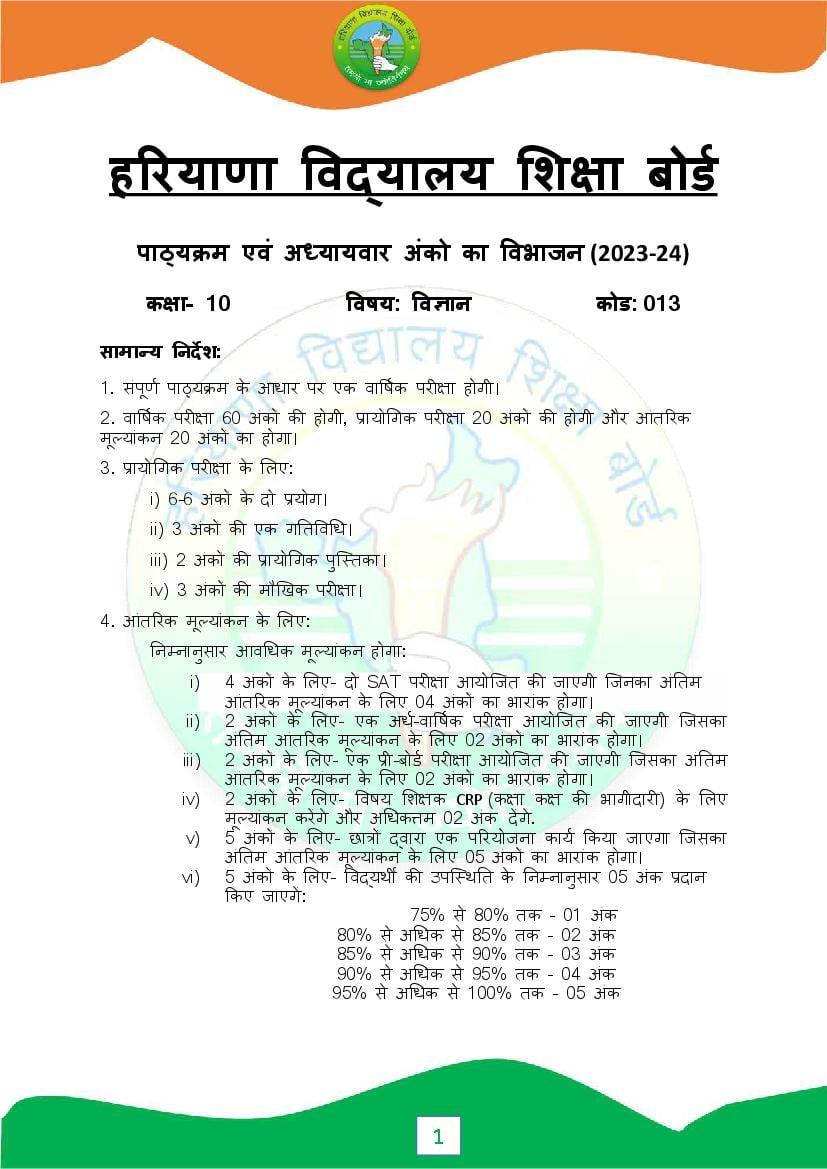
पा य म एवं अ यायवार अंको का वभाजन (2023-24)
क ा- 10 वषय: व ान कोड: 013
सामा य नदश:
1. संपण
ू पा य म के आधार पर एक वा षक पर ा होगी।
2. वा षक पर ा 60 अंक क होगी, ायो गक पर ा 20 अंक क होगी और आंत रक
मू यांकन 20 अंक का होगा।
3. ायो गक पर ा के लए:
i) 6-6 अंक के दो योग।
ii) 3 अंक क एक ग त व ध।
iii) 2 अंक क ायो गक पिु तका।
iv) 3 अंक क मौ खक पर ा।
4. आंत रक मू यांकन के लए:
न नानुसार आव धक मू यांकन होगा:
i) 4 अंक के लए- दो SAT पर ा आयोिजत क जाएगी िजनका अं तम
आंत रक मू यांकन के लए 04 अंक का भारांक होगा।
ii) 2 अंक के लए- एक अध-वा षक पर ा आयोिजत क जाएगी िजसका
अं तम आंत रक मू यांकन के लए 02 अंक का भारांक होगा।
iii) 2 अंक के लए- एक ी-बोड पर ा आयोिजत क जाएगी िजसका अं तम
आंत रक मू यांकन के लए 02 अंक का भारांक होगा।
iv) 2 अंक के लए- वषय श क CRP (क ा क क भागीदार ) के लए
मू यांकन करगे और अ धक म 02 अंक दगे.
v) 5 अंक के लए- छा वारा एक प रयोजना काय कया जाएगा िजसका
अं तम आंत रक मू यांकन के लए 05 अंक का भारांक होगा।
vi) 5 अंक के लए- व यथ क उपि थ त के न नानस ु ार 05 अंक दान
कए जाएग:
75% से 80% तक - 01 अंक
80% से अ धक से 85% तक - 02 अंक
85% से अ धक से 90% तक - 03 अंक
90% से अ धक से 95% तक - 04 अंक
95% से अ धक से 100% तक - 05 अंक
1
Page 2
क ा- 10 वषय: व ान कोड: 013
म इकाई अ याय अंक
सं या
1 रासाय नक पदाथ- कृ त रासाय नक अ भ याएँ एवं समीकरण
और यवहार अ ल, ारक एवं लवण
धातु एवं अधातु 20
काबन एवं उसके यौ गक
2 जीव जगत जैव म
नयं ण और सम वय
जीव जनन कैसे करते ह 18
आनुवं शकता
3 ाकृ तक घटनाएं काश-परावतन तथा अपवतन
10
मानव ने तथा रंग बरं गा संसार
4 व युत के भाव व युत
व युत धारा के चुंबक य भाव 10
5 ाकृ तक संसाधन हमारा पयावरण 2
कुल 60
ायो गक पर ा 20
आंत रक मू यांकन 20
कुल योग 100
2
Page 3
अ याय 1: रासाय नक अ भ याएँ एवं समीकरण
रासाय नक समीकरण: रासाय नक समीकरण लखना, संतु लत रासाय नक
समीकरण का मह व; रासाय नक अ भ याओं के कार: संयोजन
अ भ या, वयोजन (अपघटन) अ भ या, व थापन अ भ या, व व थापन
अ भ या,उपचयन एवं अपचयन; या आपने दै नक जीवन म उपचयन
अ भ याओं के भाव को दे खा है: सं ारण, वकृतगं धता
अ याय 2: अ ल, ारक एवं लवण
अ ल एवं ारक के रासाय नक गुणधम समझना: योगशाला म अ ल एवं
ारक, अ ल एवं ारक धातु के साथ कैसे अ भ या करते ह, धातु काब नेट
और धातु हाइ ोजनकाब नेट अ ल के साथ कैसे अ भ या करते ह, अ ल एवं
ारक पर पर कैसे अ भ या करते ह, अ ल के साथ धाि वक ऑ साइड क
अ भ याएँ, ारक के साथ अधाि वक ऑ साइड क अ भ याएँ; सभी अ ल
एवं ारक म या समानताएँ है: जल य वलयन म अ ल या ारक का या
होता है ; अ ल एवं ारक के वलयन कतने बल होते ह: दै नक जीवन म
pH का मह व: या पौधे एवं पशु pH के त संवेदनशील होते ह, आपके
बागीचे क म ट का pH या है, हमारे पाचन तं का pH, pH प रवतन के
कारण दं त- य, रासाय नक यु ध के मा यम से पशओ ु ं एवं पौध वारा उ प न
रसायन से आ मर ा; लवण के संबंध म अ धक जानकार :लवण प रवार,लवण
का pH, साधारण नमक से रसायन: साधारण नमक - रसायन का क चा पदाथ,
सो डयम हाइ ॉ साइड, वरं जक चणू , बे कं ग सोडा, धोने का सोडा, या लवण के
टल वा तव म शु क ह?: ला टर ऑफ पे रस
अ याय 3: धातु एवं अधातु
भौ तक गुणधम: धातु, अधातु; धातओ ु ं के रासाय नक गण ु धम: धातओ
ु ं का वायु
म दहन करने से या होता है, धातुएँ जब जल के साथ अ भ या करती ह तो
या होता है, या होता है जब धातुएँ अ ल के साथ अ भ या करती ह,अ य
धातु लवण के वलयन के साथ धातुएँ कैसे अ भ या करती ह,स यता ेणी;
धातुएँ और अधातुएँ कैसे अ भ या करती ह: आय नक यौ गक के गण ु धम;
धातुओं क ाि त: धातुओं का न कषण,अय क का सम ृ धकरण,स यता
ेणी म नीचे आने वाल धातओ ु ं का न कषण, स यता ेणी के म य म
ि थत धातुओं का न कषण, स यता ेणी म सबसे ऊपर ि थत धातुओं का
न कषण, धातओ ु ं का प र करण: व यत ु ्-अपघटनी प र करण; सं ारण:सं ारण
से सुर ा
अ याय 4: काबन एवं उसके यौ गक
काबन म आबंधन- सहसंयोजी आबंधन; काबन क सवतोमुखी कृ त: संत ृ त एवं
असंत ृ त काबन यौ गक: ंखलाएँ, शाखाएँ एवं वलय, मझ
ु से दो ती करगे, समजातीय
ेणी, काबन यौ गक क नामप ध त; काबन यौ गक के रासाय नक गुणधम: दहन,
ऑ सीकरण, संकलन अ भ या, त थापन अ भ या; कुछ मह वपण ू काबन
यौ गक : एथनॉल तथा एथेनॉइक अ ल; एथनॉल के गुणधम: सो डयम के साथ
3
Page 4
ु धम:
ए टर करण अ भ या, ारक के साथ अ भ या, काब नेट एवं हाइ ोजनकाब नेट
के साथ अ भ या; साबुन और अपमाजक
इकाई 2: जीव जगत
अ याय 5: जैव म
जैव म या है; पोषण: वपोषी पोषण, वषमपोषी पोषण, जीव अपना पोषण
कैसे करते ह, मनु य म पोषण; वसन: भ न पथ वारा लक ू ोज़ का वखंडन,
मानव वसन तं ; वहन: मानव म वहन: हमारा पंप- दय, दोहरा प रसंचरण,
धर वा हकाएँ, लेटलै स वारा अनरु ण, लसीका,पादप म प रवहन: जल का
प रवहन, भोजन तथा दस ू रे पदाथ का थानांतरण; उ सजन: मानव म
उ सजन,पादप म उ सजन
अ याय 6: नयं ण एवं सम वय
जंतु- तं का तं : तवत या म या होता है, मानव मि त क, ये ऊतक
र त कैसे होते ह, तं का ऊतक कैसे या करता है; पादप म सम वय:
उ द पन के लए त काल अनु या, व ृ ध के कारण ग त; जंतओु ं म हॉम न
अ याय 7: जीव जनन कैसे करते ह
या जीव पण ू तः अपनी तकृ त का सजृ न करते ह: व भ नता का मह व,
एकल जीव म जनन क व ध: वखंडन, खंडन, पुन भवन (पुनजनन),
मक
ु ु लन, का यक वधन, बीजाणु समासंघ; ल गक जनन: ल गक जनन णाल
य , पु पी पौध म ल गक जनन, मानव म ल गक जनन: नर जनन तं , मादा
जनन तं , या होता है जब अंड का नषेचन नह ं होता, जनन वा य
अ याय 8: आनुवं शकता
जनन के दौरान व भ नताओं का संचयन; आनव
ु ं शकता: वंशागत ल ण, ल ण
क वंशाग त के नयम- मडल का योगदान, यह ल ण अपने आपको कस
कार य त करते ह, लंग नधारण
इकाई 3: ाकृ तक घटनाएं
अ याय 9: काश-परावतन तथा अपवतन
काश का परावतन; गोल य दपण: गोल य दपण वारा त बंब बनना, करण
आरे ख का उपयोग करके गोल य दपण वारा बने त बंब का न पण:
अवतल दपण वारा त बंब बनना, उ ल दपण वारा त बंब बनना, गोल य
दपण वारा परावतन के लए च ह प रपाट , दपण सू तथा आवधन; काश
का अपवतन: काँच के आयताकार लैब से अपवतन, अपवतनांक, गोल य लस
वारा अपवतन, लस वारा त बंब बनना, करण आरे ख के उपयोग वारा
4
Page 5
आवधन, लस क मता
अ याय 10: मानव ने तथा रं ग बरं गा संसार
मानव ने : समंजन मता; ि ट दोष तथा उनका संशोधन: नकट- ि ट दोष,
द घ- ि ट दोष, जरा-दरू ि टता; म से काश का अपवतन; कांच के म
वारा वेत काश का व ेपण; वायुमंडल य अपवतन: तार का टम टमाना,
अ म सय ू दय तथा वलं बत सय ू ा त; काश का क णन: टंडल भाव, व छ
आकाश का रं ग नीला य होता है
इकाई 4: व युत के भाव
अ याय 11: व यत
ु
व यतु धारा और प रपथ; व यतु वभव और वभवांतर; व यत
ु प रपथ आरे ख;
ओम का नयम; वह कारक िजन पर एक चालक का तरोध नभर करता है ;
तरोधक के नकाय का तरोध: ेणी म म संयोिजत तरोधक, पाशव म
म संयोिजत तरोधक; व युत धारा का तापीय भाव: व युत धारा के तापीय
भाव के यावहा रक अनु योग; व यत
ु शि त
अ याय 12: व यत
ु धारा के चंब
ु कय भाव
चंब
ु क य े और े रे खाएँ; कसी व यत ु धारावाह चालक के कारण चंब ु कय
े : सीधे चालक से व युत धारा वा हत होने के कारण चंब
ु क य े , द ण-
ह त अंगु ठ नयम, व यत ु धारावाह व ृ ाकार पाश के कारण चंब
ु कय े ,
प रना लका म वा हत व युत धारा के कारण चुंबक य े ; चुंबक य े म
कसी व यत ु धारावाह चालक पर बल; घरे लू व यतु प रपथ
इकाई 5: ाकृ तक संसाधन
अ याय 13: हमारा पयावरण
पा रतं - इसके संघटक या ह: आहार ंख
ृ ला एवं जाल; हमारे याकलाप
पयावरण को कस कार भा वत करते ह: ओजोन परत तथा यह कस कार
अप यत होती है,कचरा बंधन
योग:
1. लोहे क क ल के जल य कॉपर स फेट वलयन के साथ रासाय नक अ भ या का
अ ययन कर।
2. pH प का उपयोग कर, ठोस पदाथ के वलयन या फल के नमून का pH ात
क िजये।
3. दशाएं क कॉपर स फेट के टल म टल य जल होता है।
5
Page 6
5. ऐ कोहॉल और काब ि स लक अ ल के म य ए टर करण अ भ या का अ ययन
कर।
6. टाच घोल पर ए मलेस क या का अ ययन कर।
7. पादप म काशानव ु तन और ग ु वानव ु तन क प रघटनाओं का अ ययन कर।
8. पु प के भाग तथा ल गक जनन म इनक भू मका का अ ययन कर।
9. कसी दरू थ ब ब का त ब ब बना कर एक पतले उ ल लस क फोकस दरू
ात कर।
10. कांच के म से गजु रने वाल काश करण का पथ अनरु े खत कर तथा वचलन
कोण माप।
11. कसी तरोधक के सर के बीच वभवांतर क उससे वा हत होने वाल व यत ु
धारा पर नभरता का अ ययन कर तथा उसका तरोध ात कर और ओम के
नयम को स या पत कर।
12. कसी छड़ चुंबक क चुंबक य े रे खाओं को आरे खत कर।
6
Page 7
क ा- 10 वषय: व ान कोड: 013
मास वषय- व तु श ण दोहराई योगा मक
कालांश कालांश काय
अ ैल अ याय 1: रासाय नक 7 1
अ भ याएँ एवं समीकरण
योग: लोहे क क ल के जल य
कॉपर स फेट वलयन के साथ 1
रासाय नक अ भ या का
अ ययन कर।
अ याय 5: जैव म (पोषण 5 1
और वसन)
योग: टाच घोल पर ए मलेस 1
क या का अ ययन कर।
अ याय 9: काश-परावतन तथा
अपवतन ( काश का परावतन 5 1
और गोल य दपण)
मई अ याय 2: अ ल, ारक एवं 8 1
लवण
योग: pH प का उपयोग कर,
ठोस पदाथ के वलयन या 1
फल के नमून का pH ात
क िजये।
योगः दशाएं क कॉपर स फेट
के टल म टल य जल
होता है। 1
अ याय 5: जैव म (वहन 4 1
और उ सजन)
अ याय 9: काश-परावतन तथा 4 1
अपवतन ( काश का अपवतन)
7
Page 8
त ब ब बना कर एक पतले 1
उ ल लस क फोकस दरू ात
कर।
जून
ी मकाल न अवकाश (उपरो त अ याय से संबं धत कोई प रयोजना
काय दया जाए।)
जुलाई अ याय 6: नयं ण और
सम वय 7 1
योग: पादप म काशानुवतन
और गु वानुवतन क 2
प रघटनाओं का अ ययन कर।
अग त अ याय 7: जीव जनन कैसे 8 1
करते ह
योग: पु प के भाग तथा
ल गक जनन म इनक भू मका 1
का अ ययन कर।
अ याय 10: मानव ने तथा 8 1
रं ग बरं गा संसार
योग: कांच के म से
गज
ु रने वाल काश करण का 1
पथ अनुरे खत कर तथा वचलन
कोण माप।
सतंबर अध-वा षक पर ा के लए 12
दोहराई
अध-वा षक पर ा
अ तू ब र अ याय 3: धातु एवं अधातु 10 2
योग: व भ न ताप अव थाओं
म धातओ
ु ं क जल के साथ 1
अ भ या का अ ययन कर।
अ याय 11: व यत
ु 7 1
8
Page 9
के बीच वभवांतर क उससे
वा हत होने वाल व युत धारा
पर नभरता का अ ययन कर 1
तथा उसका तरोध ात कर
और ओम के नयम को
स या पत कर।
नवंबर
अ याय 4: काबन एवं उसके 10 2
यौ गक
योग: ऐ कोहॉल और
काब ि स लक अ ल के म य 1
ए टर करण अ भ या का
अ ययन कर।
दसंबर अ याय 8: आनुवं शकता 6 1
अ याय 12: व यत
ु धारा के 6 1
चंब
ु क य भाव
योग: कसी छड़ चंब ु क क 1
चुंबक य े रे खाओं को
आरे खत कर।
अ याय 13: हमारा पयावरण 4 1
जनवर शीतकाल न अवकाश: 1 से 15 12
जनवर
दोहराई
फ़रवर दोहराई 20
माच वा षक पर ा
9
Page 10
वषय श क को सलाह द जाती है क वे छा को श दावल या अवधारणा क
प टता को बढ़ाने के लए अ याय म उपयोग क जाने वाल श दावल / प रभाषा मक
श द क नोटबुक तैयार करने के लए नद शत कर।
NCERT क पा य पु तक पाठ म ब से म जानकार तुत करती ह। ये छा को
वैचा रक प टता ा त करने म मदद करते ह। हालां क, इन ब से म मौजूद जानकार
का आंकलन साल के अंत क पर ा म नह ं कया जाएगा।
नधा रत पु तक:
1. व ान-क ा दसवीं के लए पा य पु तक- BSEH काशन (© NCERT)
2. योगशाला पिु तका- व ान- क ा दसवीं, NCERT काशन
3. न द शका- व ान- क ा दसवीं, NCERT काशन
10
Page 11
क ा- 10 वषय: व ान कोड: 013
न का अंक सं या ववरण कुल अंक
कार
व तु न ठ 1 15 6 बहु- वक पीय न, 15
न 3 र त थान भरो न,
3 एक श द य उ र के न,
3 अ भकथन-कारण न
अत 2 6 क ह 2 न म आंत रक 12
लघु रा मक वक प दया जाएगा
न
लघु रा मक 3 6 क ह 2 न म आंत रक 18
न वक प दया जाएगा
दघ 5 3 सभी न म आंत रक 15
उ रा मक वक प दया जाएगा
न
कुल 30 60
11
Page 12
Syllabus and Chapter wise division of Marks (2023-24)
Class- 10 Subject: Science Code: 013
General Instructions:
1. There will be an Annual Examination based on the entire syllabus.
2. The Annual Examination will be of 60 marks, Practical Examination will be
of 20 marks and 20 marks weightage shall be for Internal Assessment.
3. For Practical Examination:
i) Two experiments of 6 marks each.
ii) One activity of 3 marks.
iii) Practical record of 2 marks.
iv) Viva-voce of 3 marks.
4. For Internal Assessment:
There will be Periodic Assessment that would include:
i) For 4 marks- Two SAT exams will be conducted and will have a
weightage of 04 marks towards the final Internal Assessment.
ii) For 2 marks- One half yearly exam will be conducted and will
have a weightage of 02 marks towards the final Internal
Assessment.
iii) For 2 marks- One Pre-Board exam will be conducted and will
have a weightage of 02 marks towards the final Internal
Assessment.
iv) For 2 marks- Subject teacher will assess and give maximum 02
marks for CRP (Class room participation).
v) For 5 marks- A project work to be done by students and will have
a weightage of 05 marks towards the final Internal Assessment.
vi) For 5 marks- Attendance of student will be awarded 05 marks as:
75% to 80% - 01 marks
Above 80% to 85% - 02 marks
Above 85% to 90% - 03 marks
Above 90% to 95% - 04 marks
Above 95% to 100% - 05 marks
12
Page 13
Class- 10 Subject: Science Code: 013
Sr. No. Unit Chapter Marks
1 Chemical Substances - Chemical Reactions and Equations
Nature and Behaviour
Acids, Bases and Salts 20
Metals and Non-Metals
Carbon and Its Compounds
2 World of Living Life Processes
Control and Coordination
How do Organisms Reproduce 18
Heredity
3 Natural Phenomena Light-Reflection and Refraction
10
Human Eye and Colourful World
4 Effects of Current Electricity
Magnetic Effects of Electric Current 10
5 Natural Resources Our Environment 2
Total 60
Practical Examination 20
Internal Assessment 20
Grand Total 100
13
Page 14
Chapter 1: Chemical Reactions and Equations
Chemical equations: Writing a chemical equation, Balanced
chemical equations; Types of chemical reactions: Combination
reaction, Decomposition reaction, Displacement reaction, Double
displacement reaction, Oxidation and reduction; Have you
observed the effects of oxidation reactions in everyday life:
Corrosion, Rancidity
Chapter 2: Acids, Bases and Salts
Understanding the chemical properties of acids and bases: Acids
and bases in the laboratory, How do acids and bases react with
metals, How do metal carbonates and metal hydrogencarbonates
react with acids, How do acids and bases react with each other,
Reaction of metallic oxides with acids, Reaction of non-metallic
oxide with base; What do all acids and all bases have in common:
What happens to an acid or a base in a water solution; How strong
are acid or base solutions: Importance of pH in everyday life: Are
plants and animals pH sensitive, what is the pH of soil in your
backyard, pH in our digestive system, pH change as the cause of
tooth decay, self defence by animals and plants through chemical
warfare; More about salts: Family of salts, pH of salts, Chemicals
from common salt: common salt – a raw material for chemicals,
sodium hydroxide, bleaching powder, baking soda, washing soda,
Are the crystals of salts really dry: Plaster of Paris
Chapter 3: Metals and Non-metals
Physical properties: Metals, Non-metals; Chemical properties of
metals: What happens when metals are burnt in air, What happens
when metals react with water, What happens when metals react with
acids, How do metals react with solutions of other metal salts, The
reactivity series; How do metals and non-metals react: Properties
of ionic compounds; Occurrence of metals: Extraction of metals,
Enrichment of ores, Extracting metals low in the activity series,
Extracting metals in the middle of activity series, Extracting metals
towards the top of the activity series, Refining of metals: electrolytic
refining; Corrosion: Prevention of corrosion
14
Page 15
Bonding in carbon-the covalent bond; Versatile nature of
carbon: Saturated and unsaturated carbon compounds, Chains,
branches and ring, Will you be my friend, Homologous series,
Nomenclature of carbon compounds; Chemical properties of
carbon compounds: Combustion, Oxidation, Addition reaction,
Substitution reaction; Some important carbon compounds-
Ethanol and Ethanoic acid: Properties of ethanol: reaction with
sodium, reaction to give unsaturated hydrocarbon, Properties of
ethanoic acid: esterification reaction, reaction with a base, reaction
with carbonates and hydrogencarbonates; Soaps and detergents
Unit 2: World of Living
Chapter 5: Life Processes
What are life processes; Nutrition: Autotrophic nutrition,
Heterotrophic nutrition, How do organism obtain their nutrition,
Nutrition in human beings; Respiration: Break-down of glucose by
various pathways, Human respiratory system; Transportation:
Transportation in human beings: Our pump-heart, double
circulation, blood vessels, maintenance by platelets, lymph,
Transportation in plants: transport of water, transport of food and
other substances; Excretion: Excretion in human beings, Excretion
in plants
Chapter 6: Control and Coordination
Animals- nervous system: What happens in reflex actions, Human
brain, How are these tissues protected, How does the nervous tissue
cause action; Coordination in plants: Immediate response to
stimulus, Movement due to growth; Hormones in animals
Chapter 7: How do Organisms Reproduce?
Do organisms create exact copies of themselves: The importance
of variation; Modes of reproduction used by single organisms:
Fission, Fragmentation, Regeneration, Budding, Vegetative
15
Page 16
sexual mode of reproduction, Sexual reproduction in flowering
plants, Reproduction in human beings: male reproductive system,
female reproductive system, what happens when egg is not fertilised,
reproductive health
Chapter 8: Heredity
Accumulation of variation during reproduction; Heredity:
Inherited traits, Rules for inheritance of traits- Mendel’s
contributions, How do these traits get expressed, Sex determination
Unit 3: Natural Phenomena
Chapter 9: Light-Reflection and Refraction
Reflection of light; Spherical mirrors: Image formation by
spherical mirrors, Representation of images formed by spherical
mirror using ray diagrams: image formation by concave mirror,
image formation by convex mirror, Sign convention for reflection
by spherical mirrors, Mirror formula and magnification; Refraction
of light: Refraction through a rectangular glass slab, The refractive
index, Refraction by spherical lenses, Image formation by lenses,
Image formation in lenses using ray diagrams, Sign convention for
spherical lenses, Lens formula and magnification, Power of a lens
Chapter 10 : Human Eye and Colourful World
The human eye: Power of accommodation; Defects of vision and
their correction: Myopia, Hypermetropia, Presbyopia; Refraction
of light through a prism; Dispersion of white light by a glass
prism; Atmospheric refraction: Twinkling of stars, Advanced
sunrise and delayed sunset; Scattering of light: Tyndall effect, Why
is the colour of the clear sky blue
Unit 4: Effects of Current
Chapter 11: Electricity
Electric current and circuit; Electric potential and potential
difference; Circuit diagram; Ohm’s Law; Factors on which the
resistance of a conductor depends; Resistance of a system of
16
Page 17
electric current: Practical applications of heating effect of electric
current; Electric power
Chapter 12: Magnetic Effects of Electric Current
Magnetic field and field lines; Magnetic field due to a current-
carrying conductor: Magnetic field due to a current through a
straight conductor, Right-hand thumb rule, Magnetic field due to a
current through a circular loop, Magnetic field due to a current in a
solenoid; Force on a current-carrying conductor in a magnetic
field; Domestic electric circuits
Unit 5: Natural Resources
Chapter 13: Our Environment
Eco-system-what are its components: Food chains and webs; How
do our activities affect the environment: Ozone layer and how it
is getting depleted, Managing the garbage we produce.
Practicals:
1. Study the chemical reaction of an iron nail with aqueous copper
sulphate.
2. Find the pH of the given samples of solutions of solids or fruit juices
using pH paper.
3. Show that crystals of copper sulphate contain water of crystallisation.
4. Study the reaction of metals with water under different temperature
conditions.
5. Study esterification reaction between alcohol and carboxylic acid.
6. Study the action of salivary amylase on starch solution.
7. Study the phenomenon of phototropism and geotropism in plants.
8. Study the parts of a flower and their role in sexual reproduction.
9. Determine the focal length of a thin convex lens by obtaining image of
a distant object.
10. Trace the path of a ray of light through a glass prism and to measure
the angle of deviation.
17
Page 18
current through it and to determine its resistance and to verify the Ohm’s
law.
12.Draw magnetic field lines of a bar magnet.
18
Page 19
Class- 10 Subject: Science Code: 013
Month Subject- content Teaching Revision Practical
Periods Periods Work
April Chapter 1: Chemical 7 1
Reactions and Equations
Practical: Study the
chemical reaction of an 1
iron nail with aqueous
copper sulphate.
Chapter 5: Life Process 5 1
(Nutrition and
Respiration)
Practical: Study the action
of salivary amylase on 1
starch solution.
Chapter 9: Light-
Reflection and Refraction 5 1
(Reflection of light and
Spherical mirrors)
May Chapter 2: Acids, Bases 8 1
and Salts
Practical: Find the pH of
the given samples of 1
solutions of solids or fruit
juices using pH paper.
Practical: Show that 1
crystals of copper sulphate
19
Page 20
crystallisation.
Chapter 5: Life Process 4 1
(Transportation and
Excretion)
Chapter 9: Light-
Reflection and Refraction 4 1
(Refraction of light)
Practical: Determine the 1
focal length of a thin
convex lens by obtaining
image of a distant object.
June Summer Vacation (Any Project work should be given related to
above chapters)
July
Chapter 6: Control and 7 1
Coordination
Practical: Study the
phenomenon of
phototropism and 2
geotropism in plants.
August Chapter 7: How do 8 1
Organisms Reproduce
Practical: Study the parts
of a flower and their role 1
in sexual reproduction.
Chapter 10: Human Eye
and Colourful World 8 1
20
Page 21
of a ray of light through a
glass prism and to 1
measure the angle of
deviation.
September Revision for Half-Yearly 12
Exam
Half-Yearly Exam
October Chapter 3: Metals and 10 2
Non-Metals
Practical: Study the
reaction of metals with 1
water under different
temperature conditions.
Chapter 11: Electricity 7 1
Practical: Study the
dependence of the
potential difference across
a resistor on the current 1
through it and to
determine its resistance
and to verify the Ohm’s
law.
November Chapter 4: Carbon and 10 2
its Compounds
Practical: Study
esterification reaction 1
between alcohol and
carboxylic acid.
21
Page 22
Chapter 12: Magnetic 6 1
Effects of Current
Practical: Draw magnetic
field lines of a bar 1
magnet.
Chapter 13: Our 4 1
Environment
January Winter Vacation: 1st to
15th January
Revision 12
February Revision 20
March Annual Examination
Note:
Subject teachers are advised to direct the students to prepare notebook
of the Terminology/Definitional Words used in the chapters for
enhancement of vocabulary or clarity of the concept.
The NCERT textbooks present information in boxes across the book.
These help students to get conceptual clarity. However, the
information in these boxes would not be assessed in the year-end
examination.
Prescribed Books:
1. Science- Text book for Class X, BSEH Publication (© NCERT)
2. Laboratory Manual-Science-Class X, NCERT Publication
3. Exemplar Problems- Science-Class X, NCERT Publication
22
Page 23
Class- 10 Subject: Science Code: 013
Type of Marks Number Description Total
Question Marks
Objective 1 15 6 Multiple Choice 15
Questions Questions,
3 Fill in the Blanks
Questions,
3 One Word Answer Type
Questions, 3 Assertion-
Reason Questions
Very Short 2 6 Internal choice will be given 12
Answer Type in any 2 questions
Question
Short Answer 3 6 Internal choice will be given 18
Type in any 2 questions
Question
Essay 5 3 Internal options will be given 15
Answer Type in all the questions
Question
Total 30 60
23
Document Details
| Board / Org | Haryana Board |
| Exam | Class 10 |
| Type | Syllabus |
| Pages | 23 |
| Updated | 30 Apr 2026 |