CBSE Class 12 Question Paper 2025 Solution Painting
Finished viewing? Save it for later —
Download CBSE Class 12 Question Paper 2025 Solution Painting (PDF · 9 pages)About CBSE Class 12 Question Paper 2025 Solution Painting
CBSE Class 12 Question Paper 2025 Solution Painting is available here for free download. Published by CBSE for Class 12, this solution can be viewed online or downloaded as a PDF (9 pages). Candidates preparing for Class 12 can use CBSE Class 12 Question Paper 2025 Solution Painting to understand the exam pattern, the type of questions asked, and the overall difficulty level.
Frequently Asked Questions
How can I download CBSE Class 12 Question Paper 2025 Solution Painting?
Open this page and click the Download button to save CBSE Class 12 Question Paper 2025 Solution Painting as a PDF. It is completely free on AglaSem Docs.
Is CBSE Class 12 Question Paper 2025 Solution Painting free to download?
Yes. CBSE Class 12 Question Paper 2025 Solution Painting can be viewed online and downloaded as a PDF free of cost on AglaSem Docs.
How many pages does CBSE Class 12 Question Paper 2025 Solution Painting have?
CBSE Class 12 Question Paper 2025 Solution Painting contains 9 pages, which you can read online or download together as a single PDF.
Where can I find more Class 12 study material?
You can find more Class 12 question papers, sample papers, syllabus, and answer keys on AglaSem Docs.
CBSE Class 12 Question Paper 2025 Solution Painting – Text
Read the full text of this solution below — useful to quickly search, copy and reference the content online without downloading the PDF.
📄 View text version (9 pages)
Page 1
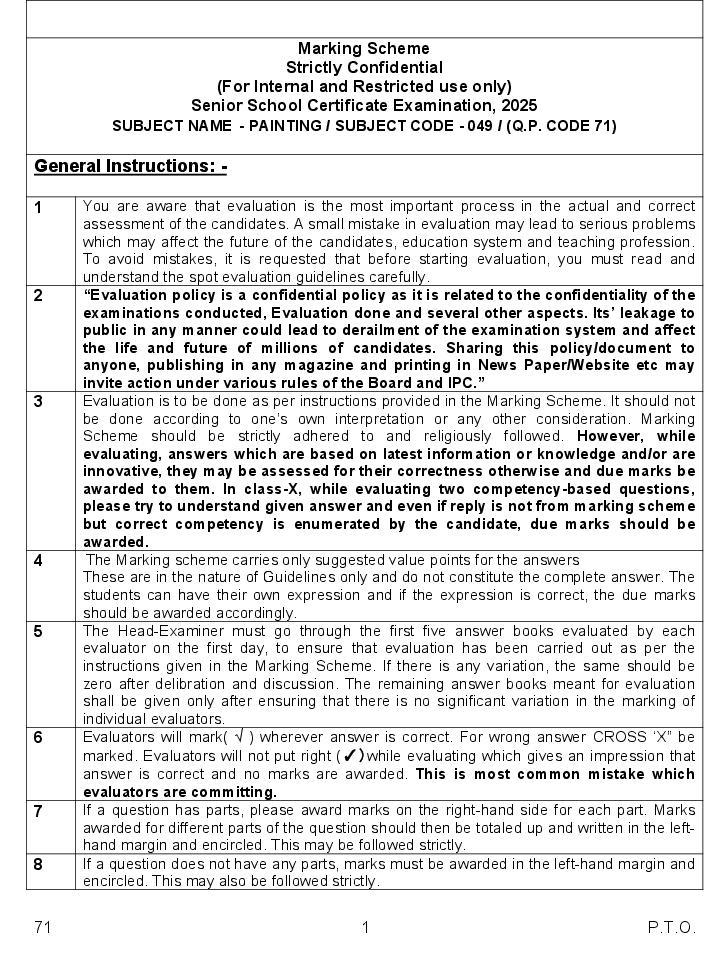
Strictly Confidential
(For Internal and Restricted use only)
Senior School Certificate Examination, 2025
SUBJECT NAME - PAINTING / SUBJECT CODE - 049 / (Q.P. CODE 71)
General Instructions: -
1 You are aware that evaluation is the most important process in the actual and correct
assessment of the candidates. A small mistake in evaluation may lead to serious problems
which may affect the future of the candidates, education system and teaching profession.
To avoid mistakes, it is requested that before starting evaluation, you must read and
understand the spot evaluation guidelines carefully.
2 “Evaluation policy is a confidential policy as it is related to the confidentiality of the
examinations conducted, Evaluation done and several other aspects. Its’ leakage to
public in any manner could lead to derailment of the examination system and affect
the life and future of millions of candidates. Sharing this policy/document to
anyone, publishing in any magazine and printing in News Paper/Website etc may
invite action under various rules of the Board and IPC.”
3 Evaluation is to be done as per instructions provided in the Marking Scheme. It should not
be done according to one’s own interpretation or any other consideration. Marking
Scheme should be strictly adhered to and religiously followed. However, while
evaluating, answers which are based on latest information or knowledge and/or are
innovative, they may be assessed for their correctness otherwise and due marks be
awarded to them. In class-X, while evaluating two competency-based questions,
please try to understand given answer and even if reply is not from marking scheme
but correct competency is enumerated by the candidate, due marks should be
awarded.
4 The Marking scheme carries only suggested value points for the answers
These are in the nature of Guidelines only and do not constitute the complete answer. The
students can have their own expression and if the expression is correct, the due marks
should be awarded accordingly.
5 The Head-Examiner must go through the first five answer books evaluated by each
evaluator on the first day, to ensure that evaluation has been carried out as per the
instructions given in the Marking Scheme. If there is any variation, the same should be
zero after delibration and discussion. The remaining answer books meant for evaluation
shall be given only after ensuring that there is no significant variation in the marking of
individual evaluators.
6 Evaluators will mark( √ ) wherever answer is correct. For wrong answer CROSS ‘X” be
marked. Evaluators will not put right (✓)while evaluating which gives an impression that
answer is correct and no marks are awarded. This is most common mistake which
evaluators are committing.
7 If a question has parts, please award marks on the right-hand side for each part. Marks
awarded for different parts of the question should then be totaled up and written in the left-
hand margin and encircled. This may be followed strictly.
8 If a question does not have any parts, marks must be awarded in the left-hand margin and
encircled. This may also be followed strictly.
71 1 P.T.O.
Page 2
marks should be retained and the other answer scored out with a note “Extra Question”.
10 No marks to be deducted for the cumulative effect of an error. It should be penalized only
once.
11 A full scale of 30 marks (as given in Question Paper) has to be used. Please do not
hesitate to award full marks if the answer deserves it.
12 Every examiner has to necessarily do evaluation work for full working hours i.e., 8 hours
every day and evaluate 20 answer books per day in main subjects and 25 answer books
per day in other subjects (Details are given in Spot Guidelines).This is in view of the
reduced syllabus and number of questions in question paper.
13 Ensure that you do not make the following common types of errors committed by the
Examiner in the past:-
● Leaving answer or part thereof unassessed in an answer book.
● Giving more marks for an answer than assigned to it.
● Wrong totaling of marks awarded on an answer.
● Wrong transfer of marks from the inside pages of the answer book to the title page.
● Wrong question wise totaling on the title page.
● Wrong totaling of marks of the two columns on the title page.
● Wrong grand total.
● Marks in words and figures not tallying/not same.
● Wrong transfer of marks from the answer book to online award list.
● Answers marked as correct, but marks not awarded. (Ensure that the right tick mark
is correctly and clearly indicated. It should merely be a line. Same is with the X for
incorrect answer.)
● Half or a part of answer marked correct and the rest as wrong, but no marks awarded.
14 While evaluating the answer books if the answer is found to be totally incorrect, it should
be marked as cross (X) and awarded zero (0)Marks.
15 Any unassessed portion, non-carrying over of marks to the title page, or totaling error
detected by the candidate shall damage the prestige of all the personnel engaged in the
evaluation work as also of the Board. Hence, in order to uphold the prestige of all
concerned, it is again reiterated that the instructions be followed meticulously and
judiciously.
16 The Examiners should acquaint themselves with the guidelines given in the “Guidelines
for Spot Evaluation” before starting the actual evaluation.
17 Every Examiner shall also ensure that all the answers are evaluated, marks carried over to
the title page, correctly totaled and written in figures and words.
18 The candidates are entitled to obtain photocopy of the Answer Book on request on
payment of the prescribed processing fee. All Examiners/Additional Head Examiners/Head
Examiners are once again reminded that they must ensure that evaluation is carried out
strictly as per value points for each answer as given in the Marking Scheme.
71 2
Page 3
MARKING SCHEME
PAINTING
SECTION A
(Multiple Choice Questions)
1. Select the right answer from the given options : 81=8
(i) (C) Radha (Bani-thani) is shown in a plain white costume. 1
(ii) (A) Both (A) and (R) are true and (R) is the correct explanation
of (A). 1
(iii) (C) Sahibdin 1
(iv) (B) Mughal school 1
(v) (A) Miskin 1
(vi) (D) Saffron 1
(vii) (B) Deccan School 1
(viii) (A) Abanindranath Tagore 1
SECTION B
(Short Answer Type Questions)
(Answer for these questions is expected in around 100 words.) 52=10
2. (a) (i) Title of the painting - Chaugan Players 1
2
Name of the painter - Dana 1
2
71 3 P.T.O.
Page 4
2
1
(iii) Compositional arrangement 2
2
Six Princess, Horses of three different colours, Playing
Polo, Royal clothes, Jewellery, Well decorated apparels,
Red coloured ball white, Blue, Deep brown, Calligraphic
work, Water colour on paper, Tempera Technique.
OR
1
(b) (i) Title of the painting - Krishna lifting Mount Goverdhana
2
1
Name of the painter - Miskin
2
(ii) Compositional arrangement and Artistic aspect of
painting 1 2
Akbar period, Mughal school, Water colours on paper,
Tempera Technique, based on Bhagwat/Harivansh Puran,
Krishna as main figure, Wearing Pitambar, Mountain in
Persian Styles, Mountain used as an umbrella, Villagers,
Cows, Wild animals, One eyed faces, Thin lines,
Maximum used of blue, Orange and green, Indra : God of
rain, Vanquising the pride of Indra, Dense clouds.
3. (a) (i) Title - Hazrat Nizamuddin Auliya and Amir Khusro 1
2
Medium of painting - Water colours with Tempera 1
2
(ii) Sub-school - Hyderabad 1
2
Aesthetic aspect of painting 1 2
2
71 4
Page 5
Respect towards Guru, Musical instrument, Sitting on his knees,
blue background, Pose of deep thinking, Big tree in background,
etc.
OR
1
(b) (i) Painter - Ustad Faquirullah Khan
2
1
Medium of art work - Water colour with Tempera
2
(ii) School of painting - Mughal school (sub-school) –
Shahjahan period 1
2
Critically interpretation of the painting. 1 2
2
Kabir and Raidas, Saint Kabir Das, Saint Raidas, 1640
A.D., Weaving cloth, Raidas sitting on a carpet, Half-
naked body, Turbans rural scene, Hut, Numerous shades,
Black, White and Brown, etc.
4. (a) (i) Medium and Techniques - Oxidised copper, Tin and wires 1
(ii) Appreciation of Art work 1 2
Ganesha, sculpture, P.V. Janaki Ram, period – 1970-80
A.D., dancing Ganesha, Playing veena, Six handed
Ganesha, Traditional form, having wheel, conch, lotus,
mace, folk art of South India, etc.
OR
71 5 P.T.O.
Page 6
Etching / Intaglio 1
(ii) Appreciation of Art work 1 2
Devi, Graphic-print, Artist – Jyoti Bhatt, Tantra-Kala,
Awakening of Kundalini, Supernatural power, Nervous
system, Power of Tantra, Different source of energy,
Woman power, Adoration, Yoga and Tantra, etc.
5. (a) (i) Appreciation of Art work 1
(ii) Depiction of emotions/feelings 1 2
School – Bengal School, Artist – Abanindranath Tagore,
Artwork – Journey’s End, Medium – Water colour
with Tempera, Technique – Wash with Tempera,
Period – Modern (1937 A.D.), Camel, Massive goods, Tied
with the cords, Use of red col, Sunset, Weak and tired
camel, Half opened eyes, Tries to stand up again,
Atmosphere of desert, Journey’s End, etc.
OR
(b) (i) Appreciation of Art work 1
(ii) Depiction of emotions/feelings 1 2
Shiv and Sati, Painter – Nandlal Bose, Medium – water
colour with Tempera on paper, Technique – Indian wash
with Tempera, Lord Shiva and his wife Sati (Parvati),
Bengal School, mythological event, various tones and
shades, sad mood, faded faces, body of Sati, lying on the
left knee, unconscious, wearing necklace, bracelets, saree
in red shade, armlets, earrings, aura of light, behind the
head of Shiva, neckless and snake, blurry vision
foreground etc.
71 6
Page 7
2
Name of the painter - Manku 1
2
(ii) Aesthetic description of compositional arrangement of the
painting 1 2
School, Pahari, Sub-school, Basohli, Medium – water
colour with Tempera Technique, main figure of Lord
Krishna in blue colour, dancing with Gopis, Eight Gopis,
at the bank of Yamuna river, folk art impact, pearl
necklace, decorated trees, well decorated crown with
pearls and lustrous peacock’s feather, two buds of flowers,
dhoti, one-eyed faces, charming, big eyes, eyebrows are
curved like a bow, etc.
OR
(b) (i) Title of painting - Nand, Yashoda and Krishna with
Kinsmen going to Vrindavana 1
2
Name of the painter - Nainsukh 1
2
(ii) Artistic features of the painting 1 2
School – Pahari, Sub-school – Kangra, Medium – water
colour with Tempera technique on paper, Episode of
Bhagwat Purana, Vivid colours, Golden Building of
Vrindavana, Half-naked body, blue costume, stripped
cloth, bird sitting, coiled round creepers, river, greenery,
etc.
71 7 P.T.O.
Page 8
(Long Answer Type Questions)
(Answer for these questions is expected in around 200 words.)
Attempt any two questions from the given options :- 26=12
7. (a) Title of painting - Bharat Meets Rama at Chitrakuta 1
Name of the painter - Guman 1
(b) Medium - Water colour with Tempera on paper 1
Sub-school - Jaipur 1
(c) Subject matter and compositional arrangement of the painting 2 6
School – Rajasthani, Sub-school – Jaipur, Theme – based on
‘Ramayana’, 18th century painting, 49 figures, an episode of
Ramayana, Bharat, Shatrughana, their wives, mothers, Ram, Laxman,
Sita, to take back to Ayodhya, duty, ideal depiction of Human virtues,
Sacrifice, death of Dasharatha, Sita is discussing with her mother-in-
law, sitting together, dark green, yellow and white shades, water
source, etc.
8. (a) Origin and development of Bengal School 2
(b) Four painters of Bengal School - Abanindranath Tagore,
1
Nandlal Bose, M. A.R. Chugtai, Ram Gopal 4 2
2
(c) Aesthetic description of painting ‘Radhika’ 2 6
Early face of 20th century, Indian Renaissance, Indian traditional art,
lifeless style of western art, Art movement, new direction,
Abanindranath Tagore, known as the father of Indian Renaissance,
Nandlal Bose, E.B. Havell, 1904, study of Ajanta, Bagh and Ellora,
Rajput and Mughal miniature painting, Nandlal Bose, Shailendra
71 8
Page 9
Asit Kumar Haldar, Surendra Ganguli, D.P. Roy Chowdhury,
K. Venktappa, K.N. Majumdar, etc. Japanese wash, Indian Tempera,
Indian wash, dipping in the water, Amazing effect
Radhika, Painter – M.A.R. Chugtai, period – 1940 A.D., water colour
with Tempera, wash technique, shades of Yellow, Red and Brown,
decorated lamp, blended blue, yellow stole, emotion of love, etc.
9. (a) Title of painting - Marriage procession of Dara Shikoh 1
Name of the Artist - Haji Madni 1 2
(b) Composition description 2
(c) Any two stylistic Mughal school features 2 6
Water colour with Tempera Technique on paper, 1740-50 AD, Dara
Sikoh riding on the horse, Horses and Elephants, Elephants used for
female members of Groom side, mostly Ek chasma figures, Shahjahan
has been shown with Holo, Fireworks
Stylish Features - Decorative Border, Profile faces, Portraits,
Calligraphy, Gold and Silver colours, Animal and Birds.
71 9 P.T.O.
Document Details
| Board / Org | CBSE |
| Exam | Class 12 |
| Type | Solution |
| Pages | 9 |
| Updated | 24 Sep 2026 |