CBSE Class 12 Sample Paper 2027 Solution (Marking Scheme) for Painting
Finished viewing? Save it for later —
Download CBSE Class 12 Sample Paper 2027 Solution (Marking Scheme) for Painting (PDF · 5 pages)About CBSE Class 12 Sample Paper 2027 Solution (Marking Scheme) for Painting
CBSE Class 12 Sample Paper 2027 Solution (Marking Scheme) for Painting is available here for free download. Published by CBSE for Class 12, this solution can be viewed online or downloaded as a PDF (5 pages). Candidates preparing for Class 12 can use CBSE Class 12 Sample Paper 2027 Solution (Marking Scheme) for Painting to understand the exam pattern, the type of questions asked, and the overall difficulty level.
Frequently Asked Questions
How can I download CBSE Class 12 Sample Paper 2027 Solution (Marking Scheme) for Painting?
Open this page and click the Download button to save CBSE Class 12 Sample Paper 2027 Solution (Marking Scheme) for Painting as a PDF. It is completely free on AglaSem Docs.
Is CBSE Class 12 Sample Paper 2027 Solution (Marking Scheme) for Painting free to download?
Yes. CBSE Class 12 Sample Paper 2027 Solution (Marking Scheme) for Painting can be viewed online and downloaded as a PDF free of cost on AglaSem Docs.
How many pages does CBSE Class 12 Sample Paper 2027 Solution (Marking Scheme) for Painting have?
CBSE Class 12 Sample Paper 2027 Solution (Marking Scheme) for Painting contains 5 pages, which you can read online or download together as a single PDF.
Where can I find more Class 12 study material?
You can find more Class 12 question papers, sample papers, syllabus, and answer keys on AglaSem Docs.
CBSE Class 12 Sample Paper 2027 Solution (Marking Scheme) for Painting – Text
Read the full text of this solution below — useful to quickly search, copy and reference the content online without downloading the PDF.
📄 View text version (6 pages)
Page 1
CBSE Class 12 Sample
Paper 2027 Solution
(Marking Scheme) for
Painting
EXAM YEAR TYPE SUBJECT
CBSE Class 12 2027 Solutions Painting
Notes · Sample Papers · Previous Year Papers · Mock Tests
Page 2
.co s e m
s em l a
a ag
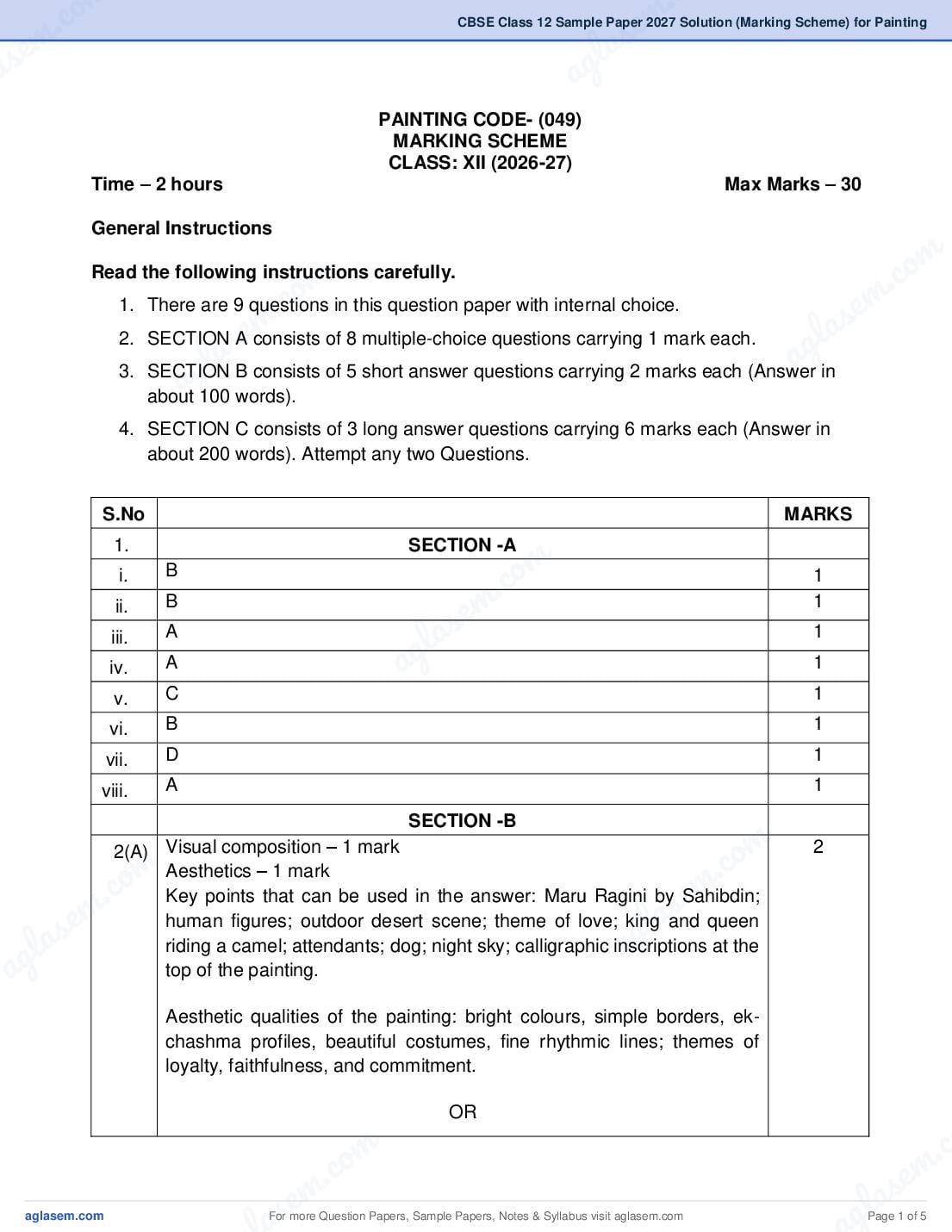
PAINTING CODE- (049)
MARKING SCHEME
CLASS: XII (2026-27)
Time – 2 hours Max Marks – 30
General Instructions
m
om
Read the following instructions carefully.
. co
. c e m
1. There are 9 questions in this question paper with internal choice.
m
2. SECTION sAeconsists of 8 multiple-choice questions carrying 1 mark each. l as
a g
a in
l B consists of 5 short answer questions carrying 2 marks each (Answer
g
a 100 words).
3. SECTION
about
4. SECTION C consists of 3 long answer questions carrying 6 marks each (Answer in
about 200 words). Attempt any two Questions.
S.No MARKS
1. SECTION -A
m
.co
i. B 1
ii. B
e m 1
A
l as 1
ag
iii.
iv. A 1
v. C 1
vi. B 1
vii. D 1
viii. A 1
SECTION -B
m
.co
2(A) Visual composition – 1 mark 2
m
.co
Aesthetics – 1 mark
e m
e m
Key points that can be used in the answer: Maru Ragini by Sahibdin;
las
las human figures; outdoor desert scene; theme of love; king and queen
ag
g
riding a camel; attendants; dog; night sky; calligraphic inscriptions at the
a top of the painting.
Aesthetic qualities of the painting: bright colours, simple borders, ek-
chashma profiles, beautiful costumes, fine rhythmic lines; themes of
loyalty, faithfulness, and commitment.
OR
m . c
c. o s e m
s em
Page 1 of 5
Page 3
Compositional structure and visual features– 1 mark
Chand Bibi playing polo; Golconda; warrior queen of Bijapur; women
playing polo, a game mainly played by men at that time; decorated
horses; Deccan School; depiction of nature; outdoor scene; life of
women; princess and female figures; use of trees and pond;
representation of a female referee; importance of women; well-
composed artwork; aesthetic qualities; realistic figures; vibrant colours;
Persian influence.
3(A) Origin – 1 mark 2
Chronological development – 1 mark
Origin in the 17th century; Manaku and Nainsukh; hybrid style influenced
by Gujarat, Mughal, and Rajasthani miniature traditions Artist fled from
Aurangzeb’s wrath to the north in areas of Himachal.
Main centres: Basohli, Guler, Kangra, Jammu. Basohli as the earliest
centre of painting; characteristics include vigorous and bold lines, strong
glowing primary colours, and intense emotional scenes. Kangra style
(18th century); main patron Raja Sansar Chand; golden period; refined
drawing and brilliant colour schemes. Garhwal style noted for peaceful
backdrops and natural beauty.
OR
3(B) Name of the painting and sub-school – 1 mark 2
Description of the artwork and values – 1 mark
Key points: Hazrat Nizamuddin Auliya and Amir Khusro; artist unknown;
sub-school: Hyderabad; medium: watercolour (tempera technique) on
paper; respect towards the Guru; simplicity; peace; divine atmosphere;
devotion towards the mentor; fruitful tree; blissful preaching; musical
instrument; outdoor setting; minimalistic architecture; connection
between young and old; sharing and acceptance of wisdom; halo behind
the Guru.
4(A) Name, artist, technique, and medium – 1 mark 2
Depiction of composition – 1 mark
The painter conveys both the emotional and aestheticaly pleasing
essence.
Key points: Nand, Yashoda, and Krishna with Kinsmen Going to
Vrindavan by Nainsukh; tempera; watercolour on paper; pitambar worn
by Krishna; well-balanced composition; bright colours; depiction of
For more Question Papers, Sample Papers, Notes & Syllabus visit Page 2 of 5
Page 4
.co s e m
s em l a
a ag
kinsmen; jewellery; multiple figures in action, showing the artist’s
success.
OR
4(B) Name of the artist, artwork.– 1 mark 2
Compositinal arrangements – 1 mark
o m
m
o be used in the answer: . c
.
Key points that can
c e m
em school, Bikaner sub school. Artist – Nuruddin, medium gla
i. Title of the painting- Krishna on swings. The painting belongs to the s
s
la Tempera - 1 mark
Rajasthani
a
g
ii.a It’s a vertical painting divided into two panel which gives a single
water/
painting illusion. Divided by two hills. Upper panel- Krishna on swing
in orange dhoti and crown, picture in bluish hue. Other side
balcony/architecture, Radha watching from balcony. Lower panel-
Garden/natural settings, tree, foliage, Krishna Radha seated
separately the artistic form used to divide the two parts is a horizontal
architectural or ground line element. - 1mark
m
.co
5(A) Raja Ravi Verma 2
e m
l as
Key points: Rama Vanquishing the Pride of the Ocean; oil on canvas;
ag
Rama as the main figure on a foreground rock; expression of anger and
annoyance; diagonal composition; central figure balanced by turbulent
waves; dark, stormy sky; realistic figures; stones; violent waves; flowing
clothes; three figures including Varuna pleading with his consorts; use of
light and shadow; detailed brushwork.
OR
5(B) Amrita Sher-Gil. 2
Amrita Sher-Gil painted Haldi Grinder in 1940. This was the time when
she was seeking inspiration from India’s idyllic rural scene. Such a scene,
m
m depicting Indian women busy in a traditional activity of grinding dry
.co
m .co turmeric, had to be painted in Indian style. It is not surprising that she
s e m
e la
used bright, saturated pigments to paint this work. Given her training in
las modern art in Europe, she was quick to see parallels between miniature
ag
ag traditions of north India and modern art of Paul Gaugin, an artist she
admired.
6(A) Key points: Colours: saffron, white, green, blue symbolising courage, 2
peace, sacrifice, strength, prosperity, unity, truth, honesty, and
agriculture. Icons: Dharma Chakra – eternal wheel of law; motion and
growth; 24 spokes representing the 24 hours of the day; commitment and
duty.
m . c
c. o s e m
s em
Page 3 of 5
Page 5
6(B) Name of the print and technique – 1 mark Aesthetic description – 1 mark 2
Key points: Of Walls; etching on paper; modern artwork; female figure;
dark face; dirty white saree; bare legs of a male figure; brick wall; chalk
drawings; haveli; poverty and injustice; monochromatic print; realism
blended with abstraction; fine line work and textures.
SECTION-C
Attempt any two questions from the given options
7. Name of the artist, title– 1 marks for each painting. 3+3
Medium, technique– 1 marks each painting.
Compositional arrangement – 1 marks each painting.
Students can explain any two Mughal miniature painting from Akbar
period, Jehangir period and Shahjahan period as per the point mentioned
above.
Eg : Darashikoh ki Baraat by Haji Madni; Shahjahan period; watercolour
on paper; tempera technique; huge wedding procession; multiple
decorated horses; use of fireworks; females on elephants; groom at the
centre with a halo; attendants holding candles; bride’s welcome party;
musicians; dancing boy; more than 100 figures; bright colours; jewellery;
Mughal costumes; floral borders.
8. Contribution of Indian art in freedom struggle 2+2+2
i. With the colonial rule around the eighteenth century, the English
were charmed by different manners and customs of people of all
ranks, tropical flora and fauna, and varying locales. Partly for
documentation and partly for artistic reasons, many English
officers commissioned local artists to paint scenes around them to
get a better idea of the natives.
ii. The year 1896 was important in the Indian history of visual arts.
E. B. Havell and Abanindranath Tagore saw a need to Indianise
art education in the country. This began in the Government Art
School, Calcutta, now, Government College of Art and Craft,
Kolkata. Similar art schools were established in Lahore, Bombay
and Madras but their primary focus was on crafts like metalwork,
furniture and curios.
iii. Nandalal Bose, a student of Abanindranath Tagore, was invited
by poet and philosopher Rabindranath Tagore to head the
For more Question Papers, Sample Papers, Notes & Syllabus visit Page 4 of 5
Page 6
.co s e m
s em l a
a ag
painting department in the newly established Kala Bhavana. Kala
Bhavana was India’s first national art school.
9. i. Name of the artist, title of the painting, technique, and medium – 6
2 marks
ii. Subject matter – 1 mark
Depiction of emotions – 3 marks
iii.
o m
o m . c
. cYaksha
Key points: Meghdoot by Ram Gopal Vijayvargiya; tempera technique;
e m
em poetic representation; well-composed flowing hair; sense gla
Bengal School;
shaped s
figure writing a message; tears flowing from doe- s
la movement of wind; theme of love and longing; clouds; a
eyes;
g
of adoration;
a lines; delicate figures; fresh colours such as yellow garments;
rhythmic
flying birds; loneliness; agony of separation; melancholy; hope.
m
m .co
s e
l a
ag
m
m .co
m .co s e m
s e g la
g la a
a
m . c
c. o s e m
s em
Page 5 of 5
Document Details
| Board / Org | CBSE |
| Exam | Class 12 |
| Type | Solution |
| Pages | 5 |
| Updated | 29 Oct 2026 |