CBSE Class 12 Physics Question Paper 2020 Set 55-1-3
Finished viewing? Save it for later —
Download CBSE Class 12 Physics Question Paper 2020 Set 55-1-3 (PDF · 23 pages)About CBSE Class 12 Physics Question Paper 2020 Set 55-1-3
CBSE Class 12 Physics Question Paper 2020 Set 55-1-3 is available here for free download. Published by CBSE for Class 12, this question paper can be viewed online or downloaded as a PDF (23 pages). Candidates preparing for Class 12 can use CBSE Class 12 Physics Question Paper 2020 Set 55-1-3 to understand the exam pattern, the type of questions asked, and the overall difficulty level.
Frequently Asked Questions
How can I download CBSE Class 12 Physics Question Paper 2020 Set 55-1-3?
Open this page and click the Download button to save CBSE Class 12 Physics Question Paper 2020 Set 55-1-3 as a PDF. It is completely free on AglaSem Docs.
Is CBSE Class 12 Physics Question Paper 2020 Set 55-1-3 free to download?
Yes. CBSE Class 12 Physics Question Paper 2020 Set 55-1-3 can be viewed online and downloaded as a PDF free of cost on AglaSem Docs.
How many pages does CBSE Class 12 Physics Question Paper 2020 Set 55-1-3 have?
CBSE Class 12 Physics Question Paper 2020 Set 55-1-3 contains 23 pages, which you can read online or download together as a single PDF.
Where can I find more Class 12 study material?
You can find more Class 12 question papers, sample papers, syllabus, and answer keys on AglaSem Docs.
CBSE Class 12 Physics Question Paper 2020 Set 55-1-3 – Text
Read the full text of this question paper below — useful to quickly search, copy and reference the content online without downloading the PDF.
📄 View text version (23 pages)
Page 1
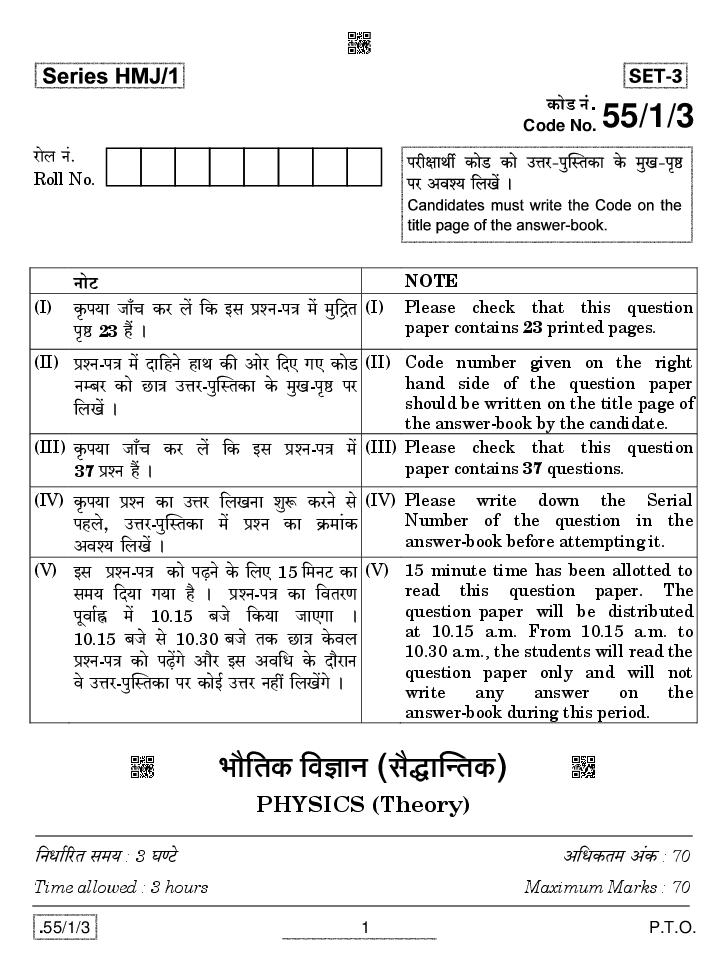
Code No. 55/1/3
amob Z§.
Roll No.
ZmoQ> NOTE
(I) H¥$n`m Om±M H$a b| {H$ Bg àíZ-nÌ _o§ _w{ÐV (I) Please check that this question
n¥ð> 23 h¢ & paper contains 23 printed pages.
(II) àíZ-nÌ _| Xm{hZo hmW H$s Amoa {XE JE H$moS (II) Code number given on the right
>Zå~a H$mo N>mÌ CÎma-nwpñVH$m Ho$ _wI-n¥ð> na hand side of the question paper
{bI| & should be written on the title page of
the answer-book by the candidate.
(III) H¥$n`m Om±M H$a b| {H$ Bg àíZ-nÌ _| (III) Please check that this question
>37 àíZ h¢ & paper contains 37 questions.
(IV) H¥$n`m àíZ H$m CÎma {bIZm ewê$ H$aZo go (IV) Please write down the Serial
nhbo, CÎma-nwpñVH$m _| àíZ H$m H«$_m§H$ Number of the question in the
Adí` {bI| & answer-book before attempting it.
(V) Bg àíZ-nÌ H$mo n‹T>Zo Ho$ {bE 15 {_ZQ >H$m (V) 15 minute time has been allotted to
g_` {X`m J`m h¡ & àíZ-nÌ H$m {dVaU read this question paper. The
nydm©• _| 10.15 ~Oo {H$`m OmEJm & question paper will be distributed
10.15 ~Oo go 10.30 ~Oo VH$ N>mÌ Ho$db at 10.15 a.m. From 10.15 a.m. to
10.30 a.m., the students will read the
àíZ-nÌ H$mo n‹T>|Jo Am¡a Bg Ad{Y Ho$ Xm¡amZ question paper only and will not
do CÎma-nwpñVH$m na H$moB© CÎma Zht {bI|Jo & write any answer on the
answer-book during this period.
^m¡{VH$ {dkmZ (g¡ÕmpÝVH$)
PHYSICS (Theory)
{ZYm©[aV g_` : 3 KÊQ>o A{YH$V_ A§H$ : 70
Time allowed : 3 hours Maximum Marks : 70
.55/1/3 1 P.T.O.
Page 2
{ZåZ{b{IV {ZX}em| H$mo ~hþV gmdYmZr go n{‹T>E Am¡a CZH$m g™Vr go nmbZ H$s{OE :
(i) `h àíZ-nÌ Mma IÊS>m| _§| {d^m{OV {H$`m J`m h¡ – H$, I, J Am¡a K &
(ii) Bg àíZ-nÌ _| 37 àíZ h¢ & g^r àíZ A{Zdm`© h¢ &
(iii) IÊS> H$ – àíZ g§»`m 1 go 20 VH$ A{V bKw-CÎmar` àíZ h¢, àË`oH$ àíZ 1 A§H$ H$m
h¡ &
(iv) IÊS> I – àíZ g§»`m 21 go 27 VH$ bKw-CÎmar` àíZ h¢, àË`oH$ àíZ 2 A§H$m| H$m h¡ &
(v) IÊS> J – àíZ g§»`m 28 go 34 VH$ XrK©-CÎmar` àH$ma Ho$ àíZ h¢, àË`oH$ àíZ
3 A§H$m| H$m h¡ &
(vi) IÊS> K – àíZ g§»`m 35 go 37 VH$ ^r XrK©-CÎmar` àH$ma Ho$ àíZ h¢, àË`oH$ àíZ
5 A§H$m| H$m h¡ &
(vii) àíZ-nÌ _| H$moB© g_J« {dH$ën Zht h¡ & VWm{n, EH$-EH$ A§H$ Ho$ Xmo àíZm| _|, Xmo-Xmo A§H$m|
dmbo Xmo àíZm| _§o, VrZ-VrZ A§H$m| dmbo EH$ àíZ _§o VWm nm±M-nm±M A§H$m| dmbo$ VrZm| àíZm|
_§o Am§V[aH$ {dH$ën {X`m J`m h¡ & Eogo àíZm| _| Ho$db EH$ hr {dH$ën H$m CÎma Xr{OE &
(viii) BgHo$ A{V[aº$, Amdí`H$VmZwgma, àË`oH$ IÊS> Am¡a àíZ Ho$ gmW `Wmo{MV {ZX}e {XE JE
h¢ &
(ix) Ho$ëHw$boQ>am| AWdm bm°J Q>o~bm| Ho$ à`moJ H$s AZw_{V Zht h¡ &
(x) Ohm± Amdí`H$ hmo, Amn {ZåZ{b{IV ^m¡{VH$ {Z`Vm§H$m| Ho$ _mZm| H$m Cn`moJ H$a gH$Vo h¢ :
c = 3 108 m/s
h = 6.63 10–34 Js
e = 1.6 10–19 C
0 = 4 10–7 T m A–1
0 = 8.854 10–12 C2 N–1 m–2
1
= 9 109 N m2 C–2
4
0
BboŠQ´>m°Z H$m Ðì`_mZ (me) = 9.1 10–31 kg
Ý`yQ´>m°Z H$m Ðì`_mZ = 1.675 10–27 kg
àmoQ>m°Z H$m Ðì`_mZ = 1.673 10–27 kg
AmdmoJmÐmo g§»`m = 6.023 1023 à{V J«m_ _mob
~moëQ²>µO_mZ {Z`Vm§H$ = 1.38 10–23 JK–1
.55/1/3 2
Page 3
Read the following instructions very carefully and strictly follow them :
(i) This question paper comprises four Sections – A, B, C and D.
(ii) There are 37 questions in the question paper. All questions are
compulsory.
(iii) Section A – Questions no. 1 to 20 are very short answer type questions,
carrying one mark each.
(iv) Section B – Questions no. 21 to 27 are short answer type questions,
carrying two marks each.
(v) Section C – Questions no. 28 to 34 are long answer type questions,
carrying three marks each.
(vi) Section D – Questions no. 35 to 37 are also long answer type questions,
carrying five marks each.
(vii) There is no overall choice in the question paper. However, an internal
choice has been provided in 2 questions of 1 mark, 2 questions of
2 marks, 1 question of three marks and all the 3 questions of five marks.
You have to attempt only one of the choices in such questions.
(viii) In addition to this, separate instructions are given with each section and
question, wherever necessary.
(ix) Use of calculators and log tables is not permitted.
(x) You may use the following values of physical constants wherever
necessary.
c = 3 108 m/s
h = 6.63 10–34 Js
e = 1.6 10–19 C
0 = 4 10–7 T m A–1
0 = 8.854 10–12 C2 N–1 m–2
1
= 9 109 N m2 C–2
4
0
Mass of electron (me) = 9.1 10–31 kg
Mass of neutron = 1.675 10–27 kg
Mass of proton = 1.673 10–27 kg
Avogadro’s number = 6.023 1023 per gram mole
Boltzmann constant = 1.38 10–23 JK–1
.55/1/3 3 P.T.O.
Page 4
ZmoQ> : ZrMo {XE JE àË`oH$ àíZ _| g~go A{YH$ Cn`wº$ {dH$ën Mw{ZE :
1. AndV©Zm§H$ 1·47 Ho$ H$m±M go ~Zm H$moB© C^¶moÎmb b|g {H$gr Ðd ‘| Sy>~m h¡ & ¶h b|g
AÑí¶ hmo OmVm h¡ Am¡a H$m±M H$s g‘Vb n{Å>H$m H$s ^m±{V ì¶dhma H$aVm h¡ & Bg Ðd H$m
AndV©Zm§H$ h¡ 1
(A) 1·47
(B) 1·62
(C) 1·33
(D) 1·51
2. ZrMo {XE JE {H$g dU© Ho$ àH$me Ho$ {bE {H$gr H$m±M Ho$ {àµÁ‘ Ho$ AënV‘ {dMbZ H$moU
H$m ‘mZ g~go H$‘ hmoJm ? 1
(A) bmb dU©
(B) Zrbm dU©
(C) nrbm dU©
(D) ham dU©
3. aXaµ’$moS>© ‘m°S>b Ho$ AZwgma {ZåZ{b{IV _| go H$m¡Z-gm H$WZ ghr Zht h¡ ? 1
(A) {H$gr na‘mUw Ho$ ^rVa CgH$m A{YH$m§e ^mJ Imbr h¡ &
(B) Zm{^H$ Ho$ Mmam| Amoa Bbo³Q´>m°Z CZ na H$m¶©aV Hy$bm°‘r ~b Ho$ à^md ‘| n[aH«$‘m
H$aVo h¢ &
(C) na‘mUw H$m A{YH$m§e Ð춑mZ VWm CgH$m Hw$b YZmdoe CgHo$ Ho$ÝÐ na gm§{ÐV hmoVm
h¡ &
(D) Bg ‘m°S>b Ûmam na‘mUw Ho$ ñWm{¶Ëd H$mo ñWm{nV {H$¶m J¶m &
4. 0·5 eV H$m¶©’$bZ Ho$ {H$gr YmpËdH$ n¥îR> na 1 eV Am¡a 2 eV D$Om©Am| Ho$ µ\$moQ>m°Z H«$‘mJV
AmnVZ H$aVo h¢ & BZ XmoZm| àH$aUm| ‘| A{YH$V_ D$Ou¶ àH$m{eH$-Bbo³Q´>m°Zm| H$s J{VO
D$Om©Am| H$m AZwnmV hmoJm 1
(A) 1:2
(B) 1:1
(C) 1:3
(D) 1:4
.55/1/3 4
Page 5
Note : Select the most appropriate option from those given below each
question :
1. A biconvex lens of glass having refractive index 1·47 is immersed in a
liquid. It becomes invisible and behaves as a plane glass plate. The
refractive index of the liquid is 1
(A) 1·47
(B) 1·62
(C) 1·33
(D) 1·51
2. For a glass prism, the angle of minimum deviation will be smallest for
the light of 1
(A) red colour.
(B) blue colour.
(C) yellow colour.
(D) green colour.
3. Which of the following statements is not correct according to Rutherford
model ? 1
(A) Most of the space inside an atom is empty.
(B) The electrons revolve around the nucleus under the influence of
coulomb force acting on them.
(C) Most part of the mass of the atom and its positive charge are
concentrated at its centre.
(D) The stability of atom was established by the model.
4. Photons of energies 1 eV and 2 eV are successively incident on a metallic
surface of work function 0·5 eV. The ratio of kinetic energy of most
energetic photoelectrons in the two cases will be 1
(A) 1:2
(B) 1:1
(C) 1:3
(D) 1:4
.55/1/3 5 P.T.O.
Page 6
H$aVm h¡ ? 1
(A) Hw$ÊS>br ‘| ’o$am| H$s g§»¶m
(B) Hw$ÊS>br H$s AZwàñW-H$mQ> H$m joÌ’$b
(C) Hw$ÊS>br ‘| àdm{hV Ymam
(D) Hw$ÊS>br Ho$ ’o$am| H$m nXmW©
6. Vmn ‘| d¥{Õ hmoZo na {H$gr YmVw H$s MmbH$Vm ‘| H$‘r hmoZo H$m H$maU h¡ 1
(A) Bbo³Q´>m°Zm| Ho$ g§»¶m KZËd ‘| H$‘r hmoZm &
(B) à{VamoYH$Vm ‘| H$‘r hmoZm &
(C) {dlmpÝV H$mb ‘| H$‘r hmoZm &
(D) ‘mܶ ‘w³V nW ‘| d¥{Õ hmoZm &
7. Xmo Ag‘mZ à{VamoYH$ {H$gr ~¡Q>ar go loUr ‘| g§¶mo{OV h¢ & V~ 1
(A) à˶oH$ à{VamoYH$ Ho$ {gam| na g‘mZ {d^dmÝVa hmoJm &
(B) N>moQ>o à{VamoYH$ go A{YH$ Ymam àdm{hV hmoJr &
(C) ~‹S>o à{VamoYH$ Ho$ {gam| na {d^dmÝVa A{YH$ hmoJm &
(D) XmoZm| à{VamoYH$m| ‘| g‘mZ e{³V j¶ hmoJm &
8. H$moB© {~ÝXþ Amdoe {H$gr N>moQ>o {dÚwV² {ÛY«wd Ho$ Ajr¶ {~ÝXþ na Cggo H$m’$s Xÿar na pñWV
h¡ & ¶h {~ÝXþ Amdoe F ~b H$m AZw^d H$aVm h¡ & ¶{X Amdoe H$s Xÿar XþJwZr H$a Xr OmE,
Vmo Amdoe na H$m¶©aV ~b hmoJm 1
(A) 2F
(B) F/2
(C) F/4
(D) F/8
9. ¶{X {H$gr ~ÝX n¥îR> go JwµOaZo dmbm ZoQ> {dÚwV² âb³g eyݶ h¡, Vmo Bggo ¶h {ZîH$f©
{ZH$mbm Om gH$Vm h¡ {H$ 1
(A) Bg n¥îR> go H$moB© ZoQ> Amdoe n[a~Õ Zht h¡ &
(B) Bg n¥îR> Ho$ ^rVa EH$g‘mZ {dÚwV²-joÌ {dÚ‘mZ h¡ &
(C) Bg n¥îR> Ho$ ^rVa EH$ {~ÝXþ go Xÿgao {~ÝXþ VH$ {dÚwV² {d^d {dM[aV H$aVm h¡ &
(D) n¥îR> Ho$ ^rVa Amdoe CnpñWV h¡ &
.55/1/3 6
Page 7
upon 1
(A) number of turns of the coil.
(B) cross-sectional area of the coil.
(C) current flowing in the coil.
(D) material of the turns of the coil.
6. The conductivity of a metal decreases with the increase in temperature
on account of 1
(A) decrease in number density of electrons.
(B) decrease in resistivity.
(C) decrease in relaxation time.
(D) increase in mean free path.
7. Two unequal resistors are connected in series across a battery. Then the 1
(A) potential difference across each resistor is the same.
(B) current in the smaller resistor is larger.
(C) potential difference across the bigger resistor is greater.
(D) power dissipated in both resistors is the same.
8. A point charge is situated at an axial point of a small electric dipole at a
large distance from it. The charge experiences a force F. If the distance of
the charge is doubled, the force acting on the charge will become 1
(A) 2F
(B) F/2
(C) F/4
(D) F/8
9. If the net electric flux through a closed surface is zero, then we can infer 1
(A) no net charge is enclosed by the surface.
(B) uniform electric field exists within the surface.
(C) electric potential varies from point to point inside the surface.
(D) charge is present inside the surface.
.55/1/3 7 P.T.O.
Page 8
(A) Zo{ÌH$m H$s ’$moH$g Xÿar go A{YH$ &
(B) Zo{ÌH$m H$s ’$moH$g Xÿar go H$‘ &
(C) Zo{ÌH$m H$s ’$moH$g Xÿar Ho$ g‘mZ &
(D) gyú‘Xeu H$s Z{bH$m H$s bå~mB© Ho$ g‘mZ &
ZmoQ> : Cn`wº$ CÎma go [aº$ ñWmZm| H$s ny{V© H$s{OE :
11. {H$gr n[aZm{bH$m H$s bå~mB© Am¡a CgH$s AZwàñW-H$mQ> Ho$ joÌ’$b ‘| {~Zm H$moB© n[adV©Z
{H$E Cg‘| ’o$am| H$s g§»¶m XþJwZr H$a Xr JB© h¡ & Bg n[aZm{bH$m H$m ñd -àoaH$Ëd
_________ JwZm hmo OmEJm & 1
12. ~moa Ho$ na‘mUw ‘m°S>b Ho$ AZwgma Bbo³Q´>m°Z H$s H$jm H$s n[a{Y gX¡d Xo ~«m°½br Va§JX¡¿¶© H$s
_________ JwUO hmoVr h¡ & 1
AWdm
-j¶ ‘| OZH$ Am¡a g§V{V Zm{^H$m| ‘| _________ H$s g§»¶m g‘mZ hmoVr h¡ & 1
13. {H$gr H$m±M Ho$ g‘~mhþ {àµÁ‘ go JwµOaVr hþB© {H$gr àH$me {H$aU ‘| Cg {àµÁ_ Ho$ H$moU Ho$
~am~a AënV‘ {dMbZ hmoVm h¡ & Bg {àµÁ‘ Ho$ nXmW© Ho$ AndV©Zm§H$ H$m _mZ _________
h¡ & 1
14. {H$gr AZwMwå~H$s¶ nXmW© Ho$ Ûmam Mwå~H$s¶ joÌ aoImE± _________ hmoVr h¢ & 1
15. {H$gr Q´>mÝg’$m°‘©a Ho$ H«$moS> ‘| _________ YmamAm| H$mo {ZåZV‘ H$aZo Ho$ {bE nQ>{bV bmoho
H$s erQ>m| H$m Cn¶moJ {H$¶m OmVm h¡ & 1
ZmoQ> : {ZåZ{b{IV Ho$ CÎma Xr{OE :
27 64
16. Al H$s Zm{^H$s¶ {ÌÁ¶m 3·6 ’$‘u h¡ & Cu H$s Zm{^H$s¶ {ÌÁ¶m kmV H$s{OE & 1
13 29
AWdm
{H$gr Bbo³Q´>m°Z Am¡a {H$gr àmoQ>m°Z H$s Mmb g‘mZ h¢ & BZgo g§~Õ Xo ~m°½br Va§JX¡¿¶m] H$m
AZwnmV kmV H$s{OE & 1
.55/1/3 8
Page 9
(A) greater than the focal length of eyepiece.
(B) lesser than the focal length of eyepiece.
(C) equal to the focal length of eyepiece.
(D) equal to the length of its tube.
Note : Fill in the blanks with appropriate answer :
11. The number of turns of a solenoid are doubled without changing its
length and area of cross-section. The self-inductance of the solenoid will
become ___________ times. 1
12. According to Bohr’s atomic model, the circumference of the electron orbit
is always an ___________ multiple of de Broglie wavelength. 1
OR
In -decay, the parent and daughter nuclei have the same number of
_____________ . 1
13. A ray of light on passing through an equilateral glass prism, suffers a
minimum deviation equal to the angle of the prism. The value of
refractive index of the material of the prism is ___________ . 1
14. The magnetic field lines are _________ by a paramagnetic substance. 1
15. Laminated iron sheets are used to minimize ___________ currents in the
core of a transformer. 1
Note : Answer the following :
27 64
16. The nuclear radius of Al is 3·6 fermi. Find the nuclear radius of Cu . 1
13 29
OR
A proton and an electron have equal speeds. Find the ratio of de Broglie
wavelengths associated with them. 1
.55/1/3 9 P.T.O.
Page 10
{ZamoYr {d^d (Vo) H$m {dMaU AmaoI ‘| Xem©E AZwgma h¡ & BZ‘| go A{YH$ H$m¶©’$bZ
dmbo n¥îR> H$s nhMmZ H$s{OE & 1
18. Ñí¶ LED Ho$ {daMZ ‘| h‘ Si Am¡a Ge H$m Cn¶moJ ³¶m| Zht H$a gH$Vo h¢ ? 1
19. MmbZ Ymam Am¡a {dñWmnZ Ymam Ho$ ~rM {d^oXZ H$s{OE & 1
20. ‘mXZ gm§ÐVm ‘| d¥{Õ {H$g àH$ma {H$gr p-n g§{Y S>m¶moS> Ho$ õmgr ñVa H$s Mm¡‹S>mB© H$mo
à^m{dV H$aVr h¡ ? 1
IÊS> I
21. {H$gr p-n g§{Y S>m¶moS> Ho$ {bE nX ‘õmgr ñVa’ Am¡a ‘{d^d àmMra’ H$s ì¶m»¶m H$s{OE &
O~ {H$gr p-n g§{Y H$mo AJ«{X{eH$ ~m¶g H$aVo h¢, Vmo
(a) õmgr ñVa H$s Mm¡‹S>mB©, VWm
(b) {d^d àmMra H$m ‘mZ {H$g àH$ma à^m{dV hmoVm h¡ ? 2
22. ~moa Ho$ na‘mUw ‘m°S>b H$m Cn¶moJ H$aHo$ hmBS´>moOZ na‘mUw H$s ndt H$jm ‘| n[aH«$‘m H$aVo
hþE Bbo³Q´>m°Z Ho$ doJ Ho$ {bE 춧OH$ ì¶wËnÞ H$s{OE & 2
AWdm
ì¶m»¶m H$s{OE {H$ -H$Um| Ho$ CËgO©Z H$s à{H«$¶m go àH$m{eH$-Bbo³Q´>m°Zm| Ho$ CËgO©Z H$s
à{H«$¶m {H$g àH$ma {^Þ hmoVr h¡ & 2
.55/1/3 10
Page 11
light incident on two different photosensitive surfaces M1 and M2 is
shown in the figure. Identify the surface which has greater value of the
work function. 1
18. Why cannot we use Si and Ge in fabrication of visible LEDs ? 1
19. Differentiate between conduction current and displacement current. 1
20. How does an increase in doping concentration affect the width of
depletion layer of a p-n junction diode ? 1
SECTION B
21. Explain the terms ‘depletion layer’ and ‘potential barrier’ in a
p-n junction diode. How are the (a) width of depletion layer, and
(b) value of potential barrier affected when the p-n junction is forward
biased ? 2
22. Using Bohr’s atomic model, derive the expression for the velocity of
electron revolving in the nth orbit of hydrogen atom. 2
OR
Explain, how the process of emission of photoelectrons is different from
the process of emission of -particles. 2
.55/1/3 11 P.T.O.
Page 12
pñWV h¢, go g‘mZ {Xem ‘| g‘mZ Ymam I àdm{hV hmo ahr h¡ &
(a) BZ Vmam| Ho$ ~rM {H$gr EH$ Vma go Xÿar x na pñWV {H$gr {~ÝXþ P na Mwå~H$s¶ joÌ
kmV H$s{OE &
(b) Xÿar x Ho$ gmW, 0 < x < d Ho$ {bE, Mwå~H$s¶ joÌ ‘| {dMaU H$mo Xem©Zo Ho$ {bE J«m’$
It{ME & 2
24. J{Verb Va§J Ho$ Va§JmJ« H$s n[a^mfm {b{IE & hmBJoÝg {gÕmÝV H$m Cn¶moJ H$aHo$, Cg
pñW{V ‘| O~ àH$me {H$gr gKZ ‘mܶ‘ go {dab ‘mܶ‘ ‘| J‘Z H$aVm h¡, {H$gr g‘Vb
AÝVamn¥îR> na AndV©Z H$m {Z¶‘ àmßV H$s{OE & 2
AWdm
b|g _oH$a gyÌ H$m Cn`moJ H$aHo$ {H$gr nVbo C^`moÎmb b|g Ho$ gyÌ 1 1 – 1 H$mo
f v u
ì`wËnÞ H$s{OE & 2
25. nX ao{S>¶moEop³Q>d nXmW© H$s ‘AY©-Am¶w’ H$s n[a^mfm {b{IE & Xmo {d{^Þ ao{S>¶moEop³Q>d
nXmWm] H$s AY©-Am¶w T1 Am¡a T2 VWm {H$gr jU na CZ‘| eof ~Mo hþE na‘mUwAm| H$s
g§»¶m H«$‘e… N1 Am¡a N2 h¡ & Cg jU BZH$s g{H«$¶VmAm| H$m AZwnmV kmV H$s{OE & 2
26. {H$gr g‘mÝVa n{Å>H$m g§Ym[aÌ H$s Xmo n{Å>H$mAm| Ho$ ~rM Ho$ [a³V ñWmZ H$mo Xmo àH$ma go
nyU©V… ^am J¶m h¡ & nhbo àH$aU ‘| [a³V ñWmZ H$mo namd¡ÚwVm§H$ K Ho$ {H$gr JwQ>Ho$ go ^am
J¶m h¡ & Xÿgao àH$aU ‘| Bgo g‘mZ {d‘mAm|, naÝVw namd¡ÚwVm§H$ K1 Am¡a K2 Ho$ Xmo JwQ>H$m| go
AmaoI ‘| Xem©E AZwgma ^am J¶m h¡ & XmoZm| àH$aUm| ‘| g§Ym[aÌ H$s Ym[aVm g‘mZ h¡ &
K, K1 Am¡a K2 ‘| g§~§Y àmßV H$s{OE & 2
(àH$aU 1) (àH$aU 2)
27. {H$gr ‘rQ>a goVw H$s H$m¶©{d{Y Ho$ {gÕmÝV H$s ì¶m»¶m H$s{OE & BgHo$ Cn¶moJ Ûmam {H$gr
AkmV à{VamoY Ho$ ‘mZ H$mo {ZYm©[aV H$aZo Ho$ {bE n[anW AmaoI It{ME & 2
.55/1/3 12
Page 13
equal current I flowing in same direction as shown in the figure.
(a) Find the magnetic field at a point P situated between them at a
distance x from one wire.
(b) Show graphically the variation of the magnetic field with distance
x for 0 < x < d. 2
24. Define wavefront of a travelling wave. Using Huygens principle, obtain
the law of refraction at a plane interface when light passes from a denser
to rarer medium. 2
OR
1 1 1
Using lens maker’s formula, derive the thin lens formula – for a
f v u
biconvex lens. 2
25. Define the term ‘Half-life’ of a radioactive substance. Two different
radioactive substances have half-lives T1 and T2 and number of
undecayed atoms at an instant N1 and N2, respectively. Find the ratio of
their activities at that instant. 2
26. The space between the plates of a parallel plate capacitor is completely
filled in two ways. In the first case, it is filled with a slab of dielectric
constant K. In the second case, it is filled with two slabs of equal
dimensions but dielectric constants K1 and K2, respectively as shown in
the figure. The capacitance of the capacitor is same in the two cases.
Obtain the relationship between K, K1 and K2. 2
(Case 1) (Case 2)
27. Explain the principle of working of a meter bridge. Draw the circuit
diagram for determination of an unknown resistance using it. 2
.55/1/3 13 P.T.O.
Page 14
28. (a) Amno{jH$ {dÚwV²erbVm r VWm Amno{jH$ Mwå~H$erbVm r Ho$ {H$gr Ðì¶mË‘H$
‘mܶ‘ ‘| àH$me H$s Mmb Ho$ {bE 춧OH$ {b{IE &
(b) {ZåZ{b{IV ‘| Cn¶moJ hmoZo dmbr {dÚwV²-Mwå~H$s¶ Va§Jm| Ho$ Zm‘ Am¡a Va§JX¡¿¶©
n[aga {b{IE :
(i) aoS>ma àUm{b¶m| ‘| {d‘mZ MmbZ (nW-àXe©Z) ‘|
(ii) µ\$gbm| H$s d¥{Õ Ho$ àojU Ho$ {bE n¥Ïdr Ho$ CnJ«hm| _| 3
29. {ZåZ{b{IV à˶oH$ Ho$ {bE H$maU Xr{OE : 3
(a) ¶§J Ho$ {Û{Par à¶moJ ‘| nX} Ho$ Hw$N> {~ÝXþAm| na àH$me H$s Vrd«Vm eyݶ hmoVr h¡ &
(b) {H$gr nmoboam°BS> Ûmam nmaJ{‘V àH$me H$s Vrd«Vm Cg na Amn{VV AY«w{dV àH$me
H$s Vrd«Vm go H$‘ hmoVr h¡ &
(c) EH$b {Par {ddV©Z à¶moJ ‘|, O~ ídoV àH$me òmoV H$m Cn¶moJ {H$¶m OmVm h¡, Vmo
nX} na Ho$ÝÐr¶ ídoV C{ƒîR> Ho$ Mmam| Amoa Hw$N> a§JrZ q’«$O| {XImB© XoVr h¢ &
30. Xmo p-n g§{Y S>m¶moS>m| H$m Cn¶moJ H$aHo$ {H$gr nyU© Va§J {XîQ>H$mar H$m n[anW AmaoI
It{ME & BgH$s H$m¶©{d{Y H$s ì¶m»¶m H$s{OE VWm {Zdoer Am¡a {ZJ©V dmoëQ>Vm Ho$ {dMaUm|
H$mo Xem©BE & 3
31. (a) Xmo gobm| Ho$ {d.dm. ~b (emf) E1 Am¡a E2 VWm BZHo$ AmÝV[aH$ à{VamoY H«$‘e… r1
Am¡a r2 h¢ & O~ BZHo$ nmíd© g§¶moOZ H$mo {H$gr ~mø à{VamoY R go g§¶mo{OV {H$¶m
OmVm h¡, BZHo$ Vwë¶ {d.dm. ~b (emf) VWm Am§V[aH$ à{VamoY Ho$ {bE 춧OH$
ì¶wËnÞ H$s{OE & ¶h ‘m{ZE {H$ XmoZm| gob EH$-Xÿgao H$s ghm¶Vm H$a aho h¢ &
(b) Cg àH$aU ‘| O~ XmoZm| gob gd©g‘ h¢ Am¡a à˶oH$ H$m {d.dm. ~b (emf)
E = 5 V VWm Am§V[aH$ à{VamoY r = 2 h¡, R = 10 Ho$ ~mø à{VamoY Ho$ {gam|
na dmoëQ>Vm n[aH${bV H$s{OE & 3
.55/1/3 14
Page 15
28. (a) Write the expression for the speed of light in a material medium of
relative permittivity r and relative magnetic permeability r.
(b) Write the wavelength range and name of the electromagnetic
waves which are used in (i) radar systems for aircraft navigation,
and (ii) Earth satellites to observe the growth of the crops. 3
29. Give reasons for each of the following : 3
(a) The intensity of light at some points on the screen in Young’s
double slit experiment is zero.
(b) The intensity of light transmitted by a polaroid is less than the
intensity of the unpolarised light incident on it.
(c) In the single slit diffraction experiment, some coloured fringes
around the central white maximum are observed on the screen
when one uses a source of white light.
30. Draw the circuit diagram of a full wave rectifier using two p-n junction
diodes. Explain its working and show input and output voltage
variations. 3
31. (a) Two cells of emf E1 and E2 have their internal resistances r1 and
r2, respectively. Deduce an expression for the equivalent emf and
internal resistance of their parallel combination when connected
across an external resistance R. Assume that the two cells are
supporting each other.
(b) In case the two cells are identical, each of emf E = 5 V and internal
resistance r = 2 , calculate the voltage across the external
resistance R = 10 . 3
.55/1/3 15 P.T.O.
Page 16
g§Ym[aÌ C g§¶mo{OV h¢ &
(a) n[anW ‘| VmËj{UH$ Ymam (I) Ho$ {bE 춧OH$ àmßV H$s{OE &
(b) t Ho$ ’$bZ Ho$ ê$n ‘| V Am¡a I Ho$ {dMaUm| H$mo J«m’$ Ûmam Xem©BE & 3
33. (a) {H$gr Ymamdmhr d¥ÎmmH$ma Hw$ÊS>br, {OgH$s {ÌÁ¶m r VWm ’o$am| H$s g§»¶m N h¡, go
Ymam (I) àdm{hV hmo ahr h¡ & Bg Hw$ÊS>br go g§~Õ Mwå~H$s¶ joÌ Ho$ {bE 춧OH$
{b{IE &
(b) ¶h ‘m{ZE {H$ Cn`w©º$ Hw$ÊS>br H$mo YZ Vb ‘| BgHo$ Ho$ÝÐ H$mo ‘yb-{~ÝXþ na aIVo
hþE pñWV {H$¶m J¶m h¡ & {~ÝXþ (x, 0, 0) na Bg Hw$ÊS>br Ho$ H$maU CËnÞ Mwå~H$s¶
joÌ Ho$ _mZ Ho$ {bE 춧OH$ ì¶wËnÞ H$s{OE & 3
AWdm
(a) {H$gr J¡ëdoZmo‘rQ>a H$s Ymam gwJ«m{hVm H$s n[a^mfm Xr{OE Am¡a BgHo$ {bE 춧OH$
{b{IE &
(b) {H$gr J¡ëdoZmo‘rQ>a H$m à{VamoY G Am¡a BgH$s nyU© n¡‘mZm {djonU Ymam Ig h¡ &
(i) Bg J¡ëdoZmo‘rQ>a H$mo I0 (I0 > Ig) VH$ H$s Ymam ‘mn gH$Zo dmbo Eo‘rQ>a ‘|
{H$g àH$ma n[ad{V©V {H$¶m Om gH$Vm h¡ ?
(ii) Bg Eo‘rQ>a H$m à^mdr à{VamoY ³¶m h¡ ? 3
34. Zm{^H$ 235
92
Y Omo Amaå^ ‘| {dam‘ ‘| h¡, EH$ -H$U H$mo CËg{O©V H$aHo$
231
90
X ‘|
Anj{¶V hmo OmVm h¡ &
235 231 4
Y X He + D$Om©
92 90 2
OZH$ Zm{^H$, g§V{V Zm{^H$ Am¡a -H$U H$s ~§YZ D$Om© à{V ݶyp³bAm°Z H«$‘e…
7·8 MeV, 7·835 MeV Am¡a 7·07 MeV h¢ & ¶h nyd©YmaUm aIVo hþE {H$ ~ZZo dmbm
g§V{V Zm{^H$ CÎmo{OV AdñWm ‘| Zht h¡ VWm A{^{H«$¶m H$s D$Om© ‘| CgH$s ^mJrXmar H$s
Cnojm H$aVo hþE CËg{O©V -H$U H$s Mmb kmV H$s{OE & 3
(-H$U H$m Ð춑mZ = 6·68 10–27 kg)
.55/1/3 16
Page 17
ac source V = V0 sin t.
(a) Obtain the expression for the instantaneous current (I) in the
circuit.
(b) Show graphically variations of V and I as a function of t. 3
33. (a) Write an expression of magnetic moment associated with a
current (I) carrying circular coil of radius r having N turns.
(b) Consider the above mentioned coil placed in YZ plane with its
centre at the origin. Derive expression for the value of magnetic
field due to it at point (x, 0, 0). 3
OR
(a) Define current sensitivity of a galvanometer. Write its expression.
(b) A galvanometer has resistance G and shows full scale deflection for
current Ig.
(i) How can it be converted into an ammeter to measure
current up to I0 (I0 > Ig) ?
(ii) What is the effective resistance of this ammeter ? 3
235 231
34. The nucleus Y , initially at rest, decays into X by emitting an
92 90
-particle
235 231 4
Y X He + energy.
92 90 2
The binding energies per nucleon of the parent nucleus, the daughter
nucleus and -particle are 7·8 MeV, 7·835 MeV and 7·07 MeV,
respectively. Assuming the daughter nucleus to be formed in the
unexcited state and neglecting its share in the energy of the reaction, find
the speed of the emitted -particle. (Mass of -particle = 6·68 10–27 kg) 3
.55/1/3 17 P.T.O.
Page 18
35. (a) Cg pñW{V Ho$ {bE {H$gr IJmobr¶ XÿaXe©H$ H$m {H$aU AmaoI It{ME {Og‘| A§{V‘
à{V{~å~ AZÝV na ~ZVm h¡ & Bg XÿaXe©H$ H$s {d^oXZ j‘Vm Ho$ {bE 춧OH$
{b{IE &
(b) {H$gr IJmobr¶ XÿaXe©H$ Ho$ A{^Ñí¶H$ b|g H$s ’$moH$g Xÿar 20 m Am¡a BgH$s
Zo{ÌH$m H$s ’$moH$g Xÿar 1 cm h¡ &
(i) Bg XÿaXe©H$ H$m H$moUr¶ AmdY©Z kmV H$s{OE &
(ii) ¶{X Bg XÿaXe©H$ H$m Cn¶moJ MÝБm H$mo XoIZo ‘| {H$¶m OmVm h¡,
Vmo A{^Ñí¶H$ b|g Ûmam ~Zo à{V{~å~ H$m ì¶mg kmV H$s{OE & {X¶m J`m
h¡ {H$ MÝБm H$m ì¶mg 3·5 106 m VWm MÝБm H$s H$jm H$s {ÌÁ¶m
3·8 108 m h¡ & 5
AWdm
(a) H$moB© {~å~ {H$gr AdVb Xn©U Ho$ gm‘Zo pñWV h¡ & àojU H$aZo na ¶h nm¶m OmVm
h¡ {H$ {~å~ H$m Am^mgr à{V{~å~ ~Zm h¡ & à{V{~å~ ~ZZm Xem©Zo Ho$ {bE {H$aU
AmaoI It{ME VWm Bggo Xn©U g‘rH$aU, 1 1 1 ì¶wËnÞ H$s{OE &
f u v
(b) H$moB© {~å~ {H$gr g‘Vb-CÎmb b|g Ho$ gm‘Zo, {OgHo$ Jmobr¶ n¥îR> H$s dH«$Vm
{ÌÁ¶m 20 cm h¡, Ho$ gm‘Zo 30 cm Xÿar na pñWV h¡ & ¶{X b|g Ho$ nXmW© H$m
AndV©Zm§H$ 1·5 h¡, Vmo ~Zo à{V{~å~ H$s pñW{V Am¡a àH¥${V kmV H$s{OE & 5
36. (a) JmCg {Z¶‘ H$m Cn¶moJ H$aVo hþE, R {ÌÁ¶m Ho$ EH$g‘mZ Amdoe {dVaU Ho$
Jmobr¶ Imob Ho$ H$maU BgHo$ Ho$ÝÐ go Xÿar x Ho$ {H$gr {~ÝXþ na {dÚwV²-joÌ Ho$ {bE
춧OH$ ì¶wËnÞ H$s{OE, O~{H$
(i) 0 < x < R, Am¡a
(ii) x > R.
.55/1/3 18
Page 19
35. (a) Draw the ray diagram of an astronomical telescope when the final
image is formed at infinity. Write the expression for the resolving
power of the telescope.
(b) An astronomical telescope has an objective lens of focal length
20 m and eyepiece of focal length 1 cm.
(i) Find the angular magnification of the telescope.
(ii) If this telescope is used to view the Moon, find the diameter
of the image formed by the objective lens. Given the
diameter of the Moon is 3·5 106 m and radius of lunar orbit
is 3·8 108 m. 5
OR
(a) An object is placed in front of a concave mirror. It is observed that
a virtual image is formed. Draw the ray diagram to show the
1 1 1
image formation and hence derive the mirror equation .
f u v
(b) An object is placed 30 cm in front of a plano-convex lens with its
spherical surface of radius of curvature 20 cm. If the refractive
index of the material of the lens is 1·5, find the position and nature
of the image formed. 5
36. (a) Using Gauss law, derive expression for electric field due to a
spherical shell of uniform charge distribution and radius R at a
point lying at a distance x from the centre of shell, such that
(i) 0 < x < R, and
(ii) x > R.
.55/1/3 19 P.T.O.
Page 20
H$m¶©aV h¡ & naÝVw BgHo$ gmW-gmW G UmË‘H$ x Ho$ joÌ ‘| – x {Xem Ho$ AZw{Xe ¶h
g‘mZ n[a‘mU Ho$ gmW H$m¶©aV h¡ & Bg joÌ H$m ‘mZ E = 200 N/C x > 0 Ho$
{bE VWm E = – 200 N/C x < 0 Ho$ {bE h¡ & bå~mB© 20 cm Am¡a {ÌÁ¶m 5 cm
H$m H$moB© bå~-d¥Îmr` {g{bÊS>a x-Aj Ho$ AZw{Xe Bg àH$ma pñWV h¡ {H$ BgH$m
Ho$ÝÐ ‘yb-{~ÝXþ na VWm EH$ g_Vb ’$bH$ x = + 10 cm Am¡a Xÿgam ’$bH$
x = – 10 cm na h¡ &
kmV H$s{OE :
(i) {g{bÊS>a go hmoH$a JwµOaZo dmbm ZoQ> ~{h‘w©Ir âb³g &
(ii) {g{bÊS>a Ho$ ^rVa CnpñWV Hw$b Amdoe & 5
AWdm
(a) {H$gr ~mø {dÚwV²-joÌ E ‘|
r Am¡a r na H«$‘e… pñWV Xmo {~ÝXþ Amdoem|
1 2
q1 Am¡a q2 Ho$ {ZH$m¶ H$s pñW{VO D$Om© Ho$ {bE 춧OH$ àmá H$s{OE &
(b) {H$gr {d¶w³V {~ÝXþ Amdoe (– q) Ho$ H$maU g‘{d^d n¥îR> It{ME VWm BgH$s
{dÚwV²-joÌ aoImE± {M{ÌV H$s{OE &
(c) + 1 C, – 1 C Am¡a + 2 C Ho$ VrZ {~ÝXþ Amdoe Amaå^ ‘| EH$-Xÿgao go AZÝV
Xÿar na h¢ & BZ g^r Amdoem| H$mo 10 cm ^wOm Ho$ {H$gr g‘~mhþ {Ì^wO Ho$ erfm] na
ñWm{nV H$aZo ‘| {H$¶m J¶m Hw$b H$m¶© n[aH${bV H$s{OE & 5
37. (a) {H$gr J¡ëdoZmo‘rQ>a H$s Am¶VmH$ma Ymamdmhr Hw$ÊS>br na H$m¶©aV ~b-AmKyU© Ho$ {bE
춧OH$ ì¶wËnÞ H$s{OE & Mwå~H$s¶ joÌ H$mo Aar¶ ³¶m| ~Zm¶m OmVm h¡ ?
(b) {H$gr -H$U H$mo 10 kV Ho$ {d^dmÝVa VH$ Ëd[aV {H$¶m J¶m h¡ VWm ¶h x-Aj Ho$
AZw{Xe J{V‘mZ h¡ & ¶h y-Aj Ho$ AZw{Xe H$m¶©aV B = 2 10–3 T Ho$ EH$g‘mZ
Mwå~H$s¶ joÌ ‘| àdoe H$aVm h¡ & BgHo$ nW H$s {ÌÁ¶m kmV H$s{OE &
(-H$U H$m Ð춑mZ = 6·4 10–27 kg br{OE) 5
AWdm
(a) Zm‘m§{H$V AmaoI H$s ghm¶Vm go {H$gr CÀMm¶r Q´>mÝg’$m°‘©a H$s H$m¶©{d{Y H$s
ì¶m»¶m H$s{OE & {ZåZ{b{IV H$s ì¶m»¶m Ho$ {bE H$maU Xr{OE :
(i) Q´>mÝg’$m°‘©a H$m H«$moS> nQ>{bV hmoVm h¡ &
(ii) bnoQ>m| ‘| Vm±~o (H$m°na) Ho$ ‘moQ>o Vma H$m Cn¶moJ {H$¶m OmVm h¡ &
.55/1/3 20
Page 21
region of positive x. It is also uniform with the same magnitude
but acts in – x direction in the region of negative x. The value of
the field is E = 200 N/C for x > 0 and E = – 200 N/C for x < 0. A
right circular cylinder of length 20 cm and radius 5 cm has its
centre at the origin and its axis along the x-axis so that one flat
face is at x = + 10 cm and the other is at x = – 10 cm.
Find :
(i) The net outward flux through the cylinder.
(ii) The net charge present inside the cylinder. 5
OR
(a) Find the expression for the potential energy of a system of two
point charges q1 and q2 located at r and r , respectively in an
1 2
external electric field E .
(b) Draw equipotential surfaces due to an isolated point charge (– q)
and depict the electric field lines.
(c) Three point charges + 1 C, – 1 C and + 2 C are initially infinite
distance apart. Calculate the work done in assembling these
charges at the vertices of an equilateral triangle of side 10 cm. 5
37. (a) Derive the expression for the torque acting on the rectangular
current carrying coil of a galvanometer. Why is the magnetic field
made radial ?
(b) An -particle is accelerated through a potential difference of 10 kV
and moves along x-axis. It enters in a region of uniform magnetic
field B = 2 10–3 T acting along y-axis. Find the radius of its path.
(Take mass of -particle = 6·4 10–27 kg ) 5
OR
(a) With the help of a labelled diagram, explain the working of a
step-up transformer. Give reasons to explain the following :
(i) The core of the transformer is laminated.
(ii) Thick copper wire is used in windings.
.55/1/3 21 P.T.O.
Page 22
{MH$Zr g‘mÝVa nQ>[a¶m| AA Am¡a CC na pñWV h¡ & ¶h N>‹S> BZ nQ>[a¶m| na gaH$
gH$Vr h¡ VWm ¶h ì¶dñWm EH$g_mZ Mwå~H$s¶ joÌ B = 0·4 T CËnÞ H$aZo dmbo
ñWm¶r Mwå~H$ Ho$ Y«wdm| Ho$ ~rM aIr JB© h¡ & AmaoI ‘| Xem©E AZwgma nQ>[a¶m±, N>‹S>
VWm Mwå~H$s¶ joÌ VrZ nañna bå~dV² {XemAm| ‘| h¢ & ¶{X nQ>[a¶m| Ho$ {gam| A
Am¡a C H$m bKwnWZ H$a {X¶m OmE, Vmo kmV H$s{OE
(i) Bg N>‹S> H$mo v = 10 cm/s Ho$ EH$g‘mZ doJ go J{V H$amZo Ho$ {bE
Amdí¶H$ ~mø ~b, Am¡a
(ii) Eogm H$aZo Ho$ {bE Amdí¶H$ e{³V & 5
.55/1/3 22
Page 23
two smooth parallel rails of negligible resistance AA and CC. It
can slide on the rails and the arrangement is positioned between
the poles of a permanent magnet producing uniform magnetic field
B = 0·4 T. The rails, the rod and the magnetic field are in three
mutually perpendicular directions as shown in the figure. If the
ends A and C of the rails are short circuited, find the
(i) external force required to move the rod with uniform
velocity v = 10 cm/s, and
(ii) power required to do so. 5
.55/1/3 23 P.T.O.
Document Details
| Board / Org | CBSE |
| Exam | Class 12 |
| Type | Question Paper |
| Pages | 23 |
| Updated | 22 Jul 2026 |