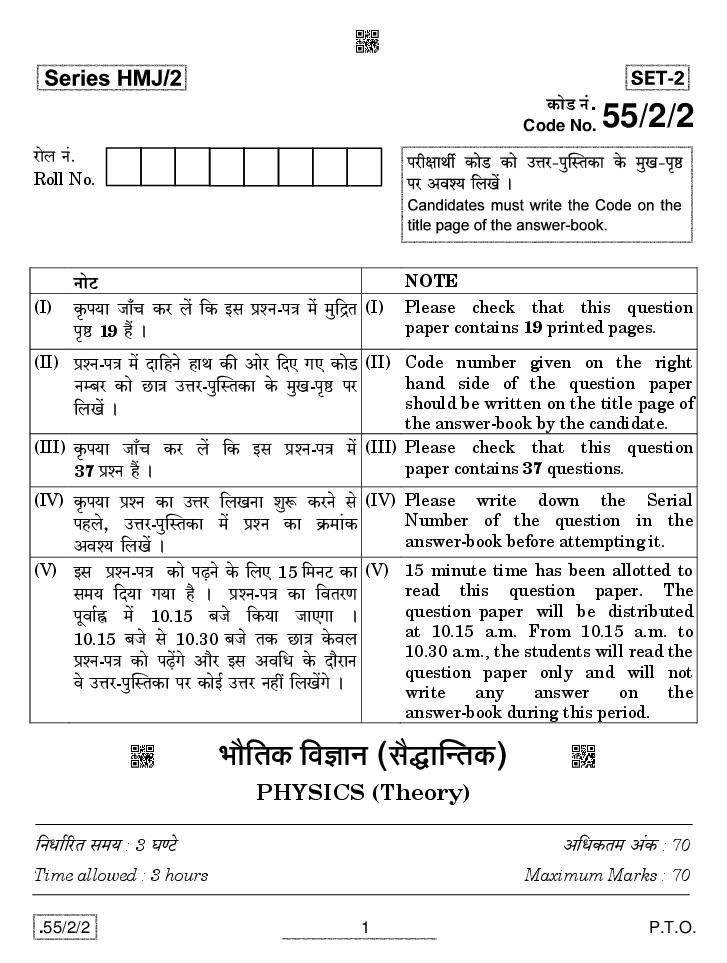
CBSE Class 12 Physics Question Paper 2020 Set 55-2-2
Finished viewing? Save it for later —
Download CBSE Class 12 Physics Question Paper 2020 Set 55-2-2 (PDF · 19 pages)About CBSE Class 12 Physics Question Paper 2020 Set 55-2-2
CBSE Class 12 Physics Question Paper 2020 Set 55-2-2 is available here for free download. Published by CBSE for Class 12, this question paper can be viewed online or downloaded as a PDF (19 pages). Candidates preparing for Class 12 can use CBSE Class 12 Physics Question Paper 2020 Set 55-2-2 to understand the exam pattern, the type of questions asked, and the overall difficulty level.
Frequently Asked Questions
How can I download CBSE Class 12 Physics Question Paper 2020 Set 55-2-2?
Open this page and click the Download button to save CBSE Class 12 Physics Question Paper 2020 Set 55-2-2 as a PDF. It is completely free on AglaSem Docs.
Is CBSE Class 12 Physics Question Paper 2020 Set 55-2-2 free to download?
Yes. CBSE Class 12 Physics Question Paper 2020 Set 55-2-2 can be viewed online and downloaded as a PDF free of cost on AglaSem Docs.
How many pages does CBSE Class 12 Physics Question Paper 2020 Set 55-2-2 have?
CBSE Class 12 Physics Question Paper 2020 Set 55-2-2 contains 19 pages, which you can read online or download together as a single PDF.
Where can I find more Class 12 study material?
You can find more Class 12 question papers, sample papers, syllabus, and answer keys on AglaSem Docs.
CBSE Class 12 Physics Question Paper 2020 Set 55-2-2 – Text
Read the full text of this question paper below — useful to quickly search, copy and reference the content online without downloading the PDF.
📄 View text version (19 pages)
Page 1
Code No. 55/2/2
amob Z§.
Roll No.
ZmoQ> NOTE
(I) H¥$n`m Om±M H$a b| {H$ Bg àíZ-nÌ _o§ _w{ÐV (I) Please check that this question
n¥ð> 19 h¢ & paper contains 19 printed pages.
(II) àíZ-nÌ _| Xm{hZo hmW H$s Amoa {XE JE H$moS (II) Code number given on the right
>Zå~a H$mo N>mÌ CÎma-nwpñVH$m Ho$ _wI-n¥ð> na hand side of the question paper
{bI| & should be written on the title page of
the answer-book by the candidate.
(III) H¥$n`m Om±M H$a b| {H$ Bg àíZ-nÌ _| (III) Please check that this question
>37 àíZ h¢ & paper contains 37 questions.
(IV) H¥$n`m àíZ H$m CÎma {bIZm ewê$ H$aZo go (IV) Please write down the Serial
nhbo, CÎma-nwpñVH$m _| àíZ H$m H«$_m§H$ Number of the question in the
Adí` {bI| & answer-book before attempting it.
(V) Bg àíZ-nÌ H$mo n‹T>Zo Ho$ {bE 15 {_ZQ >H$m (V) 15 minute time has been allotted to
g_` {X`m J`m h¡ & àíZ-nÌ H$m {dVaU read this question paper. The
nydm©• _| 10.15 ~Oo {H$`m OmEJm & question paper will be distributed
10.15 ~Oo go 10.30 ~Oo VH$ N>mÌ Ho$db at 10.15 a.m. From 10.15 a.m. to
10.30 a.m., the students will read the
àíZ-nÌ H$mo n‹T>|Jo Am¡a Bg Ad{Y Ho$ Xm¡amZ question paper only and will not
do CÎma-nwpñVH$m na H$moB© CÎma Zht {bI|Jo & write any answer on the
answer-book during this period.
^m¡{VH$ {dkmZ (g¡ÕmpÝVH$)
PHYSICS (Theory)
{ZYm©[aV g_` : 3 KÊQ>o A{YH$V_ A§H$ : 70
Time allowed : 3 hours Maximum Marks : 70
.55/2/2 1 P.T.O.
Page 2
{ZåZ{b{IV {ZX}em| H$mo ~hwV gmdYmZr go n{‹T>E Am¡a CZH$m g™Vr go nmbZ H$s{OE :
(i) Bg àíZ-nÌ H$mo Mma IÊS>m| _§| {d^m{OV {H$`m J`m h¡ – H$, I, J Am¡a K &
(ii) Bg àíZ-nÌ _| 37 àíZ h¢ & g^r àíZ A{Zdm`© h¢ &
(iii) IÊS> H$ – àíZ g§»`m 1 go 20 VH$ A{V bKw-CÎmar` àíZ h¢, àË`oH$ àíZ 1 A§H$ H$m h¡ &
(iv) IÊS> I – àíZ g§»`m 21 go 27 VH$ bKw-CÎmar` àíZ h¢, àË`oH$ àíZ 2 A§H$m| H$m h¡ &
(v) IÊS> J – àíZ g§»`m 28 go 34 VH$ XrK©-CÎmar` àíZ h¢, àË`oH$ àíZ 3 A§H$m| H$m h¡ &
(vi) IÊS> K – àíZ g§»`m 35 go 37 VH$ ^r XrK©-CÎmar` àíZ h¢, àË`oH$ àíZ 5 A§H$m| H$m
h¡ &
(vii) àíZ-nÌ _| H$moB© g_J« {dH$ën Zht h¡ & VWm{n, EH$-EH$ A§H$ Ho$ Xmo àíZm| _|, Xmo-Xmo A§H$m|
dmbo Xmo àíZm| _§o, VrZ-VrZ A§H$m| dmbo EH$ àíZ _§o VWm nm±M-nm±M A§H$m| Ho$ VrZm| àíZm| _§o
Am§V[aH$ {dH$ën {X`m J`m h¡ & Eogo àíZm| _| Ho$db EH$ hr {dH$ën H$m CÎma Xr{OE &
(viii) BgHo$ A{V[aº$, Amdí`H$VmZwgma, àË`oH$ IÊS> Am¡a àíZ Ho$ gmW `Wmo{MV {ZX}e {XE JE
h¢ &
(ix) H¡$ëHw$boQ>a AWdm bm°J Q>o~b Ho$ à`moJ H$s AZw_{V Zht h¡ &
(x) Ohm± Amdí`H$ hmo, Amn {ZåZ{b{IV ^m¡{VH$ {Z`Vm§H$m| Ho$ _mZm| H$m Cn`moJ H$a gH$Vo h¢ :
c = 3 108 m/s
h = 6.63 10–34 Js
e = 1.6 10–19 C
0 = 4 10–7 T m A–1
0 = 8.854 10–12 C2 N–1 m–2
1
= 9 109 N m2 C–2
4
0
BboŠQ´>m°Z H$m Ðì`_mZ (me) = 9.1 10–31 kg
Ý`yQ´>m°Z H$m Ðì`_mZ = 1.675 10–27 kg
àmoQ>m°Z H$m Ðì`_mZ = 1.673 10–27 kg
AmdmoJmÐmo g§»`m = 6.023 1023 à{V J«m_ _mob
~moëQ²>µO_mZ {Z`Vm§H$ = 1.38 10–23 JK–1
.55/2/2 2
Page 3
Read the following instructions very carefully and strictly follow them :
(i) This question paper comprises four Sections – A, B, C and D.
(ii) There are 37 questions in the question paper. All questions are
compulsory.
(iii) Section A – Questions no. 1 to 20 are very short answer type questions,
carrying 1 mark each.
(iv) Section B – Questions no. 21 to 27 are short answer type questions,
carrying 2 marks each.
(v) Section C – Questions no. 28 to 34 are long answer type questions,
carrying 3 marks each.
(vi) Section D – Questions no. 35 to 37 are also long answer type questions,
carrying 5 marks each.
(vii) There is no overall choice in the question paper. However, an internal
choice has been provided in 2 questions of 1 mark, 2 questions of
2 marks, 1 question of three marks and all the 3 questions of five marks.
You have to attempt only one of the choices in such questions.
(viii) In addition to this, separate instructions are given with each section and
question, wherever necessary.
(ix) Use of calculators and log tables is not permitted.
(x) You may use the following values of physical constants wherever
necessary :
c = 3 108 m/s
h = 6.63 10–34 Js
e = 1.6 10–19 C
0 = 4 10–7 T m A–1
0 = 8.854 10–12 C2 N–1 m–2
1
= 9 109 N m2 C–2
4
0
Mass of electron (me) = 9.1 10–31 kg
Mass of neutron = 1.675 10–27 kg
Mass of proton = 1.673 10–27 kg
Avogadro’s number = 6.023 1023 per gram mole
Boltzmann constant = 1.38 10–23 JK–1
.55/2/2 3 P.T.O.
Page 4
ZmoQ> : ZrMo {XE JE àË`oH$ àíZ _| g~go A{YH$ Cn`wº$ {dH$ën Mw{ZE :
1. {H$gr {XE JE MmbH$ H$s à{VamoYH$Vm, {ZåZ{b{IV _§o go {H$g na {Z^©a H$aVr h¡ ? 1
(A) Vmn
(B) MmbH$ H$s bå~mB©
(C) AZwàñW-H$mQ> H$m joÌ\$b
(D) MmbH$ H$s AmH¥${V
2. Ymam KZËd Am¡a {dÚwV²-joÌ Ho$ AZwnmV H$mo H$hVo h¢ 1
(A) à{VamoYH$Vm
(B) MmbH$Vm
(C) Andmh doJ
(D) J{VerbVm
3. j` _§o 1
(A) Ý`yQ´>m°Z EopÝQ>Ý`yQ´>rZmo CËg{O©V H$aHo$ àmoQ>m°Z _| n[ad{V©V hmo OmVm h¡ &
(B) Ý`yQ´>m°Z Ý`yQ´>rZmo CËg{O©V H$aHo$ àmoQ>m°Z _| n[ad{V©V hmo OmVm h¡ &
(C) àmoQ>m°Z EopÝQ>Ý`yQ´>rZmo CËg{O©V H$aHo$ Ý`yQ´>m°Z _| n[ad{V©V hmo OmVm h¡ &
(D) àmoQ>m°Z Ý`yQ´>rZmo CËg{O©V H$aHo$ Ý`yQ´>m°Z _| n[ad{V©V hmo OmVm h¡ &
4. {ZåZ{b{IV nXmWm] _§o go H$m¡Z-gm ñWm`r Mwå~H$ ~ZmZo Ho$ {bE Cn`wº$ Zht h¡ ? 1
(A) ñQ>rb
(B) Q>mBH$moZb
(C) b¡S>
(D) EopëZH$mo
5. dopëS>¨J H$aZo dmbm ì`{º$ {deof àH$ma Ho$ H$m±M Ho$ Mí_o H$m Cn`moJ AnZo ZoÌm| H$mo
{ZåZ{b{IV _§o go {H$gHo$ hm{ZH$a à^md go ~MmZo Ho$ {bE H$aVm h¡ ? 1
(A) A{V Vrd« Ñí` àH$me
(B) Adaº$ {d{H$aU
(C) nam~¢JZr {H$aU|
(D) gyú_ Va§J|
.55/2/2 4
Page 5
Note : Select the most appropriate option from those given below each
question :
1. Resistivity of a given conductor depends upon 1
(A) temperature.
(B) length of conductor.
(C) area of cross-section.
(D) shape of the conductor.
2. The ratio of current density and electric field is called 1
(A) Resistivity
(B) Conductivity
(C) Drift velocity
(D) Mobility
3. In decay, a 1
(A) neutron converts into a proton emitting antineutrino.
(B) neutron converts into a proton emitting neutrino.
(C) proton converts into a neutron emitting antineutrino.
(D) proton converts into a neutron emitting neutrino.
4. The material which is not suitable for making a permanent magnet is 1
(A) Steel
(B) Ticonal
(C) Lead
(D) Alnico
5. A welder wears special glasses to protect his eyes mostly from the
harmful effect of 1
(A) very intense visible light.
(B) infrared radiation.
(C) ultraviolet rays.
(D) microwaves.
.55/2/2 5 P.T.O.
Page 6
(A) D$Om© AÝVamb Ho$ Ho$ÝÐ na &
(B) MmbZ ~¡ÊS> Ho$ R>rH$ ZrMo &
(C) g§`moOH$Vm ~¡ÊS> Ho$ R>rH$ D$na &
(D) MmbZ ~¡ÊS> _| &
7. O~ Xmo Zm{^H$ (A 10) EH$-Xÿgao Ho$ gmW g§J{bV hmoH$a EH$ ^mar Zm{^H$ ~ZmVo h¢, Vmo 1
(A) ~§YZ D$Om© à{V Ý`ypŠbAm°Z _| d¥{Õ hmoVr h¡ &
(B) ~§YZ D$Om© à{V Ý`ypŠbAm°Z _| H$_r hmoVr h¡ &
(C) ~§YZ D$Om© à{V Ý`ypŠbAm°Z _| H$moB© n[adV©Z Zht hmoVm &
(D) Hw$b ~§YZ D$Om© KQ> OmVr h¡ &
8. Am¡fY ({M{H$Ëgm) _| {ZXmZ Ho$ gmYZ Ho$ ê$n _| Cn`moJ hmoZo dmbr {dÚwV² -Mwå~H$s` Va§J| h¢ 1
(A) X-{H$aU| &
(B) nam~¢JZr {H$aU| &
(C) Adaº$ {H$aU| &
(D) namlì` Va§J| &
9. gmå` _| {H$gr p-n g§{Y S>m`moS> _o| ZoQ> Ymam hmoVr h¡ 1
(A) ~hþg§»`H$ Amdoe dmhH$m| Ho$ {dgaU Ho$ H$maU &
(B) Aënm§e Amdoe dmhH$m| Ho$ Andmh Ho$ H$maU &
(C) eyÝ` Š`m|{H$ {dgaU Am¡a Andmh YmamE± g_mZ Am¡a {dnarV hmoVr h¢ &
(D) eyÝ` Š`m|{H$ Amdoe dmhH$m| _| H$moB© ^r g§{Y H$mo nma Zht H$a nmVo h¢ &
10. {H$gr BboŠQ´>m°Z H$mo {dam_ go {H$gr Eogo joÌ _| _wº$ {H$`m J`m h¡ Ohm± EH$g_mZ {dÚwV² Am¡a
Mwå~H$s` joÌ EH$-Xÿgao Ho$ g_mÝVa H$m`©aV h¢ & `h BboŠQ´>m°Z 1
(A) {H$gr gab aoIm _§o J{V H$aoJm &
(B) {H$gr d¥Îm _| J{V H$aoJm &
(C) pñWa ahoJm &
(D) g{n©bmH$ma nW _| J{V H$aoJm &
ZmoQ> : Cn`wº$ CÎma go [aº$ ñWmZm| H$s ny{V© H$s{OE :
11. AmaoI _| Xem©E JE Jmobr` n¥ð> go JwµOaZo dmbm {dÚwV² âbŠg __________ h¡ & 1
.55/2/2 6
Page 7
(A) at the centre of the energy gap.
(B) just below the conduction band.
(C) just above the valance band.
(D) in the conduction band.
7. When two nuclei (A 10) fuse together to form a heavier nucleus, the 1
(A) binding energy per nucleon increases.
(B) binding energy per nucleon decreases.
(C) binding energy per nucleon does not change.
(D) total binding energy decreases.
8. Electromagnetic waves used as a diagnostic tool in medicine are 1
(A) X-rays.
(B) ultraviolet rays.
(C) infrared radiation.
(D) ultrasonic waves.
9. At equilibrium, in a p-n junction diode the net current is 1
(A) due to diffusion of majority charge carriers.
(B) due to drift of minority charge carriers.
(C) zero as diffusion and drift currents are equal and opposite.
(D) zero as no charge carriers cross the junction.
10. An electron is released from rest in a region of uniform electric and
magnetic fields acting parallel to each other. The electron will 1
(A) move in a straight line.
(B) move in a circle.
(C) remain stationary.
(D) move in a helical path.
Note : Fill in the blanks with appropriate answer :
11. Electric flux through a spherical surface shown in the figure, is ________ . 1
.55/2/2 7 P.T.O.
Page 8
13. {H$gr g§`wº$ gyú_Xeu H$m Cn`moJ Bg{bE {H$`m OmVm h¡ Š`m|{H$ {H$gr dmñV{dH$ gab
gyú_Xeu H$m ____________ AmdY©Z Zht hmoVm h¡ & 1
14. {H$gr nmoboam°BS> go Io Vrd«Vm H$m AY«w{dV àH$me JwµOmam J`m h¡ & àmá g_Vb Y«w{dV àH$me
H$s Vrd«Vm __________ hmoJr & 1
15. `§J Ho$ {Û{Par à`moJ _| nX} Ho$ {H$gr {~ÝXþ na ì`{VH$aU H$aVr Xmo Va§Jm| Ho$ ~rM nWmÝVa
5
h¡, `hm± Cn`moJ {H$E JE àH$me H$s Va§JX¡¿`© h¡ & Bg {~ÝXþ na _________ H$mbr
2
q\«$O hmoJr & 1
AWdm
`{X `§J Ho$ {Û{Par à`moJ _| EH$ {Par nyU©V: ~ÝX hmo, Vmo ZE n¡Q>Z© _§o Ho$ÝÐr` C{ƒð> H$m
H$moUr` gmBµO _________ hmoJm & 1
ZmoQ> : {ZåZ{b{IV Ho$ CÎma Xr{OE :
16. àH$me-{dÚwV² CËgO©Z _| nX ‘Xohbr Amd¥{Îm’ H$s n[a^mfm {b{IE & 1
17. AmaoI _§o Xem©E AZwgma bå~mB© l H$s {H$gr YmVw H$s N>‹S> PQ H$mo H$moUr` doJ go AnZo
_Ü`-{~ÝXþ (O) go JwµOaZo dmbo {H$gr Aj Ho$ n[aV:, Omo Bg n¥ð> Ho$ Vb Ho$ bå~dV² h¡,
{H$gr EH$g_mZ Mwå~H$s` joÌ B _§o KyU©Z H$am`m J`m h¡ & Bg N>‹S> Ho$ Xmo {gam| P Am¡a Q
Ho$ ~rM {dH${gV {d^dmÝVa Š`m hmoJm ? 1
18. n Hz Amd¥{Îm Ho$ òmoV H$m Cn`moJ H$aZo na {H$gr àË`mdVu Ymam (ac) n[anW _| Ym[aVm C
Ho$ {H$gr g§Ym[aÌ H$s à{V~mYm Š`m hmoVr h¡ ? 1
AWdm
{H$gr loUr AZwZmX LCR n[anW H$s à{V~mYm H$m _mZ Š`m hmoVm h¡ ? 1
.55/2/2 8
Page 9
maximum. 1
13. A compound microscope is used because a realistic simple microscope
does not have __________ magnification. 1
14. An unpolarised light of intensity Io is passed through a polaroid. The
intensity of a plane polarised light obtained is __________ . 1
15. In Young’s double slit experiment, the path difference between two
5
interfering waves at a point on the screen is , being wavelength of
2
the light used. The ___________ dark fringe will lie at this point. 1
OR
If one of the slits in Young’s double slit experiment is fully closed, the
new pattern has __________ central maximum in angular size. 1
Note : Answer the following :
16. Define the term ‘threshold frequency’ in photoelectric emission. 1
17. A metallic rod PQ of length l is rotated with an angular velocity about
an axis passing through its mid-pint (O) and perpendicular to the plane
of the paper, in uniform magnetic field B , as shown in the figure. What
is the potential difference developed between the two ends of the rod, P
and Q ? 1
18. What is the impedance of a capacitor of capacitance C in an ac circuit
using source of frequency n Hz ? 1
OR
What is the value of impedance of a resonant series LCR circuit ? 1
.55/2/2 9 P.T.O.
Page 10
Ho$ H$m`©\$bZm| H$m AZwnmV Š`m h¡ ? 1
20. {H$gr AmXe© àoaH$ go àdm{hV Ymam _| n[adV©Z H$s Xa H$mo \$bZ _mZH$a Cg_| ào[aV
{d.dm.~b (emf) Ho$ _mZ Ho$ {dMaU H$mo Xem©Zo Ho$ {bE J«mµ\$ It{ME &$ 1
IÊS> I
21. {ZåZ{b{IV {dÚwV²-Mwå~H$s` Va§Jm| _| go (a) Ý`yZV_ Va§JX¡¿`©, VWm (b) Ý`yZV_ Amd¥{Îm
{H$gH$s h¡ ? BZ XmoZm| Va§Jm| _| go àË`oH$ H$m EH$ Cn`moJ {b{IE &
Adaº$ Va§J|, gyú_ Va§J|, -{H$aU| Am¡a X-{H$aU| 2
22. 16 à{VamoY H$m H$moB© J¡ëdoZmo_rQ>a 4 mA Ymam hmoZo na nyU© n¡_mZm {djonU XoVm h¡ & Bg
J¡ëdoZmo_rQ>a H$mo Amn 3 V VH$ H$s dmoëQ>Vm _mnZo dmbo dmoëQ>_rQ>a _| {H$g àH$ma n[ad{V©V
H$a|Jo ? 2
23. p-n g§{Y S>m`moS> Ho$ V-I A{^bmj{UH$ It{ME & ñnï> H$s{OE {H$ níM{X{eH$
~m`g Ho$ AYrZ Ymam H«$m§{VH$ dmoëQ>Vm VH$ AZwà`wº$ dmoëQ>Vm na bJ^J {Z^©a Š`m| Zht
H$aVr h¡ & 2
24. {H$gr Ymamdmhr MmbH$ _| nX Amdoe dmhH$m| H$s ‘J{VerbVm’ H$s n[a^mfm {b{IE &
{dlmpÝV H$mb Ho$ nXm| _| J{VerbVm Ho$ {bE g§~§Y àmá H$s{OE & 2
AWdm
{H$gr Ymamdmhr MmbH$ _| nX BboŠQ´>m°Zm| Ho$ ‘Andmh doJ’ H$s n[a^mfm {b{IE & Ymam KZËd
Am¡a BboŠQ´>m°Zm| Ho$ Andmh doJ Ho$ ~rM g§~§Y àmá H$s{OE & 2
25. {H$gr C^`mdVb (g_mdVb) b|g H$s \$moH$g Xÿar CgHo$ n¥ð>m| H$s dH«$Vm {ÌÁ`m H$s 3 JwZr
4
h¡ & b|g Ho$ nXmW© H$m AndV©Zm§H$ kmV H$s{OE & {H$g AdñWm _| `h b|g EH$ A{^gmar
b|g H$s Vah H$m`© H$aoJm ? 2
26. (a) {H$gr ao{S>`moEpo ŠQ>d nXmW© Ho$ {bE, g_` t Ho$ \$bZ Ho$ ê$n _§o Hw$b {dK{Q>V
Ðì`_mZ Ho$ {dMaU H$mo J«mµ\$ ItMH$a Xem©BE &
(b) {H$gr ao{S>`moEopŠQ>d nXmW© H$m Amapå^H$ Ðì`_mZ 3·2 mg h¡ & BgH$s AY© Am`w
4 h h¡ & 8 h Ho$ níMmV² eof ~Mo ao{S>`moEopŠQ>d nXmW© H$m Ðì`_mZ kmV H$s{OE & 2
.55/2/2 10
Page 11
and 2, respectively. What is the ratio of the work functions of the two
surfaces ? 1
20. Draw the graph showing variation of the value of the induced emf as a
function of rate of change of current flowing through an ideal inductor. 1
SECTION B
21. Which of the following electromagnetic waves has (a) minimum
wavelength, and (b) minimum frequency ? Write one use of each of these
two waves.
Infrared waves, Microwaves, -rays and X-rays 2
22. A galvanometer of resistance 16 shows full scale deflection for a
current of 4 mA. How will you convert it into a voltmeter to measure a
voltage up to 3 V ? 2
23. Draw V-I characteristics of a p-n junction diode. Explain, why the current
under reverse bias is almost independent of the applied voltage up to the
critical voltage. 2
24. Define the term ‘mobility’ of charge carriers in a current carrying
conductor. Obtain the relation for mobility in terms of relaxation time. 2
OR
Define the term ‘drift velocity’ of electrons in a current carrying
conductor. Obtain the relationship between the current density and the
drift velocity of electrons. 2
3
25. The focal length of an equiconcave lens is times of radius of curvature
4
of its surfaces. Find the refractive index of the material of the lens. Under
what condition will this lens behave as a converging lens ? 2
26. (a) For a radioactive substance, show the variation of the total mass
disintegrated as a function of time t graphically.
(b) Initial mass of a radioactive substance is 3·2 mg. It has a half-life
of 4 h. Find the mass of the substance left undecayed after 8 h. 2
.55/2/2 11 P.T.O.
Page 12
(b) {H$gr loUr LCR n[anW _§o, VL = VC VR h¡ & Bg n[anW Ho$ {bE e{º$ JwUm§H$
H$m _mZ {H$VZm h¡ ? 2
AWdm
V = V0 sin t {d.dm.~b (emf) H$m H$moB© àË`mdVu Ymam (ac) òmoV Ym[aVm C Ho$ {H$gr
g§Ym[aÌ go g§`mo{OV h¡ & Bg_| àdm{hV Ymam (I) Ho$ {bE ì`§OH$ ì`wËnÞ H$s{OE &
(i) V Am¡a t, VWm (ii) I Am¡a t Ho$ ~rM J«mµ\$ It{ME & 2
IÊS> J
28. (a) Xmo {dÚwV²-joÌ aoImE± EH$-Xÿgao H$mo Zht H$mQ> gH$Vt & gmW hr, `o ~ÝX nmem| H$mo ^r
Zht ~Zm gH$Vt & H$maU Xr{OE &
^
(b) 1·6 g Ðì`_mZ VWm 2 C Amdoe H$m H$moB© H$U 4 i ms–1 Ho$ doJ go J{V_mZ h¡ &
g_` t = 0 na `h H$U E (NC–1 _|) = 80 ^i + 60 ^j Ho$ {H$gr {dÚwV²-joÌ _|
àdoe H$aVm h¡ & t = 5 s na Bg H$U H$m doJ kmV H$s{OE & 3
AWdm
ZrMo {XE JE AmaoI _|, kmV H$s{OE
(a) ZoQ>dH©$ Ho$ {~ÝXþ A Am¡a B Ho$ ~rM Vwë` Ym[aVm &
{X`m J`m h¡ : C1 = C5 = 4 F, C2 = C3 = C4 = 2 F.
(b) ~¡Q>ar Ûmam AmnyV© A{YH$V_ Amdoe, Am¡a
(c) ZoQ>dH©$ _§o g§{MV Hw$b D$Om© & 3
29. (a) {H$gr ao{S>`moEopŠQ>d nXmW© H$s AY© Am`w Am¡a Am¡gV Am`w Ho$ ~rM {d^oXZ H$s{OE &
(b) H$moB© ao{S>`moEopŠQ>d nXmW© AnZr _mÜ` Am`w H$s Ad{Y Ho$ ~am~a g_` VH$ j{`V
hmoVm h¡ & Bg Ad{Y Ho$ níMmV² Bg nXmW© H$m Aj{`V eof ^mJ kmV H$s{OE & 3
.55/2/2 12
Page 13
(b) In a series LCR circuit, VL = VC VR. What is the value of power
factor for this circuit ? 2
OR
An ac source of emf V = V0 sin t is connected to a capacitor of
capacitance C. Deduce the expression for the current (I) flowing in it. Plot
the graph of (i) V vs. t, and (ii) I vs. t. 2
SECTION C
28. (a) Two electric field lines cannot cross each other. Also, they cannot
form closed loops. Give reasons.
(b) A particle of charge 2 C and mass 1·6 g is moving with a velocity
^
4 i ms–1. At t = 0 the particle enters in a region having an electric
^ ^
field E (in NC–1) = 80 i + 60 j . Find the velocity of the particle at
t = 5 s. 3
OR
In the figure given below, find the
(a) equivalent capacitance of the network between points A and B.
Given : C1 = C5 = 4 F, C2 = C3 = C4 = 2 F.
(b) maximum charge supplied by the battery, and
(c) total energy stored in the network. 3
29. (a) Differentiate between half-life and average life of a radioactive
substance.
(b) A radioactive substance decays for an interval of time equal to its
mean life. Find the fraction of the amount of the substance which
is left undecayed after this time interval. 3
.55/2/2 13 P.T.O.
Page 14
{H$gr g§`wº$ gyú_Xeu Ho$ A{^Ñí`H$ Am¡a Zo{ÌH$m H$s \$moH$g Xÿ[a`m± H«$_e: 1·25 cm Am¡a
5·0 cm h¢ & O~ A§{V_ à{V{~å~ {ZH$Q> {~ÝXþ na ~ZVm h¡, Vmo H$moUr` AmdY©Z 30 àmá
H$aZo Ho$ {bE A{^Ñí`H$ Ho$ gmnoj {~å~ H$s pñW{V kmV H$s{OE & 3
31. {H$gr àH$me-gwJ«mhr n¥ð> na Amn{VV àH$me H$s Va§JX¡¿`© H$mo 1 go 2 H$aZo na Cggo
CËg{O©V àH$m{eH$-BboŠQ´>m°Zm| H$s A{YH$V_ J{VO D$Om© XþJwZr hmo OmVr h¡ & 1 Am¡a 2 Ho$
nXm| _| YmVw n¥ð> Ho$ {bE Xohbr Va§JX¡¿`© Am¡a H$m`©\$bZ Ho$ {bE ì`§OH$ ì`wËnÞ H$s{OE & 3
32. (a) ìhrQ>ñQ>moZ goVw Ho$ {bE g§VwbZ Ho$ à{V~ÝY ì`wËnÞ H$s{OE &
(b) {H$gr _rQ>a goVw H$m n[anW AmaoI `h ì`m»`m H$aZo Ho$ {bE It{ME {H$ _rQ>a goVw
{H$g àH$ma ìhrQ>ñQ>moZ goVw na AmYm[aV h¡ & 3
33. AmaoI _| àË`mdVu Ymam (ac) òmoV H$s Amd¥{Îm Ho$ gmW {H$gr g§Ym[aÌ Ho$ à{VKmV _§o
{dMaU H$mo J«mµ\$ Ûmam Xem©`m J`m h¡ &
(a) g§Ym[aÌ H$s Ym[aVm kmV H$s{OE &
(b) {H$gr AmXe© àoaH$ H$m 100 Hz Amd¥{Îm na à{VKmV Bg g§Ym[aÌ H$s Cgr Amd¥{Îm
na à{VKmV Ho$ g_mZ h¡ & àoaH$ Ho$ àoaH$Ëd H$m _mZ kmV H$s{OE &
(c) Amd¥{Îm Ho$ gmW Bg àoaH$ Ho$ à{VKmV _| {dMaU H$mo Xem©Zo Ho$ {bE J«mµ\$ It{ME & 3
.55/2/2 14
Page 15
and a compound microscope ? The focal lengths of the objective and
eyepiece of a compound microscope are 1·25 cm and 5·0 cm, respectively.
Find the position of the object relative to the objective in order to obtain
an angular magnification of 30 when the final image is formed at the
near point. 3
31. The maximum kinetic energy of the photoelectrons emitted is doubled
when the wavelength of light incident on the photosensitive surface
changes from 1 to 2. Deduce expressions for the threshold wavelength
and work function for the metal surface in terms of 1 and 2. 3
32. (a) Derive the condition of balance for Wheatstone bridge.
(b) Draw the circuit diagram of a meter bridge to explain how it is
based on Wheatstone bridge. 3
33. The figure shows the graphical variation of the reactance of a capacitor
with frequency of ac source.
(a) Find the capacitance of the capacitor.
(b) An ideal inductor has the same reactance at 100 Hz frequency as
the capacitor has at the same frequency. Find the value of
inductance of the inductor.
(c) Draw the graph showing the variation of the reactance of this
inductor with frequency. 3
.55/2/2 15 P.T.O.
Page 16
I1 > I2 > I3 Ho$ {bE V-I A{^bmj{UH$ It{ME &
(b) {H$gr µOoZa {Z`§{ÌV {dÚwV² Amny{V© _|, {Z`§ÌU Ho$ {bE {H$gr Vz = 6 V dmbo µOoZa
S>m`moS> H$m Cn`moJ {H$`m J`m h¡ & 10 V Ho$ A{Z`§{ÌV {Zdoe na µOoZa Ymam bmoS>
Ymam H$s nm±M JwZr h¡ VWm bmoS> Ymam H$m _mZ 4·0 mA hmoZm Mm{hE & Bg {dÚwV²
Amny{V© _| Cn`moJ hmoZo dmbo loUr à{VamoYH$ Rs H$m _mZ kmV H$s{OE & 3
IÊS> K
35. (a) {ÌÁ`m R Ho$ {H$gr d¥ÎmmH$ma nme go Ymam I àdm{hV hmo ahr h¡ & Bg nme Ho$ Ho$ÝÐ go
BgHo$ Aj na pñWV x Xÿar Ho$ {H$gr {~ÝXþ na Mwå~H$s` joÌ Ho$ {bE ì`§OH$ àmá
H$s{OE &
(b) 2 m bå~r H$moB© MmbH$ N>‹S> {H$gr j¡{VO _oµO na CÎma -X{jU {Xem _| aIr h¡ &
Bg_§o X{jU go CÎma H$s Amoa 5 A Ymam àdm{hV hmo ahr h¡ & Bg N>‹S> na H$m`©aV
Mwå~H$s` ~b H$s {Xem Am¡a n[a_mU kmV H$s{OE & `h {X`m J`m h¡ {H$ Bg ñWmZ
na n¥Ïdr H$m Mwå~H$s` joÌ 0·6 10–4 T VWm Z{V H$moU h¡ & 5
6
AWdm
(a) {H$gr EH$g_mZ Mwå~H$s` joÌ _| {H$gr J¡ëdoZmo_rQ>a H$s Ymamdmhr Am`VmH$ma
Hw$ÊS>br na H$m`©aV {djonH$ ~b-AmKyU© Ho$ {bE ì`§OH$ àmá H$s{OE & Mb
Hw$ÊS>br J¡ëdoZmo_rQ>a _| Aar` Mwå~H$s` joÌ H$m Cn`moJ Š`m| {H$`m OmVm h¡ ?
(b) {H$gr gmBŠbmoQ´>m°Z, {OgH$s S>rµO H$s {ÌÁ`m 40 cm h¡, Ho$ Ûmam Ðì`_mZ
1·6 10–27 kg Am¡a Amdoe 1·6 10–19 C Ho$ H$Um| H$mo Ëd[aV {H$`m J`m h¡ &
Bg_| 0·4 T Ho$ Mwå~H$s` joÌ H$m Cn`moJ {H$`m J`m h¡ & Bg ËdaH$ Ûmam H$U -nw§O
H$mo Xr J`r J{VO D$Om© (MeV _|) kmV H$s{OE & 5
36. (a) {H$gr C^`moÎmb b|g Ho$ {bE b|g _oH$a gyÌ ì`wËnÞ H$s{OE &
(b) 10 cm \$moH$g Xÿar Ho$ {H$gr CÎmb b|g go 12 cm Xÿar na, _w»` Aj na, H$moB©
{~ÝXþ{H$V {~å~ pñWV h¡ & b|g Ho$ Xÿgar Amoa 10 cm Xÿar na {H$gr CÎmb Xn©U H$mo
g_mj aIm J`m h¡ & `{X A§{V_ à{V{~å~ {~å~ Ho$ g§nmVr h¡, Vmo {H$aU AmaoI
It{ME Am¡a CÎmb Xn©U H$s \$moH$g Xÿar kmV H$s{OE & 5
AWdm
(a) Va§JmJ« {H$go H$hVo h¢ ? `h {H$g àH$ma àdY©Z H$aVm h¡ & hmBJoÝg Ho$ {gÕmÝV H$m
Cn`moJ H$aHo$ {H$gr n¥ð> go g_Vb Va§JmJ« Ho$ namdV©Z H$s ì`m»`m VWm namdV©Z Ho$
{Z`_m| H$m gË`mnZ H$s{OE &
.55/2/2 16
Page 17
reverse bias for three different illumination intensities I1 > I2 > I3.
(b) In a zener regulated power supply, a zener diode with Vz = 6 V is
used for regulation. The load current should be 4·0 mA and zener
current is five times the load current for unregulated input of 10 V.
Find the series resistor Rs used in the power supply. 3
SECTION D
35. (a) A circular loop of radius R carries a current I. Obtain an
expression for the magnetic field at a point on its axis at a distance
x from its centre.
(b) A conducting rod of length 2 m is placed on a horizontal table in
north-south direction. It carries a current of 5 A from south to
north. Find the direction and magnitude of the magnetic force
acting on the rod. Given that the Earth’s magnetic field at the
place is 0·6 10–4 T and angle of dip is . 5
6
OR
(a) Obtain the expression for the deflecting torque acting on the
current carrying rectangular coil of a galvanometer in a uniform
magnetic field. Why is a radial magnetic field employed in the
moving coil galvanometer ?
(b) Particles of mass 1·6 10–27 kg and charge 1·6 10–19 C are
accelerated in a cyclotron of dee radius 40 cm. It employs a
magnetic field 0·4 T. Find the kinetic energy (in MeV) of the
particle beam imparted by the accelerator. 5
36. (a) Derive lens maker’s formula for a biconvex lens.
(b) A point object is placed at a distance of 12 cm on the principal axis
of a convex lens of focal length 10 cm. A convex mirror is placed
coaxially on the other side of the lens at a distance of 10 cm. If the
final image coincides with the object, sketch the ray diagram and
find the focal length of the convex mirror. 5
OR
(a) What is a wavefront ? How does it propagate ? Using Huygens’
principle, explain reflection of a plane wavefront from a surface
and verify the laws of reflection.
.55/2/2 17 P.T.O.
Page 18
H$aVm h¡ {OgHo$ \$bñdê$n 1 m Xÿar na pñWV nX} na {ddV©Z n¡Q>Z© àmá hmoVm h¡ &
`{X nhbm {ZpåZð> nX} Ho$ Ho$ÝÐ go 2·5 mm Xÿar na ~ZVm h¡, Vmo (i) {Par H$s
Mm¡‹S>mB©, Am¡a (ii) nX} Ho$ Ho$ÝÐ go nhbo {ÛVr`H$ C{ƒð> H$s Xÿar kmV H$s{OE & 5
37. (a) `h Xem©Zo Ho$ {bE JmCg Ho$ {Z`_ H$m Cn`moJ H$s{OE {H$ {ÌÁ`m R Ho$ EH$g_mZ
Amdo{eV {H$gr Jmobr` Imob Ho$ ~mha Imob Ho$ Ho$ÝÐ go r Xÿar na {ñWV {H$gr {~ÝXw
na {dÚwV²-joÌ H$m _mZ CVZm hr hmoVm h¡, {OVZm {H$ Ho$ÝÐ na gånyU© Amdoe H$mo
gm§{ÐV _mZH$a Bgr {~ÝXþ na hmoVm & Xÿar r Ho$ gmW, r R Am¡a r R Ho$ {bE,
{dÚwV²-joÌ Ho$ {dMaU H$mo Xem©Zo Ho$ {bE J«mµ\$ ^r It{ME &
(b) Xmo {~ÝXþ Amdoe + 1 C Am¡a + 4 C EH$-Xÿgao go 30 cm Xÿar na pñWV h¢ &
BZ XmoZm| Amdoem| H$mo {_bmZo dmbr aoIm na + 1 C Amdoe go {H$VZr Xÿar na ZoQ>
{dÚwV²-joÌ eyÝ` hmoJm ? 5
AWdm
(a) {H$gr ~mø EH$g_mZ {dÚwV²-joÌ E _| Xmo {~ÝXþ Amdoe q1 Am¡a q2 EH$-Xÿgao go
r Xÿar na pñWV h¡§ & Amdoem| Ho$ Bg {ZH$m` H$mo g§H${bV H$aZo _| {H$`m J`m H$m`©
kmV H$s{OE &
(b) 20 cm ^wOm H$m H$moB© KZ AmaoI _| Xem©E AZwgma {H$gr joÌ _| aIm h¡ & Bg joÌ
_| H$moB© {dÚwV²-joÌ E Bg àH$ma {dÚ_mZ h¡ {H$ {H$gr {~ÝXþ na {d^d H$mo Bg
àH$ma ì`º$ {H$`m OmVm h¡
V = 10x + 5, Ohm± V dmoëQ _|> VWm x _rQ>a _| h¡ &
kmV H$s{OE
(i) {dÚwV²-joÌ E , Am¡a
(ii) Bg KZ go JwµOaZo dmbm Hw$b {dÚwV² âbŠg & 5
.55/2/2 18
Page 19
slit and the resulting diffraction pattern is obtained on a screen
1 m away. If the first minimum is formed at a distance of 2·5 mm
from the centre of the screen, find the (i) width of the slit, and
(ii) distance of first secondary maximum from the centre of the
screen. 5
37. (a) Use Gauss’s law to show that due to a uniformly charged spherical
shell of radius R, the electric field at any point situated outside the
shell at a distance r from its centre is equal to the electric field at
the same point, when the entire charge on the shell were
concentrated at its centre. Also plot the graph showing the
variation of electric field with r, for r R and r R.
(b) Two point charges of + 1 C and + 4 C are kept 30 cm apart. How
far from the + 1 C charge on the line joining the two charges, will
the net electric field be zero ? 5
OR
(a) Two point charges q1 and q2 are kept r distance apart in a uniform
external electric field E . Find the amount of work done in
assembling this system of charges.
(b) A cube of side 20 cm is kept in a region as shown in the figure. An
electric field E exists in the region such that the potential at a
point is given by V = 10x + 5, where V is in volt and x is in m.
Find the
(i) electric field E , and
(ii) total electric flux through the cube. 5
.55/2/2 19 P.T.O.
Document Details
| Board / Org | CBSE |
| Exam | Class 12 |
| Type | Question Paper |
| Pages | 19 |
| Updated | 22 Jul 2026 |