CBSE Class 12 Physics Question Paper 2020 Set 55-3-2
Finished viewing? Save it for later —
Download CBSE Class 12 Physics Question Paper 2020 Set 55-3-2 (PDF · 19 pages)About CBSE Class 12 Physics Question Paper 2020 Set 55-3-2
CBSE Class 12 Physics Question Paper 2020 Set 55-3-2 is available here for free download. Published by CBSE for Class 12, this question paper can be viewed online or downloaded as a PDF (19 pages). Candidates preparing for Class 12 can use CBSE Class 12 Physics Question Paper 2020 Set 55-3-2 to understand the exam pattern, the type of questions asked, and the overall difficulty level.
Frequently Asked Questions
How can I download CBSE Class 12 Physics Question Paper 2020 Set 55-3-2?
Open this page and click the Download button to save CBSE Class 12 Physics Question Paper 2020 Set 55-3-2 as a PDF. It is completely free on AglaSem Docs.
Is CBSE Class 12 Physics Question Paper 2020 Set 55-3-2 free to download?
Yes. CBSE Class 12 Physics Question Paper 2020 Set 55-3-2 can be viewed online and downloaded as a PDF free of cost on AglaSem Docs.
How many pages does CBSE Class 12 Physics Question Paper 2020 Set 55-3-2 have?
CBSE Class 12 Physics Question Paper 2020 Set 55-3-2 contains 19 pages, which you can read online or download together as a single PDF.
Where can I find more Class 12 study material?
You can find more Class 12 question papers, sample papers, syllabus, and answer keys on AglaSem Docs.
CBSE Class 12 Physics Question Paper 2020 Set 55-3-2 – Text
Read the full text of this question paper below — useful to quickly search, copy and reference the content online without downloading the PDF.
📄 View text version (19 pages)
Page 1
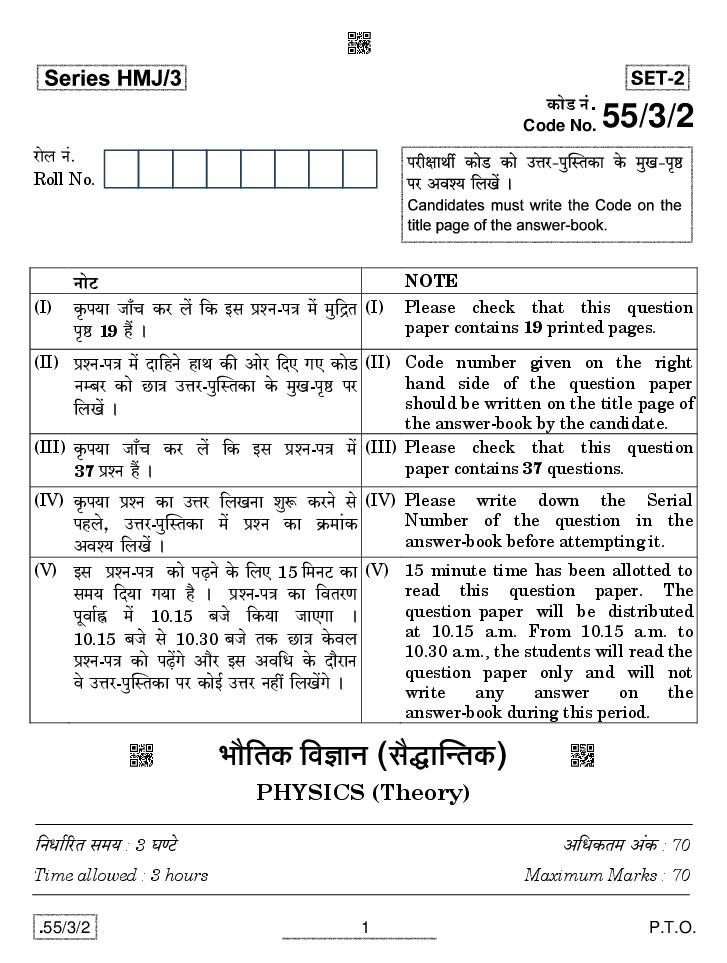
Code No. 55/3/2
amob Z§.
Roll No.
ZmoQ> NOTE
(I) H¥$n`m Om±M H$a b| {H$ Bg àíZ-nÌ _o§ _w{ÐV (I) Please check that this question
n¥ð> 19 h¢ & paper contains 19 printed pages.
(II) àíZ-nÌ _| Xm{hZo hmW H$s Amoa {XE JE H$moS (II) Code number given on the right
>Zå~a H$mo N>mÌ CÎma-nwpñVH$m Ho$ _wI-n¥ð> na hand side of the question paper
{bI| & should be written on the title page of
the answer-book by the candidate.
(III) H¥$n`m Om±M H$a b| {H$ Bg àíZ-nÌ _| (III) Please check that this question
>37 àíZ h¢ & paper contains 37 questions.
(IV) H¥$n`m àíZ H$m CÎma {bIZm ewê$ H$aZo go (IV) Please write down the Serial
nhbo, CÎma-nwpñVH$m _| àíZ H$m H«$_m§H$ Number of the question in the
Adí` {bI| & answer-book before attempting it.
(V) Bg àíZ-nÌ H$mo n‹T>Zo Ho$ {bE 15 {_ZQ >H$m (V) 15 minute time has been allotted to
g_` {X`m J`m h¡ & àíZ-nÌ H$m {dVaU read this question paper. The
nydm©• _| 10.15 ~Oo {H$`m OmEJm & question paper will be distributed
10.15 ~Oo go 10.30 ~Oo VH$ N>mÌ Ho$db at 10.15 a.m. From 10.15 a.m. to
10.30 a.m., the students will read the
àíZ-nÌ H$mo n‹T>|Jo Am¡a Bg Ad{Y Ho$ Xm¡amZ question paper only and will not
do CÎma-nwpñVH$m na H$moB© CÎma Zht {bI|Jo & write any answer on the
answer-book during this period.
^m¡{VH$ {dkmZ (g¡ÕmpÝVH$)
PHYSICS (Theory)
{ZYm©[aV g_` : 3 KÊQ>o A{YH$V_ A§H$ : 70
Time allowed : 3 hours Maximum Marks : 70
.55/3/2 1 P.T.O.
Page 2
{ZåZ{b{IV {ZX}em| H$mo ~hþV gmdYmZr go n{‹T>E Am¡a CZH$m g™Vr go nmbZ H$s{OE :
(i) `h àíZ-nÌ Mma IÊS>m| _§| {d^m{OV {H$`m J`m h¡ – H$, I, J Am¡a K &
(ii) Bg àíZ-nÌ _| 37 àíZ h¢ & g^r àíZ A{Zdm`© h¢ &
(iii) IÊS> H$ – àíZ g§»`m 1 go 20 VH$ A{V bKw-CÎmar` àíZ h¢, àË`oH$ àíZ 1 A§H$ H$m
h¡ &
(iv) IÊS> I – àíZ g§»`m 21 go 27 VH$ bKw-CÎmar` àíZ h¢, àË`oH$ àíZ 2 A§H$m| H$m h¡ &
(v) IÊS> J – àíZ g§»`m 28 go 34 VH$ XrK©-CÎmar` àH$ma Ho$ àíZ h¢, àË`oH$ àíZ
3 A§H$m| H$m h¡ &
(vi) IÊS> K – àíZ g§»`m 35 go 37 VH$ ^r XrK©-CÎmar` àH$ma Ho$ àíZ h¢, àË`oH$ àíZ
5 A§H$m| H$m h¡ &
(vii) àíZ-nÌ _| H$moB© g_J« {dH$ën Zht h¡ & VWm{n, EH$-EH$ A§H$ Ho$ Xmo àíZm| _|, Xmo-Xmo A§H$m|
dmbo Xmo àíZm| _§o, VrZ-VrZ A§H$m| dmbo EH$ àíZ _§o VWm nm±M-nm±M A§H$m| dmbo$ VrZm| àíZm|
_§o Am§V[aH$ {dH$ën {X`m J`m h¡ & Eogo àíZm| _| Ho$db EH$ hr {dH$ën H$m CÎma Xr{OE &
(viii) BgHo$ A{V[aº$, Amdí`H$VmZwgma, àË`oH$ IÊS> Am¡a àíZ Ho$ gmW `Wmo{MV {ZX}e {XE JE
h¢ &
(ix) Ho$ëHw$boQ>am| AWdm bm°J Q>o~bm| Ho$ à`moJ H$s AZw_{V Zht h¡ &
(x) Ohm± Amdí`H$ hmo, Amn {ZåZ{b{IV ^m¡{VH$ {Z`Vm§H$m| Ho$ _mZm| H$m Cn`moJ H$a gH$Vo h¢ :
c = 3 108 m/s
h = 6.63 10–34 Js
e = 1.6 10–19 C
0 = 4 10–7 T m A–1
0 = 8.854 10–12 C2 N–1 m–2
1
= 9 109 N m2 C–2
4
0
BboŠQ´>m°Z H$m Ðì`_mZ (me) = 9.1 10–31 kg
Ý`yQ´>m°Z H$m Ðì`_mZ = 1.675 10–27 kg
àmoQ>m°Z H$m Ðì`_mZ = 1.673 10–27 kg
AmdmoJmÐmo g§»`m = 6.023 1023 à{V J«m_ _mob
~moëQ²>µO_mZ {Z`Vm§H$ = 1.38 10–23 JK–1
.55/3/2 2
Page 3
Read the following instructions very carefully and strictly follow them :
(i) This question paper comprises four Sections – A, B, C and D.
(ii) There are 37 questions in the question paper. All questions are
compulsory.
(iii) Section A – Questions no. 1 to 20 are very short answer type questions,
carrying one mark each.
(iv) Section B – Questions no. 21 to 27 are short answer type questions,
carrying two marks each.
(v) Section C – Questions no. 28 to 34 are long answer type questions,
carrying three marks each.
(vi) Section D – Questions no. 35 to 37 are also long answer type questions,
carrying five marks each.
(vii) There is no overall choice in the question paper. However, an internal
choice has been provided in 2 questions of 1 mark, 2 questions of
2 marks, 1 question of three marks and all the 3 questions of five marks.
You have to attempt only one of the choices in such questions.
(viii) In addition to this, separate instructions are given with each section and
question, wherever necessary.
(ix) Use of calculators and log tables is not permitted.
(x) You may use the following values of physical constants wherever
necessary.
c = 3 108 m/s
h = 6.63 10–34 Js
e = 1.6 10–19 C
0 = 4 10–7 T m A–1
0 = 8.854 10–12 C2 N–1 m–2
1
= 9 109 N m2 C–2
4
0
Mass of electron (me) = 9.1 10–31 kg
Mass of neutron = 1.675 10–27 kg
Mass of proton = 1.673 10–27 kg
Avogadro’s number = 6.023 1023 per gram mole
Boltzmann constant = 1.38 10–23 JK–1
.55/3/2 3 P.T.O.
Page 4
ZmoQ> : ZrMo {XE JE àË`oH$ àíZ H$m g~go A{YH$ Cn`wº$ {dH$ën Mw{ZE :
1. {ÌÁ`m r Ho$ {H$gr d¥Îm Ho$ Ho$ÝÐ na H$moB© Amdoe Q pñWV h¡ & {H$gr narjU Amdoe q0 H$mo
Bg d¥Îm na {~ÝXþ X go {~ÝXþ Y na bo Om`m OmVm h¡ & X Am¡a Y Bg àH$ma pñWV h¢ {H$
Mmn XY d¥Îm Ho$ Ho$ÝÐ na 60 H$m H$moU A§V[aV H$aVm h¡ & Bg à{H«$`m _| {H$`m J`m H$m`©
hmoJm 1
1 Q q0
(A)
4 0 2r
1 3Qq
0
(B)
4 0 2r
(C) eyÝ`
1 3Qq
0
(D)
4 0 r
2. H$moB© Ymamdmhr g_{Û~mhþ g_H$mo{UH$ nme PQR {H$gr EH$g_mZ Mwå~H$s` joÌ B , Omo
PR Ho$ AZw{Xe g§Ho$V H$aVm h¡, _| pñWV h¡ & `{X ^wOm PQ na H$m`©aV Mwå~H$s` ~b F
h¡, Vmo ^wOm QR na H$m`©aV Mwå~H$s` ~b hmoJm 1
(A) F
F
(B)
2
(C) 2F
(D) –F
.55/3/2 4
Page 5
Note : Select the most appropriate option from those given below each
question :
1. A charge Q is kept at the centre of a circle of radius r. A test charge q0 is
carried from a point X to the point Y on this circle such that arc XY
subtends an angle of 60 at the centre of the circle. The amount of work
done in this process will be 1
1 Q q0
(A)
4 0 2r
1 3Qq
0
(B)
4 0 2r
(C) Zero
1 3Qq
0
(D)
4 0 r
2. An isosceles right angled current carrying loop PQR is placed in a
uniform magnetic field B pointing along PR. If the magnetic force acting
on the arm PQ is F, then the magnetic force which acts on the arm QR
will be 1
(A) F
F
(B)
2
(C) 2F
(D) –F
.55/3/2 5 P.T.O.
Page 6
H$mën{ZH$ Jmobo Ho$ Ho$ÝÐ na g_{_V ê$n go aIm J`m h¡ & H$moB© AÝ` {~ÝXþ{H$V Amdoe Q
^r Bg Jmobo Ho$ Ho$ÝÐ na aIm h¡ & Bg Jmobo go ~mha AmZo dmbm ZoQ> {dÚwV² âbŠg hmoJm 1
– (2q Q)
(A)
4 0
Q
(B)
0
2q Q
(C)
0
–Q
(D)
0
4. V dmoëQ> H$s {H$gr ~¡Q>ar go {H$gr g_mÝVa n{Å>H$m g§Ym[aÌ H$mo Amdo{eV {H$`m J`m h¡ & Bg
~¡Q>ar H$mo hQ>mH$a n{Å>H$mAm| Ho$ ~rM n¥WH$Z H$mo AmYm H$a {X`m OmVm h¡ & Bg g§Ym[aÌ Ho$
{gam| na Z`m {d^dmÝVa hmoJm 1
V
(A)
2
(B) V
(C) 2V
V
(D)
4
5. {H$gr joÌ _| Mwå~H$s` joÌ EH$g_mZ h¡ & H$moB© àmoQ>m°Z Bg joÌ _| {H$gr doJ go Mwå~H$s`
joÌ H$s {Xem go 45 H$m H$moU ~ZmVo hþE àdoe H$aVm h¡ & Bg joÌ _| `h àmoQ>m°Z {Og nW
na J{V H$aoJm, CgH$s AmH¥${V hmoJr 1
(A) gab aoIm
(B) d¥Îm
(C) g{n©b
(D) Hw$ÊS>{bZr
6. n à{VamoYH$m| {OZ_| àË`oH$ H$m à{VamoY R h¡ H$mo {d.dm. ~b (emf) E Ho$ òmoV go nhbo
(a) loUr _|, Am¡a {\$a (b) nmíd© _| g§`mo{OV {H$`m J`m h¡ & XmoZm| àH$aUm| _| à{V goH$ÊS>
CËnÞ D$î_m H$m AZwnmV hmoJm 1
(A) n:1
(B) 1:n
(C) n2 : 1
(D) 1 : n2
.55/3/2 6
Page 7
distance r, is kept symmetrically at the centre of an imaginary sphere of
radius R (> r). Another point charge Q is also kept at the centre of the
sphere. The net electric flux coming out of the sphere will be 1
– (2q Q)
(A)
4 0
Q
(B)
0
2q Q
(C)
0
–Q
(D)
0
4. A parallel plate capacitor is charged to V volt by a battery. The battery is
disconnected and the separation between the plates is halved. The new
potential difference across the capacitor will be 1
V
(A)
2
(B) V
(C) 2V
V
(D)
4
5. A region has a uniform magnetic field in it. A proton enters into the
region with velocity making an angle of 45 with the direction of the
magnetic field. In this region the proton will move on a path having the
shape of a 1
(A) straight line
(B) circle
(C) spiral
(D) helix
6. n resistors, each of resistance R are connected (a) in series, and (b) in
parallel. Each combination is then connected to a source of emf E. The
ratio of heat produced per second in the two cases will be 1
(A) n:1
(B) 1:n
(C) n2 : 1
(D) 1 : n2
.55/3/2 7 P.T.O.
Page 8
(A) p-\$bH$ AË`{YH$ An{_{lV VWm n-\$bH$ Aën An{_{lV hmoVm h¡ &
(B) n-\$bH$ AË`{YH$ An{_{lV VWm p-\$bH$ Aën An{_{lV hmoVm h¡ &
(C) n-\$bH$ Am¡a p-\$bH$ XmoZm| hr AË`{YH$ An{_{lV hmoVo h¢ &
(D) n-\$bH$ Am¡a p-\$bH$ XmoZm| hr Aën An{_{lV hmoVo h¢ &
8. hmBS´>moOZ na_mUw Ho$ ~moa _m°S>b _|, ndt {d{dº$ H$jm _§o BboŠQ´>m°Z H$s Hw$b D$Om©
{ZåZ{b{IV _| go {H$gHo$ AZwH«$_mZwnmVr hmoVr h¡ ? 1
(A) n
1
(B)
n
(C) n2
1
(D)
n2
9. m2V–1s–1 {ZåZ{b{IV _| go {H$gH$m SI _mÌH$ h¡ ? 1
(A) Andmh doJ
(B) J{VerbVm
(C) à{VamoYH$Vm
(D) {d^d àdUVm
10. 1 C Amdoe go {ZJ©V {dÚwV² âbŠg hmoVm h¡ 1
1
(A)
0
(B) 4
4
(C)
0
(D) 0
.55/3/2 8
Page 9
(A) heavily doped p-side and lightly doped n-side.
(B) heavily doped n-side and lightly doped p-side.
(C) heavily doped n-side as well as p-side.
(D) lightly doped n-side as well as p-side.
8. In Bohr’s model of hydrogen atom, the total energy of the electron in
nth discrete orbit is proportional to 1
(A) n
1
(B)
n
(C) n2
1
(D)
n2
9. m2V–1s–1 is the SI unit of which of the following ? 1
(A) Drift velocity
(B) Mobility
(C) Resistivity
(D) Potential gradient
10. The electric flux emerging out from 1 C charge is 1
1
(A)
0
(B) 4
4
(C)
0
(D) 0
.55/3/2 9 P.T.O.
Page 10
11. `§J Ho$ {Û-{Par à`moJ _| O~ EH$dUu àH$me òmoV H$mo ídoV àH$me òmoV go à{VñWm{nV
{H$`m OmVm h¡, Vmo Ho$ÝÐr` q\«$O __________ hmo OmVr h¡ & 1
12. àH$me-{dÚwV² à^md _|, CËg{O©V àH$m{eH$-BboŠQ´>m°Zm| H$s g§»`m Amn{VV àH$me Ho$/H$s
___________ Ho$ AZwH«$_mZwnmVr hmoVr h¡ & 1
AWdm
Xohbr Amd¥{Îm v0 (v > v0) Ho$ {H$gr àH$me-gwJ«mhr n¥ð> na Amd¥{Îm v H$m àH$me AmnVZ
H$aVm h¡ & CËg{O©V àH$m{eH$-BboŠQ´>m°Zm| H$s J{VO D$Om© H$m _mZ ___________ hmoJm & 1
13. g_mZ Va§JmJ« na Xmo {~ÝXþAm| Ho$ ~rM H$bm§Va ___________ hmoVm h¡ & 1
14. {H$gr A{^gmar b|g Ho$ nXmW© H$m AndV©Zm§H$ 1·5 h¡ & `{X dm`w H$mo AndV©Zm§H$ 1·6 Ho$
{H$gr AÝ` _mÜ`_ go à{VñWm{nV H$a {X`m OmE, Vmo `h b|g ___________ b|g H$s
^m±{V ì`dhma H$aoJm & 1
15. dm`w-H$m±M AÝVamn¥ð> Ho$ {bE ~w«wñQ>a H$moU H$m _mZ h¡, AV: H$m±M H$m AndV©Zm§H$
3
___________ h¡ & 1
ZmoQ> : {ZåZ{b{IV Ho$ CÎma Xr{OE :
16. {H$gr n[anW Ad`d H$mo {H$gr àË`mdVu Ymam (ac) òmoV Ho$ {gam| go g§`mo{OV {H$`m J`m
Am¡a `h nm`m J`m {H$ Bg Ad`d Ho$ {gam| na dmoëQ>Vm Bggo àdm{hV {dÚwV² Ymam go H$bm
H$moU _| AJ« h¡ & Bg n[anW Ad`d H$s nhMmZ H$s{OE & 1
2
17. L, C Am¡a R Ho$ nXm| _| {H$gr LCR loUr AZwZmX n[anW H$s à{V~mYm {b{IE & 1
18. {dÚwV²-Mwå~H$s` Va§Jm| H$mo CËnÞ H$aZo _| ^maVr` ^m¡{VH$s {dkmZr Oo.gr. ~mog Ho$ `moJXmZ
H$m C„oI H$s{OE & 1
19. {H$gr àË`mdVu Ymam (ac) n[anW _|, AZwà`wº$ dmoëQ>Vm Am¡a àdm{hV Ymam H«$_e:
E = E0 sin t Am¡a I = I0 sin (t + ) h¢ & Bg n[anW _| EH$ MH«$ _| Am¡gV Cn^wº$
2
e{º$ Š`m hmoJr ? 1
AWdm
Š`m hmoVm h¡ O~ {H$gr YmVw Ho$ JwQ>Ho$ H$mo {H$gr n[adVu Mwå~H$s` joÌ _§o aIm OmVm h¡ ? 1
20. EH$ _mÜ`_ go Xÿgao _mÜ`_ _| g§MaU H$aVo g_` {H$gr {dÚwV²-Mwå~H$s` Va§J go g§~Õ
H$m¡Z-gr ^m¡{VH$ am{e n[ad{V©V Zht hmoVr h¡ ? 1
.55/3/2 10
Page 11
11. In Young’s double slit experiment, when the monochromatic source is
replaced by a source of white light, the central fringe becomes _________ . 1
12. In photoelectric effect, the number of emitted photoelectrons is
proportional to __________ of incident light. 1
OR
Light of frequency v is incident on a photosensitive surface of threshold
frequency v0 (v > v0). The value of kinetic energy of the emitted
photoelectrons will be __________ . 1
13. The phase difference between the two points on the same wavefront is
___________ . 1
14. The refractive index of the material of a converging lens is 1·5. If air is
replaced by a medium of refractive index 1·6, then the lens will now
behave as a __________ lens. 1
15. The value of Brewster’s angle for air-glass interface is , hence the
3
refractive index of glass is __________ . 1
Note : Answer the following :
16. A circuit element is connected across an ac source. It is observed that the
voltage across the element leads the current flowing through it by a
phase angle . Identify the circuit element. 1
2
17. Write the impedance of a series LCR resonant circuit in terms of L, C
and R. 1
18. Mention the contribution of Indian physicist J.C. Bose in the production
of electromagnetic waves. 1
19. In an ac circuit, the applied voltage and flowing current are E = E0 sin t
and I = I0 sin (t + ) respectively. What is the average power consumed
2
in one cycle in this circuit ? 1
OR
What happens when a block of metal is kept in a varying magnetic field ? 1
20. Which physical quantity associated with an electromagnetic wave does
not change when it propagates from one medium into another medium ? 1
.55/3/2 11 P.T.O.
Page 12
21. Am§V[aH$ à{VamoY 4 Am¡a {d.dm. ~b (emf) 12 V H$s H$moB© ~¡Q>ar {H$gr ~mø à{VamoY R
go g§`mo{OV h¡ & `{X à{VamoY go àdm{hV Ymam 0·5 A h¡, Vmo (a) R, VWm (b) ~¡Q>ar H$s
Q>{_©Zb dmoëQ>Vm H$m _mZ n[aH${bV H$s{OE & 2
22. f1 \$moH$g Xÿar H$m H$moB© A{^gmar b|g f2 \$moH$g Xÿar (f1 > f2) Ho$ {H$gr Angmar b|g Ho$
g_mj gånH©$ _| aIm J`m h¡ & f1 Am¡a f2 Ho$ nXm| _| Bg g§`moOZ H$s j_Vm Am¡a àH¥${V
{ZYm©[aV H$s{OE & 2
AWdm
{H$gr g§`wº$ gyú_Xeu H$s {d^oXZ j_Vm {H$g àH$ma à^m{dV hmoVr h¡ `{X
(a) Cn`moJ {H$E JE àH$me H$s Va§JX¡¿`© H$_ hmo OmVr h¡, Am¡a (b) BgHo$ A{^Ñí`H$ b|g
H$m ì`mg A{YH$ hmo OmVm h¡ ? AnZo CÎmam| H$s nw{ï> H$s{OE & 2
23. àoaH$Ëd L H$s {H$gr n[aZm{bH$m _| g§{MV D$Om© U h¡ & Bg n[aZm{bH$m _§o à{V EH$m§H$
bå~mB© \o$am| H$s g§»`m XþJwZr H$a Xr JB© h¡ & Ymam Am¡a AÝ` g^r H$maH$m| H$mo g_mZ aIVo
hþE (a) n[aZm{bH$m Ho$ àoaH$Ëd _| n[adV©Z, VWm (b) àoaH$ _§o g§{MV A§{V_ D$Om© kmV
H$s{OE & 2
24. H$moB© hmBS´>moOZ na_mUw AnZr V¥Vr` CÎmoOH$ AdñWm _| h¡ &
(a) {ZåZV_ AdñWm _§o AmZo go nyd© Bggo {H$VZr ñnoŠQ´>_r aoImE± CËg{O©V H$s Om gH$Vr
h¢ ? BZ g§H«$_Um| H$mo D$Om© ñVa AmaoI _| Xem©BE &
(b) Cn`w©º$ g§H«$_Um| _§o go {H$g_| g~go N>moQ>r Va§JX¡¿`© H$s ñnoŠQ´>_r aoIm CËg{O©V hmoJr ? 2
25. Xmo gd©g_ N>‹S>|, {OZ_| EH$ AZwMwå~H$s` nXmW© H$s VWm Xÿgar à{VMwå~H$s` nXmW© H$s ~Zr
h¡, {H$gr ~mø EH$g_mZ Mwå~H$s` joÌ _| joÌ Ho$ g_mÝVa aIr OmVr h¢ & àË`oH$ àH$aU _|
Mwå~H$s` joÌ Ho$ n¡Q>Z© _| hmoZo dmbo ê$nmÝVaUm| H$mo AmaoI ItMH$a Xem©BE & 2
26. {H$gr BboŠQ´>m°Z Am¡a {H$gr àmoQ>m°Z go g§~Õ Xo ~«m°½br Va§JX¡¿`© g_mZ h¢ & {gÕ H$s{OE {H$
BboŠQ´>m°Z H$s J{VO D$Om© àmoQ>m°Z H$s J{VO D$Om© go A{YH$ h¡ & 2
27. H$moB© Xmobm`_mZ Amdoe {H$g àH$ma {dÚwV²-Mwå~H$s` Va§J {d{H${aV H$aVm h¡ ? Xmobm`_mZ
Amdoe H$s Amd¥{Îm VWm {d{H$[aV Va§J H$s Amd¥{Îm Ho$ ~rM g§~§Y Xr{OE & 2
AWdm
(a) Bg VÏ` H$s g§jon _| ì`m»`m H$s{OE {H$ {dÚwV²-Mwå~H$s` Va§J| D$Om© dhZ H$aVr h¢ &
(b) h_ gy`© H$s {H$aUm| (Yyn) Ho$ H$maU Xm~ H$m AZw^d Š`m| Zht H$aVo h¢ ? 2
.55/3/2 12
Page 13
21. A battery of emf 12 V and internal resistance 4 is connected to an
external resistance R. If the current in the resistance is 0·5 A, calculate
the value of (a) R, and (b) the terminal voltage of the battery. 2
22. A converging lens of focal length f1 is placed coaxially in contact with a
diverging lens of focal length f2 (f1 > f2). Determine the power and nature
of the combination in terms of f1 and f2. 2
OR
How is the resolving power of a compound microscope affected if
(a) wavelength of light used is decreased, and (b) the diameter of its
objective lens is increased ? Justify your answers. 2
23. The energy stored in a solenoid of inductance L is U. The number of turns
per unit length of the solenoid is doubled. Keeping the current and all
other factors same, find (a) change in inductance of the solenoid, and
(b) the final energy stored in the inductor. 2
24. A hydrogen atom is in its third excited state.
(a) How many spectral lines can be emitted by it before coming to the
ground state ? Show these transitions in the energy level diagram.
(b) In which of the above transitions will the spectral line of shortest
wavelength be emitted ? 2
25. Two identical bars, one of paramagnetic material and other of
diamagnetic material are kept in a uniform external magnetic field
parallel to it. Draw diagrammatically the modifications in the magnetic
field pattern in each case. 2
26. The de Broglie wavelengths associated with an electron and a proton are
equal. Prove that the kinetic energy of the electron is greater than that of
the proton. 2
27. How does an oscillating charge radiate an electromagnetic wave ? Give
the relation between the frequency of radiated wave and the frequency of
oscillating charge. 2
OR
(a) Explain briefly the fact that electromagnetic waves carry energy.
(b) Why do we not feel the pressure due to sunshine ? 2
.55/3/2 13 P.T.O.
Page 14
28. (a) {H$gr Ymamdmhr MmbH$ _| J{VerbVm Am¡a Andmh doJ Ho$ ~rM g§~§Y {b{IE &
(b) Eobw{_{Z`_ Ho$ Xmo Vmam| H$s bå~mB`m| _| 2 : 3 H$m AZwnmV VWm CZH$s {ÌÁ`mAm| _|
1 : 3 H$m AZwnmV h¡ & BZ XmoZm| Vmam| H$mo CnojUr` AmÝV[aH$ à{VamoY Am¡a {d.dm.
~b (emf) E H$s {H$gr ~¡Q>ar go nmíd© _o| g§`mo{OV {H$`m J`m h¡ & BZ XmoZm| Vmam| _|
BboŠQ´>m°Zm| Ho$ Andmh doJm| H$m AZwnmV kmV H$s{OE & 3
29. (a) {H$gr Z¡O AY©MmbH$ H$mo OmZ~yP H$a Cg_| AewÕ na_mUwAm| H$mo {_bmH$a ~mø
AY©MmbH$ _| Š`m| n[ad{V©V {H$`m OmVm h¡ ?
(b) {H$gr {d^d amo{YH$m H$m g¥OZ H$aZo Ho$ {bE p-n g§{Y joÌ _| hmoZo dmbr Xmo
à{H«$`mAm| H$s g§jon _| ì`m»`m H$s{OE & 3
30. (a) {H$gr nXmW© Ho$ ^m¡{VH$ KZËd H$s VwbZm _| CgHo$ Zm{^H$s` nXmW© H$m KZËd
~hþV-~hþV A{YH$ hmoVm h¡ & ì`m»`m H$s{OE &
(b) Zm{^H$s` ~b Ý`ypŠbAm°Zm| Ho$ ~rM Hy$bm°_r ~b Zht hmoVo & ì`m»`m H$s{OE &
(c) {H$gr Zm{^H$ Ho$ ^rVa Ý`ypŠbAm°Zm| Ho$ ~rM H$s Xÿar H$mo \$bZ _mZH$a Ý`ypŠbAm°Zm|
Ho$ {H$gr `wJb Ho$ ~rM pñW{VO D$Om© H$m J«m\$ It{ME & 3
31. Ðì` Va§J| Š`m h¢ ? àmoQ>m°Z Am¡a -H$Um| go g§~Õ Xo ~«m°½br Va§JX¡¿`m] H$m AZwnmV kmV
H$s{OE O~{H$ XmoZm| H$Um| H$mo/Ho$
(a) g_mZ {d^dmÝVa go Ëd[aV {H$`m J`m h¡ &
(b) doJ g_mZ h¢ & 3
32. (a) Amdí`H$ {H$aU AmaoI H$m Cn`moJ H$aHo$ AdVb Xn©U Ho$ {bE Xn©U gyÌ ì`wËnÞ
H$s{OE &
(b) {H$gr AdVb Xn©U Ho$ _w»` Aj Ho$ AZw{Xe pñWV {H$gr _mnH$ n¡_mZo ({OgHo$
A§emH$Z g_XÿañW h¢) Ho$ {dd{Y©V à{V{~å~ _| A§emH$Z g_XÿañW Zht hmoVo &
ì`m»`m H$s{OE & 3
33. n[anW AmaoI H$s ghm`Vm go ì`m»`m H$s{OE {H$ _Ü` {ZîH$mgr Q´>mÝg\$m°_©a Ho$ gmW Xmo
p-n g§{Y S>m`moS>m| H$m Cn`moJ, nyU© Va§J {Xï>H$mar Ho$ ê$n _| {H$g àH$ma {H$`m Om gH$Vm
h¡ & 3
.55/3/2 14
Page 15
28. (a) Write the relationship between mobility and drift velocity in a
current carrying conductor.
(b) Two aluminium wires have their lengths in the ratio 2 : 3 and radii
in the ratio 1 : 3. These are connected in parallel across a battery of
emf E and of negligible internal resistance. Find the ratio of drift
velocities of the electrons in the two wires. 3
29. (a) Why is an intrinsic semiconductor deliberately converted into an
extrinsic semiconductor by adding impurity atoms ?
(b) Explain briefly the two processes that occur in p-n junction region
to create a potential barrier. 3
30. (a) The density of the nuclear matter is tremendously larger than the
physical density of the material. Explain.
(b) The nuclear forces are not coulomb forces between nucleons.
Explain.
(c) Draw a plot of the potential energy between a pair of nucleons as a
function of distance between them inside a nucleus. 3
31. What are matter waves ? Find the ratio of de Broglie wavelengths
associated with proton and alpha particles when both particles
(a) are accelerated through the same potential difference.
(b) have same velocity. 3
32. (a) Using the necessary ray diagram, derive the mirror formula for a
concave mirror.
(b) In the magnified image of a measuring scale (with equidistant
markings) lying along the principal axis of a concave mirror, the
markings are not equidistant. Explain. 3
33. With the help of a circuit diagram, explain how two p-n junction diodes
along with a centre tapped transformer can be used as a full wave
rectifier. 3
.55/3/2 15 P.T.O.
Page 16
h¡ &
(a) àË`mdVu Ymam (ac) H$s {H$g H$moUr` Amd¥{Îm na `h AZwZmX H$aoJm ?
(b) Bg n[anW H$m Q _mZ n[aH${bV H$s{OE & 3
AWdm
5
H àoaH$Ëd H$m H$moB© AmXe© àoaH$ 200 V, 50 Hz H$s àË`mdVu Ymam (ac) Amny{V© go
g§`mo{OV h¡ &
(a) Bg àoaH$ _| Ymam H$m dJ©-_mÜ`-_yb (rms) Am¡a {eIa _mZ n[aH${bV H$s{OE &
(b) àoaH$ go àdm{hV Ymam Am¡a AZwà`wº$ dmoëQ>Vm Ho$ ~rM H$bmÝVa Š`m h¡ ? `{X n[anW
_| Bg àoaH$ Ho$ gmW loUr _| H$moB© N>moQ>m à{VamoY g§`mo{OV H$a {X`m OmE, Vmo
H$bmÝVa _§o Š`m n[adV©Z hmoJm ? 3
IÊS> K
35. (a) Xmo Ymamdmhr bå~o grYo g_mÝVa MmbH$m| Ho$ ~rM à{V EH$m§H$ bå~mB© na H$m`©aV ~b
Ho$ {bE ì`§OH$ ì`wËnÞ H$s{OE & Bg àH$ma EH$ Eopån`a H$s n[a^mfm {b{IE &
(b) Xmo grYo bå~o g_mÝVa MmbH$ dm`w _| EH$-Xÿgao go 12 cm Xÿar na aIo h¢ & XmoZm|
Vmam| go 3 A Ymam àdm{hV hmo ahr h¡ & AmaoI ItMH$a `h Xem©Vo hþE {H$ XmoZm| Vmam|
go àdm{hV YmamAm| H$s {Xem {dnarV h¡, BZ Vmam| Ho$ _Ü` _| {H$gr {~ÝXþ na
Mwå~H$s` joÌ H$m n[a_mU Am¡a {Xem kmV H$s{OE & 5
AWdm
(a) gmBŠbmoQ´>m°Z H$m ì`dñWm AmaoI It{ME & {H$gr Amdo{eV H$U Ho$ Cg nW H$s
AmH¥${V H$s ì`m»`m H$s{OE {Og na dh V~ J{V H$aVm h¡ O~ Cgo gmBŠbmoQ´>m°Z
Ûmam Ëd[aV {H$`m OmVm h¡ &
(b) {H$gr {XE JE J¡ëdoZmo_rQ>a H$mo 2 V, V Am¡a V dmoëQ> n[agam| Ho$ dmoëQ>_rQ>a _|
2
n[ad{V©V H$aZo Ho$ {bE Bg J¡ëdoZmo_rQ>a Ho$ gmW loUr _| g§`mo{OV H«$_e: R1, R2
Am¡a R3 Amo_ Ho$ à{VamoYm| H$s Amdí`H$Vm hmoVr h¡ & R1, R2 Am¡a R3 Ho$ ~rM
g§~§Y àmá H$s{OE & 5
.55/3/2 16
Page 17
(a) At what angular frequency of ac will it resonate ?
(b) Calculate the Q value of the circuit. 3
OR
5
An ideal inductor of H inductance is connected to a 200 V, 50 Hz ac
supply.
(a) Calculate the rms and peak value of current in the inductor.
(b) What is the phase difference between current through the inductor
and the applied voltage ? How will it change if a small resistance is
connected in series with this inductor in the circuit ? 3
SECTION D
35. (a) Derive the expression for the force acting per unit length between
two long straight parallel current carrying conductors. Hence
define one ampere.
(b) Two long parallel straight conductors are placed 12 cm apart in
air. They carry equal currents of 3 A each. Find the magnitude and
direction of the magnetic field at a point midway between them
(drawing a figure) when the currents in them flow in opposite
directions. 5
OR
(a) Draw the schematic sketch of a cyclotron. Explain the shape of the
path on which charged particle moves when the particle is
accelerated by it.
(b) To convert a given galvanometer into a voltmeter of ranges 2 V, V
V
and volt, resistances R1, R2 and R3 ohm respectively, are
2
required to be connected in series with the galvanometer. Obtain
the relationship between R1, R2 and R3. 5
.55/3/2 17 P.T.O.
Page 18
~ZmVo hþE H$moB© AY«w{dV àH$me AmnVZ H$aVm h¡ & `{X namd{V©V Am¡a And{V©V
{H$aU| EH$-Xÿgao Ho$ bå~dV² h¢, Vmo Am¡a Ho$ ~rM g§~§Y àmá H$s{OE &
(b) Xmo nmoboam°BS>m| P1 Am¡a P2 H$mo H«$m°{gV pñW{V _| aIm J`m h¡ & Vrd«Vm I0 H$m
AY«w{dV àH$me P1 na AmnVZ H$aVm h¡ & `{X P1 H$mo pñWa aIVo hþE P2
H$mo àH$me Ho$ g§MaU H$s {Xem Ho$ n[aV… H$moU na Ky{U©V {H$`m OmE, Vmo
0 < < 360 Ho$ {bE Cg àH$me H$s Vrd«Vm Ho$ {bE J«m\$ It{ME Omo (i) P1 Ûmam
nmaJ{_V, VWm (ii) P2 Ûmam nmaJ{_V hmoVm h¡ & 5
AWdm
(a) àH$me Ho$ ì`{VH$aU Ho$ `§J Ho$ {Û-{Par à`moJ H$m g§jon _| dU©Z H$s{OE & Bg n¡Q>Z©
_| q\«$O Mm¡‹S>mB© Ho$ {bE ì`§OH$ ì`wËnÞ H$s{OE &
(b) dm`w go Ob _| AÝVamn¥ð> na Va§JX¡¿`© 588 nm H$m EH$dUu àH$me AmnVZ H$aVm
h¡ & And{V©V àH$me H$s Va§JX¡¿`© Am¡a Mmb kmV H$s{OE & Ob H$m AndV©Zm§H$
4
h¡ & 5
3
37. (a) {ÛY«wd AmKyU© p Ho$ {H$gr {dÚwV² {ÛY«wd H$mo {H$gr EH$g_mZ {dÚwV²-joÌ E _|
H$moU ~ZmVo hþE aIm J`m h¡ & Bg na H$m`©aV ~b-AmKyU© ( ) Ho$ {bE ì`§OH$
ì`wËnÞ H$s{OE & {dÚwV²-joÌ Ho$ gmnoj {ÛY«wd H$m dh {dÝ`mg kmV H$s{OE {Og_|
Cg na ~b-AmKyU© (i) A{YH$V_, Am¡a (ii) A{YH$V_ H$m AmYm h¡ &
(b) Xmo {~ÝXþ Amdoe q1 = + 1 C Am¡a q2 = + 4 C dm`w _| EH$-Xÿgao go 2 m Xÿar na
pñWV h¢ & BZ XmoZm| Amdoem| H$mo {_bmZo dmbr aoIm Ho$ AZw{Xe q1 go {H$g Xÿar na
XmoZm| Amdoem| Ho$ H$maU ZoQ> {dÚwV²-joÌ eyÝ` hmoJm ? 5
AWdm
(a) {H$gr g_mÝVa n{Å>H$m g§Ym[aÌ, {OgH$s Ym[aVm C Am¡a {Ogo dmoëQ>Vm V VH$
Amdo{eV {H$`m J`m h¡, _| g§{MV D$Om© Ho$ {bE ì`§OH$ ì`wËnÞ H$s{OE & g§Ym[aÌ _|
`h D$Om© {H$g àH$ma g§{MV hmoVr h¡ ?
(b) 1 F Ym[aVm Ho$ {H$gr g§Ym[aÌ H$mo CnojUr` AmÝV[aH$ à{VamoY VWm 10 V {d.dm.
~b (emf) H$s {H$gr ~¡Q>ar Ho$ {gam| go g§`mo{OV H$a Amdo{eV {H$`m J`m h¡ & Bg
g§Ym[aÌ H$mo nyU© ê$n go Amdo{eV H$aZo _| ~¡Q>ar Ûmam AmnyV© {H$E JE Amdoe H$s _mÌm
H$m n[aH$bZ H$s{OE & 5
.55/3/2 18
Page 19
incident at an angle on the surface of glass of refractive index .
If the reflected and refracted rays are perpendicular to each other,
then obtain the relationship between and .
(b) Two polaroids P1 and P2 are placed in a crossed position.
Unpolarised light of intensity I0 is incident on P1. If P2 is rotated
through an angle about the direction of propagation of
light, keeping P1 fixed, plot the graph of intensity of light for
0 < < 360 which is (i) transmitted by P1, and (ii) transmitted
by P2. 5
OR
(a) Briefly describe the Young’s double slit experiment of interference
of light. Drive the expression for fringe width in the pattern.
(b) Monochromatic light of wavelength 588 nm is incident from air to
water interface. Find the wavelength and speed of the refracted
4
light. The refractive index of water is . 5
3
37. (a) An electric dipole of dipole moment p is placed in a uniform
electric field E at an angle with it. Derive the expression for
torque ( ) acting on it. Find the orientation of the dipole relative
to the electric field for which torque on it is (i) maximum, and
(ii) half of maximum.
(b) Two point charges q1 = + 1 C and q2 = + 4 C are placed 2 m
apart in air. At what distance from q1 along the line joining the
two charges, will the net electric field be zero ? 5
OR
(a) Derive an expression for the energy stored in a parallel plate
capacitor of capacitance C when charged up to voltage V. How is
this energy stored in the capacitor ?
(b) A capacitor of capacitance 1 F is charged by connecting a battery
of negligible internal resistance and emf 10 V across it. Calculate
the amount of charge supplied by the battery in charging the
capacitor fully. 5
.55/3/2 19 P.T.O.
Document Details
| Board / Org | CBSE |
| Exam | Class 12 |
| Type | Question Paper |
| Pages | 19 |
| Updated | 22 Jul 2026 |