CBSE Class 12 Sample Paper 2027 Solution (Marking Scheme) for Political Science
Finished viewing? Save it for later —
Download CBSE Class 12 Sample Paper 2027 Solution (Marking Scheme) for Political Science (PDF · 10 pages)About CBSE Class 12 Sample Paper 2027 Solution (Marking Scheme) for Political Science
CBSE Class 12 Sample Paper 2027 Solution (Marking Scheme) for Political Science is available here for free download. Published by CBSE for Class 12, this solution can be viewed online or downloaded as a PDF (10 pages). Candidates preparing for Class 12 can use CBSE Class 12 Sample Paper 2027 Solution (Marking Scheme) for Political Science to understand the exam pattern, the type of questions asked, and the overall difficulty level.
Frequently Asked Questions
How can I download CBSE Class 12 Sample Paper 2027 Solution (Marking Scheme) for Political Science?
Open this page and click the Download button to save CBSE Class 12 Sample Paper 2027 Solution (Marking Scheme) for Political Science as a PDF. It is completely free on AglaSem Docs.
Is CBSE Class 12 Sample Paper 2027 Solution (Marking Scheme) for Political Science free to download?
Yes. CBSE Class 12 Sample Paper 2027 Solution (Marking Scheme) for Political Science can be viewed online and downloaded as a PDF free of cost on AglaSem Docs.
How many pages does CBSE Class 12 Sample Paper 2027 Solution (Marking Scheme) for Political Science have?
CBSE Class 12 Sample Paper 2027 Solution (Marking Scheme) for Political Science contains 10 pages, which you can read online or download together as a single PDF.
Where can I find more Class 12 study material?
You can find more Class 12 question papers, sample papers, syllabus, and answer keys on AglaSem Docs.
CBSE Class 12 Sample Paper 2027 Solution (Marking Scheme) for Political Science – Text
Read the full text of this solution below — useful to quickly search, copy and reference the content online without downloading the PDF.
📄 View text version (11 pages)
Page 1
CBSE Class 12 Sample
Paper 2027 Solution
(Marking Scheme) for
Political Science
EXAM YEAR TYPE SUBJECT
CBSE Class 12 2027 Solutions Political Science
Notes · Sample Papers · Previous Year Papers · Mock Tests
Page 2
m .co
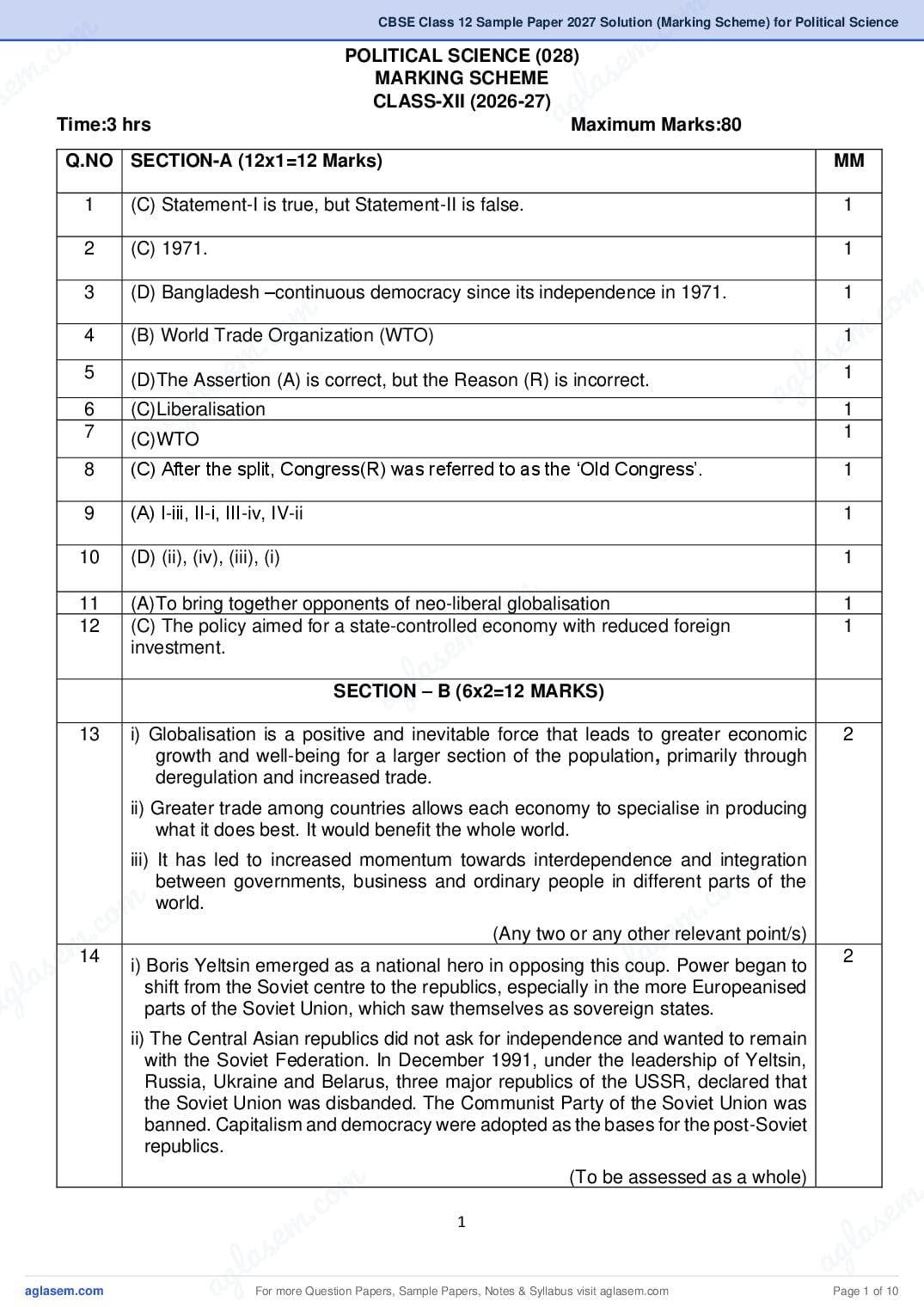
m .co POLITICAL SCIENCE (028)
s e m
se
MARKING SCHEME
g l a
Time:3 hrs
CLASS-XII (2026-27)
a
Maximum Marks:80
Q.NO SECTION-A (12x1=12 Marks) MM
1 (C) Statement-I is true, but Statement-II is false. 1
2 (C) 1971. 1
3 (D) Bangladesh –continuous democracy since its independence in 1971. 1
o m
m . c
4 •
.co
(B) World Trade Organization (WTO) 1m
e
s1
s em l a
ag 1
5
la
(D)The Assertion (A) is correct, but the Reason (R) is incorrect.
6
7 a g
(C)Liberalisation
1
(C)WTO
8 (C) After the split, Congress(R) was referred to as the ‘Old Congress’. 1
9 (А) І-ііі, II-і, ІII-iv, IV-ii 1
10 (D) (ii), (iv), (iii), (i) 1
m
.co
11 (A)To bring together opponents of neo-liberal globalisation 1
12 (C) The policy aimed for a state-controlled economy with reduced foreign 1
investment.
s em
g l–aB (6x2=12 MARKS)
a
SECTION
13 i) Globalisation is a positive and inevitable force that leads to greater economic 2
growth and well-being for a larger section of the population, primarily through
deregulation and increased trade.
ii) Greater trade among countries allows each economy to specialise in producing
what it does best. It would benefit the whole world.
iii) It has led to increased momentum towards interdependence and integration
m
.co
between governments, business and ordinary people in different parts of the
m
.co
world.
s em
em14
(Any two or any other relevant point/s)
s g la Power began to 2
la
i) Boris Yeltsin emerged as a national hero in opposing this coup.
shift from the Soviet centre to the republics, especially inathe more Europeanised
ag parts of the Soviet Union, which saw themselves as sovereign states.
ii) The Central Asian republics did not ask for independence and wanted to remain
with the Soviet Federation. In December 1991, under the leadership of Yeltsin,
Russia, Ukraine and Belarus, three major republics of the USSR, declared that
the Soviet Union was disbanded. The Communist Party of the Soviet Union was
banned. Capitalism and democracy were adopted as the bases for the post-Soviet
republics.
om .
(To be assessed as a whole)
.c e m
em
1
l as
l as ag
ag For more Question Papers, Sample Papers, Notes & Syllabus visit Page 1 of 10
Page 3
ii) Agricultural intensification =2
iii) Population growth
iv) Ecosystem degradation
(All four or other relevant point/s)
16 i) To reflect linguistic divisions: The national movement had promised that states 2
would be formed on the basis of language, as the old colonial boundaries were
seen as artificial divisions made for administrative convenience or British
annexation.The States Reorganisation Commission (SRC) accepted that the
boundaries of states should largely reflect the boundaries of different languages
to accommodate linguistic diversity.
ii) To enhance democratic practice and administration: The accommodation of
regional demands through linguistic states was seen as a more democratic
approach. It was hoped that accepting regional and linguistic claims would
strengthen national unity, rather than leading to disintegration as some leaders
initially feared, and would provide a more uniform and manageable basis for
administration.
(To be assessed as a whole)
17 The Dravida Munnetra Kazhagam (DMK) movement had several objectives: 2
i) Restoring the original name of the Kallakudi railway station which had been
renamed Dalmiapuram.
ii) Emphasizing Tamil language and culture in school curricula.
iii) Agitation against making Hindi the country’s official language.
(Any two points)
18 i) Severe Food Crisis: Widespread drought and failure of monsoons in 1965–1966 2
led to a drastic decline in agricultural production, resulting in acute food
shortages and depletion of food reserves across several states (particularly
Bihar).
ii) Devaluation of the Rupee: Under economic pressure from external forces like
the United States, the Indian government devalued the Indian rupee in 1966 (the
value of the US dollar shifted from rupees 5 to over rupees 7), which triggered
public discontent.
iii) Inflation and Price Rise: There was a steep increase in the prices of essential
commodities, food grains, and everyday consumer items, creating huge
economic hardships for the general public.
iv) Diversion of resources to defence spending: Due to military conflicts with
China (1962) and Pakistan (1965), a huge portion of India's development budget
had to be diverted toward national security and military expenditures, stagnating
five-year planning goals.
(Any two or other relevant point point/s)
SECTION – C (5x4=20 MARKS)
19 Mikhail Gorbachev was forced to initiate reforms in the USSR for the following 4
reasons:
i) To keep the USSR abreast of the information and technological revolutions taking
place in the West.
ii) To make the Soviet system less bureaucratic and more efficient to improve the
daily life of citizens.
iii) To address the internal dissatisfaction, lack of democracy, and absence of
freedom of speech that stifled the people.
iv) To normalize relations with the West, democratisation with in the country.
2
For more Question Papers, Sample Papers, Notes & Syllabus visit Page 2 of 10
Page 4
m .co
m .co e
v) To counter the economic stagnation caused by diverting vast resources to a large
s
m
se
military and supporting allies.
g l a
a
(Any four or other relevant point/s)
20 i) The various countries in South Asia have experienced mixed record of 4
democracies and the people also share an aspiration for democracy to be
flourished not only in rich or developed countries but in developing and
underdeveloped countries also which can be drawn from the examples of Nepal,
Pakistan, Bangladesh, Bhutan and Maldives, because:
ii) Every ordinary citizen, rich or poor belonging to different religions view the idea
of democracy positively and support the institutions of representative
m
.co
democracy.
m
.co
iii) They prefer democracy over any other form of democracy and think that
democracy is suitable for their country.
e m
e m
iv) There has been a hint of spread and demand for democracy as we have
l as
as
witnessed in the case of Nepal. Nepal has transformed politically from Monarchy
l ag
ag
to Democracy. It confirms the expansion of Democracy in South Asia.
(To be assessed as a whole or other relevant point/s)
4
(A) Ans:
21
Oil is the resource which generates immense wealth, hence it creates political
struggles involving industrialised countries to adopt various methods to ensure
steady flows of oil:
i) These include deployment of military forces near exploitation sites and along sea
lanes of communications.
ii) The stockpiling of strategic resources.
m
agreements.
m .co
iii) They support multinational companies by making favourable international
s e
iv) The global economy relied on oil as a portable and indispensable fuel; hence,
g la
the history of petroleum is the history of war and struggle.
a
v) It created conflict between Iraq and Saudi Arabia as Iraq’s known reserves are
second only to Saudi Arabia and since substantial portions of Iraqi territory are
yet to be fully explored, there is a fair chance that actual reserves might be far
larger.
OR
(B)
The UN defines indigenous population as the descendants of people who inhabited
the present territory of a country at the time when persons of a different culture or
ethnic origin arrived there from other parts of world and overcame them.
m
m .co
The demands of indigenous people can be summarised as follows:
.co m
i) Indigenous people speak of their struggles, agenda and fights like social
m
movements.
s e
s e l a
ii) Their voices in world politics call for the admission of indigenous people to the
g
g la world community as equals.
a
a iii) Many of the present day island states in the Oceania region (including Australia,
New Zealand) appeal to their governments to come to terms with the continuing
existence of indigenous nations with an identity of their own.
(To be assessed as a whole or other relevant point/s)
22 4
(A) India’s first general election was the biggest test of democracy in a poor and
illiterate country.
m .
.co s e m
em a
3
s l
l a ag
ag For more Question Papers, Sample Papers, Notes & Syllabus visit Page 3 of 10
Page 5
critics believed that democratic elections were only possible in prosperous,
educated countries like North America. India proved this wrong by successfully
conducting the world's largest democratic exercise under conditions of poverty
and widespread illiteracy.
ii) Universal Adult Franchise: The election was based on universal adult
franchise, granting voting rights to all citizens over 21, including women, at a time
when many European countries still hadn't given voting rights to women. India’s
experiment with universal adult franchise appeared very bold and risky.
iii) Participation: The level of participation was encouraging more than half the
eligible voters turned out to vote on the day of election.
iv) Peaceful and Fair Conduct: The elections were competitive, peaceful, and
the results were accepted as fair even by the losing parties.Its success inspired
many other nations that democracy could be practiced successfully in diverse
conditions.
OR
(B) Four major challenges faced by the Election Commission of India were:
i) Massive Scale of Illiteracy: Out of 17 crore (170 million) eligible voters,
only 15 per cent were literate. This low literacy rate meant the Election
Commission had to think of a special method of voting, such as using visual
symbols for candidates and separate ballot boxes for each party.
ii) Massive Electoral Size and Delimitation: The sheer size of the electorate
was unprecedented. The country had to be divided into electoral
constituencies, and a comprehensive voters' list (electoral roll) had to be
prepared from scratch for millions of people, many of whom lived in remote,
inaccessible areas.
iii) Problem of Missing Names of Women Voters: When the first draft of the
electoral roll was prepared, the names of nearly 40 lakh (4 million) women
were missing. They were simply listed as "wife of..." or "daughter of...". The
Election Commission refused to accept these entries and ordered a revision,
which led to a massive effort to get their proper names registered.
iv) Lack of Trained Personnel: Holding a free and fair election on such a vast
scale required a massive administrative machinery. Over 3 lakh (300,000)
polling staff and officers had to be specially trained to conduct the polling
process, manage booths, and handle ballot boxes.
(To be assessed as a whole or other relevant point/s)
23 The major conflicts between the Judiciary and the executive in 1973: 4
i) On the issue of Fundamental Right and right to property, the Supreme Court
denied the amendment to Constitution. While on the issue of Fundamental Right
giving effect to Directive principles, Parliament amended the Constitution, but
later Supreme Court rejected it.
ii) Court gave a decision that there are some basic features of the Constitution and
the Parliament cannot amend these basic features. This created tension
between parliament and judiciary.
iii) Tension between judiciary and executive further expanded, when a vacancy
arose of the post of Chief Justice of India. As per the constitutional practice,
4
For more Question Papers, Sample Papers, Notes & Syllabus visit Page 4 of 10
Page 6
m .co
m .co em
senior-most judge of the Supreme Court should be appointed as Chief Justice
s
se la
of India in case of vacancy. But in 1973 government ignored the seniority of
a g
three judges and appointed A.N. Ray as Chief Justice of India.
iv) The appointment became politically controversial because all the three judges
who were superseded had given rulings against the stand of the government.
Thus, constitutional interpretations and political ideologies were getting mixed
up rapidly. Highest point in controversy came when Allahabad High Court
declared Indira Gandhi’s election invalid.
(To be assessed as a whole or other relevant poin/st)
SECTION – D (3x4=12)
m
m .co
.co m
24 I (C) Israel attacked Lebanon 1+1+
II (C) Statement I is true, but Statement II is false.
s e 1+1=
s em
.III (D) Kofi A Annan
g l a 4
l a
IV(D) The UN cannot act without approval of Security Council members
g a
The a following questions are for the Candidates with Visual Impairment only,
in lieu of Question No. 24.
I) António Guterres is the current Secretary-General.
II) Amnesty International is the NGO that works for human rights protection all
over the World.
III) It shows that security threats come not only from states but also from non- state
actors (Hezbollah).
IV) Veto power means that any one of the five permanent members can stop a
o m
decision or resolution from being passed, even if all other members agree.
c
. and his supporters accused the
25
e m
I (C) The Chogyal did not accept the merger, 1+1+
las
Government of India of foul play and force. 1+1=
II (C) A protectorate of India.
III (B) Referendum. ag 4
IV (A) Defence, External Affairs, and Communications.
26 1+1+
Serial Number of Concerned alphabet given in the Name of the State
1+1=
the information map
4
used
(i) C Gujarat
m
m (ii) A
.co
Maharashtra
m .co s em
la
(iii) D Chhattisgarh
s e g
g la (iv) B
a Andhra Pradesh
a The following questions are for the Candidates with Visual Impairment only,
in lieu of Question No. 26.
I) Junagarh
II) Andhra Pradesh
III) SardarVallabhbhai Patel
IV) Razakars
SECTION E (4X6=24 MARKS)
m .
.co s e m
em a
5
s l
l a ag
ag For more Question Papers, Sample Papers, Notes & Syllabus visit Page 5 of 10
Page 7
‘Sino-Indian Conflict of 1962’ dented India’s image at home and international level,
India had to approach the Americans and the British for military assistance to
tide over the issues. The Soviet Union remained neutral during the conflict:
Ayaan
(Assess the answer as a whole or other relevant point)
OR
(B)
Objectives of India’s foreign policy:
i) Preservation of Sovereignty and Territorial Integrity: The foremost goal was
to protect India's hard earned sovereignty and territorial boundaries. This was
reflected in India's refusal to join any military alliance during the Cold War, thereby
ensuring the nation's capacity for independent decision-making in world affairs.
ii) Promotion of International Peace and Security: India's Constitution, in Article
51, outlines the Directive Principles of State Policy for the promotion of international
peace and security. India actively participated in UN peacekeeping missions and
advocated for global disarmament efforts.
iii) Panchsheel (Five Principles of Peaceful Coexistence): Nehru formulated
these five principles with China in 1954. These included mutual respect for territorial
integrity and sovereignty, mutual non-aggression, mutual non-interference in
internal affairs, equality and mutual benefit, and peaceful coexistence.
iv) Advocacy for Afro-Asian Unity: India played a significant role in fostering
solidarity among newly independent nations in Asia and Africa. The Afro Asian
conference held in the Indonesian city of Bandung in 1955, commonly known as
the Bandung Conference, marked the zenith of India’s engagement with the newly
independent Asian and African nations. The Bandung Conference later led to the
establishment of the NAM.
v) Rapid Economic Development: The foreign policy also aimed to secure
economic and technological assistance from both superpower blocs (the US and
USSR), which was crucial for its early industrial development
vi) Independent Nuclear Policy: India opposed the discriminatory nature of
treaties like the Nuclear Non-Proliferation Treaty (NPT) and the Comprehensive
Test Ban Treaty (CTBT). This independent stance culminated in India conducting
its first nuclear test in 1974, framed as a "peaceful nuclear explosion."
(Assess the answer as a whole or other relevant point)
28 6
(A) Ans:
Regional organisations like the European Union (EU) and the Association of
Southeast Asian Nations (ASEAN) play an effective role by providing platforms for
member states to economic growth, foster stability, and enhance their collective
influence on the global stage.
i) Economic Integration and Growth
Both the EU and ASEAN are highly effective in removing trade barriers and creating
larger markets that boost economic prosperity for their members.
• European Union (EU): The EU created a single market where goods, services,
capital, and people move freely. The introduction of the Euro currency further
simplified trade and investment and making the EU a dominant global economic
power.
• ASEAN: ASEAN is working towards an ASEAN Economic Community (AEC),
which aims to create a single market and production base. This integration has
6
For more Question Papers, Sample Papers, Notes & Syllabus visit Page 6 of 10
Page 8
m .co
m .co em
increased intra-regional trade and attracted foreign direct investment to Southeast
s
se
Asia.
g l a
ii) Maintaining Regional Peace and Stability a
Regional organisations provide crucial mechanisms for dialogue, cooperation, and
conflict resolution.
• European Union (EU): The EU coordinates common foreign and security policies
to address external threats collectively.
• ASEAN: The organisation is known for the "ASEAN Way," a form of interaction
that is informal, non- confrontationist and cooperative allowing members to focus
on economic development rather than security threats from neighbours.
m
.co
The ASEAN Regional Forum (ARF) also provides a unique platform for major
o m
global powers to discuss security issues related to Asia.
m
. c e
em (EU): The EU often speaks on critical global issues, such asglas
iii) Collective Influence
s
a agreements, trade negotiations with powers like China or the US,
• European Union
climate lchange a
ag
and upholding specific international norms
• ASEAN: ASEAN has effectively managed relations with major powers—including
the US, China, and India—through diplomatic platforms. ASEAN countries can
negotiate trade deals or address geopolitical tensions with major powers on a more
level playing field.
• Both EU and ASEAN coordinates many contemporary problems such as climate
change, pandemics, and disaster management.
m
.co
• (Assess the answer as a whole or other relevant point)
m
eOR
la s
(B)
g
a Republic of China in 1949, following the
After the inception of the People’s
communist revolution under the leadership of Mao, its economy was based on
Soviet Model.
i) The Chinese leadership took major policy decisions in the 1970s because its
industrial production was not growing fast enough, international trade was
minimal and per capita income was very low.
ii) China ended its political and economic isolation with the establishment of relations
with the United States in 1972.
m
.co
iii) Premier Zhou Enlai proposed the four modernisations (agricultural, industry,
m
.co
science and technology and military) in 1973.
iv) In 1978, the then leader Deng Xiaoping announced the ‘Open Door’ policy and e m
e m l as
s
economic reforms in China.
la ag
v) The government carried out the privatization of agriculture in 1982 and industry in
ag 1998, which drastically boosted productivity.
vi) Trade barriers were eliminated to establish Special Economic Zones (SEZs)
where foreign investors could set up their own enterprises, providing a major
impetus to export-led growth.
In China, the state played and continues to play a central role in setting up a market
economy and become a leading global power.
(Assess the answer as a whole or other relevant point)
m .
.co s e m
em a
7
s l
l a ag
ag For more Question Papers, Sample Papers, Notes & Syllabus visit Page 7 of 10
Page 9
Non-traditional notions of security go beyond military threats to include a wide
range of threats and dangers affecting the conditions of human existence.
i) Human security is about the protection of people more than the protection of
states. The traditional focus on protecting a state's borders and sovereignty does
not always guarantee the well-being of the people within those borders.
ii) History shows that more people have been killed by their own governments
(through genocide, famine, or internal conflict) than by foreign armies.
iii) All proponents of human security agree that its primary goal is the protection of
individuals.
Proponents of the ‘narrow’ concept of human security focus on violent threats to
individuals or, according to former UN Secretary-General Kofi Annan, “the
protection of communities and individuals from internal violence”.
iv) Proponents of the ‘broad’ concept of human security argue that the threat
agenda should include hunger, disease and natural disasters because these kill
far more people than war, genocide and terrorism combined. Human security
policy, should protect people from these threats as well as from violence.
v) Human security shifts the focus from the protection of the state to the protection
of the individual.
vi) It emphasizes two main goals:
Freedom from Fear: This involves protecting people from violent threats,
including war, ethnic cleansing, terrorism, and human rights abuses.
Freedom from Want: This addresses fundamental human needs, such as
ensuring economic security, access to food and healthcare, and protection from
environmental disasters.
(Assess the answer as a whole or other relevant point)
OR
(B)
The traditional notion of security focuses primarily on theuse or threat of military
force to protect a state's sovereignty, territorial integrity, and political independence
from external aggression.
Balance of Power: The balance of power as a component of traditional security
policy means that not every country is equal in terms of power. When other
countries are looked around, it can be judged easily that who is threat for our nation
in coming future. Some countries are bigger and stronger. For instance, a
neighbouring country may not be preparing to attack. In fact, there is no strong
reason for a war or attack to happen. But the fact that the country is very strong is
a sign that it may be aggressive in future Therefore Governments are very sensitive
to the balance of power between their country and other countries.
It is important to maintain a favourable balance of power with the countries with
whom they have differences and with those they have had issues in the past.
In the following way state/nation can achieve balance of power:
i) Building up one’s military power is essential to have a balance of power.
ii) Developing economic and technological power are also important since they are
the basis for military power.
Alliance building:
i) An alliance is a coalition of states that coordinate their actions to deter or defend
against military attack.
ii) Most alliances are formalised in written treaties and are based on a clear
identification of who constitutes the threat. Countries form alliances to increase their
effective power relative to another country or alliance.
8
For more Question Papers, Sample Papers, Notes & Syllabus visit Page 8 of 10
Page 10
m .co
m .co e
iii) Alliances are based on national interests and can change when national interests
s
m
se l a
change. For example, the US backed the Islamic militants in Afghanistan against
g
a
the Soviet Union in the 1980s, but later attacked them when Al Qaeda—a group of
Islamic militants led by Osama bin Laden—launched terrorist strikes against
America on 11 September 2001.
(Assess the answer as a whole or other relevant point)
30 (A) Ans: 6
Coalition politics since 1989 has transformed the nature of Indian democracy by:
decentralizing power, empowering regional parties and fostering a system based
on negotiation and consensus rather than single-party command.
m
i) End of Single-Party Dominance and Rise of Multi-Party System:
.co
The most significant transformation was the end of the Congress dominance. Thus,
m
.co m
began an era of multi-party system. For example
m
In the 1989 general election, for the first time, no single party secured an absolute
s e
s e
majority, leading to the formation of the National Front government an alliance
l a
l a
of Janata Dal and some other regional parties.
g ag
a
ii) Empowerment of Regional Parties and Federalism: The nineties also saw the
emergence of powerful parties and movements that represented the Dalit and
backward castes (Other Backward Classes or OBCs). Many of these parties
represented powerful regional assertion as well. These parties played an
important role in the United Front government that came to power in 1996.
iii) The influence of the DMK and AIADMK in national coalitions in successive
governments (e.g., UPA I and II, NDA) strengthened India's federal system,
forcing the central government to be more responsive to diverse regional
aspirations and demands.
m
.co
iv) Shift towards Inclusive and Consensus-Based Governance: Stable coalitions
have successfully implemented significant, accepted welfare policies. The
e m
economic liberalization reforms of 1991, initiated by a minority Congress
las
government under P.V. Narasimha Rao, required negotiation and external
ag
support to pass, demonstrating how crucial reforms could proceed even without
majority.
(Any three to be explained or other relevant point)
(B) OR
i) Elections in 1989 led to the defeat of the Congress party but did not result in a
majority for any other party. Though the Congress was the largest party in the
Lok Sabha, it did not have a clear majority and therefore, it decided to sit in the
m
.co
opposition.
m
.co
ii) The National Front (which itself was an alliance of Janata Dal and some other
regional parties) lead by V.P.Singhreceived support from two opposite political
e m
e m groups: the BJP and the Left Front.
l as
las iii) On this basis, the National Front formed a coalition government, but the BJP
ag
ag represented by L.K Advani and the Left Front represented by JyotiBasu did not
join in this government but gave support from outside.
Iv) These parties played an important role in the United Front government that
came to power in 1996. The United Front was similar to the National Front of
1989 for it included Janata Dal and several regional parties. This time the BJP
did not support the government.
v) The United Front government was supported by the Congress. This shows how
unstable the political equations were.
vi) In 1989, both the Left and the BJP supported the National Front Government
m
because they wanted to keep the Congress out of power. In 1996, the Left
.
.co s e m
em a
9
s l
l a ag
ag For more Question Papers, Sample Papers, Notes & Syllabus visit Page 9 of 10
Page 11
supported it, as both the Congress and the Left wanted to keep the BJP out of
power. They did not succeed for long, as the BJP continued to consolidate its
position in the elections of 1991 and 1996.
(Or other relevant point/s)
10
For more Question Papers, Sample Papers, Notes & Syllabus visit Page 10 of 10
Document Details
| Board / Org | CBSE |
| Exam | Class 12 |
| Type | Solution |
| Pages | 10 |
| Updated | 29 Oct 2026 |