CBSE Class 12 Sample Paper 2027 Solution (Marking Scheme) for Psychology
Finished viewing? Save it for later —
Download CBSE Class 12 Sample Paper 2027 Solution (Marking Scheme) for Psychology (PDF · 7 pages)About CBSE Class 12 Sample Paper 2027 Solution (Marking Scheme) for Psychology
CBSE Class 12 Sample Paper 2027 Solution (Marking Scheme) for Psychology is available here for free download. Published by CBSE for Class 12, this solution can be viewed online or downloaded as a PDF (7 pages). Candidates preparing for Class 12 can use CBSE Class 12 Sample Paper 2027 Solution (Marking Scheme) for Psychology to understand the exam pattern, the type of questions asked, and the overall difficulty level.
Frequently Asked Questions
How can I download CBSE Class 12 Sample Paper 2027 Solution (Marking Scheme) for Psychology?
Open this page and click the Download button to save CBSE Class 12 Sample Paper 2027 Solution (Marking Scheme) for Psychology as a PDF. It is completely free on AglaSem Docs.
Is CBSE Class 12 Sample Paper 2027 Solution (Marking Scheme) for Psychology free to download?
Yes. CBSE Class 12 Sample Paper 2027 Solution (Marking Scheme) for Psychology can be viewed online and downloaded as a PDF free of cost on AglaSem Docs.
How many pages does CBSE Class 12 Sample Paper 2027 Solution (Marking Scheme) for Psychology have?
CBSE Class 12 Sample Paper 2027 Solution (Marking Scheme) for Psychology contains 7 pages, which you can read online or download together as a single PDF.
Where can I find more Class 12 study material?
You can find more Class 12 question papers, sample papers, syllabus, and answer keys on AglaSem Docs.
CBSE Class 12 Sample Paper 2027 Solution (Marking Scheme) for Psychology – Text
Read the full text of this solution below — useful to quickly search, copy and reference the content online without downloading the PDF.
📄 View text version (8 pages)
Page 1
CBSE Class 12 Sample
Paper 2027 Solution
(Marking Scheme) for
Psychology
EXAM YEAR TYPE SUBJECT
CBSE Class 12 2027 Solutions Psychology
Notes · Sample Papers · Previous Year Papers · Mock Tests
Page 2
m .co
m .co s e m
se g l a
a
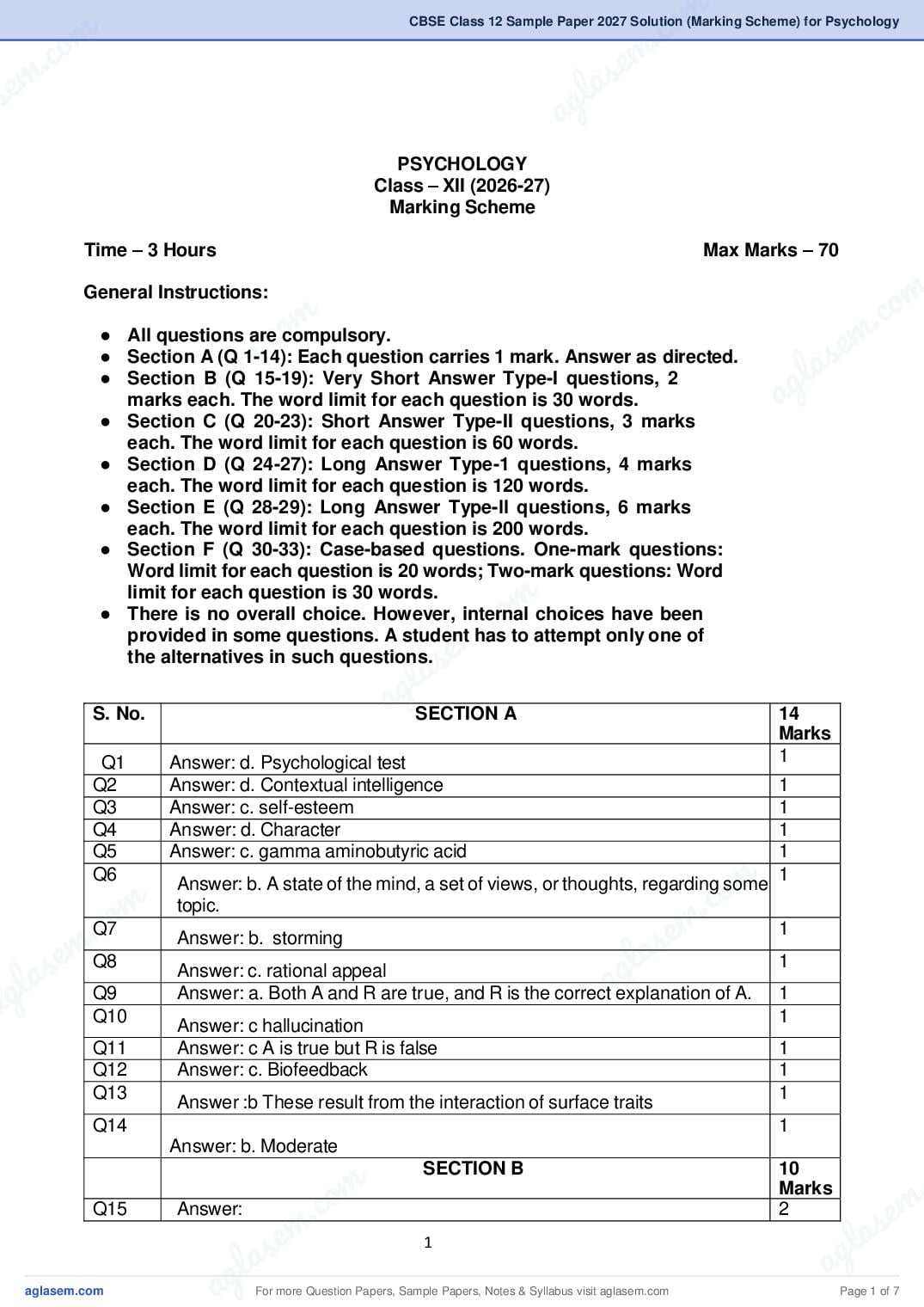
PSYCHOLOGY
Class – XII (2026-27)
Marking Scheme
Time – 3 Hours Max Marks – 70
m
.co
General Instructions:
m
.co
● All questions are compulsory.
s e m
s em
● Section A (Q 1-14): Each question carries 1 mark. Answer as directed.
● Section B (Q 15-19): Very Short Answer Type-I questions, 2
g l a
l a a
ag
marks each. The word limit for each question is 30 words.
● Section C (Q 20-23): Short Answer Type-II questions, 3 marks
each. The word limit for each question is 60 words.
● Section D (Q 24-27): Long Answer Type-1 questions, 4 marks
each. The word limit for each question is 120 words.
● Section E (Q 28-29): Long Answer Type-ll questions, 6 marks
each. The word limit for each question is 200 words.
● Section F (Q 30-33): Case-based questions. One-mark questions:
Word limit for each question is 20 words; Two-mark questions: Word
limit for each question is 30 words.
m
.co
● There is no overall choice. However, internal choices have been
em
provided in some questions. A student has to attempt only one of
the alternatives in such questions.
las
S. No.
g
a SECTION A 14
Q1 Answer: d. Psychological test 1
Q2 Answer: d. Contextual intelligence 1
Q3 Answer: c. self-esteem 1
Q4 Answer: d. Character 1
Q5 Answer: c. gamma aminobutyric acid 1
Q6 Answer: b. A state of the mind, a set of views, or thoughts, regarding some 1 m
m .co
.co
topic.
Q7
s em 1
emQ8 la
Answer: b. storming
s
la Q9 g 1
Answer: a. Both A and R are true, and R is the correctaexplanation of A.
Answer: c. rational appeal
ag Q10
1
1
Answer: c hallucination
Q11 Answer: c A is true but R is false 1
Q12 Answer: c. Biofeedback 1
Q13 Answer :b These result from the interaction of surface traits 1
Q14 1
Answer: b. Moderate
SECTION B 10
m .
.co
e m
s
Q15 Answer: 2
s em l a
la ag
1
ag For more Question Papers, Sample Papers, Notes & Syllabus visit Page 1 of 7
Page 3
relationships during childhood.
-When parents' behaviour towards a child is indifferent, erratic the child
feels insecure and a feeling called basic anxiety develops. Deep
resentment towards parents or basic hostility occurs due to this anxiety.
-By showing too much dominance or indifference, parents can generate
among children feelings of isolation and helplessness which interferes
with their healthy development.
Any two points. 1+1=2
Q16 2
Answer :
-Prejudice/negative attitude
-Behavioral component: Discrimination, violence, and genocide against
Jewish people.
1+1=2
Q17 Answer: 2
Primary Groups: Pre-existing group, close physical proximity, face to face
interaction. Eg family
Secondary group: Joins by choice, impersonal and indirect
relationship, Eg Political group
1+1=2
Q18 2
Answer :
-Confidentiality
-protects the client’s privacy and builds trust
1+1=2
Q19(A)
Answer :
-Increased humanism and curiosity about behavior
-psychological conflict and disturbed interpersonal relationships were
causes of psychological disorders.
-‘Witches’ were no longer considered mentally disturbed but required
medical treatment.
Any two points 1+1=2 2
OR
Q19(B) Answer :
-Obsessive behaviour the inability to stop thinking about a particular idea
or topic.
2
For more Question Papers, Sample Papers, Notes & Syllabus visit Page 2 of 7
Page 4
m .co
m .co s em
se g la
a behaviors over and
-Compulsive behaviour the need to perform certain
over again.
1+1=2
SECTION C 12
Q20 3
Answer: Pattern of responses an organism makes to a stimulus event that
disturbs the equilibrium and exceeds a person’s ability to cope.
m
m .co
.co e m
Sources of stress:
emevents (e.g., death, illness, marriage) l as
s
● Life
● laDaily hassles (e.g., traffic, deadlines) ag
g
a ●● Traumatic events (e.g., accidents, natural disasters)
Environmental stressors (noise, pollution, crowding)
Any two points
1+2=3
Q21 Answer: 3
Maladaptive behaviors resulting from regular and consistent use of the
m
.co
substance involved.
or
e m
Problems associated with the use and abuse of alcohol, cocaine,
las
tobacco and opioids among others, which alter the way people think, feel
and behave. 1mk
ag
Consequences:
● Interferes with social behaviour and ability to think and work.
Intoxicated drivers are responsible for many road accidents.
● tolerance ; withdrawal responses
● Serious effects on the children of persons with this disorder. These
children have higher rates of psychological problems, particularly
anxiety, depression, phobias and substance-related disorders.
● Excessive drinking can seriously damage physical health.
m
m .co
.co m
Any two points
s e
s emQ22 1+2=3
g la
g la Answer:
a 3
a Nomadic people require a constant movement in small bands from one
forest to another in search of games and other forest products.
-Such children are allowed enormous freedom to move into forests and
learn hunting gathering skills.
-Child socialization practices are also aimed at making children
independent, autonomous
-Achievement-oriented like taking risks and challenges from an early age
of life.
m .
.co m
1+1+1=3
s e
s em l a
la ag
3
ag For more Question Papers, Sample Papers, Notes & Syllabus visit Page 3 of 7
Page 5
-Cultural differences have an impact on intelligence tests. The test used
by the psychologist would have been a verbal test which did not respect
the culture of rural students.
It can be overcome by:
-It is important for her to use culture fair tests like the non-verbal tests
e.g. RSPM or performance tests like Koh’s Block Design test.
-Even those verbal tests that are based on the culture of the rural
population can be implemented.
1+2=3
OR
Q23(B) Answer: 3
Aliya is high in cognitive and entrepreneurial competence. Ajay is showing
social and emotional competence.
- Integral Intelligence: gives emphasis on connectivity with the social and
world environment.
Views intelligence from a holistic perspective where equal attention is
paid to cognitive and non-cognitive processes as well as their integration.
1+2=3
SECTION D 16
Q24 4
Answer:
Different types of intelligences interact and work together to find a
solution to a problem. 8 intelligences-
-Linguistic- use language fluently and flexibly to express one’s thinking
and understand others.
-Logical-Mathematical- Persons high on this type of intelligence can think
logically and critically.
-Spatial: refers to the abilities involved in forming, using, and
transforming mental images.
-Musical: capacity to produce, create and manipulate musical
patterns.
-Bodily-Kinesthetic: use of the whole body or portions of it for display or
construction of products and problem solving.
-Interpersonal: skill of understanding the motives, feelings and behaviors
of other
-Intrapersonal: knowledge of one’s internal strengths and limitations
and using that knowledge to effectively relate to others.
-Naturalistic: awareness of our relationship with the natural world.
Any four points 1+1+1+1=4
Q25 4
Answer: Attention Deficit Hyperactivity disorder
Symptoms:
● Inattentive: cannot concentrate, disorganized, forgetful, does not
follow instructions
● Impulsive : unable to control their immediate reactions or to think
before, find it difficult to wait or take turns, difficult to delaying
gratification, minor mishaps and accidents are common
4
For more Question Papers, Sample Papers, Notes & Syllabus visit Page 4 of 7
Page 6
m .co
m .co s em
se g la
● a by a motor’, always on
Hyperactivity: in constant motion, ‘driven
the go, and talk incessantly.
1+3=4
Q26(A) 4
Answer :
No, this situation highlights that positive attitudes do not always lead to
corresponding behaviour. (La Pierre)
m
m .co
.co
Factors:
• the attitude is strong , and occupies a central place in the attitude
e m
system
em l as
l as
• the person is aware of her/his attitude,
ag
ag
• there is very little or no external pressure for the person to behave in
a particular way. For example, when there is no group pressure to
follow a particular norm,
• the person’s behaviour is not being watched or evaluated by others,
and
• the person thinks that the behaviour would have a positive
consequence, and therefore, intends to engage in that behaviour
Any three points
o m
1+3=4
OR .
c
s em Theory, attitude change occurs 4
Q26(B) Answer : According to Mohsin’s Two-Step
First Step –Identification ag
in two stages: la
Identification
Means that the target has liking and regard for the source. S/he puts
herself/himself in the place of the target, and tries to feel like her/him
The message is first communicated to popular social media influencers,
who are respected, influential, and trusted individuals in society.
o m
m Second Step – Influence on the Masses:
c
.actually
c. o Here the source herself/himself shows an attitude change, by
s e m
e m l a
changing her/him behaviour towards the attitude object. Observing the
l as source’s changed attitude and behaviour, the
g
target also shows
a of imitation or
an
ag
attitude change through behaviour. This is a kind
observational learning.
2+2=4
Q27 4
Answer: Coping strategies are:
-Task-oriented Strategy: This involves obtaining information about the
stressful situation and about alternative courses of action and their
m .
probable outcome; it also involves deciding priorities and acting so as to
.co s e m
s em l a
la ag
5
ag For more Question Papers, Sample Papers, Notes & Syllabus visit Page 5 of 7
Page 7
better, or think about how I have solved similar problems.
-Emotion-oriented Strategy: This can involve efforts to maintain hope and
to control one’s emotions; it can also involve venting feelings of anger
and frustration, or deciding that nothing can be done to change things.
For example, tell myself that it is not really happening to me, or worry
about what I am going to do.
-Avoidance-oriented Strategy: This involves denying or minimizing the
seriousness of the situation; it also involves conscious suppression of
stressful thoughts and their replacement by self-protective thoughts.
-Problem-focused coping is useful when the stressor is controllable, such
as planning better to manage academic pressure.
-Emotion-focused coping is more effective when the stressor cannot be
changed, such as dealing with the loss of a loved one through
emotional expression or relaxation.
Explanation of any two
2+2=4
SECTION E 12
Q28(A) 6
Answer :
Allport suggested that the best method to assess a person is by asking
about her/him about herself/himself. This led to the use of self-report
measures. These are fairly structured measures that require subjects to
give verbal responses using some kind of rating scale. This requires the
subject to objectively report her/his feelings with respect to various
items. They are scored in quantitative terms and interpreted on the basis
of norms.
Limitations:
Social desirability and Acquiescence :brief description
Any two tests
MMPI, Eysenck Personality Questionnaire,16 PF (brief description of
any two)
2+2+2=6
OR
Q28(B) Answer : 6
The Psychodynamic approach, proposed by Sigmund Freud, explains
personality in terms of unconscious mental processes, inner conflicts,
and early childhood experiences.
Three levels of consciousness: Conscious, preconscious and
unconscious ( brief explanation)
Structure of personality: id, ego, superego
2+2+2=6
Q29(A) 6
Answer :
6
For more Question Papers, Sample Papers, Notes & Syllabus visit Page 6 of 7
Page 8
m .co
m .co s em
se g la
a events and their
Irrational beliefs mediate between the antecedent
consequences
Antecedent-belief-consequence (ABC) analysis:
Antecedent events – not selected irrational
beliefs- musts, should,
consequence, i.e. negative emotions and behaviors
m
.co
Process of therapy - questionnaires and interviews; non-directive
questioning.
m
1+3+2=6
.co s e m
em a
OR
s 6l
a ag
Q29(B) Answer: Psychotherapy is a voluntary relationship between the one
g l
seeking treatment or the client and the one who treats or the therapist.
aFactors contributing to healing;:
-Technique
-Therapeutic Alliance
-Catharsis
-Nonspecific factors : patient variables and therapist variables
2+4=6
m
SECTION F
m .co 6
e
CASE 1
las
Q30 Answer:
Emotional intelligence ag 1
1 mk
Q31 Answer: 2
He has the ability to monitor his own and other’s emotions, to discriminate
among them, and uses the information to guide his thinking and actions.
1+1=2
CASE 2
m
.co
Q32 Answer: 1
m Group polarization
m .co
Q33 Answer: 2
s e m
s e
a. In the company of like-minded people one hears newer
g l a
la
arguments that favor one's viewpoints.
g b. Bandwagon effect a
a C. Ingroup and outgroup phenomenon
m .
.co s e m
s em l a
la ag
7
ag For more Question Papers, Sample Papers, Notes & Syllabus visit Page 7 of 7
Document Details
| Board / Org | CBSE |
| Exam | Class 12 |
| Type | Solution |
| Pages | 7 |
| Updated | 29 Oct 2026 |