ISC Class 11 Specimen Paper for Chemistry
Finished viewing? Save it for later —
Download ISC Class 11 Specimen Paper for Chemistry (PDF · 8 pages)About ISC Class 11 Specimen Paper for Chemistry
ISC Class 11 Specimen Paper for Chemistry is available here for free download. Published by CISCE for Class 11, this sample paper can be viewed online or downloaded as a PDF (8 pages). Candidates preparing for Class 11 can use ISC Class 11 Specimen Paper for Chemistry to understand the exam pattern, the type of questions asked, and the overall difficulty level.
Frequently Asked Questions
How can I download ISC Class 11 Specimen Paper for Chemistry?
Open this page and click the Download button to save ISC Class 11 Specimen Paper for Chemistry as a PDF. It is completely free on AglaSem Docs.
Is ISC Class 11 Specimen Paper for Chemistry free to download?
Yes. ISC Class 11 Specimen Paper for Chemistry can be viewed online and downloaded as a PDF free of cost on AglaSem Docs.
How many pages does ISC Class 11 Specimen Paper for Chemistry have?
ISC Class 11 Specimen Paper for Chemistry contains 8 pages, which you can read online or download together as a single PDF.
Where can I find more Class 11 study material?
You can find more Class 11 question papers, sample papers, syllabus, and answer keys on AglaSem Docs.
ISC Class 11 Specimen Paper for Chemistry – Text
Read the full text of this sample paper below — useful to quickly search, copy and reference the content online without downloading the PDF.
📄 View text version (8 pages)
Page 1
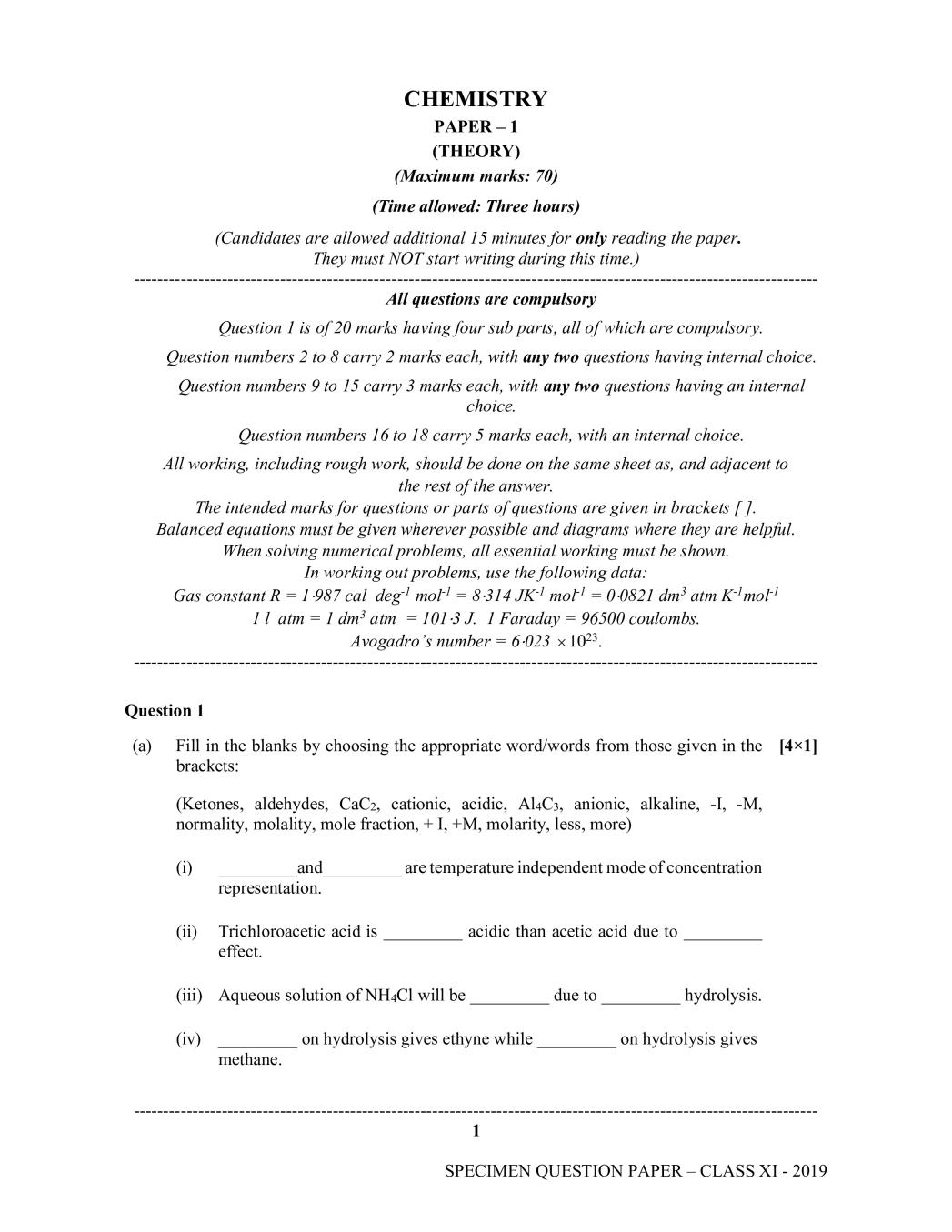
PAPER – 1
(THEORY)
(Maximum marks: 70)
(Time allowed: Three hours)
(Candidates are allowed additional 15 minutes for only reading the paper.
They must NOT start writing during this time.)
All questions are compulsory
Question 1 is of 20 marks having four sub parts, all of which are compulsory.
Question numbers 2 to 8 carry 2 marks each, with any two questions having internal choice.
Question numbers 9 to 15 carry 3 marks each, with any two questions having an internal
choice.
Question numbers 16 to 18 carry 5 marks each, with an internal choice.
All working, including rough work, should be done on the same sheet as, and adjacent to
the rest of the answer.
The intended marks for questions or parts of questions are given in brackets [ ].
Balanced equations must be given wherever possible and diagrams where they are helpful.
When solving numerical problems, all essential working must be shown.
In working out problems, use the following data:
Gas constant R = 1987 cal deg-1 mol-1 = 8314 JK-1 mol-1 = 00821 dm3 atm K-1mol-1
1 l atm = 1 dm3 atm = 1013 J. 1 Faraday = 96500 coulombs.
Avogadro’s number = 6023 1023.
Question 1
(a) Fill in the blanks by choosing the appropriate word/words from those given in the [4×1]
brackets:
(Ketones, aldehydes, CaC2, cationic, acidic, Al4C3, anionic, alkaline, -I, -M,
normality, molality, mole fraction, + I, +M, molarity, less, more)
(i) _________and_________ are temperature independent mode of concentration
representation.
(ii) Trichloroacetic acid is _________ acidic than acetic acid due to _________
effect.
(iii) Aqueous solution of NH4Cl will be _________ due to _________ hydrolysis.
(iv) _________ on hydrolysis gives ethyne while _________ on hydrolysis gives
methane.
1
Page 2
the choices given:
(i) The electronic configuration of outer most shell of the most electronegative
element is:
(1) ns2np3
(2) ns2np4
(3) ns2np5
(4) ns2np6
(ii) Which of the following species is diamagnetic in nature?
(1) He
(2) H2
(3) H
(4) H
(iii) The volume of ‘10 vol’ H2O2 required to liberate 500 ml of O2 at NTP is:
(1) 50 ml
(2) 25 ml
(3) 100 ml
(4) 125 ml
(iv) The compound which is not isomeric with diethyl ether is:
(1) methyl n-propyl ether
(2) 1 – butanol
(3) 2 – methyl propan – 2 – ol
(4) butanone
(c) Match the following: [4×1]
(i) Magnetic quantum number (a) Optical isomerism
(ii) Boron halides (b) Sodium carbonate
(iii) Lactic acid (c) Orientation of the orbital
(iv) Solvay’s process (d) Lewis acid.
2
Page 3
(i) (1) For a molecule Nb = Na will the molecule be stable? Explain why.
(2) What type of bond is formed when two p-orbitals overlap sidewise?
(ii) (1) Which alkyne on reductive ozonolysis will produce glyoxal only?
(2) Which gas is produced on dehydrohalogenation of ethyl iodide?
(iii) (1) At what temperature is the entropy of a perfectly crystalline substance
taken as zero?
(2) Predict the sign of ∆G for a reaction that is exothermic and
accompanied by an increase in entropy.
(iv) (1) Why are alkali metals used as reducing agents?
(2) Name the alkaline earth metal which shows diagonal relationship with
aluminium.
Question 2 [2]
(a) In the Carius method of estimation of halogens, 0.250g of an organic compound
gives 0.141g of AgBr. Calculate the percentage of bromine in the compound.
(at.wt. of Ag = 108, Br = 80).
OR
(b) In the Carius determination 0.234 g of an organic compound gave 0.334 g of Barium
Sulphate. Calculate the percentage of Sulphur in the given compound.
(at.wt. of Ba=137, S = 32, O = 16)
Question 3 [2]
Complete and balance the following equations:
(i) FeSO4 + H2O2 +H2SO4 → _________ + _________
(ii) H2O2 + Ag2O → _________ + _________ + _________
Question 4 [2]
A dry gas measuring 280 ml at 305 K and 750 mm of Hg, weighs 0.344 g. Calculate the
molecular weight of the gas.
3
Page 4
Write the structural formula of the compounds having the following IUPAC names.
(i) 5 – methyl hept – 3 – enal
(ii) 3 – hydroxy 6, 6 dimethyl hept – 4 – ene – 1 – oic acid.
Question 6 [2]
The first ionisation enthalpy of nitrogen (Z = 7) is greater than that of oxygen (Z = 8) but
the reverse is true for the second ionisation enthalpy. Explain why.
Question 7 [2]
(a) Which alkene on reductive ozonolysis gives only:
(i) Ethanal
(ii) Propanone
OR
(b) How will you convert the following:
(i) Ethyl alchohol to ethene
(ii) Propene to 2 - bromopropane.
Question 8 [2]
Discuss the structure of diamond and graphite and explain the hardness of these allotropes
on the basis of their structures.
Question 9 [3]
(i) Which one of the following is more paramagnetic Fe2+ or Fe3+ ? Explain.
(ii) What is the number of unpaired electrons in Mn2+ ion? (at.no. Mn = 25)
4
Page 5
(a) In a Victor Meyer’s determination, 0.36g of volatile substance displaces air which
measures 140 ml at STP. Calculate the vapour density and molecular weight of the
substance.
(1 litre of H2 gas at STP weights 0.09g)
OR
(b) 750 ml of N2 gas when taken in a vessel has pressure equal to 900 mm of Hg, 1200
ml of O2 gas when taken in another vessel has pressure equal to 1450 mm of Hg. If
both the gases are taken in 1000 ml vessel, what will be the total pressure exerted by
the mixture of above gases? Assume that the gases are non-reacting.
Question 11 [3]
Write the balance equations for the following:
(i) Dilute hydrochloric acid is added to sodium thiosulphate solution.
(ii) Silver nitrate solution is treated with sodium thiosulphate solution.
(iii) Iodine solution is treated with sodium thiosulphate solution.
Question 12 [3]
(a) Calculate the standard heat of formation (∆H°f) of C6H12O6(s) from the following data:
(i) ∆𝐻𝑐 of C6H12O6(s) = - 2816 k.J mole -1
(ii) ∆H°f of CO2(g) = - 395.5 k.J mole -1
(iii) ∆H°f of H2O(l) = - 285.9 k.J mole -1
OR
(b) Answer the following questions in brief:
(i) Define heat of neutralisation.
(ii) What is the criteria for spontaneity in terms of free energy change?
5
Page 6
1. Gaseous substance
2. Liquid substance
Question 13 [3]
Answer the following questions:
(i) Name the gas that had leaked from the storage tank of the Union Carbide
plant in the Bhopal gas tragedy.
(ii) What is acid rain and how it is formed?
(iii) What are the two effects of ozone layer depletion?
Question 14 [3]
(i) Discuss the optical isomerism of Lactic acid.
(ii) Can a compound of the type aaC = Cab show geometrical isomerism? Explain why.
Question 15 [3]
Write the molecular orbital configuration of N2 . Calculate the bond order and predict its
magnetic behaviour.
Question 16 [5]
(a) (i) Balance the following equations by ion-electron method:
(1) Mn𝑂 + Fe2+ + H+ → Mn2+ + Fe3+ +H2O (acidic medium)
(2) Mn𝑂 + Sn𝑂 + H2O → MnO2 + Sn𝑂 + 𝑂𝐻 (alkaline medium)
(ii) Find the oxidation number of:
(1) S in Na2S4 O6
(2) Cr in K2Cr2O7
(3) Mn in K2MnO4
(4) Fe in Fe3O4
6
Page 7
(b) (i) Balance the following equations by oxidation number method:
(1) Cu + HNO3 → Cu (NO3)2 + NO2 + H2O)
(2) K2Cr2O7 + HCl → KCl + CrCl3 + H2O + Cl2
(ii) Give reasons for the following:
(1) HNO3 acts only as an oxidising agent while HNO2 can act both as a
reducing agent and an oxidising agent.
(2) Chlorine liberates iodine from KI solution.
Question 17 [5]
(a) (i) Explain why:
(1) The colour of Baeyer’s reagent gets discharged when treated with an
alkene.
(2) Alkanes and alkynes do not give geometrical isomerism.
(ii) How will you convert the following? (Give balanced equation.)
(1) Sodium acetate to methane
(2) Ethane to butane
(3) Benzene to toluene
OR
(b) (i) Identify the compounds A and B.
(1) `C6H5COONa + NaOH ⎯ A B
(2) C 2 H6 A B
(ii) State an appropriate chemical test used to distinguish between the following
pairs of compounds:
(1) Ethene and Ethyne
(2) But – 1 – ene and but – 2 - ene
7
Page 8
(a) (i) 15 moles of N2 is mixed with 20 moles of H2 in an 8 litre vessel. 5.6 moles
of ammonia is formed. Calculate Kc for the equation;
N2(g) + 3 H2(g)⇌2NH3(g) + ℎ𝑒𝑎𝑡
(ii) The solubility product of silver chloride is 1x10⁻¹⁰ at 25°C. Calculate the
solubility of silver chloride in 0.1 M sodium chloride.
OR
(b) (i) State and explain Le Chatelier’s principle. On the basis of this principle
discuss the conditions for obtaining the maximum yield of SO3 in the
following reaction.
2SO2(g) + O2(g)⇌2SO3(g); ∆𝐻 = - 42 k.cal.
(ii) Calculate the pH value of 0.01M CH3 COOH if it is 5% dissociated.
8