Maharashtra 12th Std Model Question Paper Economics
Finished viewing? Save it for later —
Download Maharashtra 12th Std Model Question Paper Economics (PDF · 16 pages)About Maharashtra 12th Std Model Question Paper Economics
Maharashtra 12th Std Model Question Paper Economics is available here for free download. Published by Maharashtra Board for Class 12, this sample paper can be viewed online or downloaded as a PDF (16 pages). Candidates preparing for Class 12 can use Maharashtra 12th Std Model Question Paper Economics to understand the exam pattern, the type of questions asked, and the overall difficulty level.
Frequently Asked Questions
How can I download Maharashtra 12th Std Model Question Paper Economics?
Open this page and click the Download button to save Maharashtra 12th Std Model Question Paper Economics as a PDF. It is completely free on AglaSem Docs.
Is Maharashtra 12th Std Model Question Paper Economics free to download?
Yes. Maharashtra 12th Std Model Question Paper Economics can be viewed online and downloaded as a PDF free of cost on AglaSem Docs.
How many pages does Maharashtra 12th Std Model Question Paper Economics have?
Maharashtra 12th Std Model Question Paper Economics contains 16 pages, which you can read online or download together as a single PDF.
Where can I find more Class 12 study material?
You can find more Class 12 question papers, sample papers, syllabus, and answer keys on AglaSem Docs.
Maharashtra 12th Std Model Question Paper Economics – Text
Read the full text of this sample paper below — useful to quickly search, copy and reference the content online without downloading the PDF.
📄 View text version (16 pages)
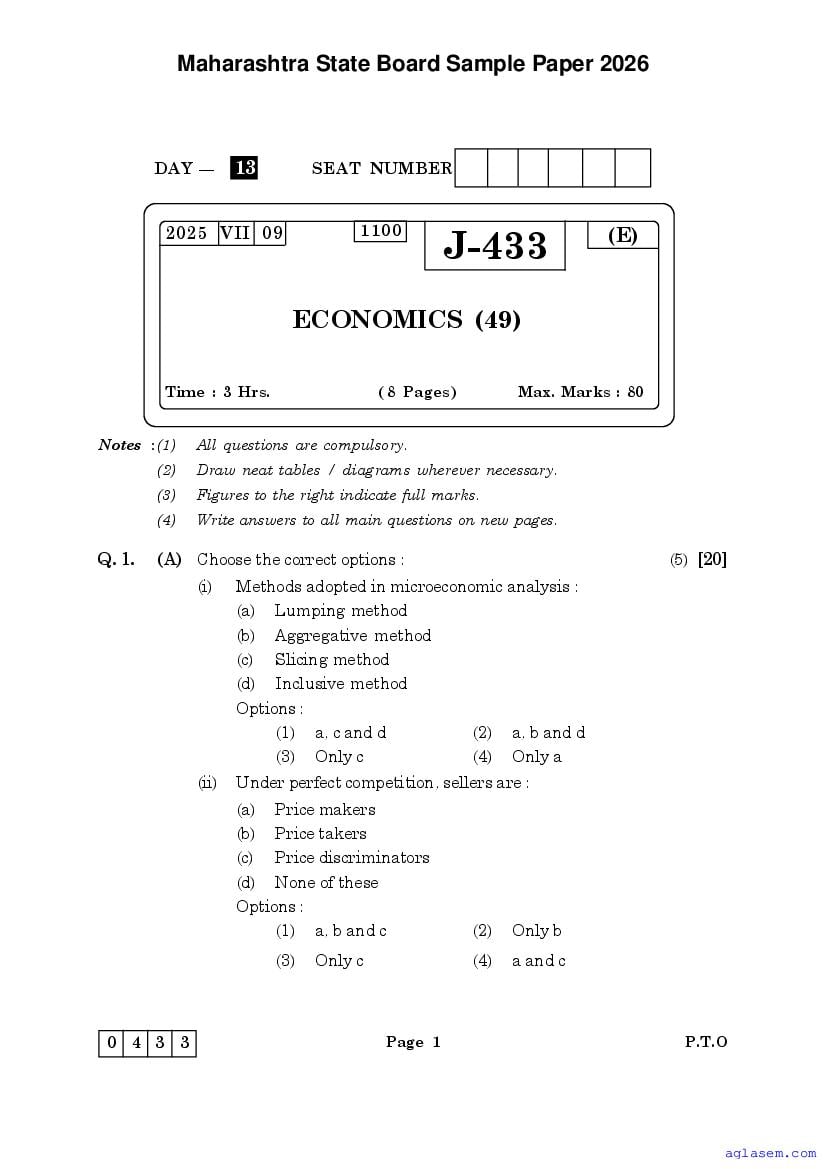
Page 1
DAY — 13 SEAT NUMBER
2025 VII 09 1100 (E)
J-433
ECONOMICS (49)
Time : 3 Hrs. ( 8 Pages ) Max. Marks : 80
Notes : (1) All questions are compulsory.
(2) Draw neat tables / diagrams wherever necessary.
(3) Figures to the right indicate full marks.
(4) Write answers to all main questions on new pages.
Q. 1. (A) Choose the correct options : (5) [20]
(i) Methods adopted in microeconomic analysis :
(a) Lumping method
(b) Aggregative method
(c) Slicing method
(d) Inclusive method
Options :
(1) a, c and d (2) a, b and d
(3) Only c (4) Only a
(ii) Under perfect competition, sellers are :
(a) Price makers
(b) Price takers
(c) Price discriminators
(d) None of these
Options :
(1) a, b and c (2) Only b
(3) Only c (4) a and c
0 4 3 3 Page 1 P.T.O
Page 2
Numbers :
(a) Index numbers are a geographical tool.
(b) Index numbers measure changes in the air
pressure.
(c) Index numbers measure relative changes in an
economic variable.
(d) Index numbers are specialized average.
Options :
(1) c and d (2) a and b
(3) b and c (4) a and d
(iv) Obligatory functions of the government :
(a) Protection from external attacks
(b) Maintaining internal law and order
(c) Welfare measures
(d) Exporting goods and services
Options :
(1) c and d (2) a and b
(3) Only b (4) a, c and d
(v) Types of foreign trade are as follows :
(a) Import trade
(b) Export trade
(c) Entrepot trade
(d) Internal trade
Options :
(1) a and b (2) a, b and c
(3) a, b, c and d (4) None of these
(B) Give Economic terms : (5)
(i) A desire which is backed by willingness to purchase
and ability to pay.
0 4 3 3 Page 2
Page 3
more unit of output.
(iii) The type of market where there are few sellers.
(iv) The gross market value of all final goods and services
produced within the domestic territory of a country
during a period of one year.
(v) Buying and selling of goods and services within the
boundaries of a nation.
(C) Complete the following statements : (5)
(i) Micro economics is also known as ______.
(a) Price Theory
(b) Income Theory
(c) Growth Theory
(d) Development Theory
(ii) When total utility is maximum then marginal utility
is ______.
(a) Positive (b) Negative
(c) Zero (d) One
(iii) Demand curve is parallel to ‘X’ axis in case of ______.
(a) Perfectly elastic demand
(b) Perfectly inelastic demand
(c) Relatively elastic demand
(d) Relatively inelastic demand
(iv) In India, National Income is estimated by Central
Statistical Organization (CSO) using ______.
(a) Output method
(b) Income method
(c) Expenditure method
(d) Combination of Output and Income method
0 4 3 3 Page 3 P.T.O
Page 4
funds is known as _____.
(a) Money market (b) Capital market
(c) Labour market (d) Product market
(D) Find the odd word : (5)
(i) Types of utility :
Form utility, Place utility, Marginal utility,
Service utility
(ii) Determinants of demand :
Price, Income, Prices of substitute goods,
Giffen’s paradox
(iii) Methods of measuring price elasticity of demand :
Income method, Percentage method, Total
Expenditure method, Point method / Geometric
method.
(iv) Exceptions to the law of supply :
Supply of labour, Agricultural goods, Prestige goods,
Perishable goods.
(v) Non-Tax Revenue Sources :
Fees, Custom duty, Special Assessment, Fines and
penalties
Q. 2. (A) Identify and explain the following concepts (Any THREE) : (6) [12]
(i) Raju collected the information about total
consumption, total savings and total investment of
Indian economy.
(ii) Rise in price by 20% of a commodity ‘X’ leads to fall in
the demand of the same commodity ‘X’ by 20%.
(iii) Swara receives monthly pension of ` 8,000 from the
State Government of Maharashtra.
0 4 3 3 Page 4
Page 5
in the bank for a period of three years.
(v) Sharad was able to supply less paper to market due
to technical problems in paper making factory
although the price of paper remained constant.
(B) Distinguish between (Any THREE) : (6)
(i) Slicing method and Lumping method
(ii) Expansion of demand and Increase in demand
(iii) Stock and Supply
(iv) Simple Index Number and Weighted Index Number
(v) Public Finance and Private Finance
Q. 3. Answer the following questions (Any THREE) : [12]
(i) Explain any four features of Micro Economics.
(ii) Explain any four features of perfect competition.
(iii) Explain any four functions of Reserve Bank of India.
(iv) Explain the two sector model of the circular flow of
National Income.
(v) Explain the types of Index Number.
Q. 4. State with reasons whether you agree or disagree with [12]
the following statements (Any THREE) :
(i) There are no real exceptions to the law of Diminishing
Marginal Utility.
(ii) There are many features of monopolistic competition.
(iii) There are no limitations of Index Number.
(iv) Money market plays important role in India.
(v) There is no difference between the concepts of Balance of
Trade and Balance of Payment.
0 4 3 3 Page 5 P.T.O
Page 6
the questions given below it (Any TWO) :
(i) Observe the given table and answer the questions: (4)
Unit of
Total Utility Marginal Utility
commodity
1 10
2 18 8
3 6
4 28 4
5 30
6 30 0
7 –2
Questions :
(a) Complete the above table. (2)
(b) When total utility increases at a diminishing rate then
marginal utility goes on . (1)
(c) After consuming six units of the commodity, MU
becomes . (1)
(ii) Observe the following diagrams and answer the questions
given below: (4)
DIAGRAM A
0 4 3 3 Page 6
Page 7
Questions :
(1) Diagram ‘A’ represents _______ in supply. (1)
(2) Diagram ‘B’ represents _______ in supply. (1)
(3) In diagram ‘A’, the supply curve shifts _______ side
of the original supply curve. (1)
(4) In diagram ‘B’, the supply curve shifts _______ side
of the original supply curve. (1)
(iii) Read the given passage and answer the questions : (4)
The Government of India and various agencies
continuously monitor and calculate the National Income
using different methods such as output, income and
expenditure methods, etc. These methods help in providing
a comprehensive picture of India’s economic performance.
From 2001 to 2021, India’s GDP grew at an average
annual rate of around 6 to 7%. The country saw a
significant shift from primarily agriculture-based to a
0 4 3 3 Page 7 P.T.O
Page 8
playing a more prominent role in GDP composition.
However it is important to note that there were
fluctuations and challenges along the way, including the
global financial crisis in 2008 and the COVID-19 pandemic
in 2020 which temporarily disrupted growth trends.
In recent years, India has aimed for sustainable
economic development, focusing on information
technology. The initiatives such as “Make in India” and
“Digital India” have been launched to boost economic
activities and create employment opportunities which in
turn impact the National Income positively.
Questions :
(1) What is the average annual growth rate of India
for the period from 2001 to 2021? (1)
(2) Which factors disrupted the growth trends of India’s
National Income? (1)
(3) Express your opinion about the given passage. (2)
Q. 6. Answer the following questions in detail (Any TWO ) : [16]
(i) State and explain the law of demand with its assumptions.
(ii) Explain the factors influencing the elasticity of demand.
(iii) Explain the reasons for the growth in public expenditure
in India.
uuu
0 4 3 3 Page 8
Page 9
DAY — 13 SEAT NUMBER
2025 VII 09 1100 (M)
J-434
ECONOMICS (49)
Time : 3 Hrs. ( 8 Pages ) Max. Marks : 80
‚ÍøŸÊ — (1) ‚fl¸ ¬˝‡Ÿ ‚Ù«UÁfláÊ •ÁŸflÊÿ¸§•Ê„U.
(2) •Êfl‡ÿ∑§ àÿÊ Á∆U∑§ÊáÊË ∑§Ùc≈U∑§ / •Ê∑ΧàÿÊ ∑§Ê…UÊ.
(3) ©U¡√ÿÊ ’Ê¡Íø •¢∑§ ¬˝‡ŸÊ¢ø ¬Íáʸ ªÈáÊ Œ‡Ê¸ÁflÃÊÃ.
(4) ‚fl¸ ◊ÈÅÿ ¬˝‡ŸÊ¥øË U©UàÃ⁄U ŸflËŸ ¬ÊŸÊ¥fl⁄U Á‹„UÊflËÃ.
¬˝. 1. (•) ÿÊÇÿ ¬ÿʸÿ ÁŸfl«UÊ — (5) [20]
(i) ‚͡◊ •Õ¸‡ÊÊSòÊËÿ Áfl‡‹·áÊÊà flʬ⁄U‹Ë ¡ÊáÊÊ⁄UË ¬Œ˜äÊÃ.
(•) ⁄UʇÊË ¬Œ˜äÊà (’) ‚◊ª˝ ¬Œ˜äÊÃ
(∑§) Áfl÷Ê¡Ÿ ¬Œ˜äÊà («U) ‚fl¸‚◊Êfl‡Ê∑§ ¬Œ˜äÊÃ
¬ÿʸÿ —
(1) •, ∑§ •ÊÁáÊ «U (2) •, ’ •ÊÁáÊ «U
(3) »§Äà ∑§ (4) »§Äà •
(ii) ¬Íáʸ S¬äʸà Áfl∑˝§àÿÊøË ÷ÍÁ◊∑§Ê ¬È…UË‹ ¬˝∑§Ê⁄UøË •‚Ã.
(•) Á∑¥§◊Ã∑§Ãʸ (’) Á∑¥§◊à SflË∑§Ê⁄UáÊÊ⁄UÊ
(∑§) Á∑¥§◊Ã÷Œ ∑§⁄UáÊÊ⁄UÊ («U) ÿÊ¥¬Ò∑§Ë ŸÊ„UË
¬ÿʸÿ —
(1) •, ’ •ÊÁáÊ ∑§ (2) »§Äà ’
(3) »§Äà ∑§ (4) • •ÊÁáÊ ∑§
0 4 3 4 Page 1 P.T.O
Page 10
(•) ÁŸŒ¸‡ÊÊ¥∑§ ∞∑§ ÷ÊÒªÊÁ‹∑§ ‚ÊäÊŸ •Ê„U.
(’) ÁŸŒ¸‡ÊÊ¥∑§Êà „UflëÿÊ ŒÊ’Êø ◊Ê¡◊ʬ ∑§‹ ¡ÊÃ.
(∑§) ÁŸŒ¸‡ÊÊ¥∑§Êà •ÊÁÕ¸∑§ ø‹ÊÃË‹ ‚ʬˇÊ ’Œ‹Êø ◊Ê¡◊ʬ ∑§‹ ¡ÊÃ.
(«U) ÁŸŒ¸‡ÊÊ¥∑§ „UÊ ÁflÁ‡Êc≈U ‚⁄UÊ‚⁄UË◊äÿ •‚ÃÊ.
¬ÿʸÿ —
(1) ∑§ •ÊÁáÊ «U (2) •, •ÊÁáÊ ’
(3) ’ »§Äà ∑§ (4) • •ÊÁáÊ «U
(iv) ‚⁄U∑§Ê⁄UëÿÊ ‚ÄÃËëÿÊ ∑§ÊÿÊZ◊äÿ ¬È…UË‹¬Ò∑§Ë ÿÊ ∑§ÊÿÊZøÊ ‚◊Êfl‡Ê „UÊÃÊ.
(•) ¬⁄U∑§Ëÿ •Ê∑˝§◊áÊÊ¥¬Ê‚ÍŸ ‚¥⁄UˇÊáÊ
(’) •¥Ãª¸Ã ∑§ÊÿŒÊ fl ‚È√ÿflSÕÊ
(∑§) ∑§ÀÿÊáÊ∑§Ê⁄UË ©U¬ÊÿÿÊ¡ŸÊ
(«U) flSÃÍ fl ‚flÊ¥øË ÁŸÿʸÃ
¬ÿʸÿ —
(1) ∑§ •ÊÁáÊ «U (2) •, •ÊÁáÊ ’
(3) »§Äà ’ (4) •, ∑§ •ÊÁáÊ «U
(v) ÁflŒ‡ÊË √ÿʬÊ⁄UÊø ¬˝∑§Ê⁄U πÊ‹Ë‹ ¬˝∑§Ê⁄‘U •Ê„UÃ.
(•) •ÊÿÊà √ÿʬÊ⁄U (’) ÁŸÿʸà √ÿʬÊ⁄U
(∑§) ¬ÈŸÁŸ¸ÿʸà √ÿʬÊ⁄U («U) •¥Ãª¸Ã √ÿʬÊ⁄U
¬ÿʸÿ —
(1) •, •ÊÁáÊ ’ U (2) •, ’ •ÊÁáÊ ∑§
(3) •, ’, ∑§ •ÊÁáÊ «U (4) ÿÊ¥¬Ò∑§Ë ŸÊ„UË
(’) •Õ¸‡ÊÊSòÊËÿ ¬ÊÁ⁄U÷ÊÁ·∑§ ‡ÊéŒ Á‹„UÊ — (5)
(i) •‡ÊË ßUë¿UÊ, Á¡‹Ê π⁄‘UŒË‡ÊÄÃËø ¬Ê∆U’› •ÊÁáÊ Ã πø¸ ∑§⁄UáÿÊøË
◊ÊŸÁ‚∑§ ÃÿÊ⁄UË •‚Ã.
0 4 3 4 Page 2
Page 11
ÁŸ√fl› flÊ…U.
(iii) ’Ê¡Ê⁄UÊøÊ •‚Ê ¬˝∑§Ê⁄U íÿÊà ∑§Ê„UË Áfl∑˝§Ã •‚ÃÊÃ.
(iv) ∞∑§Ê fl·Ê¸ëÿÊ ∑§Ê‹ÊfläÊËà Œ‡ÊÊëÿÊ ÷ÊÒªÊÁ‹∑§ ‚Ë◊Ê⁄‘U·ëÿÊ •Êà ©Uà¬ÊÁŒÃ
„UÊáÊÊ:ÿÊ •¥ÁÃ◊ flSÃÍ fl ‚flÊ¥ø ’Ê¡Ê⁄U÷ÊflÊŸÈ‚Ê⁄U ÿáÊÊ⁄‘U ◊ÍÀÿ.
(v) ⁄UÊc≈˛UÊëÿÊ ÷ÊÒªÊÁ‹∑§ ‚Ë◊Ê¥ëÿÊ •¥Ãª¸Ã ∑§‹Ë ¡ÊáÊÊ⁄UË flSÃÍ fl ‚flÊ¥øË
π⁄‘UŒË-Áfl∑˝§Ë.
(∑§) πÊ‹Ë‹ ÁfläÊÊŸ ¬Íáʸ ∑§⁄UÊ — (5)
(i) ‚͡◊ •Õ¸‡ÊÊSòÊÊ‹Ê ------- ê„UáÊÍŸ„UË •Ê›π‹ ¡ÊÃ.
(•) Á∑¥§◊à Á‚Œ˜äÊʥà (’) ©Uà¬ãŸ Á‚Œ˜äÊÊ¥Ã
(∑§) flÎŒ˜äÊËø Á‚Œ˜äÊʥà («U) Áfl∑§Ê‚Êø Á‚Œ˜äÊÊ¥Ã
(ii) ¡√„UÊ ∞∑ͧáÊ ©U¬ÿÊÁªÃÊ ◊„UàÃ◊ •‚à Ã√„UÊ ‚Ë◊Êãà ©U¬ÿÊÁªÃÊ ----
(•) äÊŸ •‚à (’) ´§áÊ •‚Ã
(∑§) ‡ÊÍãÿ •‚à («U) ∞∑§ •‚Ã
(iii) “ˇÊ” •ˇÊÊ‚ ‚◊Ê¥ à ⁄U •‚‹ ‹ Ê Á∑¥ § ◊à ‹flÁø∑§Ã ø Ê ◊ʪáÊË
fl∑˝§ -------
(•) ‚¥¬Íáʸ ‹fløË∑§ ◊ʪáÊË (’) ‚¥¬Íáʸ •‹fløË∑§ ◊ʪáÊË
(∑§) ¡ÊSà ‹fløË∑§ ◊ʪáÊË («U) ∑§◊Ë ‹fløË∑§ ◊ʪáÊË
(iv) ÷Ê⁄UÃÊø ⁄UÊc≈˛UËÿ ©Uà¬ãŸ ◊Ê¡áÿÊ‚Ê∆UË ∑¥§Œ˝Ëÿ ‚Ê¥ÁÅÿ∑§Ëÿ ‚¥ÉÊ≈UŸŒ˜flÊ⁄‘U
flʬ⁄U‹Ë ¡ÊáÊÊ⁄UË ¬Œ˜äÊà -------
(•) ©Uà¬ÊŒŸ ¬Œ˜äÊÃË
(’) ©Uà¬ãŸ ¬Œ˜äÊÃË
(∑§) πø¸ ¬Œ˜äÊÃË
(«U) ©Uà¬ÊŒŸ ¬Œ˜äÊÃË •ÊÁáÊ ©Uà¬ãŸ ¬Œ˜äÊÃË ÿÊ¥ø ∞∑§òÊË∑§⁄UáÊ
0 4 3 4 Page 3 P.T.O
Page 12
(•) ŸÊáÊ ’Ê¡Ê⁄U (’) ÷Ê¥«Ufl‹ ’Ê¡Ê⁄U
(∑§) üÊ◊ ’Ê¡Ê⁄U («U) flSÃÍ ’Ê¡Ê⁄U
(«U) Áfl‚¥ªÃ ‡ÊéŒ •Ê›πÊ — (5)
(i) ©U¬ÿÊÁªÃø ¬˝∑§Ê⁄U —
M§¬ ©U¬ÿÊÁªÃÊ, SâÊ‹ ©U¬ÿÊÁªÃÊ, ‚Ë◊Êãà ©U¬ÿÊÁªÃÊ, ‚flÊ ©U¬ÿÊÁªÃÊ
(ii) ◊ʪáÊËø ÁŸäÊʸ⁄U∑§ ÉÊ≈U∑§ —
Á∑¥§◊Ã, ©Uà¬ãŸ, ¬ÿʸÿË flSÃÍ¥ëÿÊ Á∑¥§◊ÃË, Áª»§ŸøÊ Áfl⁄UÊäÊÊ÷Ê‚
(iii) ◊ʪáÊËëÿÊ Á∑¥§◊à ‹fløË∑§ÃÊ ◊Ê¡áÿÊëÿÊ ¬Œ˜äÊÃË —
©Uà¬ãŸ ¬Œ˜äÊÃË, ‡Ê∑§«UflÊ⁄UË ¬Œ˜äÊÃË, ∞∑ͧáÊ πø¸ ¬Œ˜äÊÃË,
Á’¥ŒÍ ¬Œ˜äÊÃË / ÷ÍÁ◊ÃË ¬Œ˜äÊÃË
(iv) ¬È⁄Ufl∆UÊ ÁŸÿ◊Êø •¬flÊŒ —
üÊ◊ÊøÊ ¬È⁄Ufl∆UÊ, ∑Χ·Ë ©Uà¬ÊŒŸ, ¬˝ÁÃc∆UëÿÊ flSÃÍ, ŸÊ‡Êfl¥Ã flSÃÍ
(v) ∑§⁄‘UÃ⁄U ©Uà¬ãŸÊø dÊà —
‡ÊÈÀ∑§, ‚Ë◊Ê ‡ÊÈÀ∑§, Áfl‡Ê· •ÁäÊ÷Ê⁄U, Œ¥«U fl Œ¥«UÊà◊∑§ ⁄U∑§◊Ê
¬˝. 2. (•) πÊ‹Ë‹ ©UŒÊ„U⁄UáÊÊ¥ëÿÊ •ÊäÊÊ⁄‘U ‚¥∑§À¬ŸÊ •Ê›πÍŸ ÃË S¬c≈U ∑§⁄UÊ (∑§ÊáÊÄUË ÃËŸU) — (6) [12]
(i) ⁄UÊ¡ÍŸ ÷Ê⁄UÃËÿ •Õ¸√ÿflSÕÃË‹ ∞∑ͧáÊ ©U¬÷ʪ, ∞∑ͧáÊ ’øà •ÊÁáÊ
∞∑ͧáÊ ªÈ¥ÃfláÊÍ∑§ ÿÊ¥øË ◊ÊÁ„UÃË ªÊ›Ê ∑§‹Ë.
(ii) x flSÃÍëÿÊ Á∑¥§◊ÃËà 20% Ÿ flÊ…U ¤ÊÊ‹Ë •‚ÃÊ x flSÃÍëÿÊ ◊ʪáÊËÃ
20% Ÿ ÉÊ≈U „UÊÃ.
(iii) Sfl⁄UÊ‹Ê ◊„UÊ⁄UÊc≈˛U ⁄UÊíÿ ‚⁄U∑§Ê⁄U∑§«ÍŸ Œ⁄U◊„UÊ ` 8000 ÁŸflÎàÃËflß Á◊›Ã.
(iv) ÃÈ·Ê⁄UŸ ` 1,00,000 ∞∑§ ⁄U∑§◊Ë ⁄UÄ∑§◊ ÃËŸ fl·ÊZ∑§Á⁄UÃÊ ’°∑§Ã
¡◊Ê ∑§‹Ë.
0 4 3 4 Page 4
Page 13
∑§Ê⁄UπÊãÿÊÃË‹ ÃÊ¥ÁòÊ∑§ •«UøáÊË ◊È› ‡Ê⁄UŒ‹Ê ∑§◊Ë ∑§ÊªŒÊøÊ ¬È⁄Ufl∆UÊ
∑§⁄UÊflÊ ‹Êª‹Ê.
(’) »§⁄U∑§ S¬c≈U ∑§⁄UÊ (∑§ÊáÊÄUË ÃËŸU) — (6)
(i) Áfl÷Ê¡Ÿ ¬Œ˜äÊà •ÊÁáÊ ⁄UʇÊË ¬Œ˜äÊÃ
(ii) ◊ʪáÊËÃË‹ ÁflSÃÊ⁄U •ÊÁáÊ ◊ʪáÊËÃË‹ flÎŒ˜äÊË
(iii) ‚Ê∆UÊ •ÊÁáÊ ¬È⁄Ufl∆UÊ
(iv) ‚ÊäÊÊ ÁŸŒ¸‡ÊÊ¥∑§ •ÊÁáÊ ÷Ê⁄UÊÁãflà ÁŸŒ¸‡ÊÊ¥∑§
(v) ‚Êfl¸¡ÁŸ∑§ Áflàà √ÿfl„UÊ⁄U •ÊÁáÊ πÊ¡ªË Áflàà √ÿfl„UÊ⁄U
¬˝. 3. πÊ‹Ë‹ ¬˝‡ŸÊ¥øË ©UàÃ⁄‘U Á‹„UÊ (∑§ÊáÊÄUË ÃËŸ) — [12]
(i) ‚͡◊ •Õ¸‡ÊÊSòÊÊøË ∑§ÊáÊÃË„UË øÊ⁄U flÒÁ‡Êc≈UK S¬c≈U ∑§⁄UÊ.
(ii) ¬Íáʸ S¬äʸøË ∑§ÊáÊÃË„UË øÊ⁄U flÒÁ‡Êc≈UK S¬c≈U ∑§⁄UÊ.
(iii) ÷Ê⁄UÃËÿ Á⁄U¤Ê√„¸U ’°∑§øË ∑§ÊáÊÃË„UË øÊ⁄U ∑§Êÿ¸ S¬c≈U ∑§⁄UÊ.
(iv) ⁄UÊc≈˛UËÿ ©Uà¬ãŸÊëÿÊ ø∑˝§Ëÿ ¬˝flÊ„UÊø Œ˜ÁflˇÊòÊËÿ ¬˝ÁÃ◊ÊŸ S¬c≈U ∑§⁄UÊ.
(v) ÁŸŒ¸‡ÊÊ¥∑§Êø ¬˝∑§Ê⁄U S¬c≈U ∑§⁄UÊ.
¬˝. 4. πÊ‹Ë‹ ÁfläÊÊŸÊ¥‡ÊË •Ê¬áÊ ‚„U◊à •Ê„UÊà ∑§Ë ŸÊ„UË Ã ‚∑§Ê⁄UáÊ S¬c≈U ∑§⁄UÊ [12]
(∑§ÊáÊÄUË ÃËŸU) —
(i) ÉÊ≈UàÿÊ ‚Ë◊ʥà ©U¬ÿÊÁªÃÊ Á‚Œ˜äÊÊ¥ÃÊ‹Ê ∑§ÊáÊÄUË π⁄‘U •¬flÊŒ ŸÊ„UËÃ.
(ii) ◊ÄÃŒÊ⁄UËÿÈÄà S¬äʸøË •Ÿ∑§ flÒÁ‡Êc≈UK •Ê„UÃ.
(iii) ÁŸŒ¸‡ÊÊ¥∑§Ê‹Ê ∑§ÊáÊàÿÊ„UË ◊ÿʸŒÊ ŸÊ„UËÃ.
(iv) ÷Ê⁄UÃÊÃË‹ ŸÊáÊ ’Ê¡Ê⁄U ◊„UààflÊøË ÷ÍÁ◊∑§Ê ’¡ÊflÃÊ.
(v) √ÿfl„UÊ⁄UÃÊ‹ •ÊÁáÊ √ÿʬÊ⁄UÃÊ‹ „UKÊ ŒÊŸ ‚¥∑§À¬ŸÊ¥◊äÿ »§⁄U∑§ ŸÊ„UË.
0 4 3 4 Page 5 P.T.O
Page 14
(∑§ÊáÊÄUË ŒÊŸ)U —
(i) ÃÄàÿÊø ÁŸ⁄UˡÊáÊ ∑§M§Ÿ ¬˝‡ŸÊ¥øË ©UàÃ⁄‘U Á‹„UÊ — (4)
flSÃÍø Ÿª ∞∑ͧáÊ ©U¬ÿÊÁªÃÊ ‚Ë◊ʥà ©U¬ÿÊÁªÃÊ
(TU) (MU)
1 10
2 18 8
3 6
4 28 4
5 30
6 30 0
7 –2
¬˝‡Ÿ —
(•) fl⁄UË‹ ÃÄÃÊ ¬Íáʸ ∑§⁄UÊ. (2)
(’) ¡√„UÊ ∞∑ͧáÊ ©U¬ÿÊÁªÃÊ ÉÊ≈UàÿÊ Œ⁄UÊŸ flÊ…Uà Ã√„UÊ ‚Ë◊ʥà (1)
©U¬ÿÊÁªÃÊ
(∑§) flSÃÍø ‚„UÊ Ÿª ©U¬÷ʪÀÿÊfl⁄U ‚Ë◊ʥà ©U¬ÿÊÁªÃÊ (1)
©U¬ÿÊÁªÃÊ „UÊÃ.
(ii) πÊ‹Ë‹ •Ê∑ΧÃËø ÁŸ⁄UˡÊáÊ ∑§⁄UÊ •ÊÁáÊ ¬˝‡ŸÊ¥øË ©UàÃ⁄‘U Á‹„UÊ — (4)
•Ê∑ΧÃË “•”
0 4 3 4 Page 6
Page 15
¬˝‡Ÿ —
(1) •Ê∑ΧÃË “•” ¬È⁄Ufl∆UKÊÃË‹ ------- Œ‡Ê¸flÃ. (1)
(2) •Ê∑ΧÃË “’” ¬È⁄Ufl∆UKÊÃË‹ ------- Œ‡Ê¸flÃ. (1)
(3) •Ê∑ΧÃË “•” ◊äÿ ¬È⁄Ufl∆UÊ fl∑˝§ ◊Í› ¬È⁄Ufl∆UÊ fl∑˝§ÊëÿÊ ------- (1)
’Ê¡Í‚ ‚⁄U∑§ÃÊ.
(4) •Ê∑ΧÃË “’” ◊äÿ ¬È⁄Ufl∆UÊ fl∑˝§ ◊Í› ¬È⁄Ufl∆UÊ fl∑˝§ÊëÿÊ ------- (1)
’Ê¡Í‚ ‚⁄U∑§ÃÊ.
(iii) πÊ‹Ë‹ ©UÃÊ⁄UÊ flÊøÍŸ àÿÊfl⁄UË‹ ¬˝‡ŸÊøË ©UàÃ⁄‘U ŒKÊ — (4)
÷Ê⁄Uà ‚⁄U∑§Ê⁄U •ÊÁáÊ ‚⁄U∑§Ê⁄UëÿÊ ÁflÁfläÊ ‚¥SÕÊ •Ê¬ÀÿÊ ⁄UÊc≈˛UËÿ ©Uà¬ãŸÊø
ÁŸ⁄UˡÊáÊ •ÊÁáÊ ªáÊŸÊ ÁflÁfläÊ ¬Œ˜äÊÃËŸ ∑§⁄UÃÊà ¡‚ ∞∑ͧáÊ ©Uà¬ÊŒŸ ¬Œ˜äÊÃ,
©Uà¬ãŸ •ÊÁáÊ ∞∑ͧáÊ πø¸ ¬Œ˜äÊÃ, ßU. ◊È› •Ê¬ÀÿÊ‹Ê èÊÊ⁄UÃÊëÿÊ •ÊÁÕ¸∑§
∑§Ê◊Áª⁄UËø ‚fl¸‚◊Êfl‡Ê∑§ ÁøòÊ ‚◊¡Ã.
‚Ÿ 2001 à 2021 ëÿÊ ∑§Ê‹ÊfläÊËà ÷Ê⁄UÃÊø SÕÍ‹ Œ‡Êʥê¸Ã ©Uà¬ÊŒŸ
‚⁄UÊ‚⁄UË flÊÁ·¸∑§ 6 à 7% ŸË flÊ…U‹. ÷Ê⁄UÃÊà ¬˝Ê◊ÈÅÿÊŸ ‡ÊÃˬ˝äÊÊŸ •Õ¸√ÿflSÕÃ
•ÁäÊ∑§ flÒÁfläÿ¬Íáʸ ¤ÊÊ‹‹Ê ’Œ‹ ÷Ê⁄UÃÊŸ ¬ÊÁ„U‹Ê •Ê„U. SÕÍ‹ Œ‡Êʥê¸Ã
©Uà¬ÊŒŸÊëÿÊ ⁄UøŸ◊äÿ ‚flÊ •ÊÁáÊ •ÊÒŒKÊÁª∑§ ˇÊòÊ ¬˝◊Èπ ÷ÍÁ◊∑§Ê ’¡ÊflÃ
•Ê„UÃ.
0 4 3 4 Page 7 P.T.O
Page 16
ø…U©UÃÊ⁄U fl •Ê√„UÊŸ „UÊÃË. 2008 ◊äÊË‹ ¡ÊªÁÃ∑§ •ÊÁÕ¸∑§ ‚¥∑§≈U •ÊÁáÊ
2020 ◊äÊË‹ ∑§ÊÁfl«U-19 ‚ÊÕËëÿÊ ⁄UʪÊ◊È› ©Uà¬ãŸ flÊ…UËëÿÊ ¬˝flÎàÃËà ÃÊà¬È⁄UÃÊ
√ÿàÿÿ •Ê‹Ê.
•‹Ë∑§«UëÿÊ fl·Ê¸Ã ÷Ê⁄UÃÊŸ ‡Êʇflà •ÊÁÕ¸∑§ Áfl∑§Ê‚ÊëÿÊ äÿÿ¬ÍÃ˸‚Ê∆UË
◊ÊÁ„UÃË •ÊÁáÊ Ã¥òÊôÊÊŸ Áfl∑§Ê‚Êfl⁄U ‹ˇÊ ∑¥§ÁŒ˝Ã ∑§‹ •Ê„U. •Õ¸√ÿSÕ‹Ê øÊ‹ŸÊ
ŒáÿÊ‚Ê∆UË “◊∑§ ßUŸ ߥUÁ«UÿÊ” •ÊÁáÊ “Á«UÁ¡≈U‹ ߥUÁ«UÿÊ” ÿÊ ‚Ê⁄Uπ ©U¬∑˝§◊
‚ÈM§ ∑§⁄UáÿÊà •Ê‹ •Ê„UÃ. àÿÊ◊È› •ÊÁÕ¸∑§ Á∑˝§ÿÊ •ÊÁáÊ ⁄UÊ¡ªÊ⁄UÊëÿÊ ‚¥äÊË
ÁŸ◊ʸáÊ ¤ÊÊÀÿÊ •Ê„UÃ. àÿÊøÊ ⁄UÊc≈˛UËÿ ©Uà¬ãŸÊfl⁄U ‚∑§Ê⁄UÊà◊∑§ ¬Á⁄UáÊÊ◊ ÁŒ‚ÍŸ
ÿÃ •Ê„U.
¬˝‡Ÿ —
(1) 2001 à 2021 ÿÊ ∑§Ê‹ÊfläÊË‚Ê∆UË ÷Ê⁄UÃÊøÊ ‚⁄UÊ‚⁄UË flÊÁ·¸∑§ Áfl∑§Ê‚ (1)
Œ⁄U Á∑§ÃË •Ê„U?
(2) ÷Ê⁄UÃÊëÿÊ ⁄UÊc≈˛UËÿ ©Uà¬ãŸÊëÿÊ flÊ…UËëÿÊ ¬˝flÎàÃË◊äÿ ∑§ÊáÊàÿÊ ÉÊ≈U∑§Ê¥ŸË (1)
√ÿàÿÿ •ÊáÊ‹Ê?
(3) ÁŒ‹ÀÿÊ ©UÃÊ:ÿÊfl⁄U Sfl◊à Á‹„UÊ. (2)
¬˝. 6. ‚ÁflSÃ⁄U ©àÃ⁄U Á‹„UÊ (∑§ÊáÊÄUË ŒÊŸ)U — [16]
(i) ◊ʪáÊËøÊ ÁŸÿ◊ S¬c≈U ∑§M§Ÿ ◊ʪáÊËëÿÊ ÁŸÿ◊ÊøË ªÎ„UËÃ∑§ S¬c≈U ∑§⁄UÊ.
(ii) ◊ʪáÊËøË ‹fløË∑§ÃÊ ÁŸäÊʸÁ⁄Uà ∑§⁄UáÊÊ⁄‘U ÉÊ≈U∑§ S¬c≈U ∑§⁄UÊ.
(iii) ÷Ê⁄UÃÊÃË‹ ‚Êfl¸¡ÁŸ∑§ πøʸà flÊ…U „UÊáÿÊøË ∑§Ê⁄UáÊ S¬c≈U ∑§⁄UÊ.
uuu
0 4 3 4 Page 8
Document Details
| Board / Org | Maharashtra Board |
| Exam | Class 12 |
| Type | Sample Paper |
| Pages | 16 |
| Updated | 24 Sep 2026 |