Maharashtra 12th Std Model Question Paper History
Finished viewing? Save it for later —
Download Maharashtra 12th Std Model Question Paper History (PDF · 22 pages)About Maharashtra 12th Std Model Question Paper History
Maharashtra 12th Std Model Question Paper History is available here for free download. Published by Maharashtra Board for Class 12, this sample paper can be viewed online or downloaded as a PDF (22 pages). Candidates preparing for Class 12 can use Maharashtra 12th Std Model Question Paper History to understand the exam pattern, the type of questions asked, and the overall difficulty level.
Frequently Asked Questions
How can I download Maharashtra 12th Std Model Question Paper History?
Open this page and click the Download button to save Maharashtra 12th Std Model Question Paper History as a PDF. It is completely free on AglaSem Docs.
Is Maharashtra 12th Std Model Question Paper History free to download?
Yes. Maharashtra 12th Std Model Question Paper History can be viewed online and downloaded as a PDF free of cost on AglaSem Docs.
How many pages does Maharashtra 12th Std Model Question Paper History have?
Maharashtra 12th Std Model Question Paper History contains 22 pages, which you can read online or download together as a single PDF.
Where can I find more Class 12 study material?
You can find more Class 12 question papers, sample papers, syllabus, and answer keys on AglaSem Docs.
Maharashtra 12th Std Model Question Paper History – Text
Read the full text of this sample paper below — useful to quickly search, copy and reference the content online without downloading the PDF.
📄 View text version (22 pages)
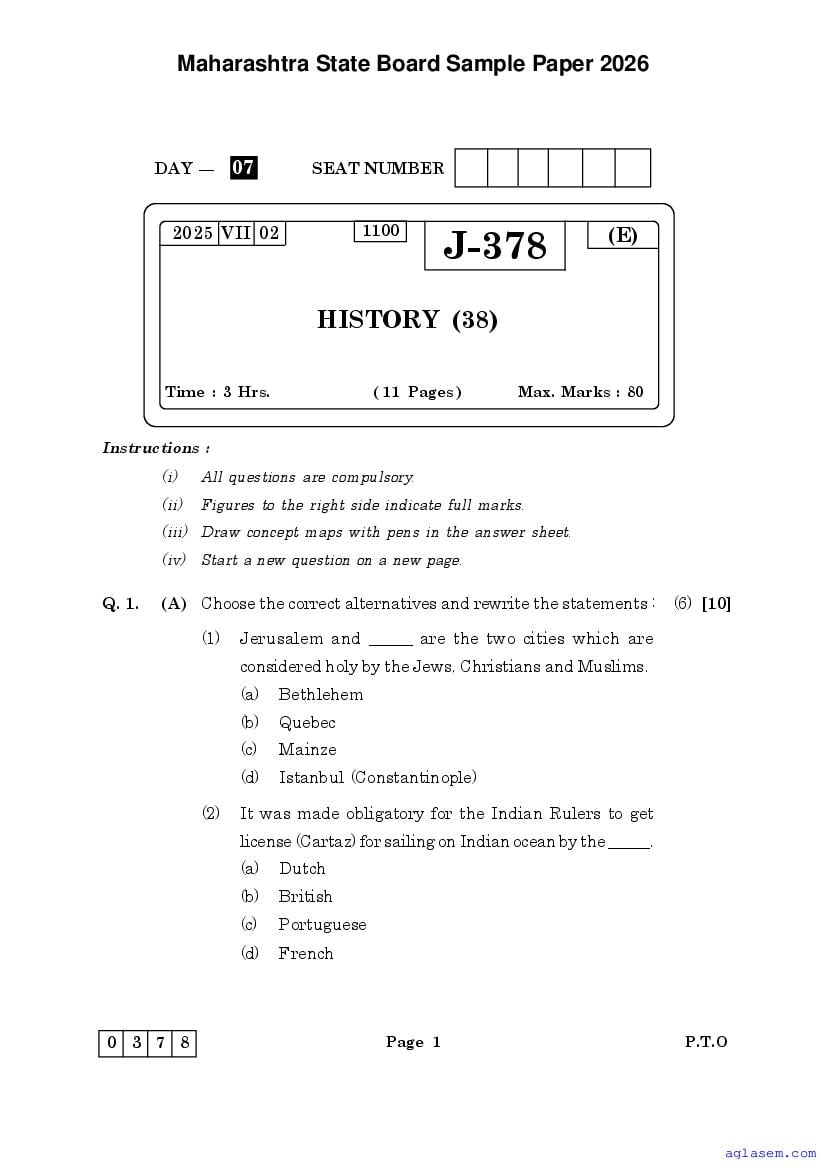
Page 1
DAY — 07 SEAT NUMBER
2025 VII 02 1100 (E)
J-378
HISTORY (38)
Time : 3 Hrs. ( 11 Pages ) Max. Marks : 80
Instructions :
(i) All questions are compulsory.
(ii) Figures to the right side indicate full marks.
(iii) Draw concept maps with pens in the answer sheet.
(iv) Start a new question on a new page.
Q. 1. (A) Choose the correct alternatives and rewrite the statements : (6) [10]
(1) Jerusalem and _____ are the two cities which are
considered holy by the Jews, Christians and Muslims.
(a) Bethlehem
(b) Quebec
(c) Mainze
(d) Istanbul (Constantinople)
(2) It was made obligatory for the Indian Rulers to get
license (Cartaz) for sailing on Indian ocean by the _____.
(a) Dutch
(b) British
(c) Portuguese
(d) French
0 3 7 8 Page 1 P.T.O
Page 2
by seeking permission from _____.
(a) Chhatrapati Shahu Maharaj
(b) Chhatrapati Sambhaji Maharaj
(c) Chhatrapati Rajaram Maharaj
(d) Chhatrapati Shivaji Maharaj
(4) The Satyashodhak Samaj was founded by _____.
(a) Raja Ram Mohan Roy
(b) Mahatma Jotirao Phule
(c) Swami Dayanand Saraswati
(d) Swami Vivekanand
(5) The Concept of the ‘League of Nations’ was deliberated
by _____.
(a) France
(b) America
(c) Italy
(d) Germany
(6) Headquarters of SEATO was located at _____ .
(a) Thailand
(b) Philippines
(c) Pakistan
(d) United Kingdom
0 3 7 8 Page 2
Page 3
the correct ones : (4)
(1) Group ‘A’ Group ‘B’
(i) Kunwar Singh — Lucknow
(ii) Nanasaheb Peshwa — Kanpur
(iii) Queen Lakshmibai — Jhansi
(iv) Chimasaheb — Kolhapur
(2) Group ‘A’ Group ‘B’
(i) Accession of the — Swami Ramanand
princely state of Tirth
Hyderabad
(ii) Signed instrument of — Shaikh Abdullah
accession of Kashmir
(iii) Significant — Mohan Ranade
contribution in Goa
liberation Movement
(iv) The trade Unionist — V. Subbayya
leader in Puducherry
(3) Group ‘A’ Group ‘B’
(i) Bandung — Bandung Conference
(ii) Paris — The Pan-African
Congress in 1919
(iii) London — The 1st Conference of
African Association in
1900
(iv) Manchester — Asian Unity Conference
0 3 7 8 Page 3 P.T.O
Page 4
(i) “Do boond Zindagi ke” — Swaccha Bharat
Abhiyan
(ii) “Let’s all learn, Let’s — Sarvashiksha Abhiyan
all progress”
(iii) “Come and Play” — A scheme for
development of sports
(iv) “Atulya Bharat” — Advertisement
Campaign design to
boost tourism
Q. 2. (A) Write the names of historical places/persons/events: (4) [8]
(1) An engineer who successfully sailed the steamboat
named ‘Clermont’_____.
(2) The fort built by the British at the north of Chennai
_____.
(3) The place where the Portuguese stored ammunition
_____.
(4) The one who participated in ‘Vykom Satyagraha’ _____.
(B) Choose the correct reasons and complete the sentences : (4)
(1) Ravindranath Tagore gave up his title(Sir) because he
wished —
(a) To criticise ‘Jallianwala Bagh Massacre.’
(b) To oppose Simon Commission.
(c) To support Indian freedom struggle.
(d) To support Non-Cooperation Movement.
0 3 7 8 Page 4
Page 5
World War because _____
(a) To ease import export taxes in Europe.
(b) To avoid any situation that could lead to another
World War.
(c) To exploit defeated nations economically.
(d) America wished to be recognized as world leader.
(3) During the Second World War the Independence
movement in Africa was more intensified because —
(a) The colonies in Africa threw away the dominance
of alien European powers.
(b) African leaders were trained in Western education
system.
(c) During the Second World War the British and the
French began to give some rights to the people in
their colonies.
(d) European countries were involved in the Second
World War.
(4) No country was included in the ANZUS treaty except
Australia, New Zealand and the United States of
America because —
(a) They did not want to let United Kingdom and
France to have an upper hand.
(b) It was a military pact.
(c) It was a secret pact.
(d) It was a pact only among countries with friendly
relations.
0 3 7 8 Page 5 P.T.O
Page 6
on it : (5)
(1) How many colonies are shown in this map?
(2) Name the port city that you can find in Massachusette
where incidence of dumping tea cartons happened.
(3) Name the Ocean located near eastern coast of America.
(4) The city of Williamburg is located in which colony?
(5) Name the colony towards the Southmost tip in the
given map.
0 3 7 8 Page 6
Page 7
(1) Complete the concept map –
---------- ----------
The spread of the
British Empire was in
these continents
---------- ----------
(2) Complete the concept map regarding European powers
and their important colonies in India –
Pondicherry _________ Mumbai _________
_________ Portuguese _________ Dutch
(3) Complete the following concept map –
Raja Ram Mohan Roy
Sir Sayyad Ahmad Khan
...................
Arya Samaj
...................
...................
Social Reformers
and their
organisations
Ramkrishna
Mission
...................
0 3 7 8 Page 7 P.T.O
Page 8
.............
Four British .............
colonies in South
.............
Africa
.............
(5) Complete the concept map –
............. .............
Four Megacities to be joined
under golden quadrilateral
scheme (Suvarna Chatushkon
Yojana)
............. .............
(6) Complete the following table –
Environmental activist Organisations
(1) Rahibai Popere __________________
(2) Bhau Katdare __________________
(3) Premsagar Mestry __________________
(4) Hamid Dalwai __________________
0 3 7 8 Page 8
Page 9
(1) Rajarshi Shahu Maharaj
(2) Kamagata Maru
(3) Decolonisation
(4) Speed Post
(5) AYUSH
(B) Explain the following statements with reasons
(Any THREE) : (9)
(1) Industrial Revolution first began in England.
(2) Chhatrapati Shivaji Maharaj decided to attack the
region of Bardesh.
(3) Dr. Babasaheb Ambedkar had determined to work for
creating a society based on the principles of “Freedom,
Equality and Fraternity.”
(4) Ultimately the princely state of Hyderabad was acceded
to India.
(5) There were three wars fought between the British and
Myanmar.
Q. 5. State your opinion (Any THREE) : [9]
(1) A document known as ‘the Declaration of Independence of
America’ was adopted.
(2) The contribution of Krantisinha Nana Patil is significant in
the Indian freedom stuggle.
0 3 7 8 Page 9 P.T.O
Page 10
(4) India is a leading country in the field of space research.
(5) All of us have the responsibility of taking care of our Heritage
places.
Q. 6. Answer the following questions in detail (Any TWO) : [10]
(1) Explain the conflict between the Portuguese and Maratha
Empires.
(2) Write in detail about the movement for liberation of Goa.
(3) Give the causes of the Second World War.
Q. 7. Answer the following questions in detail with the help of
given points (Any THREE) : [15]
(1) Write the information about the Geographical – Discoveries
and Explorers
(a) Christopher Columbus
(b) Amerigo Vespucci
(c) Vasco-da-Gama
(2) Write in detail about the British East India Company –
(a) Foundation
(b) Powers given to the East India Company
(c) Administrative structure of Factory
(3) Write about the Quit India Movement of 1942.
(a) Mumbai Session
(b) Appeal by Mahatma Gandhi
(c) Its impact
0 3 7 8 Page 10
Page 11
States.
(a) Jharkhand
(b) Telangana
(c) Uttarakhand
(5) Write the information about South Asian Association for
Regional Co-operation (SAARC).
(a) Establishment and objectives
(b) Challenges for SAARC to tackle
(c) Success of SAARC
uuu
0 3 7 8 Page 11 P.T.O
Page 12
DAY — 07 SEAT NUMBER
2025 VII 02 1100 (M)
J-379
HISTORY (38)
Time : 3 Hrs. ( 11 Pages ) Max. Marks : 80
‚ÍøŸÊ — (1) ‚fl¸ ¬˝‡Ÿ ‚Ù«UÁfláÊ •ÁŸflÊÿ¸ •Ê„U.
(2) ©U¡√ÿÊ ’Ê¡Í‚ ªÈáÊ Œ‡Ê¸Áfl‹‹ •Ê„UÃ.
(3) ©UàÃ⁄U¬ÁòÊ∑§◊äÿ •Ê∑ΧàÿÊ ¬ŸŸø ∑§Ê…UÊ√ÿÊÃ.
(4) ŸflËŸ ¬˝‡ŸÊø ©UàÃ⁄ ŸflËŸ ¬ÊŸÊ¥fl⁄U ‚ÈM§ ∑§⁄UÊfl.
¬˝. 1. (•) ÁŒ‹ÀÿÊ ¬ÿʸÿÊ¥¬Ò∑§Ë ÿÊÇÿ ¬ÿʸÿ ÁŸfl«ÍUŸ ¬Íáʸ ÁfläÊÊŸ ¬Èã„UÊ Á‹„UÊ — (6) [10]
(1) ¡M§‚‹◊ •ÊÁáÊ óóóó„UË ŒÊŸ ‡Ê„U⁄‘U íÿÍ, Áπ˝‡øŸ •ÊÁáÊ ßUS‹Ê◊ ÿÊ
äÊ◊ÊZëÿÊ •ŸÈÿÊÿÊ¥‚Ê∆UË •àÿ¥Ã ¬ÁflòÊ •Ê„UÃ.
(•) ’Õ‹„ÚU◊
(’) ÄÿÍ’∑ §
(∑§) ◊¥¤Ê
(«U) ßUSÃ¥’Í‹ (∑§ÊÚãS≈UÚÁã≈UŸÊ¬‹)
(2) ÷Ê⁄UÃËÿ ⁄UÊ¡Ê¥ŸÊ Á„¥UŒË ◊„Uʂʪ⁄UÊà ¡„UÊ¡ ¬Ê∆UflÊÿøË •‚ÃË‹ Ã⁄U óó
óó ø ¬⁄UflÊŸ (∑§ÊÃʸ¤Ê) ÉÊáÊ •Êfl‡ÿ∑§ „UÊÃ.
(•) «Uø
(’) Á’˝Á≈U‡Ê
(∑§) ¬ÊÃȸªË¡
(«U) »¥˝§ø
0 3 7 9 Page 1 P.T.O
Page 13
flπÊ⁄U ‚ÈM§ ∑§‹Ë.
(•) ¿UòʬÃË ‡ÊÊ„ÍU ◊„UÊ⁄UÊ¡
(’) ¿UòʬÃË ‚¥÷Ê¡Ë ◊„UÊ⁄UÊ¡
(∑§) ¿UòʬÃË ⁄UÊ¡Ê⁄UÊ◊ ◊„UÊ⁄UÊ¡
(«U) ¿UòʬÃË Á‡ÊflÊ¡Ë ◊„UÊ⁄UÊ¡
(4) ‚àÿ‡ÊÊäÊ∑§ ‚◊Ê¡ÊøË SÕʬŸÊ óóóó ÿÊ¥ŸË ∑§‹Ë.
(•) ⁄UÊ¡Ê ⁄UÊ◊◊Ê„UŸ ⁄UÊÚÿ
(’) ◊„UÊà◊Ê íÊÊÃË⁄UÊfl »È§‹
(∑§) SflÊ◊Ë ŒÿÊŸ¥Œ ‚⁄USflÃË
(«U) SflÊ◊Ë Áflfl∑§ÊŸ¥Œ
(5) ⁄UÊc≈˛U‚¥ÉÊ „UË ‚¥∑§À¬ŸÊ óóóóŸ ◊Ê¥«U‹Ë.
(•) »˝§Êã‚
(’) •◊Á⁄U∑§Ê
(∑§) ßU≈U‹Ë
(«U) ¡◊¸ŸË
(6) Á‚∞≈UÊ ‚¥ÉÊ≈UŸø ◊ÈÅÿÊ‹ÿ óóóó ÿÕ „UÊÃ.
(•) ÕÊÿ‹¥«U
(’) Á»§Á‹¬Ê߸Uã‚
(∑§) ¬ÊÁ∑§SÃÊŸ
(«U) ª˝≈U Á’˝≈UŸ
0 3 7 9 Page 2
Page 14
Á‹„UÊ — (4)
(1) “•” ª≈U “’” ª≈U
(i) ∑È¥§fl⁄UÁ‚¥„U ó ‹πŸÊÒ
(ii) ŸÊŸÊ‚Ê„U’ ¬‡Êfl ó ∑§ÊŸ¬Í⁄U
(iii) ⁄UÊáÊË ‹ˇ◊Ë’Ê߸U ó ¤ÊʇÊË
(iv) Áø◊Ê‚Ê„U’ ó ∑§ÊÀ„UʬÍ⁄U
(2) “•” ª≈U “’” ª≈U
(i) „ÒUŒ⁄UÊ’ÊŒ ‚¥SÕÊŸÊø ó SflÊ◊Ë ⁄UÊ◊ÊŸ¥Œ ÃËÕ¸
Áfl‹ËŸË∑§⁄UáÊ
(ii) ∑§Ê‡◊Ë⁄U ‚¥SÕÊŸëÿÊ ó ‡Êπ •éŒÈÀ‹Ê
Áfl‹ËŸË∑§⁄UáÊÊ‚Ê∆UË
‚Ê◊Ë‹ŸÊêÿÊfl⁄U ‚„UË
(iii) ªÊflÊ ◊ÈÁÄË…UKÊÃË‹ ó ◊Ê„UŸ ⁄UÊŸ«U
◊Ê‹Êø ÿʪŒÊŸ
(iv) ¬ÈŒÈëø⁄UË ÿÕË‹ ∑§Ê◊ªÊ⁄U ŸÃ ó √„UË. ‚È’ƒÿÊ
(3) “•” ª≈U “’” ª≈U
(i) ’Ê¥«¥ÈUª ó ’Ê¥«¥ÈUª ¬Á⁄U·Œ
(ii) ¬ÚÁ⁄U‚U ó 1919 ◊äÊË‹ “•Áπ‹
•ÊÁ»˝§∑§Ê ∞Äÿ ¬Á⁄U·Œ”
(iii) ‹¥«UŸ ó 1900 ◊äÊË‹ ¬Á„U‹Ë “
•Áπ‹ •ÊÁ»˝§∑§Ê ∞Äÿ
¬Á⁄U·Œ”
(iv) ◊°øS≈U⁄U ó •ÊÁ‡ÊÿÊ߸ ∞Äÿ ¬Á⁄U·Œ
0 3 7 9 Page 3 P.T.O
Page 15
(i) “ŒÊ ’Í¥Œ Á¡¥ŒªË ∑§” ó Sflë¿U ÷Ê⁄Uà •Á÷ÿÊŸ
(ii) “‚Ê⁄‘U Á‡Ê∑ͧ ÿÊ, ¬È…U ¡Ê™§ ÿÊ” ó ‚fl¸ Á‡ÊˇÊÊ •Á÷ÿÊŸ
(iii) “ÿÊ •ÊÁáÊ π›Ê” ó ∑˝§Ë«UÊ ˇÊòÊÊëÿÊ
Áfl∑§Ê‚ÊøË ÿÊ¡ŸÊ
(iv) “•ÃÈÀÿ ÷Ê⁄UÔ ó ¬ÿ¸≈UŸÊ‚ ©U÷Ê⁄UË
ŒáÿÊøË ◊Ê„UË◊
¬˝. 2. (•) ∞ÁÄUÊÁ‚∑§ Á∆U∑§ÊáÊ, √ÿÄÃË, ÉÊ≈UŸÊ ÿÊ ‚¥’¥äÊËøË ŸÊfl Á‹„UÊ — (4) [8]
(1) ’Êc¬‡ÊÄÃËfl⁄U øÊ‹áÊÊ⁄UË Ä‹⁄U◊Ê°≈U „UË ’Ê≈U ÃÿÊ⁄U ∑§⁄UáÊÊ⁄Ê
ߥUÁ¡ÁŸÿ⁄U -
(2) Á’˝Á≈U‡ÊÊ¥ŸË øãŸß¸UëÿÊ ©UàÃ⁄‘U‹Ê ’Ê¥äÊ‹‹Ê Á∑§À‹Ê -
(3) ¬ÊøȪˡʥøÊ ŒÊM§ªÊ›Ê •‚‹‹ Á∆U∑§ÊáÊ -
(4) flÊÿ∑§Ê◊ ‚àÿʪ˝„UÊà ÷ʪ ÉÊáÊÊ⁄‘U -
(’) ÁŒ‹ÀÿÊ ∑§Ê⁄UáÊÊ¥¬Ò∑§Ë ÿÊÇÿ ∑§Ê⁄UáÊ ÁŸfl«ÍUŸ ÁfläÊÊŸ ¬Íáʸ ∑§⁄UÊ — (4)
(1) ⁄UÁfl¥Œ˝ŸÊÕ ≈UʪÊ⁄U ÿÊ¥ŸË “‚⁄U” ÿÊ ¬ŒflËøÊ àÿʪ ∑§‹Ê, ∑§Ê⁄UáÊ -
(•) ¡ÊÁ‹ÿŸflÊ‹Ê ’ʪ „UàÿÊ∑§Ê¥«UÊëÿÊ ÁŸ·äÊ ∑§⁄UáÿÊ‚Ê∆UË.
(’) ‚Êÿ◊Ÿ ∑§Á◊‡ÊŸ‹Ê Áfl⁄UÊäÊ ∑§⁄UáÿÊ‚Ê∆UË.
(∑§) ÷Ê⁄UÃËÿ SflÊÃ¥òÿ ø›fl›Ë‹Ê ¬ÊÁ∆¥U’Ê ŒáÿÊ‚Ê∆UË.
(«U) •‚„U∑§Ê⁄U •Ê¥ŒÊ‹ŸÊ‹Ê ¬ÊÁ∆¥U’Ê ŒáÿÊ‚Ê∆UË.
0 3 7 9 Page 4
Page 16
(•) ÿÈ⁄Uʬ◊äÿ •ÊÿÊÃ-ÁŸÿʸà äÊÊ⁄UáÊÁfl·ÿ∑§ ¡∑§Êà ÁŸÁ‡øÃË
∑§⁄UáÿÊ‚Ê∆UË.
(’) ⁄UÊc≈˛UÊ-⁄UÊc≈U˛ÊÃË‹ ∑§‹„U fl flÊŒ ‚Ê◊ʬøÊ⁄UÊŸ Á◊≈Ufl‹ ¡ÊflÃ,
¡ªÊà ‡Ê¥ÊÃÃÊ ¬˝SÕÊÁ¬Ã √„UÊflË ÿÊ‚Ê∆UË.
(∑§) ¬⁄UÊ÷Íà ⁄UÊc≈˛UÊ¥ø •ÊÁÕ¸∑§ ‡ÊÊ·áÊ ∑§⁄UáÿÊ‚Ê∆UË.
(«U) •◊Á⁄U∑§‹Ê ¡ªÊø ŸÃÎàfl ∑§⁄UÊflÿÊø „UÊà ÿÊ‚Ê∆UË.
(3) ŒÈ‚:ÿÊ ◊„UÊÿÈŒ˜äÊ∑§Ê›Êà •ÊÁ»˝§∑§ÃË‹ SflÊÃ¥òÿ ø›fl› •ÁäÊ∑§ ÃËfl˝
¤ÊÊ‹Ë, ∑§Ê⁄UáÊ -
(•) •ÊÁ»˝§∑§ÃË‹ fl‚Ê„UÃË¥ŸË ¬⁄U∑§ËÿÊ¥ø flø¸Sfl ¤ÊȪÊM§Ÿ ≈UÊ∑§‹.
(’) •ÊÁ»˝§∑§Ã ¬Ê‡øÊûÿ Á‡ÊˇÊáʬŒ˜äÊÃË „UÊÃË.
(∑§) ŒÈ‚:ÿÊ ◊„UÊÿÈŒä˜ Ê∑§Ê›Êà ߥUª¡
˝ fl »˝§¥ øÊŸË fl‚Ê„UÃË¥ŸÊ ∑§Ê„UË •ÁäÊ∑§Ê⁄U
ŒKÊÿ‹Ê ‚ÈL§flÊà ∑§‹Ë.
(«U) ¬Ê‡øÊûÿ Œ‡Ê ŒÈ‚:ÿÊ ◊„UÊÿÈŒ˜äÊÊà ª¥ÈË „UÊÃ.
(4) •Úã¤ÊÈ‚ (ANZUS) ∑§⁄UÊ⁄UÊà •ÊÚS≈˛UÁ‹ÿÊ, ãÿȤÊË‹¥«U •ÊÁáÊ ÿÈŸÊÿ≈U«U
S≈U≈U‚ •ÊÚ»§ •◊Á⁄U∑§Ê flª›ÃÊ ∑§ÊáÊàÿÊ„UË ⁄UÊc≈˛UÊ‹Ê ¬˝fl‡Ê ÁŒ‹Ê ŸÊ„UË,
∑§Ê⁄UáÊ -
(•) àÿÊ¥ŸÊ ª˝≈U Á’˝≈UŸ fl »˝§Ê¥‚ø ◊„Uààfl flÊ…ÍU ŒKÊÿø Ÿ√„UÃ.
(’) „UÊ ‹c∑§⁄UË ∑§⁄UÊ⁄U „UÊÃÊ.
(∑§) „UÊ ªÈåà ∑§⁄UÊ⁄U „UÊÃÊ.
(«U) „UÊ »§Äà Á◊òÊŒ‡ÊÊ¥ÃË‹ ∑§⁄UÊ⁄U „UÊÃÊ.
0 3 7 9 Page 5 P.T.O
Page 17
(1) ¬˝SÃÈà Ÿ∑§Ê‡ÊÊà Á∑§ÃË fl‚Ê„UÃË Œ‡Ê¸ÁflÀÿÊ •Ê„UÃ?
(2) •◊Á⁄U∑§ÃË‹ ◊Ú‚ÚëÿÈ‚≈U◊äÊË‹ ∑§ÊáÊàÿÊ ’¥Œ⁄UÊà ø„UÊëÿÊ ¬≈UKÊ ‚◊ÈŒ˝ÊÃ
»§∑§áÿÊøË ÉÊ≈UŸÊ ÉÊ«U‹Ë?
(3) •◊Á⁄U∑§Ê π¥«UÊëÿÊ ¬Ífl¸‚ ∑§ÊáÊÃÊ ‚◊ÈŒ˝ •Ê„U?
(4) ÁflÀÿ◊’ª¸ „U ‡Ê„U⁄U ∑§ÊáÊàÿÊ fl‚Ê„UÃËà ÁSÕà •Ê„U?
(5) Ÿ∑§Ê‡ÊÊà ‚flʸà ŒÁˇÊáÊ‹Ê ∑§ÊáÊÃË fl‚Ê„Uà •Ê„U?
0 3 7 9 Page 6
Page 18
(1) ‚¥∑§À¬ŸÊ ÁøòÊ ¬Íáʸ ∑§⁄UÊ—
---------- ----------
Á’˝Á≈U‡ÊÊ¥ø ‚Ê◊˝Êíÿ
¬‚⁄U‹‹ π¥«U
---------- ----------
(2) ÿÈ⁄UʬËÿ ‚àÃÊ fl àÿÊ¥øË ÷Ê⁄UÃÊÃË‹ ◊„UààflÊøË fl‚Ê„UÃË Á‹„ÍUŸ ‚¥∑§À¬ŸÊ
ÁøòÊ ¬Íáʸ ∑§⁄UÊ—
¬Ê°Á«Uø⁄UË _________ ◊È’¥ ߸U _________
_________ ¬ÊÃȸªË¡ _________ «Uø
(3) ‚¥∑§À¬ŸÊ ÁøòÊ ¬Íáʸ ∑§⁄UÊ—
⁄UÊ¡Ê ⁄UÊ◊◊Ê„UŸ ⁄UÊÚÿ
...................
‚⁄U ‚ƒÿŒ •„U◊Œ πÊŸ
...................
‚◊Ê¡‚ÈäÊÊ⁄U∑§ fl
...................
•Êÿ¸ ‚◊Ê¡
àÿÊ¥ŸË SÕʬŸ
∑§‹ÀÿÊ ‚¥SÕÊ
⁄UÊ◊∑ΧcáÊ Á◊‡ÊŸ
...................
0 3 7 9 Page 7 P.T.O
Page 19
.............
ŒÁˇÊáÊ •ÊÁ»˝§∑§ÃË‹ .............
Á’˝Á≈U‡ÊÊ¥ëÿÊ øÊ⁄U ¬˝◊Èπ
fl‚Ê„UÃË .............
.............
(5) ‚¥∑§À¬ŸÊ ÁøòÊ ¬Íáʸ ∑§⁄UÊ—
............. .............
‚Èfláʸ øÃÈc∑§ÊáÊ ÿÊ¡ŸÃÍŸ
¡Ê«U‹Ë ¡ÊáÊÊ⁄UË øÊ⁄U
¬˝◊Èπ ‡Ê„U⁄‘U
............. .............
(6) ÃÄÃÊ ¬Íáʸ ∑§⁄UÊ —
¬ÿʸfl⁄UáÊ ˇÊòÊÊà ∑§Ê◊ ∑§⁄UáÊÊ:ÿÊ √ÿÄÃË ‚¥SÕÊ
(1) ⁄UÊ„UË’Ê߸U ¬Ê¬⁄‘U -----------
(2) ÷Ê™§ ∑§Ê≈UŒ⁄‘U -----------
(3) ¬˝◊‚ʪ⁄U ◊SòÊË -----------
(4) „U◊ËŒ Œ‹flÊ߸U -----------
0 3 7 9 Page 8
Page 20
(1) ⁄UÊ¡·Ë¸ ‡ÊÊ„ÍU ◊„UÊ⁄UÊ¡
(2) “∑§Ê◊ʪÊ≈UÊ ◊ÊM§§”
(3) ÁŸfl¸‚Ê„UÃË∑§⁄UáÊ
(4) S¬Ë«U ¬ÊS≈U
(5)U •ÊÿÈ·
(’) ¬È…UË‹ ÁfläÊÊŸ ‚∑§Ê⁄UáÊ S¬c≈U ∑§⁄UÊ (∑§ÊáÊÃË„UË ÃËŸ) — (9)
(1) •ÊÒŒKÊÁª∑§ ∑˝§Ê¥ÃËøË ‚ÈL§flÊà ‚fl¸¬˝Õ◊ ߥUÇ‹«U◊äÿ ¤ÊÊ‹Ë.
(2) ¿UòʬÃË Á‡ÊflÊ¡Ë ◊„UÊ⁄UÊ¡Ê¥ŸË ’Ê⁄UŒ‡ÊÊfl⁄U SflÊ⁄UË ∑§‹Ë.
(3) «UÊ.Ú ’Ê’Ê‚Ê„U’ •Ê¥’« U∑§⁄U ÿÊ¥ŸË SflÊÃ¥òÿ, ‚◊ÃÊ •ÊÁáÊ ’¥äÊÈÃÊ ÿÊ ÃààflÊ¥fl⁄U
‚◊Ê¡ ©U÷Ê⁄UáÊË ∑§‹Ë.
(4) „ÒUŒ⁄UÊ’ÊŒ ‚¥SÕÊŸ ÷Ê⁄UÃÊà Áfl‹ËŸ ¤ÊÊ‹.
(5)U Á’˝Á≈U‡Ê •ÊÁáÊ êÿÊŸ◊Ê⁄U ÿÊ¥ëÿÊà ÃËŸ ÿÈŒ˜äÊ ¤ÊÊ‹Ë.
¬˝. 5. ÃÈ◊ø ◊à ŸÊ¥ŒflÊ (∑§ÊáÊÄUË ÃËŸ) — [9]
(1) “•◊Á⁄U∑§Ÿ SflÊÃ¥òÿÊøÊ ¡ÊÁ„U⁄UŸÊ◊Ê” ¬˝Á‚Œ˜äÊ ¤ÊÊ‹Ê.
(2) ÷Ê⁄UÃËÿ SflÊÃ¥òÿ‹…UKÊ◊äÿ ∑˝§Ê¥ÃËÁ‚¥„U ŸÊŸÊ ¬Ê≈UË‹ ÿÊ¥ø ÿʪŒÊŸ
◊„UààflÊø •Ê„U.
(3) •◊Á⁄U∑§Ê fl ⁄UÁ‡ÊÿÊ ÿÊ¥ëÿÊà ‡ÊËÃÿÈŒ˜äÊ ‚ÈM§ ¤ÊÊ‹.
(4) ÷Ê⁄Uà •fl∑§Ê‡Ê ‚¥‡ÊÊäÊŸ ˇÊòÊÊÃË‹ •ª˝áÊË Œ‡Ê •Ê„U.
(5) ¬ÿ¸≈UŸ S՛ʥøË ∑§Ê›¡Ë ‚flÊZŸË ÉÿÊflË.
0 3 7 9 Page 9 P.T.O
Page 21
(1) ¬ÊÃȸªË¡-◊⁄UÊ∆UÊ ‚¥ÉʷʸÁfl·ÿË ◊ÊÁ„UÃË Á‹„UÊ.
(2) ªÊflÊ ◊ÈÁÄà ‹…UKÊÁfl·ÿË ◊ÊÁ„UÃË Á‹„UÊ.
(3) ŒÈ‚:ÿÊ ◊„UÊÿÈŒ˜äÊÊøË ∑§Ê⁄UáÊ Á‹„UÊ.
¬˝. 7. πÊ‹Ë‹ ¬˝‡ŸÊ¥øË ÁŒ‹ÀÿÊ ◊ÈŒ˜ŒKÊ¥ëÿÊ •ÊäÊÊ⁄‘U ‚ÁflSÃ⁄U ©UàÃ⁄U Á‹„UÊ
(∑§ÊáÊÄUË ÃËŸ) — [15]
(1) ÷ÊÒªÊÁ‹∑§ ‡ÊÊäÊ fl ‡ÊÊäÊ∑§Ê¥øË ◊ÊÁ„UÃË Á‹„UÊ —
(•) Áπ˝SÃÊ»§⁄U ∑§Ê‹¥’‚
(’) •◊Á⁄UªÊ flS¬È‚Ë
(∑§) flÊS∑§Ê-Œ-ªÊ◊Ê
(2) Á’˝Á≈U‡Ê ߸US≈U ߥUÁ«UÿÊ ∑¥§¬ŸË Áfl·ÿË ◊ÊÁ„UÃË Á‹„UÊ —
(•) SÕʬŸÊ
(’) ߸US≈U ߥUÁ«UÿÊ ∑¥§¬ŸË‹Ê Á◊›Ê‹‹ •ÁäÊ∑§Ê⁄U
(∑§) flπÊ⁄UËø ¬˝‡ÊÊ‚Ÿ
(3) 1942 ëÿÊ “ø‹¡Êfl” •Ê¥ŒÊ‹ŸÊøË ◊ÊÁ„UÃË Á‹„UÊ —
(•) ◊È¥’߸U •ÁäÊfl‡ÊŸ
(’) ◊„UÊà◊Ê ªÊ¥äÊË¡Ë¥ø •ÊflÊ„UŸ
(∑§) •Ê¥ŒÊ‹ŸÊø ¬Á⁄UáÊÊ◊
(4) ⁄UÊíÿÊ¥ëÿÊ ¬ÈŸ⁄¸UøŸÁfl·ÿË ◊ÊÁ„UÃË Á‹„UÊ —
(•) ¤ÊÊ⁄Uπ¥«U
(’) Ë¥ªáÊ
(∑§) ©UàÃ⁄UÊπ¥«U
0 3 7 9 Page 10
Page 22
(•) SÕʬŸÊ fl äÿÿ
(’) ‚Ê∑¸§ ‚◊Ê⁄UË‹ •Ê√„UÊŸ
(∑§) ‚Ê∑¸§ø ÿ‡Ê
uuu
0 3 7 9 Page 11 P.T.O
Document Details
| Board / Org | Maharashtra Board |
| Exam | Class 12 |
| Type | Sample Paper |
| Pages | 22 |
| Updated | 24 Sep 2026 |