Maharashtra 12th Std Model Question Paper Geography
Finished viewing? Save it for later —
Download Maharashtra 12th Std Model Question Paper Geography (PDF · 16 pages)About Maharashtra 12th Std Model Question Paper Geography
Maharashtra 12th Std Model Question Paper Geography is available here for free download. Published by Maharashtra Board for Class 12, this sample paper can be viewed online or downloaded as a PDF (16 pages). Candidates preparing for Class 12 can use Maharashtra 12th Std Model Question Paper Geography to understand the exam pattern, the type of questions asked, and the overall difficulty level.
Frequently Asked Questions
How can I download Maharashtra 12th Std Model Question Paper Geography?
Open this page and click the Download button to save Maharashtra 12th Std Model Question Paper Geography as a PDF. It is completely free on AglaSem Docs.
Is Maharashtra 12th Std Model Question Paper Geography free to download?
Yes. Maharashtra 12th Std Model Question Paper Geography can be viewed online and downloaded as a PDF free of cost on AglaSem Docs.
How many pages does Maharashtra 12th Std Model Question Paper Geography have?
Maharashtra 12th Std Model Question Paper Geography contains 16 pages, which you can read online or download together as a single PDF.
Where can I find more Class 12 study material?
You can find more Class 12 question papers, sample papers, syllabus, and answer keys on AglaSem Docs.
Maharashtra 12th Std Model Question Paper Geography – Text
Read the full text of this sample paper below — useful to quickly search, copy and reference the content online without downloading the PDF.
📄 View text version (16 pages)
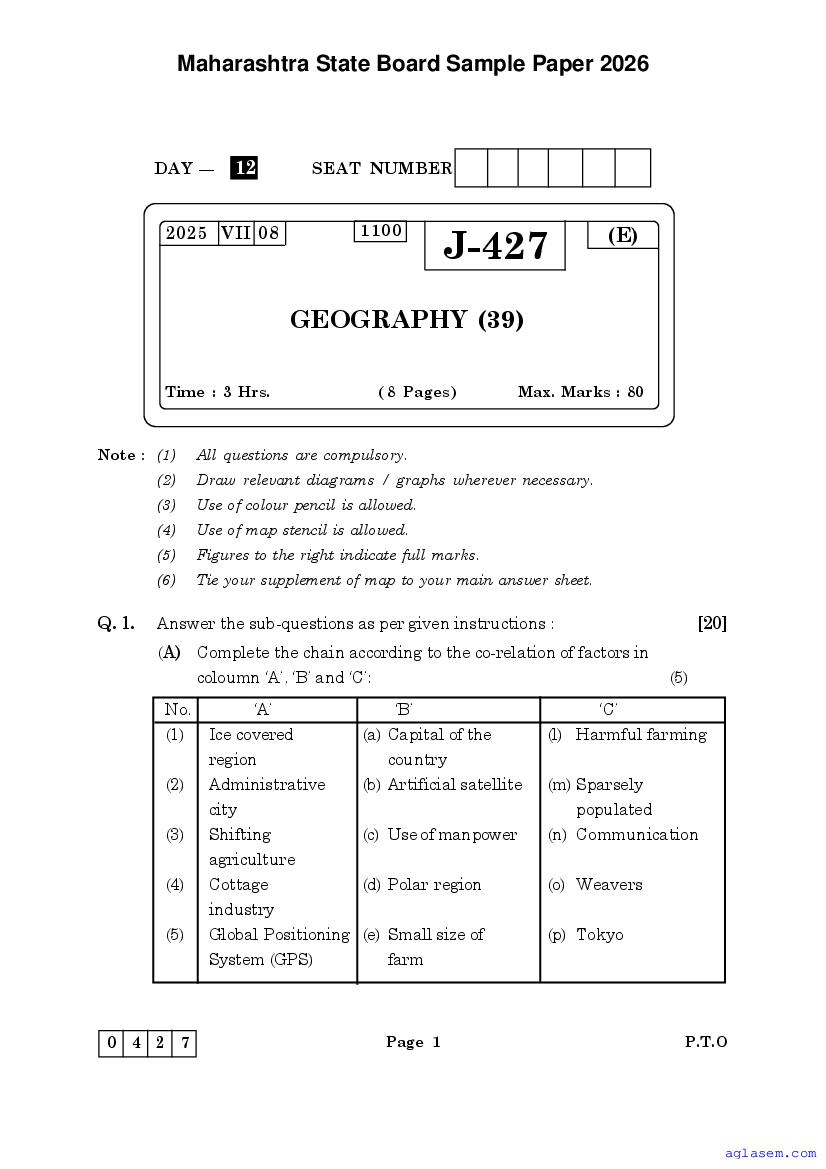
Page 1
DAY — 12 SEAT NUMBER
2025 VII 08 1100 (E)
J-427
GEOGRAPHY (39)
Time : 3 Hrs. ( 8 Pages ) Max. Marks : 80
Note : (1) All questions are compulsory.
(2) Draw relevant diagrams / graphs wherever necessary.
(3) Use of colour pencil is allowed.
(4) Use of map stencil is allowed.
(5) Figures to the right indicate full marks.
(6) Tie your supplement of map to your main answer sheet.
Q. 1. Answer the sub-questions as per given instructions : [20]
(A) Complete the chain according to the co-relation of factors in
coloumn ‘A’, ‘B’ and ‘C’: (5)
No. ‘A’ ‘B’ ‘C’
(1) Ice covered (a) Capital of the (l) Harmful farming
region country
(2) Administrative (b) Artificial satellite (m) Sparsely
city populated
(3) Shifting (c) Use of manpower (n) Communication
agriculture
(4) Cottage (d) Polar region (o) Weavers
industry
(5) Global Positioning (e) Small size of (p) Tokyo
System (GPS) farm
0 4 2 7 Page 1 P.T.O
Page 2
(1) Important component of population change :
(A) Literacy
(B) Sex ratio
(C) Birth rate
(D) Age composition
(2) Land use in Rural Area :
(A) Industries
(B) Trade
(C) Recreational
(D) Forests
(3) Characteristics of Extensive Commercial Grain Farming :
(A) Monoculture, use of irrigation, tropical region,
food crops.
(B) Monoculture, use of machineries, temperate
region, cereal production.
(C) Monoculture, use of manpower, equatorial region,
horticulture.
(D) Monoculture, use of scientific knowledge, sub-
tropical region, production of pulses.
(4) Mineral Based Industries :
(A) Iron and steel industries
(B) Textile industries
(C) Sugar industries
(D) Food Processing industries
(5) Tertiary Economic Activities :
(A) Agriculture
(B) Transportation of goods
(C) Honey production
(D) Petrochemical industry
0 4 2 7 Page 2
Page 3
(1) If the proportion of working population is high, then the
possibility of economic development is high.
(2) Tertiary occupations are non productive.
(3) Africa’s Kalahari desert is the land of Eskimos.
(4) Every country has its own definition of literacy.
(5) Location of human settlement is not affected by physical
factors.
(D) Do as directed : (5)
(1) Identify the correct correlation :
A : Assertion R : Reasoning
A: In population pyramid a broad base indicates high
number of children.
R: Broad apex of pyramid is an indicator of high
number of elderly.
(A) Only A is correct
(B) Only R is correct
(C) Both A and R are correct and R is the correct
explanation of A.
(D) Both A and R are correct but R is not the correct
explanation of A.
(2) Identify the incorrect factor :
(a) Plains
(b) Lakes
(c) Plateaus
(d) Mountains
0 4 2 7 Page 3 P.T.O
Page 4
population in ascending order :
(a) Metropolitan city
(b) Suburb
(c) City
(d) Megacity
(4) Identify the correct group :
(a) (i) Social Science (b) (i) Social Geography
(ii) Political Science (ii) Political Geography
(iii) Economics (iii) Economic Geography
(iv) Demography (iv) Soil Geography
(c) (i) Climatology (d) (i) History
(ii) Biology (ii) Geomorphology
(iii) Geology (iii) Psychology
(iv) Remote Sensing (iv) Demography
(5) Arrange the following industries in ascending order
on the basis of their capital investment.
(a) Medium scale industries
(b) Small scale industries
(c) Large scale industries
(d) Micro scale industries
Q. 2. Give geographical reasons (Any FOUR) : [12]
(1) Climate affects the distribution of population.
(2) Literacy rate of a country is an indicator of its socio-economic
development.
0 4 2 7 Page 4
Page 5
(4) Regional development is dependent on physiography of
a region.
(5) The scope of geography is widening day-by-day.
(6) Extensive agriculture is a commercial type of agriculture.
Q. 3. Differentiate between (Any THREE) : [9]
(1) Lumbering in Equatorial Forests and Temperate forests
(2) Demographic Transition Theory Stage 1 and Stage 5
(3) Waterways and Airways
(4) Physical Region and Political Region
(5) Determinism and Possibilism
Q. 4. (A) Mark and name the following on the outline map of the [11]
world with suitable index (Any SIX) : (6)
(1) Lowest populated continent
(2) A city in India: attracts a large number of immigrants :
Mumbai
(3) A country having highest life expectancy : Japan
(4) Administrative City : Moscow
(5) London to New York Airway
(6) Suez Canal
(7) Area of commercial animal husbandry in South America
: Pampas
(8) Industrial Region in South Africa : Kimberley
Witwatersand.
0 4 2 7 Page 5 P.T.O
Page 6
given below : (5)
0 4 2 7 Page 6
Page 7
(1) What does map indicate?
(2) In which continent Perth and Sydney industrial regions
are located?
(3) Name the industrial regions in the U.S.A.
(4) Which continent has less industrial development?
(5) In which country Osaka-Kobe and Kyoto industrial
regions are located?
Q. 5. Write short notes on the following (Any THREE) : [12]
(1) Land use in Rural area.
(2) Factors affecting Fishing activity.
(3) Importance of artificial satellites as means of communication.
(4) Causes of regional imbalance in India.
(5) Nature of Geography.
Q. 6. (A) Read the following passage and answer the questions given [8]
below : (4)
Age Composition
There are three basic determinants of age composition
of a population. These includes natality (fertility), mortality
and mobility. According to Clarke (1972), these three
determinants of age structure are inter-dependent and any
change in one of these may influence the other two. Through
these variables socio-economic conditions influence the age
structure.
It is fertility rate that determines the proportion of
population in different age categories.
That is why, the countries of Latin America, Africa and
Asia which are characterized by high birth rates display large
proportion in young age groups. In most of the countries of
these continents, about two fifth of population is below
0 4 2 7 Page 7 P.T.O
Page 8
years, according to 2001 census. By contrast, the countries
with low fertility rate and longer life expectancy, have about
one fourth of their population in the younger age groups. But
the proportion of population in the older age groups in these
countries is relatively large. Most of the countries of
Northwestern Europe and North America, CIS countries,
Australia and Japan belong to this category. A continuous
downward trend in fertility contributes to the increase in the
proportion of population in older age.
Questions :
(1) What are basic determinants of age composition?
(2) Which continent has large proportion of young age
group?
(3) According to 2001 census, what is the percentage of
population aged below 15 years in India?
(4) Which factor is responsible for increase in old age group?
(B) Draw neat, labelled diagrams ( Any TWO) : (4)
(1) Triangular pattern of settlement.
(2) Classification of tertiary economic activity –
communication.
(3) Provision of infrastructure and Stimulus to reduce
regional imbalance.
Q. 7. Answer the following questions in detail (Any ONE) : [8]
(1) Explain the human factors affecting the distribution of
population with suitable example.
(2) Explain in detail the classification of industries based on the
source of raw material.
uuu
0 4 2 7 Page 8
Page 9
DAY — 12 SEAT NUMBER
2025 VII 08 1100 (M)
J-428
GEOGRAPHY (39)
Time : 3 Hrs. ( 8 Pages ) Max. Marks : 80
‚ÍøŸÊ — (1) ‚fl¸ ¬˝‡Ÿ ‚Ê«UÁfláÊ •Êfl‡ÿ∑§ •Ê„U.
(2) •Êfl‡ÿ∑§ ÃÕ ÿÊÇÿ •Ê∑ΧàÿÊ / •Ê‹π ∑§Ê…UÊfl.
(3) ⁄¥UªËà ¬Áã‚‹øÊ flʬ⁄U ∑§⁄UáÿÊ‚ ¬⁄UflÊŸªË •Ê„U.
(4) Ÿ∑§Ê‡ÊÊ S≈UÁã‚‹øÊ flʬ⁄U ∑§⁄UáÿÊ‚ ¬⁄UflÊŸªË •Ê„U.
(5) ©U¡flË∑§«UË‹ •¥∑§ ¬Íáʸ ªÈáÊ Œ‡Ê¸ÁflÃÊÃ.
(6) Ÿ∑§Ê‡ÊÊ ¬È⁄UfláÊË ◊Í› ©UàÃ⁄U¬ÁòÊ∑§‚ ¡Ê«UÊflË.
¬˝. 1. ÁŒ‹ÀÿÊ ‚ÍøŸŸÈ‚Ê⁄U πÊ‹Ë‹ ©U¬¬˝‡Ÿ ‚Ê«UflÊ. [20]
(•) “•” “’” •ÊÁáÊ “∑§” SÃ¥÷ÊÃË‹ ‚„U‚¥’¥äÊ •Ê›ÅÊÍŸ ‚Êπ›Ë ¬Íáʸ ∑§⁄UÊ — (5)
•.Ÿ¥. “•” “’” “∑§”
(1) ’»§Ê¸ë¿UÊÁŒÃ ¬˝Œ‡Ê (∑§U) Œ‡ÊÊøË ⁄UÊ¡äÊÊŸË (ÿ) „UÊÁŸ∑§Ê⁄U∑§ ‡ÊÃË ¬˝∑§Ê⁄U
(2) ¬˝‡ÊÊ‚∑§Ëÿ ‡Ê„U⁄U (π) ∑ΧÁòÊ◊ ©U¬ª˝„U (⁄U) Áfl⁄U› ‹Ê∑§‚¥ÅÿÊ
(3) SÕ‹Ê¥ÃÁ⁄Uà ‡ÊÃË (ª) ◊ÊŸflË üÊ◊ÊøÊ flʬ⁄U (‹) ‚¥Œ‡Ê fl„UŸ
(4) ªÎ„U ©UŒKʪ (ÉÊ) äÊ˝ÈflËÿ ¬˝Œ‡Ê (fl) ÁfláÊ∑§⁄U U
(5) ¡ÊªÁÃ∑§ SÕÊŸ- («U) ‡ÊÃËøÊ •Ê∑§Ê⁄U πͬ (‡Ê) ≈UÊÁ∑§ÿÊ
ÁŸÁ‡øÃË ¬˝áÊÊ‹Ë ‹„UÊŸ
(G.P.S.)
0 4 2 8 Page 1 P.T.O
Page 10
(1) ‹Ê∑§‚¥ÅÿÊ ’Œ‹ÊÃË‹ ◊„UààflÊøÊ ÉÊ≈U∑§ ......
(•) ‚ÊˇÊ⁄UÃÊ
(’) Á‹¥ª ªÈáÊÊàÃ⁄U
(∑§) ¡ã◊Œ⁄U
(«U) flÿÊ⁄UøŸÊ
(2) ª˝Ê◊ËáÊ ÷Í◊Ë ©U¬ÿÊ¡Ÿ .......
(•) •ÊÒŒKÊÁª∑§
(’) √ÿʬÊ⁄U
(∑§) ◊ŸÊ⁄¥U¡Ÿ
(«U) flŸ
(3) ÁflSÃÎà √ÿʬÊ⁄UË ‡ÊÃËøË flÒÁ‡Êc≈UK ....
(•) ∞∑§-¬Ë∑§ ¬Œ˜äÊÃË, ¬ÊáÿÊøÊ flʬ⁄U, ©UcáÊ∑§Á≈U’¥äÊ, äÊÊãÿ Á¬∑§
(’) ∞∑§-¬Ë∑§ ¬Œ˜äÊÃË, ÿ¥òÊÊøÊ flʬ⁄U, ‚◊‡ÊËÃÊcáÊ ∑§Á≈U’ä¥ Ê, •ãŸäÊÊãÿ
Á¬∑§
(∑§) ∞∑§-¬Ë∑§ ¬Œ˜äÊÃË, ◊ÊŸflË üÊ◊ÊøÊ flʬ⁄U, Áfl·ÈflflÎàÃËÿ ¬˝Œ‡Ê,
©UŒKÊŸ ‡ÊÃË
(«U) ∞∑§-¬Ë∑§ ¬Œ˜äÊÃË, ‡ÊÊSòÊËÿ ôÊÊŸÊøÊ flʬ⁄U, ©U¬ÊcáÊ ∑§Á≈U’¥äÊ,
«UÊ›Ë ©Uà¬ÊŒŸ
(4) πÁŸ¡Ê¥fl⁄U •ÊäÊÊÁ⁄Uà ©UŒKʪ ......
(•) ‹Ê„U¬Ê‹ÊŒ ©UŒKʪ
(’) ∑§Ê¬«U ©UŒKʪ
(∑§) ‚Êπ⁄U ©UŒKʪ
(«U) •ãŸ¬˝Á∑˝§ÿÊ ©UŒKʪ
(5) ÃÎÃËÿ∑§ √ÿfl‚Êÿ ......
(•) ‡ÊÃË
(’) ◊Ê‹flÊ„UÃÍ∑§
(∑§) ◊äÊÁŸÌ◊ÃË
(«U) ¬≈˛UÊ∑§Á◊∑§À‚ ©UŒKʪ
0 4 2 8 Page 2
Page 11
(1) ‹Ê∑§‚¥ÅÿëÿÊ ¬˝◊ÊáÊÊà ∑§Êÿ¸‡ÊË‹ ª≈UÊø ¬˝◊ÊáÊ ¡ÊSà •‚‹ Ã⁄U •ÊÁÕ¸∑§
Áfl∑§Ê‚ÊøË ‡ÊÄÿÃÊ ¡ÊSà •‚Ã.
(2) ÃÎÃËÿ∑§ √ÿfl‚Êÿ „U •ŸÈà¬ÊŒ∑§ √ÿfl‚Êÿ •Ê„UÃ.
(3) •ÊÁ»˝§∑§ëÿÊ ∑§‹„UÊ⁄UË flÊ›fl¥≈UÊà “∞ÁS∑§◊Ê” ¡◊ÊÃËø ‹Ê∑§ •Ê…U›ÃÊÃ.
(4) ‚ÊˇÊ⁄UÃøË √ÿÊÅÿÊ Œ‡ÊÊŸÈ‚Ê⁄U ’Œ‹Ã.
(5) ◊ÊŸflË flSÃËëÿÊ SÕÊŸÊfl⁄U ¬˝Ê∑ΧÁÃ∑§ ÉÊ≈U∑§Ê¥øÊ ¬Á⁄UáÊÊ◊ „UÊà ŸÊ„UË.
(«U) ¬È…UË‹ ÁfläÊÊŸ ÁŒ‹ÀÿÊ ‚ÍøŸŸÈ‚Ê⁄U ¬Íáʸ ∑§⁄UÊ — (5)
(1) •øÍ∑§ ‚„U‚¥’¥äÊ •Ê›πÊ —
A : ÁfläÊÊŸ, R : ∑§Ê⁄UáÊ
A: ‹Ê∑§‚¥ÅÿÊ ◊ŸÊ:ÿÊà L¥§Œ Û ’Ê‹∑§Ê¥øË ‚¥ÅÿÊ •ÁäÊ∑§ •‚ÀÿÊø
Œ‡Ê¸ÁflÃÊ.
R: ‹Ê∑§‚¥ÅÿÊ ◊ŸÊ:ÿÊø L¥§Œ ‡ÊË·¸ flÎŒ˜äÊÊ¥øË ‚¥ÅÿÊ •ÁäÊ∑§ •‚ÀÿÊø
ŒKÊÃ∑§ •Ê„U.
(•) ∑§fl› A ’⁄UÊ’⁄U •Ê„U.
(’) ∑§fl› R ’⁄UÊ’⁄U •Ê„U.
(∑§) A •ÊÁáÊ R „U ŒÊã„UË ’⁄UÊ’⁄U •Ê„Uà •ÊÁáÊ R „U Aø
•øÍ∑§ S¬c≈UË∑§⁄UáÊ •Ê„U.
(«U) A •ÊÁáÊ R „U ŒÊã„UË ’⁄UÊ’⁄U •Ê„Uà ¬⁄¥UÃÈ R „U A ø
•øÍ∑§ S¬c≈UË∑§⁄UáÊ ŸÊ„UË.
(2) •ÿÊÇÿ ÉÊ≈U∑§ •Ê›πÊ —
(•) ◊Ҍʟ
(’) ‚⁄UÊfl⁄‘U
(∑§) ¬∆UÊ⁄‘U
(«U) ¬fl¸Ã
0 4 2 8 Page 3 P.T.O
Page 12
(•) ◊„UÊŸª⁄U
(’) ©U¬Ÿª⁄U
(∑§) Ÿª⁄U
(«U) ◊„UÊ∑§Êÿ Ÿª⁄U
(4) •øÍ∑§ ª≈U •Ê›πÊ —
(•) (1) ‚◊Ê¡‡ÊÊSòÊ (’) (1) ‚Ê◊ÊÁ¡∑§ ÷ͪʋ
(2U) ⁄UÊíÿ‡ÊÊSòÊ (2) ⁄UÊ¡∑§Ëÿ ÷ͪʋ
(3U) •Õ¸‡ÊÊSòÊ (3) •ÊÁÕ¸∑§ ÷ͪʋ
(4) ‹Ê∑§‚¥ÅÿʇÊÊSòÊ (4) ◊ÎŒÊ ÷ͪʋ
(∑§) (1) „UflÊ◊ÊŸ‡ÊÊSòÊ («U) (1) ßUÁÄUÊ‚
(2U) ¡Ëfl‡ÊÊSòÊ (2) ÷ÍM§¬‡ÊÊSòÊ
(3U) ÷ͪ÷¸‡ÊÊSòÊ (3) ◊ÊŸ‚‡ÊÊSòÊ
(4) ‚ÈŒÍ⁄U ‚¥flŒŸ (4) ‹Ê∑§‚¥ÅÿʇÊÊSòÊ
(5) ÷Ê¥«Ufl‹ ªÈ¥ÃfláÊÈ∑§ËŸÈ‚Ê⁄U ©UŒKʪʥø ¬˝∑§Ê⁄U ø…UàÿÊ ∑˝§◊ÊŸ Á‹„UÊ —
(•) ◊äÿ◊ ©UŒKʪ
(’) ‹ÉÊÍ ©UŒKʪ
(∑§) ◊Ê∆U ©UŒKʪ
(«U) ‚͡◊ ©UŒKʪ
¬˝. 2. πÊ‹Ë‹ ÁfläÊÊŸÊ¥øË ÷ÊÒªÊÁ‹∑§ ∑§Ê⁄UáÊ Á‹„UÊ (∑§ÊáÊÄUË øÊ⁄U) — [12]
(1) „UflÊ◊ÊŸ ÿÊ ÉÊ≈U∑§ÊøÊ ‹Ê∑§‚¥ÅÿÊ ÁflÃ⁄UáÊÊfl⁄U ¬Á⁄UáÊÊ◊ „UÊÃÊ.
(2) ‹Ê∑§‚¥ÅÿÃË‹ ‚ÊˇÊ⁄UÃø ¬˝◊ÊáÊ „U Œ‡ÊÊëÿÊ •ÊÁÕ¸∑§ fl ‚Ê◊ÊÁ¡∑§ Áfl∑§Ê‚Êø
ŒKÊÃ∑§ •‚Ã.
0 4 2 8 Page 4
Page 13
(4) ¬˝ÊŒÁ‡Ê∑§ Áfl∑§Ê‚ „UÊ ¬˝Ê∑ΧÁÃ∑§ ⁄UøŸfl⁄U •fl‹¥’ÍŸ •‚ÃÊ.
(5) ÷ͪʋÊøË √ÿÊåÃË ÁŒfl‚¥ÁŒfl‚ flÊ…Uà •Ê„U.
(6) ÁflSÃÎà ‡ÊÃË „UÊ √ÿʬÊ⁄UË ‡ÊÃËøÊ ¬˝∑§Ê⁄U •Ê„U.
¬˝. 3. πÊ‹Ë‹ »§⁄U∑§ S¬c≈U ∑§⁄UÊ (∑§ÊáÊÄUË ÃËŸ) — [9]
(1) Áfl·ÈflflÎàÃËÿ flŸÊÃË‹ ‹Ê∑ͧ«UÃÊ«U fl ‚◊‡ÊËÃÊcáÊ flŸÊÃË‹ ‹Ê∑ͧ«UÃÊ«U
(2) ‹Ê∑§‚¥ÅÿÊ ‚¥∑˝§◊áÊÊøÊ ¬Á„U‹Ê ≈Uå¬Ê fl ‹Ê∑§‚¥ÅÿÊ ‚¥∑˝§◊áÊÊøÊ ¬ÊøflÊ ≈Uå¬Ê
(3) ¡‹ flÊ„UÃÍ∑§ fl „UflÊ߸U flÊ„UÃÍ∑§
(4) ¬˝Ê∑ΧÁÃ∑§ ¬˝Œ‡Ê •ÊÁáÊ ⁄UÊ¡∑§Ëÿ ¬˝Œ‡Ê
(5) ÁŸ‚ª¸flÊŒ fl ‚¥÷Ê√ÿflÊŒ
¬˝. 4. (•) ÃÈê„UÊ‚ ÁŒ‹ÀÿÊ ¡ªÊëÿÊ Ÿ∑§Ê‡ÊÊ •Ê⁄UÊπ«KÊ◊äÿ ¬È…UË‹ ’Ê’Ë ÿÊÇÿ Áøã„UÊ¥ëÿÊ
‚Ê„UʃÿÊŸ ŒÊπflÊ •ÊÁáÊ ‚ÍøË ÃÿÊ⁄U ∑§⁄UÊ (∑§ÊáÊÄUË ‚„UÊ)— (6) [11]
(1) ‚flʸà ∑§◊Ë ‹Ê∑§‚¥ÅÿøÊ π¥«U
(2) SÕ‹Ê¥ÃÁ⁄UÃÊ¥ø •Ê∑§·¸áÊ •‚áÊÊ⁄‘U ÷Ê⁄UÃÊÃË‹ ∞∑§ ‡Ê„U⁄U - ◊È¥’߸U
(3) ‚flʸÁäÊ∑§ •ÊÿÈ◊ʸŸÊøÊ Œ‡Ê - ¡¬ÊŸ
(4) ¬˝‡ÊÊ‚∑§Ëÿ ‡Ê„U⁄U - ◊ÊÚS∑§Ê
(5) ‹¥«UŸ - ãÿÍÿÊÚ∑¸§ „UflÊ߸U ◊ʪ¸
(6) ‚È∞¤Ê ∑§Ê‹flÊ
(7) ŒÁˇÊáÊ •◊Á⁄U∑§ÃË‹ √ÿʬÊ⁄UË ¬‡ÊȬʋŸÊø ˇÊòÊ - ¬¥¬Ê¡
(8) ŒÁˇÊáÊ •ÊÁ»˝§∑§ÃË‹ ∞∑§ •ÊÒŒKÊÁª∑§ ¬˝Œ‡Ê - Á∑¥§’‹¸ - flË≈UflÊÚ≈U⁄U‚°«U
0 4 2 8 Page 5 P.T.O
Page 14
0 4 2 8 Page 6
Page 15
(1) Ÿ∑§Ê‡ÊÊ ∑§Êÿ Œ‡Ê¸ÁflÃÊ?
(2) ¬Õ¸ •ÊÁáÊ Á‚«UŸË „U •ÊÒŒKÊÁª∑§ ¬˝Œ‡Ê ∑§ÊáÊàÿÊ π¥«UÊà •Ê…U›ÃÊÃ?
(3) ‚¥ÿÈÄà ‚¥SÕÊŸÊ¥ÃË‹ •ÊÒŒKÊÁª∑§ ¬˝Œ‡ÊÊø ŸÊfl Á‹„UÊ.
(4) ∑§ÊáÊàÿÊ π¥«UÊà •ÊÒŒKÊÁª∑§ Áfl∑§Ê‚ ∑§◊Ë ¤ÊÊ‹‹Ê ÁŒ‚ÃÊ?
(5) •Ê‚Ê∑§Ê, ∑§Ê’ •ÊÁáÊ ÄÿÊ≈UÊ •ÊÒŒKÊÁª∑§ ¬˝Œ‡Ê ∑§ÊáÊàÿÊ Œ‡ÊÊÃ
•Ê…U›ÃÊà ?
¬˝. 5. πÊ‹Ë‹ Áfl·ÿÊfl⁄U ‚¥ÁˇÊåà Á≈U¬Ê Á‹„UÊ (∑§ÊáÊàÿÊ„UË ÃËŸ) — [12]
(1) ª˝Ê◊ËáÊ ÷Í◊Ë ©U¬ÿÊ¡Ÿ
(2) ◊Ê‚◊Ê⁄UË √ÿfl‚ÊÿÊfl⁄U ¬Á⁄UáÊÊ◊ ∑§⁄UáÊÊ⁄‘U ÉÊ≈U∑§
(3) ‚¥Œ‡Êfl„UŸÊÃË‹ ∑ΧÁòÊ◊ ©U¬ª˝„UÊ¥ø ◊„Uààfl
(4) ÷Ê⁄UÃÊÃË‹ ¬˝ÊŒÁ‡Ê∑§ Áfl·◊ÃÊ — ∑§Ê⁄UáÊ
(5) ÷ͪʋÊø SflM§¬
¬˝. 6. (•) πÊ‹Ë‹ ©UÃÊ:ÿÊø flÊøŸ ∑§M§Ÿ ¬˝‡ŸÊ¥øË ©UàÃ⁄‘U Á‹„UÊ — (4) [8]
flÿÊ⁄UøŸÊ
‹Ê∑§‚¥ÅÿëÿÊ flÿÊ⁄UøŸø ÃËŸ ◊Í‹÷Íà ÉÊ≈U∑§ •Ê„UÃ. ÿÊ◊äÿ ¡ã◊Œ⁄U,
◊ÎàÿÈŒ⁄U •ÊÁáÊ SÕ‹Ê¥Ã⁄U ÿÊ¥øÊ ‚◊Êfl‡Ê „UÊÃÊ. Ä‹Ê∑¸§ (1972) ëÿÊ ◊à flÿ
‚¥⁄UøŸø „U ÃËŸ ÉÊ≈U∑§ ¬⁄US¬⁄U •fl‹¥Á’à •Ê„UÃ. ÿʬÒ∑§Ë ∞∑§Ê◊äÿ ∑§ÊáÊÃÊ„UË
’Œ‹ ßUÃ⁄U ŒÊŸfl⁄U ¬Á⁄UáÊÊ◊ ∑§M§ ‡Ê∑§ÃÊ. ÿÊ ¬Á⁄UfløŸÊŒ˜flÊ⁄‘U ‚Ê◊ÊÁ¡∑§-•ÊÁÕ¸∑§
¬Á⁄UÁSÕÃË flÿÊëÿÊ ‚¥⁄UøŸfl⁄U ¬˝÷Êfl ≈UÊ∑§ÃÊÃ. ¡ã◊Œ⁄U „UÊ flªflª›KÊ flÿʪ≈UÊÃË‹
‹Ê∑§‚¥Åÿø ¬˝◊ÊáÊ ∆U⁄UflÃÊ. ê„UáÊÍŸø ‹ÚÁ≈UŸ •◊Á⁄U∑§Ê, •ÊÁ»˝§∑§Ê •ÊÁáÊ
•ÊÁ‡ÊÿÊÃË‹ Œ‡Ê íÿÊ¥ŸÊ ©UìÊ ¡ã◊Œ⁄UÊŸ flÒÁ‡Êc≈KË∑Χà ∑§‹ •Ê„U, ÃL§áÊ
flÿʪ≈UÊ◊äÿ ◊Ê∆KÊ ¬˝◊ÊáÊÊà ÁŒ‚ÍŸ ÿÃÊÃ. ÿÊ π¥«UÊÃË‹ ’„ÈUÃ∑§ Œ‡ÊÊ¥◊äÿ
‹Ê∑§‚¥ÅÿëÿÊ ‚È◊Ê⁄‘U ŒÊŸ ¬¥ø◊Ê¥‡Ê ‹Ê∑§ 15 fl·ÊZ¬ˇÊÊ ∑§◊Ë flÿÊø •Ê„UÃ.
2001ëÿÊ ¡ŸªáÊŸŸÈ‚Ê⁄U ÷Ê⁄UÃÊÃË‹ 36 % ‹Ê∑§‚¥ÅÿÊ 15 fl·ÊZ¬ˇÊÊ
∑§◊Ë •Ê„U.
0 4 2 8 Page 7 P.T.O
Page 16
‹Ê∑§‚¥Åÿ¬Ò∑§Ë ∞∑§ øÃÈÕÊZ‡Ê ‹Ê∑§‚¥ÅÿÊ ÃL§áÊ flÿʪ≈UÊ◊äÿ •Ê„U ¬⁄¥UÃÈ ÿÊ
Œ‡ÊÊÃË‹ flÎŒ˜äÊ flÿʪ≈UÊÃË‹ ‹Ê∑§‚¥Åÿø ¬˝◊ÊáÊ ÃÈ‹ŸŸ ◊Ê∆U •Ê„U. flÊÿ√ÿ
ÿÈ⁄Uʬ •ÊÁáÊ ©UàÃ⁄U •◊Á⁄U∑§ÃË‹ ’„ÈUÃ∑§ Œ‡Ê, ‚Ë.•Êÿ.∞‚ Œ‡Ê, •ÊÚS≈˛UÁ‹ÿÊ
•ÊÁáÊ ¡¬ÊŸ ÿÊ üÊáÊËÃË‹ •Ê„UÃ. ¬˝¡ŸŸˇÊ◊Ã◊äÿ ‚Ãà πÊ‹ëÿÊ ÁŒ‡ÊŸ
¡ÊáÊÊ⁄UÊ ∑§‹ flÎŒ˜äÊ flÿʪ≈UÊÃË‹ ‹Ê∑§‚¥ÅÿëÿÊ ¬˝◊ÊáÊÊà flÊ…U „UÊáÿÊ‚ „UÊÃ÷Ê⁄U
‹ÊflÃÊ.
¬˝‡Ÿ —
(1) ‹Ê∑§‚¥ÅÿÊ flÿÊ⁄UøŸø ◊Í‹÷Íà ÉÊ≈U∑§ ∑§ÊáÊÃ?
(2) ∑§ÊáÊàÿÊ π¥«UÊ◊äÿ ÃL§áÊ flÿʪ≈UÊøË ‹Ê∑§‚¥ÅÿÊ ¡ÊSà •Ê„U?
(3) 2001 ëÿÊ ¡ŸªáÊŸŸÈ‚Ê⁄U ÷Ê⁄UÃÊÃË‹ 15 fl·ÊZ¬ˇÊÊ ∑§◊Ë flÿʪ≈UÊøË
Á∑§ÃË ≈UÄ∑§ ‹Ê∑§‚¥ÅÿÊ •Ê„U?
(4) flÎŒ˜äÊ flÿʪ≈UÊÃË‹ ‹Ê∑§‚¥ÅÿëÿÊ ¬˝◊ÊáÊÊà flÊ…U „UÊáÿÊ‚ ∑§ÊáÊÃÊ ÉÊ≈U∑§
„UÊÃ÷Ê⁄U ‹ÊflÃÊ?
(’) •Ê∑ΧÃË ∑§Ê…ÍUŸ ŸÊfl ŒKÊ (∑§ÊáÊÄUË ŒÊŸ) — (4)
(1) ÁòÊ∑§ÊáÊÊ∑ΧÃË flSÃË
(2) ‚¥Œ‡Êfl„UŸ ÿÊ ÃÎÃËÿ∑§ •ÊÁÕ¸∑§ Á∑˝§ÿø flªË¸∑§⁄UáÊ
(3) ¬˝ÊŒÁ‡Ê∑§ •‚¥Ã‹
È Ÿ ∑§◊Ë ∑§⁄UáÿÊ‚Ê∆UË ¬ÊÿÊ÷Íà ‚ÈÁfläÊÊ •ÊÁáÊ ©UàáŸÊëÿÊ
Ã⁄UÃÈŒËøÊ ÃÄÃÊ
¬˝. 7. πÊ‹Ë‹ ¬˝‡ŸÊ¥ø ‚ÁflSÃ⁄U ©UàÃ⁄‘U Á‹„UÊ (∑§ÊáÊÃÊ„UË ∞∑§) — [8]
(1) ‹Ê∑§‚¥ÅÿëÿÊ ÁflÃ⁄UáÊÊfl⁄U ¬Á⁄UáÊÊ◊ ∑§⁄UáÊÊ⁄‘U ◊ÊŸflË ÉÊ≈U∑§ ©UŒÊ„U⁄UáÊÊ‚„U Á‹„UÊ.
(2) ∑§ëëÿÊ ◊Ê‹ÊëÿÊ ‚˝ÊÃÊŸÈ‚Ê⁄U ©UŒKʪʥø flªË¸∑§⁄UáÊ ∑§M§Ÿ ‚ÁflSÃ⁄U ◊ÊÁ„UÃË Á‹„UÊ.
uuu
0 4 2 8 Page 8
Document Details
| Board / Org | Maharashtra Board |
| Exam | Class 12 |
| Type | Sample Paper |
| Pages | 16 |
| Updated | 24 Sep 2026 |