CBSE Class 12 Question Paper 2025 Solution Physical Education
Finished viewing? Save it for later —
Download CBSE Class 12 Question Paper 2025 Solution Physical Education (PDF · 36 pages)About CBSE Class 12 Question Paper 2025 Solution Physical Education
CBSE Class 12 Question Paper 2025 Solution Physical Education is available here for free download. Published by CBSE for Class 12, this solution can be viewed online or downloaded as a PDF (36 pages). Candidates preparing for Class 12 can use CBSE Class 12 Question Paper 2025 Solution Physical Education to understand the exam pattern, the type of questions asked, and the overall difficulty level.
Frequently Asked Questions
How can I download CBSE Class 12 Question Paper 2025 Solution Physical Education?
Open this page and click the Download button to save CBSE Class 12 Question Paper 2025 Solution Physical Education as a PDF. It is completely free on AglaSem Docs.
Is CBSE Class 12 Question Paper 2025 Solution Physical Education free to download?
Yes. CBSE Class 12 Question Paper 2025 Solution Physical Education can be viewed online and downloaded as a PDF free of cost on AglaSem Docs.
How many pages does CBSE Class 12 Question Paper 2025 Solution Physical Education have?
CBSE Class 12 Question Paper 2025 Solution Physical Education contains 36 pages, which you can read online or download together as a single PDF.
Where can I find more Class 12 study material?
You can find more Class 12 question papers, sample papers, syllabus, and answer keys on AglaSem Docs.
CBSE Class 12 Question Paper 2025 Solution Physical Education – Text
Read the full text of this solution below — useful to quickly search, copy and reference the content online without downloading the PDF.
📄 View text version (36 pages)
Page 1
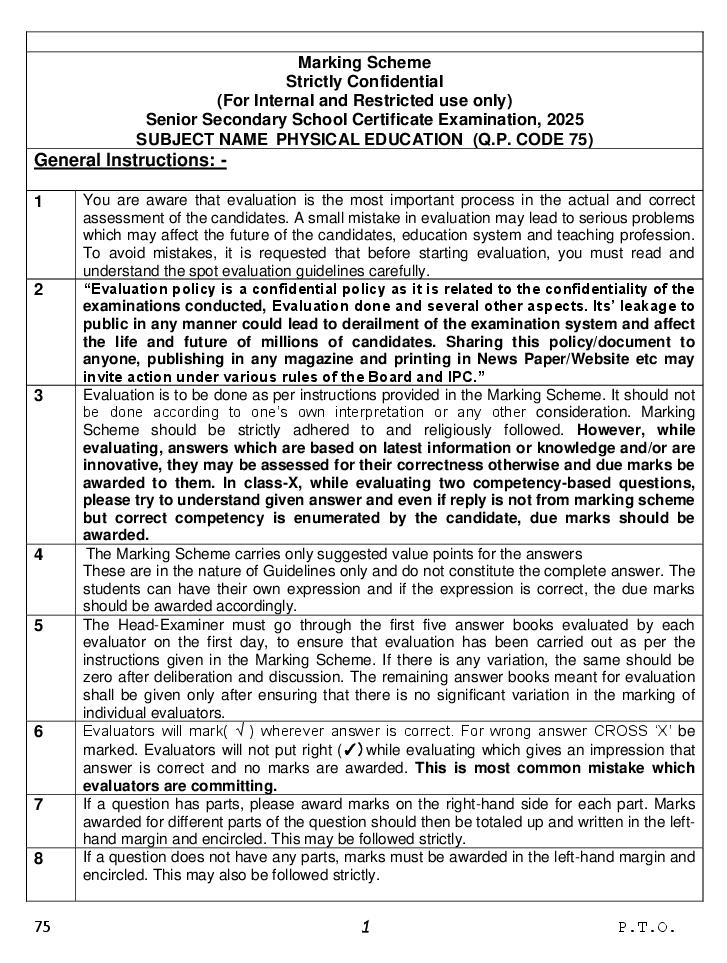
Strictly Confidential
(For Internal and Restricted use only)
Senior Secondary School Certificate Examination, 2025
SUBJECT NAME PHYSICAL EDUCATION (Q.P. CODE 75)
General Instructions: -
1 You are aware that evaluation is the most important process in the actual and correct
assessment of the candidates. A small mistake in evaluation may lead to serious problems
which may affect the future of the candidates, education system and teaching profession.
To avoid mistakes, it is requested that before starting evaluation, you must read and
understand the spot evaluation guidelines carefully.
2 “Evaluation policy is a confidential policy as it is related to the confidentiality of the
examinations conducted, Evaluation done and several other aspects. Its’ leakage to
public in any manner could lead to derailment of the examination system and affect
the life and future of millions of candidates. Sharing this policy/document to
anyone, publishing in any magazine and printing in News Paper/Website etc may
invite action under various rules of the Board and IPC.”
3 Evaluation is to be done as per instructions provided in the Marking Scheme. It should not
be done according to one’s own interpretation or any other consideration. Marking
Scheme should be strictly adhered to and religiously followed. However, while
evaluating, answers which are based on latest information or knowledge and/or are
innovative, they may be assessed for their correctness otherwise and due marks be
awarded to them. In class-X, while evaluating two competency-based questions,
please try to understand given answer and even if reply is not from marking scheme
but correct competency is enumerated by the candidate, due marks should be
awarded.
4 The Marking Scheme carries only suggested value points for the answers
These are in the nature of Guidelines only and do not constitute the complete answer. The
students can have their own expression and if the expression is correct, the due marks
should be awarded accordingly.
5 The Head-Examiner must go through the first five answer books evaluated by each
evaluator on the first day, to ensure that evaluation has been carried out as per the
instructions given in the Marking Scheme. If there is any variation, the same should be
zero after deliberation and discussion. The remaining answer books meant for evaluation
shall be given only after ensuring that there is no significant variation in the marking of
individual evaluators.
6 Evaluators will mark( √ ) wherever answer is correct. For wrong answer CROSS ‘X’ be
marked. Evaluators will not put right (✓)while evaluating which gives an impression that
answer is correct and no marks are awarded. This is most common mistake which
evaluators are committing.
7 If a question has parts, please award marks on the right-hand side for each part. Marks
awarded for different parts of the question should then be totaled up and written in the left-
hand margin and encircled. This may be followed strictly.
8 If a question does not have any parts, marks must be awarded in the left-hand margin and
encircled. This may also be followed strictly.
75 1 P.T.O.
Page 2
marks should be retained and the other answer scored out with a note “Extra Question”.
10 No marks to be deducted for the cumulative effect of an error. It should be penalized only
once.
11 A full scale of marks __________(example 0 to 80/70/60/50/40/30 marks as given in
Question Paper) has to be used. Please do not hesitate to award full marks if the answer
deserves it.
12 Every examiner has to necessarily do evaluation work for full working hours i.e., 8 hours
every day and evaluate 20 answer books per day in main subjects and 25 answer books
per day in other subjects (Details are given in Spot Guidelines).This is in view of the
reduced syllabus and number of questions in question paper.
13 Ensure that you do not make the following common types of errors committed by the
Examiner in the past:-
● Leaving answer or part thereof unassessed in an answer book.
● Giving more marks for an answer than assigned to it.
● Wrong totaling of marks awarded on an answer.
● Wrong transfer of marks from the inside pages of the answer book to the title page.
● Wrong question wise totaling on the title page.
● Wrong totaling of marks of the two columns on the title page.
● Wrong grand total.
● Marks in words and figures not tallying/not same.
● Wrong transfer of marks from the answer book to online award list.
● Answers marked as correct, but marks not awarded. (Ensure that the right tick mark
is correctly and clearly indicated. It should merely be a line. Same is with the X for
incorrect answer.)
● Half or a part of answer marked correct and the rest as wrong, but no marks awarded.
14 While evaluating the answer books if the answer is found to be totally incorrect, it should
be marked as cross (X) and awarded zero (0)Marks.
15 Any unassessed portion, non-carrying over of marks to the title page, or totaling error
detected by the candidate shall damage the prestige of all the personnel engaged in the
evaluation work as also of the Board. Hence, in order to uphold the prestige of all
concerned, it is again reiterated that the instructions be followed meticulously and
judiciously.
16 The Examiners should acquaint themselves with the guidelines given in the “Guidelines
for Spot Evaluation” before starting the actual evaluation.
17 Every Examiner shall also ensure that all the answers are evaluated, marks carried over to
the title page, correctly totaled and written in figures and words.
18 The candidates are entitled to obtain photocopy of the Answer Book on request on
payment of the prescribed processing fee. All Examiners/Additional Head Examiners/Head
Examiners are once again reminded that they must ensure that evaluation is carried out
strictly as per value points for each answer as given in the Marking Scheme.
75 2
Page 3
a. The marking scheme carries only suggested value point for the answers.
b. These are only guidelines and do not constitute the complete answer.
c. The student can have their own expression and if the expression is correct, the marks
be awarded accordingly
d. The candidates would be permitted to obtain a photocopy of the answer book on
request on payment of the prescribed processing fee. All evaluator /Additional head
examiners/Head examiners are once again reminded that they must ensure that evaluation
is carried out as per value point for each answer as given in the marking scheme.
e. All Head examiners/Additional head examiners/Evaluators are instructed that while
evaluating the answer book if the answer found to be totally incorrect, (X) should be
marked on the incorrect answer and awarded ‘0’ marks
75 3 P.T.O.
Page 4
PHYSICAL EDUCATION Max. Marks: 70
Q. No. Expected Answer Distributi
on of
Marks
1. (D) Maintenance of the field 1
2. (D) To promote health and recreation at the institution. 1
3. (B) Scoliosis 1
4. (C) Endurance activities 1
5. (A) Obesity 1
6. (B) Dhanurasana 1
(For Visually Impaired Candidates only)
(B) Forward bending in the sitting position
7. (A) Both Assertion (A) and Reason (R) are true and Reason (R) is 1
the correct explanation of the Assertion (A).
8. (C) red, blue, yellow and green 1
9. (B) Second class lever 1
10. (B) ascorbic acid 1
11. (B) Both Assertion (A) and Reason (R) are true, but Reason (R) is 1
not the correct explanation of Assertion (A)
12. (C) Sit and reach test 1
13. (B) a – (iii), b – (i), c – (iv), d – (ii) 1
14. (A) Law of Inertia 1
15. (B) a - (iii), b - (i), c - (ii), d - (iv) 1
16. (B) Self-esteem 1
17. (A) Fartlek training 1
18. (C) Iso-metric exercise 1
75 4
Page 5
(any 5 Answers)
19. Q. Suggest any two corrective measures for each, bow-leg and 1+1 = 2
round shoulder.
Ans. Corrective measures for bow-leg –
Walk on the inner edge of the feet
Perform/Practice Garudasana
Perform lunges (leg strengthening exercises)
Wearing of braces and modified shoes
Corrective measures for round shoulder :
T-stretch, wall stretch, Handclasp stretch and planks, pull-ups,
reverse shoulder stretch, etc.
Developing the habit of keeping the spine straight is also helpful in
correcting rounded shoulders.
Perform asanas like Chakrasana, Dhanurasana,
Ushtrasana, Bhujangasana
Shoulder rotation clockwise and anticlockwise
(Any two corrective measure for each)
20. Q. Enlist four benefits of participation in physical activities for 0·5 4 = 2
children with special needs.
Ans. 1. Physical benefits –
• Improves motor skills
• Improves flexibility and mobility
• Builds strength, endurance, and speed
• Supports cardiovascular health
2. Psychological benefits-
• Builds confidence and boosts self-esteem.
• Reduces stress and anxiety
• Enhances focus and attention
• Develop a sense of achievement
3. Social benefits–
• Enhances Team work
• Improves communication skills
• Develops Leadership
• Promotes inclusion
75 5 P.T.O.
Page 6
• Elevates mood
• Encourages positive attitude
• Develops resilience
• Reduces fear
(any four points)
21. Q. Enumerate any two myths related to food items with their 1+1 = 2
respective facts.
Ans. Myth: The fewer the carbohydrates, healthier you are-
Fact: Choosing the healthiest carbohydrates especially
whole grains is important for health and well-being
and is required in larger quantity.
Myth: Oils/Margarine have fewer calories than
Ghee/butter-
Fact: Ghee/Butter and Oils/ Margarine have about the
same amount of calories. Some margarines are actually
unhealthier because they contain trans-fats, which
have even more adverse effects on cholesterol and
heart health.
Myth: Apples and brinjals are rich in iron because they
turn brown when cut-
Fact: They are an excellent source of fibre but not of
iron. This change in colour is an enzymatic reaction
and has nothing to do with iron.
Myth: Drinking water in between meals affects
digestion-
Fact: The truth is that drinking water simply fills up
the stomach and as a result one tends to eat less which
is especially good when someone is trying to lose
weight.
Myth: Vegetarian diet does not build muscle
Fact: Vegetarians derive Protein required for muscle
growth from grain, pulses (dals) & Soya bean,milk and
milk product.
(Any two or any other myths with their respective facts.)
75 6
Page 7
for the Harvard step test.
Ans. The fitness index score formula =
Norms for Harvard Step Test
Upto 49 Poor
50 – 80 Average
81 or above Good
23. Q. Mention any two strategies for enhancing adherence to 1+1 = 2
exercise.
Ans. strategies for enhancing adherence to exercise are:
1. Set realistic goals
2. Create a routine
3. Choose enjoyable activities
4. Track progress
5. Find a workout buddy/partner
6. Incorporate variety
7. Work load according to physical capacity
8. Focus on benefits
9. Mindful expectations
10. Advance communication about activity, space ,resource
person should be communicated clearly
11. Approachable space
12. Appropriate equipment
13. Age appropriate graded activities (Any two)
24. Q. When wrestlers fall on the mat, why they spread their arms, 2
knees and legs? Justify your answer.
Ans. - As per the guiding principles of equilibrium and centre of
gravity, the stability of an athlete depends on his/her COG.
It is exactly in the middle of the body around which it can
rotate freely in any direction and where the body weight is
centred. Wrestlers always spread their feet, arms, knees
and legs on the mat and make COG come down.
-May reduce the chances of injuries
-Maintain balance and stability,
- Broader the base, greater the stability.
- Lower the centre of gravity, higher the stability.
75 7 P.T.O.
Page 8
(Any 5 answers)
25. Q. “The organisation of its community sports reflects the 1·5+1·5 = 3
progress of any country”. In the context of this statement,
outline ‘Run for a specific cause’ and ‘Run for unity’.
Run for a Specific Cause
Ans. This event is generally conducted to spread awareness
about social issues like cleanliness, promoting a green
environment, etc. The purpose of such events is to spread
awareness among the masses for a specific cause or to
generate charity. For example, the specific cause may be
cancer, AIDS, gender inequality, etc.
Run for Unity
In such a type of run, the purpose is to foster peace,
promote the feeling of integrity and brotherhood in the
community, state, nation or among different religions. Such
events help to develop bonding and a sense of togetherness
among people cutting across social and economic barriers.
26. Q. Describe the physical and psychological benefits of 1 3 = 3
women’s participation in sports.
Ans Physical benefits of women’s participation in sports-
1. Reduce the chances of lifestyle diseases i.e. Diabetes, High
blood pressure, Obesity etc.
2.Tones muscles
3.Improves cardiovascular system
4.Improves bone density
5.Improves reproductive health
6.Better sleep pattern
7.Improves posture and flexibility
Psychological benefits of women’s participation in sports
1.Reduces stress and anxiety
2.Improves mood and emotional well being
3.Improves self esteem
4.Better cognitive function
5.Improves sleep quality
6.Improves focus and concentration
7.Promotes goal setting skills
8.Develops leadership qualities
(any 3 points explained)
75 8
Page 9
for a gymnast.
Ans. Flexibility –Flexibility is known as the range of motion
around a joint
or
It is the ability to execute a movement with greater
amplitude or range
Methods to improve flexibility :
1.Slow Stretching
2.Slow Stretch and Hold
3.Static Stretching
4.Dynamic Stretching
5.Ballistic Method
6.Proprioceptive Neuromuscular Facilitation (PNF)
Technique
(Explanation of any two methods)
28. Q. Mention any three importance of diet during competition. 1 3 = 3
1. Dealing with nutritional needs during training is crucial
Ans. for optimal performance. The main aim during exercise and
training should be to maintain water balance, control body
temperature, sustain normal blood sugar levels and delay
fatigue. Water that is lost through sweating during exercise
needs to be replaced, in order to maintain fluid balance and
normal temperature. Even slight dehydration brings in
mental and physical fatigue and weakens the performance.
2. During small breaks in the events, such as tennis, boxing,
etc., the consumption of adequate carbohydrates and fluids
may be taken care of. In shorter breaks, carbohydrate-rich
foods like bananas, juices, carbohydrate-based drinks (less
than 2 percent concentration) or simply water may be
taken.
3. If exercising for more than 60 minutes, carbohydrate-
electrolyte beverages like diluted fruit juices containing 5
percent to 8 percent carbohydrates can be ingested.
4. As the duration of high intensity events continues, muscle
glycogen levels diminish. Therefore, for endurance athletes,
in events lasting longer than two hours, carbohydrate-rich
solids or liquid meals are recommended during exercise.
75 9 P.T.O.
Page 10
contain caffeine are not recommended.
(Any three points)
29. Q. Describe the following : 1·5+1·5 = 3
(a) Residual volume (b) Stroke volume
Ans. Residual volume: Residual volume is the volume of air that
remains in the lungs after forceful expiration. Regular
exercise increases residual volume that helps to exchange
the gases in normal limits.
Stroke Volume: The volume of blood pumped during one
beat (contraction) is called stroke volume. During exercise,
stroke volume increases as more oxygen is required. This is
accomplished by delivering blood to muscles. After an
endurance training programme, the capacity of the heart to
pump blood in one contraction is increased by 20 to 50
percent.
(Or any other relevant answer)
30. Q. Compare and contrast hostile and instrumental aggression. 3
Hostile Instrumental
Ans. Intent Harm or Harm or
Suffering Suffering
Primary Harm or injure Win or
Goal advantage
Process Non-Legitimate Non-Legitimate
Emotion Anger No Anger
Explanation Self-justification Offer apologies
instead of
apology
(any 3 points)
75 10
Page 11
(Internal Choices Available)
31. i. (A) 06 1 4 = 4
ii. 16
iii. 10 and 11
OR
NB+1
2
iv. (C) Seeding
(For Visually Impaired Candidates only)
i. 16
ii. (A) Knock out tournament
iii. (A) Logistics committee
iv. NB+1
2
OR
NB-1
2
32. i. (C) 8 1 4 = 4
ii. 1924
iii. Dr. Ludwig Guttmann
iv. Two strategies are :
1. Proper instructions
2. Proper space
3. Adapted equipment
4. Modified rules
5. Graded activities
6. Social strategies
7. Involve people with disability in decision making
8. Regular medical check up
(any 2 points or any other relevant points)
75 11 P.T.O.
Page 12
ii. Cardiac output is the amount of blood pumped out by the heart in
1 minute.
or
Stroke volume X heart rate=cardiac output
iii. (A) – Amount of air inhaled and exhaled in one breath.
iv. (D) Endurance
SECTION - E
(Answer any 3)
34. Q. Describe the procedure and benefits of Mandukasana and 2·5+2·5 = 5
Makarasana to control hypertention.
Ans.
Mandukasana :
Mandukasana comes from the Sanskrit word ‘Manduk’
which means frog. This yoga asana is aptly named frog pose
as your body resembles a frog when you practice it.
This yoga asana is fairly straightforward and can be
practiced by almost all age groups.
Procedure :
• Sit in Vajrasana and make fists with both
hands, the thumbs inside.
• Place your fists on your belly next to the
belly button.
• Bend forward with exhalation.
• Keep looking straight.
• Hold your breath in the yoga posture for a
few seconds and come up with inhalation.
• Repeat this asana 3-4 times.
Benefits :
• This asana is beneficial to all organs of the body.
• Mandukasana gives you relief from diabetes,
digestive disorders and constipation.
• This asana improves the flexibility and mobility
of the knee and ankle joints.
• It helps tone muscles of the shoulder and
abdomen.
• Regular practice of this asana increases your
lung capacity.
75 12
Page 13
from problems of the pancreas and the heart.
• This asana helps reduce fat from thighs, belly
and hips.
Makarasana :
Makar means crocodile. While doing this asana the body
resembles the shape of a crocodile, hence it is known as
Makarasana. It is also considered a relaxing asana like
Shavasana.
Procedure :
1. Lie down on the floor on your stomach
with your hands folded under the head.
2. Place the right palm over the left palm
on the ground and place the head over the
right palm in a relaxed way and close
your eyes.
3. Stretch the leg as far as possible. The
toes should point outwards.
4. Relax the whole body. Breathe
normally and slowly feel the whole body
touching the ground and the deep
relaxation in all your muscles.
5. Relax in this posture for few minutes.
6. While returning from the posture,
slowly bring the feet together unfold the
arms and come to the prone position.
Benefits :
1. Deep relaxation to the shoulder and the
spine.
2. Reduces waist pain.
3. Helps in slipped disc.
4.Beneficial for asthma
5. Relief for arthritis patients.
6. Abdominal muscles get an automatic
massage.
(any 2 benefits for each)
75 13 P.T.O.
Page 14
Equilibrium increases with the influence of various factors
Ans. by giving suitable examples from sports.
Equilibrium-
State of balance or a stable situation where opposite forces
cancel each other and where no changes occur.
Or
Condition in which the sum of all forces acting on a body is
zero, causing it to remain at rest or move with constant
velocity.
-Lower centre of gravity means more stability:
Athletes lower their centre of gravity to improve stability
during activities. For example, runners bend their knees to
stop more quickly and effectively. Similarly, a wrestler
adopts a half –sitting posture for better balance, and shot
put thrower bends their knees for better stability to avoid
foul.
- Stability increases when centre of gravity is centred:
Balance is lost if centre of gravity moves outside the
support base. Keeping the weight centred over the support
base enhances stability. For instance, balance is easily lost
in activities like walking on a balance beam with narrow
support base. If balance shifts, the gymnast might raise an
arm or leg to bring the centre of gravity back to the centre.
- Wider base of support enhance stability:
Spreading the support base, like standing with feet apart
adds stability. Using stance requiring both hands and feet,
creates the most comprehensive base and, hence more
stability.
Body weight is directly proportional to stability:
A heavier person or gravity or object is more stable and
more challenging to move. This principle is applied in
sports like Boxing, Judo, Wrestling, where competitors are
classified by weight.
More the friction on the surface more the stability:
If the surface of a sport or activity has more friction, it leads
to greater stability.For example, if the friction on a
wrestling mat is less, wrestler will tend to slip.
(Any four factors with any suitable example)
75 14
Page 15
will plan circuit training sessions with 6 stations to develop
fitness of his new trainees? Explain.
Circuit training:
Ans. Circuit training method was introduced by R.E morgan and
G.T. Admson of Leeds university in 1951. It is the training
method in which certain exercises of various kinds are
performed with or without apparatus with given dosage.
A coach planning a circuit training session for new trainees
. must consider their fitness level goals and variety of
exercises. Each station should focus on different component
of fitness such as strength, endurance, agility and flexibility.
Coach can plan following stations to develop fitness of his
new trainees –
1.Push ups
2.Jump squat
3.Rope skipping
4.Pull ups
5.Shuttle run
6.Arm curling
7.Shoulder press
8.Burpees
9.Step ups
10.Lunges
11.Medicine ball throw
12.Sit ups
13.Spot running
14.Bench press
15.Exercises with dumbbells
(Any 6 or any other relevant stations)
37. Q. Write in detail the procedure and scoring of “Flamingo 1+2+2 = 5
Balance Test’ and ‘Plate Tapping Test’ recommended for the
age group 5 – 8 years by SAI Khelo India.
Ans. Procedure Flamingo Balance Test:
- Stand on the beam. Keep the balance by holding the
instructor's hand (if required to start).
75 15 P.T.O.
Page 16
participant/subject.
- Pause the stopwatch each time the subject loses
balance (either by falling off the beam or letting go of
the foot being held).Resume over, timing again until
they lose balance.
- Count the number of falls in 60 seconds of balancing.
- If there are more than 15 falls in the first 30 seconds,
the test is terminated.
Scoring:
The total number of falls or loss of balance in 60
seconds of balancing is recorded.
If there are more than 15 falls in the first 30 seconds,
the test is terminated.
Procedure for Plate Tapping Test:
If possible, the table height should be adjusted so that
the subject may stand comfortably in front of the discs.
The two yellow discs are placed with their centers 60
cm apart on the table.
The rectangle is placed equidistant between both discs.
The non-preferred hand is placed on the rectangle.
The subject moves the preferred hand back and forth
between the discs over the hand in the middle as
quickly as possible.
This action is repeated for 25 full cycles (50 taps).
Scoring: The time taken to complete 25 cycles is
recorded.
75 16
Page 17
(For Internal and Restricted use only)
Senior Secondary School Certificate Examination, 2025
SUBJECT NAME PHYSICAL EDUCATION (Q.P. CODE 75)
General Instructions: -
1 You are aware that evaluation is the most important process in the actual and correct
assessment of the candidates. A small mistake in evaluation may lead to serious problems
which may affect the future of the candidates, education system and teaching profession.
To avoid mistakes, it is requested that before starting evaluation, you must read and
understand the spot evaluation guidelines carefully.
2 “Evaluation policy is a confidential policy as it is related to the confidentiality of the
examinations conducted, Evaluation done and several other aspects. Its’ leakage to
public in any manner could lead to derailment of the examination system and affect
the life and future of millions of candidates. Sharing this policy/document to anyone,
publishing in any magazine and printing in News Paper/Website etc may invite action
under various rules of the Board and IPC.”
3 Evaluation is to be done as per instructions provided in the Marking Scheme. It should not
be done according to one’s own interpretation or any other consideration. Marking Scheme
should be strictly adhered to and religiously followed. However, while evaluating, answers
which are based on latest information or knowledge and/or are innovative, they may
be assessed for their correctness otherwise and due marks be awarded to them. In
class-X, while evaluating two competency-based questions, please try to understand
given answer and even if reply is not from marking scheme but correct competency
is enumerated by the candidate, due marks should be awarded.
4 The Marking Scheme carries only suggested value points for the answers
These are in the nature of Guidelines only and do not constitute the complete answer. The
students can have their own expression and if the expression is correct, the due marks
should be awarded accordingly.
5 The Head-Examiner must go through the first five answer books evaluated by each
evaluator on the first day, to ensure that evaluation has been carried out as per the
instructions given in the Marking Scheme. If there is any variation, the same should be zero
after deliberation and discussion. The remaining answer books meant for evaluation shall
be given only after ensuring that there is no significant variation in the marking of individual
evaluators.
6 Evaluators will mark( √ ) wherever answer is correct. For wrong answer CROSS ‘X’ be
marked. Evaluators will not put right (✓)while evaluating which gives an impression that
answer is correct and no marks are awarded. This is most common mistake which
evaluators are committing.
7 If a question has parts, please award marks on the right-hand side for each part. Marks
awarded for different parts of the question should then be totaled up and written in the left-
hand margin and encircled. This may be followed strictly.
8 If a question does not have any parts, marks must be awarded in the left-hand margin and
encircled. This may also be followed strictly.
9 If a student has attempted an extra question, answer of the question deserving more marks
should be retained and the other answer scored out with a note “Extra Question”.
10 No marks to be deducted for the cumulative effect of an error. It should be penalized only
once.
11 A full scale of marks __________(example 0 to 80/70/60/50/40/30 marks as given in
Question Paper) has to be used. Please do not hesitate to award full marks if the answer
deserves it.
12 Every examiner has to necessarily do evaluation work for full working hours i.e., 8 hours
every day and evaluate 20 answer books per day in main subjects and 25 answer books
per day in other subjects (Details are given in Spot Guidelines).This is in view of the reduced
syllabus and number of questions in question paper.
1
Page 18
Examiner in the past :-
● Leaving answer or part thereof unassessed in an answer book.
● Giving more marks for an answer than assigned to it.
● Wrong totaling of marks awarded on an answer.
● Wrong transfer of marks from the inside pages of the answer book to the title page.
● Wrong question wise totaling on the title page.
● Wrong totaling of marks of the two columns on the title page.
● Wrong grand total.
● Marks in words and figures not tallying/not same.
● Wrong transfer of marks from the answer book to online award list.
● Answers marked as correct, but marks not awarded. (Ensure that the right tick mark is
correctly and clearly indicated. It should merely be a line. Same is with the X for
incorrect answer.)
● Half or a part of answer marked correct and the rest as wrong, but no marks awarded.
14 While evaluating the answer books if the answer is found to be totally incorrect, it should be
marked as cross (X) and awarded zero (0)Marks.
15 Any unassessed portion, non-carrying over of marks to the title page, or totaling error
detected by the candidate shall damage the prestige of all the personnel engaged in the
evaluation work as also of the Board. Hence, in order to uphold the prestige of all concerned,
it is again reiterated that the instructions be followed meticulously and judiciously.
16 The Examiners should acquaint themselves with the guidelines given in the “Guidelines for
Spot Evaluation” before starting the actual evaluation.
17 Every Examiner shall also ensure that all the answers are evaluated, marks carried over to
the title page, correctly totaled and written in figures and words.
18 The candidates are entitled to obtain photocopy of the Answer Book on request on payment
of the prescribed processing fee. All Examiners/Additional Head Examiners/Head
Examiners are once again reminded that they must ensure that evaluation is carried out
strictly as per value points for each answer as given in the Marking Scheme.
2
Page 19
अ) अंक योजना में उत्तरों के लिए केविा सझ
ु ाए गए मानब द
ं ु होते हैं |
) ये केवि ददशाननदे श हैं और पर्
ू ण उत्तर का गठन नह ं करते हैं |
स) छात्रों की अपनी अलिव्यक्तत हो सकती है और यदद अलिव्यक्तत
सह है तो उसी के अनस
ु ार अंक ददए जाएंगे |
ड) छात्रों को ननर्ाणररत प्रक्रिया शल्
ु क के िग
ु तान एवं अनरु ोर् पर
उत्तरपुक्ततका की फोटोकॉपी प्राप्त करने की अनुमनत द जाएगी | सिी
मूल्यांकनकताणओं/अनतररतत मुख्य पर क्षकों/प्रर्ान पर क्षकों को एक ार
क्रफर याद ददिाया जाता है क्रक वे यह सनु नक्चित करें क्रक अंकन योजना
में ददए गए प्रत्येक उत्तर के लिए मूल्य ब द
ं ओ
ु ं के अनुसार मूल्यांकन
क्रकया जाता है |
इ) समतत प्रर्ान पर क्षकों/ अनतररतत प्रर्ान पर क्षकों/ मल्
ू यांकनकताणओं
को ननदे लशत क्रकया जाता है क्रक उत्तरपुक्ततकाओं का मूल्यांकन करते
समय यदद उत्तर पूर्त
ण या गित पाया जाता है तो गित उत्तर पर(X)
अंक्रकत कर ‘0’ अंक प्रदान क्रकया जाए |
3
Page 20
प्रचन संिाववत उत्तर अंक ववतरर्
संख्या
खण्ड-क
1. (D) मैदान का रख रखाव 1
2. (D) संतथान में तवात्य व मनोरं जन को ढ़ावा दे ना | 1
3. (B) तकोलियोलसस 1
4. (C) सहनक्षमता की गनतववधर्यााँ 1
5. (A) मोटापे 1
6. (B) धिुरासि 1
( केवल दॄष्टिबाधधतपरीक्षाधथियों के ललए )
(B) ैठी अवतथा में आगे की ओर झक
ु ना
7. (A) अलिकथन (A) और कारर् (R) दोनो सह हैं और कारर् (R) 1
अलिकथन (A) की सह व्याख्या है |
8. (C) िाि, नीिा, पीिा और हरा 1
9. (B) दववतीय श्रेर्ी ि वर में 1
10. (B) एतकॉब क
ण अम्ि 1
11. (B) अलिकथन (A) और कारर् (R) दोनो सह हैं और कारर् (R), 1
अलिकथन (A) की सह व्याख्या िहीीं है |
12. (C) लसट एंड र ि पर क्षर् 1
13. (B) a - (iii), b - ( i ), c - (iv), d - (ii) 1
14. (A) जड़त्व का ननयम 1
15. (B) a - (iii), b - (i), c - (ii), d - (iv) 1
16. (B) आत्म-सम्मान 1
17. (A) फाटण िेक प्रलशक्षर् 1
18. (C) आइसोमेदिक 1
4
Page 21
( क्रकनह ं 5 प्रचनों के उत्तर द क्जए )
19 प्रचन) र्नुषाकार टााँगों और गोि कनर्ों के लिए दो-दो सुर्ारात्मक उपाय 1+1=2
सुझाइये |
उत्तर- र्नुषाकार टााँगों के लिए सर्
ु ारात्मक उपाय:-
1) पैरों के अंदरू
ु नी क्रकनारों पर ििें |
2) गरुड़ासन का अभ्यास करें |
3) संशोधर्त जूतों एवं ब्रेलसज़ का प्रयोग करें |
4) िंक्जस (पैरों को मज ूत नाने वािे) व्यायाम करें |
गोि कनर्ों के लिए दो-दो सुर्ारात्मक उपाय:-
1) ट -तटै ि, वॉि-तटै ि, हैंडतिेप तटै ि और प्िैंक पुि-अप्स, ररवसण
शोल्डर तटै ि आदद व्यायाम का अभ्यास करें |
2) र ढ़ की हड्डी को सीर्ा रखने की आदत को ववकलसत करना िी
गोि कंर्ों को सह करने में सहायक होता है |
3) ििासन, र्नुरासन, उष्ट्िासन और िुजंगासन का अभ्यास करें |
4) कंर्ों को गोिाकार आकृनत में आगे और पीछे घुमाएं |
(प्रत्येक के लिए कोई दो सुर्ारात्मक उपाय)
20 प्रचन) ववशेष आवचयकता वािे च्िों के लिये शार ररक गनतववधर्यों में 0.5×4=2
िाग िेने के िार िािों को सूिी दर् कीक्जए |
उत्तर:-
ववशेष आवचयकताओं वािे च्िों के लिए शार ररक क्रियाओं के िाि:-
1)शार ररक िाि :-
❖ गामक कौशिों में सुर्ार
❖ शक्तत,सहनशक्तत और गनत का ववकास
❖ ििीिेपन एवं गनतशीिता में वद
ृ धर्
❖ हृदय वादहका सं ंर्ी तवात्य में वद
ृ धर्
5
Page 22
❖ आत्मसम्मान में वद
ृ धर्
❖ तनाव एवं धिंता में कमी
❖ ध्यान व एकाग्रता में वद
ृ धर्
❖ उपिक्धर् की िावना का ववकास
3)सामाक्जक िाि :-
❖ समूह कायण में वद
ृ धर्
❖ संिार कौशि में सुर्ार
❖ नेतत्ृ व का ववकास
❖ समावेश को ढ़ावा
4)िावनात्मक िाि :-
❖ मड
ू में सर्
ु ार
❖ सकारात्मक दृक्ष्ट्टकोर् को ढ़ावा
❖ र्ैयण में वद
ृ धर्
❖ िय में कमी
(क्रकनह ं 4 ब नदओ
ु ं का वववरर् )
21 प्रचन) खादय-पदाथों से सं धर्त क्रकनह दो लमथकों और उनसे सं ंधर्त 1+1=2
त्यों का उल्िेख कीक्जए |
उत्तर-
1)लमथक:- कम का ोहाइड्रेट िेने से आप ज्यादा तवतथ रहें गे |
तथ्य:- तवात्यप्रद का ोहाइड्रेट ववशेषरूप से सा त
ु अनाज ियन करना
अच्छे तवात्य एवं कुशि-क्षेम के लिए आवचयक है और इनकी
आवचयकता िी अधर्क मात्रा में होती है |
2)लमथक:- तेि / माजणर न में घी / मतखन की तुिना में कम कैिोर
होती हैं |
6
Page 23
कैिोर होती हैं। कुछ माजणर न वाततव में अतवतथ कारक होते हैं तयोंक्रक
उनमें िांस वसा होती है , क्जसके कोिेतिॉि और हृदय तवात्य पर और
िी अधर्क प्रनतकूि प्रिाव पड़ते हैं।
3)लमथक:- से और ग
ैं न आयरन से िरपरू होते हैं तयोंक्रक उनहें काटने
पर वे िरू े रं ग के हो जाते हैं |
तथ्य:- वे फाइ र का एक उत्कृष्ट्ट स्रोत हैं, िेक्रकन आयरन का नह ं। रं ग
में यह पररवतणन एक एंजाइलमक प्रनतक्रिया है और आयरन से इसका कोई
सं ंर् नह ं है ।
4)लमथक:- िोजन के ीि में पानी पीने से पािन प्रिाववत होता है |
तथ्य:- सच्िाई यह है क्रक िोजन के ीि में पानी पीने से पेट िर जाता
है और पररर्ामतवरूप कोई व्यक्तत कम खाता है , जो ववशेष रूप से त
अच्छा होता है ज कोई व्यक्तत वजन कम करने की कोलशश कर रहा
हो।
5)लमथक:- शाकाहार आहार मांसपेलशयों का ननमाणर् नह ं करता है |
तथ्य:- शाकाहार िोग अनाज, दािों और सोया ीन से प्रोट न प्राप्त करते
हैं जो मांसपेलशयों के ववकास के लिए आवचयक है ।
(क्रकनह ं 2 लमथकों का त्यों सदहत वववरर् )
22 प्रचन) हावणडण तटे प पर क्षर् के मानदं डों तथा क्रफटनेस इंडत
े स तकोर के सूत्र 1+1=2
का उल्िेख कीक्जए |
उत्तर-
पुक्ष्ट्ट गर्ना सूत्र :-
व्यायाम की अवधर् ( सेकैंड में ) ×100
5.5×व्यायाम के पचिात ् 1 से 1.5 लमनट के ीि हृदय की र्ड़कन की
संख्या
7
Page 24
49 तक खरा
50-80 तक औसतन
81 या इस से अधर्क अच्छा
23 प्रचन) व्यायाम अनुपािन को ढ़ाने के लिए क्रकनह ं दो रर्नीनतयों का 1+1=2
उल्िेख कीक्जए |
उत्तर-
व्यायाम अनुपािन को ढ़ाने की रर्नीनतयााँ -
1. यथाथणवाद िक्ष्य ननर्ाणररत करें
2. ददनियाण नाएं
3. आनंददायक गनतववधर्यााँ िन
ु ें
4. प्रगनत पर नज़र रखें
5. कसरत करने के लिए साथी/ सहिागी ढूाँढ़ें
6. ववववर्ता को शालमि करें
7. शार ररक क्षमता के अनुसार कायण िार
8. िािों पर ध्यान दें
9. सिेत अपेक्षाएाँ रखें
10. गनतववधर्, तथान, संसार्न प्रदाता के ारे में पहिे से तपष्ट्ट रूप से
संिार क्रकया जाना िादहए
11. सुिि तथान का ियन
12. उपयुतत उपकरर्
13. आयु के अनुसार वगीकृत गनतववधर्यााँ
(कोई िी दो ब नद ु )
24 2
प्रचन) ज कुचती में खखिाड़ी मैट पर धगरते हैं, तो वे अपने हाथ, घट
ु ने
और पैर तयों फैिाते हैं? अपने उत्तर का औधित्य लसदर् कीक्जए |
8
Page 25
संतुिन और गुरुत्वाकषणर् के मागणदशणक लसदर्ांतों के अनुसार, एक एथि ट
की क्तथरता उसके गुरुत्वाकषणर् केंद्र (CG) पर ननिणर करती है । यह शर र
के ठीक मध्य में होता है , जहां शर र का वजन केंदद्रत होता है तथा यह
क्रकसी िी ददशा में तवतंत्र रूप से घम
ू सकता है ।
कुचती में पहिवान हमेशा अपने पैर, हाथ, घट
ु ने और पैरों को कुचती मैट
पर फैिाकर संति
ु न और क्तथरता नाए रखने का प्रयास करते हैं और
अपने गुरुत्वाकषणर् के केंद्र को नीिे िे आते हैं।
इसके फायदे हैं:
- िोट िगने की संिावना कम हो जाती है
- संतुिन और क्तथरता नी रहती है
- क्जतना िौड़ा आर्ार होगा, उतनी ह अधर्क क्तथरता होगी
- गुरुत्वाकषणर् का केंद्र क्जतना नीिे होगा, क्तथरता उतनी ह अधर्क होगी।
खण्ड-ग
(क्रकनह ं 5 प्रचनों के उत्तर द क्जए )
25 प्रचन) “क्रकसी िी दे श की प्रगनत उसके सामद
ु ानयक खेिों के आयोजन से 1.5+1.5=3
प्रनतब बं त होती है |” इस कथन के संदिण में “ववलशष्ट्ट कारर् के लिए
दौड़” तथा “एकता के लिए दौड़” की रूपरे खा तैयार कीक्जए |
उत्तर- क्रकसी ववलशष्ट्ट कारर् के लिए दौड़:-
दौड़-आयोजन आमतौर पर तवच्छता, हररत वातावरर् को ढ़ावा दे ने जैसे
सामाक्जक मुददों के ारे में जागरूकता फैिाने के लिए क्रकया जाता है ।
ऐसे आयोजनों का उददे चय क्रकसी ननक्चित कारर् के लिए जनमानस में
जागरूकता फैिाना या दान संग्रह करना है । उदाहरर् के लिए कुछ ववलशष्ट्ट
कारर् जैसे कैं सर, एड्स और लिंग असमानता आदद |
एकता के लिए दौड़ :-
इस प्रकार की दौड़ का उददे चय शांनत, समुदाय, राज्य, राष्ट्ि या ववलिनन
र्मों में एकता और िाईिारे की िावना को ढ़ावा दे ना है । ऐसे आयोजन
9
Page 26
एकता की िावना को ववकलसत करने में मदद करते हैं।
26 प्रचन) खेिों में मदहिाओं की िागीदार से होने वािे शार ररक और 1×3=3
मनोवैज्ञाननक िािों का वर्णन कीक्जए |
उत्तर- खेिों में मदहिाओं की िागीदार के शार ररक िाि:-
1.जीवनशैि से जड़
ु ी ीमाररयों के खतरों को कम करता है |
2. मांसपेलशयों के टोन में वद
ृ धर् |
3. हृदय-वादहका तंत्र में वद
ृ धर् |
4. हड्डडयों की घनत्व में सुर्ार |
5. प्रजनन सं ंर्ी तवात्य में सुर्ार |
6. नींद की गुर्वत्ता में सुर्ार |
7. आसन, मुद्रा और ििीिेपन में सुर्ार |
खेिों में मदहिाओं की िागीदार के मनोवैज्ञाननक िाि:-
1. तनाव और धिंता में कमी |
2. मूड और िावनात्मक तवात्य में सुर्ार |
3. आत्म-सम्मान में वद
ृ धर् ।
4. ेहतर संज्ञानात्मक कायण करना |
5. नींद की गुर्वत्ता में सुर्ार |
6. ध्यान केक्नद्रत करने और एकाग्रता में सुर्ार |
7. िक्ष्य ननर्ाणरर् के कौशिों को ढ़ावा दे ना |
8. नेतत्ृ व के गर्
ु ों का ववकास करना |
(क्रकनह तीन ब नदओ
ु ं का वर्णन )
27 प्रचन) ििीिेपन को पररिावषत कीक्जए | एक क्जमनातट के ििीिेपन को 1+2=3
सुर्ारने की ववधर्यों का वर्णन कीक्जए |
10
Page 27
लचीलापि :-
ििीिेपन को जोड़ के िारों ओर गनत ववततार की सीमा के रूप में जाना
जाता है |
या
यह अधर्क आयाम या सीमा के साथ क्रकसी गनत के ननष्ट्पाददत करने की
क्षमता है |
ििीिेपन में सुर्ार की ववधर्यााँ :-
1) र्ीमी गनत के खखंिाव वािे व्यायाम
2) र्ीमी गनत से खखंिाव एवं रुकना
3) क्तथर खखंिाव
4) गनतशीि खखंिाव
5) ैलिक्तटक ववधर्
6) प्रोवप्रयोसेक्प्टव नयरू ोमतकुिर फैलसलिटे शन तकनीक
(पी0 एन0 एफ0)
(क्रकनह 2 ववधर्यों की व्याख्या )
28 प्रचन) प्रनतयोधगता के दौरान आहार के क्रकनह ं तीन महत्त्वों का उल्िेख 1×3=3
कीक्जए |
उत्तर- प्रनतयोधगता के दौरान आहार के महत्त्व :-
1) सवणश्रेष्ट्ठ प्रदशणन के लिए प्रलशक्षर् के दौरान पोषर् सं ंर्ी आवचयकताओं
से ननपटना महत्वपर्
ू ण है | व्यायाम और प्रलशक्षर् के दौरान मख्
ु य उददे चय-
पानी के सनतुिन को नाए रखना, शर र के तापमान को ननयंबत्रत करना,
सामानय रतत शकणरा के ततर को नाए रखना और थकान को कम करना
आदद होने िादहए | व्यायाम के दौरान तरि पदाथण का संतुिन व शर र
के सामानय तापमान को नाए रखने के लिए पसीने के दवारा जो पानी
की कमी होती है , उसे प्रनततथावपत करने की आवचयकता होती है | यहााँ
11
Page 28
है और प्रदशणन क्षमता में कमी कर दे ता है |
2) टे ननस, ॉक्तसंग आदद जैसे आयोजनों में छोटे -छोटे अंतराि
(ववराम) के दौरान पयाणप्त मात्रा में का ोहाइड्रेट और तरि पदाथों के सेवन
का उधित ध्यान रखना िादहए | छोटे -छोटे अंतराि पर का ोहाइड्रेट यत
ु त
खादय पदाथण जैसे केिा, जूस, का ोहाइड्रेट आर्ाररत पेय (2% से कम
सानद्रता वािे) अथवा पानी लिया जा सकता है |
3) यदद 60 लमनट से अधर्क समय तक व्यायाम करते हैं तो 5 से 8%
का ोहाइड्रेट वािे फिों के रस या का ोहाइड्रेट इिेतिोिाइट पेय पदाथों का
सेवन क्रकया जा सकता है |
4) जैसे-जैसे उच्ि तीव्रता वाि तपर्ाणएाँ ििती हैं वैसे-वैसे मांसपेलशयों में
ग्िाइकोजन का ततर कम होता जाता है | इसलिए सहनक्षमता वाि
तपर्ाणओं के एथि टों के लिए 2 घंटे से अधर्क समय तक ििने वाि
तपर्ाणओं में व्यायाम के दौरान का ोहाइड्रेट युतत ठोस व तरि िोजन की
सिाह द जाती है |
5)का न
ण युतत पेय व कैफीन युतत पेय पदाथों की सिाह नह ं द जाती
है |
(या अनय क्रकनह ं तीन ब नदओ
ु ं का वववरर् )
29 प्रचन) ननम्न का वर्णन कीक्जए:- 1.5+1.5=3
अ)अवलशष्ट्ट मात्रा ( रे लसडुअि वॉल्यूम )
)आघात मात्रा ( तिोक वॉल्यूम )
उत्तर-
अवलशष्ट्ट आयतन:- अवलशष्ट्ट आयतन हवा का वह आयतन है जो िपूवक
ण
चवास छोड़ने के ाद फेफड़ों में शेष रहती है । ननयलमत व्यायाम से अवलशष्ट्ट
12
Page 29
करता है ।
आघात (तिोक) आयतन:- हृदय संकुिन क्रिया के दौरान पंप क्रकए गए
रतत का आयतन ‘तिोक आयतन’ कहिाता है । व्यायाम के दौरान, अधर्क
ऑतसीजन की आवचयकता होने के कारर् तिोक आयतन ढ़ जाता है ।
यह मांसपेलशयों में रतत पहुाँिाकर परू ा क्रकया जाता है । सहनक्षमता प्रलशक्षर्
कायणिम के ाद एक संकुिन में रतत पंप करने की हृदय की क्षमता 20
से 50 प्रनतशत तक ढ़ जाती है |
(या सं ंधर्त अनय कोई उत्तर)
30 प्रचन) शत्रूतापूर्ण और ननलमत्त-आिामकता की तुिना कीक्जए व अंतर 3
ताइये |
उत्तर-
शत्रत
ु ापर्
ू ण सहायक (ननलमत्त)
प्रयोजन क्षनत या पीड़ा क्षनत या पीड़ा
प्राथलमक िक्ष्य क्षनत या िोट पहुाँिाना जीत या िाि
प्रक्रिया ननयमों के ववरूदर् ननयमों के ववरूदर्
िावना आिोश आिोश रदहत
तपष्ट्ट करर् माफी के जाय माफी मांगना
आत्म-औधित्य
(या सं ंधर्त कोई उत्तर)
खण्ड-घ
(आंतररक ववकल्प उपिधर् हैं)
31 उत्तर- 1×4=4
i. (A) 06
13
Page 30
iii. 10 और 11
या
NB+1
2
iv. (C) सीडडंग
(केवल दृष्टि बाधधत परीक्षाधथियों के ललए )
i. 16
ii. (A) नॉक आउट प्रनतयोधगता
iii. (A) िॉक्जक्तटक सलमनत
iv. NB+1
2
या
NB-1
2
32 उत्तर- 1×4=4
i. (C) 8
ii. 1924
iii. डॉ. िुडववग गट्मैन
iv. रर्नीनतयााँ :-
1. उधित ननदे श
2. उधित तथान
3. अनुकूलित उपकरर्
4.संशोधर्त ननयम
5. श्रेर्ी दर् गनतववधर्यााँ
6. सामाक्जक रर्नीनतयााँ
7. ददव्यांगों को ननर्णय िेने में शालमि करना
14
Page 31
(या अनय सं ंधर्त ब नद)ु
33 उत्तर- 4
i. (D) िैक्तटक एलसड (दग्ु र्ाम्ि) का संिय
ii. काडडणयक आउटपुट एक लमनट में हृदय दवारा पंप क्रकए गए रतत की
मात्रा है ।
या
आघात आयतन× हृदय र्ड़कन = काडडणयक आऊटपट
ु
iii. (A) एक सांस में अंदर ि गई और ाहर छोड़ी गई हवा की मात्रा।
iv. (D) सहनक्षमता
खण्ड-ङ
(क्रकनह ं 3 प्रचनों के उत्तर द क्जए )
34 प्रचन) उच्ि रततिाप को ननयंबत्रत करने के लिए मंडूकासन व मकरासन 2.5+2.5=5
की ववधर् और िािों को लिखखए |
उत्तर-
मींडूकासि:-
‘मंडूकासन’ संतकृत शधद "मंडूक" से आया है , क्जसका अथण है में ढ़क। यह
योग आसन में ढ़क मद्र
ु ा के रूप में जाना जाता है तयोंक्रक ज आप इसे
अभ्यास करते हैं तो आपका शर र में ढ़क की तरह ददखता है । यह योग
आसन काफी सरि है और िगिग सिी आयु वगण के िोग इसका अभ्यास
कर सकते हैं।
प्रक्रिया:-
· वज्रासन में ैठें और दोनों हाथों के अंगूठों को अंदर की ओर िेकर
मुट्ठी नाएं।
· अपनी मट्
ु दठयों को नालि के पास पेट पर रखें।
· सााँस छोड़ते हुए आगे की ओर झक
ु ें ।
· सीर्े दे खें।
· कुछ सेकंड के लिए सााँस रोककर आसन मुद्रा में रहें और सााँस िेते हुए
ऊपर आएं।
15
Page 32
लाभ:-
· यह आसन शर र के सिी अंगों के लिए िािदायक है ।
· मंडूकासन मर्म
ु ेह, पािन ववकार और कधज से राहत ददिाता है ।
· यह आसन घट
ु ने और टखने के जोड़ों में ििीिापन और गनतशीिता में
सर्
ु ार करता है ।
· यह आसन कंर्े और पेट की मांसपेलशयों को टोन करता है ।
· इस आसन का ननयलमत अभ्यास फेफड़ों की क्षमता ढ़ाता है ।
· यह योग आसन अग्नयाशय और हृदय की समतयाओं से पीडड़त िोगों
के लिए िािदायक है ।
· यह आसन जांघों, पेट और कूल्हों से वसा कम करने में मदद करता है ।
मकरासि:-
मकर का अथण है "मगरमच्छ"। इस आसन को करते समय शर र मगरमच्छ
की आकृनत की तरह ददखता है , इसलिए इसे मकरासन कहा जाता है । यह
आसन शवासन की तरह आरामदायक माना जाता है ।
प्रक्रिया:-
1. पेट के ि जमीन पर िेट जाएं और हाथों को लसर के नीिे मोड़कर
रखें।
2. दादहने हाथ को ाएं हाथ के ऊपर जमीन पर रखें और लसर को दादहने
हाथ पर आराम से रखें और आंखें ंद करें ।
3. पैरों को क्जतना हो सके उतना फैिाएं। पैरों की उं गलियां ाहर की ओर
होनी िादहए।
4. पूरे शर र को आराम दें । सामानय रूप से सााँस िें और र्ीरे -र्ीरे पूरे
शर र को जमीन पर तपशण करते हुए और सिी मांसपेलशयों में गहरे आराम
को महसूस करें ।
5. कुछ लमनटों के लिए इस मुद्रा में आराम करें ।
16
Page 33
को मोड़ें और पेट के ि की क्तथनत में आ जाएं।
लाभ:-
1. कंर्ों और र ढ़ की हड्डी को गहरा आराम लमिता है ।
2. कमर ददण में कमी आती है ।
3. यह आसन क्तिप्ड डडतक में मदद करता है ।
4. दमा के रोधगयों के लिए िािदायक है ।
5. गदठया के रोधगयों को राहत लमिती है ।
6. पेट की मांसपेलशयों को तवयं ह मालिश हो जाती है ।
35 प्रचन) संतुिन से आपका तया तात्पयण है ? खेिों से उपयुतत उदाहरर् दे ते 1+4=5
हुए तपष्ट्ट कीक्जए क्रक ववलिनन कारकों के प्रिाव से संतुिन कैसे ढ़ता
है ?
उत्तर-
सींतल
ु ि:- संति
ु न वह क्तथनत है जहााँ ववपर त ि एक दस
ू रे को ननरतत
(रदद) कर दे ते हैं तथा यथाक्तथनत में कोई पररवतणन नह ं होता है |
या
ऐसी क्तथनत क्जस में क्रकसी वपंड पर कायण करने वािे सिी िों का योग
शूनय होता है , क्जसके कारर् वह क्तथर रहता है या क्तथर वेग से गनत
करता है |
संतुिन को प्रिाववत करने वािे कारक:-
1)गरु
ु त्वाकषणर् केनद्र नीिे होने के कारर् अधर्क क्तथरता:-
अभ्यास गनतववधर्यों के दौरान खखिाड़ी अपनी क्तथरता में सर्
ु ार के लिए
अपने गुरुत्वाकषणर् केनद्र को नीिे िाते हैं | उदाहरर् के लिए एक र्ावक
अधर्क तेजी और प्रिावी ढ़ं ग से रुकने के लिए अपने घुटनों को मोड़ता है
| इसी तरह पहिवान ेहतर संतुिन के लिए अर्ण ैठक मुद्रा अपनाते हैं
और शॉटपुट खखिाड़ी फाऊि से िने के लिए घुटने मोड़ िेता है क्जससे
तथानयत्व ढ़ता है |
17
Page 34
यदद गुरुत्वाकषणर् केनद्र सहारे के आर्ार से ाहर ििा जाता है तो उसका
संतुिन ब गड़ जाता है | यदद िार को सहारे के आर्ार के मध्य रखा
जाता है तो क्तथरता ढ़ जाती है | उदाहरर् के लिए ैिस
ैं ीम, क्जस
पर कम आर्ार होता है , वहााँ संति
ु न आसानी से खो जाता है | यदद
संति
ु न तथानानतररत होता है तो क्जमनातट गरु
ु त्वाकषणर् केनद्र को वापस
केनद्र में िाने के लिए एक हाथ या एक पैर उठा सकता है |
3)िौड़ा आर्ार क्तथरता को ढ़ाता है :-
सहारे के आर्ार को फैिाने से, जैसे क्रक पैर फैिाकर खड़े होना, क्तथरता
को ढ़ाता है | ऐसी मुद्रा क्जसमें दोनो हाथों और पैरों का प्रयोग होता है ,
क्जससे क्रक व्यापक आर्ार नता है , तो क्तथरता अधर्क होती है |
4)क्रकसी िी वपंड का िार उसकी क्तथरता के समानप
ु ाती होता है | :-
िार व्यक्तत या वततु अधर्क क्तथर होती है तथा उसे दहिाना िन
ु ौतीपर्
ू ण
होता है | यह लसदर्ानत मुतके ाजी, जूडो और कुचती जैसे खेिों में िागू
होता है , जहााँ प्रनतिाधगयों को वज़न के आर्ार पर वगीकृत क्रकया जाता
है |
5)सतह पर अधर्क घषणर् से अधर्क क्तथरता:-
यदद क्रकसी खेि या गनतववधर् की सतह पर घषणर् अधर्क होता है तो
क्तथरता अधर्क होती है , घषणर् कम होने पर क्तथरता कम होती है जैसे
कुचती के गददे पर घषणर् कम होने पर पहिवान क्रफसि जाते हैं |
(कोई िार ब नद)ु
36 प्रचन) पररधर् प्रलशक्षर् से आप तया समझते हैं? एक कोि अपने नए 2+3=5
प्रलशक्षुओं की पुक्ष्ट्ट ववकलसत करने के लिए छह तटे शनों के साथ पररधर्
प्रलशक्षर्-सत्र की योजना कैसे नाएगा ?
18
Page 35
पररधध प्रलशक्षण:- पररधर् प्रलशक्षर् ववधर् को 1951 में ि ड्स
ववचवववदयािय के आर. ई. मॉर्िि और जी. िी. एडमसि ने प्रततुत क्रकया
था। यह प्रलशक्षर् ववधर् है क्जसमें ववलिनन प्रकार के कुछ व्यायाम उपकरर्
के साथ या उसके ब ना द गई मात्रा के साथ क्रकए जाते हैं। एक कोि
को नए प्रलशक्षुओं के लिए पररधर् प्रलशक्षर् सत्र की योजना नाते समय
उनके क्रफटनेस ततर, िक्ष्यों और व्यायाम की ववववर्ता पर वविार करना
िादहए। प्रत्येक तटे शन को क्रफटनेस के ववलिनन घटकों जैसे क्रक शक्तत,
सहनक्षमता, िपिता और ििीिेपन पर ध्यान केंदद्रत करना िादहए। कोि
अपने नए प्रलशक्षुओं की क्रफटनेस ववकलसत करने के लिए ननम्नलिखखत
तटे शनों की योजना ना सकते हैं:-
1. पुश-अप्स
2. जंप ततवाट
3. रोप क्तकवपंग
4. पि
ु -अप्स
5. शटि रन
6. आमण कलििंग
7. शोल्डर प्रेस
8. पीज
9. तटे प-अप्स
10. िंजेज
11. मेडडलसन ॉि थ्रो
12. लसट-अप्स
13. तपॉट रननंग
14. ेंि प्रेस
15. डम् ल्स के साथ व्यायाम
(कोई िी 6 तटे शन या इससे सं ंधर्त अनय तटे शन)
19
Page 36
प्रचन) ‘साई-खेिो इंडडया’ दवारा 5-8 वषण के आयु वगण के लिए अनुशंलसत
‘फ्िेलमंगो ैिस
ैं टे तट’ तथा ‘प्िेट-टै वपंग-टे तट’ की प्रक्रिया व तकोररंग के
ारे में ववततार से लिखखए |
उत्तर- फ्िेलमंगो ैिस
ैं टे तट अथाणत ् फ्िेलमंगो संति
ु न प्रलशक्षर् :-
प्रक्रिया:-
ीम पर खड़े हो जाएं,प्रलशक्षक का हाथ पकड़ कर संति
ु न नाए रखें (
यदद शुरूआत में सहारे की आवचयकता हो तिी ) जैसे ह प्रलशक्षक प्रारं ि
करने का आदे श दे ता है ववराम घड़ी (तटॉप वॉि ) शुरू करें | प्रनतिागी
के संतुिन खोने पर ववराम घड़ी को रोकें ( ीम से धगर जाने पर अथवा
पकड़े हुए पैर के छूट जाने पर ) पुन: ववराम घड़ी शुरू करें | ज तक
संतुिन न खो जाए 60 सैकैंड की संतुिन की अवधर् में धगरने की संख्या
को धगनें | यदद पहिे 30 सैकैंड में धगरने की संख्या15 से अधर्क ार है
तो पर क्षर् ननरतत कर ददया जाता है |
र्णिा (स्कोररींर्):- 60 सैकैंड की संति
ु न अवधर् में धगरने अथवा संति
ु न
खोने की कुि संख्या दजण की जाती है | यदद पहिे 30 सैकैंड में प्रनतयोगी
15 से अधर्क वार धगर जाता है तो पर क्षर् रदद कर ददया जाता है |
‘प्लेि-िै पपींर्-िे स्ि’ परीक्षण की प्रक्रिया :-
प्रनतिागी को डडतक के सामने आराम से खड़ा होने के लिए यदद संिव
हो तो टे ि की ऊाँिाई को समायोक्जत क्रकया जाना िादहए | दो पीि
डडतक को मेज पर इस प्रकार रखा जाए क्रक उनके मध्य की दरू 60 से.
मी. हो, आयाताकार को दोनो डडतक के ीि समान दरू पर रखा जाना
िादहए | गैर प्राथलमक हाथ को आयत पर रखें | प्रनतिागी प्राथलमक हाथ
को दोनो डडतकों के केनद्र पर तीव्रता से टे वपंग करता है | यह क्रिया
िगातार 25 पूर्ण ििों (50 टे वपंग) तक दोहराई जाती है |
र्णिा (स्कोररींर्):- 25 पूर्ण ििों का समय दजण क्रकया जाता है |
20
Document Details
| Board / Org | CBSE |
| Exam | Class 12 |
| Type | Solution |
| Pages | 36 |
| Updated | 24 Sep 2026 |