CBSE Class 12 Sample Paper 2027 Solution (Marking Scheme) for Sculpture
Finished viewing? Save it for later —
Download CBSE Class 12 Sample Paper 2027 Solution (Marking Scheme) for Sculpture (PDF · 5 pages)About CBSE Class 12 Sample Paper 2027 Solution (Marking Scheme) for Sculpture
CBSE Class 12 Sample Paper 2027 Solution (Marking Scheme) for Sculpture is available here for free download. Published by CBSE for Class 12, this solution can be viewed online or downloaded as a PDF (5 pages). Candidates preparing for Class 12 can use CBSE Class 12 Sample Paper 2027 Solution (Marking Scheme) for Sculpture to understand the exam pattern, the type of questions asked, and the overall difficulty level.
Frequently Asked Questions
How can I download CBSE Class 12 Sample Paper 2027 Solution (Marking Scheme) for Sculpture?
Open this page and click the Download button to save CBSE Class 12 Sample Paper 2027 Solution (Marking Scheme) for Sculpture as a PDF. It is completely free on AglaSem Docs.
Is CBSE Class 12 Sample Paper 2027 Solution (Marking Scheme) for Sculpture free to download?
Yes. CBSE Class 12 Sample Paper 2027 Solution (Marking Scheme) for Sculpture can be viewed online and downloaded as a PDF free of cost on AglaSem Docs.
How many pages does CBSE Class 12 Sample Paper 2027 Solution (Marking Scheme) for Sculpture have?
CBSE Class 12 Sample Paper 2027 Solution (Marking Scheme) for Sculpture contains 5 pages, which you can read online or download together as a single PDF.
Where can I find more Class 12 study material?
You can find more Class 12 question papers, sample papers, syllabus, and answer keys on AglaSem Docs.
CBSE Class 12 Sample Paper 2027 Solution (Marking Scheme) for Sculpture – Text
Read the full text of this solution below — useful to quickly search, copy and reference the content online without downloading the PDF.
📄 View text version (6 pages)
Page 1
CBSE Class 12 Sample
Paper 2027 Solution
(Marking Scheme) for
Sculpture
EXAM YEAR TYPE SUBJECT
CBSE Class 12 2027 Solutions Sculpture
Notes · Sample Papers · Previous Year Papers · Mock Tests
Page 2
.co s e m
s em l a
a ag
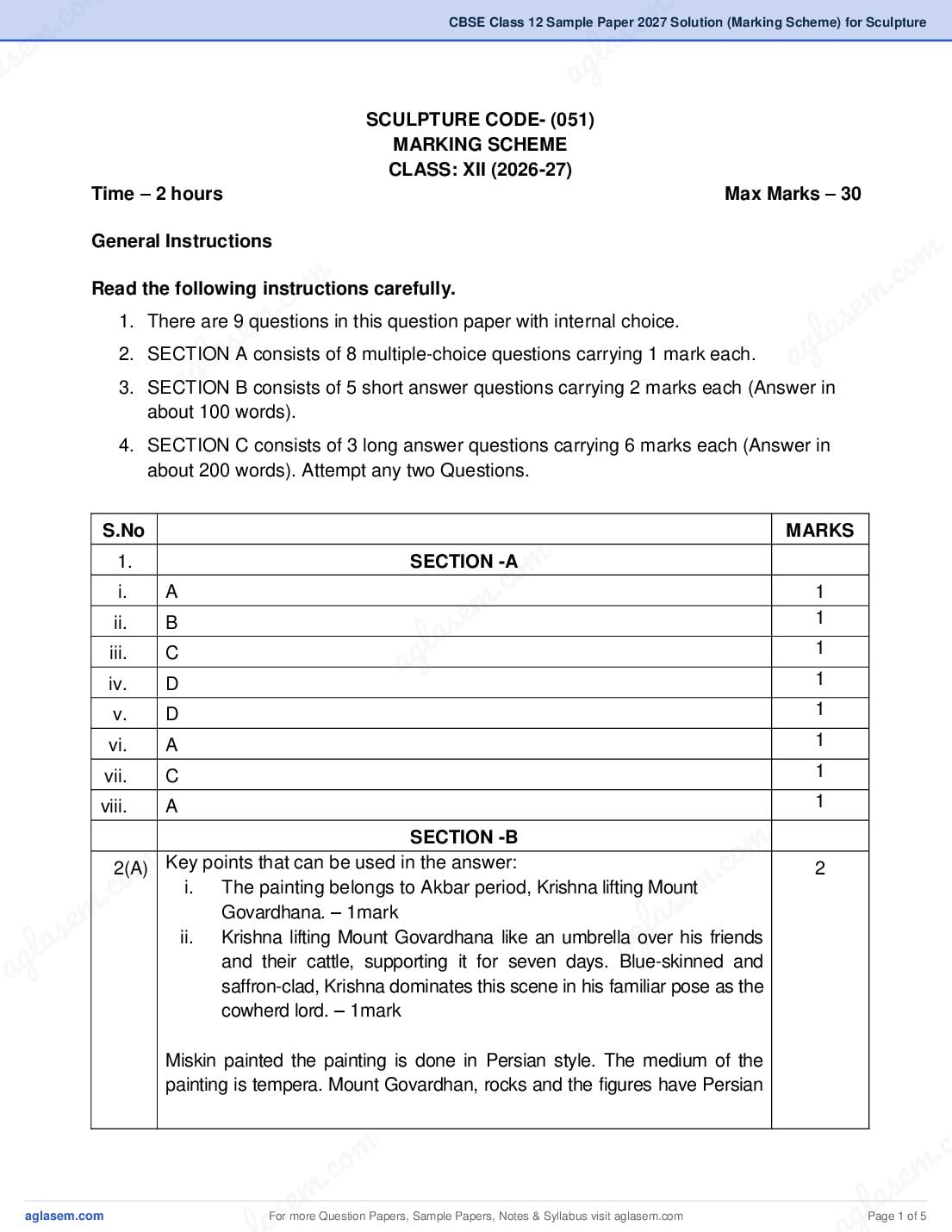
SCULPTURE CODE- (051)
MARKING SCHEME
CLASS: XII (2026-27)
Time – 2 hours Max Marks – 30
m
General Instructions
m . c o
c o
Read the following instructions
.
carefully.
e m
e m
1. There are 9 questions in this question paper with internal choice.
2. SECTION
lasA consists of 8 multiple-choice questions carrying 1 mark each. ag
g
a B consists of 5 short answer questions carrying 2 marks each (Answer in
3. SECTION
about 100 words).
4. SECTION C consists of 3 long answer questions carrying 6 marks each (Answer in
about 200 words). Attempt any two Questions.
S.No MARKS
m
.co
1. SECTION -A
em
i. A 1
ii. B
l as 1
ag
iii. C 1
iv. D 1
v. D 1
vi. A 1
vii. C 1
viii. A 1
SECTION -B
m
c. o
m
2(A) Key points that can be used in the answer:
m.co 2
m
i. The painting belongs to Akbar period, Krishna lifting Mount
s e
s e Govardhana. – 1mark
g la
g la ii. Krishna lifting Mount Govardhana like an umbrella over his friends
a
a and their cattle, supporting it for seven days. Blue-skinned and
saffron-clad, Krishna dominates this scene in his familiar pose as the
cowherd lord. – 1mark
Miskin painted the painting is done in Persian style. The medium of the
painting is tempera. Mount Govardhan, rocks and the figures have Persian
m . c
c. o s e m
s em
Page 1 of 5
Page 3
evident in the painting.
OR
2(B) Chand bibi playing polo - Medium of painting - Water colour with 2
Tempera. Sub-school. Foreground- background/ The settings is a
garden/ polo ground. Drawn on Persian, Turkish and local visual
traditions/ Local Deccan Indian plateau influences, compositional idiom,
combining elements, Persian, Turkish decorative sensibility, local Colour
pallet, Visual forms resonate with Islamic- Persian metaphors, rooted in
Indian spatial, cultural context, symbolism, spiritual and devotional,
reflects the cosmopolitan culture of Deccan. -2marks
3(A) Key points that can be used in the answer: 2
i. Title of the painting- Krishna on swings. The painting belongs to the
Rajasthani school, Bikaner sub school. Artist – Nuruddin, medium
water/ Tempera - 1 mark
ii. It’s a vertical painting divided into two panel which gives a single
painting illusion. Divided by two hills. Upper panel- Krishna on swing
in orange dhoti and crown, picture in bluish hue. Other side
balcony/architecture, Radha watching from balcony. Lower panel-
Garden/natural settings, tree, foliage, Krishna Radha seated
separately. The artistic form used to divide the two parts is a
horizontal architectural or ground line element. - 1mark
OR
3(B) Sub school- Rajasthani/ Mewar sub school, artist- Sahibdin, Water 2
Colour/ Tempera, represent romantic legends, little shorter figure
proportion, side profile /Ek chasm, flat basic warm and flat Colour, bold
lines resonate with manuscripts. The painting “Maru ragini” classifies
Maru as the ragini of Raga Shri and describes her physical beauty and
its effect on her beloved. -2marks
4(A) Key points that can be used in the answer: 2
Nihal Chand – Rajasthani /Kishangarh school, developed his own
style by Elongated facial features like large eyes, pointed chin, long
half close eyes, arched eyebrows. The painting “Bani-Thani made by
Nihal Chand which belongs to Kishangarh sub school. Portrait of
Radha, sharp elongated feature, use of lotus bud, exaggerated
feminine beauty, transparent dupatta, traditional heavy jewellery.
Radha’s face in Bani Thani as Radha is unique in her deeply curved
eyes, exaggerated arch of the eyebrows, pointed nose, serpentine curl
of hair spiralling down the cheek, thin lips and pronounced chin and
lotus shaped hands. -2marks
OR
For more Question Papers, Sample Papers, Notes & Syllabus visit Page 2 of 5
Page 4
.co s e m
s em l a
a ag
4(B) Key points that can be used in the answer: 2
i. Painting name Krishna with Gopis done by Manaku. Medium is
water Colour, technique Tempera. -1mark
ii. Use of expressive rhythmic line to evoke motion, use of vibrant
contrast Colour help differentiate figure which creates the sense of
movement, kinetic posture of the figures. -1mark
m
om
5(A) Key points that can be used in the answer: 2
. co
i.
. c
This is an open air large-scale sculpture in bronze made by Debi
em
em
Prasad Roy Chowdhury (1899–1975). It was installed at Marina
Beach, Chennai, on the eve of the Republic Day in 1959.
ag
ag
ii. It shows four men trying to move a rock, rendering the importance
and contribution of human labour in nation building.
Unconquerable men are wrestling with nature, doggedly,
indeterminately and powerfully. It is an image of labour against the
elements of nature, a well-known romantic subject of the
nineteenth century. Chowdhury loved to dwell on the strong
musculature of his workers, revealing their bones, veins, flesh, etc.
OR
5(B)
m
.co
i. Point to be elaborated- i) Print name- Children, artists name- 2
m
Somnath Hore -1mark
s e
ii. Depiction of family, mother, children, distorted/skeletal
l a
ag
physiognomy- visible bones, large head, hollow cheeks,
composition and closeness suggests confinement, helplessness,
powerlessness, empathy, pity, and moral outrage. -1mark
6(A) Key points that can be used in the answer: 2
i. This is a gouache painting on paper made by Jamini Roy (1887–
1972) in 1940. He was called the father of the folk renaissance in
India1mark
ii. He used expressive power of folk lines and rendered with bold
simplifications and thick outlines with sweeping brush strokes–
m
m 1mark
.co
m .co OR
s e m
s e 6(B) Key points that can be used in the answer:
g la 2
g la The sculpture in bronze made by Amarnath Sahgal in 1958. Although the
a
a artist only uses abstraction, in which three figures are stick-like and
shown in flat rhythmical planes, yet it is easy to understand them as a
family—husband, wife and child. They are shown flinging their arms
above and crying out for help in vain. Through the medium of sculpture,
their helplessness expressed by the hand gesture is turned into a
permanent shape. It is possible for us to read this work as socialist,
whereby, the artist pays homage to millions of destitute families in need
m . c
c. o s e m
s em
Page 3 of 5
Page 5
Raj Anand, wrote movingly about this work, which now is in the collection
of the National Gallery of Modern Art, New Delhi. – 2marks
SECTION-C
Attempt any two questions from the given options
7. Key points that can be used in the answer: 6
Point to be elaborated-
Introduction of Bengal school, time period and origin. made
posters, first image of Bharat Mata, illustrations for weekly
magazines and newspapers for freedom fighting movement.
Boycotted western medium and style for their painting and
explored Indian style and techniques for their art work.
Works like journey’s end, Mother and child, Radhika, Shiv and
Sati, Mother India.
8. Key points that can be used in the answer: 3+3
Chaugan Player:
i. This painting, depictis a princess playing Polo (Chaugan) with
companions, by artist Dana represents Jodhpur painting of Man
Singh’s reign. It may or may not be from the main court as it
betrays stylistic influence of many schools, such as Mughal in the
way women are depicted, Deccani in the way horses are depicted,
Bundi and Kishangarh in the depiction of facial features, and the
flat green background is suggestive of the indigenous preference
for flat surfaces. The painting is inscribed with a line on the upper
portion that is translated as, “beautiful maidens on horsebacks,
playing”. The painting was made in 1810 and is in the collection of
National Museum, New Delhi.
Bharat meets Rama:
ii. This painting of Ramayana by Guman, made between 1740 and
1750, is a classic example of a continuous narrative. Plain looking
huts (parna kutir) raised with basic material, such as mud, wood
and green leaves set in the woods on the foothills and surrounded
by groves establish a typical rural setting, where this episode of
Ramayana unfolds. Artist Guman begins the narrative from the left
and ends it on the right. Set in Chitrakut, the story in the painting
begins with the three mothers along with the wives of the princes
proceeding towards the thatched dwellings. On seeing the
mothers, Rama, Lakshmana and Sita bow down in reverence.
Bereaved kaushalya rushes to her son Rama and gathers him in
her arms. Rama is, then, seen respectfully greeting the other two
For more Question Papers, Sample Papers, Notes & Syllabus visit Page 4 of 5
Page 6
.co s e m
s em l a
a ag
mothers—Sumitra and Kaikeyi. He, then, dutifully acknowledges
the two sages and sits down talking to them. When the sage
breaks the news of Dashratha’s death, Rama is seen collapsing in
anguish. Sumanta is seen devotedly standing behind the sages.
The three mothers and the wives of Lakshmana, Bharat and
Shatrughana are depicted talking to Sita. The narrative ends with
m
om
the group exiting the picture frame on the right. Each character of
. co
. c
the story in the painting is labeled. A verse, describing the same,
em
em
is also inscribed on the upper portion of the painting. This painting
l a s
is in the collection of National Museum, New Delhi. g
a2+2+2
9.
a g
Key points that can be used in the answer:
Point to be elaborated-
i. The Ganesha, Artist- P.V. Jankiram. Medium- beaten copper
sheets and the technique- repousse, popular among traditional
craftsman of South India. Bend of traditional and modern, Concave
convex shapes used, copper wire, soldering, enamelling,
Ganesha’s six hands, Gada, conch, veena etc. Harmony, peace
and spiritualism
m
Description:
m .co
ii.
s e
This is a sculpture in oxidised copper made by P. V. Janakiram in
l a
1970, and is in the collection of NGMA, Delhi. He has used sheets
ag
of copper to create pictorial sculpture as free-standing forms, and
ornamented their surface with linear elements. Metal sheets are
beaten into concave planes on which are welded linear details.
These linear elements work as facial features and decorative
motifs to suggest religious icons, inviting intimate contemplation.
Janakiram is influenced by the ancient temple sculpture of South
India. The image of Ganesha, crafted frontally, lends an important
indigenous character of cave and temple sculpture.
m
m iii. In this sculpture, Ganesha is palying vina, a musical instrument.
.co
m .co Details on the sculpture and technical blending of material,
s e m
s e nevertheless, reveal his meticulous craftsmanship. He also
g la
g la experimented with the ‘openendedness’ quality of indigenous
a
a workmanship. Ganesha reveals his understanding of traditional
imagery. He has elaborated linear details into overall form. The
sculpture is conceived in terms of linear silhouettes instead of
emphasis on three-dimensionality, despite its volume. Rhythm and
growth are incorporated through lyrical stylisation. It is also an
amalgamation of folk and traditional craftsmanship.
m . c
c. o s e m
s em
Page 5 of 5
Document Details
| Board / Org | CBSE |
| Exam | Class 12 |
| Type | Solution |
| Pages | 5 |
| Updated | 29 Oct 2026 |