CBSE Class 12 Sample Paper 2027 Solution (Marking Scheme) for Sociology
Finished viewing? Save it for later —
Download CBSE Class 12 Sample Paper 2027 Solution (Marking Scheme) for Sociology (PDF · 4 pages)About CBSE Class 12 Sample Paper 2027 Solution (Marking Scheme) for Sociology
CBSE Class 12 Sample Paper 2027 Solution (Marking Scheme) for Sociology is available here for free download. Published by CBSE for Class 12, this solution can be viewed online or downloaded as a PDF (4 pages). Candidates preparing for Class 12 can use CBSE Class 12 Sample Paper 2027 Solution (Marking Scheme) for Sociology to understand the exam pattern, the type of questions asked, and the overall difficulty level.
Frequently Asked Questions
How can I download CBSE Class 12 Sample Paper 2027 Solution (Marking Scheme) for Sociology?
Open this page and click the Download button to save CBSE Class 12 Sample Paper 2027 Solution (Marking Scheme) for Sociology as a PDF. It is completely free on AglaSem Docs.
Is CBSE Class 12 Sample Paper 2027 Solution (Marking Scheme) for Sociology free to download?
Yes. CBSE Class 12 Sample Paper 2027 Solution (Marking Scheme) for Sociology can be viewed online and downloaded as a PDF free of cost on AglaSem Docs.
How many pages does CBSE Class 12 Sample Paper 2027 Solution (Marking Scheme) for Sociology have?
CBSE Class 12 Sample Paper 2027 Solution (Marking Scheme) for Sociology contains 4 pages, which you can read online or download together as a single PDF.
Where can I find more Class 12 study material?
You can find more Class 12 question papers, sample papers, syllabus, and answer keys on AglaSem Docs.
CBSE Class 12 Sample Paper 2027 Solution (Marking Scheme) for Sociology – Text
Read the full text of this solution below — useful to quickly search, copy and reference the content online without downloading the PDF.
📄 View text version (5 pages)
Page 1
CBSE Class 12 Sample
Paper 2027 Solution
(Marking Scheme) for
Sociology
EXAM YEAR TYPE SUBJECT
CBSE Class 12 2027 Solutions Sociology
Notes · Sample Papers · Previous Year Papers · Mock Tests
Page 2
m .co
m .co SOCIOLOGY (039)
s e m
se
MARKING SCHEME
g l a
CLASS XII - 2026-27
a
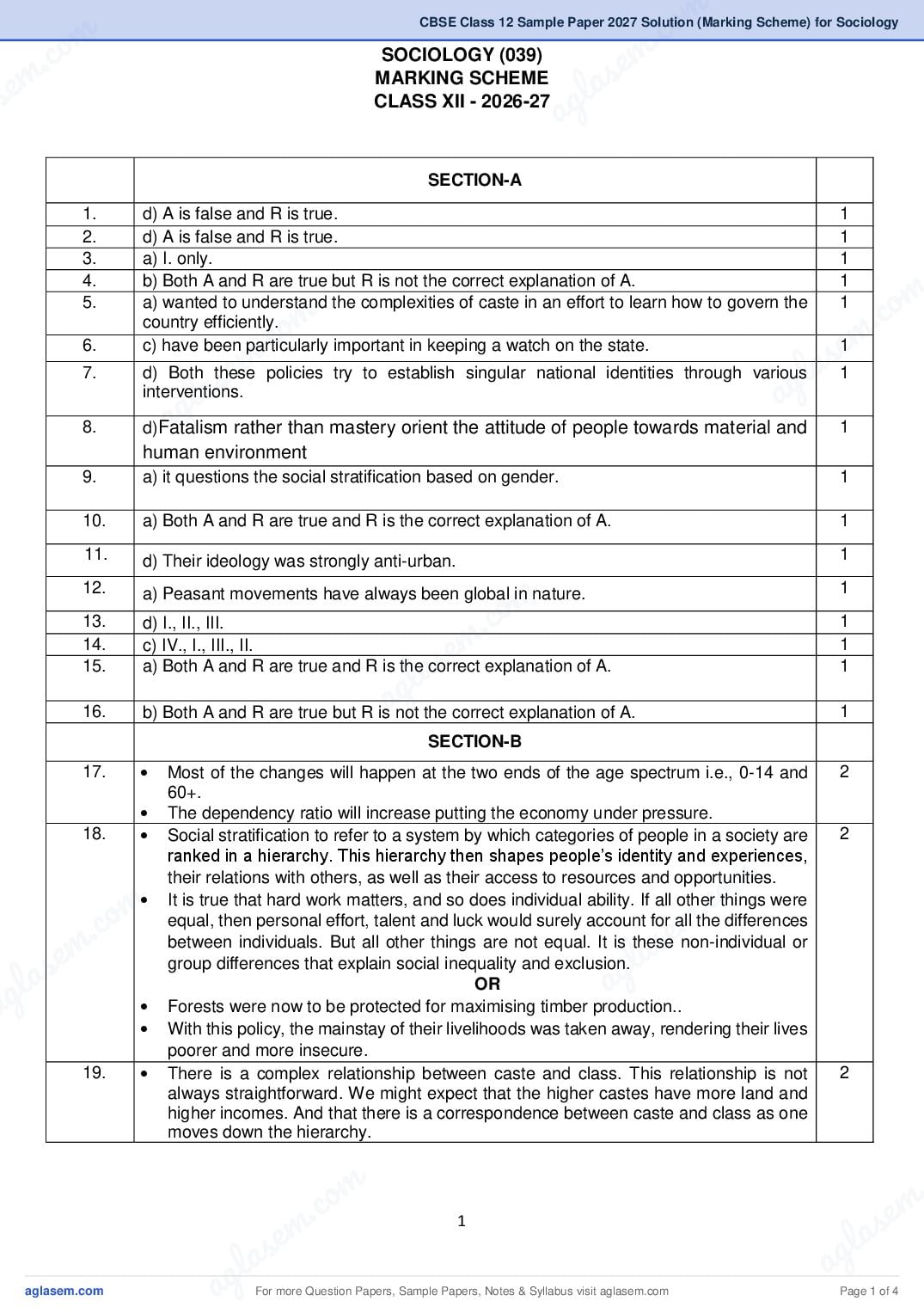
SECTION-A
1. d) A is false and R is true. 1
2. d) A is false and R is true. 1
3. a) I. only. 1
m
4. b) Both A and R are true but R is not the correct explanation of A. 1
m .co
5. a) wanted to understand the complexities of caste in an effort to learn how to govern the 1
.co m
country efficiently.
6. c) have been particularly important in keeping a watch on the state. e
m policies try to establish singular national identities through variouslas1
1
7.
s
d) Both thesee g
l a
interventions.
a
8. ag rather than mastery orient the attitude of people towards material and 1
d)Fatalism
human environment
9. a) it questions the social stratification based on gender. 1
10. a) Both A and R are true and R is the correct explanation of A. 1
11. d) Their ideology was strongly anti-urban. 1
om
12. a) Peasant movements have always been global in nature. 1
13. d) I., II., III. . c 1
14.
e m 1
s
c) IV., I., III., II.
la
15. a) Both A and R are true and R is the correct explanation of A. 1
16.
g
b) Both A and R are true but R isanot the correct explanation of A. 1
SECTION-B
17. Most of the changes will happen at the two ends of the age spectrum i.e., 0-14 and 2
60+.
The dependency ratio will increase putting the economy under pressure.
18. Social stratification to refer to a system by which categories of people in a society are 2
ranked in a hierarchy. This hierarchy then shapes people’s identity and experiences,
m
.co
their relations with others, as well as their access to resources and opportunities.
m It is true that hard work matters, and so does individual ability. If all other things were
m .co e
equal, then personal effort, talent and luck would surely account for all the differences
s
m
s e g l a
between individuals. But all other things are not equal. It is these non-individual or
la
group differences that explain social inequality and exclusion.
g OR a
a
Forests were now to be protected for maximising timber production..
With this policy, the mainstay of their livelihoods was taken away, rendering their lives
poorer and more insecure.
19. There is a complex relationship between caste and class. This relationship is not 2
always straightforward. We might expect that the higher castes have more land and
higher incomes. And that there is a correspondence between caste and class as one
moves down the hierarchy.
m .
.co s e m
em a
1
s l
l a ag
ag For more Question Papers, Sample Papers, Notes & Syllabus visit Page 1 of 4
Page 3
highest caste, the Brahmins, are not major landowners, and so they fall outside the
agrarian structure although they are a part of rural society.
20. Questions like — Who am I? How am I different from others? How do others 2
understand and comprehend me? What goals and aspirations should I have? –
constantly crop up in our life right from childhood. We are able to answer many of
these questions because of the way in which we are socialised, or taught how to live
in society by our immediate families and our community in various senses.
The socialisation process involves a continuous dialogue, negotiation and even
struggle against significant others (those directly involved in our lives) like our parents,
family, kin group and our community. Our community provides us the language (our
mother tongue) and the cultural values through which we comprehend the world. It
also anchors our self-identity.
21. Prejudices refer to pre-conceived opinions or attitudes held by members of one group 2
towards another. These are often grounded in stereotypes which are fixed
characterisations about a group of people.
Discrimination refers to actual behaviour based on prejudice rising from stereotypes
towards another group or individual.
22. “State nation”, where various “nations” can co-exist peacefully and cooperatively in a 2
single state polity.
Citizens can find the institutional and political space to identify with both their country
and their other cultural identities, to build their trust in common institutions and to
participate in and support democratic politics. All of these are key factors in
consolidating and deepening democracies and building enduring “state-nations”.
OR
privileged minorities such as extremely wealthy people are not usually referred to as
minorities.
The sociological sense of minority implies that the members of the minority form a
collectivity – that is, they have a strong sense of group solidarity, a feeling of
togetherness and belonging. This is linked to disadvantage because the experience
of being subjected to prejudice and discrimination usually heightens feelings of intra-
group loyalty and interests.
23. For most of us who are born and live in India, social inequality and exclusion are facts 2
of life.
This everydayness of social inequality and exclusion often make them appear
inevitable, almost natural. If we do sometimes recognise that inequality and exclusion
are not inevitable, we often think of them as being ‘deserved’ or ‘justified’ in some
sense.
It is believed that the marginalised haven’t worked hard or lack in ability.
24. urbanisation, 2
the loss of face-to-face relationships that were found in rural areas where people
worked on their own farms or for a landlord they knew, and their substitution by
anonymous professional relationships in modern factories and workplaces.
Industrialisation involves a detailed division of labour.
People often do not see the end result of their work because they are producing only
one small part of a product.
The work is often repetitive and exhausting. Marx called this situation alienation, when
people do not enjoy work, and see it as something they have to do only in order to
survive, and even that survival depends on whether the technology has room for any
human labour.
(Any 2 features.)
25. Social movements were seen as forces that led to disorder. 2
Scholars were concerned about how social structures enable social integration.
Scholars believe that the protestors had their own shared understanding of right and
wrong that informed their actions.
2
For more Question Papers, Sample Papers, Notes & Syllabus visit Page 2 of 4
Page 4
m .co
c. o 26. SECTION-C
s e m
m a
se
government promoted modern methods of cultivation and attempted to modernise the
l
4
rural economy through other strategies.
ag
The state invested in the development of rural infrastructure, such as irrigation
facilities, roads and electricity.
the provision of agricultural inputs, including credit through banks and cooperatives.
For regular agricultural growth, uninterrupted power supply to rural India is one of the
necessities. The ‘Deen Dayal Upadhyaya Gram Jyoti Yojna’ was launched in 2014.
OR
in some regions such as Punjab and Karnataka, farmers enter into contracts with
multinational companies (such as PepsiCo) to grow certain crops.
the government has scaled down its agricultural development programmes, and
m
.co
‘agricultural extension’ agents have been replaced in the villages by agents of seed,
m
.co m
fertiliser and pesticide companies.
entry of multinationals into this sector as sellers of agricultural inputs such as seeds,
m s e
e
pesticides and fertilisers.
s l a
a ag
This has led to the increased dependence of farmers on expensive fertilisers and
g l
pesticides, which has reduced their profits, put many farmers into debt, and also
acreated an ecological crisis in rural areas.
(Any other relevant point.)
27. Modern industry created all kinds of new jobs for which there were no caste rules. 4
Urbanisation and the conditions of collective living in the cities made it difficult for the
caste-segregated patterns of social interaction to survive.
modern educated Indians attracted to the liberal ideas of individualism and
meritocracy, began to abandon the more extreme caste practices.
it was remarkable how resilient caste proved to be. Recruitment to industrial jobs,
whether in the textile mills of Mumbai (then Bombay), the jute mills of Kolkata (then
m
.co
Calcutta), or elsewhere, continued to be organised along caste and kinship-based
lines.
e m
it was in the cultural and domestic spheres that caste has proved strongest.
las
Endogamy, or the practice of marrying within the caste, remained largely.
28. commitment to practices of pluralism,
institutional accommodation ag 4
conflict resolution through democratic means.
Critical for building a multicultural democracy is a recognition of the shortcomings of
historical nation-building exercises.
Recognition of the benefits of multiple and complementary identities.
Also important are efforts to build the loyalties of all groups in society through
identification, trust and support
29. parliamentary and a legal system, 4
a police and educational system built very much on the British model.
m
.co
We drive on the left side of the road like the British.
m
.co
We have ‘cutlets’ in the menu offered in many roadside eateries and canteens.
e m
em
A very popular manufacturer of biscuits, is actually named after Britain.
Many school uniforms include neck-ties.
l as
s
la 30. (Any 4)
ag
ag a) exaggerating social mobility.
b) justifies a model that rests on inequality and exclusion.
4
c) since Sanskritization results in the adoption of upper caste rites and rituals, it leads to
practices of secluding girls and women, adopting dowry practices instead of bride-price
and practising caste discrimination against other groups, etc.
d) erosion of Dalit culture.
e) ideology of Sanskritization accepts the ways of the ‘upper caste’ as superior and
that of the ‘lower caste’ as inferior.
(Any four)
m .
.co s e m
em a
3
s l
l a ag
ag For more Question Papers, Sample Papers, Notes & Syllabus visit Page 3 of 4
Page 5
areas.
They do not have any rights.
Not paid the minimum wage.
Wealthy farmers prefer to employ migrant workers because they are easily exploited.
32. National development involved the building of large dams, factories and mines. 4
Because the tribal areas were located in mineral rich and forest covered parts of the
country, tribals have paid a disproportionate price for the development of the rest of
Indian society. This kind of development has benefited the mainstream at the expense
of the tribes.
Forests started to be systematically exploited in British times and the trend continued
after independence.
The coming of private property in land has also adversely affected tribals, whose
community-based forms of collective ownership were placed at a disadvantage.
Many tribal concentration regions and states have also been experiencing the problem
of heavy in-migration of non-tribals in response to the pressures of development. This
threatens to disrupt and overwhelm tribal communities and cultures, besides
accelerating the process of exploitation of tribals. The industrial areas of Jharkhand
for example have suffered a dilution of the tribal share of population.
SECTION-D
33. a These pyramids show the effect of a gradual fall in the birth rate and rise in life expectancy 2
and provide a much more detailed version of age grouped data. This gives a visual sense
of the age structure of the population.
b UP has high number of dependents vis-à-vis Kerala. 2
Kerala experiences a clear demographic window of opportunity.
(Any other relevant point.)
c Low dependency ratio due to the age structure results in better economic gains. 2
Growing labour force can deliver unexpected benefits in terms of growth and
prosperity.
34. Contractor system. (Elaborate on this.) 6
Importance of jobber system has declined and management and union play an
important role in recruitment.
Badli workers substitute for regular permanent workers who are on leave but they are
not given the same status and security.
Employment opportunities have two components – job in an organization as a casual
wage labourer or regular salaried; and self-employment.
Govt. Schemes-‘MUDRA’ and ‘Aatmanirbhar Bharat’.
These are schemes floated to generate employment and self-employment to support
all sections including the marginalized sections of society.
35. a Campaign against sati by Dharma Sabha. 2
When reformers demanded education for girls, many protested.
(Any other relevant example.)
b Goes against entrenched interests and values.
There is bound to be opposition and resistance. But over a period of time, changes do 2
take place.
c Candle and torch light procession.
Use of black cloth. 2
(Any other relevant example.)
4
For more Question Papers, Sample Papers, Notes & Syllabus visit Page 4 of 4
Document Details
| Board / Org | CBSE |
| Exam | Class 12 |
| Type | Solution |
| Pages | 4 |
| Updated | 29 Oct 2026 |