CBSE Class 12 Question Paper 2025 Solution Psychology
Finished viewing? Save it for later —
Download CBSE Class 12 Question Paper 2025 Solution Psychology (PDF · 11 pages)About CBSE Class 12 Question Paper 2025 Solution Psychology
CBSE Class 12 Question Paper 2025 Solution Psychology is available here for free download. Published by CBSE for Class 12, this solution can be viewed online or downloaded as a PDF (11 pages). Candidates preparing for Class 12 can use CBSE Class 12 Question Paper 2025 Solution Psychology to understand the exam pattern, the type of questions asked, and the overall difficulty level.
Frequently Asked Questions
How can I download CBSE Class 12 Question Paper 2025 Solution Psychology?
Open this page and click the Download button to save CBSE Class 12 Question Paper 2025 Solution Psychology as a PDF. It is completely free on AglaSem Docs.
Is CBSE Class 12 Question Paper 2025 Solution Psychology free to download?
Yes. CBSE Class 12 Question Paper 2025 Solution Psychology can be viewed online and downloaded as a PDF free of cost on AglaSem Docs.
How many pages does CBSE Class 12 Question Paper 2025 Solution Psychology have?
CBSE Class 12 Question Paper 2025 Solution Psychology contains 11 pages, which you can read online or download together as a single PDF.
Where can I find more Class 12 study material?
You can find more Class 12 question papers, sample papers, syllabus, and answer keys on AglaSem Docs.
CBSE Class 12 Question Paper 2025 Solution Psychology – Text
Read the full text of this solution below — useful to quickly search, copy and reference the content online without downloading the PDF.
📄 View text version (11 pages)
Page 1
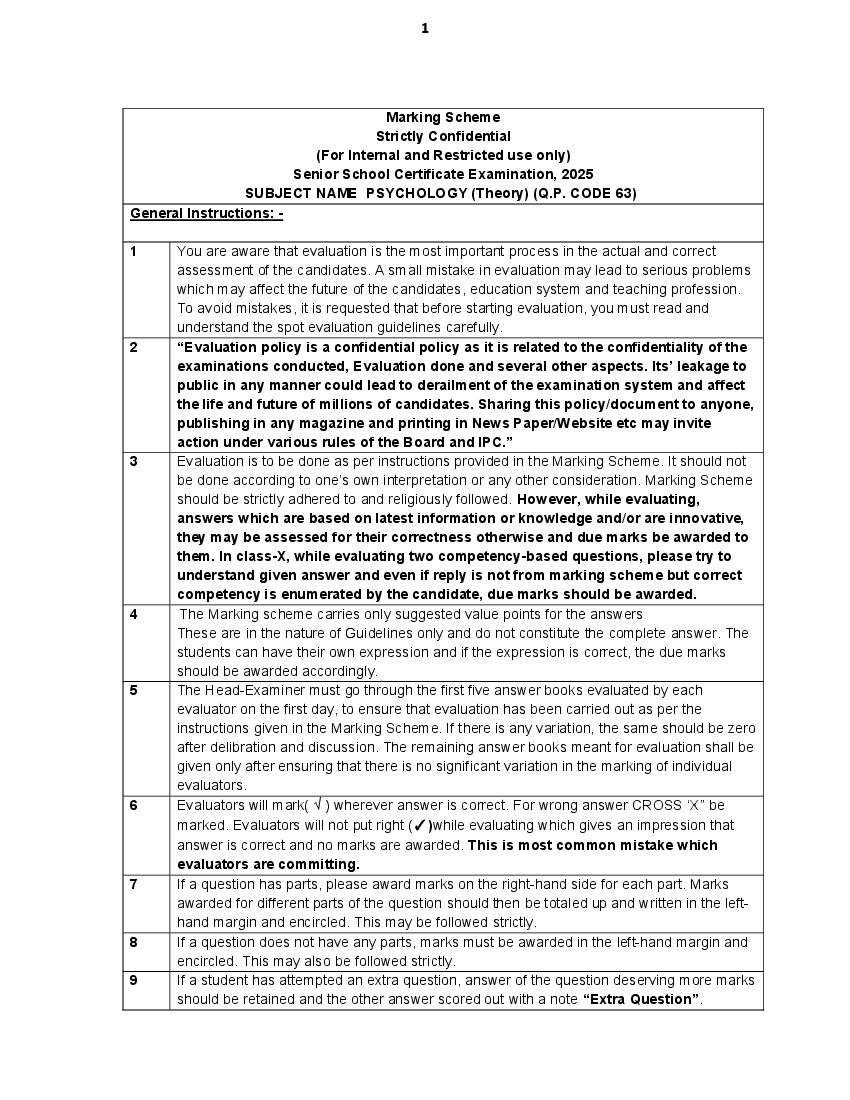
Marking Scheme
Strictly Confidential
(For Internal and Restricted use only)
Senior School Certificate Examination, 2025
SUBJECT NAME PSYCHOLOGY (Theory) (Q.P. CODE 63)
General Instructions: -
1 You are aware that evaluation is the most important process in the actual and correct
assessment of the candidates. A small mistake in evaluation may lead to serious problems
which may affect the future of the candidates, education system and teaching profession.
To avoid mistakes, it is requested that before starting evaluation, you must read and
understand the spot evaluation guidelines carefully.
2 “Evaluation policy is a confidential policy as it is related to the confidentiality of the
examinations conducted, Evaluation done and several other aspects. Its’ leakage to
public in any manner could lead to derailment of the examination system and affect
the life and future of millions of candidates. Sharing this policy/document to anyone,
publishing in any magazine and printing in News Paper/Website etc may invite
action under various rules of the Board and IPC.”
3 Evaluation is to be done as per instructions provided in the Marking Scheme. It should not
be done according to one’s own interpretation or any other consideration. Marking Scheme
should be strictly adhered to and religiously followed. However, while evaluating,
answers which are based on latest information or knowledge and/or are innovative,
they may be assessed for their correctness otherwise and due marks be awarded to
them. In class-X, while evaluating two competency-based questions, please try to
understand given answer and even if reply is not from marking scheme but correct
competency is enumerated by the candidate, due marks should be awarded.
4 The Marking scheme carries only suggested value points for the answers
These are in the nature of Guidelines only and do not constitute the complete answer. The
students can have their own expression and if the expression is correct, the due marks
should be awarded accordingly.
5 The Head-Examiner must go through the first five answer books evaluated by each
evaluator on the first day, to ensure that evaluation has been carried out as per the
instructions given in the Marking Scheme. If there is any variation, the same should be zero
after delibration and discussion. The remaining answer books meant for evaluation shall be
given only after ensuring that there is no significant variation in the marking of individual
evaluators.
6 Evaluators will mark( √ ) wherever answer is correct. For wrong answer CROSS ‘X” be
marked. Evaluators will not put right (✓)while evaluating which gives an impression that
answer is correct and no marks are awarded. This is most common mistake which
evaluators are committing.
7 If a question has parts, please award marks on the right-hand side for each part. Marks
awarded for different parts of the question should then be totaled up and written in the left-
hand margin and encircled. This may be followed strictly.
8 If a question does not have any parts, marks must be awarded in the left-hand margin and
encircled. This may also be followed strictly.
9 If a student has attempted an extra question, answer of the question deserving more marks
should be retained and the other answer scored out with a note “Extra Question”.
Page 2
10 No marks to be deducted for the cumulative effect of an error. It should be penalized only
once
11 A full scale of marks __________(example 0 to 80/70/60/50/40/30 marks as given in
Question Paper) has to be used. Please do not hesitate to award full marks if the answer
deserves it.
12 Every examiner has to necessarily do evaluation work for full working hours i.e., 8 hours
every day and evaluate 20 answer books per day in main subjects and 25 answer books
per day in other subjects (Details are given in Spot Guidelines).This is in view of the
reduced syllabus and number of questions in question paper.
13 Ensure that you do not make the following common types of errors committed by the
Examiner in the past:-
● Leaving answer or part thereof unassessed in an answer book.
● Giving more marks for an answer than assigned to it.
● Wrong totaling of marks awarded on an answer.
● Wrong transfer of marks from the inside pages of the answer book to the title page.
● Wrong question wise totaling on the title page.
● Wrong totaling of marks of the two columns on the title page.
● Wrong grand total.
● Marks in words and figures not tallying/not same.
● Wrong transfer of marks from the answer book to online award list.
● Answers marked as correct, but marks not awarded. (Ensure that the right tick mark is
correctly and clearly indicated. It should merely be a line. Same is with the X for
incorrect answer.)
● Half or a part of answer marked correct and the rest as wrong, but no marks awarded.
14 While evaluating the answer books if the answer is found to be totally incorrect, it should be
marked as cross (X) and awarded zero (0)Marks.
15 Any unassessed portion, non-carrying over of marks to the title page, or totaling error
detected by the candidate shall damage the prestige of all the personnel engaged in the
evaluation work as also of the Board. Hence, in order to uphold the prestige of all
concerned, it is again reiterated that the instructions be followed meticulously and
judiciously.
16 The Examiners should acquaint themselves with the guidelines given in the “Guidelines
for Spot Evaluation” before starting the actual evaluation.
17 Every Examiner shall also ensure that all the answers are evaluated, marks carried over to
the title page, correctly totaled and written in figures and words.
18 The candidates are entitled to obtain photocopy of the Answer Book on request on
payment of the prescribed processing fee. All Examiners/Additional Head Examiners/Head
Examiners are once again reminded that they must ensure that evaluation is carried out
strictly as per value points for each answer as given in the Marking Scheme.
Page 3
PSYCHOLGY (037)
PAPER CODE 63 (SET- 4)
MARKING SCHEME
2024-25
Q.NO NCERT BOOK DISTRIBU
PAGE NO TION OF
REFERENCE MARKS
SECTION - A
Q1 (C) Level I, associative learning Pg 6, Ch1 1
Q2 (B) 1-III, 2-II, 3-I, 4-IV Pg 10, Ch 1 1
Q3 (D) Social desirability Pg 43, Ch 2 1
Q4 (A) Divergent Pg 20, Ch 1 1
Q5 (C) The concepts are well defined and easily submitted to Pg 38, Ch 2 1
scientific testing.
Q6 (A) Both Assertion (A) and Reason (R) are true, and Reason Pg 4, Ch 1 1
(R) is the correct explanation of Assertion (A).
Q7 (C) Impaired immune response due to stress Pg 60, Ch 3 1
Q8 (D) Affective, Behavioural and Cognitive Pg 105, Ch 6 1
Q9 (C) Community social workers and doctors talking to people Pg 114, Ch 6 1
directly
Q10 (C) The polarisation of attention and shared emotions among Pg 123, Ch 7 1
the audience
Q11 (B) Mesomorphs – Strong musculature, strong body build, Pg 31, Ch 2 1
rectangular, energetic, courageous
Q12 (B) Encouraging frequent, informal interactions among Pg 126, Ch 7 1
members
Q13 (B) Overgeneralisation Pg 75, Ch 4 1
Q14 (C) Societal norms are derived from society’s culture, Pg 71, Ch 4 1
including its history, values and institutions and these
norms can change over time.
SECTION – B
Q15 (With reference to Neeraj) Pg 12-13, Ch 1 1+1=2
Gifted children show early signs of intellectual superiority.
Even during infancy and early childhood, they show larger
attention span, good recognition memory, preference for
novelty, sensitivity to environmental changes, and early
appearance of language skills.
To equate giftedness with brilliant academic performance
Page 4
is not correct. Athletes who show superior psychomotor
ability are also gifted. Each gifted student possesses
different strengths, personalities and characteristics.
OR
(Above points or any other relevant points on giftedness
or any other valid/connected theory of intelligence)
Q16(a) A simple attitude system contains only one or a few (Pg 107, Ch 6) (1½
attitudes, such as attitude towards a person. +
Complex attitude is made of many attitudes. For example
attitude towards health and well-being consists of several
‘member’ attitudes, such as one’s concept of physical and
mental health views about happiness and well-being and
beliefs about how one should achieve health and
happiness.
Example ½
OR =2
(b) In the early years of life, parents and other family members Pg 108, Ch 6 1+1=2
play a significant role in shaping attitude formation. Later, the
school environment becomes an important background for
attitude formation. Learning of attitudes within the family and
school usually takes place by association, through rewards and
punishments, and through modelling.
Q17 Social loafing may be reduced by: Pg 128, Ch 7 1+1=2
Making the efforts of each person identifiable.
Increasing the pressure to work hard(making group
members committed to task performance).
Increasing the apparent importance or value of a task.
Making people feel that their individual contribution is
important.
Strengthening group cohesiveness which increases the
motivation for successful group outcome/s.
(Any two points from above mentioned)
Q18 Assertiveness is a behaviour or skill that helps to Pg 64, Ch 3 1+1=2
communicate, clearly and confidently, our feelings, needs,
wants, and thoughts.
It is the ability to say no to a request, to state an opinion
without being self conscious, or to express emotions such
Page 5
as love, anger, etc. openly.
If you are assertive, you feel confident, and have high self-
esteem and a solid sense of your own identity.
(Any two from the above mentioned points)
Q19 When people have common motives and goals, they get Pg 126, Ch 7 1+1=2
together and form a group.
Any relevant example
SECTION – C
Q20 Stress resistant personality / hardiness by Kobasa – Pg 63, Ch 3 1+1+1 =3
Explain.
3C’s – control, commitment and challenge.
Commitment – to work, family, hobbies and social life.
Control – which is a sense of purpose and direction in life.
Challenge – see changes in life as normal and positive.
(Any three points of the above)
Note: If the student is able to evaluate the clients ability to
manage stress effectively using any model or theory,
should be awarded marks accordingly.
Q21 Age of Reason & Enlightenment as the scientific method Pg 72-73, Ch 4 1+1+1=3
replaced faith and dogma.
Contributed to Reform Movement.
Increased compassion for people who suffered from these
disorders.
Reforms of asylums initiated in Europe and America.
New inclination for deinstitutionalisation focussing on
community case.
(Any three points from above)
Q22 (a) According to Terman persons with high IQ were not Pg 19-20, Ch 1 1+1+1 =3
necessarily creative. Creative ideas could come from
persons who did not have a very high IQ.
Both high and low levels of creativity can be found in
highly intelligent children and also children of average
intelligence.
The same person can be creative as well as intelligent but
it’s not necessary that intelligent ones must be creative.
Intelligence by itself does not ensure creativity.
Page 6
Relationship between creativity and intelligence is
positive.
(Any three relevant points from above)
OR
(b) Howard Gardner proposed the theory of multiple Pg 7, Ch 1 1+1+1=3
intelligences. According to him, intelligence is not a single
entity; rather distinct types of intelligences exist.
Each of these intelligences are independent of each other.
If a person exhibits one type of intelligence, it does not
necessarily indicate being high or low on other types of
intelligences.
Different types of intelligences interact and work together
to find a solution to a problem.
There are eight types of intelligence : Spatial, linguistic,
interpersonal, intrapersonal, musical, bodily-kinesthetic,
logical-mathematical, naturalistic intelligence.
(Any three points of the above)
OR
(Any one point from above and explanation of any two 1+2=3
types of intelligences)
Q23 Kundalini Yoga Pg 101, Ch 4 1½+1½=3
Mindfulness based meditation
Cognitive-behavior therapy
Sudarshan Kriya Yoga
(Naming and justifying any one of the above)
SECTION – D (4 marks)
Q24 Comparison between Technological and Integral Pg15-17, Ch 1 2+2=4
(a) Intelligence.
Technologically advanced societies adopt child rearing
practices that foster skills of generalisation and
abstraction, speed, minimal moves, and mental
manipulation among children.
Intelligence in the Indian tradition can be termed as
integral intelligence, which gives emphasis on connectivity
with the social and world environment. Indian thinkers
view intelligence from a holistic perspective where equal
attention is paid to cognitive and non-cognitive processes
Page 7
as well as their integration.
Cultural factors:
The cultural environment provides a context for
intelligence to develop. Vygotsky, a Russian psychologist,
has argued that culture provides social context in which
people live, grow, and understand the world around them.
For example, in less technologically developed societies,
social and emotional skills in relating to people are valued,
while in technologically advanced societies, personal
achievement founded on abilities of reasoning and
judgment is considered to represent intelligence.
Four facets of integral intelligence: Cognitive. social,
emotional and entrepreneurial competence.
(Any two points from the above)
OR
(b) Characteristics of Emotionally Intelligent person which Pg 17, Ch 1 1x4=4
contribute to Manoj’s popularity as compared to Sunil-
The ability to monitor one’s own and others emotions.
To discriminate among them.
Understand the powerful influence of the nature and
intensity of your emotions.
Use this information to guide one’s thinking and actions.
(Any four of the above or any other relevant
characteristics of emotionally intelligent persons).
Q25 Four methods/processes of attitude formation Pg 107-108, 1+1+1+1=
Association Ch 7 4
Being Rewarded or Punished
Through Modelling
Through Group or Cultural Norms
Through exposure to information
(Explanation of any four points of the above)
OR
Factors influencing attitude formation: Pg 108-109,
Family and social environment Ch 7
Reference groups
Personal experiences
Page 8
Media related influences.
(Explanation of all four above points)
NOTE: As ‘methods’ term not being used in textbook, so
might confuse students thus ‘factors’ too may be
considered along with ‘process’.
Q26 Sentence Completion test: Pg 45-46, Ch 4 2+2=4
Makes use of a member of incomplete sentences. The
starting part of the sentence is presented and the subject
has to provide an ending to the sentence.
The type of ending reflects the subject’s attitudes,
motivation and conflicts.
OR
Provides subjects with several opportunities to reveal their
underlined unconscious motivations.
Sample/ example
My father …..
Draw-a-Person Test
The subject is asked to draw a person, then ask to draw
the figure of an opposite sex person. Finally he/she has to
make a story about the person as if he/she is a character
in a novel or play.
Example of interpretation.
(a) Omission of facial features suggest that the person tries to
evade a highly conflict – ridden interpersonal
relationships.
(b) Graphic emphasis on the neck suggests lack of control
over impulses.
(c) Disproportionately large head suggests organic brain
disease and preoccupation with headaches.
(Brief description of both the techniques covering all
relevant points).
Q27 Identification: Pg 76, Ch 4 (½ +½+
a) Specific Phobia 1½ +1½ =
b) Panic Disorder 4)
Any coping strategy or stress management technique
or treatment explained.
Page 9
NOTE: The second part of the question is worded as
coping instead of treatment, giving scope for interpreting
the question in different ways.
SECTION – E (6 marks)
Q28 (a) Any statement that explains Freud’s viewpoint Pg 36-37, Ch 2 1+5=6
Stages of psycho-sexual development :
1. Oral Stage
2. Anal Stage
3. Phallic Stage
4. Latency Stage
5. Genital Stage
(Explanation of all stages)
OR
(b) Introduction: Pg 39-40, Ch 2 2+2+2=6
Cultural approach attempts understand personality in
relation to the features of ecological and cultural
environment.
People develop various personality(behavioural) qualities
or an attempt to adapt to the ecological and cultural
features of a group’s life.
Economic maintenance system, climatic conditions,
nature of terrain of the habitat, availability of food etc.
Rituals, ceremonies, religious practices, arts, recreational
activities, games, plays, people’s skills, abilities,
behavioural styles and value priorities etc. are the ways
through which people’s personalities gets perfected in a
culture.
(any two points of the above)
Birhor Society (Hunting and Gathering): The Birhor of
Jharkhand live a nomadic lifestyle, moving between
forests to hunt and gather. Children are given significant
freedom to explore, learn hunting skills, and gather forest
products from an early age.
Socialization practices focus on developing independence,
autonomy, and a willingness to take risks. This approach
fosters self-relience and achievement-oriented behaviours
essential for their subsistence lifestyle.
Page 10
Agricultural Societies: In agricultural settings, children
are socialized to be obedient to elders, nurturing towards
younger siblings, and responsible for their duties. These
traits are crucial for the structured, community-focused
nature of agricultural work. As a result, obedience,
nurturance, and responsibility are emphasized,
contrasting with the independence and risk taking valued
in hunting – gathering societies.
Q29 (a) Aaron Beck’s therapy Pg 97-98, Ch 5 6
Fundamental Principle/ Irrational Belief
Explanation of core schema – Childhood experience, with
example
Negative automatic thoughts- irrational thoughts, with
example
Cognitive distortion- define or explanation – Dysfunctional
cognitive structure
Non-threatening disputation
Cognitive restructuring
OR
Rational Emotive Therapy (RET) : Developed by Albert Ellis, Pg 96-98, Ch 5 2+2+2=6
RET focuses on identifying and challenging irrational beliefs
that distort reality and cause psychological distress. Through
antecedent-belief-consequence (ABC) analysis and
nondirective questioning, RET aims to replace irrational beliefs
with rational ones, reducing negative emotions and behaviors.
Aaron Beck's Cognitive Therapy : Beck's approach centers
on identifying core schemas formed from childhood
experiences that trigger negative automatic thoughts during
critical incidents. These thoughts, marked by cognitive
distortions, lead to anxiety and depression. Therapy involves
gentle questioning to challenge and restructure dysfunctional
beliefs, aiming to alleviate psychological distress.
Cognitive Behaviour Therapy (CBT) : CBT integrates
cognitive and behavioral techniques to address psychological
distress. It takes a bio-psychosocial approach, targeting
biological, psychological, and social aspects through relaxation
techniques, cognitive restructuring, and environmental
Page 11
manipulations. CBT is effective for a range of disorders and is
known for its short-term efficacy.
Ethical issues of Psycho-therapy
(b) 1. Informed consent Pg 100, Ch 5 6
2. Confidentiality
3. Alleviating personal distress and suffering should be the goal
of all attempts of the therapist
4. Integrity of the practitioner-client relationship is important
5. Respect for human rights and dignity
6. Professional competence and skills are essential
SECTION – F
Q30 Social stress can lead to a range of observable and 1
measurable responses related to health outcomes.
(or any other relevant impact)
Q31 Difficult social interactions, for example, a conflictual or 1+1
tumultuous marital or family relationship
Evaluated performance situations -
One feels rejected, ostracized, or ignored.
(above points or any relevant answers)
(Assessment based on performance), Q30, Q31
Q32 People who are exposed to adverse circumstances – including 1
poverty, violence, disability, inequality etc.
(or any relevant answer)
Q33 Social support, including support in developing and 1+1
maintaining personal, family, and social relationships.
Support for educational programmes, employment, housing,
and participation in other meaningful activities.
(above points or any relevant answer)
(Assessment based on performance), Q32, Q33
Document Details
| Board / Org | CBSE |
| Exam | Class 12 |
| Type | Solution |
| Pages | 11 |
| Updated | 24 Sep 2026 |