Maharashtra 12th Std Model Question Paper Organisation of Commerce and Management
Finished viewing? Save it for later —
Download Maharashtra 12th Std Model Question Paper Organisation of Commerce and Management (PDF · 14 pages)About Maharashtra 12th Std Model Question Paper Organisation of Commerce and Management
Maharashtra 12th Std Model Question Paper Organisation of Commerce and Management is available here for free download. Published by Maharashtra Board for Class 12, this sample paper can be viewed online or downloaded as a PDF (14 pages). Candidates preparing for Class 12 can use Maharashtra 12th Std Model Question Paper Organisation of Commerce and Management to understand the exam pattern, the type of questions asked, and the overall difficulty level.
Frequently Asked Questions
How can I download Maharashtra 12th Std Model Question Paper Organisation of Commerce and Management?
Open this page and click the Download button to save Maharashtra 12th Std Model Question Paper Organisation of Commerce and Management as a PDF. It is completely free on AglaSem Docs.
Is Maharashtra 12th Std Model Question Paper Organisation of Commerce and Management free to download?
Yes. Maharashtra 12th Std Model Question Paper Organisation of Commerce and Management can be viewed online and downloaded as a PDF free of cost on AglaSem Docs.
How many pages does Maharashtra 12th Std Model Question Paper Organisation of Commerce and Management have?
Maharashtra 12th Std Model Question Paper Organisation of Commerce and Management contains 14 pages, which you can read online or download together as a single PDF.
Where can I find more Class 12 study material?
You can find more Class 12 question papers, sample papers, syllabus, and answer keys on AglaSem Docs.
Maharashtra 12th Std Model Question Paper Organisation of Commerce and Management – Text
Read the full text of this sample paper below — useful to quickly search, copy and reference the content online without downloading the PDF.
📄 View text version (14 pages)
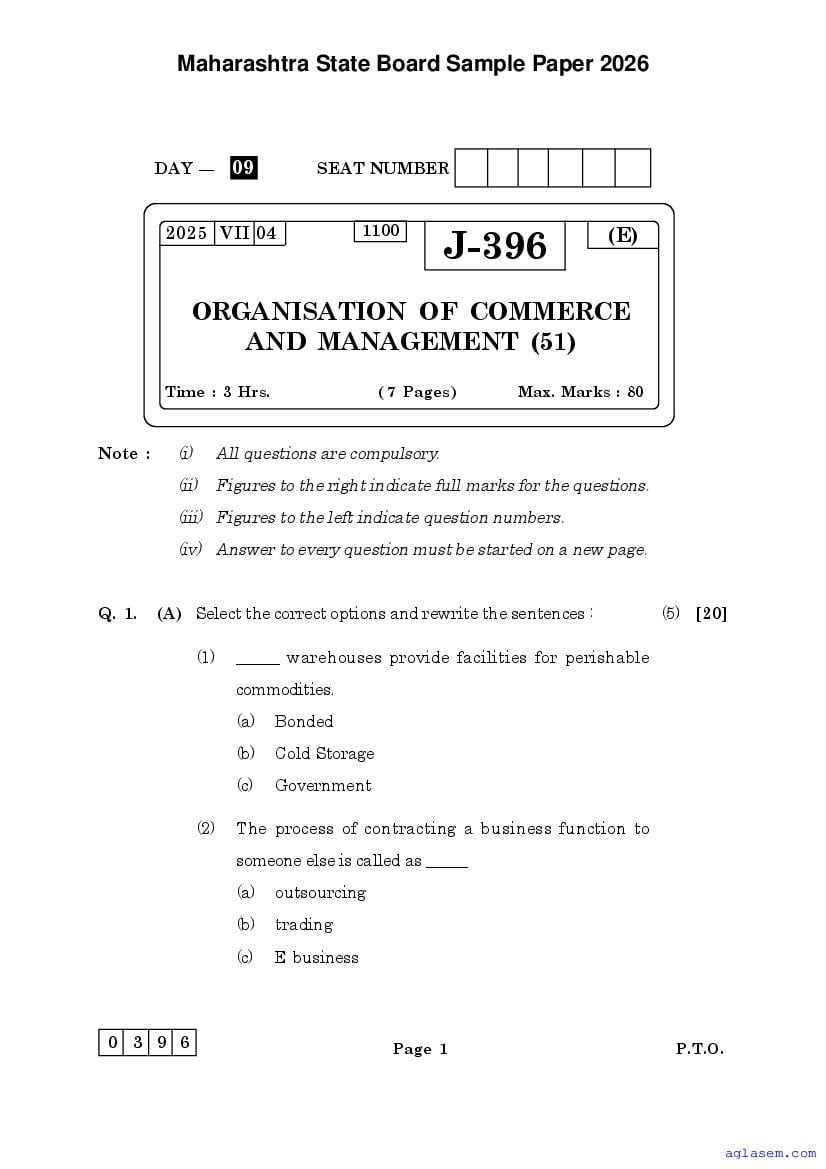
Page 1
DAY — 09 SEAT NUMBER
2025 VII 04 1100 (E)
J-396
ORGANISATION OF COMMERCE
AND MANAGEMENT (51)
Time : 3 Hrs. ( 7 Pages ) Max. Marks : 80
Note : (i) All questions are compulsory.
(ii) Figures to the right indicate full marks for the questions.
(iii) Figures to the left indicate question numbers.
(iv) Answer to every question must be started on a new page.
Q. 1. (A) Select the correct options and rewrite the sentences : (5) [20]
(1) _____ warehouses provide facilities for perishable
commodities.
(a) Bonded
(b) Cold Storage
(c) Government
(2) The process of contracting a business function to
someone else is called as _____
(a) outsourcing
(b) trading
(c) E-business
0 3 9 6 Page 1 P.T.O.
Page 2
which means character.
(a) Latin
(b) French
(c) Greek
(4) The main objective of the consumer organization is to
protect the interest of the _____ .
(a) consumer
(b) trader
(c) producer
(5) The function of management starts with _____ function.
(a) organising
(b) planning
(c) coordinating
(B) Give one word/phrase/term : (5)
(1) The process that leads the employees towards the
accomplishment of organizational goals.
(2) An art of exchanging ideas, facts, information, etc. from
one person or entity to another.
0 3 9 6 Page 2
Page 3
internet.
(4) The right of a consumer which is about safety and
protection to his life and health.
(5) Giving of distinct name to one’s product.
(C) State whether the following statements are true or false : (5)
(1) Business ethics is a code of conduct.
(2) Co-operation is not necessary for smooth flow of
organizational activities.
(3) Air transport is the cheapest mode of transport.
(4) Consumer Protection Act is not required in India.
(5) The term ‘market’ is derived from the Latin word
‘Mercatus.’
(D) Find the odd one : (5)
(1) Principle of authority and responsibility, Motion study,
Principle of division of work, Principle of discipline.
(2) Primary credit co-operative society, State co-operative
bank, District co-operative bank, Exchange bank.
0 3 9 6 Page 3 P.T.O.
Page 4
(4) Job security, Health and safety measures, Good working
condition, Reasonable profit.
(5) Stock Exchange, Foreign Exchange, Bullion Market,
Manufactured goods market.
Q. 2. Explain the following terms / concepts (Any FOUR) : [8]
(1) Time Study
(2) Staffing
(3) Warehousing
(4) Directing
(5) Lok Adalat
(6) Transport
Q. 3. Study the following case / situation and express your [6]
opinion (Any TWO) :
(1) Mr. Anil is a businessman. He has his own factories in Pune
and Nashik. He lives in Pune with his wife and two daughters
aged 5 and 8 years old.
(a) Can Mr. Anil take a life insurance policy for his wife
and two daughters?
0 3 9 6 Page 4
Page 5
factories?
(c) Which type of insurance should Mr. Anil take for
protecting his factories from loss due to fire?
(2) Sagar purchased watch from Titan shop and his friend Anjali
purchased watch from online shopping site.
(a) Who has purchased from traditional way?
(b) Who has purchased from e-business?
(c) Which business involved high risk?
(3) Balwant Co.Ltd. is providing facilities for their female staff
like daycare centre for kids and work-from-home facility. Even
management takes their suggestions while taking the
decisions though they are members of trade union.
(a) By doing this they are following social responsibilities
towards which interest groups?
(b) Write any one facility provided by the company to their
employees.
(c) What kind of responsibilities employer follows in
above case?
0 3 9 6 Page 5 P.T.O.
Page 6
(1) Planning and Organizing.
(2) Life Insurance and Fire Insurance.
(3) E-business and E-commerce.
(4) District Commission and State Commission
Q. 5. Answer in brief (Any TWO) : [8]
(1) Explain any four needs of consumer protection.
(2) Explain the types of market on the basis of area covered and
volume of transaction.
(3) Explain any four functions of a warehouse.
Q. 6. Justify the following statements (Any TWO) : [8]
(1) Principles of management are flexible in nature.
(2) Controlling is the last function of management.
(3) Business ethics can be considered as a tool for social
development.
(4) Consumers have many responsibilities.
0 3 9 6 Page 6
Page 7
(1) Explain any five principles of management of Henry Fayol.
(2) Explain characteristics of an Entrepreneur.
(3) Explain importance of Marketing to the society.
Q. 8. Answer the following questions in detail (Any ONE) : [8]
(1) What is Marketing ? Explain 7 Ps of Marketing Mix.
(2) What is Bank? Explain different types of Banks.
uuu
0 3 9 6 Page 7 P.T.O.
Page 8
DAY — 09 SEAT NUMBER
2025 VII 04 1100 (M)
J-397
ORGANISATION OF COMMERCE
AND MANAGEMENT (51)
Time : 3 Hrs. ( 7 Pages ) Max. Marks : 80
‚ÍøŸÊ — (1) ‚fl¸ ¬˝‡Ÿ ‚Ù«UÁfláÊ •ÁŸflÊÿ¸ •Ê„U.
(2) ©U¡√ÿÊ ’Ê¡Í‚ ÁŒ‹‹ •¥∑§ ¬˝‡ŸÊ¥ø ¬Íáʸ ªÈáÊ Œ‡Ê¸ÁflÃÊÃ.
(3) «UÊ√ÿÊ ’Ê¡Í‚ ÁŒ‹‹ •¥∑§ ¬˝‡ŸÊ¥ø ∑˝§◊Ê¥∑§ Œ‡Ê¸ÁflÃÊÃ.
(4) ¬˝àÿ∑§ ¬˝‡ŸÊëÿÊ ©UàÃ⁄UÊøË ‚ÈL§flÊà ŸflËŸ ¬ÊŸÊfl⁄U ∑§⁄UÊflË.
¬˝.1. (•) Á⁄U∑§ÊêÿÊ ¡ÊªË ÿÊÇÿ ¬ÿʸÿ ÁŸfl«ÍUŸ flÊÄÿ ¬Èã„UÊ Á‹„UÊ — (5) [20]
(1) ŸÊ‡Êfl¥Ã flSÃÍ óóóóó ªÊŒÊ◊Êà ‚Ê∆UÁflÀÿÊ ¡ÊÃÊÃ.
(•) ∑§⁄UŒÿ
(’) ‡ÊËê΄U
(∑§) ‚⁄U∑§Ê⁄UË
(2) íÿÊ ¬˝Á∑˝§ÿà √ÿÊfl‚ÊÁÿ∑§ ∑§Ê◊ ∑§⁄UáÿÊøÊ ∑§⁄UÊ⁄U ŒÈ‚:ÿÊ‹Ê ÁŒ‹Ê ¡ÊÃÊ,
àÿÊ ¬˝Á∑˝§ÿ‚ óóóóó •‚ ê„UáÊÃÊÃ.
(•) ’Ê„UK‚flÊ
(’) √ÿʬÊ⁄U
(∑§) ߸U-√ÿfl‚Êÿ
0 3 9 7 Page 1 P.T.O.
Page 9
(•) ‹Ú≈UËŸ
(’) »˝¥§ø
(∑§) ª˝Ë∑§
(4) óóóóóó Á„UÃÊø ‚¥⁄UˇÊáÊ ∑§⁄UáÊ „UÊ ª˝Ê„U∑§ ‚¥ÉÊ≈UŸÊ¥øÊ ◊ÈÅÿ
©UŒ˜Œ‡Ê •‚ÃÊ.
(•) ª˝Ê„U∑§Ê¥ëÿÊ
(’) √ÿʬÊ:ÿÊ¥ëÿÊ
(∑§) ©Uà¬ÊŒ∑§Ê¥ëÿÊ
(5) √ÿflSÕʬŸÊøË ∑§Êÿ¸ óóóóó ÿÊ ∑§ÊÿʸŸ ‚ÈM§ „UÊÃÊÃ.
(•) ‚¥ÉÊ≈UŸ
(’) ÁŸÿÊ¡Ÿ
(∑§) ‚◊ãflÿ
(’) ÿÊÇÿ ‡ÊéŒ, ‡Ê錂◊Í„U, ‚¥ôÊÊ Á‹„UÊU — (5)
(1) ∞∑§ •‡ÊË ¬˝Á∑˝§ÿÊ ¡Ë ∑§◊¸øÊ:ÿÊ¥ŸÊ ‚¥SÕÊà◊∑§ ©UÁŒ˜Œc≈U ‚Êäÿ ∑§⁄UáÿÊfl⁄U
÷⁄U ŒÃ.
(2) ∞∑§Ê √ÿÄÃË∑§«ÍŸ ŒÈ‚:ÿÊ √ÿÄÃË∑§«U ∑§À¬ŸÊ, flSÃÈÁSÕÃË, ◊ÊÁ„UÃË,
ßUàÿʌ˥ø ŒflÊáÊ ÉÊflÊáÊ ∑§⁄UáÿÊøË ∑§‹Ê.
0 3 9 7 Page 2
Page 10
(4) •Ê⁄UÊÇÿ •ÊÁáÊ ¡ËÁflÃÊ‚ ‚¥⁄UˇÊáÊ fl ‚È⁄UÁˇÊÃÃëÿÊ ‚¥’¥äÊËøÊ ª˝Ê„U∑§ÊøÊ
•ÁäÊ∑§Ê⁄U / „UÄ∑§.
(5) ∞πÊŒKÊ ©Uà¬ÊŒŸÊ‹Ê ÁflÁ‡Êc≈U ŸÊfl ŒáÊ.
(∑§) πÊ‹Ë‹ ÁfläÊÊŸ “’⁄UÊ’⁄”U ∑§Ë “øÍ∑§” à Á‹„UÊ — (5)
(1) √ÿfl‚Êÿ ŸËÁÇÊÊSòÊ „UË ÁŸÿ◊Êfl‹Ë •Ê„U.
(2) ‚¥ÉÊ≈UŸÊà◊∑§ ∑§Êÿ¸ ‚È⁄U›Ëà „UÊáÿÊ‚Ê∆UË ‚„U∑§ÊÿʸøË •Êfl‡ÿ∑§ÃÊ Ÿ‚Ã.
(3) „UflÊ߸U flÊ„UÃÍ∑§ „U ‚flÊZà SflSà flÊ„UÃÈ∑§Ëø ‚ÊäÊŸ •Ê„U.
(4) ÷Ê⁄UÃÊà ª˝Ê„U∑§ ‚¥⁄UˇÊáÊ ∑§ÊÿŒKÊøË •Êfl‡ÿ∑§ÃÊ ŸÊ„UË.
(5) Áfl¬áÊË „UÊ ‡ÊéŒ ‹ÚÁ≈UŸ ÷Ê·ÃË‹ “◊Ê∑¸§≈˜U‚” ‡ÊéŒÊ¬Ê‚ÍŸ •Ê‹‹Ê •Ê„U.
(«U) ª≈UÊà Ÿ ’‚áÊÊ⁄UÊ ‡ÊéŒ ‡ÊÊäÊÊ — (5)
(1) •ÁäÊ∑§Ê⁄U fl ¡’Ê’ŒÊ⁄UËø Ãààfl, „UÊ‹øÊ‹Ë¥øÊ •èÿÊ‚, ∑§Ê◊ÊëÿÊ
Áfl÷ʪáÊËø Ãààfl, Á‡ÊSÃËø Ãààfl.
(2) ¬˝ÊÕÁ◊∑§ ‚„U∑§Ê⁄UË ¬Ã ‚¥SÕÊ, ⁄UÊíÿ ‚„U∑§Ê⁄UË ’°∑§, Á¡À„UÊ ‚„U∑§Ê⁄UË
’°∑§, ÁflÁŸ◊ÿ ’°∑§.
(3) «UÁ’≈U ∑§Ê«¸U, ∑˝§Á«U≈U ∑§Ê«¸U, •ÊäÊÊ⁄U ∑§Ê«¸U, ∞.≈UË.∞◊. ∑§Ê«¸U
(4) ŸÊ∑§⁄UËøË ‚È⁄UÁˇÊÃÃÊ, •Ê⁄UÊÇÿ fl ‚È⁄UÁˇÊÃÃøË ‚ÊäÊŸ, ∑§Ê◊ÊøË ‚ÈÿÊÇÿ
ÁSâÊÃË, ÿÊÇÿ ¬˝◊ÊáÊÊà Ÿ»§Ê.
(5) ÷ʪ ’Ê¡Ê⁄U, ¬⁄U∑§Ëÿ ø‹Ÿ, ‚ÊŸ øÊ¥ŒË ’Ê¡Ê⁄U, ©Uà¬ÊÁŒÃ flSÃÍ¥øÊ ’Ê¡Ê⁄U.
0 3 9 7 Page 3 P.T.O.
Page 11
(1) fl› •èÿÊ‚
(2) ∑§◊¸øÊ⁄UË √ÿflSÕʬŸ
(3) ªÊŒÊ◊
(4) ÁŸŒ̧‡ÊŸ
(5) ‹Ê∑§ •ŒÊ‹Ã
(6) flÊ„UÃÍ∑§
¬˝.3. πÊ‹Ë‹ ÉÊ≈UŸÊ Á∑¥§flÊ ¬Á⁄UÁSÕÃËøÊ •èÿÊ‚ ∑§M§Ÿ •Ê¬‹ ◊à Á‹„UÊ [6]
(∑§ÊáÊÄUË ŒÊŸ) —
(1) üÊË. •ÁŸ‹ „U √ÿÊfl‚ÊÁÿ∑§ •Ê„UÃ. àÿÊ¥ø ¬ÈáÊ •ÊÁáÊ ŸÊÁ‡Ê∑§ ÿÕ ∑§Ê⁄UπÊŸ
•Ê„UÃ. üÊË. •ÁŸ‹ „U ∑ȧ≈È¥U’Ê‚„U ¬ÈáÿÊ◊äÿ SÕÊÁÿ∑§ •‚ÍŸ àÿÊ¥ŸÊ 5 •ÊÁáÊ 8
fl·¸ flÿÊëÿÊ ŒÊŸ ◊È‹Ë •Ê„UÃ.
(•) üÊË. •ÁŸ‹ „U àÿÊ¥ëÿÊ ¬àŸË fl ŒÊŸ ◊È‹Ë¥‚Ê∆UË ¡ËflŸ Áfl◊Ê ÉÊ™§
‡Ê∑§ÃÊà ∑§Ê?
(’) üÊË. •ÁŸ‹ àÿÊ¥ëÿÊ ∑§Ê⁄UπÊãÿÊ‚Ê∆UË ‚ʪ⁄UË Áfl◊Ê ÉÊ™§ ‡Ê∑§ÃÊà ∑§Ê?
(∑§) •ÊªË◊È› ∑§Ê⁄UπÊãÿÊëÿÊ „UÊáÊÊ:ÿÊ ŸÈ∑§‚ÊŸËëÿÊ ÷⁄U¬Ê߸‚Ê∆UË ∑§ÊáÊàÿÊ
¬˝∑§Ê⁄UøÊ Áfl◊Ê üÊË. •ÁŸ‹ ÉÊ™§ ‡Ê∑§ÃÊÃ?
0 3 9 7 Page 4
Page 12
•¥¡‹ËŸ •ÊÚŸ‹Ê߸UŸ ¬Œ˜äÊÃËŸ ÉÊ«KÊ› π⁄‘UŒË ∑§‹.
(•) ∑§ÊáÊË ¬Ê⁄¥U¬Á⁄U∑§ ◊ʪʸŸ / ¬Œ˜äÊÃËŸ π⁄‘UŒË ∑§‹Ë?
(’) ∑§ÊáÊË •ÊÚŸ‹Ê߸UŸ ◊ʪʸŸ / ¬Œ˜äÊÃËŸ π⁄‘UŒË ∑§‹Ë?
(∑§) ∑§ÊáÊàÿÊ ¬Œ˜äÊÃË◊äÿ ¡ÊSà ¡ÊπË◊ •Ê„U?
(3) ’›fl¥Ã ∑¥§¬ŸË Á‹Á◊≈U«U •Ê¬ÀÿÊ ◊Á„U‹Ê ∑§◊¸øÊ:ÿÊ¥ŸÊ àÿÊ¥ëÿÊ ‹„UÊŸ ’Ê‹∑§Ê¥‚Ê∆UË
¬Ê›áÊÊÉÊ⁄U fl ÉÊ⁄UÊà ÕÊ¥’ÍŸø ∑§Ê◊ ∑§⁄UáÿÊøË ‚fl‹Ã ŒÃ. ¡⁄UË Ã ∑§Ê◊ªÊ⁄U
‚¥ÉÊ≈UŸø ‚÷Ê‚Œ •‚‹ Ã⁄UË √ÿflSÕʬŸ ÁŸáʸÿ ÉÊáÿʬÍfl˸ àÿÊ¥ëÿÊ ‚ÍøŸÊ¥øË
Œπ‹ ÉÊÃ.
(•) „UË ∑ΧÃË ∑§⁄Uà •‚ÃÊŸÊ Ã ∑§ÊáÊàÿÊ ÉÊ≈U∑§Ê¥Áfl·ÿË ‚Ê◊ÊÁ¡∑§ ¡’Ê’ŒÊ⁄UË
¬Ê⁄U ¬Ê«UÃÊÃ?
(’) ∑¥§¬ŸË∑§«ÍUŸ àÿÊ¥ëÿÊ ∑§◊¸øÊ:ÿÊ¥ŸÊ ŒáÿÊà •Ê‹‹Ë ∑§ÊáÊÃË„UË ∞∑§
‚ÈÁfläÊÊ Á‹„UÊ.
(∑§) fl⁄UË‹ ÉÊ≈UŸ◊äÿ ◊Ê‹∑§, ∑§ÊáÊàÿÊ ¬˝∑§Ê⁄UëÿÊ ¡’Ê’ŒÊ⁄UËø
•ŸÈ‚⁄UáÊ ∑§⁄UÃÊÃ?
¬˝.4. πÊ‹Ë‹ »§⁄U∑§ S¬c≈U ∑§⁄UÊ (∑§ÊáÊÄUË ÃËŸ) — [12]
(1) ÁŸÿÊ¡Ÿ •ÊÁáÊ ‚¥ÉÊ≈UŸ
(2) ¡ËflŸ Áfl◊Ê •ÊÁáÊ •ÇŸË Áfl◊Ê
0 3 9 7 Page 5 P.T.O.
Page 13
(4) Á¡À„UÊ •Êÿʪ •ÊÁáÊ ⁄UÊíÿ •Êÿʪ.
¬˝.5. πÊ‹Ë‹ ¬˝‡ŸÊ¥øË ÕÊ«UÄÿÊà ©UàÃ⁄‘U Á‹„UÊ (∑§ÊáÊÄU Ë ŒÊŸ) — [8]
(1) ª˝Ê„U∑§ ‚¥⁄UˇÊáÊÊëÿÊ ∑§ÊáÊàÿÊ„UË øÊ⁄U ª⁄U¡Ê S¬c≈U ∑§⁄UÊ.
(2) Áfl¬áÊËø ˇÊòÊÊŸÈ‚Ê⁄U fl √ÿfl„UÊ⁄UÊëÿÊ •Ê∑§Ê⁄UÊŸÈ‚Ê⁄U ¬˝∑§Ê⁄U S¬c≈U ∑§⁄UÊ.
(3) ªÊŒÊ◊ÊøË ∑§ÊáÊÃË„UË øÊ⁄U ∑§Êÿ¸ S¬c≈U ∑§⁄UÊ.
¬˝.6. πÊ‹Ë‹ ÁfläÊÊŸ ‚∑§Ê⁄UáÊ S¬c≈U ∑§⁄UÊ (∑§ÊáÊÄUË ŒÊŸ) — [8]
(1) √ÿflSÕʬŸÊøË Ãààfl ‹fløË∑§ SflM§¬ÊøË •‚ÃÊÃ.
(2) ÁŸÿ¥òÊáÊ „U √ÿflSÕʬŸÊø •¥ÁÃ◊ ∑§Êÿ¸ •Ê„U.
(3) ‚Ê◊ÊÁ¡∑§ Áfl∑§Ê‚Ê◊äÿ, √ÿfl‚Êÿ ŸËÁÇÊÊSòÊ „U ∞∑§ ◊„UààflÊø Ã¥òÊ
◊ÊŸ‹ ¡ÊÃ.
(4) ª˝Ê„U∑§Ê¥fl⁄U •Ÿ∑§ ¡’Ê’ŒÊ:ÿÊ •Ê„UÃ.
¬˝.7. πÊ‹Ë‹ ¬˝‡Ÿ ‚Ê«UflÊ (∑§ÊáÊÄUË ŒÊŸ) — [10]
(1) „Uã⁄UË »§ÿÊÚ‹ ÿÊ¥øË √ÿflSÕʬŸÊøË ∑§ÊáÊÃË„UË ¬Êø Ãààfl S¬c≈U ∑§⁄UÊ.
(2) ©UŒKÊ¡∑§ÊøË flÒÁ‡Êc≈K S¬c≈U ∑§⁄UÊ.
(3) Áfl¬áÊŸÊø ‚◊Ê¡Ê‚Ê∆UË •‚áÊÊ⁄‘U ◊„Uààfl S¬c≈U ∑§⁄UÊ.
0 3 9 7 Page 6
Page 14
(1) Áfl¬áÊŸÊøÊ •Õ¸ ‚Ê¥ªÍŸ Áfl¬áÊŸ Á◊üÊáÊÊø ‚Êà ¬Ë (7 Ps) S¬c≈U ∑§⁄UÊ.
(2) ’°∑§øÊ •Õ¸ S¬c≈U ∑§M§Ÿ ’°∑§Ê¥ø ÁflÁfläÊ ¬˝∑§Ê⁄U S¬c≈U ∑§⁄UÊ.
uuu
0 3 9 7 Page 7 P.T.O.
Document Details
| Board / Org | Maharashtra Board |
| Exam | Class 12 |
| Type | Sample Paper |
| Pages | 14 |
| Updated | 24 Sep 2026 |