MAHA SET 2015 Question Paper 3 Commerce
Finished viewing? Save it for later —
Download MAHA SET 2015 Question Paper 3 Commerce (PDF · 40 pages)About MAHA SET 2015 Question Paper 3 Commerce
MAHA SET 2015 Question Paper 3 Commerce is available here for free download. Published by Maharashtra Exams for MAHA SET, this question paper can be viewed online or downloaded as a PDF (40 pages). Candidates preparing for MAHA SET can use MAHA SET 2015 Question Paper 3 Commerce to understand the exam pattern, the type of questions asked, and the overall difficulty level.
Frequently Asked Questions
How can I download MAHA SET 2015 Question Paper 3 Commerce?
Open this page and click the Download button to save MAHA SET 2015 Question Paper 3 Commerce as a PDF. It is completely free on AglaSem Docs.
Is MAHA SET 2015 Question Paper 3 Commerce free to download?
Yes. MAHA SET 2015 Question Paper 3 Commerce can be viewed online and downloaded as a PDF free of cost on AglaSem Docs.
How many pages does MAHA SET 2015 Question Paper 3 Commerce have?
MAHA SET 2015 Question Paper 3 Commerce contains 40 pages, which you can read online or download together as a single PDF.
Where can I find more MAHA SET study material?
You can find more MAHA SET question papers, sample papers, syllabus, and answer keys on AglaSem Docs.
MAHA SET 2015 Question Paper 3 Commerce – Text
Read the full text of this question paper below — useful to quickly search, copy and reference the content online without downloading the PDF.
📄 View text version (40 pages)
Page 1
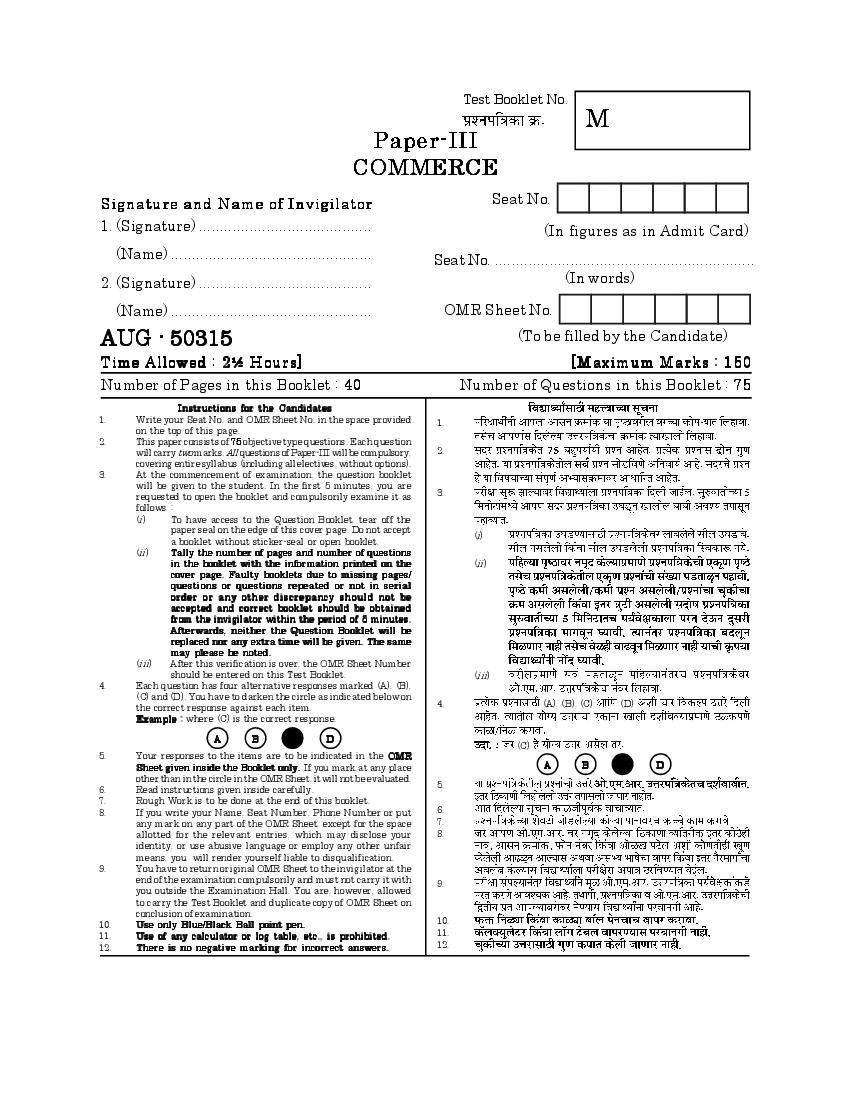
M
COMMERCE
Signature and Name of Invigilator Seat No.
1. (Signature) ......................................... (In figures as in Admit Card)
(Name) ................................................ Seat No. ..............................................................
2. (Signature) ......................................... (In words)
(Name) ................................................ OMR Sheet No.
AUG - 50315 (To be filled by the Candidate)
Time Allowed : 2½ Hours] [Maximum Marks : 150
Number of Pages in this Booklet : 40 Number of Questions in this Booklet : 75
Instructions for the Candidates
1. Write your Seat No. and OMR Sheet No. in the space provided 1.
on the top of this page.
2. This paper consists of 75 objective type questions. Each question
will carry two marks. All questions of Paper-III will be compulsory, 2.
covering entire syllabus (including all electives, without options).
3. At the commencement of examination, the question booklet
will be given to the student. In the first 5 minutes, you are
requested to open the booklet and compulsorily examine it as 3.
follows :
(i) To have access to the Question Booklet, tear off the
paper seal on the edge of this cover page. Do not accept
(i)
a booklet without sticker-seal or open booklet.
(ii) Tally the number of pages and number of questions
in the booklet with the information printed on the (ii)
cover page. Faulty booklets due to missing pages/
questions or questions repeated or not in serial
o rder or any other discre pancy should not be
accepted and correct booklet should be obtained
from the invigilator within the period of 5 minutes.
Afterwards, neither the Question Booklet will be
replaced nor any extra time will be given. The same
may please be noted.
(iii) After this verification is over, the OMR Sheet Number
should be entered on this Test Booklet. (iii)
4. Each question has four alternative responses marked (A), (B),
(C) and (D). You have to darken the circle as indicated below on
the correct response against each item. 4. (A), (B), (C) (D)
Example : where (C) is the correct response.
A B D
(C)
5. Your responses to the items are to be indicated in the OMR
Sheet given inside the Booklet only. If you mark at any place A B D
other than in the circle in the OMR Sheet, it will not be evaluated.
5.
6. Read instructions given inside carefully.
7. Rough Work is to be done at the end of this booklet.
8. If you write your Name, Seat Number, Phone Number or put 6.
any mark on any part of the OMR Sheet, except for the space 7.
allotted for the relevant entries, which may disclose your 8.
identity, or use abusive language or employ any other unfair
means, you will render yourself liable to disqualification.
9. You have to return original OMR Sheet to the invigilator at the
end of the examination compulsorily and must not carry it with 9.
you outside the Examination Hall. You are, however, allowed
to carry the Test Booklet and duplicate copy of OMR Sheet on
conclusion of examination.
10. Use only Blue/Black Ball point pen. 10.
11. Use of any calculator or log table, etc., is prohibited. 11.
12. There is no negative marking for incorrect answers. 12.
Page 2
Page 3
Paper III
III
Time Allowed : 2½ Hours] [Maximum Marks : 150
Note : This paper contains Seventy Five (75) multiple choice questions. Each
question carrying Two (2) marks. Attempt All questions.
(75) (2)
1. Which one of the following is not a 1.
capital expenditure ?
(A) Legal expenses incurred in (A)
raising a debenture loan
(B) Compensation paid to a (B)
dismissed employee
(C)
(C) Brokerage paid to the broker at
the time of purchase of land
(D)
(D) Expenses for pulling down an
old structure
3 [P.T.O.
Page 4
is ` 10,000. However, its current
market price is ` 9,500 (buying) and ` 9,500 ` 9,000
` 9,000 (selling). If the market price
is interpreted in the sense of
replacement cost, the stock should
be valued at :
(A) ` 9,500
(A) ` 9,500
(B) ` 10,000
(B) ` 10,000
(C) ` 9,000 (C) ` 9,000
(D) ` 500 (D) ` 500
3. Accounting is generally understood 3.
as :
(1)
(1) Summarization of business
transaction (2)
(2) Language of the business (3)
(3) Source of business information (4)
(4) Means of communication
Select the correct answer using the
codes given below :
(A) (1)
(A) (1) only
(B) (1) and (2) (B) (1) (2)
(C) (2) and (3) (C) (2) (3)
(D) (1), (2), (3) and (4) (D) (1), (2), (3) (4)
4
Page 5
are the measuring parameters :
(1) Value added statement (1)
(2) Employee turnover ratio (2)
(3) Savings in foreign exchange (3)
(4) Capital output ratio
(4)
Which of these statements are
correct ?
(A) (1) (4)
(A) (1) and (4)
(B) (1) (2)
(B) (1) and (2)
(C) (2), (3) (4)
(C) (2), (3) and (4)
(D) (1), (2), (3) (4)
(D) (1), (2), (3) and (4)
5. Indian Companies are generally 5.
following Human Resource
Accounting according to model as
suggested by :
(A)
(A) Morese
(B)
(B) Falmholtz
(C)
(C) Lav and Schwartz
(D)
(D) W.C. Pyle
5 [P.T.O.
Page 6
Exchange is to :
(A)
(A) Mobilise savings from the public
for long-term investment
(B)
(B) Offer a secondary market for
shares and other securities
(C) Facilitate barter deals between (C)
buyer and seller holding
different securities
(D) Enable Reserve Bank of India
(D)
to trade in Govt. Securities in
their efforts to control money
supply in the economy
7. In a contract, where the buyer has 7.
a right but not an obligation to
exercise his right is termed as :
(A) Future Contract (A)
(B) Option Contract (B)
(C) Forward Contract (C)
(D) Derivatives (D)
6
Page 7
the correct answer from the codes
given below :
I
List I (Activities)
(a)
(a) Mutual Fund
(b)
(b) Public issue of capital
(c)
(c) Forward trading
(d)
(d) Option pricing
II
List II (Associated Organisations)
(1)
(1) Stock Exchange
(2)
(2) Assets Management Company
(3)
(3) Merchant Banking
(4)
(4) Forex market
Codes :
(a) (b) (c) (d)
(a) (b) (c) (d)
(A) (2) (3) (1) (4)
(A) (2) (3) (1) (4)
(B) (2) (3) (4) (1)
(B) (2) (3) (4) (1)
(C) (3) (2) (4) (1) (C) (3) (2) (4) (1)
(D) (3) (2) (1) (4) (D) (3) (2) (1) (4)
7 [P.T.O.
Page 8
responsibility for and authority to
make decision that affect costs and
revenue but no responsibility for or
authority over assets invested in
department, the department is
referred to as.................... .
(A)
(A) Cost Centre
(B)
(B) Profit Centre
(C) Investment Centre (C)
(D) Revenue Centre (D)
10. Venture Capital provides the service
10.
of :
(A)
(A) Seed financing
(B) Purchasing a company (B)
(C) Selling a company (C)
(D) Borrowing and lending from the
(D)
company
8
Page 9
ratio is determined on the basis
of :
(A)
(A) Potential of merging company
(B)
(B) Issued capital of the two
companies
(C)
(C) Market share
(D) Future value of company to the (D)
acquirer
12. Commercial papers are : 12.
(A) Papers transacted at business
(A)
houses
(B) Papers based for financing
(B)
(C) Unsecured negotiable
(C)
promissory notes
(D)
(D) Papers for financial guarantees
9 [P.T.O.
Page 10
(A) is a Euro dominated negotiable
(A)
instrument
(B)
(B) is a dollar denominated
negotiable instrument (C)
(C) it is not a negotiable instrument
but a stock in the capital
(D)
market
(D) is a negotiable instrument
traded settled and cleared in
Europe
14.
14. Credit rating can be done by :
(A) CRISIL
(A) CRISIL
(B)
(B) an Insurance Company
(C) a Mutual Fund Company (C)
(D) a Chit Fund Company (D)
10
Page 11
with :
(A)
(A) Unsystematic Risk
(B)
(B) Market Risk
(C)
(C) Portfolio Risk
(D)
(D) Total Risk
16.
16. The sales oriented concept of
marketing is............... .
(A) Production oriented (A)
(B) Consumer oriented (B)
(C) Promotion oriented
(C)
(D) Price oriented
(D)
11 [P.T.O.
Page 12
Place) of marketing were coined
by..................... .
(A)
(A) H. Fayol
(B)
(B) Peter Drucker
(C)
(C) M.C. Carthy
(D)
(D) Kotler
18.
18. Which of the following is not micro-
marketing ?
(A)
(A) Societal
(B)
(B) Customer
(C) Employees (C)
(D) Company Management (D)
12
Page 13
19.
decision process ?
(A) Problem recognition,
information search, evaluation (A)
of alternatives, purchase
decision
(B) Information search, problem (B)
recognition, evaluation of
alternatives, purchase decision
(C)
(C) Evaluation of alternatives,
problem recognition, purchase
decision, information search
(D)
(D) Problem recognition,
information search, purchase
decision and evaluation of
20.
alternatives
20. Which among the following is not
a part of marketing plan ?
(A)
(A) Identify marketing objectives
(B)
(B) Determining steps in planning
(C) Achieving goals (C)
(D) Product manufacturing
(D)
13 [P.T.O.
Page 14
required for which goods ?
(A) Industrial goods (A)
(B) Manufactured goods (B)
(C) Durable goods (C)
(D) Fast moving goods (D)
22. Which does not include in direct
22.
marketing ?
(A) Tele-marketing
(A)
(B) e-Mail
(B)
(C) Only marketing
(C)
(D) Catalogue marketing
(D)
14
Page 15
buyer behaviour is....................... .
(A) Life style (A)
(B) Family (B)
(C) Age and life cycle (C)
(D) Fashions (D)
24. Out of the following which is not the
24.
part of product research ?
(A) Quality
(A)
(B) Features
(B)
(C) Transportation
(C)
(D) After sales service
(D)
15 [P.T.O.
Page 16
(A) Buyers and consumers are the (A)
same
(B)
(B) Online marketing is a part of
direct marketing
(C)
(C) Social marketing and modern
marketing are the same
(D)
(D) Micro-environment is un-
controllable
26.
26. Buyer behaviour is basically
.........................in nature.
(A) Economical (A)
(B) Biological (B)
(C) Social (C)
(D) Cultural
(D)
16
Page 17
conducted by.................... .
(A)
(A) Charles Babbage
(B)
(B) Henry Fayol
(C)
(C) F.W. Taylor
(D)
(D) Elton Mayo
28.
28. .........................provides written
information about the product.
(A) Label (A)
(B) Brand
(B)
(C) Trademark
(C)
(D) Company Booklet
(D)
17 [P.T.O.
Page 18
of all the marketing activities of an
enterprise.
(A)
(A) Marketing Research
(B)
(B) Marketing Planning
(C)
(C) Marketing Survey
(D)
(D) Marketing Analysis
30.
30. Which of the following is not a
feature of marketing ?
(A)
(A) Integrated Management
(B)
(B) Consumer Orientation
(C)
(C) Profit Maximization
(D) More Sales (D)
18
Page 19
focuses on utilisation of....................... .
(A) Physical Resources (A)
(B) Knowledge (B)
(C) Development (C)
(D) Personnel (D)
32. Which one of the following in the 32.
internal factor is an organisation ?
(A) GDP
(A)
(B) Political
(B)
(C) Customers
(C)
(D) Structure
(D)
19 [P.T.O.
Page 20
of HRM policy :
(A) Competence (A)
(B) Responsibility (B)
(C) Uniformity (C)
(D) Authority (D)
34. Job analysis consists of....................... 34.
.
(A) Job design (A)
(B) Job rotation (B)
(C) Job option (C)
(D) Job description (D)
35. Fundamentally human resource 35.
planning is based on...................... .
(A) Strategic plan (A)
(B) Personnel (B)
(C) Workforce planning (C)
(D) Job analysis (D)
20
Page 21
is................... .
(A)
(A) Human resource planning
(B)
(B) Job description
(C)
(C) Job design
(D)
(D) Attracting the applications
37.
37. The objective of written examination
is.................... .
(A)
(A) to measure experience
(B) to measure performance (B)
(C) to measure ability (C)
(D) to pay compensation (D)
21 [P.T.O.
Page 22
established as per the provisions of
the Act of the number of employee’s
that is :
(A) 100
(A) 100
(B) 50
(B) 50
(C) 10
(C) 10
(D) 20
(D) 20
39. Worker director is a form of the part 39.
of...................... .
(A) Collective Bargaining (A)
(B) Participative Management
(B)
(C) Trade Union
(C)
(D) Negotiation
(D)
22
Page 23
(A) Below the minimum wage (A)
(B) Above the living age (B)
(C) Between minimum and living (C)
wage
(D) Average wage (D)
41. The act of increasing the job
41.
knowledge and skills of an employee
for doing a job is called................... .
(A) Development
(A)
(B) Performance
(B)
(C) Training
(C)
(D) Placement
(D)
23 [P.T.O.
Page 24
representatives of employers and
employees negotiate regarding
wages is known as.................... .
(A)
(A) Grievance
(B) Discipline (B)
(C) Trade Union Activity
(C)
(D) Collective Bargaining
(D)
43. ...........................is written record of
43.
the duties, responsibilities and
conditions of the job.
(A) Job Description (A)
(B) Job analysis
(B)
(C) Skills inventory
(C)
(D) Human Resource Information
(D)
System
24
Page 25
training which includes a
combination of both on-the-job and
in-class training is :
(A)
(A) Mentorship
(B)
(B) Computer based Training
(C)
(C) Vestibule Training
(D) Apprenticeship (D)
45. An error of omission when a job 45.
description fails to incorporate
important aspect of the job required
is called :
(A)
(A) Contamination
(B)
(B) Deficiency
(C)
(C) Performance gap
(D)
(D) Dropping
25 [P.T.O.
Page 26
is working for regional co-operation
of nations ?
(A) Asian Development Bank (A)
(B) International Finance
(B)
Co-operation
(C)
(C) World Bank
(D) International Monetary Fund (D)
47. The SAARC is not established for 47.
the following objective :
(A) To develop welfare of South (A)
Asian people
(B) To help economical
(B)
development of South Asian
countries
(C)
(C) To help industrial development
of South Asian countries
(D)
(D) To increase the Co-operation
among developing countries
26
Page 27
free trade is :
(A)
(A) World Trade Organisation
(B)
(B) International Monetary Fund
(C)
(C) World Bank
(D)
(D) United Nations Union
49.
49. Global Depository Receipts (GDR) is
denominated in.......................... .
(A) U.S. Dollar (A)
(B) British Pound (B)
(C) Euro
(C)
(D) Rupee
(D)
27 [P.T.O.
Page 28
‘NAFTA’ includes U.S.A., Canada,
and.................. .
(A) U.K. (A)
(B) Brazil (B)
(C) Argentina (C)
(D) Mexico (D)
51. Exporters can reduce their risk 51.
by :
(A) Hedging (A)
(B) Arbitrage (B)
(C) Speculation (C)
(D) Arbitrage and Speculation
(D)
52. Which of the following is not the
52.
items of Capital Account ?
(A) External Assistance
(A)
(B) Disbursement
(B)
(C) NRI Deposits
(C)
(D) Official Transfer
(D)
28
Page 29
approach to markets and production
is known as :
(A) Multinational enterprises (A)
(B) Multinational efficiency (B)
(C) National undertaking (C)
(D) International company (D)
54. The forward exchange rate may be 54.
quoted at a premium or at a
......................on the spot rate.
(A)
(A) Discount rate
(B)
(B) Proposed dividend rate
(C)
(C) High price
(D) Market price (D)
29 [P.T.O.
Page 30
currency ?
(A) Loko
(A)
(B) Pound
(B)
(C) Lira
(C)
(D) Mark
(D)
56. Induced capital movement have
56.
great significance from the point of
view of formulation of.........................
by a country.
(A) Economic policy (A)
(B) Monetary policy (B)
(C) Fiscal policy (C)
(D) Tax policy (D)
57. Foreign exchange is supplied 57.
by...................... .
(A) Importers
(A)
(B) Exporter
(B)
(C) Buyers of fixed assets abroad
(C)
(D) Borrowing from abroad (D)
30
Page 31
convert local financial assets into
foreign financial assets and vice
versa at market determined rate of
exchange.
(A)
(A) Capital Account
(B) Current Account (B)
(C) Assets Account (C)
(D) Cash Account (D)
59. Accounting is a function of
59.
International Business :
(A)
(A) False
(B)
(B) True
(C)
(C) Cannot say
(D) Partially true (D)
31 [P.T.O.
Page 32
the invester a controlling interest in
a company :
(A) Domestic company (A)
(B) Multinational company (B)
(C) Transnational company (C)
(D) Foreign company (D)
61. Which of the following income from 61.
land situated in India is an
agricultural income exempt from
tax ?
(A)
(A) Sale of sugar manufactured
from sugarcane
(B)
(B) Income from nurseries
(C)
(C) Dividend from a company
engaged in agriculture
(D) Income from dairy farming on (D)
a large scale
62. Agricultural income can be taxed 62.
either by :
(A) Central Govt. (A)
(B) State Govt. (B)
(C) Local Authority (C)
(D) Central and State Govt. both (D)
32
Page 33
income tax is not chargeable for AY
2013-14 in case of an Indian
Company is :
(A) ` 2,50,000
(A) ` 2,50,000
(B) ` 3,00,000
(B) ` 3,00,000
(C) ` 5,00,000
(C) ` 5,00,000
(D)
(D) Nil
64.
64. Super Senior Citizen as per Income
Tax Act means an individual who
has attained the age of :
(A) 60 years (A) 60
(B) 65 years (B) 65
(C) 75 years (C) 75
(D) 80 years (D) 80
65. Which of the following income of a 65.
Paramveer Chakra Awardee is
exempt from tax ?
(A)
(A) Basic Salary
(B)
(B) Dearness Allowance
(C)
(C) House Rent Allowance
(D) Pension (D)
33 [P.T.O.
Page 34
given by :
(A)
(A) Income Tax Act, 1961
(B)
(B) Annual Finance Act
(C)
(C) Central Board of Direct Taxes
(D)
(D) Finance Minister of India
67.
67. An employee of a University
` 8
receives ` 8,00,000 on Voluntary
Retirement of a scheme of the
University. He is entitled to have
exemption of ..................... .
(A) ` 5,00,000
(A) ` 5,00,000
(B) ` 8,00,000
(B) ` 8,00,000
(C) ` 2,50,000
(C) ` 2,50,000
(D) ` 4,00,000
(D) ` 4,00,000
68. 44
68. Turnover limit for Tax Audit u/s
14-15
44AB for AY 14-15 is :
(A) ` 10,00,000
(A) ` 10,00,000
(B) ` 65,00,000 (B) ` 65,00,000
(C) ` 40,00,000 (C) ` 40,00,000
(D) ` 1,00,00,000 (D) ` 1,00,00,000
34
Page 35
for ` 5 lakhs. Mrs. A succeeds the 2000
above flat on the death of A in the
year 2000, on which date the market
value of the property is ` 20 lakhs. 20
Mrs. A sells the above flat in Dec. 2013
2013. Mrs. A will have to adopt for
computation of capital gains :
(A) Cost of acquisition ` 5 lakhs (A) ` 5 1990
with indexation from 1990
(B) Cost of acquisition ` 5 lakhs (B) ` 5 2000
with indexation from 2000
(C) Cost of acquisition ` 20 lakhs (C) ` 20 2000
with indexation from 2000
(D) Cost of acquisition ` 20 lakhs (D) ` 20 1990
with indexation from 1990
35 [P.T.O.
Page 36
each from non-relatives aggregating
` 17,000
to ` 51,000. Gifts are taxable in the
` 51,000.
hands of Mr. X to the extent
of :
(A) ` 51,000
(A) ` 51,000
(B) ` 1,000
(B) ` 1,000
(C) ` 25,000
(C) ` 25,000
(D)
(D) NIL
71. 80C
71. Life Insurance premium payment is
not eligible for deduction u/s 80C in
respect of an individual :
(A)
(A) On the life of spouse
(B)
(B) On the life of son
(C)
(C) On the life of married daughter
(D)
(D) On the life of daughter-in-law
36
Page 37
returns to a company subject to
international transfer pricing audit
is.................... .
(A) 31st July (A)
(B) 30th September (B)
(C)
(C) 30th November
(D)
(D) 31st December
73.
73. The aggregate limit for domestic
transfer pricing audit requirement
2014-15
is...................... .(AY 2014-15)
(A) ` 65
(A) ` 65 lakhs
(B) ` 100
(B) ` 100 lakhs
(C) ` 500
(C) ` 500 lakhs
(D) ` 2000
(D) ` 2000 lakhs
37 [P.T.O.
Page 38
before remuneration and interest
` 60,000
(` 60,000) of a professional firm is
40(b)
` 10,00,000. After considering the
deduction permissible u/s 40(b), the
tax payable by firm excluding
education as will be ..................
(A) ` 3,00,000
(A) ` 3,00,000
(B) ` 2,82,000
(B) ` 2,82,000
(C) ` 1,25,000
(C) ` 1,25,000
(D) ` 85,600 (D) ` 85,600
75. Rate of interest permissible to a firm 75. 40(b)
on the capital of partners u/s 40(b)
is.................. .
(A) 10%
(A) 10%
(B) 11%
(B) 11%
(C) 12%
(C) 12%
(D) 13%
(D) 13%
38
Page 39
39 [P.T.O.
Page 40
40
Document Details
| Board / Org | Maharashtra Exams |
| Exam | MAHA SET |
| Type | Question Paper |
| Pages | 40 |
| Updated | 30 Apr 2026 |