HBSE Class 11 Sample Paper 2026 Answers Chemistry
Finished viewing? Save it for later —
Download HBSE Class 11 Sample Paper 2026 Answers Chemistry (PDF · 10 pages)About HBSE Class 11 Sample Paper 2026 Answers Chemistry
HBSE Class 11 Sample Paper 2026 Answers Chemistry is available here for free download. Published by Haryana Board for Class 11, this answer key can be viewed online or downloaded as a PDF (10 pages). Candidates preparing for Class 11 can use HBSE Class 11 Sample Paper 2026 Answers Chemistry to understand the exam pattern, the type of questions asked, and the overall difficulty level.
Frequently Asked Questions
How can I download HBSE Class 11 Sample Paper 2026 Answers Chemistry?
Open this page and click the Download button to save HBSE Class 11 Sample Paper 2026 Answers Chemistry as a PDF. It is completely free on AglaSem Docs.
Is HBSE Class 11 Sample Paper 2026 Answers Chemistry free to download?
Yes. HBSE Class 11 Sample Paper 2026 Answers Chemistry can be viewed online and downloaded as a PDF free of cost on AglaSem Docs.
How many pages does HBSE Class 11 Sample Paper 2026 Answers Chemistry have?
HBSE Class 11 Sample Paper 2026 Answers Chemistry contains 10 pages, which you can read online or download together as a single PDF.
Where can I find more Class 11 study material?
You can find more Class 11 question papers, sample papers, syllabus, and answer keys on AglaSem Docs.
HBSE Class 11 Sample Paper 2026 Answers Chemistry – Text
Read the full text of this answer key below — useful to quickly search, copy and reference the content online without downloading the PDF.
📄 View text version (10 pages)
Page 1
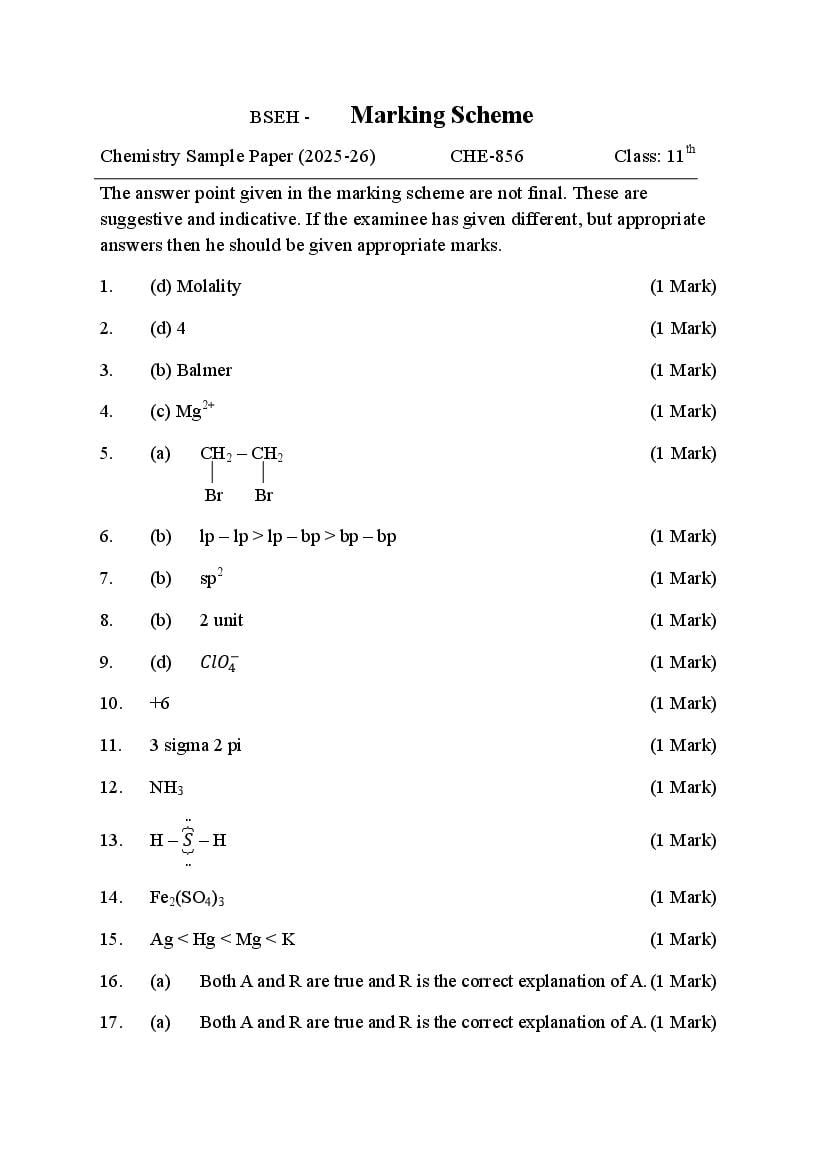
Chemistry Sample Paper (2025-26) CHE-856 Class: 11th
The answer point given in the marking scheme are not final. These are
suggestive and indicative. If the examinee has given different, but appropriate
answers then he should be given appropriate marks.
1. (d) Molality (1 Mark)
2. (d) 4 (1 Mark)
3. (b) Balmer (1 Mark)
4. (c) Mg2+ (1 Mark)
5. (a) CH2 – CH2 (1 Mark)
Br Br
6. (b) lp – lp > lp – bp > bp – bp (1 Mark)
7. (b) sp2 (1 Mark)
8. (b) 2 unit (1 Mark)
9. (d) 𝐶𝑙𝑂 (1 Mark)
10. +6 (1 Mark)
11. 3 sigma 2 pi (1 Mark)
12. NH3 (1 Mark)
..
13. H–⏞
𝑆–H
⏟ (1 Mark)
..
14. Fe2(SO4)3 (1 Mark)
15. Ag < Hg < Mg < K (1 Mark)
16. (a) Both A and R are true and R is the correct explanation of A. (1 Mark)
17. (a) Both A and R are true and R is the correct explanation of A. (1 Mark)
Page 2
19. When two elements combine to form more than one compound, the masses
of one element that combine with a fixed mass of the other element are in
ratio of small whole number. (1 Mark)
Example :- Carbon and Oxygen
C O CO2
12 : 16 12 : 32
16 : 32 = 1 : 2 (1 Mark)
20. 𝑥. ∆𝑝 ≥ (1 Mark)
where 𝑥 = uncertainty in position
𝑝 = uncertainty in momentum
h = Planck’s constant
The principal state that the more precisely the position of a particle is
known, the less precisely its momentum can be known and vice – versa.
(1 Mark)
21. As moves across a period, electrons are added to sand energy level, but the
number of protons in the nuclear increase. It increase positive charge of the
nucleus pulls the electrons more strongly inwards, resulting in a smaller
atomic radius. (2 Mark)
22. Electron gain enthalpy is the tendency of an isolate gaseous atom to accept
an electron to form a negative ion. (1 Mark)
Electronegativity is the tendency of the atom of an element to attract shared
pair of electrons towards it in a covalent bond. (1 Mark)
23. According to Le Chatelier’s principle on addition of H2 the equilibrium will
shift in the backward direction. (2 Mark)
Page 3
added. An example of a buffer solution is a mixture of acetic acid and
sodium acetate.
24. (i) 4H++3e-+Mn𝑂 MnO2 + 2H2O (1 Mark)
2 I- I2 + 2e-
(ii) 8H++ 6e- + 2Mn𝑂 2MnO2 + 4H2O
6 I- 3I2 + 6e-
2Mn𝑂 + 6 I- + 8H+ 2MnO2 + 3I2 + 4H2O (1 Mark)
(i) Exhibits only negative oxidation state :- F(Fluorine) ( Mark)
(ii) Exhibits only positive oxidation state :- Cs (Cesium) ( Mark)
(iii) Exhibit both negative and positive oxidation state : I(Iodine) ( Mark)
(iv) Exhibit neither negative nor positive oxidation state :- Ne (Neon)
( Mark)
25. Those isomerism which have the same molecular formula but different
functional groups is known as Functional isomers. (1 Mark)
Example :- Molecular formula C3H6O
Isomers :- C2H5OH (ethane), CH3 – O – CH3 (Methoxy methane) (1 Mark)
(i) 2 hydroxy but – 3en – 1 – oic Acid (1 Mark)
(ii) 5 Bromo cyclohex – 2 en – 1 – ol (1 Mark)
26. (i) The ratio of the no. of moles of a particular component to the total
number of moles of all components in a solution. (1 Mark)
.
(ii) Molarity (M) = (1 Mark)
Page 4
Molarity = = × = 0.5𝑀 (1 Mark)
27. (i) The sign of H is negative because bond formation releases energy.
In this reaction two chlorine atom forms a bond to create chlorine
molecule. ( Mark)
The sign of S is also negative because the number of gaseous
molecule decrease from two to one. ( Mark)
(ii) 𝐺 = - RTLnK (1 Mark)
𝐺 = - 8.314 J K-1mol-1 x 300K x Ln10 (1 Mark)
= - 8.314 x 300 x 2.303 = -5705.74 J mol-1 (1 Mark)
(Deduct ( ) marks if unit is not mention)
28. (i) pH is a scale used to specify the acidity or basicity of an aqueous
solution. (1 Mark)
(ii) [OH-] = [KOH] = 0.002M = 2 x 10⁻³M (1 Mark)
pOH = - log10 [OH-]
pOH = -log10(2 x 10⁻³) pOH 2.7
pH + pOH = 14, pH = 14 – pOH = 14 – 2.7 = 11.3 (1 Mark)
(Deduct ( ) marks if unit is not mention)
29. (i) CH3Br + OH- CH3OH + Br- (1 Mark)
The hydroxide(OH-) ion acts as a nuclophile.
(ii) + 𝐶𝐻 𝐶 𝑂 → COCH3 (1 Mark)
𝐶𝐻 𝐶 𝑂 acts as a nuclophile.
Page 5
effect of the nitro group. (1 Mark)
Resonance effect is defined as the withdrawl or releasing of electrons related
to a certain substituents through the process of the delocalisation of pi –
electron. (1 Mark)
Types of Resonance effect :-
Positive Resonance Effect (+R) :- Electron donating group increase electron
density in the molecule. (1 Mark)
Example :- NH2 group donates electron to the benzene rings.
Negative Resonance effect :- (-R) Electron withdrawing groups decrease
electron density in the molecule. (1 Mark)
Example :- NO2 group withdraw electron from the benzene ring.
/
30. (i) CH3-C CH + H2O ⎯⎯⎯⎯⎯
333k
CH3 – C – CH3 (1 Mark)
O
(ii) Ozonolysis is a reaction between ozone and an alkane or an alkyne.
Ozone adds across the multiple bond to form an ozonide which
decompose to give carbonyl compound. (1 Mark)
For example :- O
/
CH2 = CH2 + O3 CH2 CH2 ⎯⎯⎯⎯ 2HCHO (1 Mark)
O O
(i) The name of the Alkane is n – heptane. (1 Mark)
(ii) When 1,2 dichloroethane is treated with alcoholic KOH it undergoes
dehydrohalogenation. (1 Mark)
Page 6
31. (i) Extensive properties are those that depend on the amount of
substance present in the system. Example :- Mass, Volume (1 Mark)
(ii) The unit of G is expressed in Joules or Kilojoules. H can be
approximated by U. (1 Mark)
(iii) G = H - TS (1 Mark)
G = -10.5 – (298 x -0.0441)
G = -10.5 + 13.14 KJ = 2.64 KJ (1 Mark)
(Deduct ( ) marks if unit is not mention)
(i) H < 0 and S > 0 spontaneous at all temperature. ( Mark)
(ii) H > 0 and S < 0 non-spontaneous at all temperature. ( Mark)
(iii) H < 0 and S < 0 spontaneous at low temperature. ( Mark)
(iv) H > 0 and S > 0 spontaneous at high temperature. ( Mark)
32. (i) Correct order of relative stability of carbon ions:- (1 Mark)
Stability of carbonion increase with the presence of electron
withdrawing group.
CCl3 < CHCl2 < CH2Cl < CH3CH2 < CH3
(ii) Homolytic fission of CH3Cl results in the formation of two free
radicals:- (1 Mark)
CH3Cl CH3 + Cl
(iii) (CH3)3C+ is sp2 hybridized a trigonal planar geometry. (1 Mark)
(CH3)3C- is sp3 hybridized with a tetrahedral geometry. (1 Mark)
Page 7
33. (i) The de Broglie equation relates the wavelength of a particle to its
momentum. (1 Mark)
= or h = Plank’s constant, p = momentum of particle
m = masses of particle, v = velocity of particle
(ii) K. E = 𝑚𝑣 , 𝑣 = (1 Mark)
× . × . ×
𝑣= = = √6.59 × 10 = 811.78𝑚
. × . ×
. × . ×
= = = = 8.47 × 10 (1 Mark)
. × × . . ×
(Deduct (1) marks if unit is not mention)
(iii) The Aufbau principle states that electrons are filled in an atom in
increasing order of energy. (2 Mark)
(i) The square of wave function represents the probability density of
finding a particle at specific location in space. (1 Mark)
(ii) It was unable to explain the different spectra lines given off by gases
of different atoms or molecules. It does not describe the structure of
atoms with more than one electron. (1 Mark)
It is not able to describe different types of atom such as alkanes and
halogens. (1 Mark)
(iii) =𝑅 = 1.097 × 10 − = 1.097 × 10
1 3
= 1.097 × 10 = 2.056875 × 10 𝑚
16
=
. ×
4.86 × 10 𝑚 (1 Mark)
Page 8
(Deduct (1) marks if unit is not mention)
34. (i) The BeH2 molecule has a zero dipole moment because of its linear
structure. The two Be – H bonds are equal in magnitude but points in
opposite direction so cancel each other. (1 Mark)
(ii) Species Orbital Configuration Bond order Magnetic Properties
O2 (2s) (2s*) 2 Paramagnetic
(2p) (2p*) (1 Mark)
(2p) (2p*)
𝑂 (2s) (2s*) 1.5 Paramagnetic
(2p) (2p*) (1 Mark)
(2p)
𝑂 (2s) (2s*) 1 Diamagnetic
(2p) (1 Mark)
(2p)4 (2p*)4 (1 Mark)
(i) The hybridisation of PCl5 molecule is sp3d Axial bond in PCl5 are
longer than equilateral bond due to greater repulsion. The axial bond
repulsion from three equatorial bonds while the equatorial bonds
repulsion form two axial bonds. The increased repulsion causes the
axial bond to stretch and becomes longer. (3 Mark)
(ii) Sigma bond Pi bond (2 Mark)
Formed by head on overlap Formed by sideways overlap
of p-orbital
Sigma bond are strong bond Pi bond are weak bond
Page 9
symmetrical.
35. (i) Benzene to p – nitrochlorobenzene. (1 Mark)
Cl Cl
/
+ 𝐶𝑙 ⎯⎯⎯⎯⎯⎯⎯ ⎯⎯⎯⎯⎯⎯⎯⎯
NO2
Benzene to m – nitrochlorobenzene (1 Mark)
NO2 NO2
+ 𝐻𝑁𝑂 ⎯⎯ + 𝐶𝑙 ⎯⎯⎯⎯⎯⎯⎯
Cl
(ii) Wurtz Reaction:- (1 Mark)
𝐶𝐻 𝐶𝑙 + 2𝑁𝑎 + 𝐶𝐻 𝐶𝑙 ⎯⎯⎯⎯⎯ 𝐶𝐻 − 𝐶𝐻 + 2𝑁𝑎𝐶𝑙
333k
Decarboxylation reaction :- (1 Mark)
𝐶𝐻 𝐶𝑂𝑂𝑁𝑎 + 𝑁𝑎𝑂𝐻 ⎯ 𝐶𝐻 + 𝑁𝑎 + 𝐶𝑂
(iii) Huckel’s Rule states that for a planer, cyclic conjugated molecule to
be aromatic it must have 4n + 2 electron , where n is a non –
negative integer. (1 Mark)
When a polar molecule is attached to an unsymmetrical alkene in the
presence of organic peroxide, the negative half of the molecule is attached to
the carbon atom that has more hydrogen atom than that of other unsaturated
carbon atom. (1 Mark)
Page 10
R – O – O – R ⎯⎯⎯⎯⎯⎯ 2 𝑅𝑂
peroxide
RO + H – Br ⎯⎯⎯ ROH + Br (1 Mark)
Step – I
CH3 – CH = CH2 + Br ⎯ CH3 – CH – CH2Br (1 Mark)
Step – II
CH3 – CH – CH2 Br + HBr ⎯ CH3 – CH2 – CH2Br (1 Mark)
In case of HCl and HI it is not observed because H – Cl bond is strong free
radical produced from peroxide may not broke into form Cl. In case of H – I
bond is weak and broken free radical produced from peroxide to form I. But
it prefers combine to form I2 rather than double bond of Alkene. (1 Mark)
Document Details
| Board / Org | Haryana Board |
| Exam | Class 11 |
| Type | Sample Paper |
| Pages | 10 |
| Updated | 24 Sep 2026 |