CBSE Class 12 Question Paper 2025 Solution Sociology
Finished viewing? Save it for later —
Download CBSE Class 12 Question Paper 2025 Solution Sociology (PDF · 11 pages)About CBSE Class 12 Question Paper 2025 Solution Sociology
CBSE Class 12 Question Paper 2025 Solution Sociology is available here for free download. Published by CBSE for Class 12, this solution can be viewed online or downloaded as a PDF (11 pages). Candidates preparing for Class 12 can use CBSE Class 12 Question Paper 2025 Solution Sociology to understand the exam pattern, the type of questions asked, and the overall difficulty level.
Frequently Asked Questions
How can I download CBSE Class 12 Question Paper 2025 Solution Sociology?
Open this page and click the Download button to save CBSE Class 12 Question Paper 2025 Solution Sociology as a PDF. It is completely free on AglaSem Docs.
Is CBSE Class 12 Question Paper 2025 Solution Sociology free to download?
Yes. CBSE Class 12 Question Paper 2025 Solution Sociology can be viewed online and downloaded as a PDF free of cost on AglaSem Docs.
How many pages does CBSE Class 12 Question Paper 2025 Solution Sociology have?
CBSE Class 12 Question Paper 2025 Solution Sociology contains 11 pages, which you can read online or download together as a single PDF.
Where can I find more Class 12 study material?
You can find more Class 12 question papers, sample papers, syllabus, and answer keys on AglaSem Docs.
CBSE Class 12 Question Paper 2025 Solution Sociology – Text
Read the full text of this solution below — useful to quickly search, copy and reference the content online without downloading the PDF.
📄 View text version (11 pages)
Page 1
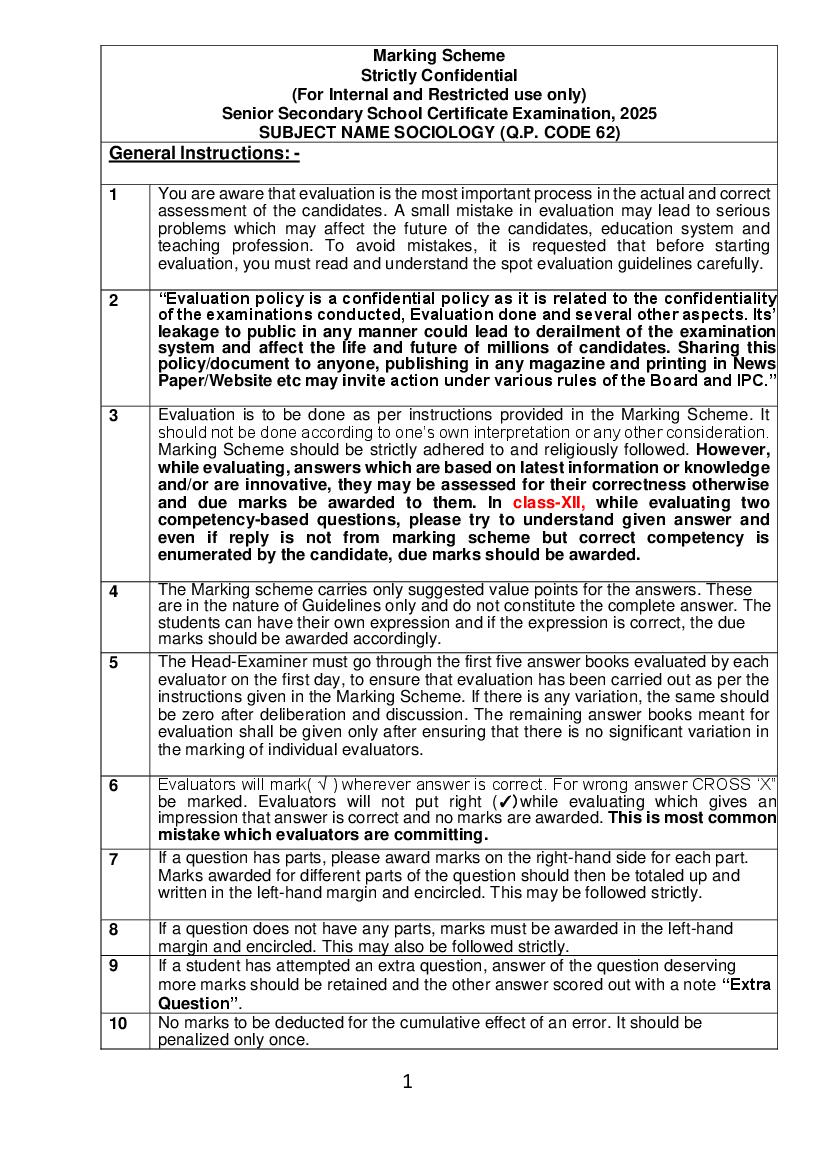
Strictly Confidential
(For Internal and Restricted use only)
Senior Secondary School Certificate Examination, 2025
SUBJECT NAME SOCIOLOGY (Q.P. CODE 62)
General Instructions: -
1 You are aware that evaluation is the most important process in the actual and correct
assessment of the candidates. A small mistake in evaluation may lead to serious
problems which may affect the future of the candidates, education system and
teaching profession. To avoid mistakes, it is requested that before starting
evaluation, you must read and understand the spot evaluation guidelines carefully.
2 “Evaluation policy is a confidential policy as it is related to the confidentiality
of the examinations conducted, Evaluation done and several other aspects. Its’
leakage to public in any manner could lead to derailment of the examination
system and affect the life and future of millions of candidates. Sharing this
policy/document to anyone, publishing in any magazine and printing in News
Paper/Website etc may invite action under various rules of the Board and IPC.”
3 Evaluation is to be done as per instructions provided in the Marking Scheme. It
should not be done according to one’s own interpretation or any other consideration.
Marking Scheme should be strictly adhered to and religiously followed. However,
while evaluating, answers which are based on latest information or knowledge
and/or are innovative, they may be assessed for their correctness otherwise
and due marks be awarded to them. In class-XII, while evaluating two
competency-based questions, please try to understand given answer and
even if reply is not from marking scheme but correct competency is
enumerated by the candidate, due marks should be awarded.
4 The Marking scheme carries only suggested value points for the answers. These
are in the nature of Guidelines only and do not constitute the complete answer. The
students can have their own expression and if the expression is correct, the due
marks should be awarded accordingly.
5 The Head-Examiner must go through the first five answer books evaluated by each
evaluator on the first day, to ensure that evaluation has been carried out as per the
instructions given in the Marking Scheme. If there is any variation, the same should
be zero after deliberation and discussion. The remaining answer books meant for
evaluation shall be given only after ensuring that there is no significant variation in
the marking of individual evaluators.
6 Evaluators will mark( √ ) wherever answer is correct. For wrong answer CROSS ‘X”
be marked. Evaluators will not put right (✓)while evaluating which gives an
impression that answer is correct and no marks are awarded. This is most common
mistake which evaluators are committing.
7 If a question has parts, please award marks on the right-hand side for each part.
Marks awarded for different parts of the question should then be totaled up and
written in the left-hand margin and encircled. This may be followed strictly.
8 If a question does not have any parts, marks must be awarded in the left-hand
margin and encircled. This may also be followed strictly.
9 If a student has attempted an extra question, answer of the question deserving
more marks should be retained and the other answer scored out with a note “Extra
Question”.
10 No marks to be deducted for the cumulative effect of an error. It should be
penalized only once.
1
Page 2
given in Question Paper) has to be used. Please do not hesitate to award full marks
if the answer deserves it.
12 Every examiner has to necessarily do evaluation work for full working hours i.e., 8
hours every day and evaluate 20 answer books per day in main subjects and 25
answer books per day in other subjects (Details are given in Spot Guidelines).
13 Ensure that you do not make the following common types of errors committed by the
Examiner in the past:-
● Giving more marks for an answer than assigned to it.
● Wrong totaling of marks awarded on an answer.
● Wrong transfer of marks from the inside pages of the answer book to the
title page.
● Wrong question wise totaling on the title page.
● Leaving answer or part thereof unassessed in an answer book.
● Wrong totaling of marks of the two columns on the title page.
● Wrong grand total.
● Marks in words and figures not tallying/not same.
● Wrong transfer of marks from the answer book to online award list.
● Answers marked as correct, but marks not awarded. (Ensure that the right
tick mark is correctly and clearly indicated. It should merely be a line. Same
is with the X for incorrect answer.)
● Half or a part of answer marked correct and the rest as wrong, but no marks
awarded.
14 While evaluating the answer books if the answer is found to be totally incorrect, it
should be marked as cross (X) and awarded zero (0) Marks.
15 Any un assessed portion, non-carrying over of marks to the title page, or totaling
error detected by the candidate shall damage the prestige of all the personnel
engaged in the evaluation work as also of the Board. Hence, in order to uphold the
prestige of all concerned, it is again reiterated that the instructions be followed
meticulously and judiciously.
16 The Examiners should acquaint themselves with the guidelines given in the
“Guidelines for spot Evaluation” before starting the actual evaluation.
17 Every Examiner shall also ensure that all the answers are evaluated, marks carried
over to the title page, correctly totaled and written in figures and words.
18 The candidates are entitled to obtain photocopy of the Answer Book on request on
payment of the prescribed processing fee. All Examiners/Additional Head
Examiners/Head Examiners are once again reminded that they must ensure that
evaluation is carried out strictly as per value points for each answer as given in the
Marking Scheme.
2
Page 3
SOCIOLOGY
SECTION A
1 A 1
2 B 1
3 D 1
4 A 1
5 C 1
6 A 1
7 A 1
8 A 1
9 D 1
10 C 1
11 A 1
12 B 1
13 B 1
14 A 1
15 A 1
16 A 1
SECTION B
Q17 (a) “By and large, work for most Indians is still in small scale workplaces. Here personal 1+1=2
relationships determine many aspects of work”.
In large organisations work is not determined by personal relationships. What inference
can you draw from this statement?
Ans In large organisations rules are well-defined and recruitment is more transparent.
There are mechanisms for complaints and redressal if there is any disagreement
with the immediate superior.
Q18 (a) “Cultural diversity can present tough challenges.” 1+1=2
Support this statement with suitable examples.
Ans The difficulties arise from the fact that cultural identities are very powerful – they can
arouse intense passions and are often able to moblise large numbers of people.
Sometimes cultural differences are accompanied by economic and social
inequalities and this further complicates things.
The situation is made worse when scarce resources – like river waters, jobs or
government funds – have to be shared.
(Any two)(Any other relevant point)
OR
3
Page 4
Q18 1+1=2
For- Secularism implies equal respect for all religions, rather than separation or
Ans. distancing. For example, the secular Indian state declares public holidays to mark
the festivals of all religions.
A secular person or state is one that does not favour any particular religion over
others.
(Any other relevant example)
Against-Opponents argue that secularism is only an excuse to favour the minorities
in return for their votes or other kinds of support.
Supporters argue that without special protection, secularism can turn into an excuse
for imposing the majority community’s values and norms on the minorities.
(Any one of each)
Q19 Adivasis shared a common hatred for dikus. Why? Give reasons.
Ans Dikus-migrant traders and moneylenders who had settled in the area and grabbed 1+1=2
Adivasis’ wealth, impoverishing the original residents.
For example, in the state of Jharkhand , most of the benefits from the mining and
industrial projects in this mineral-rich region had gone to dikus even as Adivasis
were alienated from their lands.
Adivasi therefore have experienced marginalisation and a sense of injustice.
(Any other relevant point)
Q20 (a) Workers in underground mines face very dangerous conditions. Give examples.
Ans Workers in underground mines face very dangerous conditions, due to flooding and 1+1=2
fire.
The collapse of roofs and sides.
The emission of gases and ventilation failures.
Many workers develop breathing problems and diseases like tuberculosis and
silicosis.
They may face injuries due to mine blasting, falling objects etc. (Any two)
OR
Q20 (b) Give one advantage and one disadvantage of the policy of liberalisation.
Ans Advantage- (i) Licenses are no longer required to open industries.
(ii) Foreign products are now easily available in Indian shops.
(Any one)
Disadvantage- (i) More and more companies are reducing the number of
permanent employees and outsourcing their work to smaller companies.
(ii) Employment has become more insecure due to the rise in contract labour. 1+1=2
(iii) Rise in income inequality.
(iv) Government embarks the policy of land acquisition for industries.
(Any one)
Q21 During the 1960s, scholars debated whether tribes should be seen as one end of a
continuum with caste-based (Hindu) peasant society, or whether they were an altogether 1+1=2
different kind of community.
What is the basis for the argument for tribe and caste distinction?
Ans. ● Those who argued for the continuum saw tribes as not being fundamentally
different from caste-peasant society.
Tribes are less stratified with a more community-based rather than individual notion
4
Page 5
Others argued that tribes were wholly different from castes because they had no
notion of purity and pollution which is central to the caste system.
Tribe-caste distinction was founded on an assumed cultural difference between
Hindu castes, with their beliefs in purity and pollution and hierarchical integration,
Tribals are ‘animist’, more egalitarian and they have kinship-based modes of social
organisation. (Any two)
Q22 Many districts of colonial India were administered through the Zamindari system.
1+1=2
What problems were faced by the peasants due to the Zamindari system?
Ans During the Bristish rule, local kings or zamindars controlled the land, since the British
granted property rights to the zamindars.
They were given more control over the land than they had before.
The colonisers imposed heavy land revenue (taxes) on agriculture.
The zamindars extracted as much produce or money as they could out of the
cultivators.
The peasants or cultivators who worked on the land had to handover a substantial
portion of the produce to them (Zamindars).
Zamindars extracted as much produce or money as they could out of the cultivators
and hence the burden of taxation on the peasants increased.
As a result, agricultural production stagnated or declined during the British rule.
Therefore, the peasants fled from oppressive landlords and frequent famines and
wars decimated the population.
(Any two) (Any other relevant point)
Q23 One of the negative outcomes of the Green Revolution strategy was the worsening of
regional inequalities. 1+1=2
Give two reasons for your answer.
Ans The areas that underwent technological transformation became more developed
while other areas stagnated.
The Green Revolution was promoted more in the western and southern parts of the
country, and in Punjab, Haryana, and western U.P. as they had better irrigation
facilities than in the eastern parts of the country.
Well-to-do farmers in these regions had access to land, capital which helped them
to increase their production and earn more money.
Whereas, the other regions continued to have an entrenched ‘feudal’ agrarian
structure, in which the landed castes and landlords-maintained power over the lower
castes, landless workers and small cultivators.
This further led to the sharp caste and class inequalities, together with exploitative
labour relations. This has given rise to various kinds of violence in recent years.
(Any two)
5
Page 6
and cholera. But the single largest epidemic was the influenza epidemic of 1918-19, which 1+1=2
killed about 5% of the total population of India at that time.
Differentiate between epidemic and pandemic.
Ans
Epidemic refers to sudden increase in the rate at which a disease affects the people
of a given geographic area at a specific time.
Pandemic refers to an epidemic that affects a very wide geographical area. It is at
National, International or even global level.
Q25 “Theoretically, the caste system can be understood as the combination of two sets of 1/2+1/2
principles.” Name them and define any one. +1=2
Ans The combination of two sets of principles are-
a) Difference and separation
b) Wholism and hierarchy.
Difference and Separation - Each caste is supposed to be different from – and is
therefore strictly separated from – every other caste. Many of the scriptural rules of caste
are thus designed to prevent the mixing of castes – rules ranging from marriage, food
sharing and social interaction to occupation.
Wholism and Hierarchy- The different and separated castes do not have an individual
existence – they can only exist in relation to a larger whole, the totality of society
consisting of all castes. This societal whole or system is hierarchical rather than
egalitarian system.
(Any one)
SECTION C
Q26 From the 1950s to the 1970s, a series of land reform laws were passed- at the national 1+1+1
level as well as in the states. What were the reasons behind these reforms? +1=4
Ans
After India became independent, Nehru and his policy advisors embarked on a
programme of planned development that focused on agrarian reform as well as
industrialisation.
The policymakers were responding to the dismal agricultural situation in India at that
time.
This was marked by low productivity, dependence on imported food grains, and the
intense poverty of a large section of the rural population.
The policymakers felt that a major reform in the agrarian structure, landholding
system and the distribution of land, was necessary if agriculture were to progress.
Land reforms are necessary to boost agricultural growth and to eradicate poverty in
rural areas and to bring social justice.
(Any four)
Q27 Sociologists use the term ‘Social Stratification’ to refer to a system by which categories of 1+1+1
people in a society are ranked in a hierarchy. +1=4
How does Social Stratification persist over generations?
Ans It is closely linked to the family and to the inheritance of social resources from one
generation to the next.
6
Page 7
their parents.
Within the caste system, birth dictates occupational opportunities.
The ascribed aspect of social inequality is reinforced by the practice of endogamy
that is marriage is restricted to members of the same caste.
(Any other relevant point)
Q28 (a) Westernisation does involve the imitation of external forms of culture. Illustrate the 1+1+1
process of westernisation. +1=4
Ans M.N. Srinivas defines westernisation as “the changes brought about in Indian
society and culture as a result of over 150 years of British rule, the term subsuming
changes occurring at different levels…technology, institutions, ideology and values”.
It refers to the emergence of a westernised sub-cultural pattern through a minority
section of Indians who first came in contact with western culture.
This included the sub culture of Indian intellectuals who not only adopted many
cognitive patterns, or ways of thinking, and styles of life, but supported its expansion.
Small sections of people who adopted western life styles or were affected by
western ways of thinking
There has been also the general spread of western cultural traits, such as the use
of new technology, dress, food, and changes in the habits and styles of people in
general.
Across the country a very wide section of middle-class homes has a television set,
a fridge, some kind of sofa set, a dining table and chair in the living room.
People adopt modern values of democracy and equality.
Apart from ways of life and thinking, the west influenced Indian art and literature.
(Any four)
OR
(b) The varied Social Reform Movements did have common themes. Yet there were also
significant differences. Discuss.
Q28 For some the concerns were confined to the problems that the upper caste, middle 1+1+1
class women and men faced. +1=4
Ans For others the injustices suffered by the discriminated castes were central
questions.
For some social evils had emerged because of a decline of the true spirit of
Hinduism.
For others caste and gender oppression was intrinsic to the religion.
Muslim social reformers actively debated the meaning of polygamy and purdah.
(Any four)(Any other relevant point)
7
Page 8
feel very strongly about our family. The family is an integral part of lives. Elaborate. +1=4
Ans Sometimes we feel very good about our parents, grandparents, siblings, uncles,
aunts and cousins.
We miss their overbearing ways when we are away from them.
The family is a space of great warmth and care.
The work schedules of young parents may lead to increasing number of grandparents
moving in as care-givers to young grandchildren.
Families could be classified on the basis of authority or dominance (patriarchy-
matriarchy), residence (patrilocal-matrilocal), inheritance (patrilineal- matrilineal) or
size (joint/extended-nuclear/small).
(Any Four) (Any other relevant point)
Q30 “In India, the impact of the very same British industrilisation led to deindustrilisation in some 1+1+1
sectors.” +1=4
Identify the impacts on the basis of the above statement.
Ans Just as manufacturing boomed in Britain, traditional exports of cotton and silk
manufactures from India declined in the face of Manchester competition.
Decline of old urban centres such as Surat and Masulipatnam while Bombay and
Madras grew.
When the British took over Indian states, towns like Thanjavur, Dhaka, and
Murshidabad lost their courts and, therefore, some of their artisans and court gentry.
From the end of the 19th century, with the installation of mechanised factory
industries, some towns became much more heavily populated
Unlike Britain where the impact of industrialisation led to more people moving into
urban areas, in India the initial impact of the same British industrialization led to
more people moving into agriculture.
(Any four)
Q31 There is a close relationship between disability and poverty. Discuss. 1+1+1
+1=4
Ans
Malnutrition
Mothers weakened by frequent childbirth
Inadequate immunisation programmes
Accidents in overcrowded homes contribute to an incidence of disability among
poor people.
Disability creates and exacerbates poverty by increasing isolation and economic
strain, not just for the individual but for the family;
(Any four) (Any other relevant point)
8
Page 9
example of the famous Bombay Textile Strike of 1982. +1=4
Ans Bombay Textile strike of 1982, which was led by the trade union leader, Dr. Datta
Samant, and affected nearly a quarter of a million workers and their families.
The strike lasted nearly two years. The workers wanted better wages.
They also wanted the right to form their own union.
Slowly after two years, people started going back to work because they were
desperate.
Nearly one lakh workers lost their jobs and went back to their villages, or took up
casual labour and others moved to smaller towns.
Workers also found it hard to sustain themselves without wages.
(Any four)
SECTION D
Q33 (a) What are the reasons for the declining child sex ratio? 1+1=2
Ans
Severe neglect of girl babies in infancy
Sex specific abortions that prevent girl babies from being born leading to higher
death rates.
Female infanticide or killing of girl babies due to religious or cultural beliefs.
Modern techniques (medical), such as the availability of the Sonogram are misused
to identify and selectively abort female foetuses.
(Any two)
(b) Based on the above data, compare the data of the 20th century with that of 21st century 1+1+1
and state your inferences. +1=4
Ans From 972 females per 1000 males at the turn of the twentieth century, the sex ratio
has declined to 933 at the turn of the twenty-first century.
The sex ratio for the 0–6 years age group has generally been substantially higher
than the overall sex ratio for all age groups, but it has been falling very sharply.
In the decade 1991–2001, the overall sex ratio has increased from 927 to 933 but
the child sex ratio has dropped from 945 to 927 as economically prosperous families
decide to have fewer children. So they may also wish to choose the sex of their
child.
According to Census of India 2011 sex ratio has increased and now it is 943 females
per 1000 males due to development in the levels of nutrition, general education and
awareness, as well as the availability of medical and communication facilities.
Government of India has introduced the programme that can prove to be an
important policy to increase the child sex ratio in the country. For ex. ‘Beti-Bachao,
Beti-Padhao’ and Ladli Yojna.
9
Page 10
Q34 Discuss the classification of Social Movements. 2+2+2
Ans =6
Reformist Movement-It strives to change the existing social and political
arrangements through gradual, incremental steps.
For ex-The 1960s movement for the reorganisation of Indian states on the basis of
language Right to Information campaign.
Redemptive Movement-It aims to bring about a change in the personal
consciousness and actions of its individual members.
For ex- People in the Ezhava community in Kerala were led by Narayana Guru to
change their social practices.
Revolutionary Movement-It attempts to radically transform social relations, often
by capturing state power.
For ex- The Bolshevik revolution in Russia and the Naxalite movement in India.
Old and New Social Movements
(Any other relevant Social Movement)
Q35 The Civil Society has been instrumental in taking many significant initiatives, the most 1+1+1
recent being the campaign for the Right to Information, Discuss the initiative and its +1+1+
outcome. 1=6
Ans Beginning with an agitation in rural Rajasthan for the release of information on
government funds spent on village development, this effort grew into a nation-wide
campaign.
Despite the resistance of the bureaucracy, the government was forced to respond
to the campaign and pass a new law formally acknowledging the citizens’ right to
information.
As a result, The Right to Information Act 2005 is a law enacted by the Parliament of
India giving Indians access to Government records.
Under this Act, any person may request information from a “public authority” which
is expected to reply expeditiously or within thirty days.
The Act also requires every public authority to computerise their records so that the
citizens need minimum recourse to request for information formally.
This law was passed by Parliament on 15 June 2005 and came into force on 13
October 2005.
The Act specifies that citizens have a right to request any information, take copies
of documents, inspect documents, works and records take certified samples of
materials of work and obtain information in the form of printouts, diskettes, floppies,
tapes, video cassettes or in any other electronic mode. (Any six)
10
Page 11
Document Details
| Board / Org | CBSE |
| Exam | Class 12 |
| Type | Solution |
| Pages | 11 |
| Updated | 24 Sep 2026 |