CBSE Class 12 Political Science Question Paper 2020 Set 59-1-1
Finished viewing? Save it for later —
Download CBSE Class 12 Political Science Question Paper 2020 Set 59-1-1 (PDF · 19 pages)About CBSE Class 12 Political Science Question Paper 2020 Set 59-1-1
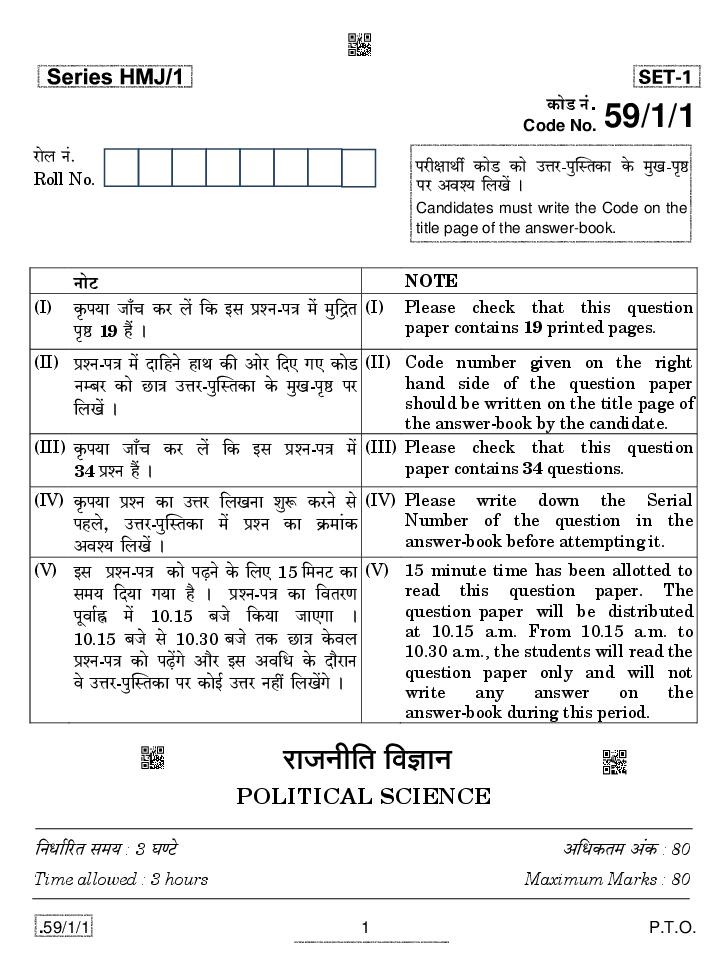
CBSE Class 12 Political Science Question Paper 2020 Set 59-1-1 is available here for free download. Published by CBSE for Class 12, this question paper can be viewed online or downloaded as a PDF (19 pages). Candidates preparing for Class 12 can use CBSE Class 12 Political Science Question Paper 2020 Set 59-1-1 to understand the exam pattern, the type of questions asked, and the overall difficulty level.
Frequently Asked Questions
How can I download CBSE Class 12 Political Science Question Paper 2020 Set 59-1-1?
Open this page and click the Download button to save CBSE Class 12 Political Science Question Paper 2020 Set 59-1-1 as a PDF. It is completely free on AglaSem Docs.
Is CBSE Class 12 Political Science Question Paper 2020 Set 59-1-1 free to download?
Yes. CBSE Class 12 Political Science Question Paper 2020 Set 59-1-1 can be viewed online and downloaded as a PDF free of cost on AglaSem Docs.
How many pages does CBSE Class 12 Political Science Question Paper 2020 Set 59-1-1 have?
CBSE Class 12 Political Science Question Paper 2020 Set 59-1-1 contains 19 pages, which you can read online or download together as a single PDF.
Where can I find more Class 12 study material?
You can find more Class 12 question papers, sample papers, syllabus, and answer keys on AglaSem Docs.
CBSE Class 12 Political Science Question Paper 2020 Set 59-1-1 – Text
Read the full text of this question paper below — useful to quickly search, copy and reference the content online without downloading the PDF.
📄 View text version (19 pages)
Page 1
Code No. 59/1/1
amob Z§. narjmWu H$moS >H$mo CÎma-nwpñVH$m Ho$ _wI-n¥ð
Roll No. >na Adí` {bIo§ &
Candidates must write the Code on the
title page of the answer-book.
ZmoQ> NOTE
(I) H¥$n`m Om±M H$a b| {H$ Bg àíZ-nÌ _o§ _w{ÐV (I) Please check that this question
n¥ð> 19 h¢ & paper contains 19 printed pages.
(II) àíZ-nÌ _| Xm{hZo hmW H$s Amoa {XE JE H$moS (II) Code number given on the right
>Zå~a H$mo N>mÌ CÎma-nwpñVH$m Ho$ _wI-n¥ð> na hand side of the question paper
{bI| & should be written on the title page of
the answer-book by the candidate.
(III) H¥$n`m Om±M H$a b| {H$ Bg àíZ-nÌ _| (III) Please check that this question
>34 àíZ h¢ & paper contains 34 questions.
(IV) H¥$n`m àíZ H$m CÎma {bIZm ewê$ H$aZo go (IV) Please write down the Serial
nhbo, CÎma-nwpñVH$m _| àíZ H$m H«$_m§H$ Number of the question in the
Adí` {bI| & answer-book before attempting it.
(V) Bg àíZ-nÌ H$mo n‹T>Zo Ho$ {bE 15 {_ZQ >H$m (V) 15 minute time has been allotted to
g_` {X`m J`m h¡ & àíZ-nÌ H$m {dVaU read this question paper. The
nydm©• _| 10.15 ~Oo {H$`m OmEJm & question paper will be distributed
10.15 ~Oo go 10.30 ~Oo VH$ N>mÌ Ho$db at 10.15 a.m. From 10.15 a.m. to
10.30 a.m., the students will read the
àíZ-nÌ H$mo n‹T>|Jo Am¡a Bg Ad{Y Ho$ Xm¡amZ question paper only and will not
do CÎma-nwpñVH$m na H$moB© CÎma Zht {bI|Jo & write any answer on the
answer-book during this period.
amOZr{V {dkmZ
POLITICAL SCIENCE
{ZYm©[aV g_` : 3 KÊQ>o A{YH$V_ A§H$ : 80
Time allowed : 3 hours Maximum Marks : 80
.59/1/1 1 P.T.O.
Page 2
{ZåZ{b{IV {ZX}em| H$mo ~hþV gmdYmZr go n{‹T>E Am¡a CZH$m g»Vr go nmbZ H$s{OE :
(i) àíZ-nÌ nm±M IÊS>m| _| {d^m{OV h¡ H$, I, J, K Ed§ L> & g^r àíZ A{Zdm`©
h¢ &
(ii) IÊS> H$ àíZ g§»`m 1 go 20 VH$ A{V bKw-CÎmar` àíZ h¢, àË`oH$ àíZ 1 A§H$ H$m h¡ &
àË`oH$ àíZ H$m CÎma EH$ eãX `m EH$ dmŠ` naÝVw 20 eãXm| go A{YH$ Zht hmoZm Mm{hE &
(iii) IÊS> I àíZ g§»`m 21 go 23 bKw-CÎmar` àíZ h¢, àË`oH$ àíZ 2 A§H$m| H$m h¡ & àË`oH$ àíZ
H$m CÎma 40 eãXm| go A{YH$ Zht hmoZm Mm{hE &
(iv) IÊS> J àíZ g§»`m 24 go 27 VH$ XrK©-CÎmar` àíZ h¢, àË`oH$ àíZ 4 A§H$m| H$m
h¡ & àË`oH$ àíZ H$m CÎma 100 eãXm| go A{YH$ Zht hmoZm Mm{hE &
(v) IÊS> K àíZ g§»`m 28 go 30 VH$ Xmo àíZ AdVaU na VWm EH$ àíZ {MÌ AWdm H$mQy>©Z na
AmYm[aV h¡, àË`oH$ àíZ 5 A§H$m| H$m h¡ & àË`oH$ àíZ H$m CÎma 150 eãXm| go A{YH$ Zht hmoZm
Mm{hE &
àíZ g§»`m 31 _mZ{MÌ go g§~§{YV h¡ {Og_| _hÎdnyU© ñWmZm| H$s nhMmZ Xr JB© OmZH$mar Ho$
AmYma na hr H$s OmZr h¡ & BgH$m CÎma AnZr CÎma-nwpñVH$m _| {b{IE &
(vi) IÊS> L>> àíZ g§»`m 32 go 34 VH$ XrK©-CÎmar` àíZ h¢, àË`oH$ àíZ 6 A§H$m| H$m
h¡ & àË`oH$ àíZ H$m CÎma 150 eãXm| go A{YH$ Zht hmoZm Mm{hE &
(vii) CÎma g§{jßV VWm q~Xþdma hmoZo Mm{hE Am¡a gmW hr Cn`w©º$ eãX gr_m H$m `Wmg§^d nmbZ
H$s{OE &
(viii) àíZ-nÌ _| H$moB© g_J« {dH$ën Zht h¡ & VWm{n, EH$-EH$ A§H$ dmbo EH$ àíZ _|, Mma-Mma A§H$m|
dmbo EH$ àíZ _| VWm N> :-N> : A§H$m| dmbo VrZ àíZm| _| Am§V[aH$ {dH$ën {XE JE h¢ & Eogo àíZm|
_| go Ho$db EH$ hr {dH$ën H$m CÎma {b{IE &
(ix) BgHo$ A{V[aº$, Amdí`H$VmZwgma, àË`oH$ IÊS> Am¡a àíZ Ho$ gmW `Wmo{MV {ZX}e {XE JE h¢ &
IÊS> H$
1. nydu nm{H$ñVmZ Am¡a npíM_r nm{H$ñVmZ H$~ VH$ EH$ gmW EH$ Xoe Ho$ ê$n _| BH$Æ>o aho ? > 1
AWdm
lrb§H$m H$s amOZr{V na {H$g g_wXm` H$m X~X~m h¡ ? 1
.59/1/1 2
Page 3
Read the following instructions very carefully and strictly follow them :
(i) Question paper comprises five Sections A, B, C, D and E. All questions are
compulsory.
(ii) Section A – Questions no. 1 to 20 are very short-answer type questions,
carrying 1 mark each. They are required to be answered in one word or one
sentence each, but not exceeding 20 words.
(iii) Section B – Questions no. 21 to 23 are short-answer type questions, carrying
2 marks each. Answers to them should not exceed 40 words each.
(iv) Section C – Questions no. 24 to 27 are long-answer type questions, carrying
4 marks each. Answers to them should not exceed 100 words each.
(v) Section D – Questions no. 28 to 30 are two passage based questions and one
picture OR cartoon based question, carrying 5 marks each. Answers to them
should not exceed 150 words each.
Question no. 31 is a map based question that includes identification of
important places on the basis of given information. Write its answers in your
answer-book.
(vi) Section E – Questions no. 32 to 34 are long-answer type questions, carrying
6 marks each. Answers to them should not exceed 150 words each.
(vii) Answers should be brief and to the point and the above word limit be adhered
to as far as possible.
(viii) There is no overall choice in the question paper. However, an internal choice
has been provided in 1 question of one mark, 1 question of four marks and
3 questions of six marks. Only one of the choices in such questions is to be
attempted.
(ix) In addition to this, separate instructions are given with each section and
question, wherever necessary.
SECTION A
1. How long did East Pakistan and West Pakistan remain together as one
country ? 1
OR
Which community dominates the politics of Sri Lanka ? 1
.59/1/1 3 P.T.O.
Page 4
(A) EñQ>mo{Z`m
(B) CH«o$Z
(C) bVm{d`m
(D) {bWwAm{Z`m
3. {ZåZ{b{IV _| go H$m¡Z-gm Xoe gmH©$ H$m gXñ` Zht h¡ ? 1
(A) ^maV
(B) å`m±_ma
(C) ~m§½bmXoe
(D) Zonmb
1 1
4. {ZåZ{b{IV H$WZ H$mo ghr H$aHo$ AnZr CÎma-nwpñVH$m _| nwZ: {b{IE : + =1
2 2
ZmQ>mo OyZ 1949 _| ApñVËd _| Am`m Am¡a `h 11 amÁ`m| H$m g§K Wm &
5. X{jU E{e`m _| bmoH$V§Ì H$s AmH$m§jm Ho$ {bE {H$gr EH$ H$maU H$s nhMmZ H$s{OE & 1
6. ^maV _| d¡ídrH$aU H$m {damoY {H$g gm§ñH¥${VH$ à^md Ho$ H$maU hþAm ? H$moB© EH$ CXmhaU
Xr{OE & 1
7. {díd H$s gmPr {damgV Ho$ ~mao _| {ZåZ{b{IV H$WZ Ho$ {bE ghr `m µJbV Ho$ ê$n _|
nhMmZ H$s{OE : 1
CÎmar JmobmÕ© Ho$ Xoe ‘{díd H$s gmPr {damgV’ H$s gwajm Ho$ {bE, X{jUr JmobmÕ© Ho$ Xoem|
go H$ht Á`mXm qM{VV h¢ &
8. gwajm H$m g§~§Y {H$g àH$ma Ho$ ˜Vam| go h¡ ? 1
9. ñdV§Ì ^maV _| ^mfm Ho$ AmYma na ~Zm`m J`m nhbm amÁ` H$m¡Z-gm Wm ? 1
.59/1/1 4
Page 5
(A) Estonia
(B) Ukraine
(C) Latvia
(D) Lithuania
3. Which country among the following is not a member of SAARC ? 1
(A) India
(B) Myanmar
(C) Bangladesh
(D) Nepal
1 1
4. Correct the following statement and rewrite in your answer-book : + =1
2 2
NATO came into existence in June 1949 and it was an association of
11 States.
5. Identify any one reason for the aspiration of democracy in South Asia. 1
6. Resistance to globalisation in India has come from which cultural
influence ? Give any one example. 1
7. Identify the following statement about the global commons as true or
false : 1
The countries of the North are more concerned about the protection of the
global commons than the countries of the South.
8. Security is related to which types of threats ? 1
9. Which was the first state created on the basis of language in free India ? 1
.59/1/1 5 P.T.O.
Page 6
gm_m{OH$ JR>~§YZ Wm ? 1
11. BboŠQ´>m°{ZH$ dmoqQ>J _erZ (B©.dr.E_.) Ûmam _VXmZ {H$Z Xmo VarH$m| go _VnÌm| Ûmam _VXmZ
1 1
H$aZo go ~ohVa h¡ ? + =1
2 2
12. A§Vam©îQ´>r` KQ>ZmAm| Ho$ Eogo H$moB© Xmo CXmhaU Xr{OE Ohm± ^maV Zo AnZm ñdV§Ì éI
1 1
AnZm`m hmo & + =1
2 2
1 1
13. {ZåZ{b{IV H$WZ H$mo ghr H$aHo$ AnZr CÎma-nwpñVH$m _| nwZ: {b{IE : + =1
2 2
^maV Am¡a ~m§½bmXoe Ho$ ~rM Zdå~a 1971 _| nyU© n¡_mZo na `wÕ Amaå^ hmo J`m Wm &
14. Eogr {H$Ýht Xmo ~mVm| H$m CëboI H$s{OE Omo 1971 _| ZB© H$m±J«og Ho$ nmg Vmo Wt naÝVw CgHo$
1
~‹S>o {dn{j`m| Ho$ nmg CZH$m A^md Wm & 2 =1
2
15. 1977 _| H|$Ð _| gÎmm _| AmE ghr amOZr{VH$ Xb H$mo Mw{ZE & 1
(A) OZVm nmQ>u
(B) ^maVr` OZg§K
(C) H$å`w{ZñQ> nmQ>u Am°µ\$ B§{S>`m
(D) ^maVr` amîQ´>r` H$m±J«og
16. ‘‘AmnmVH$mb Am¡a BgHo$ Amgnmg H$s Ad{Y H$mo h_ g§d¡Ym{ZH$ g§H$Q> H$s Ad{Y Ho$ ê$n _|
^r XoI gH$Vo h¢ &’’ Bg H$WZ Ho$ nrN>o Ho$ _w»` H$maU H$m {díbofU H$s{OE & 1
17. BKU H$ho OmZo dmbo amOZr{VH$ Xb H$m nyam Zm_ {b{IE & 1
.59/1/1 6
Page 7
time of Independence ? 1
11. In which two ways is the voting by EVM better than voting by ballot
1 1
papers ? + =1
2 2
12. Give any two examples of international events where India took an
1 1
independent stand. + =1
2 2
1 1
13. Correct the following statement and rewrite in your answer-book : + =1
2 2
A full-scale war between India and Bangladesh broke out in
November 1971.
14. Mention any two things which the New Congress had but its big
1
opponents lacked in 1971. 2 =1
2
15. Select the correct political party which came to power at the centre in
1977. 1
(A) Janata Party
(B) Bharatiya Jana Sangh
(C) Communist Party of India
(D) Indian National Congress
16. ‘‘The Emergency and the period around it can be described as a period of
constitutional crisis.’’ Analyse the main reason behind this statement. 1
17. Write the full name of the political party called BKU. 1
.59/1/1 7 P.T.O.
Page 8
{ZåZ{b{IV _| go {H$gZo {H$`m Wm ? 1
(A) MÝÐeoIa
(B) EM.S>r. XodJm¡S>m
(C) AmB©.Ho$. JwOamb
(D) dr.nr. qgh
19. nydm}Îma _| ~‹S>o n¡_mZo na AmE Amàdm{g`m| H$mo A{VH«$_U H$aZo dmbm Š`m| g_Pm OmVm h¡ ? 1
20. {ZåZ{b{IV _| go {H$g JR>~§YZ Zo 1989 _| H|$Ð _| gaH$ma ~ZmB© ? 1
(A) amOJ (EZ.S>r.E.)
(B) g§`wº$ _moMm©
(C) amîQ´>r` _moMm©
(D) g§àJ (`y.nr.E.)
IÊS> I
21. ~mhar gwajm H$s nma§n[aH$ AdYmaUm Ho$ EH$ VÎd Ho$ ê$n _| e{º$ g§VwbZ ~ZmE aIZo Ho$
{bE g~go ~{‹T>`m VarH$m Š`m h¡ ? 2
22. 1969 _| H$m±J«og nmQ>u _| {d^mOZ Ho$ {H$Ýht Xmo H$maUm| H$m {díbofU H$s{OE & 21=2
23. _§S>b Am`moJ Ûmam gwPmB© JB© {H$Ýht Xmo {gµ\$m[aem| H$m CëboI H$s{OE & 21=2
IÊS> J
24. _hme{º$`m| Ho$ {_Ì amîQ´>m| Ho$ ê$n _| N>moQ>o amÁ` {H$Z Mma VarH$m| go CZHo$ {bE ghm`H$ hmoVo
h¡¢ ? 41=4
25. A_arH$s e{º$ H$s amh _| AmZo dmbo {H$Ýht VrZ AdamoYm| H$m {díbofU H$s{OE & AmnHo$
{dMma _|, BZ_| go H$m¡Z-gm AdamoY ^{dî` _| g~go A{YH$ _hÎdnyU© hmo gH$Vm h¡ ? 3+1=4
.59/1/1 8
Page 9
with the outside support of the Left Front and the BJP ? 1
(A) Chandrashekhar
(B) H.D. Deve Gowda
(C) I.K. Gujral
(D) V.P. Singh
19. Why are the large scale migrants to the North-East seen as encroachers ? 1
20. Which one of the following coalitions formed the government at the
Centre in 1989 ? 1
(A) NDA
(B) United Front
(C) National Front
(D) UPA
SECTION B
21. What best can be done to maintain the balance of power as a component
of traditional notion of external security ? 2
22. Analyse any two causes of the split in the Congress Party in 1969. 21=2
23. Mention any two recommendations suggested by the Mandal
Commission. 21=2
SECTION C
24. In which four ways are the smaller states helpful to the superpowers as
their allies ? 41=4
25. Analyse any three constraints on American power. In your view, which
constraint can get more important in the future ? 3+1=4
.59/1/1 9 P.T.O.
Page 10
AWdm
^maV _| nhbo VrZ Am_ MwZmdm| _| H$m±J«og nmQ>u Ho$ à^wËd Ho$ {H$Ýht Mma H$maUm| H$mo ñnîQ>
H$s{OE & 41=4
27. ^maV H$s {dXoe Zr{V H$mo à^m{dV H$aZo dmbo {H$Ýht Mma H$maH$m| H$s naI H$s{OE & 41=4
IÊS> K
28. ZrMo {XE JE {MÌ H$m Ü`mZnyd©H$ AÜ``Z H$s{OE Am¡a {ZåZ{b{IV àíZm| Ho$ CÎma
{b{IE :
MrZ
(i) MrZ H$m à{V{Z{YËd H$aZo Ho$ {bE gmB{H$b H$mo EH$ àVrH$ Ho$ ê$n _| Š`m| MwZm
J`m h¡ ?
(ii) gmB{H$b Ho$ Xmo n{h`m| Ho$ ^rVa Ho$ {M• Š`m Xem©Vo h¢ ?
(iii) {XE JE {MÌ Ûmam Š`m g§Xoe {X`m J`m h¡ ? 1+2+2=5
ZmoQ> : {ZåZ{b{IV àíZ Ho$db Ñ{ï>~m{YV narjm{W©`m| Ho$ {bE àíZ g§»`m 28 Ho$ ñWmZ na
h¢ &
(28.1) MrZ Am¡a g§.am. A_o[aH$m Ûmam AnZmB© JB© Am{W©H$ Zr{V`m| Ho$ ~rM H$moB© Xmo A§Va
ñnîQ> H$s{OE &
(28.2) MrZ H$s {H$Ýht VrZ ZB© Am{W©H$ Zr{V`m| H$m CëboI H$s{OE {OZHo$ H$maU BgH$m
VoµO J{V go {dH$mg hþAm & 2+3=5
.59/1/1 10
Page 11
OR
Explain any four reasons for the dominance of Congress Party in the first
three general elections in India. 41=4
27. Examine any four factors that have influenced India’s foreign policy. 41=4
SECTION D
28. Study the picture given below carefully and answer the questions that
follow :
CHINA
(i) Why has the bicycle been chosen as a symbol to represent China ?
(ii) What do the symbols within the two wheels of the bicycle stand
for ?
(iii) What message is conveyed by the given picture ? 1+2+2=5
Note : The following questions are for the Visually Impaired Candidates
only, in lieu of Q. No. 28.
(28.1) Explain any two points of distinction between the economic
policies adopted by China and USA.
(28.2) Mention any three new economic policies of China which made it
grow at a faster rate. 2+3=5
.59/1/1 11 P.T.O.
Page 12
{b{IE :
‘brJ Am°µ\$ ZoeÝg’ Ho$ CÎmam{YH$mar Ho$ ê$n _| g§`wº$ amîQ´>g§K H$s ñWmnZm hþB© &
{ÛVr` {díd `wÕ H$s g_m{ßV Ho$ Vwa§V ~mX gZ² 1945 _| Bgo ñWm{nV {H$`m J`m &
............... Xoem| Ûmam g§`wº$ amîQ´>g§K Ho$ KmofUm-nÌ na XñV˜V H$aZo Ho$ gmW Bg g§JR>Z
H$s ñWmnZm hmo JB© & Xmo {díd `wÕm| Ho$ ~rM ‘brJ Am°µ\$ ZoeÝg’ Omo Zht H$a nm`m Wm Cgo
H$a {XImZo H$s H$mo{ee g§`wº$ amîQ´>g§K Zo H$s & g§`wº$ amîQ´>g§K Ho$ CÔoí` h¢ ............... &
(a) g§`wº$ amîQ´>g§K Ho$ KmofUm-nÌ na 1945 _| {H$VZo Xoem| Zo hñVmja {H$E ?
(b) Eogo {H$Ýht Xmo CÔoí`m| H$mo COmJa H$s{OE {OZHo$ {bE g§`wº$ amîQ´>g§K H$s ñWmnZm H$s
JB© Wr &
(c) g§`wº$ amîQ´> H$s Eogr {H$Ýht Xmo CnbpãY`m| H$m CëboI H$s{OE {OÝh| Xmo {díd `wÕm|
Ho$ ~rM ‘brJ Am°µ\$ ZoeÝg’ Zht àmßV H$a nm`m Wm & 1+2+2=5
30. ZrMo {XE JE AdVaU H$mo Ü`mZnyd©H$ n{‹T>E VWm {ZåZ{b{IV àíZm| Ho$ CÎma {b{IE :
µOê$ar Zht {H$ ha {Z`moOZ H|$ÐrH¥$V hr hmo & Eogm ^r Zht h¡ {H$ {Z`moOZ H$m _Vb~ h_oem
CÚmoJm| Am¡a ~‹S>r-~‹S>r n[a`moOZmAm| go hr bJm`m OmE & Ho$ab _| {dH$mg Am¡a {Z`moOZ Ho$
{bE Omo amñVm MwZm J`m Cgo ‘Ho$ab _m°S>b’ H$hm OmVm h¡ & Bg _m°S>b _| ............... na
µOmoa {X`m OmVm ahm h¡ & Ho$ab _| à{V ì`{º$ Am` AnojmH¥$V H$_ h¡ Am¡a `hm±
Am¡Úmo{JH$-AmYma ^r VwbZmË_H$ ê$n go H$_µOmoa ahm h¡ & BgHo$ ~mdOyX Ho$ab _| gmjaVm
eV-à{VeV h¡ & Am`w àË`mem ~‹T>r h¡ Am¡a dhm± {eew _¥Ë`w-Xa, _mV¥ _¥Ë`w-Xa Am¡a OÝ_-Xa
^r H$_ h¡ & Ho$ab _| bmoJm| H$mo H$ht µÁ`mXm {M{H$Ëgm-gw{dYm _wh¡`m h¡ &
(a) H|$ÐrH¥$V {Z`moOZ go Š`m A{^àm` h¡ ?
(b) {dH|$ÐrH$aU {H$Z Xmo àH$ma go H|$ÐrH$aU go ~ohVa h¡ ?
(c) {Z`moOZ Am¡a {dH$mg Ho$ {bE MwZo JE ‘Ho$ab _m°S>b’ _| {H$Z joÌm| na ~b {X`m J`m
h¡ ? {H$Ýht Xmo joÌm| H$m CëboI H$s{OE & 1+2+2=5
.59/1/1 12
Page 13
follow :
The UN was founded as a successor to the League of Nations. It
was established in 1945 immediately after the Second World War. The
organisation was set up through the signing of the United Nations
Charter by ............... states. It tried to achieve what the League could not
between the two world wars. The UN’s objectives are ............... .
(a) How many countries signed the UN Charter in 1945 ?
(b) Highlight any two objectives for which the UNO was formed.
(c) Mention any two achievements of the United Nations which the
League of Nations could not achieve between the two World
Wars. 1+2+2=5
30. Read the passage given below carefully and answer the questions that
follow :
It is not necessary that all planning always has to be centralised; nor is it
that planning is only about big industries and large projects. The ‘Kerala
Model’ is the name given to the path of planning and development
charted by the State of Kerala. There has been a focus in this model on
............... . Despite low per capita incomes, and a relatively weak
industrial base, Kerala achieved nearly total literacy, long life
expectancy, low infant and female mortality, low birth rates and high
access to medical care.
(a) What is meant by centralised planning ?
(b) In which two ways is decentralisation better than centralisation ?
(c) The ‘Kerala Model’ of planning and development focused on which
areas ? Mention any two areas. 1+2+2=5
.59/1/1 13 P.T.O.
Page 14
VWm Ho$ Ûmam A§{H$V {H$`m J`m h¡ & ZrMo Xr JB© OmZH$mar Ho$
AmYma na BZ amÁ`m| H$s nhMmZ H$s{OE Am¡a AnZr CÎma-nwpñVH$m _| BZHo$ ghr Zm_, à`moJ
H$s JB© OmZH$mar H$s H«$_ g§»`m VWm _mZ{MÌ _| {X`m J`m g§~pÝYV Aja, ZrMo Xr JB©
Vm{bH$m Ho$ ê$n _| {b{IE :
à`moJ H$s JB© OmZH$mar _mZ{MÌ _| amÁ` H$m Zm_
H$s H«$_ g§»`m g§~pÝYV Aja
(i)
(ii)
(iii)
(iv)
(v)
(i) dh amÁ` Ohm± S>r.E_.Ho$. nmQ>u ApñVËd _| AmB© &
(ii) dh amÁ` Ohm± 1967 _| ZŠgbdmXr Am§XmobZ H$m Amaå^ hþAm Wm &
(iii) dh amÁ` {OgH$m g§~§Y H$m±J«og Ho$ nyd© AÜ`j, Eg. {ZOqbJßnm go Wm &
(iv) dh amÁ` Ohm± go ‘Am`m am_, J`m am_’ H$m Ow_bm àma§^ hþAm &
(v) dh amÁ` {Og_| H$m±J«og nmQ>u H$mo 1967 Ho$ {dYmZg^m MwZmd _| ~hþ_V Zht {_bm,
na§Vw CgZo Xÿgam| H$s ghm`Vm go gaH$ma ~ZmB© & 51=5
.59/1/1 14
Page 15
^maV H$m aoIm-_mZ{MÌ (amOZr{VH$)
B
C
A
E
D
.59/1/1 15 P.T.O.
Page 16
been marked as and . Identify these States on the
basis of information given below and write their correct names in your
answer-book along with the respective serial number of the information
used and the concerned alphabets given in the map as per the following
format :
Sr. no. of the Concerned alphabet Name of the
information used in the map State
(i)
(ii)
(iii)
(iv)
(v)
(i) The State where DMK Party came into existence.
(ii) The State where the Naxalite Movement began in 1967.
(iii) The State associated with the former President of Congress,
S. Nijalingappa.
(iv) The State from where the phrase ‘Aya Ram, Gaya Ram’ originated.
(v) The State in which the Congress Party did not get majority in the
Assembly elections of 1967, but formed the government with the
help from others. 51=5
.59/1/1 16
Page 17
Outline Map of India (Political)
B
C
A
E
D
.59/1/1 17 P.T.O.
Page 18
h¢ &
(31.1) S>r.E_.Ho$. nmQ>u H$m nyam Zm_ {b{IE &
(31.2) 1967 _| JwOamV {dYmZg^m MwZmd _| {H$g nmQ>u H$mo ~hþ_V {_bm Wm ?
(31.3) Eg. {ZOqbJßnm H$m g§~§Y {H$g amÁ` go Wm ?
(31.4) ‘Am`m am_, J`m am_’ Ow_bo H$m àma§^ {H$g amÁ` go h¡ ?
(31.5) Cg amÁ` H$m Zm_ {b{IE, Omo nyd© àYmZ _§Ìr, MaU qgh go g§~§{YV h¡ & 5 1=5
IÊS> L>>
32. ‘‘Am§XmobZ Am¡a {damoY àXe©Z bmoH$V§Ì H$mo _O~yV H$aVo h¢ &’’ Š`m Amn Bg H$WZ go gh_V
h¢ ? {H$Ýht VrZ Cn`wº$ CXmhaUm| Ûmam AnZo CÎma H$m g_W©Z H$s{OE & 32=6
AWdm
‘‘^maV Ho$ {d{^Þ {hñgm| go joÌr` _m±J| {d{dYVm Ho$ gmW EH$Vm Ho$ {gÕm§V H$mo Xem©Vr h¢ &’’
{H$Ýht VrZ Cn`wº$ CXmhaUm| Ho$ Ûmam Bg H$WZ H$s nw{îQ> H$s{OE & 32=6
33. 1972 _| A§H$Q>mS> (`y.EZ.gr.Q>r.E.S>r.) Ûmam d¡pídH$ ì`mnma àUmbr _| gwYma bmZo Ho$ {bE
àñVm{dV [anmoQ>© Ho$ AZwgma àmßV {H$E OmZo dmbo {H$Ýht VrZ bú`m| H$m dU©Z H$s{OE & 3 2=6
AWdm
gmo{d`V àUmbr H$s {H$Ýht VrZ gH$mamË_H$ {deofVmAm| Am¡a VrZ H$_µOmo[a`m| H$m dU©Z
H$s{OE & 3+3=6
34. {H$Ýht Mma n`m©daUr` qMVmAm| H$s ì`m»`m H$s{OE Omo d¡pídH$ amOZr{V Ho$ _wÔo ~Z JE
1
h¢ & 41 =6
2
AWdm
1
{H$gr Xoe H$s g§ñH¥${V na d¡ídrH$aU Ho$ {H$Ýht Mma à^mdm| H$s ì`m»`m H$s{OE & 41 =6
2
.59/1/1 18
Page 19
only, in lieu of Q. No. 31.
(31.1) Write the full name of DMK Party.
(31.2) Which party got majority in the 1967 Assembly elections in
Gujarat ?
(31.3) S. Nijalingappa belonged to which State ?
(31.4) The phrase ‘Aya Ram, Gaya Ram’ got initiated from which State ?
(31.5) Name the State associated with the former Prime Minister,
Charan Singh. 51=5
SECTION E
32. ‘‘Movements and protests strengthen democracy.’’ Do you agree with this
statement ? Support your answer with any three suitable examples. 32=6
OR
‘‘Regional demands from different parts of India exemplify the principle
of unity with diversity.’’ Support the statement with any three suitable
examples. 32=6
33. Describe any three targets to be achieved according to the proposed
reforms of the global trading system in the report brought out by
UNCTAD in 1972. 32=6
OR
Describe any three positive features and three weaknesses of the Soviet
System. 3+3=6
34. Explain any four environmental concerns that have become issues of
1
global politics. 41 =6
2
OR
1
Explain any four effects of globalisation on the culture of a country. 41 =6
2
.59/1/1 19 P.T.O.
Document Details
| Board / Org | CBSE |
| Exam | Class 12 |
| Type | Question Paper |
| Pages | 19 |
| Updated | 22 Jul 2026 |