CBSE Class 12 Political Science Question Paper 2020 Set 59-2-2
Finished viewing? Save it for later —
Download CBSE Class 12 Political Science Question Paper 2020 Set 59-2-2 (PDF · 19 pages)About CBSE Class 12 Political Science Question Paper 2020 Set 59-2-2
CBSE Class 12 Political Science Question Paper 2020 Set 59-2-2 is available here for free download. Published by CBSE for Class 12, this question paper can be viewed online or downloaded as a PDF (19 pages). Candidates preparing for Class 12 can use CBSE Class 12 Political Science Question Paper 2020 Set 59-2-2 to understand the exam pattern, the type of questions asked, and the overall difficulty level.
Frequently Asked Questions
How can I download CBSE Class 12 Political Science Question Paper 2020 Set 59-2-2?
Open this page and click the Download button to save CBSE Class 12 Political Science Question Paper 2020 Set 59-2-2 as a PDF. It is completely free on AglaSem Docs.
Is CBSE Class 12 Political Science Question Paper 2020 Set 59-2-2 free to download?
Yes. CBSE Class 12 Political Science Question Paper 2020 Set 59-2-2 can be viewed online and downloaded as a PDF free of cost on AglaSem Docs.
How many pages does CBSE Class 12 Political Science Question Paper 2020 Set 59-2-2 have?
CBSE Class 12 Political Science Question Paper 2020 Set 59-2-2 contains 19 pages, which you can read online or download together as a single PDF.
Where can I find more Class 12 study material?
You can find more Class 12 question papers, sample papers, syllabus, and answer keys on AglaSem Docs.
CBSE Class 12 Political Science Question Paper 2020 Set 59-2-2 – Text
Read the full text of this question paper below — useful to quickly search, copy and reference the content online without downloading the PDF.
📄 View text version (19 pages)
Page 1
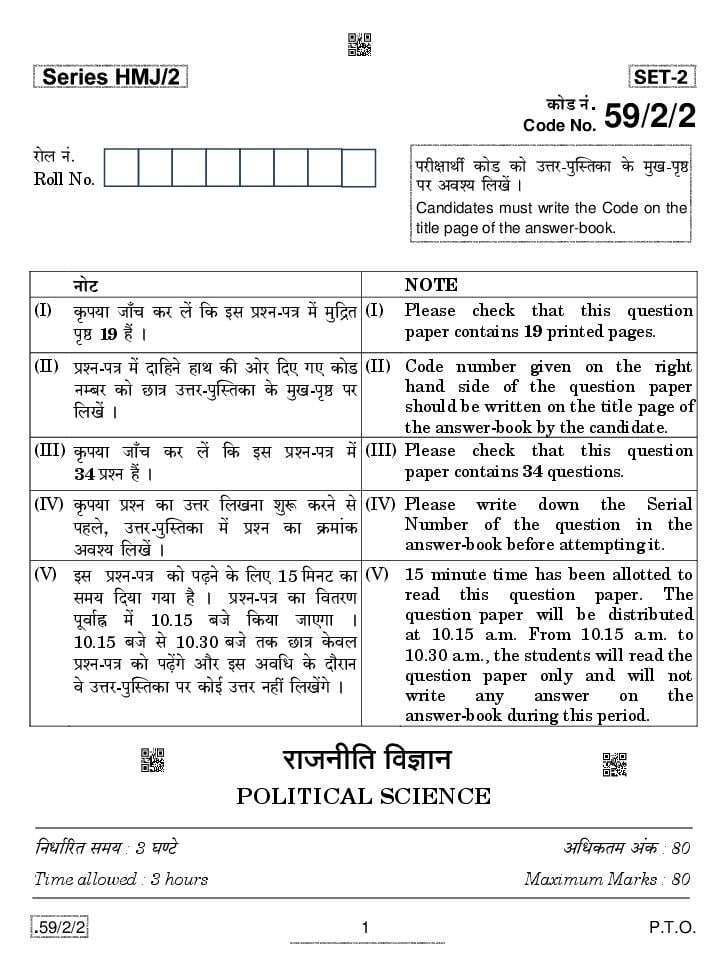
Code No. 59/2/2
amob Z§. narjmWu H$moS >H$mo CÎma-nwpñVH$m Ho$ _wI-n¥ð
Roll No. >na Adí` {bIo§ &
Candidates must write the Code on the
title page of the answer-book.
ZmoQ> NOTE
(I) H¥$n`m Om±M H$a b| {H$ Bg àíZ-nÌ _o§ _w{ÐV (I) Please check that this question
n¥ð> 19 h¢ & paper contains 19 printed pages.
(II) àíZ-nÌ _| Xm{hZo hmW H$s Amoa {XE JE H$moS (II) Code number given on the right
>Zå~a H$mo N>mÌ CÎma-nwpñVH$m Ho$ _wI-n¥ð> na hand side of the question paper
{bI| & should be written on the title page of
the answer-book by the candidate.
(III) H¥$n`m Om±M H$a b| {H$ Bg àíZ-nÌ _| (III) Please check that this question
>34 àíZ h¢ & paper contains 34 questions.
(IV) H¥$n`m àíZ H$m CÎma {bIZm ewê$ H$aZo go (IV) Please write down the Serial
nhbo, CÎma-nwpñVH$m _| àíZ H$m H«$_m§H$ Number of the question in the
Adí` {bI| & answer-book before attempting it.
(V) Bg àíZ-nÌ H$mo n‹T>Zo Ho$ {bE 15 {_ZQ >H$m (V) 15 minute time has been allotted to
g_` {X`m J`m h¡ & àíZ-nÌ H$m {dVaU read this question paper. The
nydm©• _| 10.15 ~Oo {H$`m OmEJm & question paper will be distributed
10.15 ~Oo go 10.30 ~Oo VH$ N>mÌ Ho$db at 10.15 a.m. From 10.15 a.m. to
10.30 a.m., the students will read the
àíZ-nÌ H$mo n‹T>|Jo Am¡a Bg Ad{Y Ho$ Xm¡amZ question paper only and will not
do CÎma-nwpñVH$m na H$moB© CÎma Zht {bI|Jo & write any answer on the
answer-book during this period.
amOZr{V {dkmZ
POLITICAL SCIENCE
{ZYm©[aV g_` : 3 KÊQ>o A{YH$V_ A§H$ : 80
Time allowed : 3 hours Maximum Marks : 80
.59/2/2 1 P.T.O.
Page 2
{ZåZ{b{IV {ZX}em| H$mo ~hþV gmdYmZr go n{‹T>E Am¡a CZH$m g»Vr go nmbZ H$s{OE :
(i) àíZ-nÌ nm±M IÊS>m| _| {d^m{OV h¡ H$, I, J, K Ed§ L> & g^r àíZ A{Zdm`©
h¢ &
(ii) IÊS> H$ àíZ g§»`m 1 go 20 VH$ A{V bKw-CÎmar` àíZ h¢, àË`oH$ àíZ 1 A§H$ H$m h¡ &
àË`oH$ àíZ H$m CÎma EH$ eãX `m EH$ dmŠ` naÝVw 20 eãXm| go A{YH$ Zht hmoZm Mm{hE &
(iii) IÊS> I àíZ g§»`m 21 go 23 bKw-CÎmar` àíZ h¢, àË`oH$ àíZ 2 A§H$m| H$m h¡ & àË`oH$ àíZ
H$m CÎma 40 eãXm| go A{YH$ Zht hmoZm Mm{hE &
(iv) IÊS> J àíZ g§»`m 24 go 27 VH$ XrK©-CÎmar` àíZ h¢, àË`oH$ àíZ 4 A§H$m| H$m
h¡ & àË`oH$ àíZ H$m CÎma 100 eãXm| go A{YH$ Zht hmoZm Mm{hE &
(v) IÊS> K àíZ g§»`m 28 go 30 VH$ Xmo àíZ AdVaU na VWm EH$ àíZ {MÌ AWdm H$mQy>©Z na
AmYm[aV h¡, àË`oH$ àíZ 5 A§H$m| H$m h¡ & àË`oH$ àíZ H$m CÎma 150 eãXm| go A{YH$ Zht hmoZm
Mm{hE &
àíZ g§»`m 31 _mZ{MÌ go g§~§{YV h¡ {Og_| _hÎdnyU© ñWmZm| H$s nhMmZ Xr JB© OmZH$mar Ho$
AmYma na hr H$s OmZr h¡ & BgH$m CÎma AnZr CÎma-nwpñVH$m _| {b{IE &
(vi) IÊS> L>> àíZ g§»`m 32 go 34 VH$ XrK©-CÎmar` àíZ h¢, àË`oH$ àíZ 6 A§H$m| H$m
h¡ & àË`oH$ àíZ H$m CÎma 150 eãXm| go A{YH$ Zht hmoZm Mm{hE &
(vii) CÎma g§{jßV VWm q~Xþdma hmoZo Mm{hE Am¡a gmW hr Cn`w©º$ eãX gr_m H$m `Wmg§^d nmbZ
H$s{OE &
(viii) àíZ-nÌ _| H$moB© g_J« {dH$ën Zht h¡ & VWm{n, EH$ -EH$ A§H$ dmbo EH$ àíZ _|, Mma-Mma A§H$m|
dmbo EH$ àíZ _| VWm N> :-N> : A§H$m| dmbo VrZ àíZm| _| Am§V[aH$ {dH$ën {XE JE h¢ & Eogo àíZm|
_| go Ho$db EH$ hr {dH$ën H$m CÎma {b{IE &
(ix) BgHo$ A{V[aº$, Amdí`H$VmZwgma, àË`oH$ IÊS> Am¡a àíZ Ho$ gmW `Wmo{MV {ZX}e {XE JE h¢ &
IÊS> H$
1. {H$g `wÕ H$mo ‘H$åß`yQ>a `wÕ’ Ho$ Zm_ go ^r OmZm OmVm h¡ ? > 1
AWdm
lrb§H$m H$mo nhbo {H$g Zm_ go OmZm OmVm Wm ? 1
.59/2/2 2
Page 3
Read the following instructions very carefully and strictly follow them :
(i) Question paper comprises five Sections A, B, C, D and E. All questions are
compulsory.
(ii) Section A – Questions no. 1 to 20 are very short-answer type questions,
carrying 1 mark each. They are required to be answered in one word or one
sentence each, but not exceeding 20 words.
(iii) Section B – Questions no. 21 to 23 are short-answer type questions, carrying
2 marks each. Answers to them should not exceed 40 words each.
(iv) Section C – Questions no. 24 to 27 are long-answer type questions, carrying
4 marks each. Answers to them should not exceed 100 words each.
(v) Section D – Questions no. 28 to 30 are two passage based questions and one
picture OR cartoon based question, carrying 5 marks each. Answers to them
should not exceed 150 words each.
Question no. 31 is a map based question that includes identification of
important places on the basis of given information. Write its answers in your
answer-book.
(vi) Section E – Questions no. 32 to 34 are long-answer type questions, carrying
6 marks each. Answers to them should not exceed 150 words each.
(vii) Answers should be brief and to the point and the above word limit be adhered
to as far as possible.
(viii) There is no overall choice in the question paper. However, an internal choice
has been provided in 1 question of one mark, 1 question of four marks and
3 questions of six marks. Only one of the choices in such questions is to be
attempted.
(ix) In addition to this, separate instructions are given with each section and
question, wherever necessary.
SECTION A
1. Which war is also known as the ‘Computer War’ ? 1
OR
What was the earlier name of Sri Lanka ? 1
.59/2/2 3 P.T.O.
Page 4
(A) _m¡bmZm A~wb H$bm_ AmµOmX
(B) gr. amOJmonmbmMmar
(C) AmMm`© ZaoÝÐ Xod
(D) Oo.gr. Hw$_maßnm
3. 22d| amÁ` Ho$ ê$n _|, {g{ŠH$_ Ho$ ^maV Ho$ gmW {db` Ho$ g_`, Mmo½`mb H$s ^y{_H$m H$m
{díbofU H$s{OE & 1
4. {díd ì`mnma g§JR>Z (S>ãë`y.Q>r.Amo.) H$mo {dH$mgerb Xoem| Ho$ {bE A{YH$ ñdrH$m`© ~ZmZo
Ho$ {bE H$moB© EH$ H$X_ gwPmBE & 1
5. ^maV _| Xoer [a`mgVm| H$mo {_bmZo _| _hÎdnyU© ^y{_H$m {Z^mZo dmbo ZoVm H$m nyam Zm_
{b{IE & 1
6. gm§ñH¥${VH$ {df_Vm go Š`m A{^àm` h¡ ? 1
7. 1985 Ho$ Ag_ g_Pm¡Vo Ho$ n[aUm_ H$m AmH$bZ H$s{OE & 1
8. {H$gr amîQ´> H$s {dXoe Zr{V {H$g H$maH$ go à^m{dV hmoVr h¡ ? ghr CÎma Mw{ZE & 1
(A) Ho$db gm§ñH¥${VH$ H$maH$
(B) Ho$db Am§V[aH$ H$maH$
(C) Am§V[aH$ Am¡a A§Vam©îQ´>r` H$maH$
(D) Ho$db Am{W©H$ H$maH$
9. ê$g _| g_mOdmXr H«$m§{V Ho$ ~mX g_mOdmXr gmo{d`V JUamÁ` (`y.Eg.Eg.Ama.) {H$g df©
_| ApñVËd _| Am`m ? 1
(A) 1914
(B) 1917
(C) 1939
(D) 1991
.59/2/2 4
Page 5
Permanence’ ? 1
(A) Maulana Abul Kalam Azad
(B) C. Rajagopalachari
(C) Acharya Narendra Dev
(D) J.C. Kumarappa
3. Analyse Chogyal’s role at the time of Sikkim’s merger with India as its
22nd State. 1
4. Suggest any one step that should be taken to make the World Trade
Organisation (WTO) more acceptable to the developing countries. 1
5. Write the full name of the leader who played a prominent role in the
integration of Princely States with India. 1
6. What is meant by cultural heterogenisation ? 1
7. Assess the outcome of the Assam Accord of 1985. 1
8. The foreign policy of a nation is affected by which factors ? Choose the
correct answer. 1
(A) Cultural factors only
(B) Domestic factors only
(C) Domestic and international factors
(D) Economic factors only
9. The Union of Soviet Socialist Republics (USSR) came into being after the
Socialist Revolution in Russia in 1
(A) 1914
(B) 1917
(C) 1939
(D) 1991
.59/2/2 5 P.T.O.
Page 6
Ho$ g§Kr` {dVaU H$mo H$_µOmoa H$a {X`m’’ ? {H$gr EH$ VH©$ Ûmam AnZo CÎma H$s nw{îQ>
H$s{OE & 1
11. ZrMo {XE JE H$WZ H$mo ghr H$aHo$ AnZr CÎma-nwpñVH$m _| nwZ: {b{IE :
Zohê$ Ho$ ~mX, AQ>b {~hmar dmOno`r, 1988 _| Xmo Xoem| Ho$ ~rM g§~§Ym| H$mo gwYmaZo Ho$ {bE,
MrZ OmZo dmbo àW_ àYmZ _§Ìr ~Zo & 1
12. {ZåZ{b{IV KQ>ZmAm| _| go g~go A§V _| H$m¡Z-gr KQ>Zm KQ>r ? 1
(A) ZmQ>mo H$s ñWmnZm
(B) àW_ {díd `wÕ
(C) {hamo{e_m _| na_mUw ~_ H$m {Jam`m OmZm
(D) àW_ JwQ>{Zanoj gå_obZ
13. AmnHo$ {dMma _|, ^maV _| nhbo VrZ Am_ MwZmdm| _| H$m±J«og nmQ>u Ho$ à^wËd Ho$ {bE CÎmaXmB©
à_wI H$maU H$m¡Z-gm Wm ? 1
14. ‘H$m±J«og qgS>rHo$Q>’ H$m AW© ñnîQ> H$s{OE & 1
1 1
15. Cn`wº$ amÁ` Ho$ Zm_ Ûmam [aº$ ñWmZm| H$s ny{V© H$s{OE : + =1
2 2
________ amÁ` _| {Z`moOZ Am¡a {dH$mg Ho$ {bE Omo amñVm MwZm J`m Cgo ‘________m°S>b’
H$hm OmVm h¡ &
16. Vm‹S>r-{damoYr Am§XmobZ H$mo nyar Vah go EH$ _{hbm Am§XmobZ Š`m| H$hm J`m h¡ ? 1
17. Eg.B©.E.Q>r.Amo. (grQ>mo) H$m nyU© ê$n {b{IE & 1
18. {ZåZ{b{IV H$WZ H$mo ghr AWdm µJbV Ho$ ê$n _| nhMmZ H$s{OE & {H$gr EH$ CXmhaU
Ûmam AnZo CÎma H$s nw{îQ> H$s{OE &
CÎmar JmobmÕ© Ho$ Xoe ‘{díd H$s gmPr g§nXm’ H$s gwajm Ho$ {bE X{jUr JmobmÕ© Ho$ Xoem| go
H$ht Á`mXm qM{VV h¢ & 1
.59/2/2 6
Page 7
federal distribution of power in India’’ ? Give any one argument to
support your answer. 1
11. Correct the statement given below and rewrite it in your answer-book :
After Nehru, Atal Behari Vajpayee became the first Prime Minister to
visit China in 1988 to improve relations between the two countries. 1
12. Which one of the following was the last to happen ? 1
(A) Foundation of NATO
(B) First World War
(C) Dropping of Atomic bomb on Hiroshima
(D) First NAM Summit
13. In your opinion, which major factor was responsible for the dominance of
the Congress Party in the first three general elections in India ? 1
14. Explain the term ‘The Congress Syndicate’. 1
1 1
15. Fill in the blanks with the appropriate name of the State : + =1
2 2
The ‘____________ Model’ is the name given to the path of planning and
development charted by the State of ____________.
16. Why was Anti-Arrack Movement called totally a woman’s movement ? 1
17. Write the full form of SEATO. 1
18. Identify the following statement as true or false. Give any one example to
justify your answer.
‘‘The countries of the North are more concerned about the protection of
the global commons than the countries of the South.’’ 1
.59/2/2 7 P.T.O.
Page 8
(A) EH$ gmPr {dXoe Zr{V àXmZ H$aZm
(B) EH$b _wÐm H$m {Z_m©U
(C) EH$ gmPo ~mµOma H$s ñWmnZm
(D) Ý`m` VWm Am§V[aH$ _m_bm| go Ow‹S>o _wÔm| na gh`moJ
20. Cg amOZr{VH$ Xb H$s nhMmZ H$s{OE Omo EH$ Xoe, EH$ g§ñH¥${V Am¡a EH$ amîQ´> Ho$ {dMma
na ~b XoVm h¡ & 1
(A) ^maVr` amîQ´>r` H$m±J«og
(B) ^maVr` OZg§K
(C) ñdV§Ì nmQ>u
(D) ^maVr` H$å`w{ZñQ> nmQ>u
IÊS> I
21. ^maV Ho$ EH$-Xb Ho$ à^wËd Am¡a MrZ Ho$ EH$-Xb Ho$ à^wËd Ho$ ~rM A§Va ñnîQ> H$s{OE & 2
22. g§`wº$ amîQ´> gwajm n[afX² H$s ñWmB© gXñ`Vm Ho$ {bE, ^maV H$s Cå_rXdmar H$m g_W©Z {H$gr
EH$ Cn`wº$ VH©$ Ûmam H$s{OE & 2
23. ^maVr` amOZr{V na 1974 Ho$ JwOamV N>mÌ Am§XmobZ Ho$ {H$Ýht Xmo à^mdm| H$m dU©Z
H$s{OE & 21=2
IÊS> J
24. {Vã~V _wÔm Š`m Wm ? ^maV Zo {Vã~Vr eaUm{W©`m| H$s {H$g àH$ma _XX H$s ? 2+2=4
25. `h H$hZm H$hm± VH$ C{MV h¡ {H$ `{X X{jU E{e`m Ho$ g^r Xoe AnZr gr_m aoIm Ho$
Ama-nma _wº$-ì`mnma na gh_V hmo OmE±, Vmo Bg joÌ _| em§{V Am¡a gh`moJ Ho$ EH$ ZE
AÜ`m` H$s ewéAmV hmo gH$Vr h¡ ? 4
26. {H$Ýht Mma VH$m] Ûmam {gÕ H$s{OE {H$ gmo{d`V g§K àemg{ZH$ Am¡a amOZr{VH$ AWm] _|
pñWa hmo J`m Wm & 41=4
AWdm
`{X gmo{d`V g§K H$m {dKQ>Z Zht hþAm hmoVm, Vmo Cg pñW{V H$m {díd, amOZr{V na Š`m
Aga hmoVm ? 4
.59/2/2 8
Page 9
establishment of the European Union is false ? 1
(A) To provide a common foreign policy
(B) Creation of a single currency
(C) Establishment of a common market
(D) Cooperation on justice and home affairs
20. Identify the political party which lays emphasis on the idea of one
country, one culture and one nation. 1
(A) Indian National Congress
(B) Bharatiya Jana Sangh
(C) Swatantra Party
(D) Communist Party of India
SECTION B
21. Differentiate between one-party dominance of India and the one-party
dominance of China. 2
22. Give any one suitable argument to support India’s candidature for
permanent membership of the UN Security Council. 2
23. Describe any two effects of the students agitation of 1974 in Gujarat on
Indian politics. 21=2
SECTION C
24. What was the Tibet issue ? How did India help the Tibetan refugees ? 2+2=4
25. How far is it justified to say that a new chapter of peace and cooperation
might evolve in South Asia if all the countries in the region allow free
trade across the borders ? 4
26. Give any four arguments to prove that the Soviet Union had become
stagnant in an administrative and political sense. 41=4
OR
If the Soviet Union had not disintegrated, how would that situation have
affected world politics ? 4
.59/2/2 9 P.T.O.
Page 10
dU©Z H$s{OE & 1+3=4
IÊS> K
28. ZrMo {XE JE H$mQy>©Z H$m Ü`mZnyd©H$ AÜ``Z H$s{OE VWm {ZåZ{b{IV àíZm| Ho$ CÎma
Xr{OE :
(a) H$mQy>©Z _| {XImE JE g¡{ZH$ VWm H$~yVa {H$g ~mV Ho$ àVrH$ h¢ ?
(b) H$mQy>©Z Ûmam Š`m g§Xoe {X`m Om ahm h¡ ?
(c) H$mQy>©Z Ho$ AZwgma, g¡{ZH$ {H$g H$m`© H$mo nyam H$aZo H$m à`mg H$a ahm h¡ ? 2+2+1=5
ZmoQ> : {ZåZ{b{IV àíZ Ho$db Ñ{ï>~m{YV narjm{W©`m| Ho$ {bE àíZ g§»`m 28 Ho$ ñWmZ na
h¢ &
(28.1) nma§n[aH$ gwajm Zr{V Ho$ KQ>H$ Ho$ ê$n _| JR>~§YZ {Z_m©U H$m Š`m AW© h¡ ?
(28.2) nma§n[aH$ gwajm H$s Am§V[aH$ Am¡a ~mhar YmaUm Ho$ ~rM CXmhaUm| H$s ghm`Vm go
A§Va ñnîQ> H$s{OE & 2+3=5
.59/2/2 10
Page 11
Indian politics. 1+3=4
SECTION D
28. Study the cartoon given below carefully and answer the questions that
follow :
(a) What do the soldier and the pigeon shown in the cartoon
symbolise ?
(b) What message does the cartoon convey ?
(c) As per the cartoon, what task is the soldier trying to
accomplish ? 2+2+1=5
Note : The following questions are for the Visually Impaired Candidates
only, in lieu of Q. No. 28.
(28.1) What is meant by alliance building as a component of traditional
security policy ?
(28.2) Distinguish between the internal and external notion of
traditional security with the help of examples. 2+3=5
.59/2/2 11 P.T.O.
Page 12
{b{IE :
ha Xoe H$mo ny±OrdmXr AW©ì`dñWm Ho$ {bE ~Xbmd H$aZo H$s Amdí`H$Vm Wr, {OgH$m
_Vb~ Wm gmo{d`V g§K Ho$ Xm¡a _| {dH${gV hþB© ha g§aMZm go {ZOmV nmZm & em°H$ Woaonr H$s
gdm}n[a _mÝ`Vm Wr {H$ {_pëH$`V H$m g~go à^mdr ê$n {ZOr ñdm{_Ëd hmoJm & BgHo$
A§VJ©V amÁ` H$s g§nXm Ho$ {ZOrH$aU Am¡a ì`mdgm{`H$ ñdm{_Ëd Ho$ T>m±Mo H$mo Vwa§V AnZmZo
H$s ~mV em{_b Wr & gm_y{hH$ ‘\$m_©’ H$mo {ZOr ‘\$m_©’ _| ~Xbm J`m Am¡a n±yOrdmXr nÕ{V
go IoVr ewê$ hþB© & Bg g§H«$_U _| amÁ`-{Z`§{ÌV g_mOdmX `m n±yOrdmX Ho$ A{V[aº$ {H$gr
^r d¡H$pënH$ ì`dñWm `m ‘Vrgao éI’ H$mo _§µOya Zht {H$`m J`m &
(a) {ZOr ñdm{_Ëd go Š`m A{^àm` h¡ ?
(b) gm_y{hH$ \$m_m] H$mo {ZOr \$m_m] _| Š`m| ~Xbm OmZm Wm ? H$moB© Xmo H$maU Xr{OE &
(c) amÁ`-{Z`§{ÌV g_mOdmX Ho$ {H$Ýht Xmo bm^m| H$mo COmJa H$s{OE & 1+2+2=5
30. ZrMo {XE JE AdVaU H$m Ü`mZnyd©H$ AÜ``Z H$s{OE Am¡a {ZåZ{b{IV àíZm| Ho$ CÎma
{b{IE :
µ\¡$gbm hþAm {H$ A~ VH$ {Og ^y-^mJ H$mo ‘B§{S>`m’ Ho$ Zm_ go OmZm OmVm Wm Cgo ‘^maV’
Am¡a ‘nm{H$ñVmZ’ Zm_ Ho$ Xmo Xoem| Ho$ ~rM ~m±Q> {X`m OmEJm & `h {d^mOZ XX©ZmH$ Vmo Wm
hr, Bg na µ\¡$gbm H$aZm Am¡a A_b _| bmZm Am¡a ^r H${R>Z Wm & V` {H$`m J`m {H$
Ym{_©H$ ~hþg§»`m H$mo {d^mOZ H$m AmYma ~Zm`m OmEJm & BgHo$ _m`Zo `h Wo {H$ {OZ
BbmH$m| _| _wgb_mZ ~hþg§»`H$ Wo dh BbmHo$ nm{H$ñVmZ Ho$ ^y-^mJ hm|Jo Am¡a eof {hñgo
^maV H$hbmE±Jo & `h ~mV Wmo‹S>r AmgmZ OmZ n‹S>Vr h¡, bo{H$Z Agb _| Bg_| H$B© {H$ñ_
H$s {XŠH$V| Wt &
(a) 1947 _| ^maV H$m {d^mOZ BVZm A{YH$ XX©ZmH$ Š`m| {gÕ hþAm ?
(b) {d^mOZ H$s amh _| CËnÞ hþB© {H$Ýht Xmo _w»` H${R>ZmB`m| H$m {díbofU H$s{OE &
(c) `{X ^maV H$m {d^mOZ Z hþAm hmoVm, Vmo {díd _| ^maV H$s pñW{V Š`m hmoVr ? 1+2+2=5
.59/2/2 12
Page 13
follow :
Each of these countries was required to make a total shift to a capitalist
economy, which meant rooting out completely any structures evolved
during the Soviet period. Above all, shock therapy meant that private
ownership was to be the dominant pattern of ownership of property.
Privatisation of state assets and corporate ownership patterns were to be
immediately brought in. Collective farms were to be replaced by private
farming and capitalism in agriculture. This transition ruled out any
alternate or ‘third way’, other than state-controlled socialism or
capitalism.
(a) What is meant by private ownership ?
(b) Why were collective farms to be replaced by private farming ? Give
any two reasons.
(c) Highlight any two advantages of state-controlled socialism. 1+2+2=5
30. Study the passage given below carefully and answer the questions that
follow :
Thus it was decided that what was till then known as ‘India’ would be
divided into two countries, ‘India’ and ‘Pakistan’. Such a division was not
only very painful, but also very difficult to decide and to implement. It
was decided to follow the principle of religious majorities. This basically
means that areas where the Muslims were in majority would make up
the territory of Pakistan. The rest was to stay with India. The idea might
appear simple, but it presented all kinds of difficulties.
(a) Why did the partition of India in 1947 prove to be very painful ?
(b) Analyse any two major difficulties that arose in the way of
partition.
(c) What would have been India’s position in the world, had there
been no partition of India ? 1+2+2=5
.59/2/2 13 P.T.O.
Page 14
VWm Ho$ Ûmam A§{H$V {H$`m J`m h¡ & ZrMo Xr JB© OmZH$mar Ho$ AmYma
na BZ amÁ`m| H$s nhMmZ H$s{OE Am¡a AnZr CÎma-nwpñVH$m _| BZHo$ ghr Zm_, à`moJ H$s JB©
OmZH$mar H$s H«$_ g§»`m VWm _mZ{MÌ _| {X`m J`m g§~pÝYV Aja, ZrMo Xr JB© Vm{bH$m Ho$
ê$n _| {b{IE :
à`moJ H$s JB© OmZH$mar _mZ{MÌ _| amÁ` H$m Zm_
H$s H«$_ g§»`m g§~pÝYV Aja
(i)
(ii)
(iii)
(iv)
(v)
(i) Vm‹S>r-{damoYr Am§XmobZ go g§~§{YV amÁ` &
(ii) gyMZm Ho$ A{YH$ma Ho$ {bE Am§XmobZ go g§~§{YV amÁ` &
(iii) dh amÁ` Ohm± ‘Am°naoeZ ãby ñQ>ma’ {H$`m J`m &
(iv) hmb hr _| ~Zm`m J`m Ho$ÝÐ-em{gV àXoe &
(v) ~µJmdV go à^m{dV joÌ Omo 1986 _| amÁ` ~Zm & 51=5
.59/2/2 14
Page 15
^maV H$m aoIm-_mZ{MÌ (amOZr{VH$)
E
A
D
B
C
.59/2/2 15 P.T.O.
Page 16
been marked as and . Identify these States on the
basis of information given below and write their correct names in your
answer-book along with the respective serial number of the information
used and the concerned alphabets given in the map as per the following
format :
Sr. no. of the Concerned alphabet Name of the
information used in the map State
(i)
(ii)
(iii)
(iv)
(v)
(i) The State related to Anti-Arrack Movement.
(ii) The State related to the movement for Right to Information.
(iii) The State where ‘Operation Blue Star’ was launched.
(iv) Recently created Union Territory.
(v) Insurgency affected region which became a State in 1986. 51=5
.59/2/2 16
Page 17
Outline Map of India (Political)
E
A
D
B
C
.59/2/2 17 P.T.O.
Page 18
h¢ &
(31.1) Vm‹S>r-{damoYr Am§XmobZ {H$g amÁ` go g§~§{YV h¡ ?
(31.2) ‘gyMZm Ho$ A{YH$ma’ g§~§Yr Am§XmobZ H$s ewéAmV {H$g amÁ` go H$s JB© Wr ?
(31.3) ‘Am°naoeZ ãby ñQ>ma’ {H$g amÁ` go g§~§{YV h¡ ?
(31.4) hmb hr _| ~Zo Xmo Ho$ÝÐ-em{gV àXoem| Ho$ Zm_ {b{IE &
(31.5) ^maVr` g§K Ho$ 22d| amÁ` H$m Zm_ {b{IE Omo 1975 _| ApñVËd _| Am`m & 51=5
IÊS> L>>
32. CZ n[apñW{V`m| H$m dU©Z H$s{OE {OZHo$ A§VJ©V 1969 _| amîQ´>n{V nX Ho$ {bE MwZmd hþE Wo
& Bg MwZmd Ho$ n[aUm_ Zo H$m±J«og nmQ>u H$mo H¡$go à^m{dV {H$`m ? 3+3=6
AWdm
1975 Ho$ AmnmVH$mb Ûmam {gImE JE {H$Ýht VrZ g~H$m| H$m dU©Z H$s{OE & 3 2=6
33. n`m©daUr` jaU H$s amoH$Wm_ Ho$ {bE, ^maV gaH$ma Ûmam CR>mE JE {H$Ýht VrZ H$X_m| H$m
_yë`m§H$Z H$s{OE & 3 2=6
AWdm
d¡ídrH$aU Ho$ {dñVma _| àm¡Úmo{JH$s Ho$ `moJXmZ H$m AmH$bZ H$s{OE & 6
34. Eogo {H$Ýht VrZ {d{^Þ VarH$m| H$s ì`m»`m H$s{OE {OZHo$ Ûmam A_arH$s dM©ñd go {ZnQ>m Om
gH$Vm h¡ & 32=6
AWdm
`yamonr` g§K H$mo A{V à^mdembr joÌr` g§JR>Z ~ZmZo Ho$ {bE CÎmaXmB© {H$Ýht VrZ H$maH$m|
H$s ì`m»`m H$s{OE & 32=6
.59/2/2 18
Page 19
only, in lieu of Q. No. 31.
(31.1) Which State is related to Anti-Arrack Movement ?
(31.2) The movement for ‘Right to Information’ was started in which
State ?
(31.3) ‘Operation Blue Star’ is related to which State ?
(31.4) Name the two recently created Union Territories.
(31.5) Name the 22nd State of the Indian Union which came into
existence in 1975. 51=5
SECTION E
32. Describe the circumstances under which the Presidential election of 1969
was held. How did the outcome of this election affect the Congress
Party ? 3+3=6
OR
Describe any three lessons taught by the Emergency of 1975. 32=6
33. Evaluate any three steps taken by the Indian Government to check the
environmental degradation. 32=6
OR
Assess the impact of technology in the spread of globalisation. 6
34. Explain any three different ways in which American hegemony could be
overcome. 32=6
OR
Explain any three factors responsible for the European Union to be a
highly influential regional organisation. 32=6
.59/2/2 19 P.T.O.
Document Details
| Board / Org | CBSE |
| Exam | Class 12 |
| Type | Question Paper |
| Pages | 19 |
| Updated | 22 Jul 2026 |