CBSE Class 12 Political Science Question Paper 2020 Set 59-3-2
Finished viewing? Save it for later —
Download CBSE Class 12 Political Science Question Paper 2020 Set 59-3-2 (PDF · 19 pages)About CBSE Class 12 Political Science Question Paper 2020 Set 59-3-2
CBSE Class 12 Political Science Question Paper 2020 Set 59-3-2 is available here for free download. Published by CBSE for Class 12, this question paper can be viewed online or downloaded as a PDF (19 pages). Candidates preparing for Class 12 can use CBSE Class 12 Political Science Question Paper 2020 Set 59-3-2 to understand the exam pattern, the type of questions asked, and the overall difficulty level.
Frequently Asked Questions
How can I download CBSE Class 12 Political Science Question Paper 2020 Set 59-3-2?
Open this page and click the Download button to save CBSE Class 12 Political Science Question Paper 2020 Set 59-3-2 as a PDF. It is completely free on AglaSem Docs.
Is CBSE Class 12 Political Science Question Paper 2020 Set 59-3-2 free to download?
Yes. CBSE Class 12 Political Science Question Paper 2020 Set 59-3-2 can be viewed online and downloaded as a PDF free of cost on AglaSem Docs.
How many pages does CBSE Class 12 Political Science Question Paper 2020 Set 59-3-2 have?
CBSE Class 12 Political Science Question Paper 2020 Set 59-3-2 contains 19 pages, which you can read online or download together as a single PDF.
Where can I find more Class 12 study material?
You can find more Class 12 question papers, sample papers, syllabus, and answer keys on AglaSem Docs.
CBSE Class 12 Political Science Question Paper 2020 Set 59-3-2 – Text
Read the full text of this question paper below — useful to quickly search, copy and reference the content online without downloading the PDF.
📄 View text version (19 pages)
Page 1
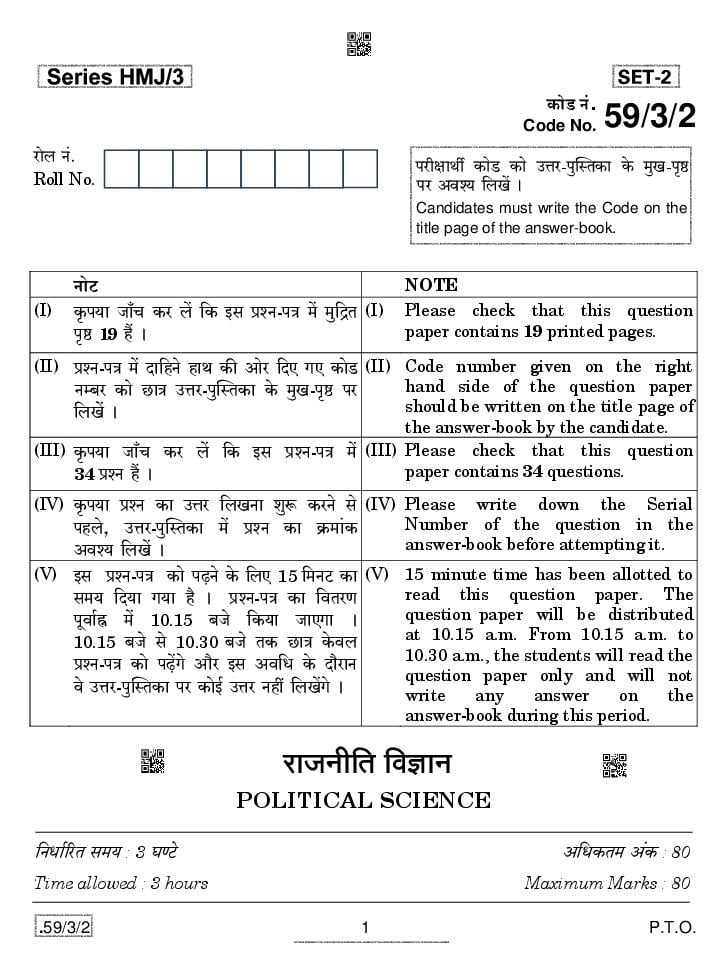
Code No. 59/3/2
amob Z§. narjmWu H$moS >H$mo CÎma-nwpñVH$m Ho$ _wI-n¥ð
Roll No. >na Adí` {bIo§ &
Candidates must write the Code on the
title page of the answer-book.
ZmoQ> NOTE
(I) H¥$n`m Om±M H$a b| {H$ Bg àíZ-nÌ _o§ _w{ÐV (I) Please check that this question
n¥ð> 19 h¢ & paper contains 19 printed pages.
(II) àíZ-nÌ _| Xm{hZo hmW H$s Amoa {XE JE H$moS (II) Code number given on the right
>Zå~a H$mo N>mÌ CÎma-nwpñVH$m Ho$ _wI-n¥ð> na hand side of the question paper
{bI| & should be written on the title page of
the answer-book by the candidate.
(III) H¥$n`m Om±M H$a b| {H$ Bg àíZ-nÌ _| (III) Please check that this question
>34 àíZ h¢ & paper contains 34 questions.
(IV) H¥$n`m àíZ H$m CÎma {bIZm ewê$ H$aZo go (IV) Please write down the Serial
nhbo, CÎma-nwpñVH$m _| àíZ H$m H«$_m§H$ Number of the question in the
Adí` {bI| & answer-book before attempting it.
(V) Bg àíZ-nÌ H$mo n‹T>Zo Ho$ {bE 15 {_ZQ >H$m (V) 15 minute time has been allotted to
g_` {X`m J`m h¡ & àíZ-nÌ H$m {dVaU read this question paper. The
nydm©• _| 10.15 ~Oo {H$`m OmEJm & question paper will be distributed
10.15 ~Oo go 10.30 ~Oo VH$ N>mÌ Ho$db at 10.15 a.m. From 10.15 a.m. to
10.30 a.m., the students will read the
àíZ-nÌ H$mo n‹T>|Jo Am¡a Bg Ad{Y Ho$ Xm¡amZ question paper only and will not
do CÎma-nwpñVH$m na H$moB© CÎma Zht {bI|Jo & write any answer on the
answer-book during this period.
amOZr{V {dkmZ
POLITICAL SCIENCE
{ZYm©[aV g_` : 3 KÊQ>o A{YH$V_ A§H$ : 80
Time allowed : 3 hours Maximum Marks : 80
.59/3/2 1 P.T.O.
Page 2
{ZåZ{b{IV {ZX}em| H$mo ~hþV gmdYmZr go n{‹T>E Am¡a CZH$m g»Vr go nmbZ H$s{OE :
(i) àíZ-nÌ nm±M IÊS>m| _| {d^m{OV h¡ H$, I, J, K Ed§ L> & g^r àíZ A{Zdm`©
h¢ &
(ii) IÊS> H$ àíZ g§»`m 1 go 20 VH$ A{V bKw-CÎmar` àíZ h¢, àË`oH$ àíZ 1 A§H$ H$m h¡ &
àË`oH$ àíZ H$m CÎma EH$ eãX `m EH$ dmŠ` naÝVw 20 eãXm| go A{YH$ Zht hmoZm Mm{hE &
(iii) IÊS> I àíZ g§»`m 21 go 23 bKw-CÎmar` àíZ h¢, àË`oH$ àíZ 2 A§H$m| H$m h¡ & àË`oH$ àíZ
H$m CÎma 40 eãXm| go A{YH$ Zht hmoZm Mm{hE &
(iv) IÊS> J àíZ g§»`m 24 go 27 VH$ XrK©-CÎmar` àíZ h¢, àË`oH$ àíZ 4 A§H$m| H$m
h¡ & àË`oH$ àíZ H$m CÎma 100 eãXm| go A{YH$ Zht hmoZm Mm{hE &
(v) IÊS> K àíZ g§»`m 28 go 30 VH$ Xmo àíZ AdVaU na VWm EH$ àíZ {MÌ AWdm H$mQy>©Z na
AmYm[aV h¡, àË`oH$ àíZ 5 A§H$m| H$m h¡ & àË`oH$ àíZ H$m CÎma 150 eãXm| go A{YH$ Zht hmoZm
Mm{hE &
àíZ g§»`m 31 _mZ{MÌ go g§~§{YV h¡ {Og_| _hÎdnyU© ñWmZm| H$s nhMmZ Xr JB© OmZH$mar Ho$
AmYma na hr H$s OmZr h¡ & BgH$m CÎma AnZr CÎma-nwpñVH$m _| {b{IE &
(vi) IÊS> L>> àíZ g§»`m 32 go 34 VH$ XrK©-CÎmar` àíZ h¢, àË`oH$ àíZ 6 A§H$m| H$m
h¡ & àË`oH$ àíZ H$m CÎma 150 eãXm| go A{YH$ Zht hmoZm Mm{hE &
(vii) CÎma g§{jßV VWm q~Xþdma hmoZo Mm{hE Am¡a gmW hr Cn`w©º$ eãX gr_m H$m `Wmg§^d nmbZ
H$s{OE &
(viii) àíZ-nÌ _| H$moB© g_J« {dH$ën Zht h¡ & VWm{n, EH$-EH$ A§H$ dmbo 1 àíZ _|, Mma-Mma A§H$m|
dmbo 1 àíZ _| VWm N> :-N> : A§H$m| dmbo 3 àíZm| _| Am§V[aH$ {dH$ën {XE JE h¢ & Eogo àíZm| _| go
Ho$db EH$ hr {dH$ën H$m CÎma {b{IE &
(ix) BgHo$ A{V[aº$, Amdí`H$VmZwgma, àË`oH$ IÊS> Am¡a àíZ Ho$ gmW `Wmo{MV {ZX}e {XE JE h¢ &
IÊS> H$
1. {ZåZ{b{IV dm³¶ H$mo gmW©H$ ê$n go nyU© H$s{OE :
{~b p³b¨Q>Z H$s gaH$ma Zo AnZr {dXoe Zr{V ‘| __________ VWm __________ O¡go Za‘
1 1
‘wÔm| na ܶmZ H|${ÐV {H$¶m & + =1
2 2
AWdm
2005 ‘| ‘mbXrd Ho$ amOZr{VH$ ‘m‘bm| ‘| H$m¡Z-gr amOZr{VH$ nmQ>u H$m X~X~m Wm ? 1
.59/3/2 2
Page 3
Read the following instructions very carefully and strictly follow them :
(i) This question paper comprises five Sections A, B, C, D and E. All questions
are compulsory.
(ii) Section A – Questions no. 1 to 20 are very short-answer type questions,
carrying 1 mark each. They are required to be answered in one word or one
sentence each, but not exceeding 20 words.
(iii) Section B – Questions no. 21 to 23 are short-answer type questions, carrying
2 marks each. Answers to them should not exceed 40 words each.
(iv) Section C – Questions no. 24 to 27 are long-answer type questions, carrying
4 marks each. Answers to them should not exceed 100 words each.
(v) Section D – Questions no. 28 to 30 are two passage-based questions and one
picture OR cartoon-based question, carrying 5 marks each. Answers to them
should not exceed 150 words each.
Question no. 31 is a map-based question that includes identification of
important places on the basis of given information. Write its answers in your
answer-book.
(vi) Section E – Questions no. 32 to 34 are long-answer type questions, carrying
6 marks each. Answers to them should not exceed 150 words each.
(vii) Answers should be brief and to the point and the above word limit be adhered
to as far as possible.
(viii) There is no overall choice in the question paper. However, an internal choice
has been provided in 1 question of one mark, 1 question of four marks and
3 questions of six marks. Only one of the choices in such questions is to be
attempted.
(ix) In addition to this, separate instructions are given with each section and
question, wherever necessary.
SECTION A
1. Complete the following sentence in a meaningful way :
In foreign policy, the government of Bill Clinton tended to focus on soft
1 1
issues like _________ and _________. + =1
2 2
OR
Which political party dominated the political affairs of Maldives in 2005 ? 1
.59/3/2 3 P.T.O.
Page 4
‘~m°å~o ßbmZ’ Ho$ AZwgma ^maV H$mo _________ {Zdoe Ho$ joÌ ‘| ~‹S>o H$X‘ CR>mZo Mm{hE± &
3. H$ma{Jb g§Kf© Ho$ g‘¶, {díd H$m ܶmZ AmH${f©V hmoZo H$m ‘w»¶ H$maU ³¶m Wm ? 1
4. nhMmZ H$s{OE {H$ n¥Ïdr gå‘obZ, 1992 Ho$ ~mao _| {ZåZ{b{IV V϶ ghr AWdm
µJbV h¡ : 1
nhbr ~ma d¡pídH$ amOZr{V Ho$ Xm¶ao ‘| n¶m©daUr¶ ‘wÔm| H$mo 1992 Ho$ n¥Ïdr gå‘obZ ‘| EH$
R>mog ê$n {X¶m J¶m &
5. WTO H$mo {dH$mgerb Xoem| Ho$ {bE A{YH$ ñdrH$m¶© ~ZmZo Ho$ {bE H$moB© ^r EH$ Cnm¶
gwPmBE & 1
6. ‘{Û-amîQ´> {gÕm§V’ H$s ~mV {H$gZo H$s Wr ? 1
7. 2014 ‘| H|$Ð ‘| gaH$ma ~ZmZo dmbo JR>~§YZ Ho$ nyao Zm‘ H$m C„oI H$s{OE Am¡a Cg gaH$ma
1 1
H$m ZoV¥Ëd {H$gZo {H$¶m ? + =1
2 2
8. AZwÀN>oX 51 go g§~§{YV {ZåZ{b{IV g§d¡Ym{ZH$ {gÕm§Vm| ‘| go H$m¡Z-gm EH$ ghr Zht h¡ ? 1
(A) A§Vam©îQ´>r¶ em§{V Am¡a gwajm H$mo ~‹T>mdm XoZm &
(B) amîQ´>m| Ho$ ~rM AÀN>o Am{W©H$ g§~§Ym| H$mo ~ZmE aIZm &
(C) A§Vam©îQ´>r¶ H$mZyZm| Am¡a g§{Y¶m| Ho$ {bE gå‘mZ &
(D) ‘ܶñWVm Ûmam A§Vam©îQ´>r¶ {ddmXm| Ho$ {ZnQ>mZ H$mo àmoËgm{hV H$aZm &
9. {ZåZ{b{IV dm³¶ H$mo gmW©H$ ê$n go nyU© H$s{OE : 1
{ÛVr` {díd ¶wÕ H$s g‘m{ßV H$m n[aUm‘ ¶h hþAm {H$ d¡pídH$ amOZr{V Ho$ ‘§M na _____
H$m CX` hþAm &
10. ‘‘bmoH${චAm§XmobZm| H$mo hVmoËgm{hV Zht {H$¶m OmZm Mm{hE &’’ H$moB© EH$ Cn¶w³V VH©$ XoVo
hþE Bg H$WZ H$s nw{îQ> H$s{OE & 1
.59/3/2 4
Page 5
The ‘Bombay Plan’ wanted India to take major initiatives in __________
investment.
3. What was the main reason for the Kargil conflict to draw worldwide
attention ? 1
4. Identify whether the following statement about the Earth Summit, 1992
is true or false. 1
For the first time, environmental issues within the arena of global
politics were firmly consolidated at the Earth Summit in 1992.
5. Suggest any one measure that should be taken to make the WTO more
acceptable to the developing countries. 1
6. By whom was the ‘two-nation theory’ advanced ? 1
7. Mention the full name of the alliance that formed the government at the
1 1
Centre in 2014 and who headed that government ? + =1
2 2
8. Which one of the following Constitutional principles related to Article 51
is incorrect ? 1
(A) Promote international peace and security.
(B) Maintain good economic relations between nations.
(C) Respect for international law and treaties.
(D) Encourage settlement of international disputes by arbitration.
9. Complete the following sentence in a meaningful way : 1
On the global political stage, the consequences of the end of the Second
World War was the rise of _________.
10. ‘‘Popular movements should not be discouraged.’’ Support the statement
by giving any one appropriate argument. 1
.59/3/2 5 P.T.O.
Page 6
am¶ ‘|, BgHo$ nrN>o ‘w»¶ H$maU ³¶m Wm ? 1
12. gmå¶dmX Ho$ nVZ Ho$ ~mX, nyd© gmå¶dmXr Xoem| ‘| ³¶m ‘w»¶ Am{W©H$ ~Xbmd Am¶m ? 1
13. 1990 Ho$ XeH$ Ho$ A§V ‘|, ^maV ‘| ‘VXmZ Ho$ VarH$m| ‘| ewê$ {H$E JE {H$gr EH$ ~‹S>o
~Xbmd H$mo COmJa H$s{OE & 1
14. bmb~hmXþa emñÌr Ho$ àYmZ‘§Ìr H$mb ‘|, ^maV Ho$ gm‘Zo AmBª Xmo à‘wI MwZm¡{V¶m| H$s Om±M
1
H$s{OE & 2 =1
2
15. {ZåZ{b{IV ‘| go H$m¡Z-gm EH$ {dMma ^maV H$s {dH$mg H$s Zr{V Ho$ ewéAmVr MaUm| H$m
{hñgm Zht Wm ? 1
(A) CXmarH$aU
(B) ¶moOZm
(C) J«m‘rU joÌ H$s µJar~r H$mo Xÿa H$aZm
(D) gm‘m{OH$ ݶm¶
16. Jmodm ^maVr¶ g§K H$m EH$ amÁ¶ H$~ ~Zm ? 1
1
17. [a³V ñWmZm| H$s ny{V© Cn¶w³V eãXm| Ûmam H$s{OE : 2 =1
2
³¶y~m H$m Ow‹S>md gmo{d¶V g§K go Wm Am¡a gmo{d¶V g§K Cgo _________ Am¡a _________
ghm¶Vm XoVm Wm &
18. ZrMo {XE JE H$WZ H$mo ghr H$aHo$ nwZ… AnZr CÎma-nwpñVH$m ‘| {b{IE : 1
JR>~§YZ {Z‘m©U µJ¡a-gaH$mar g§JR>Zm| H$m EH$ Eogm JR>~§YZ h¡ Omo µJ¡a-nma§n[aH$ gwajm go
~Mmd Ho$ {bE AnZo H$m¶m] H$m g‘Ýd¶ H$aVm h¡ &
19. Am{g¶mZ Ho$ JR>Z Ho$ {ZåZ{b{IV CÔoí¶m| ‘| go H$m¡Z-gm ghr Zht h¡ ? 1
(A) Am{g¶mZ Ho$ gXñ¶m| Ho$ ~rM ~mVMrV H$m EH$ ‘§M &
(B) AnZo gXñ¶m| Ûmam nmbZ H$s OmZo dmbr ajm Zr{V ~ZmZm &
(C) joÌ ‘| EH$ gmPm ~mµOma ~ZmZm &
(D) joÌr¶ {ddmXm| H$mo amoH$Zm &
.59/3/2 6
Page 7
opinion, what was the main reason behind this ? 1
12. After the collapse of Communism, what was the major economic change
in the post-Communist countries ? 1
13. Highlight any one of the major changes introduced in the voting methods
in India towards the end of 1990s. 1
14. Examine the two major challenges faced by India during the
1
Prime-Ministership of Lal Bahadur Shastri. 2=1
2
15. Which one of the following ideas was not part of the early phases of
India’s development policy ? 1
(A) Liberalisation
(B) Planning
(C) Alleviation of rural poverty
(D) Social justice
16. When did Goa become a State of the Indian Union ? 1
1
17. Fill in the blanks with suitable words : 2=1
2
Cuba was an ally of the Soviet Union and received both _________ and
_________ aid from it.
18. Correct the following statement and rewrite it in your answer-book : 1
An alliance building is a coalition of NGOs that coordinates their actions
to defend against non-traditional security.
19. Which one among the following objectives for the formation of ASEAN is
incorrect ? 1
(A) A forum of interaction among the ASEAN members.
(B) To create a defence policy to be followed by its members.
(C) To create a common market in the region.
(D) To stop territorial disputes.
.59/3/2 7 P.T.O.
Page 8
H$a, 1935 go 1941 VH$, ‘w»¶V¶m H$m¶© {H$¶m ? 1
(A) g‘mOdmXr nmQ>u
(B) ^maVr¶ OZg§K
(C) ñdV§Ì nmQ>u
(D) ^maVr¶ H$å¶w{ZñQ> nmQ>u
IÊS> I
21. ñdV§ÌVm Ho$ ~mX ^maV ‘| AnZmE JE Am{W©H$ {dH$mg Ho$ ‘m°S>b Ho$ g§~§Y ‘| Agh‘{V Ho$
{H$Ýht Xmo joÌm| H$s Om±M H$s{OE & 21=2
22. {H$Ýht Xmo CXmhaUm| H$s ‘XX go C{MV R>hamBE {H$ àm¡Úmo{JH$s d¡ídrH$aU H$mo ~‹T>mdm XoVr
h¡ & 21=2
23. 1975 ‘| bJmE JE AmnmVH$mb Ho$ H$maU ^maVr¶ ZmJ[aH$m| Ho$ OrdZ VWm AmµOmXr Ho$
A{YH$ma na n‹S>o {H$Ýht Xmo à^mdm| H$m C„oI H$s{OE & 21=2
IÊS> J
24. CZ n[apñW{V¶m| H$m dU©Z H$s{OE {OZHo$ H$maU {Vã~{V¶m| H$mo MrZ N>mo‹S>Zo Ho$ {bE {dde
hmoZm n‹S>m & {Vã~Vr eaUm{W©¶m| H$s ‘XX H$aZo ‘| ^maV H$s ^y{‘H$m H$mo COmJa H$s{OE & 2+2=4
25. 1990 Ho$ df© VH$ gmo{d¶V ì¶dñWm BVZr H$‘µOmoa ³¶m| hmo JB© VWm AW©ì¶dñWm ‘| J{VamoY
³¶m| Am¶m ? H$moB© Xmo H$maU ñnîQ> H$s{OE & 22=4
AWdm
JwQ>{ZanojVm H$s Zr{V Zo {H$Z Xmo VarH$m| go ^maV H$m à˶j ê$n go {hV gmYZ {H$¶m ?
ì¶m»¶m H$s{OE & 22=4
26. nm{H$ñVmZ ‘| bmoH$Vm§{ÌH$ ì¶dñWm pñWa ³¶m| Zht ahr h¡ ? {H$Ýht Xmo H$maUm| H$mo ñnîQ>
H$s{OE & 22=4
27. 1989 Ho$ bmoH$g^m MwZmdm| Ho$ n[aUm‘m| Zo {H$g àH$ma ^maV ‘o| H|$Ðr¶ ñVa na JR>~§YZ
gaH$mam| Ho$ ¶wJ H$s ewéAmV H$s ? 4
.59/3/2 8
Page 9
Indian National Congress from 1935 to 1941 before parting ways ? 1
(A) Socialist Party
(B) Bharatiya Jana Sangh
(C) Swatantra Party
(D) Communist Party of India
SECTION B
21. Examine any two areas of disagreement with respect to the model of
economic development adopted in India after independence. 21=2
22. Justify with the help of any two examples that technology gives a boost to
globalization. 21=2
23. Mention any two effects of the Emergency imposed in 1975, on the Right
to life and liberty of citizens of India. 21=2
SECTION C
24. Describe the circumstances that forced the Tibetans to leave China.
Highlight India’s role in helping the Tibetan refugees. 2+2=4
25. Why did the Soviet System become so weak and the economy stagnated
by the end of 1990. Explain any two reasons. 22=4
OR
In which two ways did the non-aligned posture serve India’s interest very
directly ? Explain. 22=4
26. Why has the democratic system not been stable in Pakistan ? Explain
any two reasons. 22=4
27. How did the outcome of Lok Sabha elections in 1989 initiate an era of
coalition governments at the Centre in India ? 4
.59/3/2 9 P.T.O.
Page 10
28. ZrMo {XE JE H$mQy>©Z H$m Ü`mZnyd©H$ AÜ``Z H$s{OE Am¡a {ZåZ{b{IV àíZm| Ho$ CÎma
{b{IE :
d¡pídH$ Vmnd¥{Õ
(a) d¡pídH$ Vmnd¥{Õ go ³¶m A{^àm¶ h¡ ?
(b) H$mQy>©Z ‘| {XImB© JB© C±J{b¶m| H$mo {M‘Zr H$s Vah ³¶m| Xem©¶m J¶m h¡ ?
(c) bmBQ>a Ho$ ê$n _| {XIm¶m J¶m {díd, ‘mZd g‘mO H$mo ³¶m g§Xoe XoVm h¡ ? 1+2+2=5
ZmoQ> : {ZåZ{b{IV àíZ Ho$db Ñ{ï>~m{YV narjm{W©`m| Ho$ {bE àíZ g§»`m 28 Ho$ ñWmZ na
h¢ &
(28.1) n¶m©daU Am¡a àmH¥${VH$ g§gmYZm| Ho$ ‘wÔo {díd amOZr{V H$m {hñgm ³¶m| ~Z JE
h¢ ? H$moB© Xmo H$maU {b{IE &
(28.2) AnZo n[adoe H$mo àXÿfU go ~MmZo Ho$ {bE H$moB© VrZ Cnm¶ gwPmBE & 2+3=5
.59/3/2 10
Page 11
28. Study the cartoon given below carefully and answer the questions that
follow :
GLOBAL WARMING
(a) What is meant by global warming ?
(b) Why are the fingers shown in the cartoon designed like chimneys ?
(c) What message does the world shown as a lighter, convey to the
mankind ? 1+2+2=5
Note : The following questions are for the Visually Impaired Candidates
only, in lieu of Q. No. 28.
(28.1) Why have the issues of environment and natural resources
become a part of world politics ? Give any two reasons.
(28.2) Suggest any three measures to protect your surroundings from
pollution. 2+3=5
.59/3/2 11 P.T.O.
Page 12
{b{IE :
qhXþñVmZ H$s OZVm Bgr jU H$s àVrjm H$a ahr Wr & AmnZo B{Vhmg H$s
nmR>çnwñVH$m| ‘| n‹T>m h¡ {H$ h‘mar AmµOmXr H$s b‹S>mB© ‘| H$B© AmdmµO| ~wb§X Wt & ~hahmb,
Xmo ~mVm| na g~H$s gh‘{V Wr nhbr ~mV ¶h {H$ AmµOmXr Ho$ ~mX Xoe H$m emgZ
bmoH$Vm§{ÌH$ gaH$ma Ho$ O[aE Mbm¶m OmEJm Am¡a Xÿgar ¶h {H$ gaH$ma g~Ho$ ^bo Ho$ {bE
H$m‘ H$aoJr & Bg emgZ ‘| µJar~m| Am¡a H$‘µOmoam| H$m Img I¶mb aIm OmEJm & Xoe A~
AmµOmX hmo MwH$m Wm Am¡a AmµOmXr go Ow‹S>o BZ gnZm| H$mo gmH$ma H$aZo H$m d³V Am J¶m Wm &
¶h H$moB© AmgmZ H$m‘ Zht Wm & AmµOmX qhXþñVmZ H$m OÝ‘ H${R>Z n[apñW{V¶m| ‘| hþAm &
qhXþñVmZ gZ² 1947 ‘| {OZ hmbmV Ho$ ~rM AmµOmX hþAm, em¶X Cg d³V VH$ H$moB© ^r
‘wëH$ d¡go hmbmV ‘| AmµOmX Zht hþAm Wm &
(a) CZ H${R>Z n[apñW{V¶m| H$s ì¶m»¶m H$s{OE {OZ‘| 1947 ‘| ^maV ñdV§Ì hþAm &
(b) ^maV H$mo EH$ bmoH$Vm§{ÌH$ Xoe ~ZmZo dmbr ^maVr¶ g§{dYmZ H$s {H$Ýht Xmo
{deofVmAm| H$mo COmJa H$s{OE &
(c) µJar~m| VWm gm‘m{OH$ ê$n go {nN>‹S>o bmoJm| Ho$ CËWmZ Ho$ {bE ~Zo {H$gr EH$
g§d¡Ym{ZH$ àmdYmZ H$m C„oI H$s{OE & 2+2+1=5
30. ZrMo {XE JE AdVaU H$m Ü`mZnyd©H$ AÜ``Z H$s{OE Am¡a {ZåZ{b{IV àíZm| Ho$ CÎma
{b{IE :
¶hm± ¶h ¶mX aIZm ^r µOê$ar h¡ {H$ ^maV Zo JwQ>{Zanoj Am§XmobZ ‘| em{‘b Aݶ
gXñ¶m| H$mo ^r Eogo H$m‘m| ‘| g§b½Z aIm & erV ¶wÕ Ho$ Xm¡amZ ^maV Zo bJmVma CZ joÌr¶
Am¡a A§Vam©îQ´>r¶ g§JR>Zm| H$mo g{H«$¶ ~ZmE aIZo H$s H$mo{ee H$s Omo ‘hme{³V¶m| Ho$ Io_o go
Zht Ow‹S>o Wo & Zohê$ Zo ‘ñdV§Ì Am¡a nañna gh¶moJr amîQ´>m| Ho$ EH$ gƒo amîQ´>Hw$b’ Ho$ D$na
Jham {dídmg OVm¶m Omo erV ¶wÕ H$mo IË‘ H$aZo ‘| Z ghr, na CgH$s OH$‹S> T>rbr H$aZo
‘| hr gH$mamË‘H$ ^y{‘H$m {Z^mE &
(a) {H$Z Xmo ‘hme{³V¶m| Zo AnZo-AnZo Io‘o H$m ZoV¥Ëd {H$¶m ?
(b) ñdV§Ì VWm nañna gh¶moJr Xoem| go {H$g àH$ma H$s gH$mamË‘H$ ^y{‘H$m H$s Anojm
H$s Om ahr Wr ?
(c) JwQ>{Zanoj Am§XmobZ Ho$ Aݶ gXñ¶m| H$mo ^maV bú¶ H$s àm{ßV ‘| ³¶m| em{‘b H$aZm
MmhVm Wm ? 1+2+2=5
.59/3/2 12
Page 13
follow :
This was the moment Indians had been waiting for. You have read
in your history textbooks that there were many voices in our national
movement. But there were two goals almost everyone agreed upon: one,
that after Independence, we shall run our country through democratic
government; and two, that the government will be run for the good of all,
particularly the poor and the socially disadvantaged groups. Now that
the country was independent, the time had come to realise the promise of
freedom. This was not going to be easy. India was born in very difficult
circumstances. Perhaps no other country by then was born in a situation
more difficult than that of India in 1947.
(a) Explain the difficult circumstances in which India became free in
1947.
(b) Highlight any two features of the Indian Constitution which make
India a democratic country.
(c) Mention any one constitutional provision meant for the upliftment
of the poor and the socially disadvantaged. 2+2+1=5
30. Read the passage given below carefully and answer the questions that
follow :
It is important to remember that India chose to involve other
members of the non-aligned group in this mission. During the Cold War,
India repeatedly tried to activate those regional and international
organisations, which were not a part of the alliances led by the
superpowers. Nehru reposed great faith in ‘a genuine Commonwealth of
free and cooperating nations’ that would play a positive role in softening,
if not ending, the Cold War.
(a) Which two superpowers led their alliances ?
(b) What type of positive role was expected from the free and
cooperating nations ?
(c) Why did India want to involve other members of the non-aligned
group in the said mission ? 1+2+2=5
.59/3/2 13 P.T.O.
Page 14
VWm Ho$ Ûmam A§{H$V {H$`m J`m h¡ & ZrMo Xr JB© OmZH$mar Ho$
AmYma na BZ amÁ`m| H$s nhMmZ H$s{OE Am¡a AnZr CÎma-nwpñVH$m _| BZHo$ ghr Zm_, à`moJ
H$s JB© OmZH$mar H$s H«$_-g§»`m VWm _mZ{MÌ _| {X`m J`m g§~pÝYV Aja, ZrMo Xr JB©
Vm{bH$m Ho$ ê$n _| {b{IE :
à`moJ H$s JB© OmZH$mar _mZ{MÌ _|
H$s H«$_-g§»`m g§~pÝYV Aja amÁ` H$m Zm_
(i)
(ii)
(iii)
(iv)
(v)
(i) dh amÁ¶ Ohm± amOrd Jm±Yr H$s h˶m hþB© &
(ii) Xÿgao ‘{nN>‹S>m dJ© Am¶moJ’ Ho$ Aܶj, ~r.nr. ‘§S>b go g§~§{YV amÁ¶ &
(iii) dh àXoe Omo 1986 ‘| EH$ AbJ amÁ¶ ~Z J¶m &
(iv) dh amÁ¶ Ohm± dm_ Xbm| Zo 2004 ‘| bmoH$g^m H$s A{YH$m§e grQ>| OrVt &
(v) dh amÁ` Ohm± ‘Am°naoeZ ãby ñQ>ma’ hþAm & 51=5
.59/3/2 14
Page 15
^maV H$m aoIm-_mZ{MÌ (amOZr{VH$)
A
B
E
C
D
.59/3/2 15 P.T.O.
Page 16
been marked as and . Identify these States on the basis
of the information given below and write their correct names in your
answer-book along with the respective serial number of the information
used and the concerned alphabet given in the map as per the following
format :
Sr. no. of the Concerned alphabet Name of the
information used in the map State
(i)
(ii)
(iii)
(iv)
(v)
(i) The State where the assassination of Rajiv Gandhi took place.
(ii) The State related to B.P. Mandal who chaired the Second
Backward Classes Commission.
(iii) The region that became a separate State in 1986.
(iv) The State where the Left Parties won the majority of Lok Sabha
seats in 2004.
(v) The State where ‘Operation Blue Star’ took place. 51=5
.59/3/2 16
Page 17
Outline Map of India (Political)
A
B
E
C
D
.59/3/2 17 P.T.O.
Page 18
h¢ &
(31.1) amOrd Jm±Yr H$s h˶m {H$g amÁ¶ ‘| hþB© Wr ?
(31.2) ~r.nr. ‘§S>b H$m g§~§Y {H$g amÁ¶ go Wm ?
(31.3) Cg amÁ¶ H$m Zm‘ {b{IE Ohm± go Eb.Ho$. AmS>dmUr Zo AnZr aW ¶mÌm ewê$ H$s
Wr &
(31.4) nyd© àYmZ‘§Ìr EM.S>r. Xodo Jm¡S>m {H$g amÁ¶ go MwZmd OrV H$a AmE Wo ?
(31.5) ñdU© ‘§{Xa {H$g amÁ¶ ‘| pñWV h¡ ? 5 1=5
IÊS> L>>
32. ^maV Ho$ amOZr{VH$ Am¡a MwZmdr B{Vhmg _| 1967 H$mo EH$ Eo{Vhm{gH$ df© ~ZmZo dmbr
{H$Ýht N>… KQ>ZmAm| H$m dU©Z H$s{OE & 6 1=6
AWdm
25 OyZ, 1975 H$mo ^maV ‘| H$s JB© AmnmVH$mb H$s KmofUm Ho$ {bE {µOå‘oXma n[apñW{V¶m|
H$m dU©Z H$s{OE & 6
33. {díd na A‘arH$s dM©ñd Ho$ amOZr{VH$ à^mdm| H$m {díbofU H$s{OE & 6
AWdm
Am{g¶mZ g‘wXm¶ Ho$ VrZ ‘w»¶ ñV§^m| H$m AmH$bZ H$s{OE & 32=6
34. g§¶w³V amîQ´> gwajm n[afX² Ho$ ZE ñWm¶r VWm AñWm¶r gXñ¶m| Ho$ {bE àñVm{dV {H$E JE
{H$Ýht N>… ‘mZX§S>m| H$mo COmJa H$s{OE & 61=6
AWdm
nma§n[aH$ gwajm H$s Am§V[aH$ Am¡a ~mhar YmaUmAm| Ho$ ~rM A§Va ñnîQ> H$s{OE & 3+3=6
.59/3/2 18
Page 19
only, in lieu of Q. No. 31.
(31.1) In which State did the assassination of Rajiv Gandhi take place ?
(31.2) B.P. Mandal was related to which State ?
(31.3) Name the State from where L.K. Advani started his Rath Yatra.
(31.4) The former Prime Minister, H.D. Deve Gowda was elected from
which State ?
(31.5) The Golden Temple is situated in which State ? 51=5
SECTION E
32. Describe any six events of the year 1967 which made it a landmark year
in India’s political and electoral history. 61=6
OR
Describe the circumstances responsible for the declaration of Emergency
in India on 25th June, 1975. 6
33. Analyse the political impact of the US hegemony on the world. 6
OR
Assess the three main pillars of the ASEAN Community. 32=6
34. Highlight any six criteria proposed for the new permanent and
non-permanent members of the UN Security Council. 61=6
OR
Distinguish between the internal and external notions of traditional
security. 3+3=6
.59/3/2 19 P.T.O.
Document Details
| Board / Org | CBSE |
| Exam | Class 12 |
| Type | Question Paper |
| Pages | 19 |
| Updated | 22 Jul 2026 |