CBSE Class 12 Question Paper 2025 Solution Tangkhul
Finished viewing? Save it for later —
Download CBSE Class 12 Question Paper 2025 Solution Tangkhul (PDF · 5 pages)About CBSE Class 12 Question Paper 2025 Solution Tangkhul
CBSE Class 12 Question Paper 2025 Solution Tangkhul is available here for free download. Published by CBSE for Class 12, this solution can be viewed online or downloaded as a PDF (5 pages). Candidates preparing for Class 12 can use CBSE Class 12 Question Paper 2025 Solution Tangkhul to understand the exam pattern, the type of questions asked, and the overall difficulty level.
Frequently Asked Questions
How can I download CBSE Class 12 Question Paper 2025 Solution Tangkhul?
Open this page and click the Download button to save CBSE Class 12 Question Paper 2025 Solution Tangkhul as a PDF. It is completely free on AglaSem Docs.
Is CBSE Class 12 Question Paper 2025 Solution Tangkhul free to download?
Yes. CBSE Class 12 Question Paper 2025 Solution Tangkhul can be viewed online and downloaded as a PDF free of cost on AglaSem Docs.
How many pages does CBSE Class 12 Question Paper 2025 Solution Tangkhul have?
CBSE Class 12 Question Paper 2025 Solution Tangkhul contains 5 pages, which you can read online or download together as a single PDF.
Where can I find more Class 12 study material?
You can find more Class 12 question papers, sample papers, syllabus, and answer keys on AglaSem Docs.
CBSE Class 12 Question Paper 2025 Solution Tangkhul – Text
Read the full text of this solution below — useful to quickly search, copy and reference the content online without downloading the PDF.
📄 View text version (5 pages)
Page 1
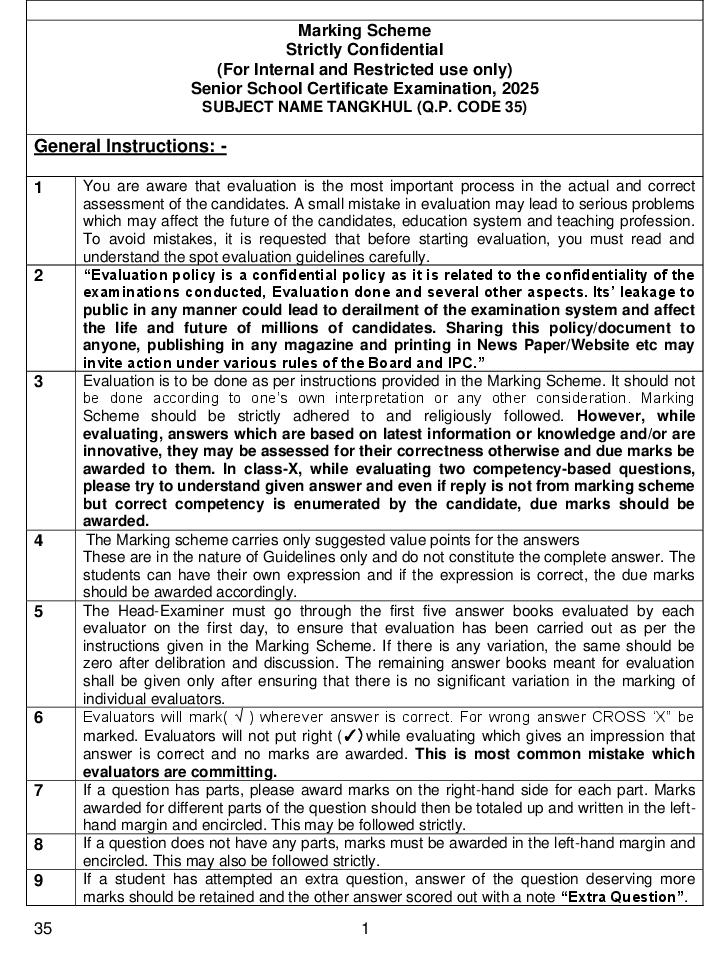
Strictly Confidential
(For Internal and Restricted use only)
Senior School Certificate Examination, 2025
SUBJECT NAME TANGKHUL (Q.P. CODE 35)
General Instructions: -
1 You are aware that evaluation is the most important process in the actual and correct
assessment of the candidates. A small mistake in evaluation may lead to serious problems
which may affect the future of the candidates, education system and teaching profession.
To avoid mistakes, it is requested that before starting evaluation, you must read and
understand the spot evaluation guidelines carefully.
2 “Evaluation policy is a confidential policy as it is related to the confidentiality of the
examinations conducted, Evaluation done and several other aspects. Its’ leakage to
public in any manner could lead to derailment of the examination system and affect
the life and future of millions of candidates. Sharing this policy/document to
anyone, publishing in any magazine and printing in News Paper/Website etc may
invite action under various rules of the Board and IPC.”
3 Evaluation is to be done as per instructions provided in the Marking Scheme. It should not
be done according to one’s own interpretation or any other consideration. Marking
Scheme should be strictly adhered to and religiously followed. However, while
evaluating, answers which are based on latest information or knowledge and/or are
innovative, they may be assessed for their correctness otherwise and due marks be
awarded to them. In class-X, while evaluating two competency-based questions,
please try to understand given answer and even if reply is not from marking scheme
but correct competency is enumerated by the candidate, due marks should be
awarded.
4 The Marking scheme carries only suggested value points for the answers
These are in the nature of Guidelines only and do not constitute the complete answer. The
students can have their own expression and if the expression is correct, the due marks
should be awarded accordingly.
5 The Head-Examiner must go through the first five answer books evaluated by each
evaluator on the first day, to ensure that evaluation has been carried out as per the
instructions given in the Marking Scheme. If there is any variation, the same should be
zero after delibration and discussion. The remaining answer books meant for evaluation
shall be given only after ensuring that there is no significant variation in the marking of
individual evaluators.
6 Evaluators will mark( √ ) wherever answer is correct. For wrong answer CROSS ‘X” be
marked. Evaluators will not put right (✓)while evaluating which gives an impression that
answer is correct and no marks are awarded. This is most common mistake which
evaluators are committing.
7 If a question has parts, please award marks on the right-hand side for each part. Marks
awarded for different parts of the question should then be totaled up and written in the left-
hand margin and encircled. This may be followed strictly.
8 If a question does not have any parts, marks must be awarded in the left-hand margin and
encircled. This may also be followed strictly.
9 If a student has attempted an extra question, answer of the question deserving more
marks should be retained and the other answer scored out with a note “Extra Question”.
35 1
Page 2
once.
11 A full scale of marks __________(example 0 to 80/70/60/50/40/30 marks as given in
Question Paper) has to be used. Please do not hesitate to award full marks if the answer
deserves it.
12 Every examiner has to necessarily do evaluation work for full working hours i.e., 8 hours
every day and evaluate 20 answer books per day in main subjects and 25 answer books
per day in other subjects (Details are given in Spot Guidelines).This is in view of the
reduced syllabus and number of questions in question paper.
13 Ensure that you do not make the following common types of errors committed by the
Examiner in the past:-
● Leaving answer or part thereof unassessed in an answer book.
● Giving more marks for an answer than assigned to it.
● Wrong totaling of marks awarded on an answer.
● Wrong transfer of marks from the inside pages of the answer book to the title page.
● Wrong question wise totaling on the title page.
● Wrong totaling of marks of the two columns on the title page.
● Wrong grand total.
● Marks in words and figures not tallying/not same.
● Wrong transfer of marks from the answer book to online award list.
● Answers marked as correct, but marks not awarded. (Ensure that the right tick mark
is correctly and clearly indicated. It should merely be a line. Same is with the X for
incorrect answer.)
● Half or a part of answer marked correct and the rest as wrong, but no marks awarded.
14 While evaluating the answer books if the answer is found to be totally incorrect, it should
be marked as cross (X) and awarded zero (0)Marks.
15 Any unassessed portion, non-carrying over of marks to the title page, or totaling error
detected by the candidate shall damage the prestige of all the personnel engaged in the
evaluation work as also of the Board. Hence, in order to uphold the prestige of all
concerned, it is again reiterated that the instructions be followed meticulously and
judiciously.
16 The Examiners should acquaint themselves with the guidelines given in the “Guidelines
for Spot Evaluation” before starting the actual evaluation.
17 Every Examiner shall also ensure that all the answers are evaluated, marks carried over to
the title page, correctly totaled and written in figures and words.
18 The candidates are entitled to obtain photocopy of the Answer Book on request on
payment of the prescribed processing fee. All Examiners/Additional Head Examiners/Head
Examiners are once again reminded that they must ensure that evaluation is carried out
strictly as per value points for each answer as given in the Marking Scheme.
35 2
Page 3
$
MARKING SCHEME
TANGKHUL
1. (i) (C) kathuka wuklungli 1
(ii) (C) kaphā mibingna 1
(iii) (D) thangkhameiya 1
(iv) (C) ringkaphā kaho mavaimana 1
(v) (B) Common noun 1
2. (i) (D) Khayon kachāngli 1
(ii) (C) kathinaobingli kapāng phanitna. 1
(iii) (D) phāzā kachida 1
(iv) (A) Zingshoshong 1
(v) (B) abstract noun 1
3. Kakapiarā – atuikhamathing – asemkhamathā – pānānhkt. yangra. 8
4. Tuipam – atuikhamathing – pānānhkt. yangra. 4
5. (i) (B) demonstrative pronoun 1
(ii) (B) indefinite 1
6. (i) (C) adverb of degree 1
(ii) (B) adverb of manner 1
7. (i) (B) phut 1
(ii) (D) zak 1
8. (i) (A) tarai 1
(ii) (C) tok 1
35 3
Page 4
10. (C) angashirva 1
11. (B) mati 1
12. (A) kanrei 1
13. (B) zur 1
14. (C) mayarnao 1
15. (D) Masorim 1
16. (B) zingthan ngashada 1
17. (B) 1983 1
18. (B) mati 1
19. (C) wui ngalang kazārli pānkatamna 1
20. (C) Si 1
21. (D) apam kateili masamkaphang 1
22. (A) maikāngasak haira 1
23. (C) William Pettigrewli 1
24. (A) shim kachida kāpeiya 1
25. (C) M. Ninghorna 1
26. (C) masārngasak khangai 1
27. Paoyi azewui wungnao Suiphungwui li shimzunsai. 1
28. Nao matina. 1
29. Kachām khangai kala marānaobingna rutkhuiya. 1
30. Shanaoli fapaimei. 1
31. Kachon tārākha khopshānkha sākahai kachonli kahona. 1
32. Zingrot kakam ramna. Chili apamlaga akazāser haoda ningrei khāsa
kahaina. 2
33. Ashee eina pharali zangpama. 2
34. Avāvali Ngayo, avali Phuireila hoi. 2
35. Athum tharuk chiya, Honkhok kala ali ngaleng kashok Honreo khani.
Kala Honyo na alung zanglaga awui yāshong kazata Meihai kala awui
uishong kazata Mipuk hibing hina. 3
35 4
Page 5
i. asheewui eina mankhangarok
ii. ngasokapiwui eina khangayao
iii. avawui eina naoli mankakā 3
37. Shirui Timrāwon eina Sangaina. Shirui Timrāwonna Ukhrul District li
khalei Shirui Kaphungli samphanga kala Sangaina Keibul Lamjao,
Thoubal li samphanga. 3
38. Paoyi langchinwui lumshilao sāda khangatuk haophokta mi tārākha
ngatuka. Chithārān Ngari Kapungwui ngazunrā mazangsāthua. Phasā
mashaohaida ala ngatukkhava khuiphalungra jihaoda Longpi awunga
Luivaoli ngatuksada kasirhaowa. Luivaona ava mangatukthei mada
mangatuk ngaiga jilala Kapungna sāphalungrada kasir kazam haowa.
Yaruina Wungnao akhali chimathālu jilala mahengsangla, “Na Longpi
awunga maningmala?” ini aja khayui theikhui thāthārada kasir khangai
kasirhaowa. Luivaona maishiri eina awui shimzunli unghailala chili eina
tangda rengrālaga rākasir katapluiya. 4
39. Ashang eina Aton khanaowa samphang kahai thili khaleilaga Aton
naosak eina thihaowa. Pao chi shākhaleoda Ashang ningkachotna
makhāngrarthuda kathi ngakaohaowa. Khikha mashai mashakla
khumpam haowa. Chikathā eina kachangmakta Ashangla masāngla
thihaowa. Chithahaoda shimkhur khaninishi wukkhananglāk eina
pamda leilakha thangkha khanong akha rārāsāda khongtheng
heikhangasak eina Ashang eina Aton rida ani okathuili mayar ngalā
sālakhawui ngāngkhangayo thāda pamkhong akhali ngashailaga
ringphāsor kapam chi theilaga ani kazei rasut sāhairada anishi chieina
ningkhalem haowa. 4
40. Kapimena Yangyir atam eina naoshinaobingwui mirin pānkatamna. Lui
khavānaobing na yangyir atamwui mārongtheilaga ninglumtur chihānsa
luivākasangwui kachot malaiser kahai thāda, naongarāli ngashan
yangda ava avā kachot malaise haowa. Naongarāwui khakshot, lākhon
chamakhon thai.Yangyir hi mi kāphā kahaili chānkasam eina ngasoda
iyurwui vang kākashunga mirin khuirāmi khavaila ngakaowa. 4
35 5
Document Details
| Board / Org | CBSE |
| Exam | Class 12 |
| Type | Solution |
| Pages | 5 |
| Updated | 24 Sep 2026 |