CBSE Class 12 Question Paper 2025 Solution Taxation
Finished viewing? Save it for later —
Download CBSE Class 12 Question Paper 2025 Solution Taxation (PDF · 8 pages)About CBSE Class 12 Question Paper 2025 Solution Taxation
CBSE Class 12 Question Paper 2025 Solution Taxation is available here for free download. Published by CBSE for Class 12, this solution can be viewed online or downloaded as a PDF (8 pages). Candidates preparing for Class 12 can use CBSE Class 12 Question Paper 2025 Solution Taxation to understand the exam pattern, the type of questions asked, and the overall difficulty level.
Frequently Asked Questions
How can I download CBSE Class 12 Question Paper 2025 Solution Taxation?
Open this page and click the Download button to save CBSE Class 12 Question Paper 2025 Solution Taxation as a PDF. It is completely free on AglaSem Docs.
Is CBSE Class 12 Question Paper 2025 Solution Taxation free to download?
Yes. CBSE Class 12 Question Paper 2025 Solution Taxation can be viewed online and downloaded as a PDF free of cost on AglaSem Docs.
How many pages does CBSE Class 12 Question Paper 2025 Solution Taxation have?
CBSE Class 12 Question Paper 2025 Solution Taxation contains 8 pages, which you can read online or download together as a single PDF.
Where can I find more Class 12 study material?
You can find more Class 12 question papers, sample papers, syllabus, and answer keys on AglaSem Docs.
CBSE Class 12 Question Paper 2025 Solution Taxation – Text
Read the full text of this solution below — useful to quickly search, copy and reference the content online without downloading the PDF.
📄 View text version (8 pages)
Page 1
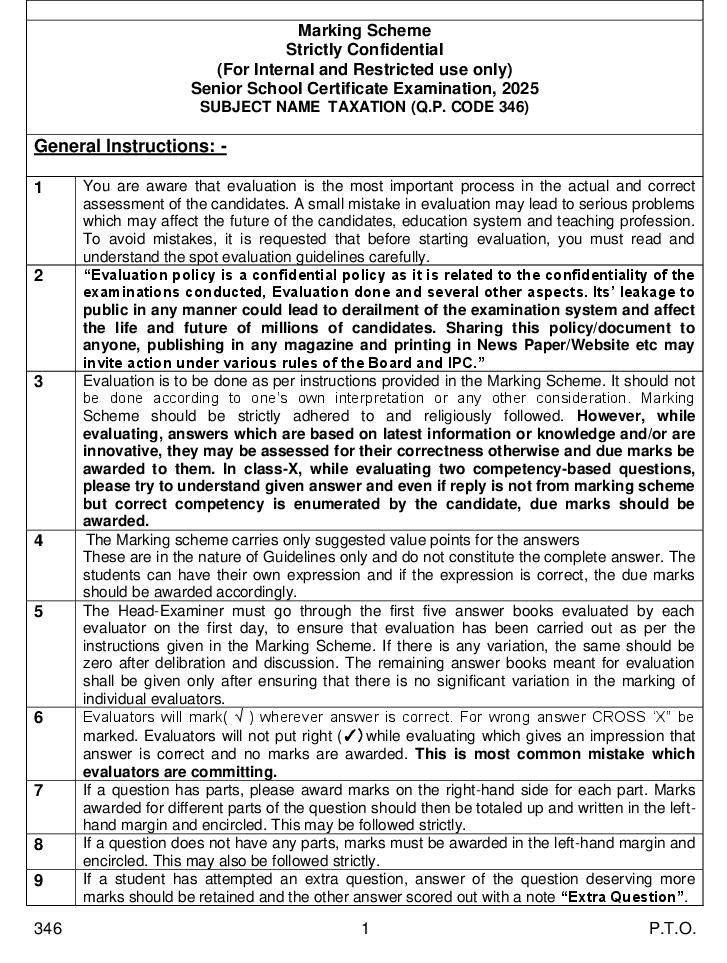
Strictly Confidential
(For Internal and Restricted use only)
Senior School Certificate Examination, 2025
SUBJECT NAME TAXATION (Q.P. CODE 346)
General Instructions: -
1 You are aware that evaluation is the most important process in the actual and correct
assessment of the candidates. A small mistake in evaluation may lead to serious problems
which may affect the future of the candidates, education system and teaching profession.
To avoid mistakes, it is requested that before starting evaluation, you must read and
understand the spot evaluation guidelines carefully.
2 “Evaluation policy is a confidential policy as it is related to the confidentiality of the
examinations conducted, Evaluation done and several other aspects. Its’ leakage to
public in any manner could lead to derailment of the examination system and affect
the life and future of millions of candidates. Sharing this policy/document to
anyone, publishing in any magazine and printing in News Paper/Website etc may
invite action under various rules of the Board and IPC.”
3 Evaluation is to be done as per instructions provided in the Marking Scheme. It should not
be done according to one’s own interpretation or any other consideration. Marking
Scheme should be strictly adhered to and religiously followed. However, while
evaluating, answers which are based on latest information or knowledge and/or are
innovative, they may be assessed for their correctness otherwise and due marks be
awarded to them. In class-X, while evaluating two competency-based questions,
please try to understand given answer and even if reply is not from marking scheme
but correct competency is enumerated by the candidate, due marks should be
awarded.
4 The Marking scheme carries only suggested value points for the answers
These are in the nature of Guidelines only and do not constitute the complete answer. The
students can have their own expression and if the expression is correct, the due marks
should be awarded accordingly.
5 The Head-Examiner must go through the first five answer books evaluated by each
evaluator on the first day, to ensure that evaluation has been carried out as per the
instructions given in the Marking Scheme. If there is any variation, the same should be
zero after delibration and discussion. The remaining answer books meant for evaluation
shall be given only after ensuring that there is no significant variation in the marking of
individual evaluators.
6 Evaluators will mark( √ ) wherever answer is correct. For wrong answer CROSS ‘X” be
marked. Evaluators will not put right (✓)while evaluating which gives an impression that
answer is correct and no marks are awarded. This is most common mistake which
evaluators are committing.
7 If a question has parts, please award marks on the right-hand side for each part. Marks
awarded for different parts of the question should then be totaled up and written in the left-
hand margin and encircled. This may be followed strictly.
8 If a question does not have any parts, marks must be awarded in the left-hand margin and
encircled. This may also be followed strictly.
9 If a student has attempted an extra question, answer of the question deserving more
marks should be retained and the other answer scored out with a note “Extra Question”.
346 1 P.T.O.
Page 2
once.
11 A full scale of marks __________(example 0 to 80/70/60/50/40/30 marks as given in
Question Paper) has to be used. Please do not hesitate to award full marks if the answer
deserves it.
12 Every examiner has to necessarily do evaluation work for full working hours i.e., 8 hours
every day and evaluate 20 answer books per day in main subjects and 25 answer books
per day in other subjects (Details are given in Spot Guidelines).This is in view of the
reduced syllabus and number of questions in question paper.
13 Ensure that you do not make the following common types of errors committed by the
Examiner in the past:-
● Leaving answer or part thereof unassessed in an answer book.
● Giving more marks for an answer than assigned to it.
● Wrong totaling of marks awarded on an answer.
● Wrong transfer of marks from the inside pages of the answer book to the title page.
● Wrong question wise totaling on the title page.
● Wrong totaling of marks of the two columns on the title page.
● Wrong grand total.
● Marks in words and figures not tallying/not same.
● Wrong transfer of marks from the answer book to online award list.
● Answers marked as correct, but marks not awarded. (Ensure that the right tick mark
is correctly and clearly indicated. It should merely be a line. Same is with the X for
incorrect answer.)
● Half or a part of answer marked correct and the rest as wrong, but no marks awarded.
14 While evaluating the answer books if the answer is found to be totally incorrect, it should
be marked as cross (X) and awarded zero (0)Marks.
15 Any unassessed portion, non-carrying over of marks to the title page, or totaling error
detected by the candidate shall damage the prestige of all the personnel engaged in the
evaluation work as also of the Board. Hence, in order to uphold the prestige of all
concerned, it is again reiterated that the instructions be followed meticulously and
judiciously.
16 The Examiners should acquaint themselves with the guidelines given in the “Guidelines
for Spot Evaluation” before starting the actual evaluation.
17 Every Examiner shall also ensure that all the answers are evaluated, marks carried over to
the title page, correctly totaled and written in figures and words.
18 The candidates are entitled to obtain photocopy of the Answer Book on request on
payment of the prescribed processing fee. All Examiners/Additional Head Examiners/Head
Examiners are once again reminded that they must ensure that evaluation is carried out
strictly as per value points for each answer as given in the Marking Scheme.
346 2
Page 3
$
MARKING SCHEME
TAXATION
SECTION A
(Objective Type Questions) (30 marks)
1. Answer any 4 out of the given 6 questions . 41=4
(i) (B) Turning communication into thoughts 1
(ii) Interruption in communication is called noise 1
(iii) (D) Ctrl + U 1
(iv) (C) Neuroticism 1
(v) (C) Both an art and a science 1
(vi) Green Jobs are Jobs that protect the environment 1
2. Answer any 5 out of the given 7 questions. 51=5
(i) (B) < 10,000 1
(ii) (D) December 31st 1
(iii) (A) PAN based 1
(iv) (D) 54EC 1
(v) A person who makes money by starting or running business 1
(vi) Skill, knowledge and attitude 1
(vii) (A) The Indian Green Building Council 1
3. Answer any 6 out of the given 7 questions. 61=6
(i) (B) < 1,50,000 1
(ii) (B) Any assessee 1
(iii) (A) 8 years 1
346 3 P.T.O.
Page 4
(v) Tax deducted at source 1
(vi) National defence fund, Prime minister national relief fund 1
(vii) (A) Section 80D 1
4. Answer any 5 out of the given 6 questions. 51=5
(i) (A) Nearest ten rupees 1
(ii) (B) Income tax surcharge if applicable 1
(iii) (A) < 72,410 1
(iv) (A) 2% 1
(v) (D) < 3,00,000 1
(vi) (D) In the states of Himachal Pradesh and Uttarakhand 1
5. Answer any 5 out of the given 6 questions. 51=5
(i) (B) Integrated 1
(ii) (B) CGST and SGST 1
(iii) (B) 4 1
(iv) (D) 1st July 2017 1
(v) (C) IGST 1
(vi) (D) Import Duty 1
6. Answer any 5 out of the given 6 questions. 51=5
(i) (B) Donation 1
(ii) (B) 100% 1
(iii) (B) Canada 1
(iv) (A) 80CCC 1
(v) (A) 80E 1
(vi) (A) 80G 1
346 4
Page 5
(Subjective Type Questions) (30 Marks)
Answer any 3 out of the given 5 questions on Employability Skills. Answer each
question in 20 – 30 words. 32=6
7. Benefits of Green Jobs are : 2
(i) Limit green house gas emissions
(ii) Minimize waste and pollution
(iii) Protect ecosystem
(iv) Improve energy and row material efficiency
8. Neuroticism raises the risk of mental disorder, depression and anxiety.
Heart diseases and cancer is also effect in neuroticism. 2
9. Characteristics of an entrepreneur are : 2
(i) Leadership
(ii) Creativity
(iii) Discipline
(iv) Adaptability
10. Active listening means being fully engaged while another person is
talking to you or listen attentively, respond and retain the information
for later. 2
11. The slides pane, the workspace and the task. 2
Answer any 3 out of the given 5 questions in 20 – 30 words each. 32=6
12. Gross total income 8,90,000 2
Less Deduction /s 80C 1,20,000
Deduction o/s 80CCD 89,000
Subjected to 10% of salary 1,50,000
7,40,000
346 5 P.T.O.
Page 6
14. (i) Less than 60 years of age
<
Gross total income 1,00,000
Less Deduction u/s 80C 1,00,000
NIL
Tax on total income NIL
NIL + < 2,50,000 shifted from LTCG
Tax on LTCG @ 20% on < 1,40,000 28,000
Less Rebate under 87A (2,000)
26,000
Add cess 780
26,780
(ii) More than 60 years of age
<
Gross total income 1,00,000
Less Deduction u/s 80C subjects to GTI 1,00,000
NIL
Tax on total income NIL
NIL + < 3,00,000 shifted from LTCG
Tax on LTCG @ 20% on < 90,000 18,000
Less Rebate under 87A (2,000)
16,000
Add cess 480
16,480 2
15. The maximum deduction under Section 80C, 80CCC and 80CCD(1) put
together is < 1.5 Lakhs. You may claim an additional deduction of
< 50,000 allowed u/s 80CCD (1B) for contribution made of National
Pension Scheme. 2
16. Total tax liability – < 1,10,210. 2
Average tax rate – < 11.48%
< 9,184 would be deducted every month
346 6
Page 7
17. Long term capital gains (land) 1,00,000 3
Income from house property 1,00,000
Salary 12,00,000
Total Income 14,00,000
Tax liability = 10% of total income
Tax liability = 10% of 14,00,000
Tax liability = 14,000
1
18. Merits of GST (i) Reduces over all tax burden 21 =3
2
(ii) Leading to potentially lower prices for
goods and services.
1
19. GSTR-1 – This return is for reporting outward supplies or sales. 21 =3
2
GSTR-2 – This return is included information on goods imported and
service procured from outside India which are subject to GST.
Answer any 3 out of the given 5 questions in 50 – 80 words each. 34=12
20. < 4
Interest on securities 9,000 15%
Winning from lotteries 7,000 30%
Interest on deposits 18,000 15%
34,000
Gross total income = 1350 + 2100 + 2700 =
Gross total income = 34,000 – 6,150 = 27,850
21. < 4
Long term Capital gains 4,00,000
Income from other sources 1,00,000
Gross total income 5,00,000
Deduction under Section 80C 1,50,000
= 5,00,000 – 1,50,000 = 3,50,000
3,50,000 10% = 35,000
Tax liability = 35,000
346 7 P.T.O.
Page 8
for the presumptive taxation scheme under section 44AD on 8% of
turnover shall be exempted from payment of advance tax. 4
23. 15 December – < 1,50,000
15 March – < 1,60,000 4
24. Total tax payable – < 2,700 4
SGST – < 1,350
CGST – < 1,350
346 8
Document Details
| Board / Org | CBSE |
| Exam | Class 12 |
| Type | Solution |
| Pages | 8 |
| Updated | 24 Sep 2026 |