MAHA SET 2015 Question Paper 3 Education
Finished viewing? Save it for later —
Download MAHA SET 2015 Question Paper 3 Education (PDF · 36 pages)About MAHA SET 2015 Question Paper 3 Education
MAHA SET 2015 Question Paper 3 Education is available here for free download. Published by Maharashtra Exams for Maharashtra State Eligibility Test, this question paper can be viewed online or downloaded as a PDF (36 pages). Candidates preparing for Maharashtra State Eligibility Test can use MAHA SET 2015 Question Paper 3 Education to understand the exam pattern, the type of questions asked, and the overall difficulty level.
Frequently Asked Questions
How can I download MAHA SET 2015 Question Paper 3 Education?
Open this page and click the Download button to save MAHA SET 2015 Question Paper 3 Education as a PDF. It is completely free on AglaSem Docs.
Is MAHA SET 2015 Question Paper 3 Education free to download?
Yes. MAHA SET 2015 Question Paper 3 Education can be viewed online and downloaded as a PDF free of cost on AglaSem Docs.
How many pages does MAHA SET 2015 Question Paper 3 Education have?
MAHA SET 2015 Question Paper 3 Education contains 36 pages, which you can read online or download together as a single PDF.
Where can I find more Maharashtra State Eligibility Test study material?
You can find more Maharashtra State Eligibility Test question papers, sample papers, syllabus, and answer keys on AglaSem Docs.
MAHA SET 2015 Question Paper 3 Education – Text
Read the full text of this question paper below — useful to quickly search, copy and reference the content online without downloading the PDF.
📄 View text version (36 pages)
Page 1
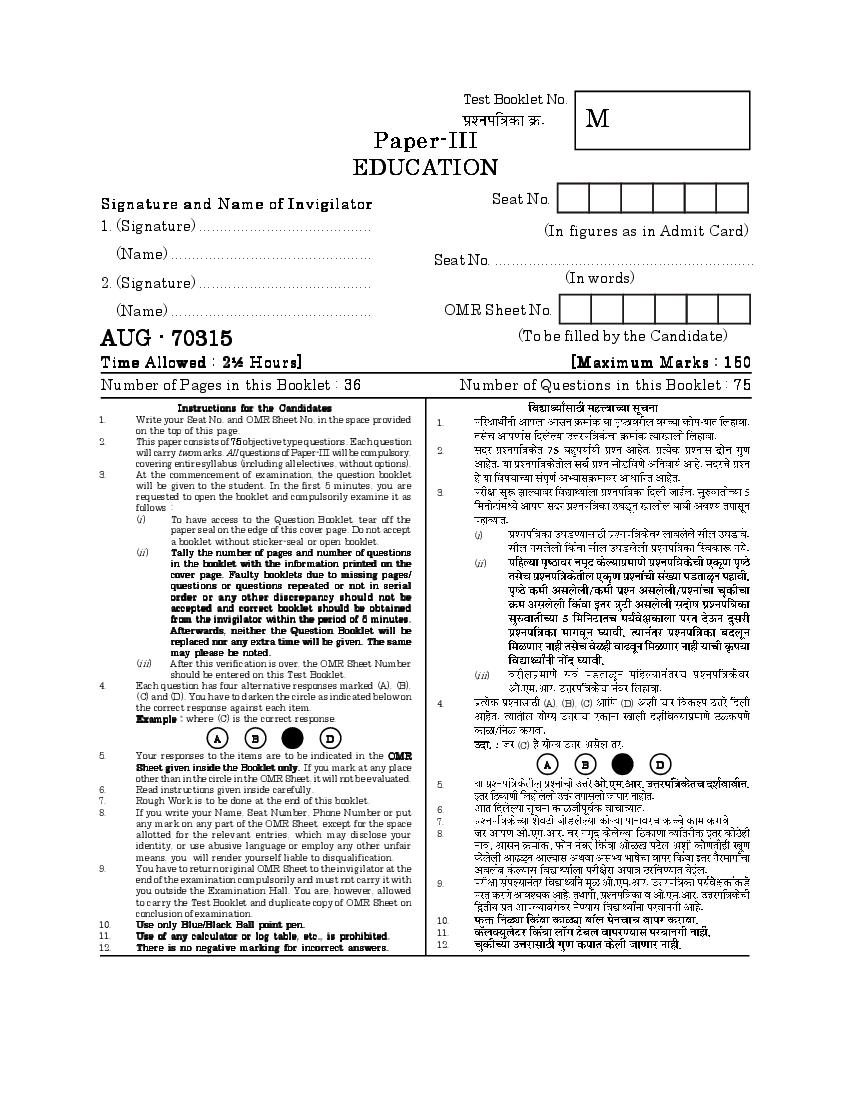
M
EDUCATION
Signature and Name of Invigilator Seat No.
1. (Signature) ......................................... (In figures as in Admit Card)
(Name) ................................................ Seat No. ..............................................................
2. (Signature) ......................................... (In words)
(Name) ................................................ OMR Sheet No.
AUG - 70315 (To be filled by the Candidate)
Time Allowed : 2½ Hours] [Maximum Marks : 150
Number of Pages in this Booklet : 36 Number of Questions in this Booklet : 75
Instructions for the Candidates
1. Write your Seat No. and OMR Sheet No. in the space provided 1.
on the top of this page.
2. This paper consists of 75 objective type questions. Each question
will carry two marks. All questions of Paper-III will be compulsory, 2.
covering entire syllabus (including all electives, without options).
3. At the commencement of examination, the question booklet
will be given to the student. In the first 5 minutes, you are
requested to open the booklet and compulsorily examine it as 3.
follows :
(i) To have access to the Question Booklet, tear off the
paper seal on the edge of this cover page. Do not accept
(i)
a booklet without sticker-seal or open booklet.
(ii) Tally the number of pages and number of questions
in the booklet with the information printed on the (ii)
cover page. Faulty booklets due to missing pages/
questions or questions repeated or not in serial
o rder or any other discre pancy should not be
accepted and correct booklet should be obtained
from the invigilator within the period of 5 minutes.
Afterwards, neither the Question Booklet will be
replaced nor any extra time will be given. The same
may please be noted.
(iii) After this verification is over, the OMR Sheet Number
should be entered on this Test Booklet. (iii)
4. Each question has four alternative responses marked (A), (B),
(C) and (D). You have to darken the circle as indicated below on
the correct response against each item. 4. (A), (B), (C) (D)
Example : where (C) is the correct response.
A B D
(C)
5. Your responses to the items are to be indicated in the OMR
Sheet given inside the Booklet only. If you mark at any place A B D
other than in the circle in the OMR Sheet, it will not be evaluated.
5.
6. Read instructions given inside carefully.
7. Rough Work is to be done at the end of this booklet.
8. If you write your Name, Seat Number, Phone Number or put 6.
any mark on any part of the OMR Sheet, except for the space 7.
allotted for the relevant entries, which may disclose your 8.
identity, or use abusive language or employ any other unfair
means, you will render yourself liable to disqualification.
9. You have to return original OMR Sheet to the invigilator at the
end of the examination compulsorily and must not carry it with 9.
you outside the Examination Hall. You are, however, allowed
to carry the Test Booklet and duplicate copy of OMR Sheet on
conclusion of examination.
10. Use only Blue/Black Ball point pen. 10.
11. Use of any calculator or log table, etc., is prohibited. 11.
12. There is no negative marking for incorrect answers. 12.
Page 2
Page 3
Paper III
III
Time Allowed : 2½ Hours] [Maximum Marks : 150
Note : This Paper contains Seventy five (75) multiple choice questions. Each question
carrying Two (2) marks. Attempt All questions.
(75) (2)
1. Hegel’s Philosophy is also described 1.
as .............
(A) Subjective idealism (A)
(B) Absolute idealism (B)
(C) Critical idealism (C)
(D) Idealism (D)
2. According to ........... to prepare a 2.
student to struggle for existence is
the aim of education.
(A)
(A) Physical naturalism
(B)
(B) Bio-naturalism
(C)
(C) Mechanical naturalism
(D)
(D) Ideal naturalism
3 [P.T.O.
Page 4
and sexual urge is the basic principle
of ............
(A) Buddhism (A)
(B) Vedanta (B)
(C) Jainism (C)
(D) Upanishadic (D)
4. As per .............. philosophy empirical 4.
knowledge is true knowledge.
(A) Sankhya (A)
(B) Vedanta (B)
(C) Upanishad (C)
(D) Buddhist (D)
5. Which of the following is not a factor 5.
affecting social change ?
(A) Control factors (A)
(B) Technological factors (B)
(C) Cultural factors (C)
(D) Education (D)
4
Page 5
special provisions for the upliftment
of disadvantaged sections of the
society is aimed at .............
(A)
(A) Social mobility
(B)
(B) Social stratification
(C) Social tensions (C)
(D) Social control (D)
7. The institutions set up for the gifted 7.
children from rural areas is known
as ............
(A)
(A) Ashram Shala
(B)
(B) Sakhar Shala
(C)
(C) Navodaya Vidyalaya
(D) Kendriya Vidyalaya (D)
5 [P.T.O.
Page 6
(A) is the same as equality (A)
(B) implies that all the resources (B) (Sections)
are distributed equally to all the
sections of the society
(C) implies distribution of resources (C) (Sections)
as per the needs and wants of
different sections of the society
(D) implies distribution of resources (D) (Sections)
to different sections of the
society as per merit
9. ‘A child is measured against his own 9.
progress rather than in terms of
achievement of others.’ This is main
characteristic of ............
(A)
(A) Project method
(B)
(B) Winnetka plan
(C) Dalton plan (C)
(D) Activity programme (D)
6
Page 7
may be because of less secretion of
hormones from .............
(A) Adrenal glands (A)
(B) Thyroid glands (B)
(C) Pituitary glands (C)
(D) Gonads (D)
11. Now-a-days, Virat likes adventure 11.
and arguing about religious faith
and traditions. Then he may be at
the ............ stage of development.
(A) Early childhood (A)
(B) Later childhood (B)
(C) Adolescence
(C)
(D) Adult
(D)
7 [P.T.O.
Page 8
12.
sequence of information processing
is ............
(A) Encoding — Inferring —
(A) — —
Mapping — Application —
Justification — Response — — —
(B) Response — Encoding —
(B) — —
Inferring — Mapping —
Application — Justification — — —
(C) Encoding — Mapping —
(C) — —
Inferring — Application —
Justification — Response — — —
(D) Response — Application —
(D) — — —
Mapping — Inferring —
Justification — Encoding — —
13. From the following tests .................
13.
is not included in Bhatia’s Battery
of Performance tests.
(A)
(A) Koh’s Block design test
(B)
(B) Alexander’s Pass along test
(C)
(C) Immediate memory test
(D)
(D) Picture drawing test
8
Page 9
is not true about the intelligence ?
(A) Intelligence is hereditary
(A)
(B) Intelligence can be increased by
(B)
achieving knowledge
(C) Intelligence is not dependent
(C)
upon caste, religion or creed
(D) We observe more percentage of
genius and idiots in males with (D)
respective to women
15. ‘Geeta always complains about her 15.
neighbours and says they are jealous
about her progress.’’ She may be
using ............. type of defense
mechanism.
(A)
(A) Delusion
(B) Displacement (B)
(C) Projection (C)
(D) Sublimation (D)
9 [P.T.O.
Page 10
personality, then ............... method or
technique will be more relevant to
assess the personality.
(A) Projective technique (A)
(B) Self report (B)
(C) Self disclosure (C)
(D) Rating scale (D)
17. To test honesty ................ tool will be 17.
more relevant.
(A) Questionnaire (A)
(B) Observation (B)
(C) Situational tests (C)
(D) Rating scale (D)
10
Page 11
18.
directive counselling is .........
(A) A D S P C F
(A) A D S P C F
(B) A S D P C F (B) A S D P C F
(C) P D A S C F (C) P D A S C F
(D) P A D S C F (D) P A D S C F
where :
A Analysis A
C Counselling C
D Diagnosis D
F Followup F
P
P Prognosis
S
S Synthesis
19. The specific function of educational 19.
guidance for elementary students
is ............
(A)
(A) Assisting pupils to select courses
and activities
(B) Assisting pupils to make (B)
appraisal of the abilities,
aptitudes, skills and interests
(C) Assisting pupils to make a
proper beginning of their (C)
educational life
(D) Assisting pupils in the
development of good study (D)
habits and in their educational
progress
11 [P.T.O.
Page 12
a part of ..............
(A) Placement (A) (Placement)
(B) Guidance (B)
(C) Job satisfaction (C)
(D) Sociometry (D)
21. Objective information for guidance 21.
and counselling can be collected by
using ............
(A) Researcher made tests (A)
(B) Standardised tests (B)
(C) Achievements tests (C)
(D) Diagnostic tests (D)
22. Convenience sampling is also called 22.
as ...........
(A)
(A) Purposive sampling
(B)
(B) Quota sampling
(C) (Judgemental
(C) Judgemental sampling
sampling)
(D) Accidental sampling
(D)
12
Page 13
population and randomly selected a
name on the list. He then selected
‘K’
each ‘K’ th individual on the list to
the desired sample size. The
researcher has used ...............
technique of sampling.
(A)
(A) Simple random sampling
(B)
(B) Stratified random sampling
(C)
(C) Cluster sampling
(D)
(D) Systematic sampling
24. For hypothesis to be testable, the 24.
variables must be ...........
(A) Different
(A)
(B) Conceptually defined
(B)
(C) Operationally defined
(C)
(D) Must be defined according to
dictionary (D)
13 [P.T.O.
Page 14
sample randomly. Further he wants
to increase reliability of data. Which
of the following will help him ?
(A) Analyzing data by using (A)
parametric statistics
(B) Computing higher statistics (B)
(C) Collecting data using (C)
standardised test
(D) Increasing sample size (D)
26. Which of the following is not a 26.
feature of quantitative research ?
(A) Focus on explanation (A)
(B) Comparison with predictions (B)
and past researches
(C)
(C) Predetermined instruments
(D)
(D) Image or text data
(Data)
14
Page 15
27.
Ethnography studies is ...............
(A) What are the characteristics of
a particular phenomenon ? (A)
(B) How do people understand their
(B)
everyday activities in order to
behave in socially accepted
ways ?
(C) What are the cultural patterns
(C)
of the groups in natural
setting ?
(D) How do people construct
(D)
meanings by interacting with
others ?
28. ‘Relationship between ‘Emotional 28.
Intelligence’ and ‘Job satisfaction of
teachers.’ This is an example of ........
(A) Correlational research (A)
(B) Status research (B)
(C) Ex post facto research (C)
(D) Causal comparative research (D)
15 [P.T.O.
Page 16
experimental study for a duration of
four months in a school. Many
students dropped out of the study,
altering the composition of the
experimental groups. This threat to
internal validity of the research is (Threat)
due to :
(A)
(A) History
(B)
(B) Maturation
(C) Testing (C)
(D) Mortality (D)
30. Which of the following is not an 30.
example of Distance Education ?
(A) Classroom interaction (A)
(B) Online courses (B)
(C) Web-based learning (C)
(D) Project-based learning (D)
16
Page 17
during the contact sessions are
called as ..........
(A)
(A) Instructors
(B)
(B) Counsellors
(C)
(C) Teachers
(D) Guides (D)
32. Vocational Education involves 32.
two important components of
..............
(A)
(A) Practical work and training
(B)
(B) Skills and theory
(C) Theory and fieldwork (C)
(D) Fieldwork and skills (D)
17 [P.T.O.
Page 18
learning (MLL) curriculum covers
................ for the first five years of
primary schooling.
(A) + + +
(A) Mother Tongue + Maths +
Social Science + English
(B) Mother Tongue + Maths + (B) + + +
Social Science + Science
(C) Mother Tongue + Maths +
(C) + + +
English + Science
(D) Mother Tongue + Maths + (D) + + +
Social Science + English
34. While developing curriculum 34.
Charles Taylor focuses on .............
(A) Developing reasoning power
(A)
(B) Setting objectives
(B)
(C) Interests and needs of the
(C)
child
(D) Making ideal citizen (D)
18
Page 19
................. evaluation.
(A) Summative (A)
(B) Formative (B)
(C) Critical (C)
(D) Practical (D)
36. Supervision as a process
36.
emphasises :
(A) Stimulating and motivating
teachers
(A)
(B) Administration of the
(B)
institution
(C) Development of curriculum
(C)
(D) Giving feedback through
(D)
inspection
19 [P.T.O.
Page 20
psychological needs and economic
incentives.’’ This is an assumption
of :
(A)
(A) Human Relations School
(B)
(B) Behavioural Science Approach
(C)
(C) Administrative Management
(D) Systems Approach (D)
38. The principle of dualism in 38.
institutional planning includes :
(A) Improvement and development
(A)
(B) Co-operation effort
(B)
(C) Short-term and long-term
goals (C)
(D) Need-based and goal-oriented (D)
functions
20
Page 21
39.
planning approach :
(A) Social Demand Approach
(A)
(B) Human Relations Approach
(B)
(C) Manpower Planning Approach
(C)
(D) Cost-Benefit Approach
(D)
40. The following is a tool to measure
40.
leadership :
(A) OHI
(A) OHI
(B) OCDQ
(B) OCDQ
(C) LBDQ
(C) LBDQ
(D) MBTI
(D) MBTI
41. One application of the systems
41.
approach is :
(A) Leadership
(A)
(B) Counselling
(B)
(C) Supervision
(C)
(D) PERT
(D) (PERT)
21 [P.T.O.
Page 22
concerned with ..............
(A) Direction (A)
(B) Improvement of performance (B)
(C) Control (C)
(D) Fact-finding (D)
43. Taylor’s principles do not include the 43.
following :
(A) Functional supervision (A)
(B) Division of work (B)
(C) Scientific job analysis (C)
(D) Selection of personnel (D)
44. Dr. Patil prepared an achievement 44.
test for VII Standard. It should have
..............
(A) Predictive validity (A)
(B) Logical validity (B)
(C) Content validity (C)
(D) Construct validity (D)
22
Page 23
............ have been fixed.
(A) procedure, apparatus and
acceptability (A)
(B) purpose, apparatus and norms (B)
(C) procedure, apparatus and
(C)
scoring
(D) purpose, apparatus and cost (D)
46. Ramesh has collected numerical 46. (Data)
data. He wants to compute
coefficient of correlation using
computer. For this purpose he should
use ............
(A) Microsoft Word (A)
(B) Microsoft Excel (B)
(C) Microsoft Paint (C)
(D) Microsoft PowerPoint
(D)
23 [P.T.O.
Page 24
absolute zero.
(A) Nominal (A)
(B) Ordinal (B)
(C) Interval (C)
(D) Ratio (D)
48. Reliability is ................... 48.
(A) necessary but not sufficient
(A)
condition for validity
(B) not a necessary condition for
(B)
validity
(C) necessary and sufficient (C)
condition for validity
(D) not sufficient condition for
(D)
validity
24
Page 25
years and mental age 12 years 6 12 6
months, then IQ = ....... (IQ) =
(A) 55.55 (A) 55.55
(B) 80 (B) 80
(C) 125 (C) 125
(D) 180 (D) 180
50. Numerical, graphic, standard and 50.
cumulative points are 'categories
of :
(A)
(A) projective technique
(B)
(B) rating scale
(C)
(C) check list
(D) observation schedule (D)
25 [P.T.O.
Page 26
............. (A) (Appraisal)
(A) appraisal of achievement and
its improvement
(B)
(B) assessment of tests and its
importance (C)
(C) assessment of personality and
its improvement
(D) (Appraisal)
(D) appraisal of intelligence and its
importance
52. Evaluation of a lesson pertains 52.
to ...............
(A)
(A) Interactive stage
(B)
(B) Postactive stage
(C) Preactive stage (C)
(D) Intermediate stage (D)
53. A teacher tries to develop his 53.
student’s handwriting. This is an
example of :
(A) teaching (A)
(B) instruction (B)
(C) conditioning (C)
(D) training
(D)
26
Page 27
(A) Hardware (A)
(B) Software (B)
(C) Teaching tool (C)
(D) Support system (D)
55. For teaching social issues ............. 55.
model of teaching will be
appropriate.
(A)
(A) Concept attainment
(B)
(B) Advance organizer
(C)
(C) Role play
(D)
(D) Inquiry training
56. More freedom is given to students 56.
in .................. type of programmed
instruction.
(A)
(A) Linear
(B) Branching (B)
(C) Example-rule (C)
(D) Rule-example
(D)
27 [P.T.O.
Page 28
come to the study centre to satisfy
their queries from the teacher. This
is ..........
(A)
(A) Lecturing
(B) Guidance (B)
(C) Counselling (C)
(D) Simplification (D)
58. When teaching is done to achieve 58.
synthesis level of cognition. This is
teaching at ................ level.
(A) Memory (A)
(B) Understanding (B)
(C) Application (C)
(D) Reflective thinking (D)
59. The feature of you tube is ............... 59.
(A) Word processing (A)
(B) Whole class chat (B)
(C) Media sharing (C)
(D) Group conferencing (D)
28
Page 29
has emerged as an antithesis
of ..............
(A)
(A) Inclusion
(B)
(B) Segregation
(C)
(C) Mainstreaming
(D)
(D) Normalization
61. A mentally retarded child who 61.
attains intellectual level comparable
to a normal six-year old is included
in the ............ category.
(A)
(A) Profound mental retardation
(B)
(B) Severe mental retardation
(C)
(C) Moderate mental retardation
(D) Mild mental retardation (D)
29 [P.T.O.
Page 30
over digit while doing addition. This
is a characteristic of ............
(A) (Dyslexia)
(A) Dyslexia
(B) (Dyscalculia)
(B) Dyscalculia
(C) (Dysgraphia)
(C) Dysgraphia
(D) (Dyspraxia)
(D) Dyspraxia
63. An individual in the .............. age 63. IPC, Cr.P.C.
group convicted by court for violating
the provisions of the Children’s Act,
IPC and Cr.P.C. is termed as
delinquent.
(A) 5—16
(A) 5—16
(B) 6—17
(B) 6—17
(C) 7—18 (C) 7—18
(D) 8—19 (D) 8—19
30
Page 31
be achieved by ..............
(A)
(A) Projects and activity oriented
home assignments (B)
(B) Ability grouping
(C)
(C) Extra courses
(D) Special guidance classes (D)
65. Orthopaedically handicapped are 65.
.............. children having some
deformities.
(A)
(A) abnormal
(B)
(B) normal
(C) below normal (C)
(D) learning disabled (D)
66. A mental by which Hearing 66.
impaired are taught to use normal
gestures to represent words, ideas
and concepts is ...............
(A)
(A) Finger spelling
(B)
(B) Cued speech
(C) Sign language (C)
(D) Total communication (D)
31 [P.T.O.
Page 32
and useful for ............
(A) Hearing impaired (A)
(B) Gifted (B)
(C) Visually impaired (C)
(D) Mentally retarded (D)
68. Which of the following national 68.
bodies are intended to prepare
(A) (NCTE)
teachers for special schools ? (RCI)
(B) (NCTE)
(A) NCTE and RCI
(UGC)
(B) NCTE and UGC (C) (NCTE)
(C) NCTE and NCERT (NCERT)
(D) (NCTE)
(D) NCTE and BCI
(BCI)
69. Teacher will be effective for students 69.
learning of he/she is a .............
(A) researcher (A)
(B) facilitator (B)
(C) instructor (C)
(D) evaluator (D)
32
Page 33
courses are offered in .................
(A) Teacher education colleges
(A)
(B) Academic staff colleges
(B)
(C) Degree colleges
(C)
(D) Post-graduation colleges
(D)
71. DIET, CTE and IASE’s were
71. DIET, CTE IASE
established on the recommendations
of :
(A) NPE—1986
(A) NPE—1986
(B) Kothari Commission, 1964-66
(B) 1964-66
(C) National Knowledge
Commission (C)
(D) RTE-2009 Act
(D) 2009
72. Sam Pitroda served as ............... 72.
(A) NCTE—Chairperson (A)
(B)
(B) NCERT—Director
(C) UGC—Chairman (C)
(D) NKC—Chairman (D)
33 [P.T.O.
Page 34
Century—A Study.’’
The above research problem is from
............. area of teacher education.
(A) Policy in teacher education (A)
(B) Teacher effectiveness through (B)
education
(C) Teacher education for special
(C)
schools
(D) Inservice teacher education (D)
74. Peer appraisal of colleagues is a 74.
feature of ............ type of appraisal (Peer appraisal)
interview. (Appraisal
interview)
(A) Judgemental
(A) (Judgemental)
(B) Laissez-faire
(B)
(C) Managerial (C)
(D) Developmental (D)
75. Web based instruction is an 75. (Web
innovative approach to teacher
based instruction)
education does not have the
following feature :
(A) Teacher’s role as a facilitator (A)
(B) Flexible entry point (B)
(C) Individualized for learner (C)
(D) Structured instruction. (D)
34
Page 35
35 [P.T.O.
Page 36
36
Document Details
| Board / Org | Maharashtra Exams |
| Exam | Maharashtra State Eligibility Test |
| Type | Question Paper |
| Pages | 36 |
| Updated | 30 Apr 2026 |