ISC Class 11 Specimen Paper for Economics
Finished viewing? Save it for later —
Download ISC Class 11 Specimen Paper for Economics (PDF · 4 pages)About ISC Class 11 Specimen Paper for Economics
ISC Class 11 Specimen Paper for Economics is available here for free download. Published by CISCE for Class 11, this sample paper can be viewed online or downloaded as a PDF (4 pages). Candidates preparing for Class 11 can use ISC Class 11 Specimen Paper for Economics to understand the exam pattern, the type of questions asked, and the overall difficulty level.
Frequently Asked Questions
How can I download ISC Class 11 Specimen Paper for Economics?
Open this page and click the Download button to save ISC Class 11 Specimen Paper for Economics as a PDF. It is completely free on AglaSem Docs.
Is ISC Class 11 Specimen Paper for Economics free to download?
Yes. ISC Class 11 Specimen Paper for Economics can be viewed online and downloaded as a PDF free of cost on AglaSem Docs.
How many pages does ISC Class 11 Specimen Paper for Economics have?
ISC Class 11 Specimen Paper for Economics contains 4 pages, which you can read online or download together as a single PDF.
Where can I find more Class 11 study material?
You can find more Class 11 question papers, sample papers, syllabus, and answer keys on AglaSem Docs.
ISC Class 11 Specimen Paper for Economics – Text
Read the full text of this sample paper below — useful to quickly search, copy and reference the content online without downloading the PDF.
📄 View text version (4 pages)
Page 1
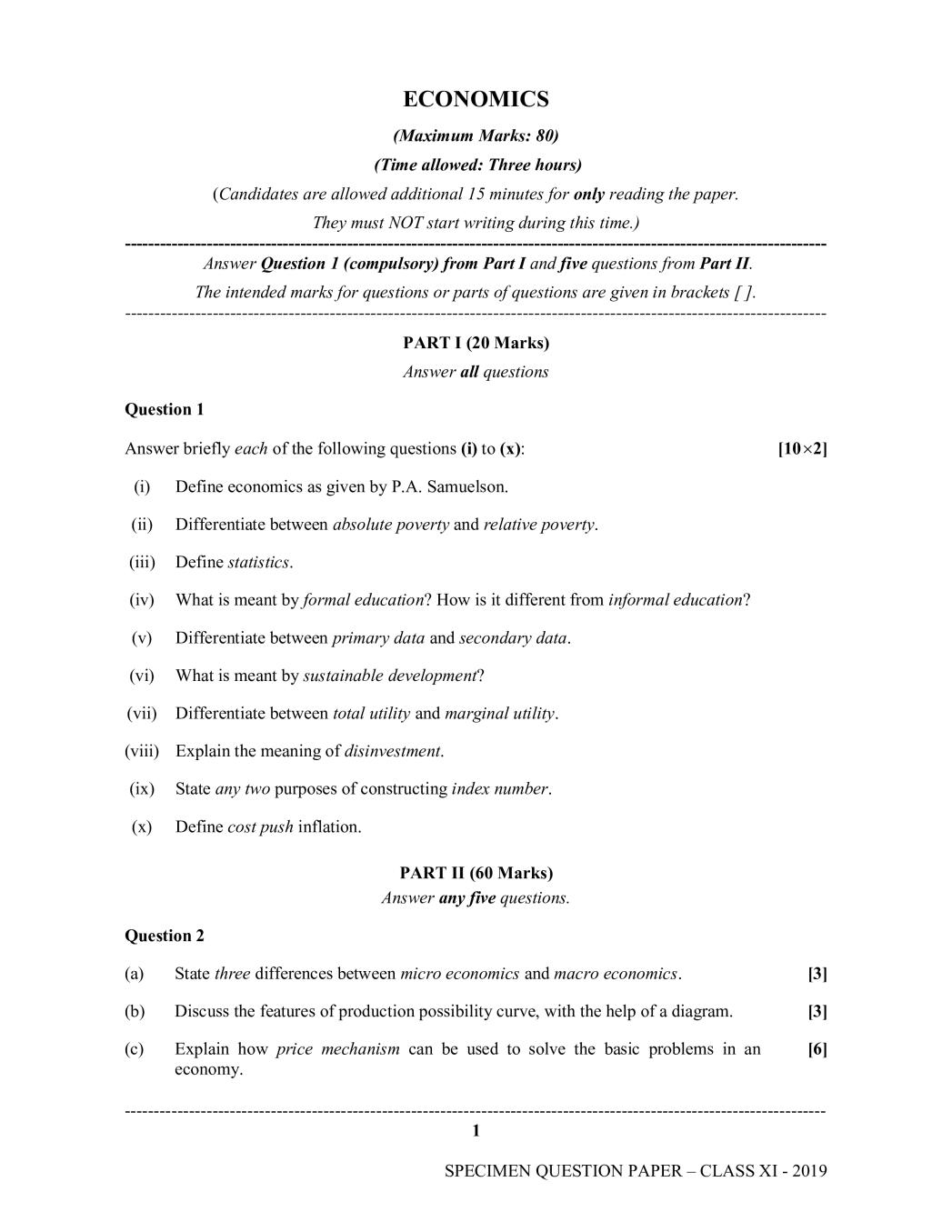
(Maximum Marks: 80)
(Time allowed: Three hours)
(Candidates are allowed additional 15 minutes for only reading the paper.
They must NOT start writing during this time.)
Answer Question 1 (compulsory) from Part I and five questions from Part II.
The intended marks for questions or parts of questions are given in brackets [ ].
PART I (20 Marks)
Answer all questions
Question 1
Answer briefly each of the following questions (i) to (x): [10 2]
(i) Define economics as given by P.A. Samuelson.
(ii) Differentiate between absolute poverty and relative poverty.
(iii) Define statistics.
(iv) What is meant by formal education? How is it different from informal education?
(v) Differentiate between primary data and secondary data.
(vi) What is meant by sustainable development?
(vii) Differentiate between total utility and marginal utility.
(viii) Explain the meaning of disinvestment.
(ix) State any two purposes of constructing index number.
(x) Define cost push inflation.
PART II (60 Marks)
Answer any five questions.
Question 2
(a) State three differences between micro economics and macro economics. [3]
(b) Discuss the features of production possibility curve, with the help of a diagram. [3]
(c) Explain how price mechanism can be used to solve the basic problems in an [6]
economy.
1
Page 2
(a) Explain three limitations of Per Capita Income Index. [3]
(b) Discuss any three importances of human capital formation in economic [3]
development.
(c) Discuss any four causes of unemployment in India. [6]
Question 4
(a) Discuss any three measures undertaken by the government to improve agricultural [3]
marketing.
(b) State one reason for each of the following types of loans being taken by farmers: [3]
(i) short-term loans
(ii) medium-term loans
(iii) long-term loans
(c) Explain four changes in the Indian economy after liberalization. [6]
Question 5
(a) Discuss three differences between growth and development. [3]
(b) Write short notes on the following Poverty Alleviation Programmes: [3]
(a) MGNREGA (b) Skill India Programme
(c) Define mixed economy. Explain four features of mixed economy. [6]
Question 6
(a) Explain three benefits of organic farming. [3]
(b) Discuss two features of privatization. [3]
(c) Discuss the various institutional sources of rural credit in India. [6]
Question 7
(a) Explain any two effects of global warming. [3]
(b) Define Human Development Index. State its dimensions. [3]
(c) Explain any four effects of economic development on the environment. [6]
2
Page 3
(a) Calculate Arithmetic mean from the data given below: [3]
Class 0 – 10 10 – 20 20 – 30 30 – 40 40 – 50 50 – 60 60 – 70 70 – 80
Interval.
Frequency 2 7 10 15 20 16 6 4
(b) Calculate median from the data given below: [3]
Class 0 – 10 10 – 20 20 – 30 30 – 40 40 – 50 50 – 60
Interval.
Frequency 5 10 18 9 5 3
(c) Using the data given below, calculate mode by grouping method: [6]
Marks 0–1 1–2 2–3 3–4 4–5 5–6 6–7 7–8
No. of 4 10 25 15 23 22 12 3
students
Question 9
(a) From the data given below, calculate quartile deviation: [3]
Marks 0 – 10 10 – 20 20 – 30 30 – 40 40 – 50
frequencies 10 15 20 10 5
(b) Calculate Index Number by using Laspeyre’s method: [3]
BASE YEAR CURRENT YEAR
Price Quantity Price Quantity
A 2 40 3 20
B 1.5 30 2.5 40
C 1 50 1.5 30
D 2.5 20 2 80
3
Page 4
variables X and Y, by using Karl Pearson’s method:
X Y
10 7
12 9
11 12
13 9
12 13
14 8
9 10
12 12
14 7
13 13
4