Karnataka 2nd PUC Model Question Paper 2022 for Chemistry
Finished viewing? Save it for later —
Download Karnataka 2nd PUC Model Question Paper 2022 for Chemistry (PDF · 10 pages)About Karnataka 2nd PUC Model Question Paper 2022 for Chemistry
Karnataka 2nd PUC Model Question Paper 2022 for Chemistry is available here for free download. Published by Karnataka Board for Class 12, this sample paper can be viewed online or downloaded as a PDF (10 pages). Candidates preparing for Class 12 can use Karnataka 2nd PUC Model Question Paper 2022 for Chemistry to understand the exam pattern, the type of questions asked, and the overall difficulty level.
Frequently Asked Questions
How can I download Karnataka 2nd PUC Model Question Paper 2022 for Chemistry?
Open this page and click the Download button to save Karnataka 2nd PUC Model Question Paper 2022 for Chemistry as a PDF. It is completely free on AglaSem Docs.
Is Karnataka 2nd PUC Model Question Paper 2022 for Chemistry free to download?
Yes. Karnataka 2nd PUC Model Question Paper 2022 for Chemistry can be viewed online and downloaded as a PDF free of cost on AglaSem Docs.
How many pages does Karnataka 2nd PUC Model Question Paper 2022 for Chemistry have?
Karnataka 2nd PUC Model Question Paper 2022 for Chemistry contains 10 pages, which you can read online or download together as a single PDF.
Where can I find more Class 12 study material?
You can find more Class 12 question papers, sample papers, syllabus, and answer keys on AglaSem Docs.
Karnataka 2nd PUC Model Question Paper 2022 for Chemistry – Text
Read the full text of this sample paper below — useful to quickly search, copy and reference the content online without downloading the PDF.
📄 View text version (10 pages)
Page 1
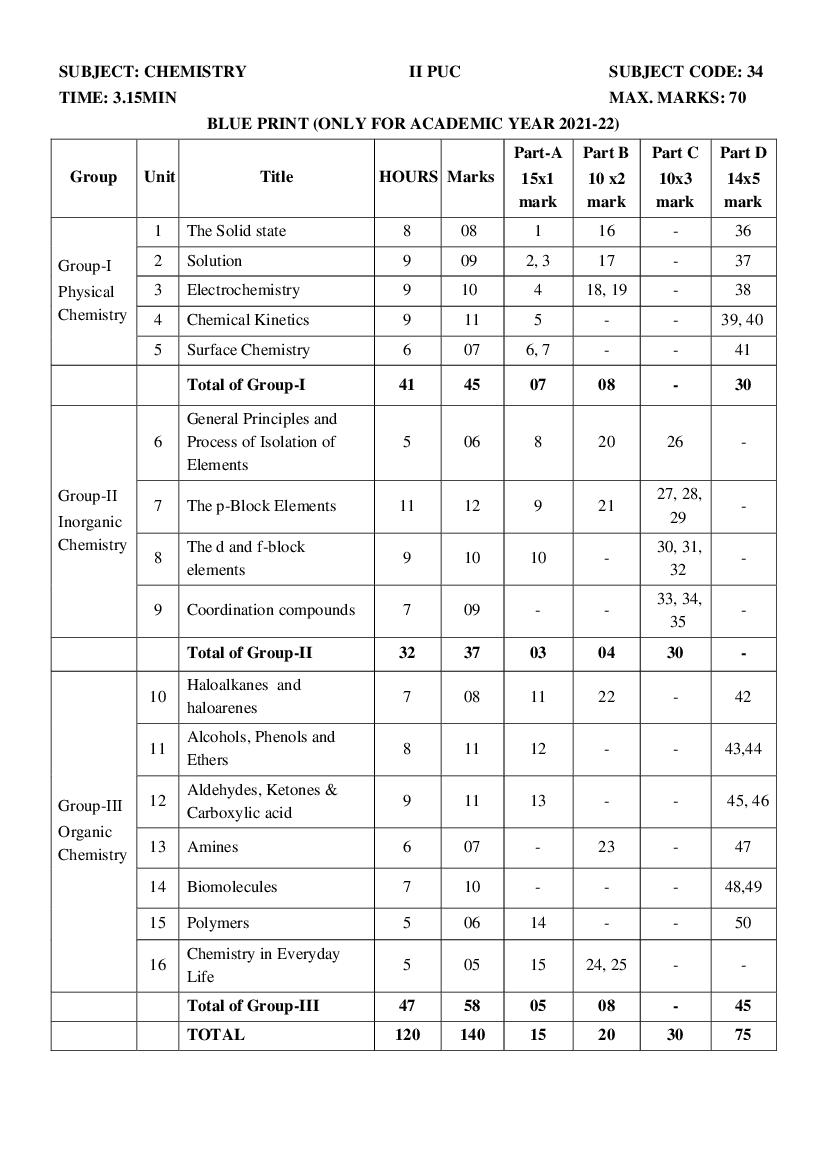
TIME: 3.15MIN MAX. MARKS: 70
BLUE PRINT (ONLY FOR ACADEMIC YEAR 2021-22)
Part-A Part B Part C Part D
Group Unit Title HOURS Marks 15x1 10 x2 10x3 14x5
mark mark mark mark
1 The Solid state 8 08 1 16 - 36
Group-I 2 Solution 9 09 2, 3 17 - 37
Physical 3 Electrochemistry 9 10 4 18, 19 - 38
Chemistry 4 Chemical Kinetics 9 11 5 - - 39, 40
5 Surface Chemistry 6 07 6, 7 - - 41
Total of Group-I 41 45 07 08 - 30
General Principles and
6 Process of Isolation of 5 06 8 20 26 -
Elements
Group-II 27, 28,
7 The p-Block Elements 11 12 9 21 -
Inorganic 29
Chemistry The d and f-block 30, 31,
8 9 10 10 - -
elements 32
33, 34,
9 Coordination compounds 7 09 - - -
35
Total of Group-II 32 37 03 04 30 -
Haloalkanes and
10 7 08 11 22 - 42
haloarenes
Alcohols, Phenols and
11 8 11 12 - - 43,44
Ethers
Aldehydes, Ketones &
Group-III 12 9 11 13 - - 45, 46
Carboxylic acid
Organic
Chemistry 13 Amines 6 07 - 23 - 47
14 Biomolecules 7 10 - - - 48,49
15 Polymers 5 06 14 - - 50
Chemistry in Everyday
16 5 05 15 24, 25 - -
Life
Total of Group-III 47 58 05 08 - 45
TOTAL 120 140 15 20 30 75
Page 2
1. The question paper has four parts: A, B, C and D. All parts are compulsory.
2. a. Part-A carries 10 marks. Each question carries 1 mark. Part A (I): Frame questions from all units as
required. Out of FIFTEEN questions (Question number 01 to 15), answer any TEN.
b. Part-B carries 10 marks. Each question carries 2 marks. Part B (II): Frame questions from all units as
required. Out of TEN questions (Question number 16 to 25), answer any FIVE.
c. Part-C carries 15 marks. Each question carries 3 marks. Part C (III): Frame questions from Inorganic
chemistry. Out of TEN questions (Question number 26 to 35), answer any FIVE.
d. Part-D carries 35 marks. Each question carries 5 marks.
(i) (Part-IV) carries 15 marks: Frame questions from physical chemistry. Out of SIX questions (Question
number 36 to 41), answer any THREE.
(ii) (Part-V) carries 20 marks: Frame questions from organic chemistry. Out of NINE questions (Question
number 42 to 50), answer any FOUR.
** A variation of ±1 mark in the unit Weightage is allowed.
3. Intermixing of questions of different units is not allowed. 5 marks question may be framed as (3+2) as
far as possible.
In part C:
i) While framing 3 questions for the unit 7 (p-block elements), frame one question each from 15th, 16th
and 17th group elements. One mark & two mark questions for 18th group elements can be framed
in Part - A & B respectively. This division is done to make it easy for the students to learn and attempt
these questions.
ii) For d and f block elements, there are more concepts and learning aspects in d-block rather than f block
elements. Hence in part-C, frame two questions from d-block part & frame a question from f-block
elements.
4. Numerical problems worth of about 10 marks should be given.
5. Avoid questions from: i) Drawings involving 3D diagrams
ii) Boxed portions of the units given in the text.
iii) The boxed materials with deep yellow bar in the text book are to bring additional life to the topic
and are non evaluative.
6. Questions on numerical data given in the form of appendix, numbered tables containing experimental
data and life history of scientists given in the chapters should be avoided.
7. In Organic chemistry R, Ar may be restricted to the groups as defined in the syllabus provided.
8. Frame the questions in such a way to strictly avoid ½ mark evaluation (or value points for ½ marks.).
9. Questions framed should not be vague and ambiguous. Avoid framing questions for which answers/
printing in the text book is not well defined/ wrong.
Page 3
KARNATAKA STATE PRE-UNIVERSITY EDUCATION EXAMINATION BOARD
II YEAR PUC MODEL QUESTION PAPER (for -2021-22 academic year only)
SUBJECT CODE: 34 SUBJECT: CHEMISTRY
ENGLISH VERSION
INSTRUCTIONS:
1. The question paper has four parts. All parts are compulsory.
2. a. Part-A carries 10 marks. Each question carries 1 mark.
b. Part-B carries 10 marks. Each question carries 2 marks.
c. Part-C carries 15 marks. Each question carries 3 marks.
d. Part-D carries 35 marks. Each question carries 5 marks.
3. Write balance chemical equations and draw diagrams wherever necessary.
4. Use log tables and simple calculator if necessary (use of scientific calculator is not allowed).
PART-A
I. ANSWER ANY TEN OF THE FOLLOWING. EACH QUESTION CARRIES 1 MARK. 10X1 = 10
1. What are F-centres?
2. How does the enthalpy change on mixing two volatile liquids to form an ideal solution?
3. Give an example for natural semipermeable membrane.
4. What happens to molar conductivity when one mole of potassium chloride dissolved in one litre is diluted
to five litres?
5. Write the energy distribution curve showing temperature dependence of rate of a reaction.
6. Name the shape selective catalyst which converts alcohols directly into gasoline in petroleum industry.
7. What are co-enzymes?
8. Name the method used for concentration of sulphide ores.
9. Complete the reaction: XeF6 + 2H2O → ? + 4HF
10. Which element of 3d series has more number of unpaired electrons in the ground state?
11. Define the term racemisation.
12. Out of ortho & para nitrophenols, which one less volatile compound?
13. Mention the role of dry HCl in the addition of alcohols to carbonyl compounds.
14. Give an example for synthetic biodegradable polyamide copolymer.
15. Name the first popular artificial sweetening agent.
PART-B
II. ANSWER ANY FIVE OF THE FOLLOWING. EACH QUESTION CARRIES 2 MARKS. 5X2=10
16. Calculate the number of particles present per unit cell in a BCC unit cell.
17. State Henry’s law. Write its mathematical form.
18. Calculate the limiting molar conductivity of calcium chloride (CaCl2). Given that the limiting molar
conductivities of Ca2+ and Cl- ions are 119.0Scm2mol-1 and 76.3Scm2mol-1 respectively.
19. Write the symbolic representation of standard hydrogen electrode. Mention its standard electrode
potential value (E0).
20. What is the role of coke and lime stone during the extraction of cast iron using blast furnace.
21. Name the noble gas which does not have general noble gas electronic configuration ns 2np6. Name the
commercial source of this noble gas.
22. Explain Friedel-Crafts reaction with equation by taking chlorobenzene as example.
Page 4
equation.
24. Why soap does not work in hard water?
25. Give an example each for. a. Anti-fertility drug b. Anionic detergents
PART-C
III. ANSWER ANY FIVE OF THE FOLLOWING. EACH QUESTION CARRIES 3MARKS. 5X3=15
26. Write the chemical equations involved in the leaching of pure alumina from bauxite ore.
27. With reaction conditions write the balanced chemical equations for the preparation of Nitric acid
(HNO3) by Ostwald’s process.
28. a. How is ozonised oxygen prepared in the laboratory? Write the chemical equation.
b. Complete the equation: CaO + H2O → ____. (2+1)
29. a. Which is the strongest acid among the hydrogen halides? Give one reason.
b. Write the structure of hypochlorous acid (HOCl). (2+1)
30. What are interstitial compounds? Write any two characteristics of interstitial compounds.
31. Write the balanced equation in the manufacture of potassium dichromate from chromite ore.
32. What is Lanthanoid contraction? Mention any two consequences of it.
33. Using Valence Bond Theory (VBT), explain hybridisation, geometry and magnetic property of
[Ni(CN)4]2- complex ion. (Z for Ni is 28).
34. Write the geometrical isomeric structures of [Co(NH 3)4Cl2]+. What is the coordination number of Cobalt
in this complex?
35. a. Give any two postulates of Werner’s theory of co-ordination compound.
b. Write the formula of the Potassium hexacyanidoferrate(III) (2+1)
PART-D
IV. ANSWER ANY THREE OF THE FOLLOWING. EACH QUESTION CARRIES 5MARKS. 3X5=15
36. a. Calculate the packing efficiency in Simple Cubic lattice.
b. Calcium metals crystallises in FCC with edge length of 556pm. Calculate the density of the metal.
(Atomic mass of Calcium = 40gmol-1, NA = 6.022 X 10²³atoms). (3+2)
37. a. 1.00g of a non-electrolyte solute is dissolved in 50g of benzene lowers the freezing point of benzene
by 0.4K. The freezing point depression constant for benzene is 5.12KKgmol-1. Find the molar mass
of solute.
b. What is reverse osmosis? Mention its one practical utility. (3+2)
38. a. Calculate equilibrium constant for the reaction:
Cu(s) + 2Ag+(aq) → Cu+2(aq) + 2Ag(S); E0cell= +0.46V.
b. Suggest any two methods to prevent corrosion of iron. (3+2)
39. a. Derive an integrated rate equation for the rate constant of a zero order reaction.
b. According to collision theory, write two factors responsible for effective collision. (3+2)
40. a. The rate of a specific reaction doubles when the temperature changes from 350K to 360K. Calculate
the energy of activation. (3+2)
b. Show that the half life period of a first order reaction is independent of initial concentration of reacting species.
41. a. Give any three differences between Lyophilic and Lyophobic Colloids.
b. How does free energy and entropy change during adsorption of gas on solids? (3+2)
Page 5
42. a. Write the equation for the steps in SN1 mechanism for the conversion of tertiary butyl bromine into
tertiary butyl alcohol. Why Tertiary alkyl halides undergo SN1 reaction very fast?
b. Explain the reaction between ethyl bromide and magnesium metal. (3+2)
43. a. Write the three steps involved in the mechanism of acid catalyzed dehydration of ethanol to ethene.
b. How is phenol prepared from Aniline? Write the equation. (3+2)
44. a. Identify the products A and B in the following equation:
(CH3)3C – OCH3 A+B
b. Between phenol and alcohol, which is more acidic? Why? (2+2+1)
c. Name the enzyme which catalyses the conversion of glucose & fructose into ethanol.
45. a. Write the name of the following reactions:
i.
ii.
iii.
b. Write the chemical equation of Benzaldehyde with Acetophenone in the presence of dilute alkali at
293K. Give the name the major product obtained in this reaction. (3+2)
46. a. What is decarboxylation reaction? Give an example.
b. Explain Hell-Volhard-Zelinsky reaction.
c. Give reason: Benzoic acid does not undergo Friedel-Crafts reaction. (2+2+1)
47. a. Write the chemical name & the structure of Hinsberg’s reagent.
b. Explain carbyl amine reaction by taking ethanamine as an example.
c. Aniline is less basic than ammonia. Give reason. (2+2+1)
48. a. Write chemical reactions to show that
i. Glucose contains carbonyl groups.
ii. Glucose contains primary alcoholic group.
b. Write the Haworth’s structure of α-D-Maltose.
c. Deficiency of which vitamin causes the disease ‘Beri-Beri’? (2+2+1)
49. a. What are non-essential amino-acids? Give an example.
b. what is peptide bond? How many peptide bonds are in tripeptide?
c. Name the sugar moiety present in DNA. (2+2+1)
50. a. Explain Vulcanization of rubber. Write the structure & IUPAC name of the isoprene.
b. What are the monomeric repeating units in the Nylon-6, 6. (3+2)
Page 6
ಪದವಿ ಪೂರ್ಾ ಶಿಕ್ಷಣ ಇಲಾಖೆ
ದ್ವಿ ತೀಯ ಪಿಯುಸಿ ಮಾದರಿ ಪರ ಶ್ನೆ ಪತರ ಕೆ (2021-22ನೇ ಸಾಲಿಗೆ ಮಾತ್ರ )
ವಿಷಯ: ರಸಾಯನಶಾಸ್ ರ ವಿಷಯ ಸಂಕೇತ್: 34
ಕನೆ ಡ ಆವೃತ್
ಸೂಚನೆಗಳು:
1. ಈ ಪ್ರ ಶ್ನೆ ಪ್ತ್ರರ ಕೆಯಲ್ಲಿ ನಾಲ್ಕು ವಿಭಾಗಗಳಿವೆ. ಎಲ್ಲಿ ವಿಭಾಗಗಳು ಕಡ್ಡಾ ಯ.
2. ವಿಭಾಗ -A ಗೆ ಹತ್ತು ಅಂಕಗಳು. ಪ್ರ ತ್ರ ಪ್ರ ಶ್ನೆ ಗೆ ಒಂದು ಅಂಕ.
ವಿಭಾಗ - B ಗೆ ಹತ್ತು ಅಂಕಗಳು. ಪ್ರ ತ್ರ ಪ್ರ ಶ್ನೆ ಗೆ ಎರಡು ಅಂಕಗಳು.
ವಿಭಾಗ - C ಗೆ ಹದಿನೈದು ಅಂಕಗಳು. ಪ್ರ ತ್ರ ಪ್ರ ಶ್ನೆ ಗೆ ಮೂರು ಅಂಕಗಳು.
ವಿಭಾಗ - D ಗೆ ಮೂವತ್ು ೈದು ಅಂಕಗಳು. ಪ್ರ ತ್ರ ಪ್ರ ಶ್ನೆ ಗೆ ಐದು ಅಂಕಗಳು.
3. ಅಗತ್ಯ ವಿರುವಲ್ಲಿ ಸರಿದೂಗಿಸಿದ ಸಮೀಕರಣಗಳನ್ನೆ ಬರೆಯಿರಿ ಮತ್ತು ಚಿತ್ರ ಗಳನ್ನೆ ಬಿಡಿಸಿರಿ.
4. ಅಗತ್ಯ ವಿದದ ಲ್ಲಿ ಲ್ಲಗ್್ಟೇಬಲ್ ಮತ್ತು ಕ್ಯಯ ಲ್ಕು ಲೇಟರ್ ಅನ್ನೆ ಬಳಸಿ. (ವೈಜ್ಞಾ ನಿಕ ಕ್ಯಯ ಲ್ಕು ಲೇಟರ್
ಬಳಕೆಗೆ ಅವಕ್ಯಶವಿಲ್ಿ ).
ವಿಭಾಗ - A
I. ಈ ಕೆಳಗಿನ ಯಾವುದಾದರೂ ಹತ್ತ್ ಪರ ಶ್ನೆ ಗಳಿಗೆ ಉತ್್ ರಿಸಿ. ಪರ ತಯೊಂದು ಪರ ಶ್ನೆ ಯೂ ಒೊಂದು
ಅೊಂಕರ್ನ್ನೆ ಹೊಂದ್ವರುತ್್ ದೆ. 1 X 1= 10
1. F- ಕಂದರ ಗಳು ಎಂದರೇನ್ನ?
2. ಎರಡು ಆವಿೀಯ ದರ ವಗಳನ್ನೆ ಮಶರ ಣ ಮಾಡಿದಾಗ ಆದಶಶ ದಾರ ವಣದ ಎಂಥಾಲ್ಲಿ ಯು ಹೇಗೆ
ಬದಲ್ಲಗುತ್ು ದೆ?
3. ಪ್ರರ ಕೃತ್ರಕವಾದ ಅರೆಪ್ರರಗಮಯ ಪೊರೆಗಳಿಗೆ ಒಂದು ಉದಾಹರಣೆಯನ್ನೆ ಕೊಡಿ.
4. ಒಂದು ಮೀಲ್ ಪೊಟಾಸಿಯಂ ಕೊಿ ೀರೈಡ್ (KCl) ಅನ್ನೆ ಒಂದು ಲ್ಲೀಟರ್ ನಿೀರಿನಲ್ಲಿ ಕರಗಿಸಿ, ಅದನ್ನೆ
ಐದು ಲ್ಲೀಟರ್ ಅಗಿ ದುಬಶಲ್ಗೊಳಿಸಿದಾಗ ಮೀಲ್ಲರ್ ವಾಹಕತ್ಯಲ್ಲಿ ಉಂಟಾಗುವ
ವಯ ತ್ಯಯ ಸಗಳೇನ್ನ?
5. ಉಷ್ಣ ತ್ಯನ್ನೆ ಆಧರಿಸಿ ಕ್ರರ ಯೆಯ ವೇಗವನ್ನೆ ತೀರಿಸುವ ಶಕ್ರು ವಿತ್ರಣಾ ವಕರ ರೇಖೆಯನ್ನೆ ಬರೆಯಿರಿ.
6. ಪೆಟ್ರ ೀಲ್ಲಯಂ ಕ್ಯರ್ಖಶನೆಯಲ್ಲಿ ಆಲ್ು ೀಹಾಲ್್ನ್ನೆ ಗ್ಯಯ ಸೀಲ್ಲನ್ (Gasoline) ಅಗಿ ಪ್ರಿವತ್ಶನೆಗೆ
ಉಪ್ಯೀಗಿಸುವ ಆಕೃತ್ರ ಆಯೆು ಯ ವೇಗವಧಶಕವನ್ನೆ ಹೆಸರಿಸಿ.
7. ಸಹಕ್ರಣವ ಗಳು ಎಂದರೇನ್ನ?
8. ಸಲ್ಿ ೈಡ್ ಅದಿರನ್ನೆ ಸಾರಿೀಕರಣಗೊಳಿಸುವ ವಿಧಾನವನ್ನೆ ಹೆಸರಿಸಿ.
9. ಈ ಸಮೀಕರಣವನ್ನೆ ಪೂಣಶಗೊಳಿಸಿ: XeF6 + 2H2O → ? + 4HF
10. 3d-ಶ್ನರ ೀಣಿಯ ಯಾವ ಸಂಕರ ಮಣ ಲ್ೀಹ ಅತ್ರೀ ಹೆಚಿಿ ನ ಸಂಖೆಯ ಯ ಆಯುಗಮ (ಒಂಟಿ)
ಎಲ್ಕ್ ರನ್ಗಳನ್ನೆ ಹಂದಿದೆ?
Page 7
12. ಆರ್ಥಶ ಮತ್ತು ಪ್ರಯ ರಾ ನೈಟ್ರ ೀಫೀನಾಲ್್ಗಳಲ್ಲಿ , ಯಾವ ಸಂಯುಕು ವೂ ಬೇಗ ಆವಿಯಾಗುತ್ು ದೆ.
13. ಕ್ಯರ್ೀಶನಿಲ್ ಸಂಯುಕು ಗಳಂದಿಗಿನ ಆಲ್ು ೀಹಾಲ್ ಸಂಕಲ್ನ ಕ್ರರ ಯೆಯಲ್ಲಿ ಶುಷ್ು HCl
ಪ್ರತ್ರ ವನ್ನೆ ತ್ರಳಿಸಿ.
14. ಜೈವಿಕ ವಿಘಟನಿೀಯ ಪ್ರಲ್ಲಅಮೈಡ್ ಸಹಪ್ರಲ್ಲಮರೆ್ೆ ಒಂದು ಉದಾಹರಣೆಯನ್ನೆ ಕೊಡಿ.
15. ಮದಲ್ ಜನಪ್ರರ ಯ ಕೃತ್ಕ ಸಿಹಿಕ್ಯರಕವನ್ನೆ ಹೆಸರಿಸಿ.
ವಿಭಾಗ - B
II. ಈ ಕೆಳಗಿನ ಯಾವುದಾದರೂ ಐದು ಪರ ಶ್ನೆ ಗಳಿಗೆ ಉತ್್ ರಿಸಿ. ಪರ ತಯೊಂದು ಪರ ಶ್ನೆ ಯೂ ಎರಡು
ಅೊಂಕಗಳನ್ನೆ ಹೊಂದ್ವರುತ್್ ದೆ. 2 X 5= 10
16. ಕ್ಯಯಕಂದಿರ ತ್ ಘಟಕ ಕೊೀಶದಲ್ಲಿ ರುವ ಒಟ್ಟ್ ಪ್ರಮಾಣುಗಳನ್ನೆ ಲ್ಕು ಹಾಕ್ರ.
17. ಹೆನಿರ ಯ ನಿಯಮವನ್ನೆ ವಾಯ ರ್ಖಯ ನಿಸಿ. ಅದರ ಗಣಿತ್ ರೂಪ್ವನ್ನೆ ಬರೆಯಿರಿ.
18. Ca2+ ಮತ್ತು Cl- ಅಯಾನ್ನಗಳ ಪ್ರಿಮತ್ರಯ ಮೀಲ್ಲರ್ ವಾಹಕತ್ಯು ಕರ ಮವಾಗಿ 119.0Scm2mol-1
ಮತ್ತು 76.3Scm2mol-1 ಆಗಿದುದ , CaCl2 ನ ಅನಂತ್ ಮೀಲ್ಲರ್ ವಾಹಕತ್ಯನ್ನೆ ಲ್ಕು ಹಾಕ್ರ.
19. ಶಿಷ್್ ಹೈಡ್ರ ೀಜನ ವಿದುಯ ದಗರ (SHE)ದ ಕೊೀಶಕ್ರರ ಯಯನ್ನೆ ಸಾಂಕತ್ರಕ ಪ್ರರ ತ್ರನಿಧಯ ವನ್ನೆ ಬರೆಯಿರಿ.
ಅದರ ಶಿಷ್್ ವಿದುಯ ದಾಗರ ವಿಭವ (E0)ವನ್ನೆ ತ್ರಳಿಸಿ.
20. ಊದುಕುಲ್ಕಮೆಯನ್ನೆ ಉಪ್ಯೀಗಿಸಿ ಎರಕ ಕಬಿಿ ಣವನ್ನೆ ಉದಧ ರಿಸುವಾಗ ಸುಣಣ ಕಲ್ಕಿ ಮತ್ತು
ಕೊೀಕ್್ನ ಪ್ರತ್ರ ವೇನ್ನ?
21. ns2np6 ಎಲ್ಕ್ಯ್ ರನ ವಿನಾಯ ಸವನ್ನೆ ಹಂದಿರದ ಶ್ನರ ೀಷ್ಠ (ರಾಜ್ಞ) ಅನಿಲ್ವನ್ನೆ ಹೆಸರಿಸಿ. ಆ ಶ್ನರ ೀಷ್ಠ
(ರಾಜ್ಞ) ಅನಿಲ್ದ ವಾಣಿಜಯ ಮೂಲ್ವನ್ನೆ ತ್ರಳಿಸಿ.
22. ಕೊಿ ೀರೀಬಂಝೀನ ಉದಾಹರಣೆ ತ್ಗೆದುಕೊಂಡು ಫರ ಡಲ್ ಕ್ಯರ ಪ್ಟ್ ರಾಸಾಯನಿಕ ಕ್ರರ ಯೆಯನ್ನೆ
ಸಮೀಕರಣವನ್ನೆ ವಿವರಿಸಿ.
23. ಹಾಫಮನ ರ್ರ ೀಮಮೈಡ್ ಅವನತ್ರ ಕ್ರರ ಯೆಯಿಂದ ಪೊರ ಪೇನ ಅಮೈನ್ನನ್ನೆ ಹೇಗೆ
ತ್ಯಾರಿಸುತ್ರು ೀರಿ? ರಾಸಾಯನಿಕ ಕ್ರರ ಯೆಗಳ ಸಮೀಕರಣಗಳನ್ನೆ ಬರೆಯಿರಿ.
24. ಸಾಬೂನ್ನಗಳು ಗಡಸು ನಿೀರಿನಲ್ಿ ೀಕೆ ಕೆಲ್ಸ ಮಾಡುವುದಿಲ್ಿ ?
25. ಇವುಗಳಿಗೆ ಒಂದು ಉದಾಹರಣೆ ಕೊಡಿ:
ಎ. ಗಭಶ ನಿರೀಧಕ ಔಷ್ಧಿಗಳು ಬಿ. ಋಣ ಆಯಾನಿಕ ಮಾಜಶಕಗಳು
ವಿಭಾಗ - C
III. ಈ ಕೆಳಗಿನ ಯಾವುದಾದರೂ ಐದು ಪರ ಶ್ನೆ ಗಳಿಗೆ ಉತ್್ ರಿಸಿ. ಪರ ತಯೊಂದು ಪರ ಶ್ನೆ ಯೂ ಮೂರು
ಅೊಂಕಗಳನ್ನೆ ಹೊಂದ್ವರುತ್್ ದೆ. 3 X 5= 15
26. ಬಾಕೆೆ ಟನ್ನೆ ಶುದದ ಆಲ್ಯಯ ಮನಾ ಅಗಿ ಪ್ರಿವತ್ರಶಸುವ ಕ್ಯಾ ಲ್ದ ವಿಧಾನದಲ್ಲಿ ಯ ರಾಸಾಯನಿಕ
ಕ್ರರ ಯೆಗಳ ಸಮೀಕರಣಗಳನ್ನೆ ಬರೆಯಿರಿ.
Page 8
ರಾಸಾಯನಿಕ ಸಮೀಕರಣಗಳನ್ನೆ ನಿಬಂಧನೆಗಳಂದಿಗೆ ಬರೆಯಿರಿ.
28. ಎ. ಒಜೀನೈಡ್ ಆಕ್ರೆ ಜನ್ನ್ನೆ ಪ್ರ ಯೀಗ್ಯಲ್ಯದಲ್ಲಿ ಹೇಗೆ ತ್ಯಾರಿಸುತ್ಯು ರೆ? ರಾಸಾಯನಿಕ
ಕ್ರರ ಯೆಗಳ ಸಮೀಕರಣಗಳನ್ನೆ ಬರೆಯಿರಿ.
ಬಿ. ಈ ಸಮೀಕರಣವನ್ನೆ ಪೂಣಶಗೊಳಿಸಿ: CaO + H2O → ____. (2+1)
29. ಎ. ಜಲ್ಜನಕ ಹಾಲೈಡುಗಳಲ್ಲಿ ಯಾವುದು ಹೆಚ್ಚಿ ಆಮಿ ೀಯವಾಗಿರುತ್ು ದೆ? ಒಂದು ಕ್ಯರಣ ಕೊಡಿ.
ಬಿ. ಹೈಪೊಕೊಿ ೀರಸ್ ಆಮಿ ದ (HOCl) ರಚನೆಯನ್ನೆ ಬರೆಯಿರಿ. (2+1)
30. ಅಂತ್ರಾಳ ಸಂಯುಕು ಗಳಂದರೇನ್ನ? ಅವುಗಳ ಎರಡು ಗುಣಲ್ಕ್ಷಣಗಳನ್ನೆ ಬರೆಯಿರಿ.
31. ಕೊರ ಮೈಟ್ ಅದಿರಿನಿಂದ ಪೊಟಾಸಿಯಂ ಡೈಕೊರ ಮೇಟನ್ನೆ ಉತ್ಯಿ ದಿಸುವಲ್ಲಿ ಅಡಕವಾಗಿರುವ
ಸಮದೂಗಿಸಿದ ಸಮೀಕರಣಗಳನ್ನೆ ಬರೆಯಿರಿ.
32. ಲ್ಲಯ ಂಥನೈಡ್ ಅಕುಂಚನ ಎಂದರೇನ್ನ? ಅದರ ಎರಡು ಪ್ರಿಣಾಮವನ್ನೆ ತ್ರಳಿಸಿ.
33. ವೇಲೇನೆ ಬಂಧ ಸಿದಾಧ ಂತ್ (VBT)ವನ್ನೆ ಉಪ್ಯೀಗಿಸಿಕೊಂಡು [Ni(CN)4]-2 ಆಯಾನ್ನ ಸಂಕರಣ,
ಜ್ಞಯ ಮತ್ರೀಯ ರಚನೆ ಮತ್ತು ಕ್ಯಂತ್ರೀಯ ಗುಣವನ್ನೆ ವಿವರಿಸಿ. (Ni ನ Z =28).
34. [Co(NH3)4Cl2]+ ನ ಜ್ಞಯ ಮತ್ರಯ ಸಮಾಂಗಿಗಳ ರಚನೆಯನ್ನೆ ಬರೆಯಿರಿ. ಈ ಸಂಕ್ರೀಣಶದಲ್ಲಿ Cobalt
ಸಮನವ ಯಿೀ ಸಂಖೆಯ ಎಷ್ಟ್ ?
35. ಎ. ವನಶರ್ೆ ಸಮನವ ಯ ಸಂಯುಕು ಶಾಸು ರದ ಯಾವುದಾದರೂ ಎರಡು ಊಹೆಗಳನ್ನೆ ಕೊಡಿ.
ಬಿ. ಪೊಟಾಯ ಶಿಯಂ ಹೆಕ್ಯೆ ಸೈನೈಡ್ ಫೆರೇಟ್ (III)ನ ಸೂತ್ರ ವನ್ನೆ ಬರೆಯಿರಿ. (2+1)
ವಿಭಾಗ - D
IV. ಈ ಕೆಳಗಿನ ಯಾವುದಾದರೂ ಮೂರು ಪರ ಶ್ನೆ ಗಳಿಗೆ ಉತ್್ ರಿಸಿ. ಪರ ತಯೊಂದು ಪರ ಶ್ನೆ ಯೂ ಐದು
ಅೊಂಕಗಳನ್ನೆ ಹೊಂದ್ವರುತ್್ ದೆ. 5 X 3= 15
36. ಎ. ಸರಳ ಘನಾಕೃತ್ರ ಜ್ಞಲ್ದ ಸಂಕುಲ್ನ ದಕ್ಷತ್ಯನ್ನೆ ಲ್ಕು ಹಾಕ್ರ.
ಬಿ. ಕ್ಯಯ ಲ್ಲೆ ಯಂ ಲ್ೀಹದ ಮುಖಕಂದಿರ ತ್ ಘನ ರಚನೆಯ ಅಂಚಿನ ಉದದ 556pm. ಕ್ಯಯ ಲ್ಲೆ ಯಂ
ಲ್ೀಹದ ಸಾಂದರ ತ್ಯನ್ನೆ ಲ್ಕು ಹಾಕ್ರ. (ದತ್ು ಕ: ಕ್ಯಯ ಲ್ಲೆ ಯಂನ ಪ್ರಮಾಣು ತೂಕ = 40gmol-1
ಮತ್ತು NA =6.022 X 10²³). (3+2)
37. ಎ. 50ಗ್ಯರ ಂ ಬಂಜಿನ್ನಲ್ಲಿ 1ಗ್ಯರ ಂ ಅವಿದುಯ ದವ ಭಾಜಯ ದರ ವಯ ವನ್ನೆ ಕರಗಿಸಿದಾಗ, ಬಂಜಿನ್ನ 0.4K
ಕಡಿಮೆಯಾಗುತ್ು ದೆ. ಬಂಜಿನ್ನ ಘನಿಸುವ ಬಿಂದುವಿನ ಕುಸಿತ್ದ ನಿಯತ್ಯಂಶವು 5.12KKgmol-1.
ಅವಿದುಯ ದಿವ ಭಾಜಯ ದರ ವಯ ದ ಅಣುದರ ವಯ ರಾಶಿಯನ್ನೆ ಲ್ಕು ಹಾಕ್ರ.
ಬಿ. ಹಿಮುಮ ಖ ಅವಿಸರಣ ಎಂದರೇನ್ನ? ಇದರ ಒಂದು ಪ್ರರ ಯೀಗಿಕ ಉಪ್ಯೀಗ ತ್ರಳಿಸಿ. (3+2)
38. ಎ. ಈ ಕೆಳಗಿನ ಕ್ರರ ಯೆಯ ಸಮಸಿಿ ತ್ರ ಸಿಿ ರಾಂಕವನ್ನೆ ಲ್ಕು ಹಾಕ್ರ:
Cu(s) + 2Ag+(aq) → Cu+2(aq) + 2Ag(S); E0cell= +0.46V.
ಬಿ. ಕಬಿಿ ಣದ ಸಂಕ್ಯಾ ರಣವನ್ನೆ ತ್ಡೆಗಟ್ಟ್ ವ ಎರಡು ವಿಧಗಳನ್ನೆ ಹೆಸರಿಸಿ. (3+2)
Page 9
ನಿಷ್ಿ ನಿೆ ಸಿ.
ಬಿ. ಸಂಘಟ್ ಸಿದಾಧ ಂತ್ದ ಪ್ರ ಕ್ಯರ, ಪ್ರಿಣಾಮಕ್ಯರಿ ಸಂಘಟನೆಗಳಿಗೆ ಕ್ಯರಣವಾಗುವ ಎರಡು
ಅಂಶಗಳನ್ನೆ ಬರೆಯಿರಿ. (3+2)
40. ಎ. ಕ್ರರ ಯೆಯಂದರಲ್ಲಿ ತ್ಯಪ್ವನ್ನೆ 350K ಯಿಂದ 360K ಗೆ ಬದಲ್ಲಯಿಸಿದಾಗ ಕ್ರರ ಯಾವೇಗವು
ಇಮಮ ಡಿಗೊಳುು ತ್ು ದೆ. ಈ ಕ್ರರ ಯೆಯ ಪ್ಟ್ಟಕರಣ ಶಕ್ರು (Ea) ಎಷ್ಟ್ ಎಂದು ಲ್ಕು ಹಾಕ್ರ.
ಬಿ. ಪ್ರ ಥಮ ಕ್ರರ ಯಾವಗಶದ ಕ್ರರ ಯೆಯಲ್ಲಿ ಅಧಾಶಯುವು ಪ್ರರ ರಂಭಿಕ ಅಭಿಕಮಶಕಗಳ ಸಾರತ್ಯನ್ನೆ
ಅವಲಂಬಿಸಿರುವುದಿಲ್ಿ ಎಂದು ನಿರೂಪ್ರಸಿ. (3+2)
41. ಎ. ದಾರ ವಕ ಪ್ರರ ಯ ಮತ್ತು ದಾರ ವಕ ದೆವ ೀಷಿ ಕಲ್ಲಲ್ಗಳ ನಡುವಿನ ಯಾವುದಾದರೂ ಮೂರು
ವಯ ತ್ಯಯ ಸಗಳನ್ನೆ ನಿೀಡಿ.
ಬಿ. ಅನಿಲ್ದ ಅಧಿಶೀಷ್ಣೆಯು ಘನ ವಸುು ವಿನ ಮೇಲ್ ನಡೆಯುವಾಗ ಎಂಥಾಲ್ಲಿ ಮತ್ತು ಎಂಟ್ರ ೀಪ್ರ
ಯಾವ ರಿೀತ್ರಯಲ್ಲಿ ಬದಲ್ಲವಣೆ ಹಂದುತ್ು ವೆ? (3+2)
V. ಈ ಕೆಳಗಿನ ಯಾವುದಾದರೂ ರ್ನಲ್ಕು ಪರ ಶ್ನೆ ಗಳಿಗೆ ಉತ್್ ರಿಸಿ. ಪರ ತಯೊಂದು ಪರ ಶ್ನೆ ಯೂ ಐದು
ಅೊಂಕಗಳನ್ನೆ ಹೊಂದ್ವರುತ್್ ದೆ. 5 X 4= 20
42. ಎ. ಟಷಿಶಯರಿ ಭ್ಯಯ ಟೈಲ್ ರ್ರ ೀಮೈಡ್್ನ್ನೆ ಟಷಿಶಯರಿ ಭ್ಯಯ ಟೈಲ್ ಆಲ್ು ೀಹಾಲ್್ ಅಗಿ
ಪ್ರಿವತ್ರಶಸುವ SN1 ಕ್ರರ ಯಾತಂತ್ರ ಹಂತ್ಗಳ ಸಮೀಕರಣಗಳನ್ನೆ ಬರೆಯಿರಿ. ಟಷಿಶಯರಿ
ಭ್ಯಯ ಟೈಲ್ ಹಾಯ ಲೈಡ್್ಗಳು SN1 ಕ್ರರ ಯೆಗಳಿಗೆ ಗರಿಷ್ಠ ಕ್ರರ ಯಾಕ್ಯರತ್ಯನ್ನೆ ಪ್ರ ದಶಿಶಸುತ್ು ವೆ. ಏಕೆ?
ಬಿ. ಈಥೈಲ್ ರ್ರ ೀಮೈಡ್ ಮತ್ತು ಮೆಗಿೆ ೀಸಿಯಂ ಲ್ೀಹದ ನಡುವಿನ ಕ್ರರ ಯೆಯನ್ನೆ ವಿವರಿಸಿ. (3+2)
43. ಎ. ಈಥನಾಲ್್ನಿಂದ ಈಥೈನ್ ಪ್ಡೆಯವ ಅಮಿ ವೇಗವಧಶಕ ನಿಜಶಲ್ಲೀಕರಣದ ಕ್ರರ ಯಾತಂತ್ರ ದ
ಮೂರು ಹಂತ್ಗಳನ್ನೆ ಬರೆಯಿರಿ.
ಬಿ. ಅನಿಲ್ಲನ್ನಿಂದ ಫನಾಲ್್ನ್ನೆ ಹೇಗೆ ತ್ಯಾರಿಸಬಹುದು? ಸಮೀಕರಣವನ್ನೆ ಬರೆಯಿರಿ. (3+2)
44. ಎ. ಈ ಕೆಳಗಿನ ರಾಸಾಯನಿಕ ಕ್ರರ ಯೆಯಲ್ಲಿ ‘A’ ಮತ್ತು ‘B’ ಅನ್ನೆ ಗುರುತ್ರಸಿ.
(CH3)3C - O - CH3 A+B (2+2+1)
ಬಿ. ಫನಾಲ್್ಮತ್ತು ಆಲ್ು ೀಹಾಲ್್ಗಳ ಮಧ್ಯಯ ಯಾವುದು ಹೆಚ್ಚಿ ಆಮಿ ೀಯವಾಗಿದೆ? ಏಕೆ?
ಸಿ. ಗೊಿ ಕೊೀಸ್ ಮತ್ತು ಫ್ರರ ಕೊ್ ೀಸ್್ನಿಂದ ಈಥನಾಲ್್ನಾಗಿ ಪ್ರಿವತ್ರಶಸುವ ಕ್ರಣವ ವನ್ನೆ ಹೆಸರಿಸಿ.
45. ಎ. ಈ ಕೆಳಗಿನ ರಾಸಾಯನಿಕ ಕ್ರರ ಯೆಗಳ ಹೆಸರನ್ನೆ ಬರೆಯಿರಿ.
i.
ii.
iii.
Page 10
ಪ್ರ ತ್ರಕ್ರರ ಯಿಸುವ ರಾಸಾಯನಿಕ ಸಮೀಕರಣವನ್ನೆ ಬರೆಯಿರಿ. ಈ ಕ್ರರ ಯೆಯಲ್ಲಿ ಬರುವ ಪ್ರ ಮುಖ ಉತ್ಿ ನೆ ದ
ಹೆಸರನ್ನೆ ತ್ರಳಿಸಿ. (3+2)
46. ಎ. ಹೆಲ್್- ವೊಲ್ಲಾ ಡ್ಶ - ಜೆಲ್ನ್ಸಿು (ಹೆಚ್.ವಿ.ಝೆಡ್) ಕ್ರರ ಯೆಯನ್ನೆ ವಿವರಿಸಿ.
ಬಿ. ಡಿಕ್ಯಬಾಶಕ್ರೆ ಲೇಷ್ನ ಎಂದರೇನ್ನ? ಒಂದು ಉದಾಹರಣೆ ಕೊಡಿ.
ಸಿ. ಬಂಜಯಿಕ್್ಅಮಿ ವೂ ಫರ ಡಲ್್-ಕ್ಯರ ಫ್ಟಟ್್ನ ಕ್ರರ ಯೆಗೆ ಒಳಪ್ಡುವುದಿಲ್ಿ . ಕ್ಯರಣ ಕೊಡಿ. (2+2+1)
47. ಎ. ಹಿನಸ್್ಬಗ್ಶ ಕ್ರರ ಯಾಕ್ಯರದ ರಾಸಾಯನಿಕ ಹೆಸರು ಮತ್ತು ರಚನೆಯನ್ನೆ ಬರೆಯಿರಿ.
ಬಿ. ಕ್ಯರ್ಬಶಲ್್ಅಮೈನ್ಕ್ರರ ಯೆಯನ್ನೆ ಈಥೇನ್ಅಮೈನ್ನ ಉದಾಹರಣೆಯಂದಿಗೆ ವಿವರಿಸಿ.
ಸಿ. ಅಮೀನಿಯಗಿಂತ್ ಅನಿಲ್ಲನ್ಕಡಿಮೆ ಪ್ರ ತ್ಯಯ ಮಿ ೀಯವಾಗಿದೆ. ಕ್ಯರಣ ಕೊಡಿ. (2+2+1)
48. ಎ. i. ಗುಿ ಕೊೀಸ್್ನಲ್ಲಿ ಒಂದು ಕ್ಯರ್ಶನಿಲ್ ಗುಂಪು ಇದೆ.
ii. ಗುಿ ಕೊೀಸ್್ನಲ್ಲಿ ಒಂದು ಪ್ರರ ಥಮಕ ಅಲ್ು ಹಾಲ್ಲಕ್ ಗುಂಪು ಇದೆ. ಎಂದು ತೀರಿಸುವ
ರಾಸಾಯನಿಕ ಕ್ರರ ಯೆಗಳನ್ನೆ ಬರೆಯಿರಿ.
ಬಿ. ಮಾಲ್್ ೀಸ್್ನ ಹಾವತ್ಶನ ರಚನೆಯನ್ನೆ ಬರೆಯಿರಿ.
ಸಿ. ಯಾವ ವಿಟಮನ ಕೊರತ್ಯಿಂದ ಬರಿ-ಬರಿ ರೀಗವು ಬರುತ್ು ದೆ. (2+2+1)
49. ಎ. ಅನವಶಯ ಕ ಆಮೈನೀ ಆಮಿ ಎಂದರೇನ್ನ? ಒಂದು ಉದಾಹರಣೆ ಕೊಡಿ.
ಬಿ. ಪೆಪೆಿ ೈಡ್ ಬಂಧ ಎಂದರೇನ್ನ? ತ್ರ ೈ ಪೆಪೆಿ ೈಡ್್ನಲ್ಲಿ ಎಷ್ಟ್ ಪೆಪೆಿ ೈಡ್್ಬಂಧಗಳಿವೆ?
ಸಿ. ಡಿ ಆಕ್ರೆ ರೈರ್ೀ ನ್ಯಯ ಕ್ರಿ ಯಿಕ್ ಅಮಿ ದಲ್ಲಿ ಇರುವ ಪೆಂಟ್ೀಸ್ ಶಕಶರವನ್ನೆ ಹೆಸರಿಸಿ. (2+2+1)
50. ಎ. ರಬಿ ರಿನ ವಲ್ು ನಿೀಕರಣವನ್ನೆ ವಿವರಿಸಿ. ಐಸಪ್ರರ ೀನನ್ನ ರಚನೆ ಮತ್ತು IUPAC ಹೆಸರನ್ನೆ ಬರೆಯಿರಿ.
ಬಿ. ನೈಲ್ಲನ-6, 6 ನಲ್ಲಿ ರುವ ಪುನರಾವತ್ರಶತ್ ಮಾನೀಮರಿಕ್ ಘಟಕಗಳಾವುವು? (3+2)
Document Details
| Board / Org | Karnataka Board |
| Exam | Class 12 |
| Type | Sample Paper |
| Pages | 10 |
| Updated | 22 Jul 2026 |