Karnataka 2nd PUC Model Question Paper 2022 for Economics
Finished viewing? Save it for later —
Download Karnataka 2nd PUC Model Question Paper 2022 for Economics (PDF · 10 pages)About Karnataka 2nd PUC Model Question Paper 2022 for Economics
Karnataka 2nd PUC Model Question Paper 2022 for Economics is available here for free download. Published by Karnataka Board for Class 12, this sample paper can be viewed online or downloaded as a PDF (10 pages). Candidates preparing for Class 12 can use Karnataka 2nd PUC Model Question Paper 2022 for Economics to understand the exam pattern, the type of questions asked, and the overall difficulty level.
Frequently Asked Questions
How can I download Karnataka 2nd PUC Model Question Paper 2022 for Economics?
Open this page and click the Download button to save Karnataka 2nd PUC Model Question Paper 2022 for Economics as a PDF. It is completely free on AglaSem Docs.
Is Karnataka 2nd PUC Model Question Paper 2022 for Economics free to download?
Yes. Karnataka 2nd PUC Model Question Paper 2022 for Economics can be viewed online and downloaded as a PDF free of cost on AglaSem Docs.
How many pages does Karnataka 2nd PUC Model Question Paper 2022 for Economics have?
Karnataka 2nd PUC Model Question Paper 2022 for Economics contains 10 pages, which you can read online or download together as a single PDF.
Where can I find more Class 12 study material?
You can find more Class 12 question papers, sample papers, syllabus, and answer keys on AglaSem Docs.
Karnataka 2nd PUC Model Question Paper 2022 for Economics – Text
Read the full text of this sample paper below — useful to quickly search, copy and reference the content online without downloading the PDF.
📄 View text version (10 pages)
Page 1
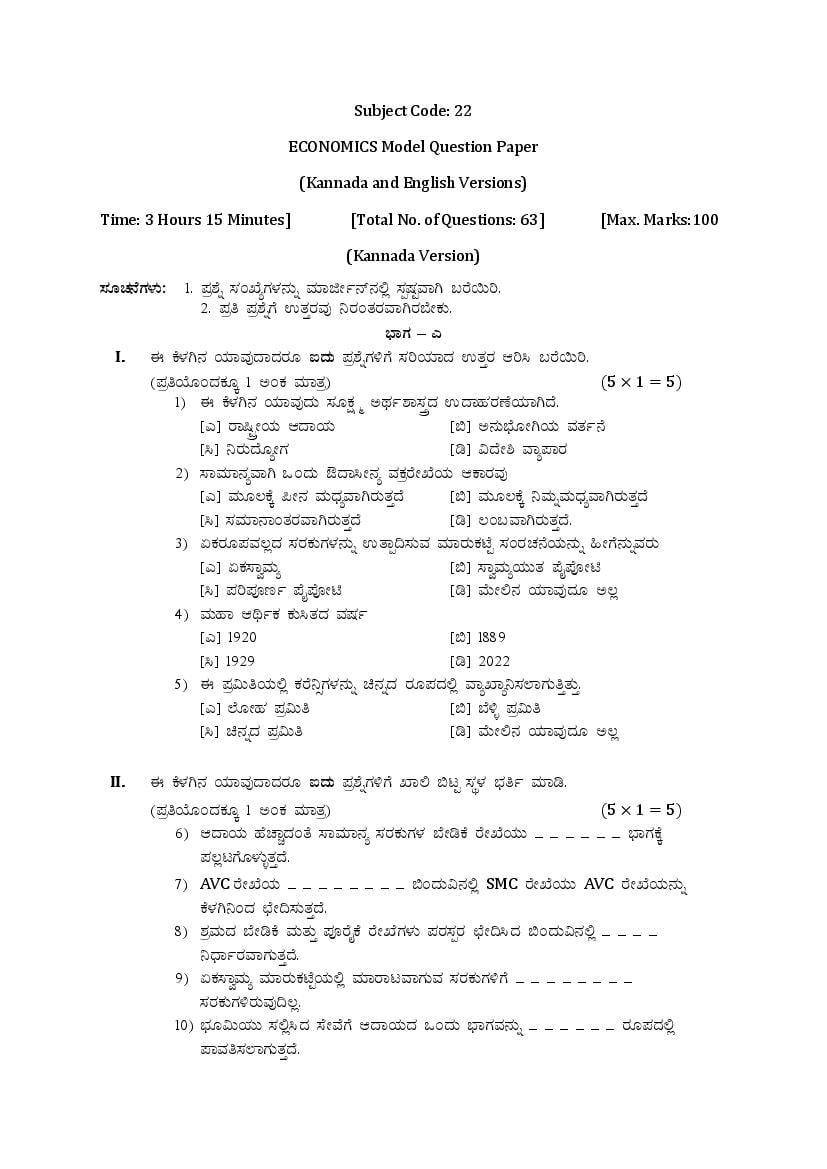
ECONOMICS Model Question Paper
(Kannada and English Versions)
Time: 3 Hours 15 Minutes] [Total No. of Questions: 63] [Max. Marks:100
(Kannada Version)
¸ÀÆZÀ£ÉUÀ¼ÀÄ: 1. ¥Àæ±Éß ¸ÀASÉåUÀ¼À£ÄÀ ß ªÀiÁfÃð£ï£À°è ¸ÀàµÀÖªÁV §gɬÄj.
2. ¥Àæw ¥Àæ±ÉßUÉ GvÀÛgÀªÀÅ ¤gÀAvÀgÀªÁVgÀ¨ÉÃPÀÄ.
¨sÁUÀ – J
I. F PɼÀV£À AiÀiÁªÀÅzÁzÀgÀÆ LzÀÄ ¥Àæ±ÉßUÀ½UÉ ¸ÀjAiÀiÁzÀ GvÀÛgÀ Dj¹ §gɬÄj.
(¥ÀæwAiÉÆAzÀPÀÆÌ 1 CAPÀ ªÀiÁvÀæ) (5 × 1 = 5)
1) F PɼÀV£À AiÀiÁªÀÅzÀÄ ¸ÀÆPÀë÷ä CxÀð±Á¸ÀÛçzÀ GzÁºÀgÀuÉAiÀiÁVzÉ.
[J] gÁ¶ÖçÃAiÀÄ DzÁAiÀÄ [©] C£ÀĨsÉÆÃVAiÀÄ ªÀvÀð£É
[¹] ¤gÀÄzÉÆåÃUÀ [r] «zÉò ªÁå¥ÁgÀ
2) ¸ÁªÀiÁ£ÀåªÁV MAzÀÄ OzÁ¹Ã£Àå ªÀPæg À ÉÃSÉAiÀÄ DPÁgÀªÀÅ
[J] ªÀÄÆ®PÉÌ ¦Ã£À ªÀÄzsÀåªÁVgÀÄvÀÛzÉ [©] ªÀÄÆ®PÉÌ ¤ªÀÄߪÀÄzsÀåªÁVgÀÄvÀÛzÉ
[¹] ¸ÀªÀiÁ£ÁAvÀgÀªÁVgÀÄvÀÛzÉ [r] ®A§ªÁVgÀÄvÀÛzÉ.
3) KPÀgÀÆ¥ÀªÀ®èzÀ ¸ÀgÀPÀÄUÀ¼£ À ÀÄß GvÁࢸÀĪÀ ªÀiÁgÀÄPÀmÉÖ ¸ÀAgÀZÀ£ÉAiÀÄ£ÀÄß »ÃUÉ£ÀÄߪÀgÀÄ
[J] KPÀ¸ÁéªÀÄå [©] ¸ÁéªÀÄåAiÀÄÄvÀ ¥ÉÊ¥ÉÇÃn
[¹] ¥Àj¥ÀÇtð ¥ÉÊ¥ÉÇÃn [r] ªÉÄð£À AiÀiÁªÀÅzÀÆ C®è
4) ªÀĺÁ DyðPÀ PÀĹvÀzÀ ªÀµÀð
[J] 1920 [©] 1889
[¹] 1929 [r] 2022
5) F ¥Àæ«ÄwAiÀÄ°è PÀgɤìUÀ¼À£ÀÄß a£ÀßzÀ gÀÆ¥ÀzÀ°è ªÁåSÁ夸À¯ÁUÀÄwÛvÀÄÛ.
[J] ¯ÉÆúÀ ¥Àæ«Äw [©] ¨É½î ¥Àæ«Äw
[¹] a£ÀßzÀ ¥Àæ«Äw [r] ªÉÄð£À AiÀiÁªÀÅzÀÆ C®è
II. F PɼÀV£À AiÀiÁªÀÅzÁzÀgÀÆ LzÀÄ ¥Àæ±ÉßUÀ½UÉ SÁ° ©lÖ ¸ÀܼÀ ¨sÀwð ªÀiÁr.
(¥ÀæwAiÉÆAzÀPÀÆÌ 1 CAPÀ ªÀiÁvÀæ) (5 × 1 = 5)
6) DzÁAiÀÄ ºÉZÁÑzÀAvÉ ¸ÁªÀiÁ£Àå ¸ÀgÀPÀÄUÀ¼À ¨ÉÃrPÉ gÉÃSÉAiÀÄÄ _ _ _ _ _ _ ¨sÁUÀPÌÉ
¥À®èlUÉƼÀÄîvÀÛzÉ.
7) AVC gÉÃSÉAiÀÄ _ _ _ _ _ _ _ _ ©AzÀÄ«£À°è SMC gÉÃSÉAiÀÄÄ AVC gÉÃSÉAiÀÄ£ÀÄß
PɼÀV¤AzÀ bÉâ¸ÀÄvÀÛzÉ.
8) ±ÀæªÀÄzÀ ¨ÉÃrPÉ ªÀÄvÀÄÛ ¥ÀÇgÉÊPÉ gÉÃSÉUÀ¼ÄÀ ¥ÀgÀ¸ÀàgÀ bÉâ¹zÀ ©AzÀÄ«£À°è _ _ _ _
¤zsÁðgÀªÁUÀÄvÀÛzÉ.
9) KPÀ¸ÁéªÀÄå ªÀiÁgÀÄPÀmÉÖAiÀÄ°è ªÀiÁgÁlªÁUÀĪÀ ¸ÀgÀPÀÄUÀ½UÉ _ _ _ _ _ _ _ _
¸ÀgÀPÀÄUÀ½gÀĪÀÅ¢®è.
10) ¨sÀÆ«ÄAiÀÄÄ ¸À°è¹zÀ ¸ÉêÉUÉ DzÁAiÀÄzÀ MAzÀÄ ¨sÁUÀªÀ£ÀÄß _ _ _ _ _ _ gÀÆ¥ÀzÀ°è
¥ÁªÀw¸À¯ÁUÀÄvÀÛzÉ.
Page 2
12) ¸ÀPÁðgÀªÀÅ CzÀÄ ¸ÀAUÀ滸ÀĪÀ DzÁAiÀÄPÉÌ ¸ÀªÀÄ£ÁzÀ ªÉÆvÀÛªÀ£ÀÄß ªÉZÀÑ ªÀiÁqÀÄvÀÛzÉ. EzÀ£ÀÄß _ _
_ _ _ _ JAzÀÄ PÀgÉAiÀÄÄvÉÛêÉ.
13) _ _ _ _ _ _ _ _ ªÀµÀðzÀ°è ¨Éæl£ïªÀÅqïì ¸ÀªÉÄäüÀ£À £ÀqɬÄvÀÄ.
III. ºÉÆA¢¹ §gɬÄj.
(¥ÀæwAiÉÆAzÀPÀÆÌ 1 CAPÀ ªÀiÁvÀæ) (5 × 1 = 5)
14) A B
1. ªÀiÁgÀÄPÀmÉÖ CxÀðªÀåªÀ¸ÜÉ J) 𝑇𝐶
2. 𝑇𝐹𝐶 + 𝑇𝑉𝐶 = ©) SÁ¸ÀV MqÉvÀ£À
3. ¥Àj¥ÀÇtð ¥ÉÊ¥ÉÇÃn ¹) PÁtzÀ PÉÊ PÁAiÀiÁðZÀgÀuÉ
4. DqÀA ¹ävï r) MlÄÖ zÉòÃAiÀÄ GvÀà£Àß
5. GDP E) ¥Àj¥ÀÇtð ªÀiÁ»w
IV. PɼÀV£À AiÀiÁªÀÅzÁzÀgÀÆ LzÀÄ ¥Àæ±ÉßUÀ½UÉ MAzÀÄ ªÁPÀå CxÀªÁ MAzÀÄ ¥ÀzÀzÀ°è GvÀÛj¹.
(¥ÀæwAiÉÆAzÀPÀÆÌ 1 CAPÀ ªÀiÁvÀæ) (5 × 1 = 5)
15) MRS «¸ÀÛj¹.
16) ¹ÃªÀiÁAvÀ DzÁAiÀĪÀ£ÀÄß ªÁåSÁ夹.
17) ¨É¯É CAvÀ¸ÀÄÛ JAzÀgÉãÀÄ?
18) KPÀ¸ÁéªÀÄå JAzÀgÉãÀÄ?
19) CAwªÀÄ ¸ÀgÀPÀÄUÀ¼A É zÀgÉ K£ÉAzÀÄ CxÉÊð¸ÀÄ«j.
20) ¸ÁéAiÀÄvÀÛ C£ÀĨsÉÆÃUÀzÀ CxÀðªÀ£ÀÄß §gɬÄj.
21) ¥ÀÅgÉÆÃUÁ«Ä vÉjUÉAiÀÄ CxÀð ¤Ãr.
22) ªÁå¥ÁgÀ ¨ÁQ JAzÀgÉãÀÄ?
V. F PɼÀV£À AiÀiÁªÀÅzÁzÀgÀÆ MA¨sÀvÀÄÛ ¥Àæ±ÉßUÀ½UÉ ¥ÀæwAiÉÆAzÀPÀÆÌ £Á®ÄÌ ªÁPÀåUÀ¼À°è GvÀÛj¹.
(¥ÀæwAiÉÆAzÀPÀÆÌ 2 CAPÀ ªÀiÁvÀæ) (9 × 2 = 18)
23) PɼÀzÀeÉðAiÀÄ ¸ÀgÀPÀÄUÀ¼ÉAzÀgÉãÀÄ? GzÁºÀgÀuÉ PÉÆr.
24) ¨ÉÃrPÉAiÀÄ ¤AiÀĪÀĪÀ£ÄÀ ß w½¹.
25) ¢ÃWÁðªÀ¢ü ªÉZÀÑUÀ¼ÁªÀŪÀÅ?
26) MAzÀÄ GzÀåªÀÄ WÀlPÀzÀ ¥ÀÇgÉÊPÉAiÀÄ gÉÃSÉAiÀÄ£ÀÄß ¤zsÀðj¸ÀĪÀ JgÀqÀÄ CA±ÀUÀ¼À£ÀÄß w½¹.
27) ¸ÀªÀÄvÉÆî£À ¨É¯É ªÀÄvÀÄÛ ¥ÀæªÀiÁtªÀ£ÄÀ ß ªÁåSÁ夹.
28) ¸ÁéªÀÄåAiÀÄÄvÀ ¥ÉÊ¥ÉÇÃn ªÀiÁgÀÄPÀmÉÖAiÀÄ CxÀð §gɬÄj ªÀÄvÀÄÛ MAzÀÄ GzÁºÀgÀuÉ ¤Ãr.
29) £Á®ÄÌ GvÁàzÀ£ÁAUÀUÀ¼ÁªÀŪÀÅ? CªÀÅUÀ¼À ¥Àæw¥sÀ®UÀ¼À£ÀÄß w½¹.
30) £ÁªÀĪÀiÁvÀæ ªÀÄvÀÄÛ £ÉÊd GDP UÀ¼À £ÀqÀÄ«£À ªÀåvÁ¸ÀªÀ£ÀÄß §gɬÄj.
31) CRR ªÀÄvÀÄÛ SLR UÀ¼À CxÀð ¤Ãr.
32) ºÀÆrPÉ ©A§PÀzÀ CxÀðªÀ£ÀÄß ¤Ãr CzÀgÀ ¸ÀÆvÀæªÀ£ÀÄß §gɬÄj.
33) «ÄvÀªÀåAiÀÄzÀ «gÉÆÃzsÁ¨sÁ¸ÀzÀ CxÀðªÀ£ÀÄß ¤Ãr.
34) ¸ÁªÀðd¤PÀ ¸ÀgÀPÀÄUÀ¼À£ÀÄß ¸ÀPÁðgÀªÉà KPÉ ¥ÀÇgÉʸÀ¨ÉÃPÀÄ?
Page 3
36) «zÉò «¤ªÀÄAiÀÄ zÀgÀ JAzÀgÉãÀÄ?
VI. F PɼÀV£À AiÀiÁªÀÅzÁzÀgÀÆ K¼ÀÄ ¥Àæ±ÉßUÀ½UÉ ¥ÀæwAiÉÆAzÀPÀÆÌ ºÀ£ÉßgÀqÀÄ ªÁPÀåUÀ¼À°è GvÀÛj¹.
(¥ÀæwAiÉÆAzÀPÀÆÌ 4 CAPÀUÀ¼ÀÄ) (7 × 4 = 28)
37) MAzÀÄ ¸ÀgÀ¼À DyðPÀvÉAiÀÄ°è PÀȶ PÀÄlÄA§, £ÉÃPÁgÀ, ²PÀëPÀgÀÄ ¸ÀA¥À£ÀÆä®UÀ¼À£ÀÄß §¼À¹ ºÉÃUÉ
vÀªÀÄä CUÀvÀåvÉUÀ¼À£ÄÀ ß ¥ÀÇgÉʹPÉƼÀÄîvÁÛgÉ JA§ÄzÀ£ÄÀ ß ¸ÀAQë¥ÀÛªÁV «ªÀj¹.
38) §zÀ° ¸ÀgÀPÀÄ ªÀÄvÀÄÛ ¥ÀÇgÀPÀ ¸ÀgÀPÀÄUÀ¼À £ÀqÀÄ«£À ªÀåvÁå¸ÀUÀ¼À£ÀÄß «ªÀj¹.
39) ¸ÀªÀÄ GvÀà£Àß gÉÃSÉAiÀÄ£ÀÄß gÉÃSÁavÀæzÀ ¸ÀºÁAiÀÄ¢AzÀ «ªÀj¹.
40) ¥Àæw¥sÀ®UÀ¼À ¥ÀæªÀiÁtzÀ §UÉÎ MAzÀÄ ¸ÀAQë¥ÀÛ n¥ÀàtÂAiÀÄ£ÀÄß §gɬÄj.
41) GzÀåªÀÄ WÀlPÀzÀ ¥ÀÇgÉÊPÉ gÉÃSÉAiÀÄ ¤zsÁðgÀPU À À¼À£ÀÄß «ªÀj¹.
42) ¥Àj¥ÀÇtð ¥ÉÊ¥ÉÇÃn ªÀiÁgÀÄPÀmÉÖAiÀÄ ®PÀëtUÀ¼À£ÀÄß «ªÀj¹.
43) ¸ÀªÀÄUÀæ CxÀð±Á¸ÀÛçªÀÅ ¸ÀÆPÀë÷ä CxÀð±Á¸ÀÛçQÌAvÀ AiÀiÁªÀ jÃwAiÀÄ°è ©ü£ÀߪÁVzÉ JA§ÄzÀ£ÄÀ ß
¸ÀAQë¥ÀÛªÁV «ªÀj¹.
44) MAzÀÄ DyðPÀvÉAiÀÄ DzÁAiÀÄzÀ ªÀÈvÁÛPÁgÀzÀ ZÀ®£ÉAiÀÄ£ÀÄß «ªÀj¹.
45) ¨ÁºÀåvÉUÀ¼À£ÀÄß PÀÄjvÀÄ MAzÀÄ n¥Ààt §gɬÄj.
46) vÀ¥À²Ã®Ä ¥ÀnÖAiÀÄ AiÉÆÃfvÀ ¸ÀAUÀæºÀuÉ ªÀÄvÀÄÛ PÀĹvÀzÀ GzÁºÀgÀuÉAiÀÄ£ÀÄß «ªÀj¹.
47) ¸ÀªÀÄUÀæ ¨ÉÃrPÉ ©A§PÀzÀ CxÀðªÀ£ÀÄß §gɬÄj. gÉÃSÁvÀäPÀªÁV CzÀ£ÀÄß ºÉÃUÉ ¥ÀqÉAiÀħºÀÄzÀÄ?
48) ZÁ°Û SÁvÉAiÀÄ ¨sÁUÀUÀ¼À ¥ÀlªÀ£ÀÄß §gɬÄj.
VII. F PɼÀV£À AiÀiÁªÀÅzÁzÀgÀÆ £Á®ÄÌ ¥Àæ±ÉßUÀ½UÉ ¥ÀæwAiÉÆAzÀPÀÆÌ E¥ÀàvÀÄÛ ªÁPÀåUÀ¼À°è GvÀÛj¹.
(¥ÀæwAiÉÆAzÀPÀÆÌ 6 CAPÀUÀ¼ÀÄ) (4 × 6 = 24)
49) E½ªÀÄÄR ¹ÃªÀiÁAvÀ vÀĶÖUÀÄt ¤AiÀĪÀĪÀ£ÄÀ ß PÉÆõÀÖPÀ ªÀÄvÀÄÛ gÉÃSÁavÀæzÀ ¸ÀºÁAiÀÄ¢AzÀ
«ªÀj¹.
50) OzÁ¹Ã£Àå ªÀPæg
À ÉÃSÉAiÀÄ ®PÀëtUÀ¼À£ÀÄß gÉÃSÁavÀæUÀ¼ÉÆA¢UÉ «ªÀj¹.
51) ¥Àj¥ÀÇtð ¥ÉÊ¥ÉÇÃn ªÀiÁgÀÄPÀmÉÖAiÀÄ°è ¨ÉÃrPÉ ªÀÄvÀÄÛ ¥ÀÇgÉÊPÉAiÀÄ KPÀPÁ®zÀ ¥À®èlUÀ¼À£ÄÀ ß
gÉÃSÁavÀæzÉÆA¢UÉ «ªÀj¹.
Page 4
GvÁàzÀ£Á ªÉZÀѪÀ£ÀÄß F PɼÀV£À C£ÀĸÀÆaAiÀÄ°è ¤ÃqÀ¯ÁVzÉ. F C£ÀĸÀÆaAiÀÄ°è£À
ªÀiÁ»wAiÀÄ£ÀÄß DzsÁj¹ PɼÀV£ÀªÀÅUÀ¼À£ÀÄß ¯ÉPÀÌ ºÁQ.
J) MR ªÀÄvÀÄÛ MC UÀ¼À C£ÀĸÀÆa
©) AiÀiÁªÀ ¥ÀæªÀiÁtzÀ°è MR ªÀÄvÀÄÛ MC UÀ¼ÀÄ ¸ÀªÀĪÁVgÀÄvÀÛªÉ.
¹) GvÀà£ÀßzÀ ¸ÀªÀÄvÉÆî£À ¥ÀæªÀiÁt ªÀÄvÀÄÛ ¸ÀgÀQ£À ¸ÀªÀÄvÉÆî£À ¨É¯É
r) ¸ÀªÀÄvÉÆî£ÀzÀ°è MlÄÖ DzÁAiÀÄ, MlÄÖ ªÉZÀÑ ªÀÄvÀÄÛ MlÄÖ ¯Á¨sÀ
¥ÀæªÀiÁt 0 1 2 3 4 5 6 7 8
(Q)
¨É¯É 52 44 37 31 26 22 19 16 13
(P)
¥ÀæªÀiÁt 0 1 2 3 4 5 6 7 8
(Q)
ªÉZÀÑ 10 60 90 100 102 105 109 115 125
(TC)
53) ¸ÀªÀÄUÀæ DyðPÀvÉAiÀÄ C£À£ÀåvÉUÀ¼À£ÀÄß «ªÀj¹.
54) ºÀtzÀ PÁAiÀÄðUÀ¼À£ÄÀ ß «ªÀj¹. EzÀÄ ºÉÃUÉ ¸Án «¤ªÀÄAiÀÄ ¥ÀzÀÞwAiÀÄ zÉÆõÀUÀ¼À£ÀÄß
¤ªÁj¹vÀÄ? w½¹.
55) ¹éÃPÀÈwUÀ¼À ªÀVÃðPÀgÀtªÀ£ÀÄß «ªÀj¹.
56) ¸ÀAzÁAiÀÄ ¨ÁQAiÀÄ §UÉÎ n¥Ààt §gɬÄj.
VIII. F PɼÀV£À AiÀiÁªÀÅzÁzÀgÀÆ JgÀqÀÄ PÁAiÀÄð¨sÁgÀ ªÀÄvÀÄÛ ¤AiÉÆÃd£É DzsÁjvÀ ¥Àæ±ÉßUÀ½UÉ GvÀÛj¹.
(¥ÀæwAiÉÆAzÀPÀÆÌ 2 CAPÀ ªÀiÁvÀæ) (2 × 5 = 10)
57) M§â C£ÀĨsÉÆÃVAiÀÄÄ JgÀqÀÄ ¸ÀgÀPÀÄUÀ¼À£ÄÀ ß C£ÀĨsÉÆÃV¸À®Ä §AiÀĸÀÄvÁÛ¼.É ¨Á¼Éºt À ÂÚ£À ¨É¯É
gÀÆ. 5 ªÀÄvÀÄÛ ªÀiÁ«£À ºÀtÂÚ£À ¨É¯É gÀÆ. 10 DVzÀÄÝ, C£ÀĨsÉÆÃVAiÀÄ DzÁAiÀÄ gÀÆ. 40
DVzÉ. F PɼÀV£ÀªÀÅUÀ½UÉ GvÀÛj¹.
J) C£ÀĨsÉÆÃVAiÀÄÄ vÀ£ßÀ ¸ÀA¥ÀÇtð DzÁAiÀĪÀ£ÄÀ ß RZÀÄðªÀiÁr JµÀÄÖ ¥ÀæªÀiÁtzÀ
¨Á¼ÉºÀtÚ£ÀÄß C£ÀĨsÉÆÃV¸À§ºÀÄzÀÄ?
©) C£ÀĨsÉÆÃVAiÀÄÄ vÀ£Àß ¸ÀA¥ÀÇtð DzÁAiÀĪÀ£ÀÄß RZÀÄðªÀiÁr JµÀÄÖ ¥ÀæªÀiÁtzÀ ªÀiÁ«£À
ºÀtÚ£ÀÄß C£ÀĨsÉÆÃV¸À§ºÀÄzÀÄ?
¹) §eÉmï gÉÃSÉAiÀÄ E½eÁgÀÄ PɼÀªÀÄÄR CxÀªÁ ªÉÄîÄäRªÁVgÀÄvÀÛzÉAiÉÄÃ?
r) §eÉmï gÉÃSÉAiÀÄ ªÉÄð£À J¯Áè ¸ÀAAiÉÆÃd£ÉUÀ¼ÄÀ C£ÀĨsÉÆÃVAiÀÄ DzÁAiÀÄPÉÌ
¸ÀªÀÄ£ÁVgÀÄvÀÛªÉAiÉÄÃ? CxÀªÁ E®èªÉÃ?
E) MAzÀÄ ¨Á¼Éºt À Ú£ÀÄß ºÉZÀÄѪÀjAiÀiÁV ¥ÀqÉAiÀÄ®Ä ªÀiÁ«£À ºÀtÚ£ÀÄß ©lÄÖPÆ
É qÀ¨ÉÃPÁUÀÄvÀÛzÉ.
EzÀÄ ¸ÀjAiÉÄÃ?
Page 5
DzÁAiÀÄ, ¹ÃªÀiÁAvÀ DzÁAiÀÄ ªÀÄvÀÄÛ ¸ÀgÁ¸Àj DzÁAiÀÄzÀ C£ÀĸÀÆaUÀ¼À ¯ÉPÁÌZÁgÀ ªÀiÁr.
ªÀiÁgÁl ¥ÀæªÀiÁt TR MR AR
0
1
2
3
4
5
6
(CAzsÀ «zÁåyðUÀ½UÉ ªÀiÁvÀæ) TR, MR ªÀÄvÀÄÛ AR UÀ¼À CxÀð §gɬÄj
59) C£ÁtÂåÃPÀgÀt CxÀªÁ ºÀtzÀ CªÀiÁ¤åÃPÀgÀt (£ÉÆÃlÄ gÀzÀÞw) §UÉÎ MAzÀÄ n¥Ààt §gɬÄj.
60) F PɼÀV£ÀªÀÅUÀ¼À°è AiÀiÁªÀÅzÁzÀgÀÆ LzÀÄ zÉñÀUÀ¼À PÀgɤìAiÀÄ£ÀÄß ºÉ¸Àj¹.
USA, UK, dªÀÄð¤, d¥Á£ï, aãÁ, CeÉðAmÉÊ£Á, UAE ¨ÁAUÁèzÉñÀ, gÀµÁå
Page 6
(English Version)
Instructions: 1. Write the question numbers legibly in the margin
2. Answer for the question should be continuous.
PART – A
I. Answer any Five of the following questions by choosing the correct answer.
(Each question carries 1 mark) (5 x 1 = 5)
1) Which of the following is an example of micro economic study
[a] National income [b] Consumer behavior
[c] Unemployment [d] Foreign Trade
2) The shape of an indifference curve is normally
[a] Convex to origin [b] Concave to origin
[c] Horizontal [d] Vertical
3) The market structure which produces heterogeneous products is called
[a] Monopoly [b] Monopolistic Competition
[c] Perfect Competition [d] None of the above
4) The year of great depression
[a] 1920 [b] 1889
[c] 1929 [c] 2022
5) In this standard all currencies were defined in terms of gold.
[a] metal [b] silver
[c] gold standard [d] none of the above
II. Answer any Five of the following questions by fill in the blanks.
(Each question carries 1 mark) (5 x 1 = 5)
6) As income increases the demand curve for normal goods shifts towards _ _ _ .
7) SMC Curve cuts the AVC curve at the _ _ _ _ _ _ _ _ point of the AVC curve from
below.
8) _ _ _ _ _ _ _ _ _ _ is determined at the point where the demand for labour and
supply of labour curves intersect.
9) In monopoly market goods which are sold have no _ _ _ _ _ _ _ _ _ _ _.
10)A part of the revenue is paid out as _ _ _ _ _ _ _ _ _ _ for the service rendered by
land.
11)Savings is that part of income that is _ _ _ _ _ _ _ _ _ _.
12)The government may spend an amount equal to the revenue it collects. This
is known as _ _ _ _ _ _ _ _ _ _ _ _ _.
13)The Bretton woods conference held in the year _ _ _ _ _ _ _ _ .
Page 7
(Each question carries 1 mark) (5 x 1 = 5)
14) A B
1. Market economy a) TC
2. TFC + TVC = b) Private
3. Perfect competition c) Operation of invisible hand
4. Adam Smith d) Gross Domestic Product
5. GDP e) Perfect Information
IV. Answer any Five of the following questions in a word or a sentence.
(Each question carries 1 mark) (5 x 1 = 5)
15)Expand MRS.
16)Define Marginal Revenue.
17)What is price floor?
18)What is monopoly?
19)What do you mean by final good.
20)Write the meaning of autonomous consumption.
21)Give the meaning of progressive tax.
22)What is balance of trade?
PART – B
V. Answer any Nine of the following question in four sentence each.
(Each question carries 2 mark) (9 x 2 = 18)
23)What do you mean by inferior good? Give example.
24)State the law of demand.
25)What are long run costs?
26)Mention the two determinants a firm’s supply curve.
27)Define equilibrium price and quantity.
28)Write the meaning of monopolistic competition and give an example.
29)What are the four factors of production? Mention their rewards.
30)Write the difference between nominal GDP and Real GDP.
31)Give the meaning of CRR and SLR.
32)Give the meaning of investment multiplier and write its formula.
33)Give the meaning of paradox of thrift.
34)Why public goods must be provided by the government?
35)Mention the three linkages of open economy.
36)What is foreign exchange rate?
Page 8
VI. Answer any Seven of the following questions in twelve sentences each.
(Each question carries 4 marks) (7 x 4 = 28)
37)Briefly explain how the family, firm, weaver, teacher can use their resources
to fulfill their needs in a simple economy.
38)Write the differences between substitutes and complements.
39)Explain Isoquant with the help of a diagram.
40)Write a brief note on returns to scale.
41)Explain the determinants of a firm’s supply curve.
42)Explain the features of perfect competition.
43)Briefly explain why Macro Economics is different from Micro Economics.
44)Explain the circular flow of income of an economy.
45)Write a note on externalities.
46)Explain the example of planned accumulation and decumulation of
inventories.
47)Give the meaning of aggregate demand function. How can it be obtained
graphically?
48)Write the chart of components of current account.
PART – D
VII. Answer any Four of the following questions in twenty sentences each.
(Each question carries 6 marks) (4 x 6 = 24)
49)Explain the law of Diminishing Marginal Utility with the help of a table and
diagram.
50)Explain the features of indifference curves with the help of diagrams.
51)Explain the simultaneous shift of demand and supply curves in perfect
competition with the help of diagrams.
Page 9
firm reducing the commodity are given by the schedules below. Use the
information to calculate the following.
a) The MR and MC schedules.
b) The quantity for which the MR and MC are equal.
c) The equilibrium quantity of output and the equilibrium price of the
commodity.
d) The Total Revenue, the Total Cost and Total Profit in equilibrium.
Quantity 0 1 2 3 4 5 6 7 8
(Q)
Price 52 44 37 31 26 22 19 16 13
(P)
Quantity 0 1 2 3 4 5 6 7 8
(Q)
Total Cost 10 60 90 100 102 105 109 115 125
(TC)
53)Explain the Macro Economic Identities.
54)Explain the functions of money and how does money overcome the short
comings of barter system.
55)Explain the classification of receipts.
56)Write a note on Balance of Payment.
PART – E
VIII. Answer any Two of the following project and assignment oriented questions.
(Each question caries 5 marks) (2 x 5 = 10)
57)A consumer wants to consume two goods. The price of banana is Rs. 5 and
the price of mangoes is Rs. 10. The consumer income is Rs. 40.
a) How much bananas can she consumes if she spends her entire income on
that good?
b) How much mangoes can she consumes if she spends her entire income on
that good?
c) Is the slope of budget line downward or upward?
d) Are the bundles on the budget line equal to the consumer’s income or
not?
e) If you want to have more of bananas you have to give up mangoes. Is it
true?
Page 10
schedules in the following table, when market price of each unit of good is Rs.
10.
Quantity Sold TR MR AR
0
1
2
3
4
5
6
For Blind Students Only: Explain the meaning of TR, MR and AR.
59)Write a note on Demonitization.
60)Name the currencies of any five countries of the following.
USA, UK, Germany, Japan, China, Argentina, UAE, Bangladesh, Russia
Document Details
| Board / Org | Karnataka Board |
| Exam | Class 12 |
| Type | Sample Paper |
| Pages | 10 |
| Updated | 22 Jul 2026 |