CBSE Class 12 Question Paper 2025 Solution Textile Design
Finished viewing? Save it for later —
Download CBSE Class 12 Question Paper 2025 Solution Textile Design (PDF · 10 pages)About CBSE Class 12 Question Paper 2025 Solution Textile Design
CBSE Class 12 Question Paper 2025 Solution Textile Design is available here for free download. Published by CBSE for Class 12, this solution can be viewed online or downloaded as a PDF (10 pages). Candidates preparing for Class 12 can use CBSE Class 12 Question Paper 2025 Solution Textile Design to understand the exam pattern, the type of questions asked, and the overall difficulty level.
Frequently Asked Questions
How can I download CBSE Class 12 Question Paper 2025 Solution Textile Design?
Open this page and click the Download button to save CBSE Class 12 Question Paper 2025 Solution Textile Design as a PDF. It is completely free on AglaSem Docs.
Is CBSE Class 12 Question Paper 2025 Solution Textile Design free to download?
Yes. CBSE Class 12 Question Paper 2025 Solution Textile Design can be viewed online and downloaded as a PDF free of cost on AglaSem Docs.
How many pages does CBSE Class 12 Question Paper 2025 Solution Textile Design have?
CBSE Class 12 Question Paper 2025 Solution Textile Design contains 10 pages, which you can read online or download together as a single PDF.
Where can I find more Class 12 study material?
You can find more Class 12 question papers, sample papers, syllabus, and answer keys on AglaSem Docs.
CBSE Class 12 Question Paper 2025 Solution Textile Design – Text
Read the full text of this solution below — useful to quickly search, copy and reference the content online without downloading the PDF.
📄 View text version (10 pages)
Page 1
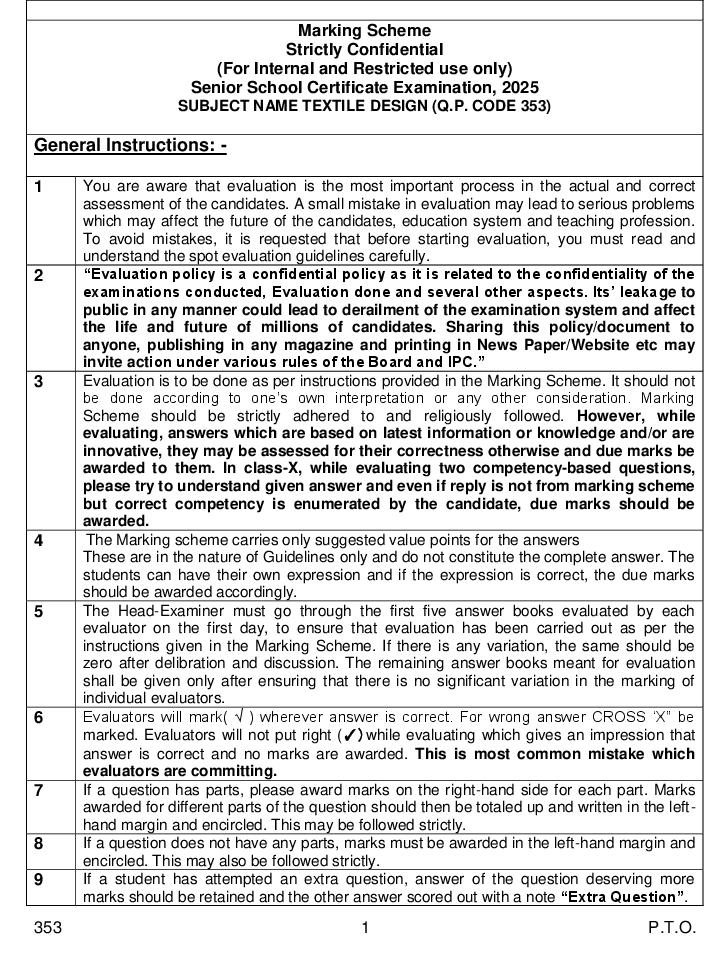
Strictly Confidential
(For Internal and Restricted use only)
Senior School Certificate Examination, 2025
SUBJECT NAME TEXTILE DESIGN (Q.P. CODE 353)
General Instructions: -
1 You are aware that evaluation is the most important process in the actual and correct
assessment of the candidates. A small mistake in evaluation may lead to serious problems
which may affect the future of the candidates, education system and teaching profession.
To avoid mistakes, it is requested that before starting evaluation, you must read and
understand the spot evaluation guidelines carefully.
2 “Evaluation policy is a confidential policy as it is related to the confidentiality of the
examinations conducted, Evaluation done and several other aspects. Its’ leakage to
public in any manner could lead to derailment of the examination system and affect
the life and future of millions of candidates. Sharing this policy/document to
anyone, publishing in any magazine and printing in News Paper/Website etc may
invite action under various rules of the Board and IPC.”
3 Evaluation is to be done as per instructions provided in the Marking Scheme. It should not
be done according to one’s own interpretation or any other consideration. Marking
Scheme should be strictly adhered to and religiously followed. However, while
evaluating, answers which are based on latest information or knowledge and/or are
innovative, they may be assessed for their correctness otherwise and due marks be
awarded to them. In class-X, while evaluating two competency-based questions,
please try to understand given answer and even if reply is not from marking scheme
but correct competency is enumerated by the candidate, due marks should be
awarded.
4 The Marking scheme carries only suggested value points for the answers
These are in the nature of Guidelines only and do not constitute the complete answer. The
students can have their own expression and if the expression is correct, the due marks
should be awarded accordingly.
5 The Head-Examiner must go through the first five answer books evaluated by each
evaluator on the first day, to ensure that evaluation has been carried out as per the
instructions given in the Marking Scheme. If there is any variation, the same should be
zero after delibration and discussion. The remaining answer books meant for evaluation
shall be given only after ensuring that there is no significant variation in the marking of
individual evaluators.
6 Evaluators will mark( √ ) wherever answer is correct. For wrong answer CROSS ‘X” be
marked. Evaluators will not put right (✓)while evaluating which gives an impression that
answer is correct and no marks are awarded. This is most common mistake which
evaluators are committing.
7 If a question has parts, please award marks on the right-hand side for each part. Marks
awarded for different parts of the question should then be totaled up and written in the left-
hand margin and encircled. This may be followed strictly.
8 If a question does not have any parts, marks must be awarded in the left-hand margin and
encircled. This may also be followed strictly.
9 If a student has attempted an extra question, answer of the question deserving more
marks should be retained and the other answer scored out with a note “Extra Question”.
353 1 P.T.O.
Page 2
once.
11 A full scale of marks __________(example 0 to 80/70/60/50/40/30 marks as given in
Question Paper) has to be used. Please do not hesitate to award full marks if the answer
deserves it.
12 Every examiner has to necessarily do evaluation work for full working hours i.e., 8 hours
every day and evaluate 20 answer books per day in main subjects and 25 answer books
per day in other subjects (Details are given in Spot Guidelines).This is in view of the
reduced syllabus and number of questions in question paper.
13 Ensure that you do not make the following common types of errors committed by the
Examiner in the past:-
● Leaving answer or part thereof unassessed in an answer book.
● Giving more marks for an answer than assigned to it.
● Wrong totaling of marks awarded on an answer.
● Wrong transfer of marks from the inside pages of the answer book to the title page.
● Wrong question wise totaling on the title page.
● Wrong totaling of marks of the two columns on the title page.
● Wrong grand total.
● Marks in words and figures not tallying/not same.
● Wrong transfer of marks from the answer book to online award list.
● Answers marked as correct, but marks not awarded. (Ensure that the right tick mark
is correctly and clearly indicated. It should merely be a line. Same is with the X for
incorrect answer.)
● Half or a part of answer marked correct and the rest as wrong, but no marks awarded.
14 While evaluating the answer books if the answer is found to be totally incorrect, it should
be marked as cross (X) and awarded zero (0)Marks.
15 Any unassessed portion, non-carrying over of marks to the title page, or totaling error
detected by the candidate shall damage the prestige of all the personnel engaged in the
evaluation work as also of the Board. Hence, in order to uphold the prestige of all
concerned, it is again reiterated that the instructions be followed meticulously and
judiciously.
16 The Examiners should acquaint themselves with the guidelines given in the “Guidelines
for Spot Evaluation” before starting the actual evaluation.
17 Every Examiner shall also ensure that all the answers are evaluated, marks carried over to
the title page, correctly totaled and written in figures and words.
18 The candidates are entitled to obtain photocopy of the Answer Book on request on
payment of the prescribed processing fee. All Examiners/Additional Head Examiners/Head
Examiners are once again reminded that they must ensure that evaluation is carried out
strictly as per value points for each answer as given in the Marking Scheme.
353 2
Page 3
$
MARKING SCHEME
TEXTILE DESIGN
SECTION− A
(Reading) (20 marks)
Source
Unity P.No.
Chapter
1. (i) b. Factual
Employability 1 3 1
Skills, XII
(ii) a. Set clear goals ,, 2 28
b. Prepare an action plan
c. Use right resources and tools
d. Communicate with mentors and
peers;
e. Make a calendar
f. Work hard– Any two
(iii) Worksheet ,, 3 42 1
(iv) Startup is a company that is in the 1st stage of its operations.
,, 4 79
It is different from traditional business in the way they think about
growth and is often financed by founders till the business gets of the
ground.
(v) b. .ods ,, 3 47
353 3 P.T.O.
Page 4
2. (i) Added
Textile Chemical Processing, XII 1 2 1
(ii) Sagwan seasoned teak wood. ,, 3 42 1
(iii) Protein fibers wool, and silk. ,, 2 7 1
(iv) Chain Traditional
Indian 1 3 1
textile XII
(v) C. To remove protruding Textile
Chemical 1 4 1
fibers from
both sides Processing, XII
of the fabric
(vi) Printing Printed textile XII 1 10 1
(vii) Black, Brown, Navy blue Textile Chemical 2 8 1
Khaki – Any two Processing, XII
3. (i) Oxidative ,, 1 4
(ii) Sikar, Bikaner, Jodhpur, ,, 2 11 1
Udaipur, Barmer, Jaipur – Any two
(iii) Hand Screen ,, 3 43 1
(iv) All over, tossed, free flowing, Printed Textile 1 8 1
stripes border, set, scenic, XII
patchwork – Any two
(v) They produce very good range Textile Chemical 2 13 1
of shades except dark blue Processing, XII
and black
(vi) Untwisted silk thread ‘pat’ Traditional Indian 1 5 1
textile XII
(vii) Not economical for short run Textile Chemical 3 47 1
of fabrics, Processing, XII
353 4
Page 5
Repeat is limited to
circumference and width of
roller – Any one
4. (i) c. 15 – 25% ,,
(ii) Chandrokhani Textile Chemical 2 34 1
Processing, XII
(iii) Orange, violet, green Printed Textile XII 1 11 1
– Any two
(iv) Stem/ Herringbone-any one Traditional Indian 1 14 1
textile XII
(v) White Textile Chemical 3 47 1
Processing, XII
(vi) Agricultural 2 20 1
5.(i) The designs develop an Printed Textile XII 3 64 1
interesting tone on tone,
merged effect often having
a three dimensional look to it
(ii) Required amount of enzyme, Textile Chemical 1 3 1
wetting agent and Sodium Processing, XII
Chloride
(iii) Lotus flowers, floral scrolls, tree of life, creepers; animal and bird forms;
fish, sea-monsters; domestic articles like mirrors, pitcher, nut cracker,
umbrella, musical instruments and human figures like gods and
goddesses, horse man, fisherwoman etc-Any two
Traditional Indian 1 23 1
Textile XII
(iv) By reducing it with the help of Textile Chemical 2 8 1
Caustic Soda and Sodium Processing, XII
hydro sulphite
(v) In Lucknow, Uttar Pradesh Traditional Indian 1 14 1
Textile XII
353 5 P.T.O.
Page 6
Processing, XII
6. (i) Floor rug Traditional
Indian 1 5 1
Textile XII
(ii) John Mercer Textile Chemical 1 5 1
Processing, XII
(iii) Ethnic Printed Textile XII 2 29 1
(iv) Mothra is a traditional Leheriya Textile Chemical 2 11 1
textile that has a fine checkered Processing, XII
pattern created by Criss crossing
lines
(v) Animal Prints Printed Textile XII 2 27 1
(vi) Definition of Warp print Textile Chemical 3 53 1
Warp Prints involve printing the warp yarns of a fabric before it is placed
on the loom for weaving; then, the fabric is woven with a solid color weft
usually white or contrast color Processing, XII
7. Remove; Eye contact; Show; Pay; Employability 1 5 2
Empathise; Clarify doubts Skills, XII
8. Paranoid personality disorder is ,, 2 35 1+1
characterised by distrust for others,
including friends, family members
and partners. People with such a
disorder mostly hold grudges against
others. Schizoid personality disorder
schizotypal personality disorder – Any one
9. a. Click on slide Employability 3 70 2
Skills, XII
b. Select New slide from the drop
down or press ctrl + M on the
keyboard.
353 6
Page 7
the presentation.
10. A entrepreneur is a self-employed person, ,, 4 87 1+1
who strives to make the business better by
taking risks and trying new ideas. For example,
Sita is an entrepreneur who set up her food
business introducing new dishes in the menu…any one example
11. a. Reusing scrap material ,, 5 119 1+1
b. Ensuring quality control,
waste exchange, managing e-waste, use
of eco-friendly material – Any two
12. In this process, fabric is treated with Textile Chemical 1 3, 4 2
strong alkali solution (5 – 10 gm/lit Processing, XII
NaOH or mixture of NaOH and Sodium
carbonate) close to or above the boiling
temperatures of 1 – 2 hours with hot rinse
and find cold rinse with citric acid.
13. Direct dyes are water soluble dyes Textile Chemical 2 10 1+1
derived from a formulation of Processing, XII
Benzidine salts. They are widely
used on cellulosic fibers.
14. a. It is simple to operate and does not ,, 3 43
require expensive equipment.
b. There is no limitation of number of
colours and reproduction of design
is very easy.
15. a. A geometric print comprises of Printed Textile XII 2 15 1+1
designs made with circles,
squares, triangles, spirals an stars.
b. They are visually stimulating.
16. The embroidery is executed on layers Traditional Indian 1 23 2
353 7 P.T.O.
Page 8
stitched together with simple
running stitch in white thread.
The emb. threads are drawn
from old sari (cotton) borders.
17.Hydrogen peroxide is called as Universal
Bleaching agent. Hydrogen peroxide
Bleaching is Textile Chemical 1 5 1+2
carried out generally near or above Processing, XII
boiling temp, under pressure, for
one hours or more. After bleaching,
the fabric is thoroughly rinsed with
slight amount of basic solution to
avoid formulation of insoluble salts
of silicates.
18. a.Produces bright, sharp, clear, fine Textile Chemical 3 48 1+1+1
line designs. Processing, XII
b. Ability to print cut garment
parts and small items.
c. Adaptable to long and short
yardage runs.
d. No after treatment of febric required,
simple operation.
e. Design transferred to piece of paper.
paper is then placed on fabric and
heat. Pressure is applied to fix image
onto the fabric. -Any three
19. 2 styles-Bagh and Phulkari
Bagh is a fully Traditional 1 6 1+1+1
embroidered wrap that is used for Indian Textile XII
special occasions whereas phulkari
353 8
Page 9
for every day use.
20.These dyes are applied in two stages; Textile Chemical 2 9 3+1
First stage is called Naptholation of Processing, XII
the fabric in which the fabric is first immersed in naphthol, which impregnates
the fibers; In the second stage the fabric
is then dipped into the diazotized color bath. The dyeing is followed by through
soaping and rinsing.
Naphthol or azoic dyes are sometimes referred to as ice dyes because ice is
frequently used to bring the dyes to a low temperature and assure efficient dye
formation
21. White discharge print : white polka ,, 3 48 2+1+1
dot on a blue background can be made
by first dyeing the fabric blue, then
printing appropriate dots with the
chemical which removes the blue colour.
For colour discharge, the two substances,
the colours removing chemical and vat dye,
may be mixed together in the same print
paste and applied in the similar fashion.
When printing with this mixture, the
colour removing chemical removes the
previously dyed background colour while
the vat dye colour is simultaneously
printed on the fabric.
22. Technique : Traditional Indian 1 14 3+1
Textile XII
The Chikankari embroidery is done on fine white cotton fabric with untwisted
white cotton or silk thread. There are three types of stitches used in chikankari:
flat stitches like stem stitch and herringbone stitch, raised stitches like bullion
and French knots and pulled thread work or jali. . A common style present in
each piece of Chikankari is the shadow work. To create the light and shade
effect, herringbone stitch is executed from the wrong side of the fabric which
353 9 P.T.O.
Page 10
outline to the motif.
.
Motifs : The motifs are inspired from nature’s flora including flowers, creepers
and lace-like patterns. Paisley or Kairi is a popular motif used in
Chikankari..
23. Steps : a. Take a drawing sheet. Printed Textile XII 3 72 2+2
b. Put the dry paint brush in
acrylic paints.
c. Make any design of your choice
on the sheet.
d. Use different colour and sizes of
brush for making of different designs.
Precautions : a. Wash the brush properly
before dipping and using another colour.
b. Dry the brush before putting it in
acrylic clolours.
24.The basic steps of creating a bandhani
textile are as follows: Textile Chemical 2 16 4
-Pre-preparation of fabric Processing, XII
-Tying of fabric
-Dyeing of fabric in the lightest colour
-Renewal of tying and dyeing in next-darker colour
-Washing
-Opening the ties
Explain each of the above step briefly
The examiners may use their judgement in marking.
353 10
Document Details
| Board / Org | CBSE |
| Exam | Class 12 |
| Type | Solution |
| Pages | 10 |
| Updated | 24 Sep 2026 |