MAHA SET 2018 Question Paper 3 History
Finished viewing? Save it for later —
Download MAHA SET 2018 Question Paper 3 History (PDF · 40 pages)About MAHA SET 2018 Question Paper 3 History
MAHA SET 2018 Question Paper 3 History is available here for free download. Published by Maharashtra Exams for Maharashtra State Eligibility Test, this question paper can be viewed online or downloaded as a PDF (40 pages). Candidates preparing for Maharashtra State Eligibility Test can use MAHA SET 2018 Question Paper 3 History to understand the exam pattern, the type of questions asked, and the overall difficulty level.
Frequently Asked Questions
How can I download MAHA SET 2018 Question Paper 3 History?
Open this page and click the Download button to save MAHA SET 2018 Question Paper 3 History as a PDF. It is completely free on AglaSem Docs.
Is MAHA SET 2018 Question Paper 3 History free to download?
Yes. MAHA SET 2018 Question Paper 3 History can be viewed online and downloaded as a PDF free of cost on AglaSem Docs.
How many pages does MAHA SET 2018 Question Paper 3 History have?
MAHA SET 2018 Question Paper 3 History contains 40 pages, which you can read online or download together as a single PDF.
Where can I find more Maharashtra State Eligibility Test study material?
You can find more Maharashtra State Eligibility Test question papers, sample papers, syllabus, and answer keys on AglaSem Docs.
MAHA SET 2018 Question Paper 3 History – Text
Read the full text of this question paper below — useful to quickly search, copy and reference the content online without downloading the PDF.
📄 View text version (40 pages)
Page 1
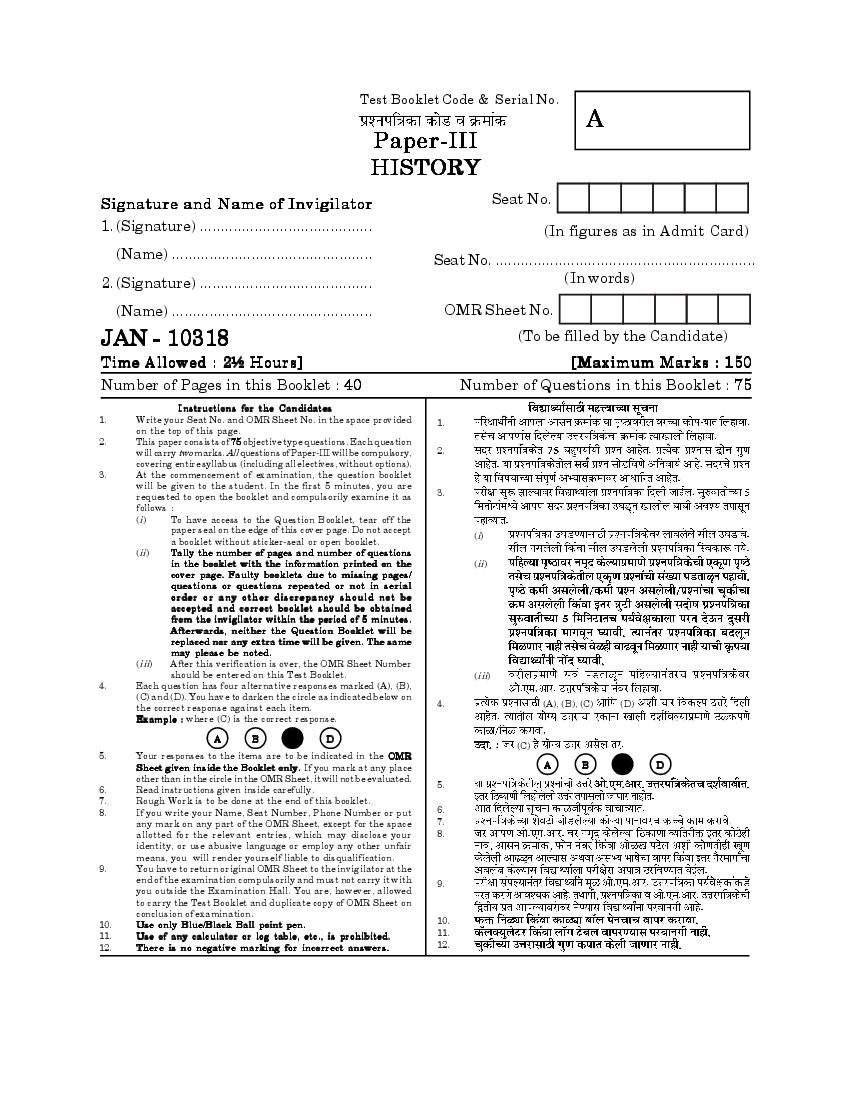
A
HISTORY
Signature and Name of Invigilator Seat No.
1. (Signature) ......................................... (In figures as in Admit Card)
(Name) ................................................ Seat No. ..............................................................
2. (Signature) ......................................... (In words)
(Name) ................................................ OMR Sheet No.
JAN - 10318 (To be filled by the Candidate)
Time Allowed : 2½ Hours] [Maximum Marks : 150
Number of Pages in this Booklet : 40 Number of Questions in this Booklet : 75
Instructions for the Candidates
1. Write your Seat No. and OMR Sheet No. in the space provided 1.
on the top of this page.
2. This paper consists of 75 objective type questions. Each question
will carry two marks. All questions of Paper-III will be compulsory, 2.
covering entire syllabus (including all electives, without options).
3. At the commencement of examination, the question booklet
will be given to the student. In the first 5 minutes, you are
requested to open the booklet and compulsorily examine it as 3.
follows :
(i) To have access to the Question Booklet, tear off the
paper seal on the edge of this cover page. Do not accept
(i)
a booklet without sticker-seal or open booklet.
(ii) Tally the number of pages and number of questions
in the booklet with the information printed on the (ii)
cover page. Faulty booklets due to missing pages/
questions or questions repeated or not in serial
o rder or any other discre pancy should not be
accepted and correct booklet should be obtained
from the invigilator within the period of 5 minutes.
Afterwards, neither the Question Booklet will be
replaced nor any extra time will be given. The same
may please be noted.
(iii) After this verification is over, the OMR Sheet Number
should be entered on this Test Booklet. (iii)
4. Each question has four alternative responses marked (A), (B),
(C) and (D). You have to darken the circle as indicated below on
the correct response against each item. 4. (A), (B), (C) (D)
Example : where (C) is the correct response.
A B D
(C)
5. Your responses to the items are to be indicated in the OMR
Sheet given inside the Booklet only. If you mark at any place A B D
other than in the circle in the OMR Sheet, it will not be evaluated.
5.
6. Read instructions given inside carefully.
7. Rough Work is to be done at the end of this booklet.
8. If you write your Name, Seat Number, Phone Number or put 6.
any mark on any part of the OMR Sheet, except for the space 7.
allotted for the relevant entries, which may disclose your 8.
identity, or use abusive language or employ any other unfair
means, you will render yourself liable to disqualification.
9. You have to return original OMR Sheet to the invigilator at the
end of the examination compulsorily and must not carry it with 9.
you outside the Examination Hall. You are, however, allowed
to carry the Test Booklet and duplicate copy of OMR Sheet on
conclusion of examination.
10. Use only Blue/Black Ball point pen. 10.
11. Use of any calculator or log table, etc., is prohibited. 11.
12. There is no negative marking for incorrect answers. 12.
Page 2
Page 3
Paper III
III
Time Allowed : 2½ Hours] [Maximum Marks : 150
Note : This paper contains Seventy Five (75) multiple choice questions. Each
question carrying Two (2) marks. Attempt All questions.
(75) (2)
1. Which among the following ancient 1.
sites is not representing the
Harappan culture ?
(A)
(A) Rakhigarhi
(B)
(B) Lothal
(C)
(C) Dholavira
(D) Nevasa (D)
2. Punchmarked coins were prevalent 2.
during :
(A) Late Medieval Period (A)
(B) Medieval Period (B)
(C) Harappan Period (C)
(D) Early Historic Period (D)
3 [P.T.O.
Page 4
merchandise was imported to India
from Rome ?
(A)
(A) Wine
(B)
(B) Cardamom
(C) Clove (C)
(D) Peacock (D)
4. Which among the following terms 4.
was used for caravan traders
according to the Jataka tells ?
(A) Panyadhyaksha (A)
(B) Kammara (B)
(C) Sarthavaha (C)
(D) Vanija (D)
5. Who wrote ‘Ashtang Hridya’ ? 5.
(A) Charaka (A)
(B) Vagbhatta (B)
(C) Atreya (C)
(D) Nagarjuna (D)
4
Page 5
ganarajya according to Buddhist
Canonical texts ?
(A)
(A) Koliya
(B)
(B) Shakya
(C)
(C) Kosala
(D) Moriya (D)
7. Which among the following 7.
Mauryan rulers is mentioned in the
Rajatarangini of Kalhana ?
(A) Dhananand (A)
(B) Jalouk (B)
(C) Samprati (C)
(D) Dasharath (D)
5 [P.T.O.
Page 6
associated with the history of ...........
dynasty ?
(A)
(A) Satavahana
(B)
(B) Shunga
(C) Kushana (C)
(D) Western Kshatrapa (D)
9. The king Milinda of the Buddhist 9.
text Milind Panho has been
identified with the Indo-Greek
king ...............
(A)
(A) Eucratides I
(B)
(B) Demetrius I
(C) Menander (C)
(D) Apollodotus I (D)
10. According to A.S. Altekar, the king 10.
Chandra mentioned in the
Meharauli Pillar inscription can be
identified with ...........
(A)
(A) Gupta King Chandragupta II
(B) Kushan King Kanishka I (B)
(C) Mauryan King Chandragupta (C)
(D) Gupta King Chandragupta I (D)
6
Page 7
the correct answer from the codes
given below :
List I I
(Mahajanapadas)
(i) Vatsa (i)
(ii) Anga (ii)
(iii) Gandhara (iii)
(iv) Shurasena (iv)
List II II
(Capitals)
(a) Mathura (a)
(b) Takshashila (b)
(c) Champa (c)
(d) Kausambi (d)
Codes :
(i) (ii) (iii) (iv) (i) (ii) (iii) (iv)
(A) (d) (b) (c) (a) (A) (d) (b) (c) (a)
(B) (d) (b) (a) (c) (B) (d) (b) (a) (c)
(C) (c) (d) (a) (b) (C) (c) (d) (a) (b)
(D) (d) (c) (b) (a) (D) (d) (c) (b) (a)
7 [P.T.O.
Page 8
kings had sent an envoy to
China ?
(A)
(A) Vijayalaya
(B)
(B) Rajendra I
(C)
(C) Rajaditya
(D)
(D) Arinjay
13. Which among the following is not 13.
an evidence to reconstruct between
the Satvahanas and the Western
Kshatrapas ?
(A) Jogalthembi coin hoard (A)
(B) Nashik cave inscription of
(B)
Vasishthiputra Pulumavi
(C) Hathigumpha inscription of
Kharavela (C)
(D) Coins of Gautamiputra
(D)
Satakarni
8
Page 9
inscription, Kharavela was the king
of ............ region.
(A)
(A) Magadha
(B)
(B) Kalinga
(C)
(C) Avanti
(D)
(D) Kosala
15. The daughter of Gupta king 15.
Chandragupta II, Prabhavatigupta
got married to .............
(A) Rudrasena I (A)
(B) Damodarasena (B)
(C) Rudrasena II (C)
(D) Divakarasena (D)
9 [P.T.O.
Page 10
throws light on the historicity of
Gupta king Ramagupta ?
(A)
(A) Durjanpur Inscriptions
(B)
(B) Allahabad Pillar Inscription
(C)
(C) Meharauli Pillar Inscription
(D)
(D) Bhitari Pillar Inscription
17. Which of the following pair is not 17.
correctly matched ?
(A) K h a r v e l — H a t h i g u m p h a (A)
Inscription
(B) R u d r a d a m a n — J u n a g a d h
(B)
Inscription
(C) Samudragupta—Allahabad
(C) —
Pillar Inscription
(D) Nahapana—Bhaje Cave
(D) —
Inscription
10
Page 11
of Badami Chalukyan king
Pulkeshi II ?
(A)
(A) Ravikirti
(B)
(B) Bharavi
(C) Harishena (C)
(D) Tilabhatta (D)
19. Who was considered as the founder 19.
of Pashupat sect ?
(A) Madhavacharya (A)
(B) Lakulisha (B)
(C) Shankaracharya (C)
(D) Vallabhacharya (D)
20. What was the term for the ‘Royal 20.
Land’ according to Kautilya’s
Arthashastra ?
(A)
(A) Sita
(B)
(B) Vraja
(C) Vinita (C)
(D) Kshetra (D)
11 [P.T.O.
Page 12
attributed to .............
(A) Adi Shankaracharya (A)
(B) Ramanuja (B)
(C) Nimbark (C)
(D) Vallabhacharya (D)
22. The Tripartite struggle of early
22.
medieval period was associated with
............, .............. and ..............
dynasties in North India.
(A) Pratihara, Rashtrakuta and
Pala
(B) Pratihara, Pala and (A)
Pushyabhuti
(B)
(C) Pratihara, Rashtrakuta and
Pushyabhuti
(C)
(D) Rashtrakuta, Badami
Chalukya and Kalachuri (D)
12
Page 13
not a French traveller to India
during the medieval period ?
(A)
(A) Jean de Thevenot
(B)
(B) Francois Bernier
(C)
(C) Berthelemy Carré
(D)
(D) Francisco Pelsaert
24. Gol Gumbaz was built by : 24.
(A) Yusuf Adil Shah (A)
(B) Muhammad Adil Shah (B)
(C) Quli Qutb Shah (C)
(D) Ahmad Shah (D)
13 [P.T.O.
Page 14
musical instruments named as :
(A) Rabab and Sarangi (A)
(B) Sitar and Flute (B)
(C) Veena and Tabla (C)
(D) Tanpura and Mridanga (D)
26. Who among the following was the 26.
first sultan to dig canals in the Delhi
Sultanate period ?
(A) Iltutmish (A)
(B) Alauddin Khilji (B)
(C) Ghiyas-uddin-Tughlaq (C)
(D) Feroz Tughlaq (D)
14
Page 15
capital from Delhi to Daulatabad
in ...................
(A) 1326 A.D. (A) 1326
(B) 1327 A.D. (B) 1327
(C) 1328
(C) 1328 A.D.
(D) 1329
(D) 1329 A.D.
28. The famous ‘Navrasnama’ is written 28.
by ............
(A)
(A) Ibrahim I
(B)
(B) Sultan Ali
(C)
(C) Ibrahim II
(D) Yusuf Ali (D)
15 [P.T.O.
Page 16
death in 1206, who was the general
who held charge of Uchh region ?
(A)
(A) Tajuddin Yalduz
(B)
(B) Nasiruddin Qubacha
(C)
(C) Qutubuddin Aibak
(D) Ziauddin Shamsi (D)
30. Which of the following cities was not 30.
founded by Feroz Shah Tughlaq ?
(A) Hissar (A)
(B)
(B) Firozabad (Delhi)
(C)
(C) Jaunpur
(D)
(D) Meerut
16
Page 17
written by ............
(A)
(A) Mansa Ram
(B)
(B) Fakir Khair-ud-din
(C)
(C) Fazl Ali
(D) Feroz Shah Tughlaq (D)
32. Which one of the following pairs is 32.
not correctly matched ?
(A) :
(A) Jaunpur : Atala Mosque
(B) :
(B) Malwa : Jahaz Mahal
(C) Ajmer : Quwat-al-Islam (C) :
(D) Gulbarga : Jami Masjid (D) :
33. Who wrote ‘Mukashifat-I-Ainiyah’ ? 33.
(A) Ahmad Aziz (A)
(B) Sirhindi (B)
(C) Abu Fazl (C)
(D) Abdul Quadir Badayuni (D)
17 [P.T.O.
Page 18
Batutah, spent eight years at the
court of .................
(A)
(A) Feroz Tughlaq
(B)
(B) Muhammad-bin-Tughlaq
(C) Alauddin Khilji (C)
(D) Balban (D)
35. The Indian classical work 35.
Ragadarpan was translated into
Persian during the reign of :
(A) Feroz Tughlaq (A)
(B) Muhammad-bin-Tughlaq (B)
(C) Alauddin Khilji (C)
(D) Iltutmish (D)
36. To which one of the following 36.
Silsilahs did Shaikh Bahauddin
Zakaria belong ?
(A)
(A) Qadriya
(B)
(B) Naqshbandi
(C) Suhrawardi (C)
(D) Chisti (D)
18
Page 19
bhishek Kalpataru’ ?
(A) Gaga Bhatt (A)
(B) Nischal Puri (B)
(C) Aniruddha Sarswati (C)
(D) Kavi Kalash (D)
38. From among the following 38.
statements regarding the work of
the Bhakti saints, which one is not
true ? (A)
(A) All saints talked about good
actions like monogamy, family
responsibility, love and
affections towards God and all
people
(B)
(B) All did not ask anybody to
renounce the world
(C) They said that Bhakti marg (C)
(path) is better than Yoga and
Dnyan marg
(D)
(D) All did not believe in
Chaturvarna
19 [P.T.O.
Page 20
‘Yavanarajya Sthapanacharya’
following the captive of :
(A) Gulbarga (A)
(B) Bidar (B)
(C) Bijapur (C)
(D) Umattur (D)
40. Who was the author of ‘Amukta 40.
Malyada’ in Telugu ?
(A) Bukka (A)
(B) Harihar I (B)
(C) Devaraya II (C)
(D) Krishnadevaraya (D)
20
Page 21
(A) Krishnaji Anant Sabhasad (A)
(B) Raghunath Yadav Chitragupta (B)
(C) Balaji Avji (The Chitnis of Chh. (C)
Shivaji’s Maharaj)
(D) Dattaji Trimal Waqnis (D)
42. From whom did Chhatrapati 42.
Shivaji derive his revenue
system ?
(A) Sher Shah Suri (A)
(B) Malik Kafur (B)
(C) Malik Ambar
(C)
(D) Raja Man Singh
(D)
21 [P.T.O.
Page 22
chartered in ...........
(A) 1601 (A) 1601
(B) 1602 (B) 1602
(C) 1603 (C) 1603
(D) 1604 (D) 1604
44. The term ‘Dastak’ implies : 44.
(A) Riot (A)
(B) Duty free trade (B)
(C) Post (C)
(D) Market (D)
45. ........... was the French military 45.
officer in the army of Mahadaji
Shinde.
(A) (De Boigne)
(A) De Boigne
(B)
(B) Dupleix
(C) Frayer (C)
(D) Broughtan (D)
22
Page 23
(1860) which was translated
(1860)
into Marathi by Moro Vitthal
Walvekar ?
(A)
(A) Dinbandhu Mitra
(B)
(B) Bankim Chandra Chatterjee
(C) Vishnudas Bhave (C)
(D) Krishnaji Prabhakar Khadilkar (D)
47. Pagal Panthis sect in Bengal was 47.
founded by :
(A) Syed Ahmad (A)
(B) Haji Shariatullah (B)
(C) Karam Shah (C)
(D) Shah Waliuliah (D)
23 [P.T.O.
Page 24
father of Indian unrest ?
(A) Valentine Chirol (A)
(B) Lord Curzon (B)
(C) Lord Morley (C)
(D) Lord Minto (D)
49. Which one of the following was not 49.
hanged in connection with Kakori
Conspiracy Case ?
(A)
(A) Bhagat Singh
(B)
(B) Ashfaqullah Khan
(C)
(C) Roshanlal
(D)
(D) Ramprasad Bismil
24
Page 25
the correct answer from the codes
given below :
I
List I
(Acts)
(
(i) Registration of the Press Act IX
(ii) Press and Registration of (ii)
Books Act (iii)
(iii) The Indian Press Act (iv)
(iv) The Indian Press (Emergency)
II
Act
List II
(a) 1867
(Year of Enactment)
(a) 1867 (b) 1835
(b) 1835 (c) 1931
(c) 1931 (d) 1910
(d) 1910
Codes :
(i) (ii) (iii) (iv)
(i) (ii) (iii) (iv)
(A) (a) (c) (d) (b)
(A) (a) (c) (d) (b)
(B) (b) (a) (c) (d)
(B) (b) (a) (c) (d)
(C) (c) (b) (d) (a)
(C) (c) (b) (d) (a)
(D) (d) (c) (a) (b) (D) (d) (c) (a) (b)
25 [P.T.O.
Page 26
of the events of Indian National
Movement and select the correct
answer from the codes given
below : (i)
(i) Gandhi-Irwin Pact
(ii)
(ii) Poona Pact
(iii)
(iii) Karachi Session of Indian
(iv)
National Congress
(iv) Individual Satyagrah by Vinoba
Bhave
Codes :
(A) (i) (iii) (ii) (iv)
(A) (i) (iii) (ii) (iv)
(B) (ii) (iii) (iv) (i)
(B) (ii) (iii) (iv) (i)
(C) (iii) (iv) (ii) (i)
(C) (iii) (iv) (ii) (i)
(D) (iv) (iii) (ii) (i) (D) (iv) (iii) (ii) (i)
26
Page 27
52.
Shahu Chhatrapati of Kolhapur
by ..............
(A) Kurmi Kshatriya Conference UP (A)
(B) All India Maratha Association
(B)
Poona
(C)
(C) Depressed Classes Mission
(D)
(D) Narendra Mandal
53. When was Kolhapur state merged 53.
into Bombay Province ?
(A) 15th August, 1947 (A) 15 1947
(B) 8th March, 1948 (B) 8 1948
(C) 1st March, 1949 (C) 1 1949
(D) 26th January, 1950 (D) 26 1950
27 [P.T.O.
Page 28
Bharatiya Krishak Samaj in
1955 ?
(A)
(A) Dr. Panjabrao Deshmukh
(B) Keshavrao Jedhe (B)
(C) Dr. P.C. Patil (C)
(D) Sant Gadage Maharaj (D)
55. Satara state was annexed in the 55.
year ...............
(A) 1818 (A) 1818
(B) 1848 (B) 1848
(C) 1856 (C) 1856
(D) 1947 (D) 1947
56. On 25th November 1946, Potti 56. 25 1946
Sriramulu began a fast-unto-death
which ended after Mahatma Gandhi
intervened. The cause for which he
started the fast was ...........
(A) Linguistic organization of states
(A)
(B) Opening temples for
untouchables (B)
(C) Opposing Hindi as the National
(C)
language
(D) None of the above (D)
28
Page 29
as the Indian ambassador in Beijing
and interviewed Mao Zedong :
(A) K.P.S. Menon (A)
(B) Ram Sathe (B)
(C) K.R. Narayanan (C)
(D) K.M. Pannikar (D)
58. Prashanta Chandra Mahalanobis 58.
was not instrumental in establishing
this institution :
(A) Indian Statistical Institute
(A)
(B) National Sample Survey
(B)
(C) Central Statistical Organi-
zation (C)
(D) National Statistical Commission (D)
29 [P.T.O.
Page 30
leaders did not belong to the
Congress Socialist group within the
Indian National Congress ?
(A)
(A) Acharya Narendra Dev
(B)
(B) Achyut Patwardhan
(C) Pandit Motilal Nehru (C)
(D) Dr. Ram Manohar Lohia (D)
60. Who among the following was not 60.
the President of Indian National
Congress ?
(A)
(A) Syed Badruddin Tyabji
(B)
(B) Syed Ahmed Khan
(C) Rahimtulla M. Sayani (C)
(D) Syed Muhammed Bahaddur (D)
30
Page 31
Nos. 61 to 64 on the basis of the
following passage :
Rukhmabai was married at the age
of 11 to Dadaji, an illiterate boy of
18. As she was too young, she was
not sent to her husband’s home. She
refused to join him when she grew
up and so in 1884, Dadaji filed a suit
1884
for getting her legal possession. She
argued that she was married
without her consent and therefore
she should not be forced to live with
him. The verdict went in her favour
though Dadaji argued that the
scriptures did not back her claim.
When Dadaji appealed in the High
Court, it accepted his claim and
ordered that she should live with
Dadaji or else face imprisonment.
This stirred up a great debate about
women’s rights among the Indian
intellectuals with M.G. Ranade
offering scriptural and moral support
to Rukhmabai and B.G. Tilak
advising her to improve her husband
and live happily with him. After an 1889
Out of Court Settlement in 1889, she
went to England to become a doctor.
She served as a doctor of women and
children in India till 1955. 1955
31 [P.T.O.
Page 32
61.
with her husband as soon as she got
married ?
(A) He was illiterate (A)
(B) She was too young (B)
(C) She was married without her
(C)
consent
(D)
(D) She refused to live with him
62. What was Rukhmbai’s reason for 62.
refusing to live with Dadaji ?
(A) She was married without her
(A)
consent
(B)
(B) He was illiterate
(C)
(C) She was too young
(D) The scriptures allowed her to (D)
live without a husband
32
Page 33
(A) Rukhmabai lived happily with (A)
her husband
(B) Rukhmabai was imprisoned for
(B)
refusing to live with her
husband
(C)
(C) Rukhmabai case caused a
debate about women’s rights
(D) The High Court gave a verdict (D)
in favour of Rukhmabai
64. Read the following statements and 64.
choose the right option :
(I)
(I) Rukhmabai refused to join her
husband.
(II)
(II) Dadaji filed a suit to get legal
possession of Rukhmabai.
(A) (I) (II) (II)
(A) (I) and (II) are correct and (II)
(I)
is the cause of (I)
(B) (I) (II) (I)
(B) (I) and (II) are correct and (I)
(II)
is the reason of (II)
(C) (I) and (II) are correct but (C) (I) (II)
unrelated
(D) (I) and (II) are both incorrect (D) (I) (II)
33 [P.T.O.
Page 34
Man’ (1791-92) which influenced the
Maharashtrian reformer and 1791-92
intellectual Mahatma Jyotirao
Phule ?
(A)
(A) Edmund Burke
(B)
(B) Jeremy Bentham
(C) Thomas Paine (C)
(D) George Washington (D)
66. Who wrote ‘Decline and Fall of the 66.
Roman Empire’ ?
(A) Voltaire (A)
(B) Robertson (B)
(C) Edward Gibbon (C)
(D) Charles Beard (D)
67. As a symbol of the end of cold war, 67.
in which year was the Berlin Wall
demolished ?
(A) 1985
(A) 1985
(B) 1988
(B) 1988
(C) 1989 (C) 1989
(D) 1990 (D) 1990
34
Page 35
Imperialism, a Study (1902),
attacked ‘New Imperialism’ and
argued that the roots of imperialism
were essentially economic, the result
of the unequal distribution of the
profits of nineteenth century
industrial growth ?
(A)
(A) V.I. Lenin
(B) J.A. Hobson (B)
(C) Nikolai Bukharin (C)
(D) Leon Trotsky (D)
69. Why is it necessary to use secondary 69.
sources for historical research ?
(A) They contain first hand
(A)
information
(B)
(B) They are easily available
(C)
(C) They help us avoid duplication
of work
(D) They contain all information on (D)
our topic of research
35 [P.T.O.
Page 36
wrote ‘ Radha Madhav Vilas
Champu’ ?
(A)
(A) Gaga Bhatt
(B)
(B) Jairam Pinde
(C) Malharrao Ramrao Chitnis (C)
(D) V.K. Rajwade (D)
71. If your topic of research is ‘‘A History
71.
of Satya Shodhak Samaj : 1873-
1873-1900
1900’’, which of the following will
be a secondary source for your
research ?
(A) Annual reports of Satya
Shodhak Samaj (A)
(B) Sarvajanik Satya Dharma
(B)
Pustak
(C) Mahatma Phule’s biography by (C)
Dhananjay Keer
(D) Nibandh Mala of Vishnushastri
Chiplunkar (D)
36
Page 37
72.
statements, which one is not
correct ? (A)
(A) James Mill, the Author of
History of British India ,
pronounced that Indians were
grossly lacking in the historical
sensibility and were
consequently not to be (B)
considered rational people
(B) Hegel also advanced the idea
(C) 1857
that India had no history
(C) Marx wrote an essay published
in 1857, that India was
vegetating in the teeth of
time (D)
(D) John Stuart Mill argued in On
Representative Government
that India was ripe for
parliamentary democracy
37 [P.T.O.
Page 38
the correct answer from the codes
given below :
List I I
(i) Therigatha (i)
(ii) Aihole inscription (ii)
(iii) Hon (iii)
(iv) Harappan Pottery (iv)
List II II
(a) Epigraphical source (a)
(b) Literary source (b)
(c) Archaeological source (c)
(d) Numismatic source (d)
Codes :
(i) (ii) (iii) (iv) (i) (ii) (iii) (iv)
(A) (b) (a) (d) (c) (A) (b) (a) (d) (c)
(B) (d) (c) (a) (b) (B) (d) (c) (a) (b)
(C) (c) (b) (d) (a) (C) (c) (b) (d) (a)
(D) (c) (d) (a) (b) (D) (c) (d) (a) (b)
38
Page 39
74.
and Lucien LeFebure are closely
associated with the :
(A) Cambridge School of
(A)
Historiography
(B)
(B) Nationalist Historiography
(C) Marxist Historiography
(C)
(D) Annales School of
(D)
Historiography
75. Which school of Historiography 75.
represents the dictum—‘‘No
Document No History’’ ?
(A) Structuralism (A)
(B) Post-modernism (B)
(C) Positivism (C)
(D) Marxism (D)
39 [P.T.O.
Page 40
40
Document Details
| Board / Org | Maharashtra Exams |
| Exam | Maharashtra State Eligibility Test |
| Type | Question Paper |
| Pages | 40 |
| Updated | 30 Apr 2026 |