MAHA SET 2015 Question Paper 3 Economics
Finished viewing? Save it for later —
Download MAHA SET 2015 Question Paper 3 Economics (PDF · 40 pages)About MAHA SET 2015 Question Paper 3 Economics
MAHA SET 2015 Question Paper 3 Economics is available here for free download. Published by Maharashtra Exams for MAHA SET, this question paper can be viewed online or downloaded as a PDF (40 pages). Candidates preparing for MAHA SET can use MAHA SET 2015 Question Paper 3 Economics to understand the exam pattern, the type of questions asked, and the overall difficulty level.
Frequently Asked Questions
How can I download MAHA SET 2015 Question Paper 3 Economics?
Open this page and click the Download button to save MAHA SET 2015 Question Paper 3 Economics as a PDF. It is completely free on AglaSem Docs.
Is MAHA SET 2015 Question Paper 3 Economics free to download?
Yes. MAHA SET 2015 Question Paper 3 Economics can be viewed online and downloaded as a PDF free of cost on AglaSem Docs.
How many pages does MAHA SET 2015 Question Paper 3 Economics have?
MAHA SET 2015 Question Paper 3 Economics contains 40 pages, which you can read online or download together as a single PDF.
Where can I find more MAHA SET study material?
You can find more MAHA SET question papers, sample papers, syllabus, and answer keys on AglaSem Docs.
MAHA SET 2015 Question Paper 3 Economics – Text
Read the full text of this question paper below — useful to quickly search, copy and reference the content online without downloading the PDF.
📄 View text version (40 pages)
Page 1
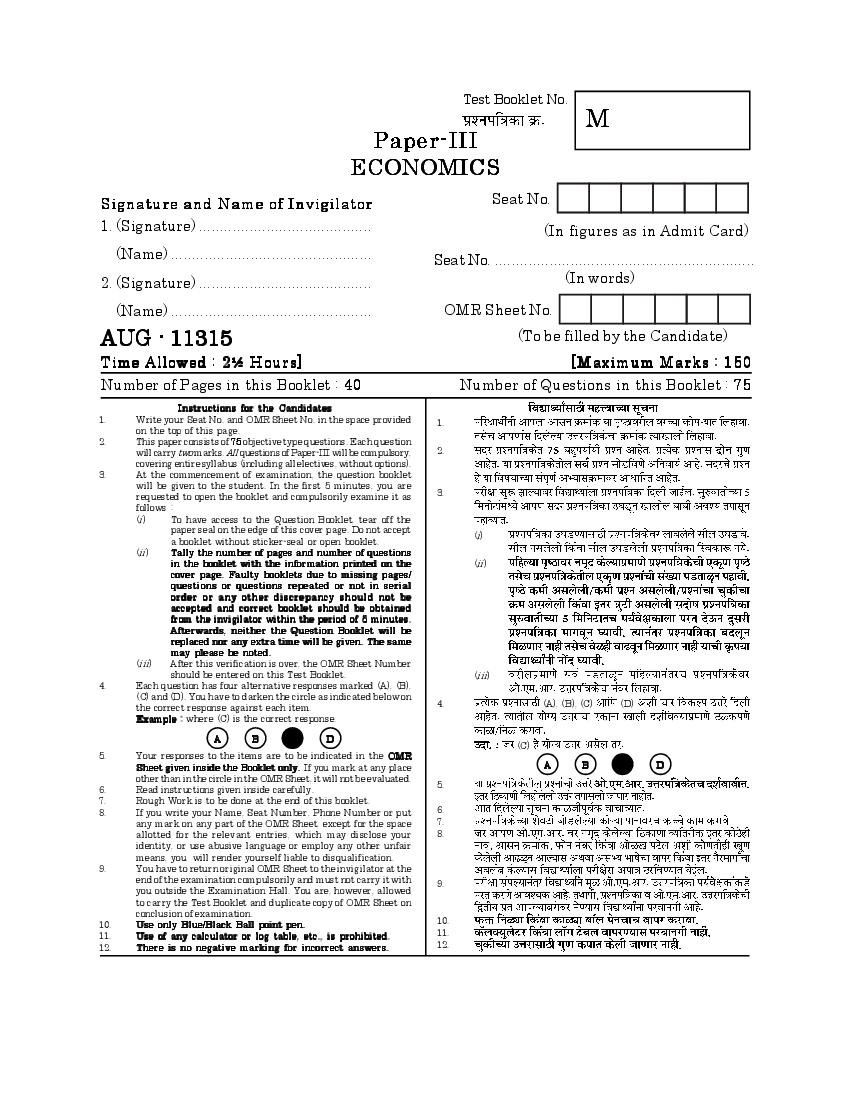
M
ECONOMICS
Signature and Name of Invigilator Seat No.
1. (Signature) ......................................... (In figures as in Admit Card)
(Name) ................................................ Seat No. ..............................................................
2. (Signature) ......................................... (In words)
(Name) ................................................ OMR Sheet No.
AUG - 11315 (To be filled by the Candidate)
Time Allowed : 2½ Hours] [Maximum Marks : 150
Number of Pages in this Booklet : 40 Number of Questions in this Booklet : 75
Instructions for the Candidates
1. Write your Seat No. and OMR Sheet No. in the space provided 1.
on the top of this page.
2. This paper consists of 75 objective type questions. Each question
will carry two marks. All questions of Paper-III will be compulsory, 2.
covering entire syllabus (including all electives, without options).
3. At the commencement of examination, the question booklet
will be given to the student. In the first 5 minutes, you are
requested to open the booklet and compulsorily examine it as 3.
follows :
(i) To have access to the Question Booklet, tear off the
paper seal on the edge of this cover page. Do not accept
(i)
a booklet without sticker-seal or open booklet.
(ii) Tally the number of pages and number of questions
in the booklet with the information printed on the (ii)
cover page. Faulty booklets due to missing pages/
questions or questions repeated or not in serial
o rder or any other discre pancy should not be
accepted and correct booklet should be obtained
from the invigilator within the period of 5 minutes.
Afterwards, neither the Question Booklet will be
replaced nor any extra time will be given. The same
may please be noted.
(iii) After this verification is over, the OMR Sheet Number
should be entered on this Test Booklet. (iii)
4. Each question has four alternative responses marked (A), (B),
(C) and (D). You have to darken the circle as indicated below on
the correct response against each item. 4. (A), (B), (C) (D)
Example : where (C) is the correct response.
A B D
(C)
5. Your responses to the items are to be indicated in the OMR
Sheet given inside the Booklet only. If you mark at any place A B D
other than in the circle in the OMR Sheet, it will not be evaluated.
5.
6. Read instructions given inside carefully.
7. Rough Work is to be done at the end of this booklet.
8. If you write your Name, Seat Number, Phone Number or put 6.
any mark on any part of the OMR Sheet, except for the space 7.
allotted for the relevant entries, which may disclose your 8.
identity, or use abusive language or employ any other unfair
means, you will render yourself liable to disqualification.
9. You have to return original OMR Sheet to the invigilator at the
end of the examination compulsorily and must not carry it with 9.
you outside the Examination Hall. You are, however, allowed
to carry the Test Booklet and duplicate copy of OMR Sheet on
conclusion of examination.
10. Use only Blue/Black Ball point pen. 10.
11. Use of any calculator or log table, etc., is prohibited. 11.
12. There is no negative marking for incorrect answers. 12.
Page 2
Page 3
Paper III
III
Time Allowed : 2½ Hours] [Maximum Marks : 150
Note : This Question Paper contains Seventy Five (75) multiple choice questions.
Each question carries Two (2) marks. Attempt All questions.
(75) (2)
1. Samuelson’s revealed preference 1.
theory proves :
(A) Negative substitution effect (A)
(B) Positive income effect (B)
(C) Negative income effect (C)
(D) Both (A) and (B) (D) (A) (B)
2. Which is not the assumption about 2.
preferences ?
(A) Completeness (A)
(B) Transitivity (B)
(C) Non-satiety (C)
(D) Maximization (D)
3 [P.T.O.
Page 4
commodity X is :
(I) X
(I) Any constant number then fall X
in price of X will not change
expenditure on X.
(II) X
(II) Less than 1 then fall in price
X
of X will reduce expenditure
on X.
(A) (I) (II)
(A) (I) is true and (II) is false
(B) (II) (I)
(B) (II) is true and (I) is false
(C) (I) (II)
(C) Both (I) and (II) are true
(D) (I) (II)
(D) Both (I) and (II) are false
4. (0, 0)
4. Elasticity of supply curve passing
through origin (0, 0) is equal to :
(A) < 1
(A) < 1
(B) > 1 (B) > 1
(C) = 1 (C) = 1
(D) Zero (D) Zero
4
Page 5
goods are :
(A) Convex to the origin
(A)
(B) Concave to the origin
(B)
(C) Horizontal
(C)
(D) Vertical
6. Optimum size of plant is the : (D)
(A) maximum level of output that 6.
can be produced with the plant
(A)
(B) level of output that can be
produced with minimum
marginal cost (B)
(C) level of output that can be
produced with minimum
(C)
average cost
(D) level of output that can be
(D)
produced with maximum fixed
cost
5 [P.T.O.
Page 6
results into increase in net profits 20,000
of Rs. 20,000 with 40 percent 40
probability and loss of Rs. 10,000 10,000
with 60% probability. What will be 60
the expected net profits if the
product is introduced ?
(A) Rs. 30,000 (A) 30,000
(B) Rs. 14,000 (B) 14,000
(C) Rs. 15,000 (C) 15,000
(D) Rs. 20,000 (D) 20,000
8. Expansion path : 8.
(A) is the line joining tangency (A)
points of isoquants and isocost
lines when price of one input
changes
(B) is the line joining tangency (B)
points of isoquants and isocost
lines when prices of both inputs
remain constant
(C) is the line showing optimal (C)
input combinations
(D) Both (B) and (C) (D) (B) (C)
6
Page 7
set prices above marginal cost
because they :
(A)
(A) face downward slopping
demand curve
(B)
(B) are great in number
(C)
(C) have freedom of entry
(D) have high fixed cost (D)
10. When commodity produced is 10.
homogenous :
(I) Bertrand equilibrium is (I)
competitive equilibrium.
(II) Cournot equilibrium is (II)
monopoly equilibrium.
Select the correct alternative :
(A) Both (I) and (II) are true (A) (I) (II)
(B) Both (I) and (II) are false (B) (I) (II)
(C) (I) is true and (II) is false (C) (I) (II)
(D) (II) is true and (I) is false (D) (II) (I)
7 [P.T.O.
Page 8
monopolist is P = a – bQ, then
marginal revenue function is :
(A) a – bQ
(A) a – bQ
(B) a – 2bQ
(B) a – 2bQ
(C) aQ – bQ2
(C) aQ – bQ2
(D) a – bQ2
(D) a – bQ2
12. The need of government
intervention in the market arises 12.
because :
(A) Employment generation is the
(A)
responsibility of the
Government
(B)
(B) The private sector is inefficient
(C)
(C) The profit motive of the private
sector is harmful to the society
(D) There are market failures (D)
8
Page 9
applicant’s skills, work attitude etc.
is an example of :
(A) Adverse selection
(A)
(B) Negative externality in selection
(B)
(C) Free riding
(C)
(D) Both (B) and (C) (D) (B) (C)
14. When both the demand and the 14.
supply curves slope downwards and
the supply curve is less steeper than
the demand curve, the equilibrium
is :
(A)
(A) Stable in both Marshallian and
Walrasian sense
(B)
(B) Unstable in both Marshallian
and Walrasian sense
(C) Unstable in Marshallian sense (C)
but stable in Walrasian sense
(D) Stable in Marshallian sense but (D)
unstable in Walrasian sense
9 [P.T.O.
Page 10
compensation principle in welfare
economics ?
(A)
(A) Hicks
(B)
(B) Kaldor
(C)
(C) Scitovsky
(D)
(D) Adam Smith
16. Which of the following consumption 16.
hypotheses predicts that young
generation saves while old
generation dissaves ?
(A) Permanent income hypothesis (A)
(B) Life-cycle hypothesis (B)
(C) Relative income hypothesis
(C)
(D) Keynesian consumption
(D)
hypothesis
10
Page 11
system has cash reserve ratio of 10% 10%
and a leakage ratio (the amount
which is not coming back to the 10%
money circulation) of 10%. If a new
1,000
deposit is thereof Rs. 1,000, what
will be the value of money
multiplier ?
(A) 4
(A) 4
(B) 2
(B) 2
(C) 5
(C) 5
(D) 3
(D) 3
18.
18. In Baumol type demand for money,
suppose fixed cost per bank trip = 5,
= 5, = 25,
planned expenditure = 25, interest
rate = 0.1, then average money = 0.1
demand will be :
(A) 15 (A) 15
(B) 25 (B) 25
(C) 20 (C) 20
(D) 30 (D) 30
11 [P.T.O.
Page 12
right of the negatively sloped IS
curve, it implies :
(A) Savings less than investment in (A)
planned levels
(B) Savings more than investment (B)
in planned levels
(C) Savings equal to investment in (C)
planned levels
(D) Savings less than investment in (D)
actual levels
20. If investment is completely 20. IS-LM
insensitive to interest rate in IS-LM
model, which one of the following will
be an effective policy to raise output
level ?
(A) A rise in money supply (A)
(B) A cut in money supply
(B)
(C) A cut in government
(C)
expenditure
(D) A cut in income tax rate (D)
12
Page 13
in IS-LM model is higher if :
(A) Savings ratio is lower
(A)
(B) Slope of investment function is
lower (B)
(C) Slope of speculative demand (C)
curve is higher
(D) Velocity of circulation of money
(D)
is lower
22. Under flexible exchange rate, 22.
Mundell-Fleming model shows
when capital is perfectly mobile :
(A) Monetary policy is a failure but (A)
fiscal policy is a success
(B) Monetary and fiscal policies, (B)
both are failures
(C) Monetary policy is a success but (C)
fiscal policy is a failure
(D) Both monetary and fiscal (D)
policies are effective
13 [P.T.O.
Page 14
23.
a downward slopping investment
function rests on the assumption :
(A) Diminishing marginal
productivity of capital
(A)
(B) Diminishing marginal
productivity of labour (B)
(C) Increasing marginal
(C)
productivity of capital
(D)
(D) Constant returns to scale
24. In Solow’s growth model, stability of 24.
equilibrium is ensured through
changes in :
(A) Wage-rental ratio (A)
(B) Savings ratio (B)
(C) Population growth rate (C)
(D) Cash reserve ratio (D)
14
Page 15
given MPC = 0.8, how much should 500
be the rise in autonomous
investment in a simple Keynesian
model ?
(A) 200
(A) 200
(B) 300
(B) 300
(C) 100
(C) 100
(D) 400
(D) 400
26. Which one of the following is not 26.
part of the endogenous growth
models ?
(A) Introduction of human capital
(A)
(B) Introduction of research and
development
(B)
(C) Introduction of endogenous
technical change (C)
(D) Introduction of different savings
(D)
behaviour
15 [P.T.O.
Page 16
vertical AD curve is produced by
which of the following conditions :
(A) Full employment in the
(A)
economy
(B) LM
(B) Inelastic LM curve
(C) LM
(C) Perfectly elastic LM curve
(D) IS
(D) Elastic IS curve
28.
28. In the Marxian theory of capitalist
development there is :
(A)
(A) a constant tendency for profits
(B) falling tendency for profits (B)
(C) increasing tendency of profits (C)
(D) profits will vary all the time (D)
16
Page 17
assumes that :
(A)
(A) Population is endogenous
(B)
(B) Agriculture has increasing
returns to scale
(C) Land is fixed in supply
(C)
(D) There is capital accumulation in
(D)
agriculture
30. Most of the two Gap models 30.
assume :
(A)
(A) The saving gap and investment
(B)
gap
(B) The foreign-exchange gap and
Import-Export gap
(C)
(C) The saving gap and foreign-
exchange gap
(D)
(D) The foreign-exchange gap and
investment gap
17 [P.T.O.
Page 18
a project and acquire equity capital,
it goes to the :
(A) Secondary market
(A)
(B) Bonds market
(B)
(C) Treasury bills market
(C)
(D) Primary market
(D)
32. In Schumpeter’s theory the
32.
existence of cycles is :
(A) Short-term cycles
(A)
(B) Ratche like fluctuations (B)
(C) Kondratieff type long waves (C)
(D) Medium term cycles (D)
18
Page 19
recommended by the 14th Finance
14
Commission to omit the definition
(A)
of :
(A) Primary Deficit (B)
(B) Fiscal Deficit
(C)
(C) Effective Revenue Deficit
(D)
(D) Revenue Deficit
34.
34. The share of direct taxes in the
central tax revenue became higher
than that of indirect tax the first
time in :
(A) 2001-02
(A) 2001-02
(B) 2005-06
(B) 2005-06
(C) 2007-08
(C) 2007-08
(D) 2009-10 (D) 2009-10
19 [P.T.O.
Page 20
components of revenue expenditure
of Central Government ?
(A)
(A) Interest payments
(B)
(B) Defence expenditure
(C) Pensions (C)
(D) Budgetary support (D)
36. All indirect taxes in India are 36.
proposed to be subsumed under ..... .
(A) Direct taxes code
(A)
(B) Goods and services tax
(B)
(C) Union excise duty (C)
(D) Value added tax (D)
37. Which one of the following is not a 37.
subsidy given by the Government of
India ?
(A)
(A) Food
(B)
(B) Fertilizer
(C) Petroleum (C)
(D) Electricity (D)
20
Page 21
under Article ..................... of the
Constitution of India.
(A) 274 (A) 274
(B) 275 (B) 275
(C) 280 (C) 280
(D) 282 (D) 282
39. When consumption by one person 39.
affects the welfare of another person,
it is called :
(A) Excludability
(A)
(B) Externality
(B)
(C) Rivalness (C)
(D) Non-excludability (D)
40. A pure public good is characterized 40.
by :
(A) Rivalness and non-excludability (A)
(B)
(B) Rivalness and excludability
(C)
(C) Non-rivalness and non-
excludability
(D)
(D) Non-rivalness and excludability
21 [P.T.O.
Page 22
statements ?
(I)
(I) The Reserve Bank of India was
1 , 1935
established as a shareholders’
bank on 1st April, 1935.
(II) 1 , 1949
(II) The Reserve Bank of India was
nationalized on 1st January,
1949.
Mark the correct alternative :
(A) (I) (II)
(A) Both statement (I) and
statement (II) are wrong
(B) (I) (II)
(B) Statement (I) is correct and
statement (II) is wrong
(C) (I) (II)
(C) Statement (I) is wrong and
statement (II) is correct
(D) Both statement (I) and (D) (I) (II)
statement (II) are correct
22
Page 23
Axis Bank, ICICI Bank, Dena Bank,
HDFC Bank.
(A) HDFC Bank (A)
(B) Axis Bank (B)
(C) ICICI Bank (C)
(D) Dena Bank (D)
43. In the context of Indian banking 43.
SLR suggests :
(A) Statutory Lending Ratio (A)
(B) Statutory Liquidity Ratio (B)
(C) Statutory Lending Rules (C)
(D) Simplified Lending Rules (D)
23 [P.T.O.
Page 24
phenomena took place in the field
of Banking in India ?
(A)
(A) Major commercial banks were
nationalized
(B) Social control over banks was (B)
announced
(C) Banking commission submitted (C)
its report
(D)
(D) State Bank of India was
nationalized
45. What can you say of the following 45.
statements ? (I)
(I) The NABARD has taken over
the activities of ARDC.
(II) 1969
(II) The NABARD was established
in the year 1969.
Choose the correct answer : (A) (I) (II)
(A) Both statement (I) and
statement (II) are wrong (B) (I) (II)
(B) Both statement (I) and
statement (II) are correct
(C) (I) (II)
(C) Statement (I) is correct and
statement (II) is wrong
(D) Statement (I) is wrong and (D) (I) (II)
statement (II) is correct
24
Page 25
percentage of urban population in
India is :
(A) 33.02 percentage (A) 33.02
(B) 31.16 percentage (B) 31.16
(C) 30.12 percentage (C) 30.12
(D) 29.10 percentage (D) 29.10
47. The survivor technique for 47.
measuring the relative efficiency of
different sizes of firms was suggested
by :
(A)
(A) Stigler
(B)
(B) Kaldor
(C)
(C) Myrdal
(D) Pratten (D)
25 [P.T.O.
Page 26
correct answer from the codes given
below :
Writers
(a)
(a) G.T. Renner
(b)
(b) Tord Palander
(c)
(c) August Losch
(d)
(d) Sargent Florence
Boo
Bo o k s
(i)
(i) The market area theory of
industrial location
(ii)
(ii) Geography of industrial
locationalization
(iii)
(iii) Investment, location and size of
plant
(iv)
(iv) The economics of location
Codes :
(a) (b) (c) (d)
(a) (b) (c) (d)
(A) (i) (ii) (iii) (iv)
(A) (i) (ii) (iii) (iv)
(B) (ii) (i) (iv) (iii)
(B) (ii) (i) (iv) (iii)
(C) (iii) (iv) (i) (ii) (C) (iii) (iv) (i) (ii)
(D) (i) (iv) (ii) (iii) (D) (i) (iv) (ii) (iii)
26
Page 27
industry was published in German
language and translated into
English language by ................... .
(A) Carl Freidrich (A)
(B) G.T. Renner (B)
(C) E.M. Rawstron (C)
(D) August Losch (D)
50. Harris-Todaro model is related 50.
with ....................... .
(A) Growth and unemployment
(A)
(B) Growth and migration
(B)
(C) Unemployment and migration
(C)
(D) Unemployment and urbani-
(D)
zation
27 [P.T.O.
Page 28
correct answer from the codes given
below :
Authors
(i)
(i) Gunnar Myrdal
(ii) E.F. Schumacher (ii)
(iii) Paul Sweezy (iii)
(iv) Joan Robinson (iv)
Title of the books
(a) Small is Beautiful
(a)
(b) Theory of Capitalist
(b)
Development
(c) Economics of Imperfect (c)
Competition (d)
(d) Asian Drama
Codes :
(i) (ii) (iii) (iv)
(i) (ii) (iii) (iv)
(A) (a) (c) (d) (b)
(A) (a) (c) (d) (b)
(B) (c) (d) (a) (b)
(B) (c) (d) (a) (b)
(C) (b) (C) (b) (c) (a) (d)
(c) (a) (d)
(D) (d) (a) (b) (c) (D) (d) (a) (b) (c)
28
Page 29
wealth between two countries are
recorded in the .................... account
of Balance of Payments.
(A) Current (A)
(B) Capital (B)
(C) Revenue (C)
(D)
(D) Financial
53. Which one of the following is not a 53.
principle of the World Trade
Organization ?
(A)
(A) Non-discrimination
(B)
(B) Multilateralism
(C)
(C) Opposition to Quota Restrictions
(D)
(D) Most Favoured Nation
29 [P.T.O.
Page 30
currency areas, fixed exchange rates
are most appropriate for :
(I)
(I) Countries that are closely
integrated through trade.
(II) Countries that are closely (II)
integrated through factor
movements.
Select the correct answer :
(A) (I) (II)
(A) (I) is true and (II) is false
(B) (II) (I)
(B) (II) is true and (I) is false
(C) (I) (II)
(C) Both (I) and (II) are false
(D) Both (I) and (II) are true (D) (I) (II)
55. The relationship between relative 55.
prices of output and relative factor
rewards is stated in ............ theorem.
(A) Mill—Marshall
(A)
(B) Heckscher—Ohlin
(B)
(C) Stolper—Samuelson (C)
(D) Rybczynski (D)
30
Page 31
by the Government is based on the
recommendations of Committee
appointed by the Government.
(A)
(A) Nachiket Mor
(B)
(B) Taraporewala
(C)
(C) Rangarajan
(D) Urgit Patel (D)
57. As per the 97th amendment of the
Constitution :
(A)
(A) Co-operation has been deleted
from state list
(B)
(B) Co-operation has become one of
the fundamental rights
(C)
(C) Co-operation has become part of
the fundamental duties
(D)
(D) Co-operative institutions shall
be progressively privatized
31 [P.T.O.
Page 32
Plan is :
(A) 2007-12 (A) 2007-12
(B) 2008-13 (B) 2008-13
(C) 2012-17 (C) 2012-17
(D) 2010-15 (D) 2010-15
59. The Second Five Year Plan in India 59.
was based on the model of :
(A) Gunnar Myrdal (A)
(B) Shriman Narayan (B)
(C) Paul Sweezy (C)
(D) P.C. Mahalnobis (D)
32
Page 33
(I) Finance Commission in India is
(I)
an advisory body appointed by
the Governor, Reserve Bank of
India annually.
(II)
(II) Finance Commission in India is
a statutory body appointed by
the President, Govt. of India
every five years.
Choose the correct alternative :
(A) (I) (II)
(A) Statement (I) is correct and
statement (II) is wrong
(B) (I) (II)
(B) Statement (I) is wrong and
statement (II) is correct
(C)
(C) Both statements are correct
(D) Both statements are wrong (D)
33 [P.T.O.
Page 34
is also known as :
(A) Derivatives market (A)
(B) Government share market (B)
(C) Gilt-edged market
(C)
(D) Intermediaries market
(D)
62. The Liquidity Adjustment Facility
62. RBI
(LAF) of RBI works through :
(A) Repos and Reverse Repos
(A)
(B) Inverse Repos
(B)
(C) Buybacks
(C)
(D) Derivatives
(D)
63. Tobin tax is a tax on :
63.
(A) Exports
(A)
(B) Imports
(B)
(C) Transactions in foreign
exchange sales (C)
(D) Sales (D)
34
Page 35
for :
(A) Long-term funds
(A)
(B) Medium-term funds
(B)
(C) Short-term funds
(C)
(D) Money supply
65. The principal business of a Non- (D)
Banking Financial Company 65.
(NBFC) is :
(A) Create money supply
(A)
(B) Create credit lines
(B)
(C) Receiving deposits from the
public under any scheme and (C)
lending in any manner
(D) Raising finance in international
capital markets
(D)
66. Suppose government raises
resources for development purposes
through market-borrowing, it results 66.
into :
(A) Expansion of share market (A)
(B) Expansion of bank credit
(B)
(C) Private investment is crowded
(C)
out due to rise in interest rate
(D) Increase in money supply
becomes unstable (D)
35 [P.T.O.
Page 36
freedom for a simple bivariate linear
regression with 50 observations ?
(A) 48 (A) 48
(B) 47 (B) 47
(C) 2 (C) 2
(D) 50 (D) 50
68. The assumption of zero mean of the 68.
error term in classical linear
regression model is needed to
prove :
(A)
(A) Bestness of the estimates
(B)
(B) Unbiasedness of the parameters
(C)
(C) Linearity of the parameters
(D) Randomness of the parameters (D)
36
Page 37
will be :
(A) –1 (A) –1
(B) +1 (B) +1
(C) Between –1 and +1 (C) –1 +1
(D) 0 (D) 0
70. The assumption of multicollinearity 70. (multicollinearity)
means that :
(A) There should be no correlation
(A) (regressors)
among the regressors
(B) There should be no linear
relationship among the (B) (regressors)
regressors
(C) There should be no non-linear
(C) (regressors)
relationship among the
regressors
(D) (regressors)
(D) There should be no relationship
among the regressors
37 [P.T.O.
Page 38
depends on its value in the previous
time-period and a random term
is :
(A) Single equation model (A)
(B) AR (1) model (B) AR (1)
(C) MA (1)
(C) MA (1) model
(D) ARMA (1, 1)
(D) ARMA (1, 1) model
72.
72. In trying to test that females earn
less than their male counterparts,
Yi = 1 + 2Di;
we estimate the following model :
Y =
Yi = 1 + 2Di, where Y = average
D=1 0
earnings per day in Rs., D = 1 for
2
females and 0 otherwise. 2 here
(A)
refers to the :
(B)
(A) Average earnings of male
(C)
(B) Average earnings of female
(differential intercept
(C) Differential intercept coefficient coefficient)
for male earnings
(D)
(D) Differential intercept coefficient (differential intercept
for female earnings coefficient)
38
Page 39
of a monopolist is P = a – b Q P = a – bQ
and marginal cost function. MC = c + kQ
MC = c + kQ, then equilibrium (Q)
output (Q) would be :
a b
(A) Q =
a b 2c k
(A) Q =
2c k
a k
(B) Q =
a k 2c b
(B) Q =
2c b
a c
(C) Q =
a c 2b k
(C) Q =
2b k
a b
(D) Q =
a b 2c k
(D) Q =
2c k 74. (integral)
74. The definite integral represents :
(A) a definite unit of measure (A)
(B) a definite length (B)
(C) a perfect shape (C)
(D) area under a curve (D)
75. Rejecting a true hypothesis results 75.
in this type of error :
(A) Type I error (A) I
(B) Type II error (B) II
(C) Structural error (C)
(D) Hypothesis error (D)
39 [P.T.O.
Page 40
40
Document Details
| Board / Org | Maharashtra Exams |
| Exam | MAHA SET |
| Type | Question Paper |
| Pages | 40 |
| Updated | 30 Apr 2026 |