CBSE Class 12 Question Paper 2025 Solution Tourism
Finished viewing? Save it for later —
Download CBSE Class 12 Question Paper 2025 Solution Tourism (PDF · 15 pages)About CBSE Class 12 Question Paper 2025 Solution Tourism
CBSE Class 12 Question Paper 2025 Solution Tourism is available here for free download. Published by CBSE for Class 12, this solution can be viewed online or downloaded as a PDF (15 pages). Candidates preparing for Class 12 can use CBSE Class 12 Question Paper 2025 Solution Tourism to understand the exam pattern, the type of questions asked, and the overall difficulty level.
Frequently Asked Questions
How can I download CBSE Class 12 Question Paper 2025 Solution Tourism?
Open this page and click the Download button to save CBSE Class 12 Question Paper 2025 Solution Tourism as a PDF. It is completely free on AglaSem Docs.
Is CBSE Class 12 Question Paper 2025 Solution Tourism free to download?
Yes. CBSE Class 12 Question Paper 2025 Solution Tourism can be viewed online and downloaded as a PDF free of cost on AglaSem Docs.
How many pages does CBSE Class 12 Question Paper 2025 Solution Tourism have?
CBSE Class 12 Question Paper 2025 Solution Tourism contains 15 pages, which you can read online or download together as a single PDF.
Where can I find more Class 12 study material?
You can find more Class 12 question papers, sample papers, syllabus, and answer keys on AglaSem Docs.
CBSE Class 12 Question Paper 2025 Solution Tourism – Text
Read the full text of this solution below — useful to quickly search, copy and reference the content online without downloading the PDF.
📄 View text version (15 pages)
Page 1
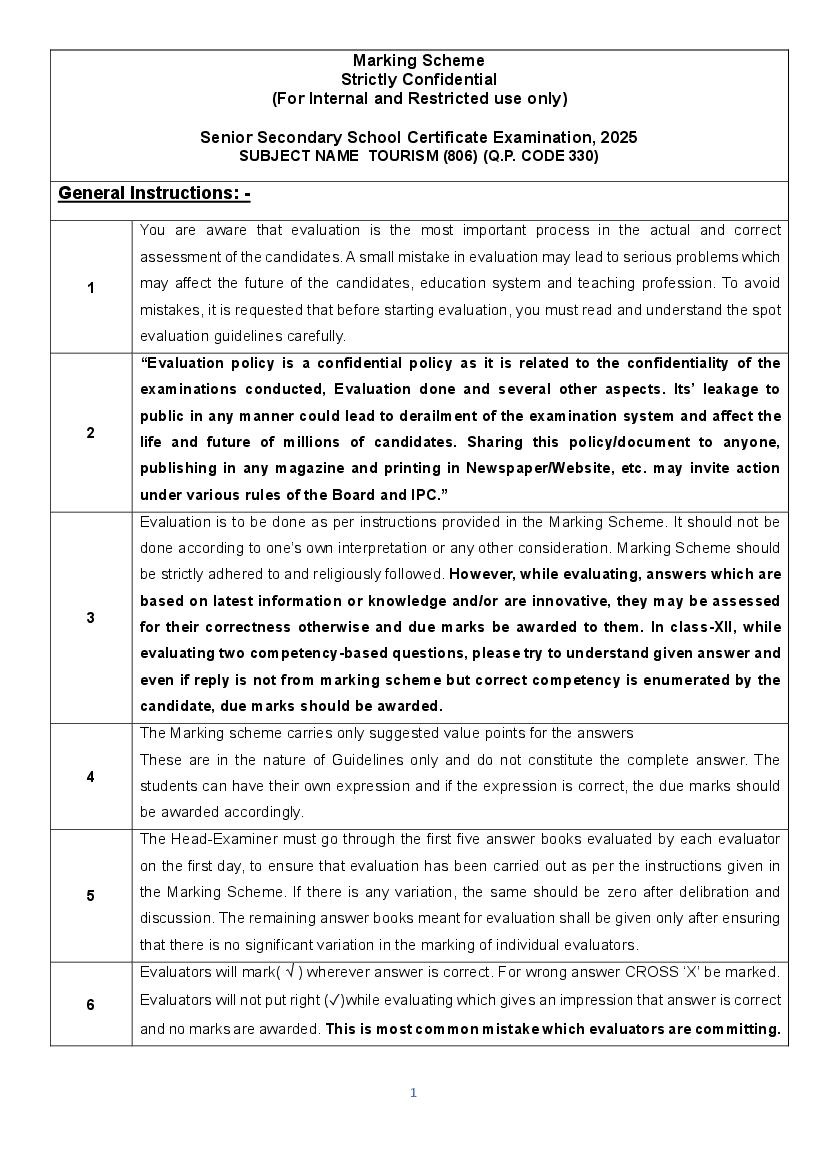
Strictly Confidential
(For Internal and Restricted use only)
Senior Secondary School Certificate Examination, 2025
SUBJECT NAME TOURISM (806) (Q.P. CODE 330)
General Instructions: -
You are aware that evaluation is the most important process in the actual and correct
assessment of the candidates. A small mistake in evaluation may lead to serious problems which
1 may affect the future of the candidates, education system and teaching profession. To avoid
mistakes, it is requested that before starting evaluation, you must read and understand the spot
evaluation guidelines carefully.
“Evaluation policy is a confidential policy as it is related to the confidentiality of the
examinations conducted, Evaluation done and several other aspects. Its’ leakage to
public in any manner could lead to derailment of the examination system and affect the
2
life and future of millions of candidates. Sharing this policy/document to anyone,
publishing in any magazine and printing in Newspaper/Website, etc. may invite action
under various rules of the Board and IPC.”
Evaluation is to be done as per instructions provided in the Marking Scheme. It should not be
done according to one’s own interpretation or any other consideration. Marking Scheme should
be strictly adhered to and religiously followed. However, while evaluating, answers which are
based on latest information or knowledge and/or are innovative, they may be assessed
3
for their correctness otherwise and due marks be awarded to them. In class-XII, while
evaluating two competency-based questions, please try to understand given answer and
even if reply is not from marking scheme but correct competency is enumerated by the
candidate, due marks should be awarded.
The Marking scheme carries only suggested value points for the answers
These are in the nature of Guidelines only and do not constitute the complete answer. The
4
students can have their own expression and if the expression is correct, the due marks should
be awarded accordingly.
The Head-Examiner must go through the first five answer books evaluated by each evaluator
on the first day, to ensure that evaluation has been carried out as per the instructions given in
5 the Marking Scheme. If there is any variation, the same should be zero after delibration and
discussion. The remaining answer books meant for evaluation shall be given only after ensuring
that there is no significant variation in the marking of individual evaluators.
Evaluators will mark( √ ) wherever answer is correct. For wrong answer CROSS ‘X’ be marked.
6 Evaluators will not put right (✓)while evaluating which gives an impression that answer is correct
and no marks are awarded. This is most common mistake which evaluators are committing.
1
Page 2
7 for different parts of the question should then be totaled up and written in the left-hand margin
and encircled. This may be followed strictly.
If a question does not have any parts, marks must be awarded in the left-hand margin and
8
encircled. This may also be followed strictly.
If a student has attempted an extra question, answer of the question deserving more marks
9
should be retained and the other answer scored out with a note “Extra Question”.
10 No marks to be deducted for the cumulative effect of an error. It should be penalized only once.
A full scale of marks __________(example 0 to 80/70/60/50/40/30 marks as given in Question
11
Paper) has to be used. Please do not hesitate to award full marks if the answer deserves it.
Every examiner has to necessarily do evaluation work for full working hours i.e., 8 hours every
day and evaluate 20 answer books per day in main subjects and 25 answer books per day in
12
other subjects (Details are given in Spot Guidelines).This is in view of the reduced syllabus and
number of questions in question paper.
Ensure that you do not make the following common types of errors committed by the Examiner
in the past:-
● Leaving answer or part thereof unassessed in an answer book.
● Giving more marks for an answer than assigned to it.
● Wrong totaling of marks awarded on an answer.
● Wrong transfer of marks from the inside pages of the answer book to the title page.
● Wrong question wise totaling on the title page.
13 ● Wrong totaling of marks of the two columns on the title page.
● Wrong grand total.
● Marks in words and figures not tallying/not same.
● Wrong transfer of marks from the answer book to online award list.
● Answers marked as correct, but marks not awarded. (Ensure that the right tick mark is
correctly and clearly indicated. It should merely be a line. Same is with the X for incorrect
answer.)
● Half or a part of answer marked correct and the rest as wrong, but no marks awarded.
While evaluating the answer books if the answer is found to be totally incorrect, it should be
14
marked as cross (X) and awarded zero (0)Marks.
Any unassessed portion, non-carrying over of marks to the title page, or totaling error detected
by the candidate shall damage the prestige of all the personnel engaged in the evaluation work
15
as also of the Board. Hence, in order to uphold the prestige of all concerned, it is again reiterated
that the instructions be followed meticulously and judiciously.
The Examiners should acquaint themselves with the guidelines given in the “Guidelines for
16
Spot Evaluation” before starting the actual evaluation.
2
Page 3
17
title page, correctly totaled and written in figures and words.
The candidates are entitled to obtain photocopy of the Answer Book on request on payment of
the prescribed processing fee. All Examiners/Additional Head Examiners/Head Examiners are
18
once again reminded that they must ensure that evaluation is carried out strictly as per value
points for each answer as given in the Marking Scheme.
Source Material Page Marks
Unit/
(NCERT/PSSCIVE/ no. of
Q. No. QUESTION Chap.
CBSE Study source
No.
Material) material
1 Answer any 4 out of the given 6 questions on Employability Skills (1 x 4 = 4 marks)
(i) D) Time NCERT Unit-1 4 1
(ii) C) Result Orientation NCERT Unit-2 23 1
(iii) B) Extrovert NCERT Unit-2 33 1
(iv) C) Column NCERT Unit-3 41 1
(v) A) First Generation Entrepreneur NCERT Unit-4 84 1
(vi) Eco-Tour Guide NCERT Unit-5 116 ½+ ½=1
Eco-Tourism Operator
(Any other relevant Option)
2 Answer any 5 out of the given 7 questions (1 x 5 = 5 marks)
(i) A) Educational CBSE Study Unit-1 2 1
(ii) B) England to Paris CBSE Study Unit-1 3 1
(iii) C)Jeena & Company CBSE Study Unit-1 3 1
(iv) D)Business Travel Houses CBSE Study Unit-1 5 1
(v) A) Brownell Travel CBSE Study Unit-2 16 1
(vi) D) Travelogue CBSE Study Unit-2 21 1
(vii) B) Complex CBSE Study Unit-2 20 1
3 Answer any 6 out of the given 7 questions (1 x 6 = 6 marks)
(i) C) Both (A) and (B) CBSE Study Unit-2 19 1
(ii) A) Low-Cost Carrier CBSE Study Unit-3 26 1
3
Page 4
(iv) D)Air CBSE Study Unit-3 24 1
(v) A) Shipping CBSE Study Unit-3 33 1
(vi) B) Point of Sale CBSE Study Unit-4 37 1
(vii) D) Complex CBSE Study Unit-4 38 1
4 Answer any 5 out of the given 6 questions (1 x 5 = 5 marks)
(i) A) Travel Itinerary CBSE Study Unit-4 38 1
(ii) B) Foreign Independent Traveller CBSE Study Unit-4 42 1
Material Unit-5 49
OR
C) Free Independent Traveller
(iii) A) One- Fourth CBSE Study Unit-6 57 1
Material Unit-5 47
OR
B) One-Third
(iv) A) Customers CBSE Study Unit-5 47 1
(v) D) Hosted Tour CBSE Study Unit-5 46 1
(vi) C) Sightseeing Tour CBSE Study Unit-5 48 1
5 Answer any 5 out of the given 6 questions (1 x 5 = 5 marks)
(i) A) Variable CBSE Study Unit-6 56 1
(ii) A) Season CBSE Study Unit-6 61 1
(iii) A) Marketing Cost CBSE Study Unit-6 59 1
(iv) Cost sheet reflects the cost of each CBSE Study Unit-6 57 1
component in the Package Tour.
(v) C) Asia Pacific CBSE Study Unit-7 71 1
(vi) The Indian Association of Tour CBSE Study Unit-7 74 1
Operators Material
6 Answer any 5 out of the given 6 questions (1 x 5 = 5 marks)
(i) D) Apex CBSE Study Unit-7 75 1
(ii) A) ADTOI CBSE Study Unit-7 77 1
(iii) C)Computer Reservation System CBSE Study Unit-8 83 1
Material Unit-8 84
4
Page 5
D)Central Reservation System
(iv) B)1964 CBSE Study Unit-8 84 1
(v) Travelocity Unit-8 85 ½+½=1
Expedia Travel
Orbitz
(Any other Relevant Option)
(vi) A) Global Distribution System CBSE Study Unit-8 83 1
SECTION B: SUBJECTIVE TYPE QUESTIONS
Answer any 3 out of the given 5 questions on Employability Skills (2 x 3 = 6 marks)
7 Lack of communication skills can NCERT Unit-1 3&4 1*2=2
result in confusion, frustration, wasted
effort, and
missed opportunities.
OR
• Will not obtain any information
• Will not be able to understand
• Will not Enjoy
• Will not Learn
• Will not be able to build and
maintain relations
• Will not be able to resolve
Conflicts
(Any 2)
8 • Physical exercise and fresh air NCERT Unit-2 25 & 26 1*2=2
• Healthy diet
• Organise academic life
• Adequate sleep
• Holidays with family and
friends
OR
5
Page 6
routine.
• Feed the mind with positivity
(Books, Music, Movies)
• Be proactive
• Focus on constructive and
positive things
• Learn from failures
• Learn to focus on the present
• Move towards your goals and
dreams.
(Any 2)
9 Presentation software: NCERT Unit-3 63 & 64 ½*4=2
• Libre Office Impress
• Microsoft Office –
PowerPoint
• Open Office Impress
• Google slides
• Apple keynote
(Any 4)
10 Qualities for Successful Entrepreneur NCERT Unit-4 81 & 82 1*2=2
• Initiative
• Willingness to take risks
• Ability to learn from experience
• Motivation
• Self-confidence
• Hard work
• Decision making ability
(Any 2)
11 Green jobs help: NCERT Unit-5 114 1*2=2
• Increase the efficiency of
energy and raw material.
• Reduce greenhouse gas
emissions.
6
Page 7
• Protect and restore
ecosystems.
• Support adaptation to the
effects of climate change.
(Any 2)
Answer any 3 out of the given 5 questions in 20 – 30 words each (2 x 3 = 6 marks)
12 A retail travel agency sells tourist CBSE Study Unit-1 6 2
products directly to the public on behalf
of the product suppliers and in return
gets commission.
OR
A retail travel agency is defined as a
business that performs the functions
like quote fares and rates, make
reservations, arrange travel tickets and
accommodation, arrange travel
insurance etc.
13 Role of Transport CBSE Study Unit-3 24 2
Transport is the key element in the
tourism industry. The demand in
transport infrastructure implies a very
large number of people who wants to
move in an efficient, fast and
inexpensive manner.
Well organized terminals and
intelligently planned schedules are
essential in promoting effective
transportation facilities for tourists.
(Any other relevant point)
7
Page 8
• Route map and Routing of
Itinerary
• Pacing the itinerary
• Interests of Tourists
• Details to be considered
15 Incentivized Tour is all- CBSE Study
usually Unit-5 46 2
inclusive package tours that include all
essential components of standard
package tour.
It is organized package tour that is
conducted for employees with the
sponsorship from the business firms or
corporate houses.
It is an incentive or intangible reward
for employees given periodically as per
organisation’s policy.
16 Galileo international is a diversified CBSE Study Unit-8 86 2
global technology leader. Its core
business is providing electronic global
distribution services for the travel
industry through its computerized
reservation system, leading edge
products and innovate interest-based
solutions.
• 49,000 travel agencies in 116
countries in 43,000 locations
• 70,000 hotel properties
• 450+ airlines
• 52 low-cost carriers
• 23 car rental companies
8
Page 9
17 Standards for Customer Service CBSE Study Unit-2 19 1*3=3
• Customers must be greeted Material
warmly, typically with a smile
• Staff must ensure high
standards of dress, appearance
and personal grooming
• All staff must be polite and able
to express themselves clearly,
while always maintaining eye
contact
• Telephones must be answered
promptly and courteously
• Customers are influenced by
first impression, their personal
posture, manner and body
language.
• It is important as being alert,
attentive and willing to
empathize and match client
needs with available products is
key.
(Any 3)
(Any other relevant point)
18 Costing a package tour is an important CBSE Study Unit-6 55 3
exercise that:
• determines the scale of sale
• margin of profit
• curtail unwanted expenditure
• increase salability
• Helps in identifying right pricing
strategy
• Identify factors influencing tour
cost
9
Page 10
The actual cost of buying the services
is incurred to acquire the goods and
services for production and
consumption.
Cost is defined as the total
expenditures for acquiring the various
components of services from the hotel,
resort, transporter etc. for the tailor
made or ready-made packages.
19 Pre-requisite CBSE Study Unit-7 78 1*3=3
• SUVIDHA : Provision of
facilities and amenities
• SURAKSHA : Guaranteeing
safety and security of
travellers.
• SOOCHNA : Upgrading,
updating and disseminating
information
Answer any 3 out of the given 5 questions in 50– 80 words each (4 x 3 = 12 marks)
20 Thomas Cook CBSE Study Unit-1 3 1*4=4
• Thomas cook is known as the
father of the Travel Agency
business.
• He coordinated railway and
steamship excursions
throughout England, Scotland
and Europe.
• In 1841, Thomas Cook as
secretary of the South Midland
Temperance Association,
organized a trip by train for 570
10
Page 11
distance of 22 miles.
• In 1845, he set up the ‘World’s
First Travel Agency’ to organize
excursions.
• In 1855, Cook started operating
package Tours.
• He conducted the world’s first
international tour from England
to Paris.
• He developed the concept of
inclusive tour.
• In 1870, to eliminate Payment in
cash Thomas cook introduced
Traveler Cheque and Hotel
Voucher.
(ANY 4)
21 CBSE Study Unit-4 37 to 40 1*4=4
• Itinerary is developed to Material
perform the sales process.
• It is prepared to identify the
duration of service, tangible and
intangible nature of service,
solves the problem of
immovability of tourism
products.
• An itinerary is the combination
of the different components of
the tourism to form a product
ready for sale.
• It explains and shows how
different components of tourism
are joined together.
11
Page 12
includes date, day, time,
duration and points of interests
etc.
• A detailed plan for a journey,
esp list of place to visit.
• A line of Travel and route.
• A guidebook for travellers: -
Travel plan , record of journey
and so on.
• An account for Journey.
• Type of Tour Itinerary: -
Skeletal, Technical,
Descriptive.
• Things to be considered :-Route
map and Routing of Itinerary,
Pacing the itinerary, Interests of
Tourists ,Details to be
considered
• Itinerary according to person: -
Bus Driver, Tourist, Tour
Escort, Tour Manager, Vendor.
(ANY 4)
OR
12
Page 13
• Initial research on destination
and source market.
• A well structured itinerary is
prepared with due
considerations to several do’s
and don’t during the tour.
• Selecting the destination
companies and authorizing
them with ground handling
responsibilities.
• Vendors of primary and
supplementary services are
contacted and negotiated to
obtain best possible quotation.
• Costing and pricing of elements
of tour.
• Tour brochure.
• Selling the package tour.
• Marketing and sales promotion.
13
Page 14
with the help of ground
operators.
(ANY 8)
23 Pricing Strategies CBSE Study Unit-6 60 & 61 1*4=4
• Rack Rate Pricing: It is full rate
before discounts are given. It is
generally printed in the tour
brochures for the forthcoming
season.
• Seasonal Pricing: A wide mix
of pricing of package tour is set
to cater low, high and shoulder
seasons as tourism is largely
driven by the season.
• Last Minute Pricing: It is
common method of giving
discount from the daily quoted
price in order to close booking.
It is put in flash item on the
website for last minute booking.
• Per Person Pricing: This type
of pricing is set per person or for
each category service. It can be
per adult or child or additional
person.
• Per Unit Pricing: It is set of
price for one unit of package. It
may include husband and wife
with children (cost free).
Sometimes, the package
includes room, transfer and
sightseeing cost. The room rate
14
Page 15
per the European Plan (EP).
• Cost-Based Pricing: This type
of pricing strategy is used to
make over the cost in order to
reach at the breakeven point.
• Competition-Based Pricing:
This pricing strategy takes tab
of the prices of its competitors in
order to tag the price of its own
product. Price may be set at the
same price of competitor or it
may be a little above or below
the price of competitor.
• Consumer-Based Pricing:
This is a form of pricing that is
primarily set to target customers
by taking the affordability and
quantity of purchase into
consideration.
(ANY 4)
24 Component of Tourism CBSE Study Unit-7 63 1*4=4
• Transportation
• Accommodation
• Attractions
• Activities
• Marketing
• Government Regulations
• Amenities
• Available Packages
(Explain Any 4)
15
Document Details
| Board / Org | CBSE |
| Exam | Class 12 |
| Type | Solution |
| Pages | 15 |
| Updated | 24 Sep 2026 |