Rajasthan Board Class 12 Question Paper 2020 Chemistry
Finished viewing? Save it for later —
Download Rajasthan Board Class 12 Question Paper 2020 Chemistry (PDF · 12 pages)About Rajasthan Board Class 12 Question Paper 2020 Chemistry
Rajasthan Board Class 12 Question Paper 2020 Chemistry is available here for free download. Published by Rajasthan Board for Class 12, this question paper can be viewed online or downloaded as a PDF (12 pages). Candidates preparing for Class 12 can use Rajasthan Board Class 12 Question Paper 2020 Chemistry to understand the exam pattern, the type of questions asked, and the overall difficulty level.
Frequently Asked Questions
How can I download Rajasthan Board Class 12 Question Paper 2020 Chemistry?
Open this page and click the Download button to save Rajasthan Board Class 12 Question Paper 2020 Chemistry as a PDF. It is completely free on AglaSem Docs.
Is Rajasthan Board Class 12 Question Paper 2020 Chemistry free to download?
Yes. Rajasthan Board Class 12 Question Paper 2020 Chemistry can be viewed online and downloaded as a PDF free of cost on AglaSem Docs.
How many pages does Rajasthan Board Class 12 Question Paper 2020 Chemistry have?
Rajasthan Board Class 12 Question Paper 2020 Chemistry contains 12 pages, which you can read online or download together as a single PDF.
Where can I find more Class 12 study material?
You can find more Class 12 question papers, sample papers, syllabus, and answer keys on AglaSem Docs.
Rajasthan Board Class 12 Question Paper 2020 Chemistry – Text
Read the full text of this question paper below — useful to quickly search, copy and reference the content online without downloading the PDF.
📄 View text version (12 pages)
Page 1
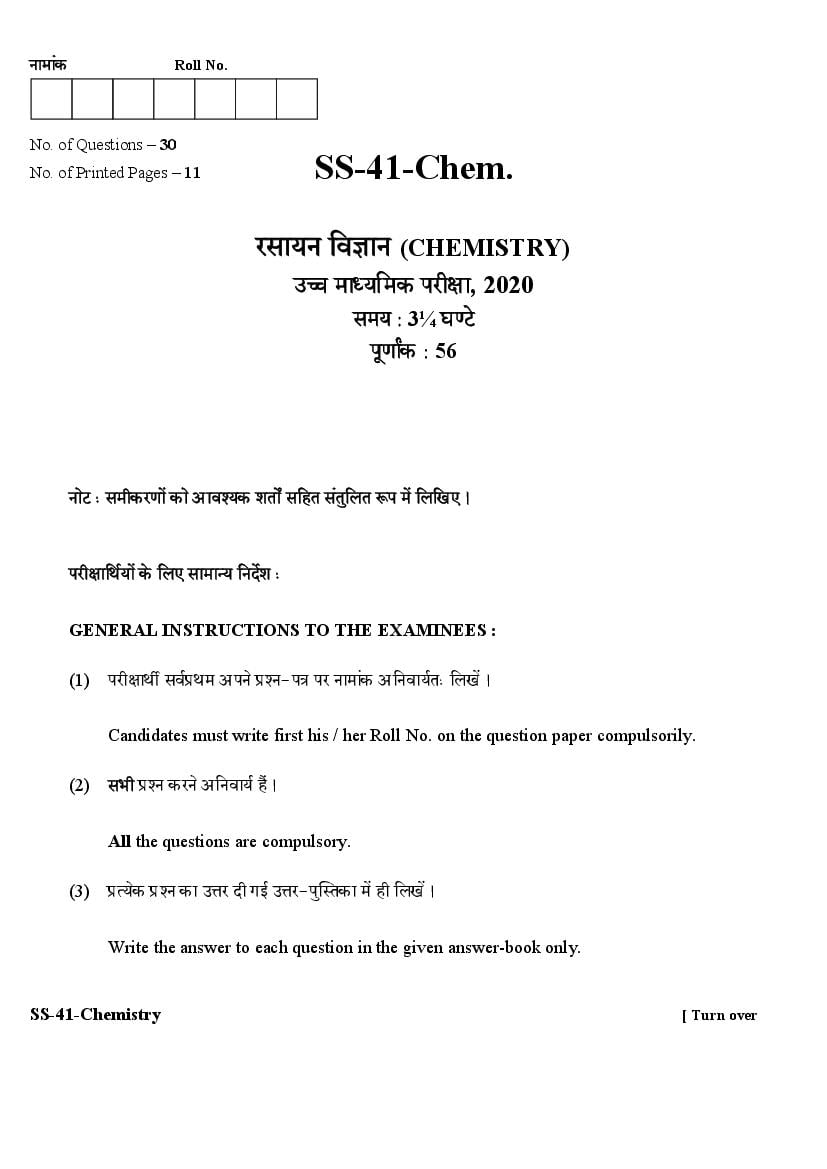
No. of Questions – 30
No. of Printed Pages – 11 SS-41-Chem.
(CHEMISTRY)
, 2020
3¼
56
GENERAL INSTRUCTIONS TO THE EXAMINEES :
(1) -
Candidates must write first his / her Roll No. on the question paper compulsorily.
(2)
All the questions are compulsory.
(3) -
Write the answer to each question in the given answer-book only.
SS-41-Chemistry [ Turn over
Page 2
(4) ,
For questions having more than one part, the answers to those parts are to be written
together in continuity.
(5) -
//
If there is any error / difference / contradiction in Hindi & English versions of the
question paper, the question of Hindi version should be treated valid.
(6)
1-13 1
14-24 2
25-27 3
28-30 4
Section Q. Nos. Marks per question
A 1-13 1
B 14-24 2
C 25-27 3
D 28-30 4
(7) 21, 27, 28, 29 30
Question Nos. 21, 27, 28, 29 and 30 have internal choices.
SS-41-Chemistry
Page 3
–
SECTION – A
1. -
Write the value of packing efficiency in body-centred cubic structure. 1
2.
Write definition of Osmosis. 1
3. -
Write the chemical equation of reaction taking place on the anode in cadmium-nickel
storage cell. 1
4.
Write Faraday’s first law of electrolysis. 1
5.
Draw a labelled diagram of electrical dispersion method for preparation of colloidal
solution. 1
6. [Ni(CO)4] Ni
Write oxidation state of Ni in [Ni(CO)4]. 1
7.
Write definition of ambidentate ligand. 1
8.
Write chemical equation of Wurtz reaction. 1
9. IUPAC
Write IUPAC name of succinic acid. 1
10.
Write chemical formula of ethyl isothiocyanate. 1
SS-41-Chemistry [ Turn over
Page 4
11.
Write the name of amino acid which is optically inactive. 1
12.
Write monomer units of polymer dacron. 1
13.
Write definition of optical isomerism. 1
-
SECTION – B
14. (a)
(b)
(a) Write any two differences between crystalline and amorphous solids.
(b) Draw the diagram showing impurity defect. 1+1=2
15. 27 °C 0.01 M
(R = 0.0821 L atm K–1 mol–1)
Calculate the osmotic pressure of 0.01 M solution of urea at 27 °C temperature.
(R = 0.0821 L atm K–1 mol–1) 2
16. 298 K CH3COOH, HCl NaCl
390.5, 425.4 126.4 S cm2 mol–1 CH3COONa
If the value of molar conductivities at infinite dilution for CH3COOH, HCl and NaCl are
390.5, 425.4 and 126.4 S cm2 mol–1 respectively at 298 K. Calculate the molar
conductivity at infinite dilution of CH3COONa. 2
SS-41-Chemistry
Page 5
17. (a)
(b)
(a) Draw a labelled diagram of froth floatation method.
(b) Write any two differences between calcination and roasting. 1+1=2
18. (a) ?
(b)
(a) Why transition elements form interstitial compounds ?
(b) The atomic radii of lanthanide elements decreases on moving from left to right.
Explain. 1+1=2
19. (a) K3[Fe(C2O4)3]
IUPAC
(b) , [NiCl4]2–
(a) Write IUPAC name of complex K3[Fe(C2O4)3].
(b) Write the geometry and magnetic nature of the complex ion [NiCl4]2–, on the basis
of valence bond theory. 1+1=2
20. (a) ,
(b) [A] [B] :
6[H] NaNO2 + HCl
C6H5NO2 [A] [B]
Sn + HCl 273 – 278 K
(a) Alkyl amines are more basic than ammonia. Explain.
(b) Identify and write chemical formula of [A] and [B] in the following sequence of
reaction : 1+1=2
6[H] NaNO2 + HCl
C6H5NO2 [A] [B]
Sn + HCl 273 – 278 K
SS-41-Chemistry [ Turn over
Page 6
21. (a) :
Cl3CCOOH, Cl2CHCOOH, ClCH2COOH
(b) , ?
(a) :
FCH2COOH, ClCH2COOH, BrCH2COOH
(b)
(a) Arrange the following haloacids in increasing order of their acidity.
Cl3CCOOH, Cl2CHCOOH, ClCH2COOH
(b) Why carboxylic acids are more acidic than phenol ? 1+1=2
OR
(a) Arrange the following haloacids in increasing order of their acidity.
FCH2COOH, ClCH2COOH, BrCH2COOH
(b) Aldehydes are more reactive than ketones towards nucleophilic addition reactions.
Explain.
22. (a) DNA RNA
(b) ?
(a) Write any two differences between DNA and RNA.
(b) What happens when glucose reacts with bromine water ? Give chemical equation. 1 + 1 = 2
23. (a)
(b)
(a) Write any two differences between condensation and addition polymerization.
(b) Differentiate between biodegradable and non-biodegradable polymers. 1+1=2
24. (a) -2-
(b)
(a) Draw the structures of geometrical isomers of but-2-ene.
(b) Draw the structures of conformers of ethane by Newmann’s projection formula. 1 + 1 = 2
SS-41-Chemistry
Page 7
–
SECTION – C
25. :
– ,
(
)
-
, ,
(a)
(b)
(c) ?
Read the given paragraph and write answers of the following questions :
On the basis of particle size, solutions may be divided into three types – true
solutions, colloids, and suspensions. Colloid is a heterogeneous system in which one
substance is dispersed (dispersed phase) as very fine particles in another substance called
dispersion medium. Colloids are further classified on the basis of various criteria.
Colloidal solutions exhibited various properties like – Tyndall effect, Brownian
movement, electrophoresis and coagulation etc.
(a) Write any two differences between lyophilic and lyophobic colloids.
(b) Define the electrophoresis.
(c) What happens when a beam of light is passed through a colloidal solution ? 1 + 1 + 1 = 3
26. :
,
, ,
‘ ’
- (i) (ii) (iii)
SS-41-Chemistry [ Turn over
Page 8
(a) ?
(b)
(c)
Read the given paragraph and write answers of the following questions :
Soaps are sodium or potassium salts of long chain fatty acids. Soaps containing sodium salts
are formed by heating fat with aqueous sodium hydroxide solution. This reaction is known as
saponification.
Synthetic detergents are cleansing agents which have all properties of soap, but which
actually do not contain any soap. Therefore, these are also called ‘soapless soap’.
Detergents are derivatives of long chain hydrocarbons and sulphuric acid. Detergents are
mainly classified into three categories :
(i) anionic
(ii) cationic
(iii) non-ionic detergents
(a) Why do soaps not work in hard water ?
(b) Write any one example of cationic detergent.
(c) Write chemical equation of saponification reaction. 1+1+1=3
27. (a)
(b)
(a)
(b)
(a) Write hybridized state of carbon bonded to halogen atom in benzyl chloride.
(b) Explain the mechanism of bimolecular nucleophilic substitution reaction. 1+2=3
OR
(a) Write hybridized state of carbon bonded to halogen atom in allyl chloride.
(b) Explain the mechanism of uni-molecular nucleophilic substitution reaction.
SS-41-Chemistry
Page 9
–
SECTION – D
28. (a)
(b)
(c) A B , 0.05 M 20 0.03 M
(a)
(b)
(c) NH3 N2 H2
1.5 × 10⁻⁴ mol L–1 S–1 ?
(a) Write definition of half life for any chemical reaction.
(b) Write any two differences between order of reaction and molecularity.
(c) For the reaction A B, the concentration of a reactant changes from 0.05 M to
0.03 M in 20 minutes. Calculate the average rate of reaction using units of time both
in minutes and seconds. 1+1+2=4
OR
(a) Write definition of first order reaction.
(b) Differentiate between rate of reaction and specific reaction rate.
(c) The decomposition of NH3 on platinum surface is zero order reaction. What are the
rates of production of N2 and H2 if value of rate constant is 1.5 × 10⁻⁴ mol L–1 S–1.
SS-41-Chemistry [ Turn over
Page 10
29. (a) -15
(b) H2O H2S ?
(c) :
2NaOH ( ) + Cl2
(d) XeOF4
(a) -16
(b) , ?
(c) :
XeF4 + O2F2 143 K
(d) H3PO3
(a) Write general electronic configuration of elements of group-15.
(b) Why is H2O a liquid and H2S a gas ?
(c) Complete the following reaction :
2NaOH (Cold and dilute) + Cl2
(d) Draw the structure of XeOF4. 1+1+2=4
OR
(a) Write general electronic configuration of elements of group-16.
(b) Why the value of electron gain enthalpy of chlorine is higher than fluorine ?
Explain.
(c) Complete the following reaction :
XeF4 + O2F2 143 K
(d) Draw the structure of H3PO3.
SS-41-Chemistry
Page 11
30. (a)
(b) ?
(c) [A] [B] :
OH
(CH3CO)2O
+ CCl4 + 4KOH [A] [B]
H+
(a) -
(b) 653 K ?
(c) [A] [B] :
N +2 Cl–
[A] Br2 [B]
+ HOH
(a) Write structural formula of isobutyl alcohol.
(b) What happens when diethyl ether reacts with chlorine in presence of sunlight ?
Give chemical reaction.
(c) Complete the following reaction sequence and write the names of products
[A] and [B].
OH
(CH3CO)2O
+ CCl4 + 4KOH [A] [B]
H+
1+1+2=4
OR
(a) Write structural formula of tert-butyl alcohol.
(b) What happens when the vapour of diethyl ether is passed over alumina at 653 K
temperature ? Give chemical reaction.
(c) Complete the following reaction sequence and write the names of products
[A] and [B].
N +2 Cl–
on boiling [A] Br2 water [B]
+ HOH
____________
SS-41-Chemistry [ Turn over
Page 12
SS-41-Chemistry
Document Details
| Board / Org | Rajasthan Board |
| Exam | Class 12 |
| Type | Question Paper |
| Pages | 12 |
| Updated | 22 Jul 2026 |