Karnataka SSLC Answer Key April 2019 Economics English Medium
Finished viewing? Save it for later —
Download Karnataka SSLC Answer Key April 2019 Economics English Medium (PDF · 11 pages)About Karnataka SSLC Answer Key April 2019 Economics English Medium
Karnataka SSLC Answer Key April 2019 Economics English Medium is available here for free download. Published by Karnataka Board for Class 10, this answer key can be viewed online or downloaded as a PDF (11 pages). Candidates preparing for Class 10 can use Karnataka SSLC Answer Key April 2019 Economics English Medium to understand the exam pattern, the type of questions asked, and the overall difficulty level.
Frequently Asked Questions
How can I download Karnataka SSLC Answer Key April 2019 Economics English Medium?
Open this page and click the Download button to save Karnataka SSLC Answer Key April 2019 Economics English Medium as a PDF. It is completely free on AglaSem Docs.
Is Karnataka SSLC Answer Key April 2019 Economics English Medium free to download?
Yes. Karnataka SSLC Answer Key April 2019 Economics English Medium can be viewed online and downloaded as a PDF free of cost on AglaSem Docs.
How many pages does Karnataka SSLC Answer Key April 2019 Economics English Medium have?
Karnataka SSLC Answer Key April 2019 Economics English Medium contains 11 pages, which you can read online or download together as a single PDF.
Where can I find more Class 10 study material?
You can find more Class 10 question papers, sample papers, syllabus, and answer keys on AglaSem Docs.
Karnataka SSLC Answer Key April 2019 Economics English Medium – Text
Read the full text of this answer key below — useful to quickly search, copy and reference the content online without downloading the PDF.
📄 View text version (11 pages)
Page 1
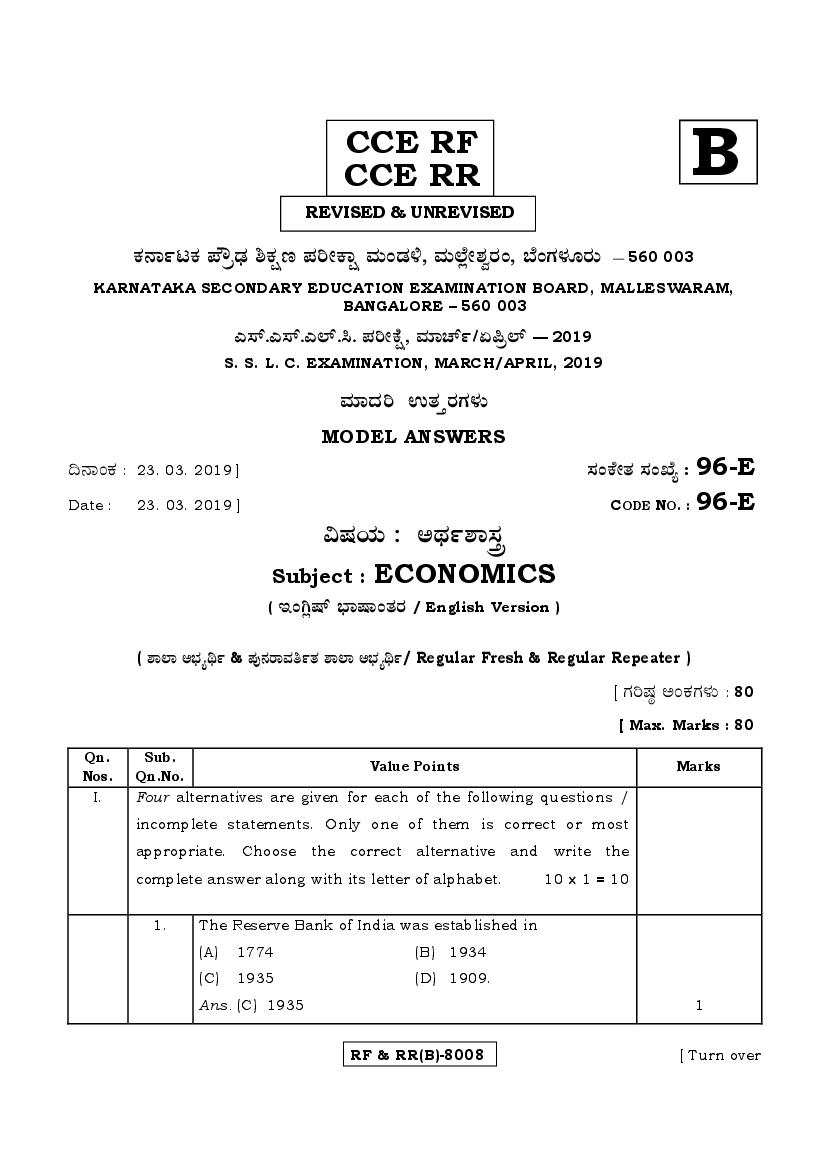
CCE RR B
REVISED & UNREVISED
O⁄´¤%lO⁄ ÆË√v⁄ ÃO⁄–y Æ⁄¬fiO¤– »⁄flMs⁄ÿ, »⁄fl≈Ê«fiÀ⁄ ¡⁄M, ∑ÊMV⁄◊⁄‡¡⁄fl — 560 003
KARNATAKA SECONDARY EDUCATION EXAMINATION BOARD, MALLESWARAM,
BANGALORE – 560 003
G—È.G—È.G≈È.“. Æ⁄¬fiOÊ⁄–, »⁄·¤^È%/HØ√≈È — 2019
S. S. L. C. EXAMINATION, MARCH/APRIL, 2019
»⁄·¤•⁄¬ D}⁄ °¡⁄V⁄◊⁄fl
MODEL ANSWERS
¶´¤MO⁄ : 23. 03. 2019 ] —⁄MOÊfi}⁄ —⁄MSÊ¿ : 96-E
Date : 23. 03. 2019 ] CODE NO. : 96-E
…Œ⁄æ⁄fl : @¢⁄%À¤—⁄°
Subject : ECONOMICS
( BMW«ŒÈ ∫¤Œ¤M}⁄¡⁄ / English Version )
( À¤≈¤ @∫⁄¥¿£% & Æ⁄‚¥´⁄¡¤»⁄~%}⁄ À¤≈¤ @∫⁄¥¿£%/ Regular Fresh & Regular Repeater )
[ V⁄¬Œ⁄r @MO⁄V⁄◊⁄fl : 80
[ Max. Marks : 80
Qn. Sub.
Value Points Marks
Nos. Qn.No.
I. Four alternatives are given for each of the following questions /
incomplete statements. Only one of them is correct or most
appropriate. Choose the correct alternative and write the
complete answer along with its letter of alphabet. 10 × 1 = 10
1. The Reserve Bank of India was established in
(A) 1774 (B) 1934
(C) 1935 (D) 1909.
Ans. (C) 1935 1
RF & RR(B)-8008 [ Turn over
Page 2
Value Points Marks
2. The British developed railway transport in India to
(A) help the people to travel
(B) help their own trade and administration
(C) help the princely states
(D) suppress 1857 revolt.
Ans. (B) help their own trade and administration 1
3. The first air transport service in India was made between
(A) Allahabad and Delhi (B) Delhi and Calcutta
(C) Mumbai and Delhi (D) Allahabad and Ninny.
Ans. (D) Allahabad and Ninny 1
4. The main aim of National Rural Livelihoods Mission is to
(A) eradicate poverty from rural areas
(B) eradicate poverty from urban areas
(C) provide basic infrastructures to rural areas
(D) provide health facilities to rural areas.
Ans. (A) eradicate poverty from rural areas 1
5. The Constitution of India has listed the labour law in the
(A) Central list (B) State list
(C) Concurrent list (D) Union territory list.
Ans. (C) Concurrent list 1
6. The Regional Rural Banks are established mainly to
provide financial assistance to
(A) large scale industries
(B) marginal and small farmers
(C) medium scale industries
(D) industrial labourers.
Ans. (B) marginal and small farmers 1
7. According to 2011 Census, the state which has the
highest density of population in India is
(A) West Bengal (B) Maharashtra
(C) Uttar Pradesh (D) Bihar.
Ans. (D) Bihar 1
RF & RR(B)-8008
Page 3
Value Points Marks
8. Liquid gold among the following is
(A) Coal (B) Petroleum
(C) Natural gas (D) Manganese.
Ans. (B) Petroleum 1
9. The largest gold producer state in India is
(A) Rajasthan (B) Andhra Pradesh
(C) Karnataka (D) Tamil Nadu.
Ans. (C) Karnataka 1
10. Long healthy life, knowledge and standard of living are
(A) Human Development Index
(B) Reasons for overpopulation
(C) Reasons for backwardness
(D) Gender Development Index.
Ans. (A) Human Development Index 1
II. 11. Match list A with list B and write it : 5×1=5
A B
a) Lord Cornwallis i) Tenancy system
b) Thomas Munroe ii) Chairman of
Planning Commission
c) Norman Borlaugh iii) Zamindari system
d) Sri M.Vishweshwaraiah iv) Ryotwari system
e) Jawaharlal Nehru v) Industrialize or
perish
vi) Father of Green
Revolution
vii) Mahalwari system
a) Lord Cornwallis iii) Zamindari system
b) Thomas Munroe iv) Ryotwari system
c) Norman Borlaugh vi) Father of Green
Revolution
d) Sri M. Vishweshwaraiah v) Industrialize or perish
e) Jawaharlal Nehru ii) Chairman of Planning
Commission 5×1=5
RF & RR(B)-8008 [ Turn over
Page 4
Qn. Sub.
Value Points Marks
Nos. Qn.No.
III. Answer the following questions in a word or sentence each :
15 × 1 = 15
12. Differentiate between Internal and External trade.
i) The exchange of goods and services within the
boundary of a country is internal trade
ii) The trade takes place with other countries is
external trade. 1
13. Which are the major imports of India ?
Petroleum, oil, capital goods, gold and silver. ( Any two ) 1
14. Define foreign exchange.
The process of facilitating the conversion of currency of
one country to another country's currency. 1
15. What is trade ?
Buying and selling of goods and services. 1
16. Between which stations the first railway transportation
made available in India ?
Bombay to Thane. 1
17. What is poverty ?
Unable to fulfill one's basic requirements. 1
18. When was Bonded Labour Abolition Act passed ?
1976 1
19. Which is the principle that the cooperative credit
societies work on ?
Principle of cooperation. 1
RF & RR(B)-8008
Page 5
Value Points Marks
20. What was the main aim of National Population Policy,
1976 ?
To control the rapid growth of population. 1
21. Define density of population.
The average number of people living in a square
kilometre area. 1
22. Which is called as Black Diamond ?
Coal. 1
23. What are the uses of bauxite ?
Manufacturing of plane, electric goods, home appliances. 1
24. What is soil erosion ?
The wearing of top soil. 1
25. There is a lack of political will to march towards
development in underdeveloped economy. How ?
Bribery, corruption, nepotism and red tapism. 1
26. Which factors are common in countries with extreme
poverty ?
Illiteracy, malnutrition, infant mortality etc. 1
IV. Answer the following questions in about three to four sentences
each : 14 × 2 = 28
27. Which are the functions of Board for financial
supervision of Reserve Bank of India ?
i) Restructuring
ii) Off site surveillance
iii) Role of statutory auditor
iv) Internal security. 2
RF & RR(B)-8008 [ Turn over
Page 6
Value Points Marks
28. The Reserve Bank of India is our government bank.
Substantiate.
i) Manages government deposits
ii) Financial advice
iii) Transfer of funds. 2
29. Which are the main publications of Reserve Bank of
India ?
i) RBI Bulletin
ii) Trends and progress
iii) Annual Report
iv) Hand book of Statistics. 2
30. How are roads classified in India ?
i) National Highways
ii) State Highways
iii) District roads
iv) Rural roads
or
i) Pakka roads
ii) Kachha roads. ( Any one ) 2
31. Give examples for economical and social infrastructures
separately.
Economic infrastructures : transport, banking, etc.
Social infrastructures : health, education, housing etc. 2
RF & RR(B)-8008
Page 7
Value Points Marks
32. Define relative poverty.
i) in terms of relative deprivation
ii) comparison with other countries. 2
33. Name the instruments used by the labourers to put
forward their frustrations.
i) Strike
ii) Boycott
iii) Work blockade
iv) Demonstration. 2
34. How do you say that small scale industries are facing
many problems ?
i) Problems of raw materials
ii) Financial problems
iii) Power scarcity
iv) Problem of marketing
2
v) Competition from large industries. ( Any four )
35. What is the necessity of industrial estates ?
i) Provide accommodation
ii) Provide basic facilities. 2
36. Which are the types of agricultural finance based on
time ?
i) Short term
ii) Medium term
iii) Long term. 2
RF & RR(B)-8008 [ Turn over
Page 8
Value Points Marks
37. How social factors contribute to the increase of
population in India ?
i) Universal marriage
ii) Child marriage
iii) Joint family
iv) Superstitions
v) Illiteracy. ( Any four )
2
38. Name the nuclear power stations established in India.
i) Tarapur
ii) Narora
iii) Ranapratap Sagar
iv) Kakrapara
v) Kalpakkam
vi) Kudankulam
vii) Kaiga. ( Any four ) 2
39. Explain India as a developing nation.
i) Increase in National Income
ii) Higher growth rate
iii) Sectoral shift
iv) Growth in banking. 2
RF & RR(B)-8008
Page 9
Value Points Marks
40. Differentiate between developed and underdeveloped
economy.
Underdeveloped economy Developed economy
a) Low per capita income i) High per capita income
b) High population ii) Zero population
growth growth
c) Low capital iii) High capital
d) Poor standard of living iv) High standard of living
2
( Any two )
V. Answer the following questions in about five to six sentences
each : 6 × 3 = 18
41. What is the necessity of foreign trade ?
i) Import of basic goods
ii) Stability in price
iii) Industrial development
iv) Expansion of market
v) International peace
vi) Use of resources
vii) Science and technology. ( Any six ) 3
42. List out the poverty eradication programmes undertaken
by the government of India.
i) Community development programme
ii) 20 points programmes
iii) Food for work
iv) IRDP
v) NREP
vi) RLEGP
RF & RR(B)-8008 [ Turn over
Page 10
Value Points Marks
vii) DWCRA
viii) JRY
ix) MGNREGP. ( Any six ) 3
43. The conditions of agricultural labourers in India is not
good. Why ?
i) Low standard of living
ii) Weak bargaining
iii) Indebtedness
iv) Seasonal employment
v) Lack of social security. 3
44. Money lenders play a great role in agricultural finance.
How ?
i) Loan for any purpose
ii) Easy to approach
iii) Simple and adjustable
iv) No lengthy formalities
v) Instant loan. 3
45. Which are the main sources of irrigation in India ?
i) Lakes
ii) Wells
— Open wells
— Tubewells
iii) Canals
iv) Drip and sprinkler irrigation. 3
RF & RR(B)-8008
Page 11
Value Points Marks
46. What are the objectives of family planning ?
i) Small family
ii) Children by choice
iii) Family planning centres
iv) Financial incentive
v) Providing health to mother and child
vi) Spread of education on women. 3
VI. Answer the following question : 1×4=4
47. Write the importance of industries in the economic
development of India.
i) Agricultural development
ii) Use of natural resources
iii) Creation of employment
iv) Balanced development
v) Increase in capital
vi) Good standard of living
vii) Reduces pressure on agriculture
viii) Foreign exchange
ix) Self reliance
x) Defence of the country. ( Any eight ) 4
RF & RR(B)-8008 [ Turn over
Document Details
| Board / Org | Karnataka Board |
| Exam | Class 10 |
| Type | Answer Key |
| Pages | 11 |
| Updated | 09 Jun 2026 |