Karnataka SSLC Answer Key April 2019 Elements of Mechanical and Electrical Engineering 2
Finished viewing? Save it for later —
Download Karnataka SSLC Answer Key April 2019 Elements of Mechanical and Electrical Engineering 2 (PDF · 15 pages)About Karnataka SSLC Answer Key April 2019 Elements of Mechanical and Electrical Engineering 2
Karnataka SSLC Answer Key April 2019 Elements of Mechanical and Electrical Engineering 2 is available here for free download. Published by Karnataka Board for Class 10, this answer key can be viewed online or downloaded as a PDF (15 pages). Candidates preparing for Class 10 can use Karnataka SSLC Answer Key April 2019 Elements of Mechanical and Electrical Engineering 2 to understand the exam pattern, the type of questions asked, and the overall difficulty level.
Frequently Asked Questions
How can I download Karnataka SSLC Answer Key April 2019 Elements of Mechanical and Electrical Engineering 2?
Open this page and click the Download button to save Karnataka SSLC Answer Key April 2019 Elements of Mechanical and Electrical Engineering 2 as a PDF. It is completely free on AglaSem Docs.
Is Karnataka SSLC Answer Key April 2019 Elements of Mechanical and Electrical Engineering 2 free to download?
Yes. Karnataka SSLC Answer Key April 2019 Elements of Mechanical and Electrical Engineering 2 can be viewed online and downloaded as a PDF free of cost on AglaSem Docs.
How many pages does Karnataka SSLC Answer Key April 2019 Elements of Mechanical and Electrical Engineering 2 have?
Karnataka SSLC Answer Key April 2019 Elements of Mechanical and Electrical Engineering 2 contains 15 pages, which you can read online or download together as a single PDF.
Where can I find more Class 10 study material?
You can find more Class 10 question papers, sample papers, syllabus, and answer keys on AglaSem Docs.
Karnataka SSLC Answer Key April 2019 Elements of Mechanical and Electrical Engineering 2 – Text
Read the full text of this answer key below — useful to quickly search, copy and reference the content online without downloading the PDF.
📄 View text version (15 pages)
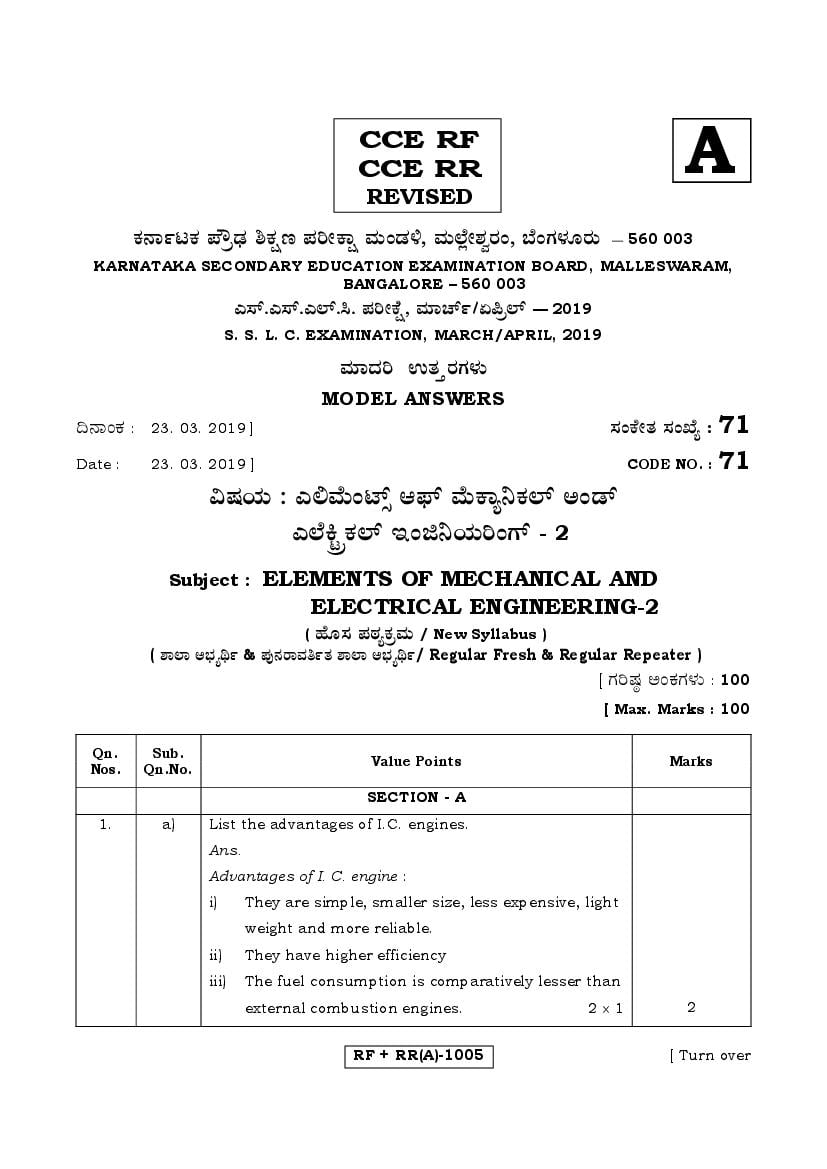
Page 1
z
CCE RR
REVISED
A
O⁄´¤%lO⁄ ÆË√v⁄ ÃO⁄–y Æ⁄¬fiO¤– »⁄flMs⁄ÿ, »⁄fl≈Ê«fiÀ⁄ ¡⁄M, ∑ÊMV⁄◊⁄‡¡⁄fl — 560 003
KARNATAKA SECONDARY EDUCATION EXAMINATION BOARD, MALLESWARAM,
BANGALORE – 560 003
G—È.G—È.G≈È.“. Æ⁄¬fiOÊ⁄–, »⁄·¤^È%/HØ√≈È — 2019
S. S. L. C. EXAMINATION, MARCH/APRIL, 2019
»⁄·¤•⁄¬ D}⁄ °¡⁄V⁄◊⁄fl
MODEL ANSWERS
¶´¤MO⁄ : 23. 03. 2019 ] —⁄MOÊfi}⁄ —⁄MSÊ¿ : 71
Date : 23. 03. 2019 ] CODE NO. : 71
…Œ⁄æ⁄fl : GΔ»ÊflMmÈ” A±È »ÊflO¤¿¨O⁄≈È @MsÈ
G≈ÊPoÒO⁄≈È BMf¨æ⁄fl¬MVÈ - 2
Subject : ELEMENTS OF MECHANICAL AND
ELECTRICAL ENGINEERING-2
( ‘ʇ—⁄ Æ⁄p⁄¿O⁄√»⁄fl / New Syllabus )
( À¤≈¤ @∫⁄¥¿£% & Æ⁄‚¥´⁄¡¤»⁄~%}⁄ À¤≈¤ @∫⁄¥¿£%/ Regular Fresh & Regular Repeater )
[ V⁄¬Œ⁄r @MO⁄V⁄◊⁄fl : 100
[ Max. Marks : 100
Qn. Sub.
Value Points Marks
Nos. Qn.No.
SECTION - A
1. a) List the advantages of I.C. engines.
Advantages of I. C. engine :
i) They are simple, smaller size, less expensive, light
weight and more reliable.
ii) They have higher efficiency
iii) The fuel consumption is comparatively lesser than
external combustion engines. 2×1 2
RF + RR(A)-1005 [ Turn over
Page 2
Value Points Marks
b) Write the classification of I.C. engines according to the
type of fuel used.
Classification of I.C. engines according to the type of
fuel used
i) Petrol engines
ii) Diesel engines
iii) Gas engines. 3×1 3
c) How are the petrol engines different from diesel
engines ?
Petrol engine Diesel engine
i) Works on Otto cycle Works on diesel cycle
ii) Requires carburetors Do not require
carburetors
iii) Charge is admitted Only air is admitted
into the cylinder into the cylinder
iv) Spark plug required Do not require spark
plug
v) Charge is ignited by Diesel fuel is injected
contact with electric into the compressed air
spark
vi) Compression ratio Compression ratio is
lower 6 : 11 high 16 to 22
vii) Lower cost more Higher cost less
running cost running cost
viii) Used in car, motors, Used in bus, truck and
cycles and light heavier vehicles
vehicles
ix) Run at higher speed. Comparatively lower
speed.
5×1 5
RF + RR(A)-1005
Page 3
Value Points Marks
2. a) Define air compressor. 2
Compressors are the power absorbing devices which
enable increasing pressure of air. They may be either
reciprocating or centrifugal type. 2
b) Explain the applications of air compressor. 3
i) inflating tubes and tyres
ii) inflating balloons
iii) used in hospitals
iv) used in automobile workshops
v) used in painting industries
vi) used in bore well digging machines. 3×1 3
c) Draw a neat sketch of single stage reciprocating air
compressor and label the parts. 5
Single stage reciprocating air compressor.
Sketch = 03
Parts = 02 5
3. a) Name the different types of refrigerants. 2
i) Air
ii) Ammonia
iii) Sulphur dioxide
RF + RR(A)-1005 [ Turn over
Page 4
Value Points Marks
iv) Carbon dioxide
v) Freon
vi) Methyl chloride. 4×½ 2
b) Why do we need refrigeration ? Give reasons. 3
i) comfort air conditioning
ii) preservation of medicines, blood and other organs
possible by refrigeration. This is essential to keep
these alive and active all time
iii) preservation of vegetables and fruits to avoid
bacterial growths
iv) manufacture of ice
v) it is most widely used in production of rocket fuels
vi) computer cooling to avoid malfunctioning of the
semiconductor chips used in computers
vii) preservation of milk, ghee, butter etc. to avoid any
bacterial growth in food products.
3×1=3
c) Draw a neat sketch of refrigeration system and label
the parts. 5
Parts of the referigeration system
Sketch = 03
Parts = 02 5
RF + RR(A)-1005
Page 5
Value Points Marks
4. a) Mention the types of lathes. 2
Types of lathes :
i) Engine lathe
ii) Bench lathe
iii) Tool room lathe
iv) Speed lathe
v) Capstan and turret lathe
vi) Automatic lathe. 4× 2
b) Differentiate between three jaw chuck and four jaw
chuck. 3
Three jaw chuck : it is called as self centering chuck as
it takes and aligns the workpiece along the axis of the
lathe. It is also called dependent chuck as all the jaws
are move simultaneously. 1½
Four jaw chuck : it is also called independent chuck
because the movement of jaw is independent. It has
four jaws that are located at 90˚. This jaw is used for
holding and rotating heavy and iregular shaped jobs.
1½ 3
c) With a line diagram show the important parts of an
engine lathe or centre lathe. 5
Lathe Diagram
Sketch = 04
Parts = 01
Total 5
OR
RF + RR(A)-1005 [ Turn over
Page 6
Value Points Marks
a) Name the types of drilling machine. 2
Drilling machine types :
i) Portable drilling machine
ii) Sensible drilling machine
iii) Upright drilling machine
iv) Radial drilling machine
v) Multiple drilling machine
vi) Gang drilling machine. 4×½ 2
b) Explain the following drilling machine operations : 3
i) drilling
ii) reaming.
Drilling : The operation of producing a cylindrical hole
in a solid workpiece using drill is called as drilling.
1½
Reaming : The operation of accurate sizing and
finishing of the previously drilled hole is called
reaming. The tool used for such operation is called
reamer.
1½ 3
c) With a neat sketch explain slot milling. 5
Slot milling : it is the operation of producing slots or
grooves is a workpiece using end mill or side milling
cutter. This operation can be performed on horizontal
milling machine.
Sketch = 03
Explanation = 02
Total
5
RF + RR(A)-1005
Page 7
Value Points Marks
5. a) What is welding ? 2
Welding : it as a permanent fastening and it is the
process of joining two metal pieces by the application of
required heat and with or without application of
pressure and filter metal. 2
b) Explain the applications of welding. 3
Applications of Welding :
i) used in automotive and manufacturing industries
ii) used in railways for wagon building works
iii) used to weld pressure vessels, storage tanks,
pipeline joining
iv) used to repair and maintenance equipment and
other metallic parts
v) special method of welding used in aircraft works
vi) used in fabrication such as cabinets, cupboards,
gates and refrigerators. 3×1=3
c) Draw a neat sketch of carburizing flame and explain
briefly. 5
Carburizing Flame : it can be obtained by supplying
excess volume of acetylene in which oxygen and
acetylene are mixed in the proportion of 1 :0·84 –
0·98:1. This flame generates low temperature about
3000 – 3150˚C. It is used for welding mainly
aluminium and its alloys.
Sketch = 03
Explanation = 02 5
RF + RR(A)-1005 [ Turn over
Page 8
Qn. Sub.
Value Points Marks
Nos. Qn.No.
SECTION – B
6. a) What is self induced emf ? 2
The e.m.f. induced in a coil, due to the changing flux
created by the current flowing through the same coil, is
called self induced e.m.f. This is always in opposition to
the applied voltage. 2
b) Differentiate between Fleming's left hand rule and right
hand rule. 3
Flemings left hand rule :
Stretch the three fingers of your left hand — the fore
finger, the middle finger and the thumb at right angles
to each other. The fore finger indicates the direction of
flux, the middle finger indicates the direction of current
and the thumb indicates the direction of motion of the
conduction.
Flemings right hand rule :
Stretch the fore finger, the middle finger and the
thumb of your right hand at right angles to each other.
The fore finger indicates the direction of flux, the
thumb indicates the direction of motion of the
conductor and middle finger indicates the direction of
e.m.f. induced in the conductor.
2 × 1½ = 3
RF + RR(A)-1005
Page 9
Value Points Marks
c) Draw a neat sketch of mutually induced emf and
explain it briefly. 5
Mutually induced e.m.f.
Sketch = 03
Explanation = 02 5
Explanation :
The e.m.f. induced in a coil due to changing flux
created by the current flowing through the
neighbouring coil, is called multually induced e.m.f.
and is measured in volts.
7. a) Define average value. 2
Average value :
Average value of an alternating current is that direct
current which when flowing through a given circuit for
a given time transfers the same amount of charge as it
is transferred by an alternating current flowing through
the same circuit for the same time. 2
b) Explain the following : 3
i) rms value
ii) Instantaneous value.
i) rms value :
rms value of an alternating current is that direct
current which when flowing through a given
circuit for a given time transfers the same amount
RF + RR(A)-1005 [ Turn over
Page 10
Qn. Sub.
Value Points Marks
Nos. Qn.No.
of heat as it produced by an alternating current
flowing through the same circuit for the same
time.
ii) Instantaneous value :
Instantaneous value of an alternating quantity is
the value of that alternating quantity at any
particular instant, in a general instantaneous
values of sine wave voltage and current. 2 × 1½ = 3
c) Draw a neat diagram of sine wave curve and mark the
following on it : 5
i) Amplitude
ii) Cycle
iii) Time period.
O
Sketch = 3 M 5
Marking = 2 M
8. a) Define step-up transformer. 2
Step-up transformer :
The transformer which takes power at a lower voltage
and delivers power at a higher voltage is called step up
transformer.
N 1 < N 2 , E1 < E 2 , I1 > I 2 2
RF + RR(A)-1005
Page 11
Value Points Marks
b) Explain the working principle of dc generator. 3
Working principle of d.c. generator :
DC generator works on the principle of Faraday’s laws
of electromagnetic induction, whenever the flux linking
with a conductor changes an e.m.f. is induced in the
conductor. The magnitude of the e.m.f. induced is
equal to the rate of change of flux linking with the
conductor.
dφ
e=N volts
dt 3
c) Draw a neat sketch of dc series motor and explain
briefly. 5
The d.c. series motor in which the field winding is
connected in series with the armature winding is called
series winding. The field is made of a few number of
turns of thick wire. It has low resistance.
Sketch = 2½
Explanation = 2½
5
OR
RF + RR(A)-1005 [ Turn over
Page 12
Value Points Marks
a) What is an alternator ? 2
An alternator is an electrical machine which converts
mechanical energy into alternating current electrical
energy. It is an alternating current generator. 2
b) Explain the applications of transformer. 3
i) transformers are extensively used in all A.C. power
transmission and distribution systems to step-up
and step-down voltage
ii) step-up transformers are used in generating
stations and receiving stations to step up the
voltage
iii) step-down transformers are used in master unit
substations and in distribution centres to step-
down the voltage
iv) core type transformers are used for higher
capacity
v) shell type transformers are used for lower
capacity. 3
c) Draw a neat sketch of an alternator and label the
parts. 5
Alternator sketch and parts
Sketch = 3
5
Marking = 2
RF + RR(A)-1005
Page 13
Value Points Marks
9. a) Name the types of electric iron. 2
Types of electric iron :
i) Non-automatic iron
ii) Automatic iron 2×1=2
b) Describe the working of an electric stove. 3
The electric stove mostly consists of metal body of thick
iron sheet heater plate made of china clay or
porecelain, heating element made of nichrome wire,
terminal housing in which the terminals are fitted with
nuts and insulated with porcelain cleats. The ends of
heating element are connected with these two
terminals. The heater plate is supported with thick iron
strip fitted with nut-bolts. The ends of element are
insulated with porcelain beads each other. The metal
body is supported with legs. When supply is given
current is passed and the heating element is heated
and produces heat. Electric stove works on the
principle of Heating effect of electric current. 3
c) Draw a neat sketch of electric iron and label the parts.
5
Electric iron sketch and parts
Sketch = 3
Parts = 2 5
RF + RR(A)-1005 [ Turn over
Page 14
Value Points Marks
10. a) What is transistor ? 2
Transistor is a three terminal semiconductor device
formed by sandwiching a layer of one type of
semiconductor ( p or n ) is between two layers of
another type of semiconductor ( N or P ) 2
b) Explain the applications of transistor. 3
Applications of transistor
i) transistor is used as switch
ii) it is used both as a general and phase shift
oscillator
iii) It is used in LED circuits 3×1=3
iv) it is used in oscillator circuits
v) it is used as an amplifier.
c) The incomplete n-p-n transistor is given in figure. What
do x, y, z indicate ? Mark the arrow which indicates the
direction of flow of charge and functions of regions.
5
RF + RR(A)-1005
Page 15
Value Points Marks
x = Emitter
y = Collector
z = Base
Functions of regions :
i) Base : Its function is to allow majority charge
carrier (electrons or holes) from the emitter
ii) Emitter : Its function is to emit majority charge
carrier into the base
iii) Collector : Its function is to collect the majority
charge carrier from the base.
Marking = 2
5
Function = 3
RF + RR(A)-1005 [ Turn over
Document Details
| Board / Org | Karnataka Board |
| Exam | Class 10 |
| Type | Answer Key |
| Pages | 15 |
| Updated | 30 Apr 2026 |